SpaceX
SpaceX’s Mr. Steven highlights ambiguity of Falcon fairing catches with port return

SpaceX’s fairing recovery vessel Mr. Steven highlighted the maddening and exhilarating uncertainty of unpublicized fairing recovery attempts with a return to Port of San Pedro on October 18th, the morning after spending a day at sea for the second Falcon fairing drop-and-catch test.
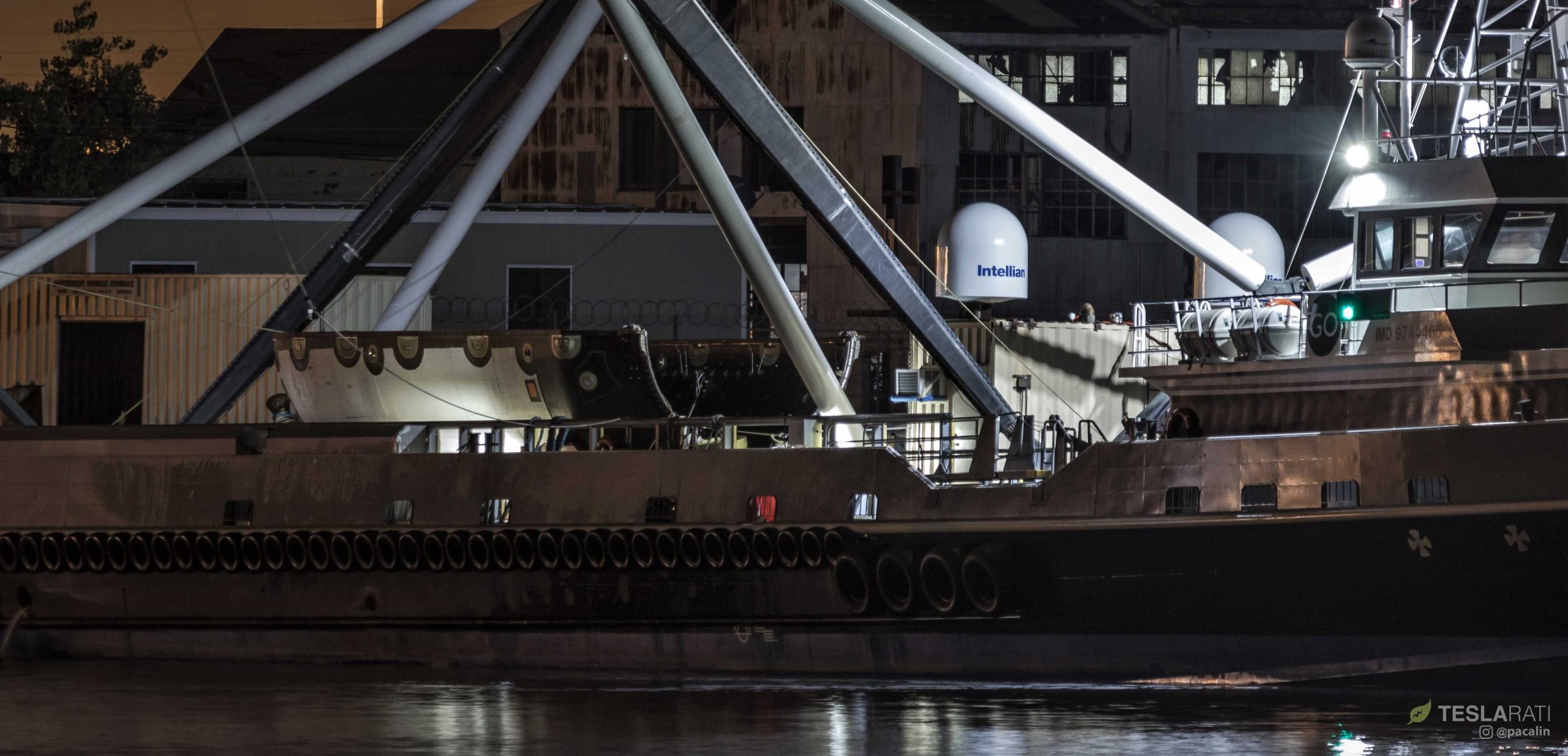
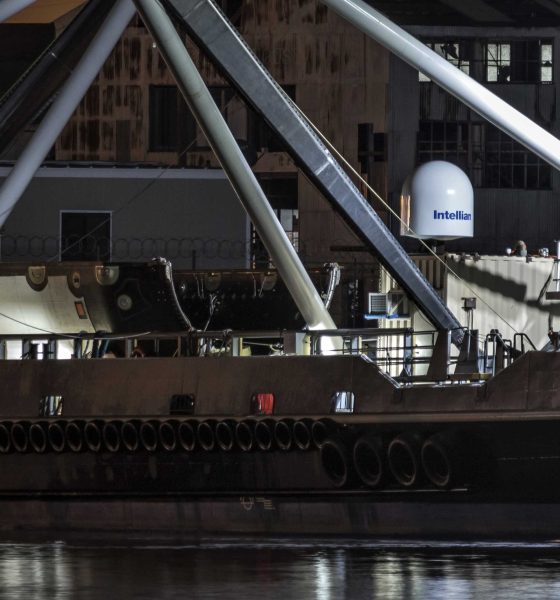
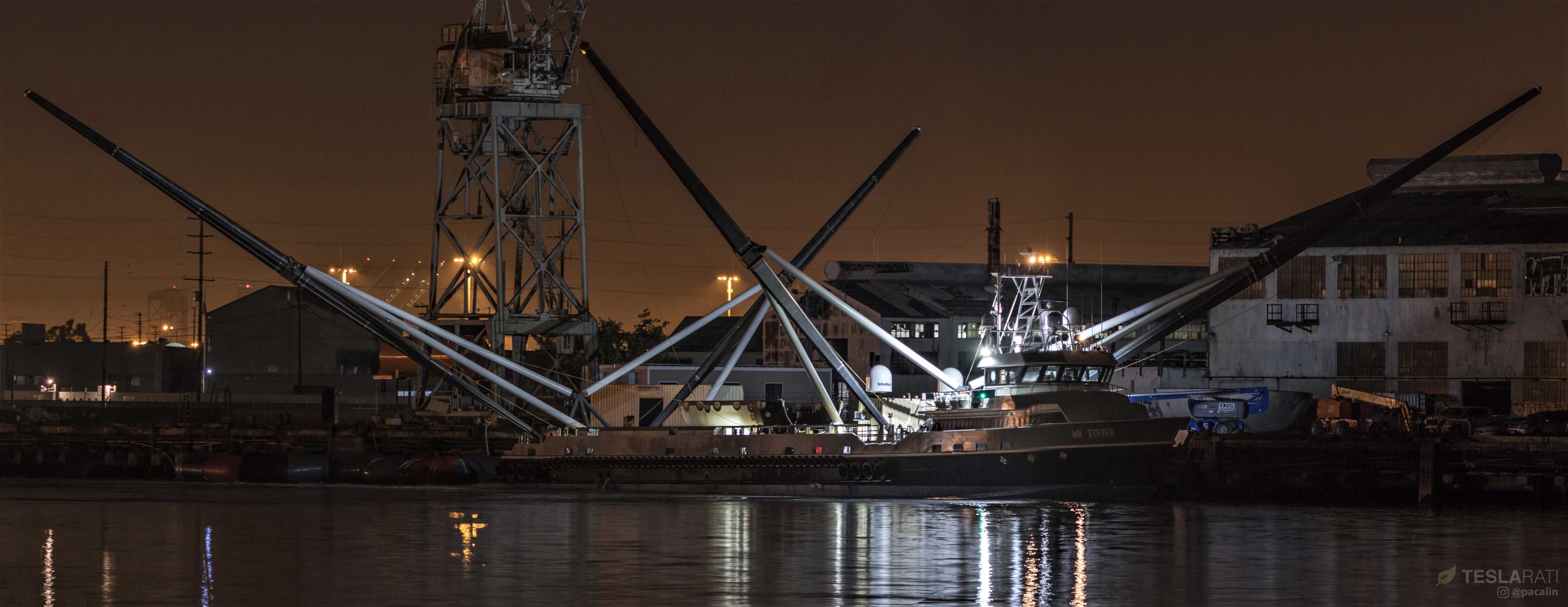
Teslarati photographer Pauline Acalin was on site to watch Mr. Steven’s 1AM Pacific port return and was able to capture the arrival, showing a familiar test fairing resting on the vessel’s deck, perfectly intact, with the recovery net fully retracted.
Schrödinger’s Fairing
Beginning with a dry run on October 8th, SpaceX technicians and engineers have spent the last 10 days testing Mr. Steven more intensely than ever previously observed, centering around a campaign of apparent Falcon fairing drop tests. Although it’s possible that these tests are more captive-carry trials than true drop tests, it seems more likely – judging by the fact that NOTAMs, notices to airmen, were only filed for 2 of the 3 attempts – that the helicopter is actually releasing a fairing half around 11,000 feet (3300 m) and letting it glide towards Mr. Steven.
Previously, SpaceX executive Hans Koenigsmann and CEO Elon Musk have mentioned a probable drop test campaign if operational (post-launch) fairing recovery attempts were unsuccessful. Mr. Steven has yet to successfully snag a fairing out of the air over the course of four post-launch catch attempts, evidence that – just like landing Falcon 9 boosters intact – recovering orbital-class rocket hardware in a state that allows for future reuse is extraordinarily difficult, regardless of the subsystem. However, SpaceX has managed to successfully recover fairing halves intact and in a condition good enough to make Koenigsmann, Vice President of Reliability, visibly excited during an IAC 2018 presentation.
-
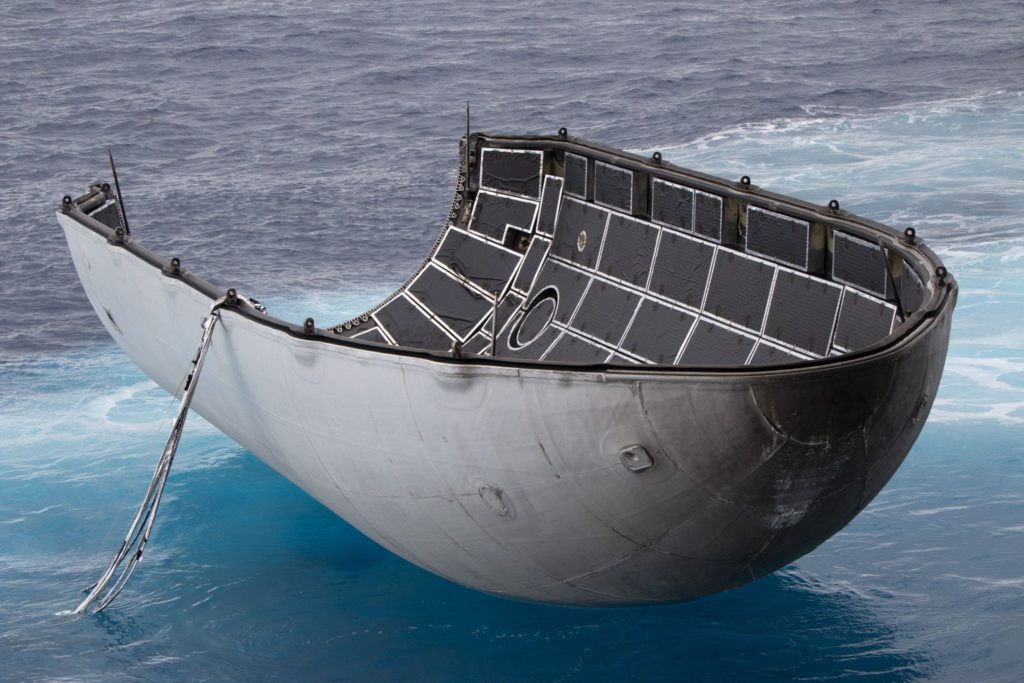
- Hans Koenigsmann was extremely excited about the condition of this particular fairing half, and included this photo in his IAC 2018 keynote. (SpaceX)
-
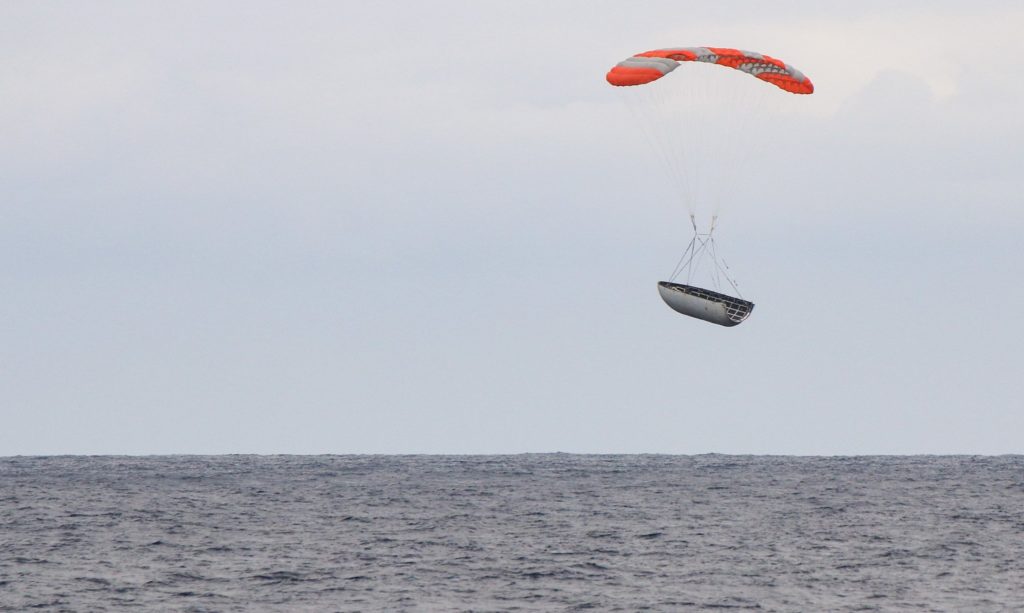
- One half of SpaceX’s Iridium-6/GRACE-FO just moments before touchdown on the Pacific Ocean. (SpaceX)
-
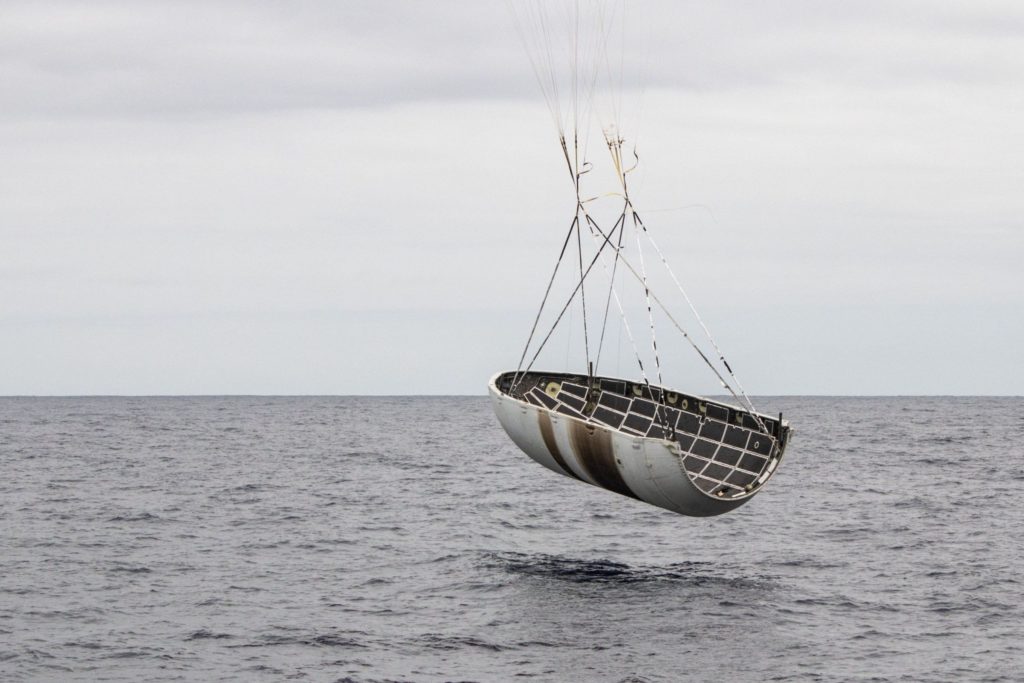
- Close. (SpaceX)
The problem with those intact halves is that they have been recovered only after soft landings in the ocean – once immersed in saltwater, the sheer expense of cleaning a fairing to the point that it would be able to host another sensitive satellite payload is apparently too high to be worthwhile, at least from a perspective of economical reusability. The (quite literally) miniscule line that thus appears to be separating failed fairing recovery attempts from successes also means that it’s extraordinarily difficult to know whether the fairing half that returned on Mr. Steven yesterday morning is indicative of a breakthrough success or another successful failure.
Clearly, the fairing is perfectly intact from a purely structural perspective, meaning that its recovery hardware – cold gas thrusters and a parafoil – worked nominally. What is impossible to tell is whether its autonomous guidance systems were able to successfully direct it to Mr. Steven’s net, or whether Mr. Steven himself was able to maneuver beneath the falling fairing in time to catch it. And yet, a fairing half still sits visibly intact on Mr. Steven’s deck, story and fate unknown. With any luck, SpaceX will offer an official confirmation of some sort once success is in hand. For now, we wait.
For prompt updates, on-the-ground perspectives, and unique glimpses of SpaceX’s rocket recovery fleet check out our brand new LaunchPad and LandingZone newsletters!


Investor's Corner
Tesla and SpaceX take “Terafab” Trademark fight to Federal Court
Tesla and SpaceX sue a small Illinois firm after cease and desist letters over Terafab.


Tesla and SpaceX are asking a federal judge to rule that their planned Terafab chip factory does not infringe a small Illinois company’s trademark, a request that arrives only after months of quiet negotiation broke down this summer.
The dispute traces to May 18, when Tesla filed three U.S. trademark applications for “Terafab” and “Tesla Terafab,” covering semiconductor chips and related chip making services. TERA-print LLC, a nanotechnology company that has held a federal trademark for “Tera-Fab” since 2021, responded five days later with a cease and desist letter. According to the lawsuit, first reported by Reuters, TERA-print argued that Tesla and SpaceX’s use of “Terafab” would confuse consumers familiar with its own trademark, which covers a desktop photolithography printer sold to researchers for sensor and bioengineering work.
What stands out in the filing is the timing of TERA-print’s own paperwork. One day before sending that cease and desist letter, on May 22, TERA-print applied to expand its existing registration to cover semiconductor materials, silicon chips, nanoelectronic devices and AI design services, categories it had not previously claimed. Tesla and SpaceX call that filing opportunistic in their complaint, noting it arrived two months after Tesla’s public Terafab announcement and just days after Tesla’s own trademark applications went in.
Elon Musk launches TERAFAB: The $25B Tesla-SpaceXAI chip factory that will rewire the AI industry
By June 10, TERA-print was threatening to sue for federal trademark infringement, false designation of origin and unfair competition, the complaint states. Rather than wait to be sued, Tesla, SpaceX and SpaceXAI met with TERA-print six separate times between June and August trying to resolve the dispute directly. Those talks collapsed, and the companies filed for declaratory judgment this week in the U.S. District Court for the Western District of Texas, asking a judge to find that “Terafab” does not infringe TERA-print’s mark before TERA-print can file a claim of its own.
TERA-print isn’t backing down. The company told PCMag it discussed a settlement with Tesla as recently as September 2 and feels misled by what it called Tesla’s professed interest in settling. Its CTO, Andrey Ivankin, said TERA-print holds a Defense Department contract to fabricate semiconductors and partially owns Mattiq Inc., an AI company built on TERA-print’s products, and that the company will vigorously defend its rights.
Tesla and SpaceX argue the overlap is superficial. Terafab is planned as a $16.8 billion complex spanning roughly 100 million square feet at the Grimes County site SpaceX confirmed last month, built to produce chips for Optimus robots, Tesla’s AI computing needs and SpaceX’s orbital data center ambitions, a scale and purpose the companies say no reasonable consumer would confuse with a tabletop lab printer. TERA-print’s product line has stayed focused on lithography tools for biological and sensor research since it registered its mark in 2021.
The trademark fight is the second legal dispute tied to the Terafab project in the past week, following a separate SpaceX suit aimed at keeping company records about the facility out of public view, as KBTX reported. Whether construction proceeds under the Terafab name now depends on a federal judge in Austin.
Elon Musk
SpaceX’s next Starship launch is about to attempt its biggest leap yet
SpaceX targets September 22 for Starship Flight 14, its first attempt to reach real orbit.
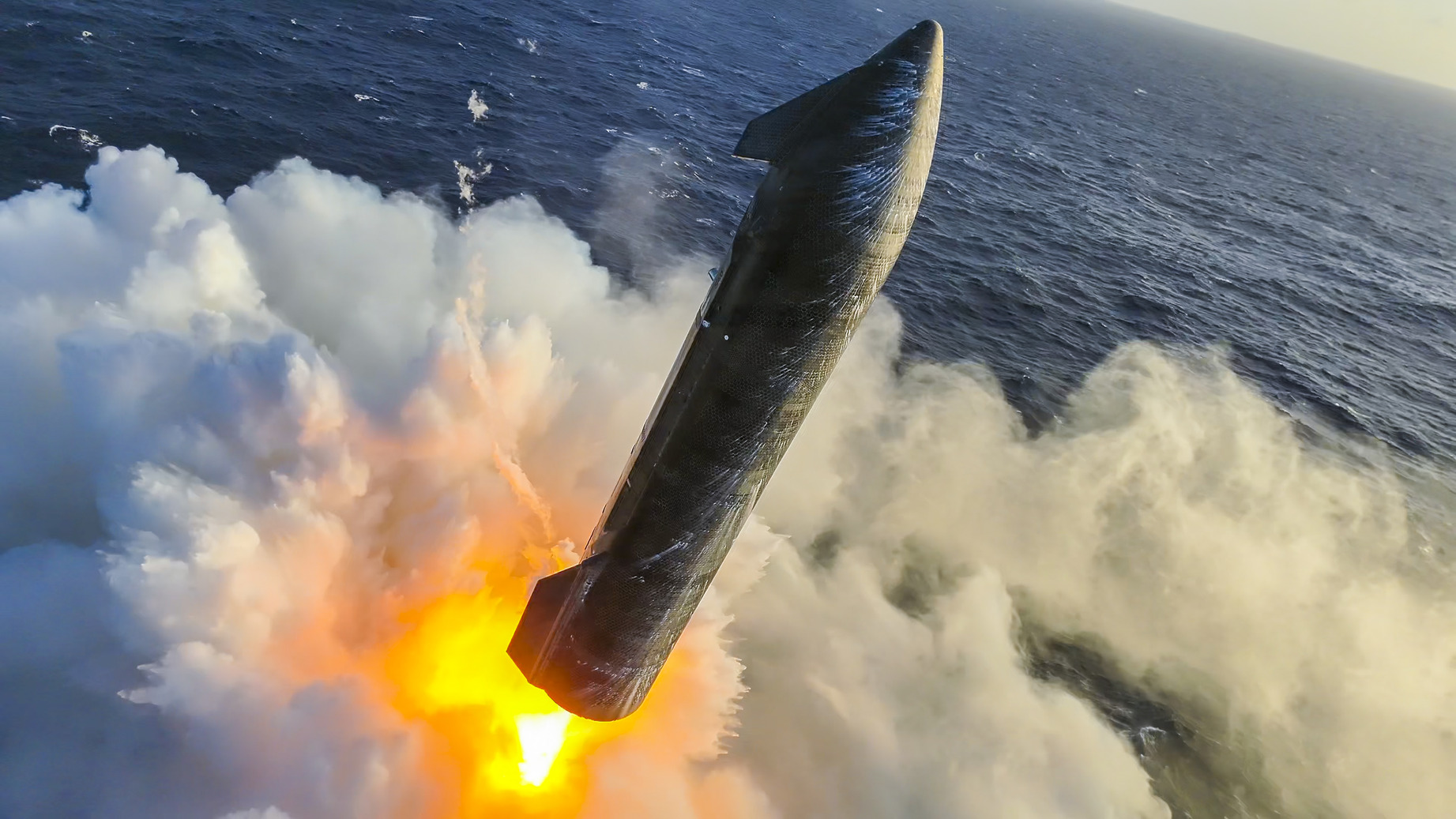
SpaceX has set September 22 as the target date for Starship’s 14th test flight, and this one carries a different goal than any of the 13 that came before it. Every previous Starship mission has intentionally flown a suborbital arc, reentering the atmosphere within the same hour it launched. Flight 14 is designed to send the craft into a genuine orbit around Earth for the first time.
The launch window opens at 7:15 a.m. Central time at Starbase in South Texas and runs for 75 minutes, pending regulatory approval, according to SpaceX’s mission description published Tuesday. If the flight goes as planned, Starship will circle the planet roughly six times at an altitude near 275 kilometers over about ten hours before a deorbit burn sends it toward a splashdown in the Pacific Ocean west of Chile, a departure from the Indian Ocean recoveries used on the last several flights.
The mission also marks the first attempt to put a working batch of Starlink V3 satellites into actual service. Flight 13 carried 20 of the new satellites in July, but because that mission never left a suborbital trajectory, the payload reentered along with the ship instead of separating into orbit.
SpaceX tells the FCC that Starship Flight 14 is going to orbit
Each V3 satellite is rated for roughly one terabit per second of downlink capacity, so a successful deployment on Flight 14 would be SpaceX’s largest single jump in network bandwidth since Starlink began flying on Falcon 9.
Flight 13 still did the heavier lifting on the technical side. That July mission flew a deliberately more stressful reentry profile to test Starship’s heat shield, and the ship survived its softest splashdown yet, intact enough for drone inspections shortly after landing. Elon Musk said the flight delivered “all the heat shield data we needed and then some,” a result Teslarati covered in detail when he later said SpaceX had solved the vehicle’s biggest reusability challenge. Flight 14 is where SpaceX starts spending that confidence on an actual orbital insertion rather than another controlled fall back to Earth.
One thing Flight 14 will not attempt is a tower catch of the ship. Musk floated the idea right after Flight 13, but walked the timeline back in August, saying a catch attempt was more likely “in a few months.” The Super Heavy booster will still aim for its own recovery, targeting an offshore landing point in the Gulf of America, the same approach used on recent flights.
September 22 is SpaceX’s own target, not a locked date. Starship’s schedule has slipped before over hardware readiness and FAA sign off, and the company has said as much in its own mission notes. But the plan itself represents the clearest marker yet that Starship is moving from a suborbital test program into something meant to carry paying payloads and, eventually, people.
Elon Musk
Elon Musk gives his most telling Tesla-SpaceX merger conversation yet
Elon Musk hinted a Tesla-SpaceX merger could be coming, and Wall Street is taking notice.
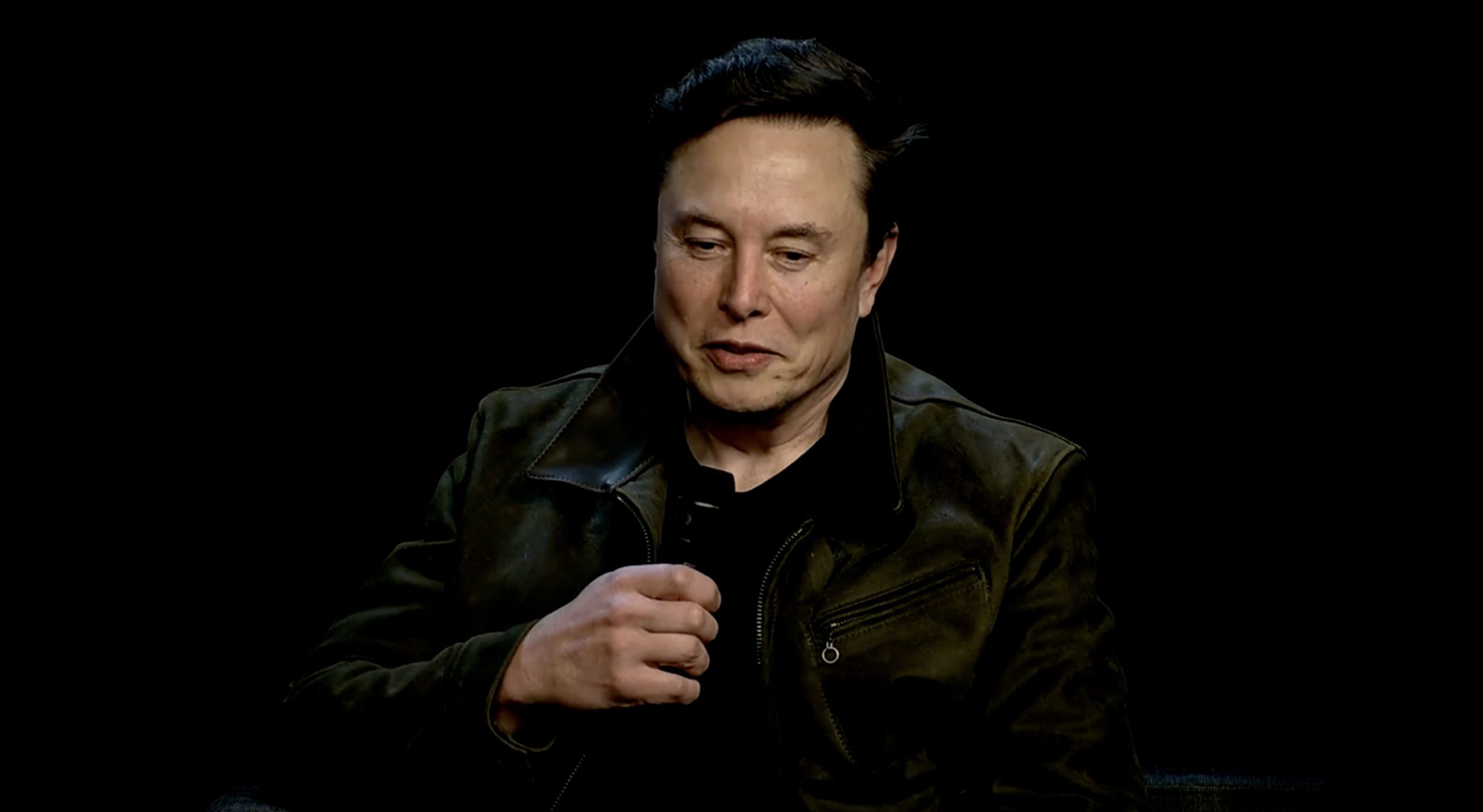
Elon Musk gave his clearest signal yet that Tesla and SpaceX could eventually combine, telling the All-In Summit in Los Angeles that the two companies’ deepening collaboration makes the question worth asking. Sawyer Merritt first surfaced the highlight on X Tuesday.
Asked directly why Tesla and SpaceX remain separate given how closely they already work together, Musk told hosts at the summit: “Great question there. With all this collaboration, on so many levels, who can imagine what action one might take when there’s so much close collaboration in so many areas.” SpaceX President Gwynne Shotwell, who joined Musk on stage, added that SpaceX personnel have already moved into xAI to fill leadership and engineering gaps, saying the businesses are integrating “faster than I thought,” though “not fully integrated yet,”
The comments landed on top of merger speculation that has been building on Wall Street for months. JPMorgan has called a tie-up “strategically coherent on paper,” pointing to overlapping ambitions in AI, robotics, energy, transportation and space. Jefferies went further, estimating Musk could retain roughly 55.3 percent voting control in a deal structured without a premium, a scenario that would still leave room for Tesla shareholders to come out ahead. On Kalshi, traders now put the odds of a merger before 2028 at 66 percent.
Tesla’s stake in SpaceX, still under one percent, traces back to its earlier investment in xAI, which converted to SpaceX equity after SpaceX absorbed the AI company. The two are also jointly building Terafab, a chip facility in Austin meant to serve both Tesla’s AI computing needs and SpaceX’s satellite ambitions. Wedbush analyst Dan Ives has stood by a 2027 merger timeline for months, and Cathie Wood’s ARK Invest recently floated a similar case, an idea Musk pushed back on directly at the time.
Another Tesla SpaceX merger prediction by ARK Invest has Elon Musk talking
The timing adds another layer. Tesla has scheduled an October 1 unveiling for its next generation Roadster at a venue near SpaceX’s McGregor, Texas test site, using the phrase “Go for launch” in its promotional material. Both stocks dipped roughly 2 percent Monday before recovering slightly in premarket trading Tuesday, with SpaceX shares up about 0.4 percent and Tesla essentially flat.
Musk stopped short of confirming anything is in motion. But unlike his past denials of a corporate restructuring, this response didn’t rule one out, and it came with Shotwell sitting next to him describing an integration that’s already underway.

Tesla and SpaceX take “Terafab” Trademark fight to Federal Court

NHTSA just escalated its Tesla Cybercab investigation in a big way


