News
SpaceX’s Elon Musk: odds of Starship reaching orbit by 2020 are “rising rapidly”

SpaceX CEO Elon Musk has suggested that the company’s newly revamped Starship and Super Heavy rocket (previously known as BFR) could perform its first integrated launches – placing Starship into orbit – as few as 12-24 months from today.
Musk indicated that the odds of Starship reaching orbit as early as 2020 are now as high as “60% [and] rising rapidly”, thanks in no small part to the flurry of radical changes the spacecraft and booster have both undergone over the course of 2018.
Probability at 60% & rising rapidly due to new architecture
— Elon Musk (@elonmusk) December 27, 2018
Combined with a decision – made public at a September 2018 media event – to delay the debut of a vacuum-optimized upper stage Raptor (RVac) and stick with its mature sea level variant, Musk apparently is quite confident that these dramatic shifts in strategy will allow SpaceX to aggressively slash the development schedules of its next-gen launch vehicle. Intriguingly, Musk noted that while these “radical” design changes were almost entirely motivated by his desire to expedite the fully-reusable rocket’s operational debut, it apparently became clear that the cheaper, faster, and easier iteration could actually end up being (in Musk’s own words) “dramatically better” than its exotic carbon-composite progenitor.
Time. Although it also turned out to be dramatically better.
— Elon Musk (@elonmusk) December 27, 2018
“Delightfully counter-intuitive”
Let there be little doubt – I am still immensely skeptical of this radical redesign and the implausible logistics of conducting said redesign at the last second while somehow maintaining the test schedule, let alone expediting it by 6-9 months. Despite the fact that Musk does seem to have a compellingly rational answer to every question thus far asked, he was no less convincing in mid-2016 when he stated with contagious conviction that Tesla’s Fremont factory would be an almost 100%-automated “alien dreadnought” as early as 2018. There is, of course, nothing wrong per se with being wrong, although taking 24 months and several hundred million dollars to realize as much can be downright fatal or at least a major health risk for any given company that faces such a challenge, as was the case with Tesla.
Skepticism aside, there are equally many reasons to be optimistic about the future of SpaceX’s Starship/Super Heavy (BFR) program over the next several years. Not only do metal hot structures have a proven track record of success (admittedly in the 1960s and for suborbital conditions, but still), but the century and a half humans have been making and building with steel serves to aggressively reduce risk in BFR’s development, whereas a giant, highly-reusable spaceship and rocket built mainly out of carbon composites is about as exotic, challenging, and alien as one could muster. One step further, Musk appears to be dead-set on the trade that the benefits of moving from composite to stainless steel far, far outweigh the costs.
-
- BFS/Starship shows off some of its heat shield. SpaceX may be looking into an advanced NASA solution for BFR’s thermal protection system. (SpaceX)
-
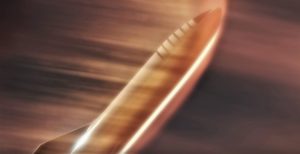
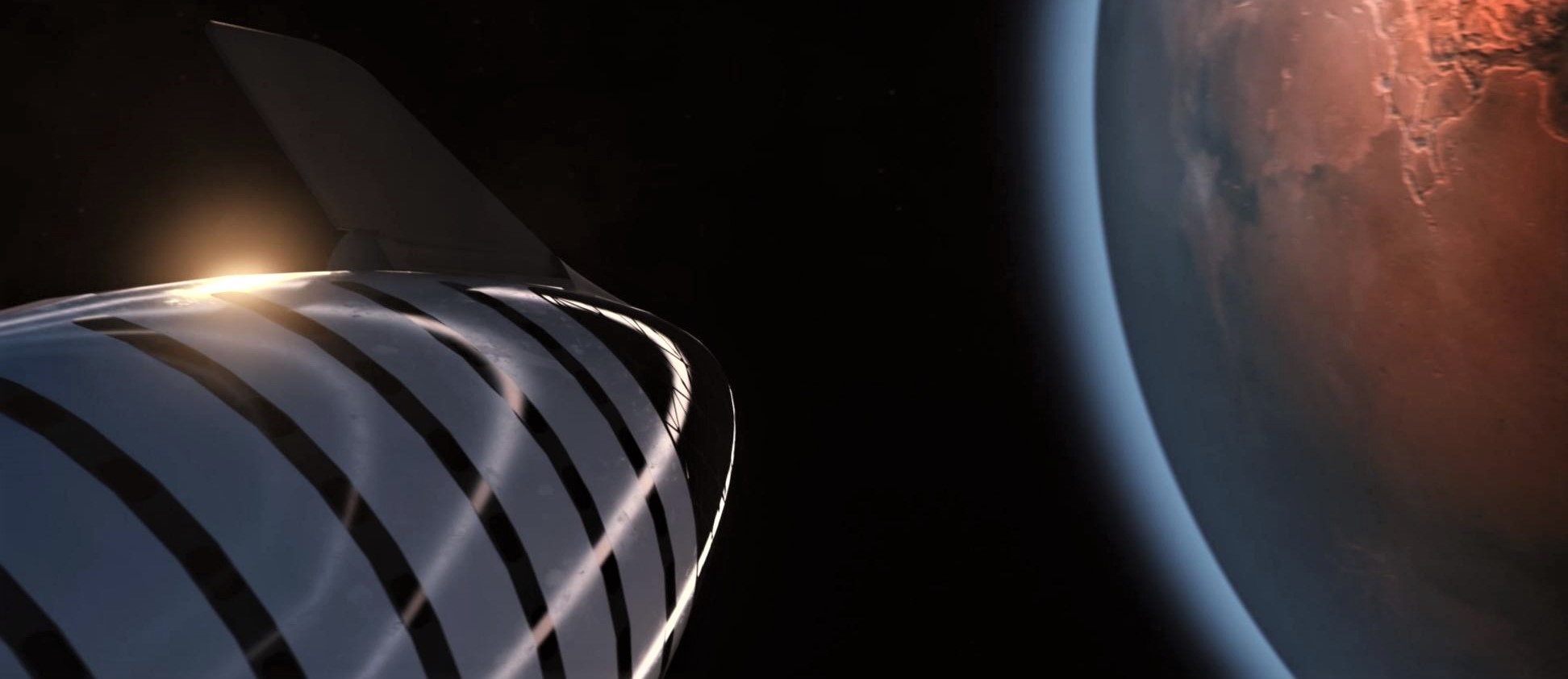
- Starship is shown here reentering Mars’ atmosphere at high speeds (SpaceX)
-
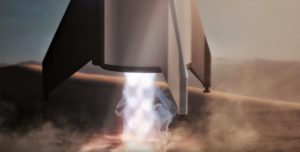
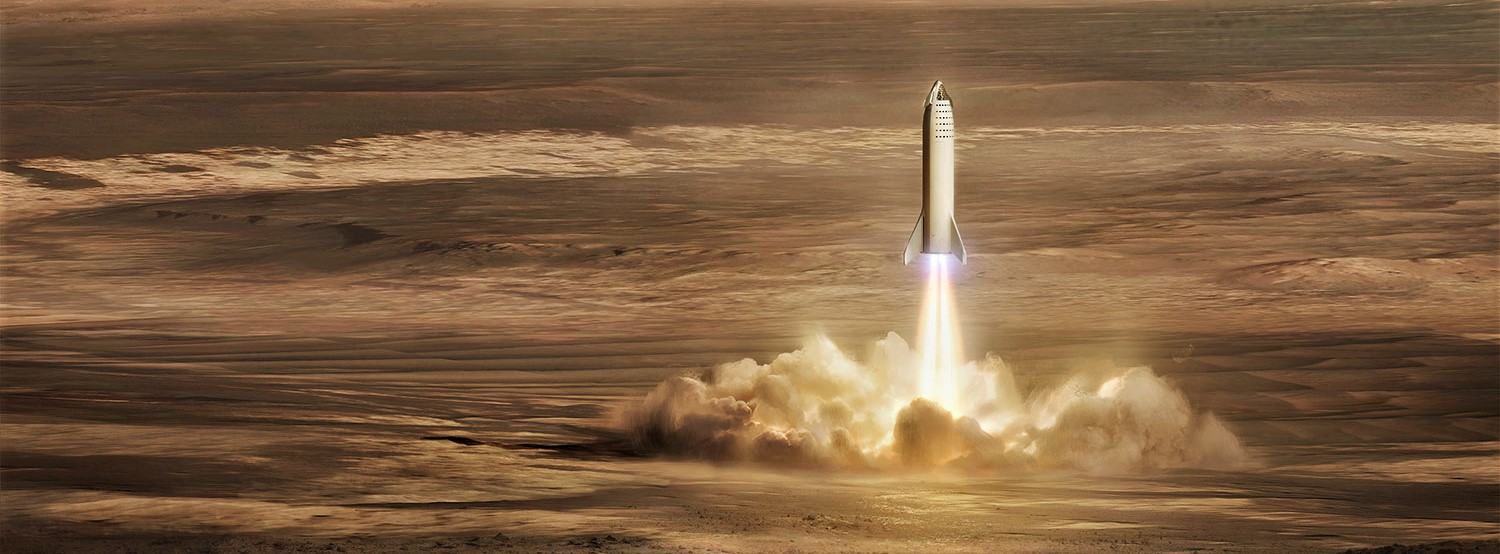
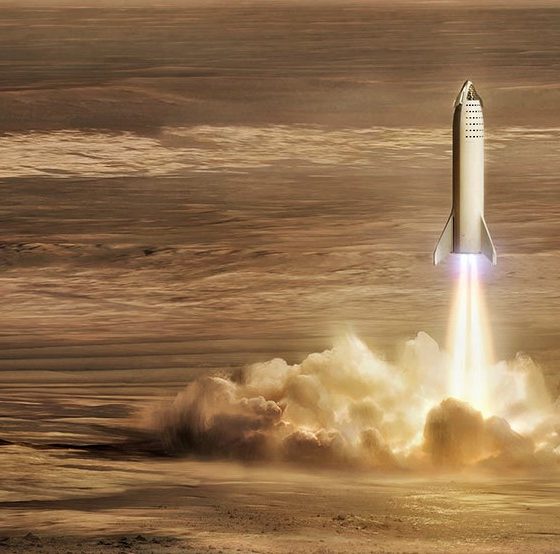
- Starship – in its 2018 design iteration – seen landing on Mars atop pillars of Raptor flame. (SpaceX)
-
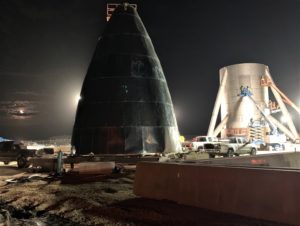
- SpaceX CEO Elon Musk visited the South Texas site where Starship’s first prototype is being built on December 23rd. (Elon Musk)
-
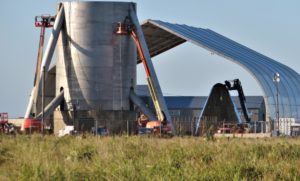
- Starship… or BFWTF? 🙂 (NASASpaceflight /u/bocachicagal)
Most notably, Musk’s implication that a steel alloy skin – albeit with regenerative (i.e. liquid) cooling – could genuinely stand in for SpaceX’s ablative PICA-X heat shield technology on Starship was the most unintuitive but logical shift yet. Although steel alloys may literally have densities that are significantly higher than carbon composites, composites simply cannot (at least in the current state of the art) withstand high temperatures like those that Starship would inevitably experience during orbital and interplanetary reentries. As a result, Starship would need an extremely advanced heat shield technology that is minimally ablative, extremely lightweight, robust, and shock-resistant, not to mention an additional layer capable of mounting it to Starship’s composite hull while also insulating the propellant tanks and structure from the extreme heat of reentry.
Leeward side needs nothing, windward side will be activity cooled with residual (cryo) liquid methane, so will appear liquid silver even on hot side
— Elon Musk (@elonmusk) December 25, 2018
Steel, on the other hand, is one of the least thermally conductive metals available, while also featuring alloys with melting points that can approach and even surpass 1500 degrees C. With regenerative cooling, it’s entirely possible that a hot steel shield and fusion of propellant tanks and load-bearing structures could ultimately result in a spaceship far more reusable, reliable, and perhaps even performant that a spaceship relying on exotic heat shield materials and linerless carbon composite propellant tanks.
Perhaps BFR Block 2 or 3 will make room for dramatically improved composite formulations and production methods down the road, but advanced steel and other metal alloys appear to be the way forward for SpaceX for the time being. For now, we can sit, watch, and wait as something comes together at the company’s South Texas test and launch facilities.
For prompt updates, on-the-ground perspectives, and unique glimpses of SpaceX’s rocket recovery fleet check out our brand new LaunchPad and LandingZone newsletters!


Elon Musk
Tesla confirmed HW3 can’t do Unsupervised FSD but there’s more to the story
Tesla confirmed HW3 vehicles cannot run unsupervised FSD, replacing its free upgrade promise with a discounted trade-in.

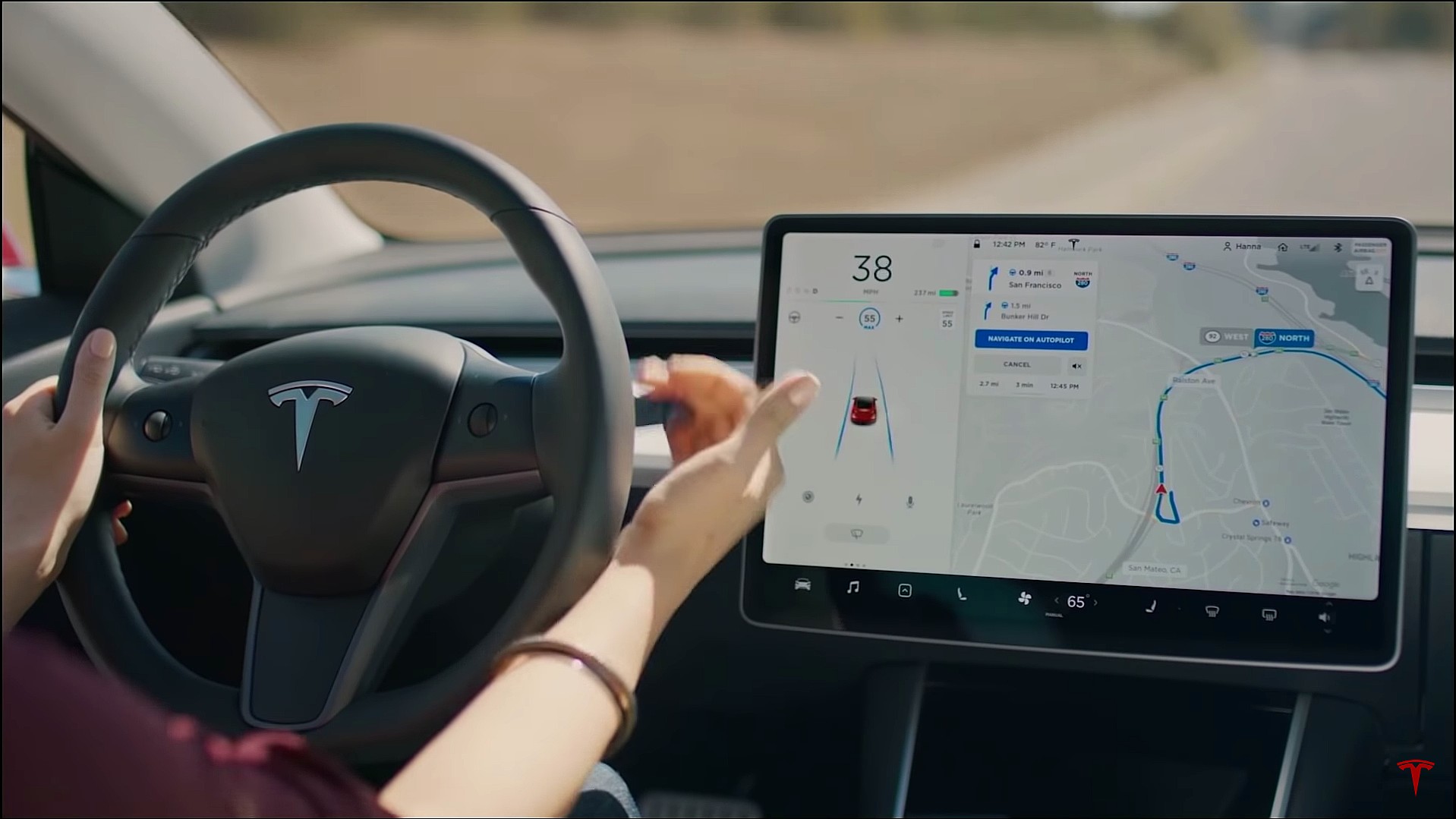
Tesla has officially confirmed that early vehicles with its Autopilot Hardware 3 (HW3) will not be capable of unsupervised Full Self-Driving, while extending a path forward for legacy owners through a discounted trade-in program. The announcement came by way of Elon Musk in today’s Tesla Q1 2026 earnings call.
🚨 Our LIVE updates on the Tesla Earnings Call will take place here in a thread 🧵
Follow along below: pic.twitter.com/hzJeBitzJU
— TESLARATI (@Teslarati) April 22, 2026
The history here matters. HW3 launched in April 2019, and Tesla sold Full Self-Driving packages to owners on the understanding that the hardware was sufficient for full autonomy. Some owners paid between $8,000 and $15,000 for FSD during that period. For years, as FSD’s AI models grew more demanding, HW3 vehicles fell progressively further behind, eventually landing on FSD v12.6 in January 2025 while AI4 vehicles moved to v13 and then v14. When Musk acknowledged in January 2025 that HW3 simply could not reach unsupervised operation, and alluded to a difficult hardware retrofit.
The near-term offering is more concrete. Tesla’s head of Autopilot Ashok Elluswamy confirmed on today’s call that a V14-lite will be coming to HW3 vehicles in late June, bringing all the V14 features currently running on AI4 hardware. That is a meaningful software update for owners who have been frozen at v12.6 for over a year, and it represents genuine effort to keep older hardware relevant. Unsupervised FSD for vehicles is now targeted for Q4 2026 at the earliest, with Musk describing it as a gradual, geography-limited rollout.
For HW3 owners, the over-the-air V14-lite update is welcomed, and the discounted trade-in path at least acknowledges an old obligation. What happens next with the trade-in pricing will define how this chapter ultimately gets written. If Tesla prices the hardware path fairly, acknowledges what early adopters are owed, and delivers V14-lite on the June timeline it committed to today, it has a real opportunity to convert one of the longest-running sore subjects among early adopters into a loyalty story.
Elon Musk
Tesla isn’t joking about building Optimus at an industrial scale: Here we go
Tesla’s Optimus factory in Texas targets 10 million robots yearly, with 5.2 million square feet under construction.
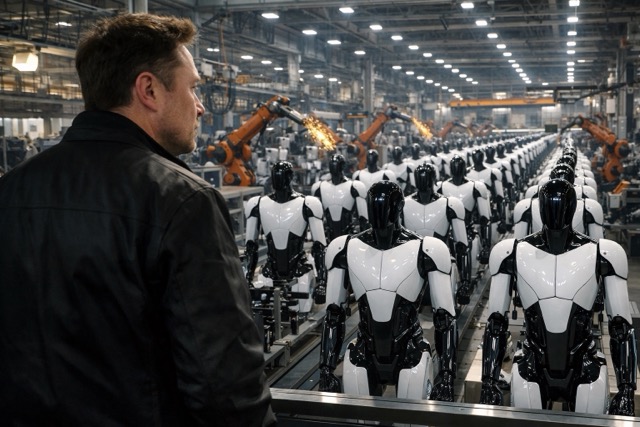
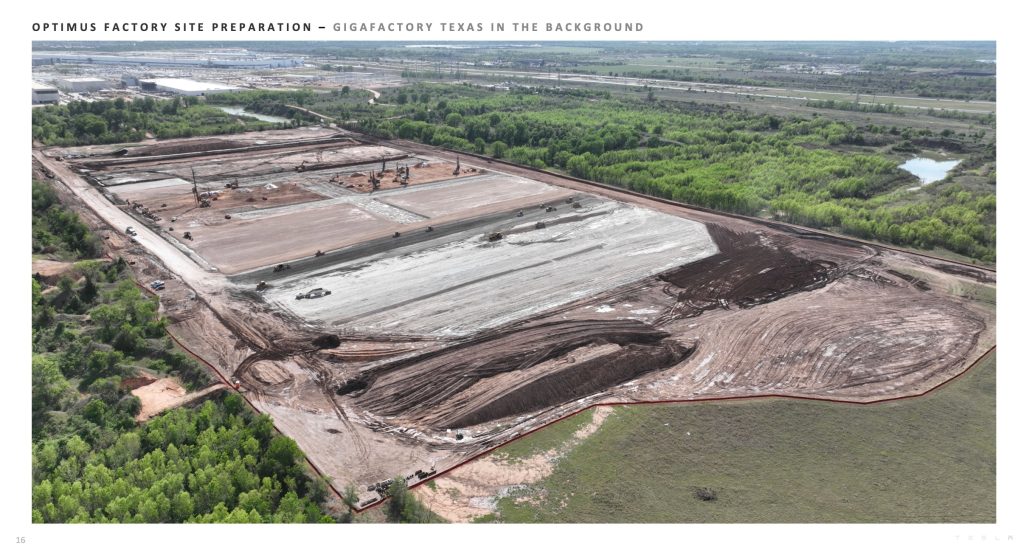
Tesla’s Q1 2026 Update Letter, released today, confirms that first generation Optimus production lines are now well underway at its Fremont, California factory, with a pilot line targeting one million robots per year to start. Of bigger note is a shared aerial image of a large piece of land adjacent to Gigafactory Texas, that Tesla has prominently labeled “Optimus factory site preparation.”
Permit documents show Tesla is seeking to add over 5.2 million square feet of new building space to the Giga Texas North Campus by the end of 2026, at an estimated construction investment of $5 billion to $10 billion. The longer term production target for that facility is 10 million Optimus units per year. Giga Texas already sits on 2,500 acres with over 10 million square feet of existing factory floor, and the North Campus expansion is being built to support multiple projects, including the dedicated Optimus factory, the Terafab chip fabrication facility (a joint Tesla/SpaceX/xAI venture), a Cybercab test track, road infrastructure, and supporting facilities.
Credit: TESLA
Texas makes strategic sense beyond the existing infrastructure. The state’s tax structure, lower labor costs relative to California, and the proximity to Tesla’s AI training cluster Cortex 1 and 2, both located at Giga Texas and now totaling over 230,000 H100 equivalent GPUs, means the Optimus software stack and the factory producing the hardware will share the same campus. Tesla’s Q1 report also confirmed completion of the AI5 chip tape out in April, the inference processor designed specifically to power Optimus units in the field.
As Teslarati reported, the Texas facility is intended to house Optimus V4 production at full scale. Musk told the World Economic Forum in January that Tesla plans to sell Optimus to the public by end of 2027 at a price between $20,000 and $30,000, stating, “I think everyone on earth is going to have one and want one.” He has previously pegged long term demand for general purpose humanoid robots at over 20 billion units globally, citing both consumer and industrial use cases.

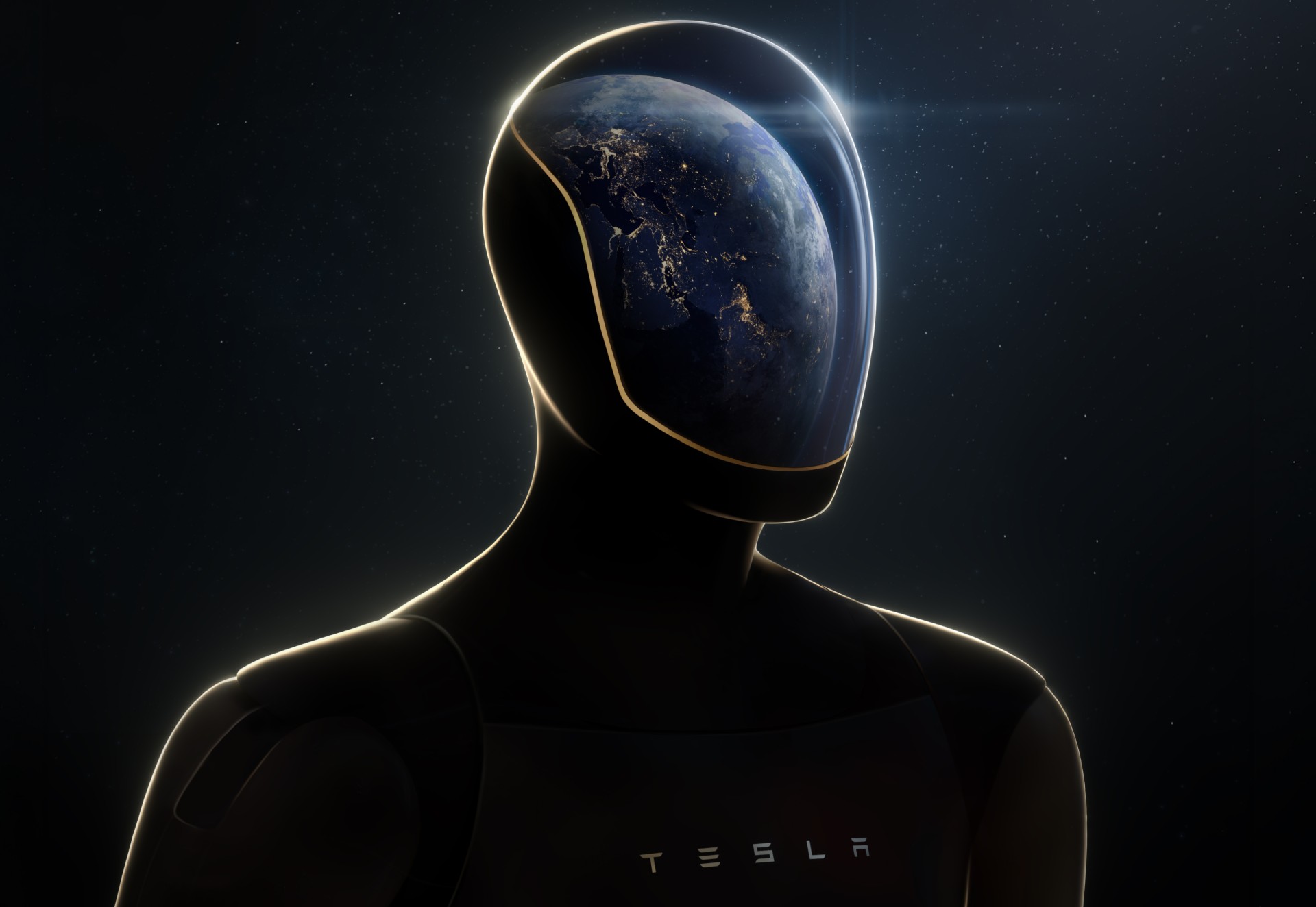
Tesla (NASDAQ: TSLA) reported its earnings for the first quarter of 2026 on Wednesday afternoon. Here’s what the company reported compared to what Wall Street analysts expected.
The earnings results come after Tesla reported a miss on vehicle deliveries for the first quarter, delivering 358,023 vehicles and building 408,386 cars during the three-month span.
As Tesla transitions more toward AI and sees itself as less of a car company, expectations for deliveries will begin to become less of a central point in the consensus of how the quarter is perceived.
Nevertheless, Tesla is leaning on its strong foundation as a car company to carry forward its AI ambitions. The first quarter is a good ground layer for the rest of the year.
Tesla Q1 2026 Earnings Results
Tesla’s Earnings Results are as follows:
- Non-GAAP EPS – $0.41 Reported vs. $0.36 Expected
- Revenues – $22.387 billion vs. $22.35 billion Expected
- Free Cash Flow – $1.444 billion
- Profit – $4.72 billion
Tesla beat analyst expectations, so it will be interesting to see how the stock responds. IN the past, we’ve seen Tesla beat analyst expectations considerably, followed by a sharp drop in stock price.
On the same token, we’ve seen Tesla miss and the stock price go up the following trading session.
Tesla will hold its Q1 2026 Earnings Call in about 90 minutes at 5:30 p.m. on the East Coast. Remarks will be made by CEO Elon Musk and other executives, who will shed some light on the investor questions that we covered earlier this week.
You can stream it below. Additionally, we will be doing our Live Blog on X and Facebook.
Q1 2026 Earnings Call at 4:30pm CT https://t.co/pkYIaGJ32y
— Tesla (@Tesla) April 22, 2026

Tesla confirmed HW3 can’t do Unsupervised FSD but there’s more to the story

Tesla isn’t joking about building Optimus at an industrial scale: Here we go


