News
SpaceX is following in Tesla’s footsteps in a way nobody expected
In the span of just months in early 2026, SpaceX has transformed itself into one of the world’s most ambitious AI companies. The catalyst: its February acquisition of xAI.

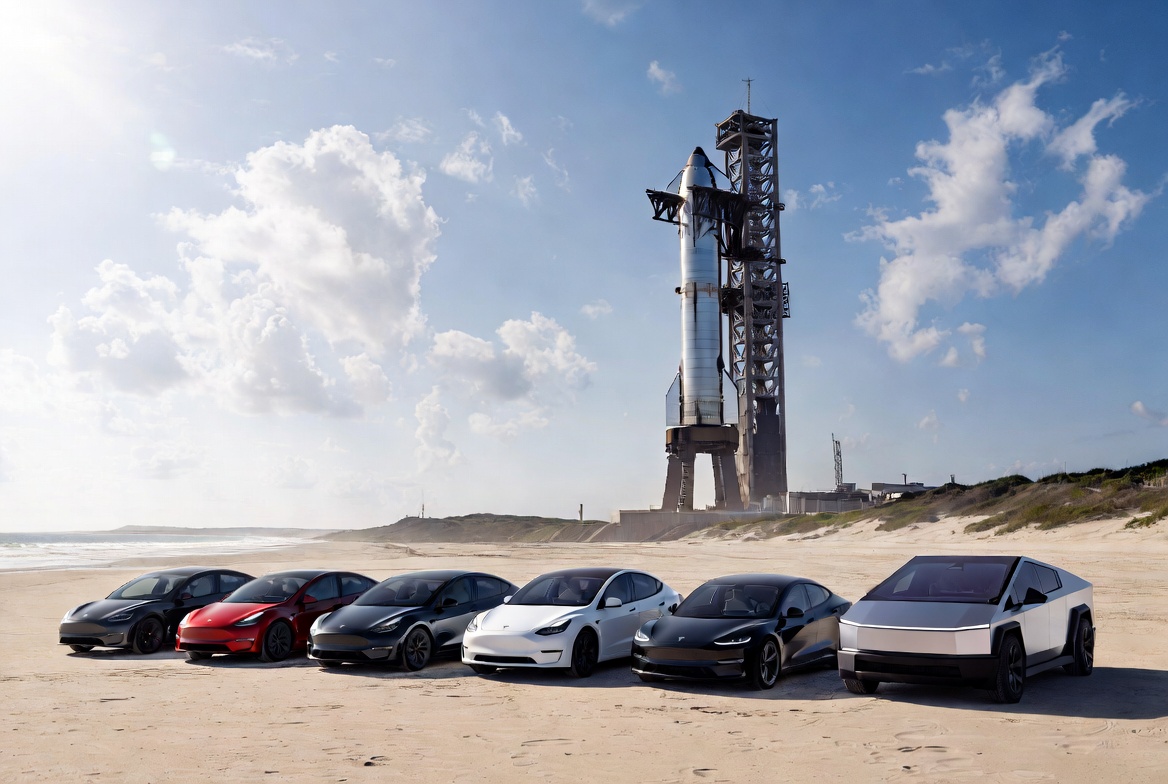
When Elon Musk founded Tesla in 2003, it was a plucky electric car startup betting everything on lithium-ion batteries and a niche luxury Roadster.
Two decades later, Tesla is far more than a car company. Its valuation increasingly hinges on Full Self-Driving software, the Optimus humanoid robot, the Robotaxi program, and the Dojo supercomputer cluster purpose-built for AI training.
Musk has repeatedly described Tesla as an AI and robotics company that happens to sell vehicles. The cars, in this view, are merely the first scalable platform for real-world AI.
Now, SpaceX is tracing an eerily similar path, only faster and in a direction almost no one anticipated. Founded in 2002 to make spaceflight routine and eventually multiplanetary, SpaceX spent its first two decades perfecting reusable rockets, landing Falcon 9 boosters, and building the Starlink megaconstellation.
Elon Musk launches TERAFAB: The $25B Tesla-SpaceXAI chip factory that will rewire the AI industry
It was an engineering and manufacturing powerhouse, not a software play. Yet, in the span of just months in early 2026, SpaceX has transformed itself into one of the world’s most ambitious AI companies. The catalyst: its February acquisition of xAI.
The xAI deal, announced on February 2, was structured as an all-stock transaction that valued the combined entity at roughly $1.25 trillion—SpaceX at $1 trillion and xAI at $250 billion. In a memo to employees, Musk framed the merger as the creation of “the most ambitious, vertically-integrated innovation engine on (and off) Earth.”
The new SpaceX now owns Grok, the large language model family that powers the chatbot of the same name, along with xAI’s massive training infrastructure. More importantly, it has a declared mission to move AI compute off-planet.
Earth-based data centers are hitting hard limits on power, cooling, and land. Musk’s solution is orbital data centers, or constellations of solar-powered satellites that act as supercomputers in the sky.
SpaceX has already asked regulators for permission to launch up to one million such satellites. Starship, the company’s fully reusable heavy-lift vehicle, is the only rocket capable of delivering the necessary mass at the required cadence.
Each orbital node would enjoy near-constant sunlight, vast radiator surfaces for passive cooling, and zero terrestrial real-estate costs. Musk has predicted that within two to three years, space-based AI inference and training could become cheaper than anything possible on the ground.
This is not a side project; it is the strategic centerpiece Musk has envisioned for SpaceX. Starlink already provides the global low-latency backbone; next-generation V3 satellites will carry onboard AI accelerators. Rockets deliver the hardware, while AI optimizes every aspect of launch, landing, and constellation management.
The feedback loop is self-reinforcing, too. Better AI makes better rockets, which launch more AI infrastructure.
Just yesterday, on April 21, SpaceX doubled down.
It secured an option to acquire Cursor—the fast-growing AI coding tool beloved by software engineers—for $60 billion later this year, or pay a $10 billion partnership fee if the full deal does not close.
Cursor’s models already help engineers write code at superhuman speed. Pairing that technology with SpaceX’s Colossus-scale training clusters (the same ones powering Grok) positions the company to dominate AI developer tools, much as Tesla dominates autonomous driving software.
Why SpaceX just made a $60 billion bet on AI coding ahead of historic IPO
The parallels with Tesla are striking. Both companies began in a single, capital-intensive sector: Tesla with EVs, SpaceX with launch vehicles. Both used early hardware success to fund AI at scale. Tesla’s Dojo supercomputers train neural nets on billions of miles of real-world driving data; SpaceX now trains on telemetry from thousands of orbital assets and re-entries.
Tesla’s FSD chip runs inference on cars; SpaceX’s future satellites will run inference in orbit.
Tesla’s Optimus robot will work in factories; SpaceX envisions lunar factories manufacturing more AI satellites, eventually using electromagnetic mass drivers to fling them into deep space.
Critics once dismissed Musk’s multi-company empire as unfocused. The 2026 moves reveal the opposite: deliberate convergence.
SpaceX is no longer merely a rocket company that sells internet from space. It is an AI company whose competitive moat is literal orbital infrastructure and the only vehicle that can service it at scale. The forthcoming IPO, expected later this year, will almost certainly be pitched not as a space play but as the purest bet on AI infrastructure the public market has ever seen.
Whether the orbital data-center vision survives regulatory scrutiny, astronomical concerns about light pollution, or the sheer engineering challenge remains to be seen.
Yet the strategic direction is unmistakable. Just as Tesla proved that software and AI could redefine the century-old automobile, SpaceX is proving that rockets are merely the delivery mechanism for the next great computing platform—one that floats above the clouds, powered by the sun, and limited only by the physics of orbit.
In that unexpected sense, history is repeating. Tesla stopped being “just a car company” years ago. SpaceX has now stopped being “just a rocket company.” Both are becoming something far larger: AI powerhouses with hardware moats so deep that competitors will need their own reusable megaconstellations to keep up.
The age of terrestrial AI is ending. The age of space-based AI is beginning—and SpaceX is building the launchpad.


News
Tesla Cybercabs take over Austin’s F1 weekend
Tesla Cybercabs swarmed Austin’s F1 Grand Prix as sightings hit a record during race weekend.

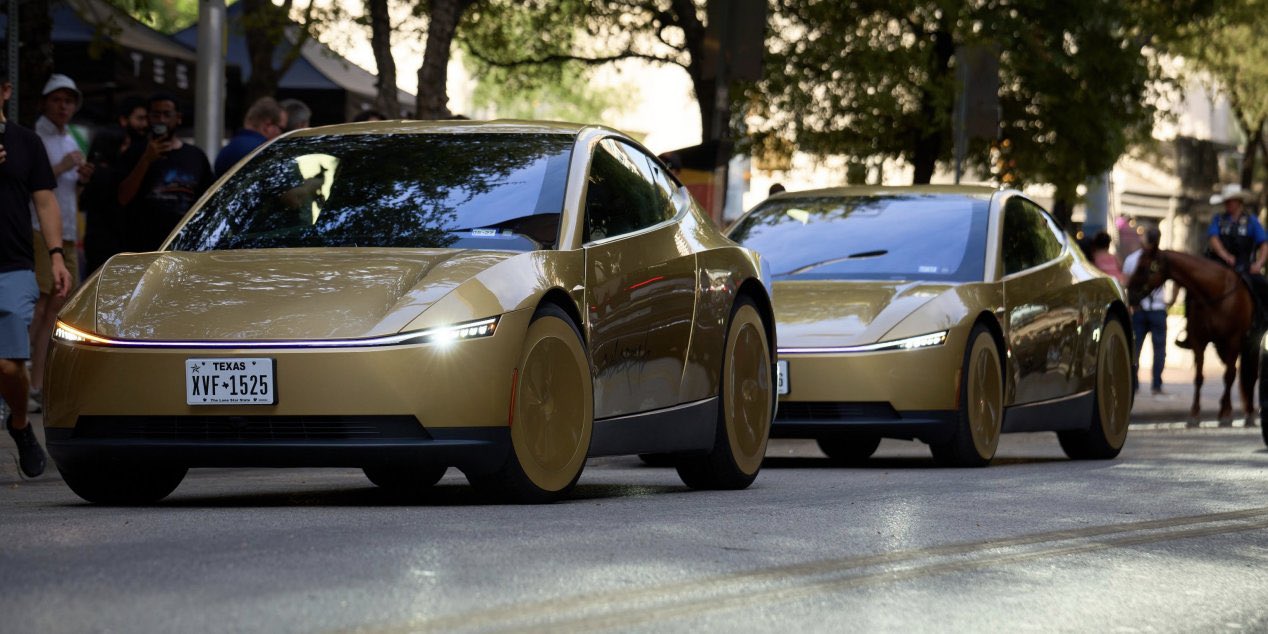
Tesla’s driverless Cybercabs used the Formula 1 United States Grand Prix in Austin as their biggest public stress test yet. On Sunday afternoon, Tesla head of AI software Ashok Elluswamy quoted a photo from X user Ben Steindl showing a long line of gold Cybercabs and Model Y Robotaxis stacked up on a road near Circuit of the Americas. “Robotaxis as far as the eye can see!” Elluswamy wrote. Steindl’s original post was more matter of fact: “@Tesla @robotaxi is busy for the Austin F1.”
The fleet also handled the trip home. The race started at 3 p.m. Central, and once it ended, Cybercab Spotter, an account that logs Cybercab sightings around Austin, posted that “People are requesting Cybercabs to get home.”
Robotaxis as far as the eye can see! 🤩
— Ashok Elluswamy (@aelluswamy) October 25, 2026
Tesla set this up days in advance without announcing it. Late on October 22, rider David Moss posted Robotaxi app screenshots showing the Austin service area wrapping around the track toward Elroy and FM 812, with ride requests open until 1 a.m. A banner in the app read “Last call is 1am · Limited to nearby dropoffs.” Austin rides ended at 11 p.m. as recently as early October, as Teslarati reported, before moving to midnight on October 17.
Not every rider got dropped at the gate. Early app searches showed spots like COTA Karting as “Service blocked,” and one rider who took a Cybercab to the track Friday said the rideshare area was less than a 20 minute walk from the front gate.
The weekend also produced a new activity record. Cybercab Spotter counted 1,250 Cybercab sightings in Austin on Saturday, qualifying day. The previous high was 1,072 on October 16. Sightings count the same car more than once, so they measure how busy the fleet is rather than how big it is. For size, the Texas automated vehicle registry listed 463 Cybercabs at midday Sunday, up from the 300+ Tesla claimed on October 10, when Elluswamy also said Dallas is next for Cybercab.
The track was out of reach for Tesla’s main rival. Waymo runs in Austin only through Uber, and its service area stops well short of COTA. Waymo did not announce any race day service.
Tesla has not said how many rides it gave to and from the circuit, or whether the expanded zone and 1 a.m. cutoff will stay after race weekend. On the third quarter earnings call, Elluswamy said 2 a.m. service is coming “pretty soon” and that Tesla plans to run Robotaxi around the clock before the end of the year. The company is also aiming to hand the first Cybercabs to customers before 2026 ends, which would put cars like these outside Tesla’s own fleet for the first time.
News
Tesla makes good on its Cybercab promise in just two weeks
Tesla Cybercab riders can now pull up a rear camera view and darken the screen.
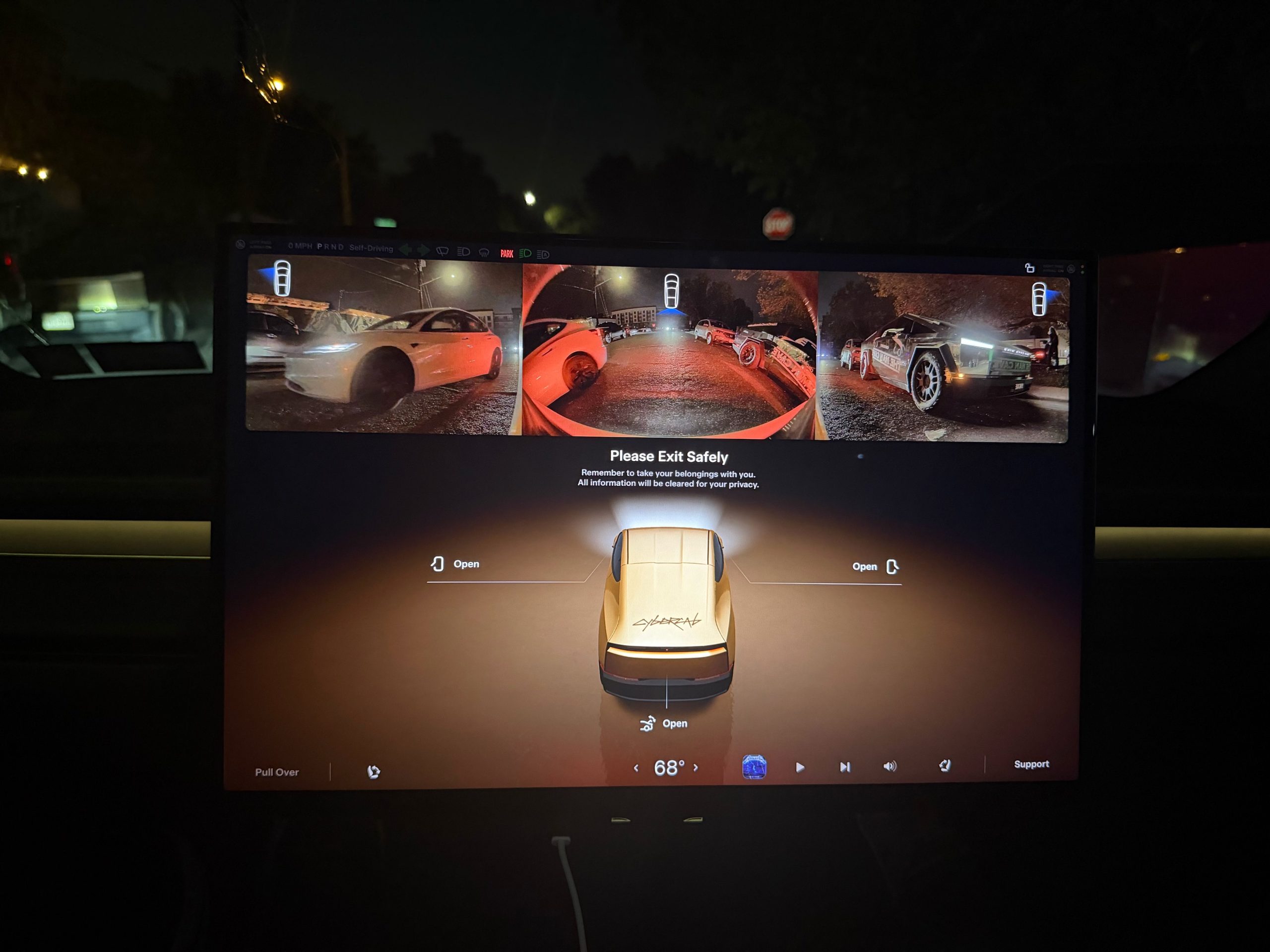
Tesla has given Cybercab passengers a way to see what is behind them, along with a way to turn the cabin screen off entirely.
Riders in Austin can now bring up a live rearview camera feed on the Cybercab’s center display in the middle of a trip. Austin rider Ethan McKanna spotted the change late Friday night, posting from a ride that “You can now open the camera to view what’s behind you in Cybercab!” His photo shows a strip of rear camera video across the top of the screen, with another Cybercab following on a bridge. Sawyer Merritt shared the image Saturday and wrote that it “sounds like” there is also a new quiet mode that darkens the entire screen for riders who want to relax, sleep, or avoid a bright display at night.
The camera view goes beyond the rear feed. Tesla UI software engineer Evan, who posts as @CarCoder, replied to McKanna with a tip: “You can also tap it to see more cameras, and swipe it up or down to hide and show.” Until now, the Cybercab only showed its rear and repeater feeds on the “Please Exit Safely” screen at the end of a ride, so passengers could check for cyclists and traffic before opening a door.
Quiet mode surfaced a day earlier. Austin rider Jackson Blatz posted a video Friday morning of the new Robotaxi interface in a Cybercab with the option. Tesla has not published release notes for either feature.
The rear camera view moved quickly from request to release. Earlier this month, Cybercab rider Dan Burkland asked Tesla to let passengers pull up the rear and repeater cameras whenever they want, “especially for peace of mind.” Evan answered “In development,” as Teslarati reported at the time. About two weeks later, riders have it.
The feature fills a gap created by the Cybercab’s design. With no steering wheel, no pedals, no mirrors and no rear window, a passenger has no natural way to glance behind the car. The eight exterior cameras that feed Tesla’s autonomy software were already on board, so the change only required software.
There is also an AI angle to how it was built. Yun-Ta Tsai, a senior staff engineer on Tesla’s AI team, quoted Merritt’s post and wrote that the “(human) camera view tuning is optimized with Grok and implements part of the algorithm by directly programming the fixed-function hardware, so I don’t even need to check the datasheet.” Tsai did not say which part of the algorithm Grok handled. Grok already plays a bigger role inside the vehicle, with Grok Bot now enabled across every Cybercab and the Model Y Robotaxi fleet after Tesla brought the agent into its cars in September.
The two features join a busy week of changes for riders in Austin, which also brought a redesigned Live Activity for iPhone and Apple Watch and live trip sharing. They also arrive as Tesla prepares the Cybercab for life outside its own fleet. On the third quarter earnings call, Lars Moravy said the company is aiming to deliver Cybercabs to customers before the end of 2026. Tesla has not said whether the camera view and quiet mode will also come to its Model Y Robotaxis.
Elon Musk
Tesla shows what Roadster drivers will see on screen before thruster activation
Tesla’s Roadster video reveals a fighter jet inspired cockpit with a 5,500 PSI thruster gauge.
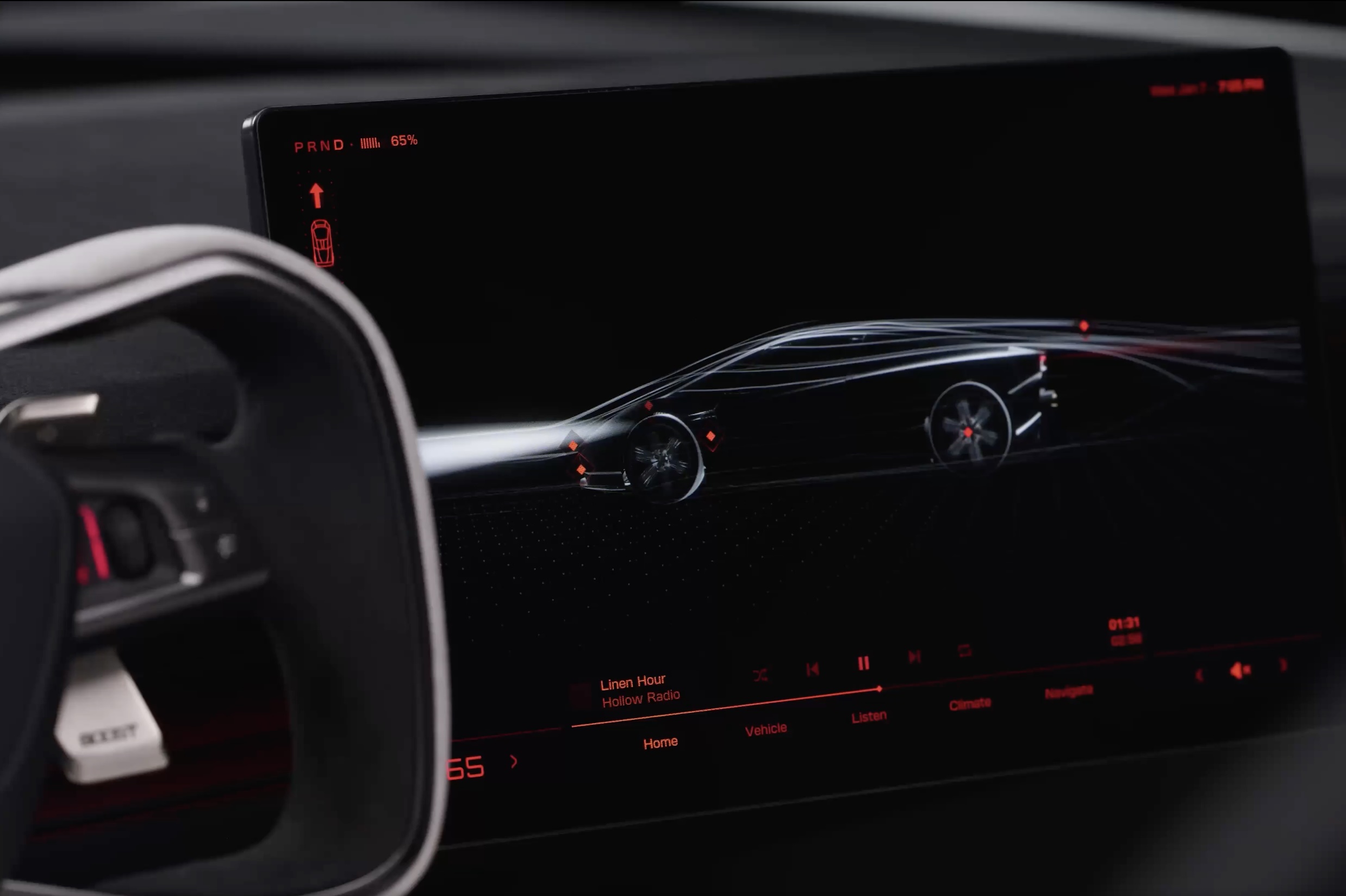
Tesla has given future owners their clearest look yet at the cockpit of its next generation Roadster. In a 34 second video posted to X on Friday afternoon, the company walked through the car’s touchscreen with a caption: “Inspired by fighter jet cockpits, Roadster’s interface was designed around the pilot.”
The clip opens on a black screen with red graphics and a 3D wireframe of the car, which sits beside the Roadster’s squared off yoke. Tapping parts of the model brings up controls for the rear wing, including low drag and high downforce positions, along with a charging page with a charge limit bar and a small music player. A row of tabs along the bottom reads Home, Vehicle, Listen, Climate and Navigate.
Most of the video is spent in Track Mode. The dashboard shows a live circuit map, a list of session lap times, brake and motor temperatures, and pressure and temperature readouts for each tire. A setup page lets the driver pick Auto, Low Drag, High Downforce or Custom aero modes, adjust aero balance and brake balance, and switch stability and traction control off. Along the bottom, a status bar reads “Thruster · 5,500 PSI” next to a “Boost Ready” indicator.
That gauge ties the software to the hardware Tesla showed off near Waco, Texas on October 15. The Thrust and Rocket versions use cold gas thrusters fed by carbon overwrapped pressure vessels, and Tesla lists 0 to 60 mph times of under 0.9 seconds and under 0.59 seconds for them, as Teslarati detailed in its breakdown of the three Roadster configurations. The base Performance car relies on a fan and ground sealing system for grip, and the aero settings on screen match the active wings and suction setup covered in our look at how the Roadster generates downforce.
The Roadster layout is a departure from the rest of Tesla’s lineup. Instead of a map centered screen, the Roadster puts the car itself at the center of the home page, and Tesla’s Roadster page lists two smaller forward displays alongside the main touchscreen. Tesla has not said whether any of the Track Mode telemetry will make its way to the Model 3 Performance or other vehicles.
The interface could still change before deliveries. Elon Musk said at the event that Roadster production will begin in 2028, and Tesla says the flagship Rocket version is not approved for public road use. Reservations are open with a $50,000 payment, while Thrust is listed as a limited release and Rocket is invite only.
Those who want to see the car in person will get their first chance this weekend. The Roadster goes on display in the lobby of the Petersen Automotive Museum in Los Angeles from October 24 to 27, according to Sawyer Merritt, the first time the public will be able to view it up close.

Tesla Cybercabs take over Austin’s F1 weekend

Tesla makes good on its Cybercab promise in just two weeks


