
News
SpaceX announces second Starlink satellite launch in two weeks

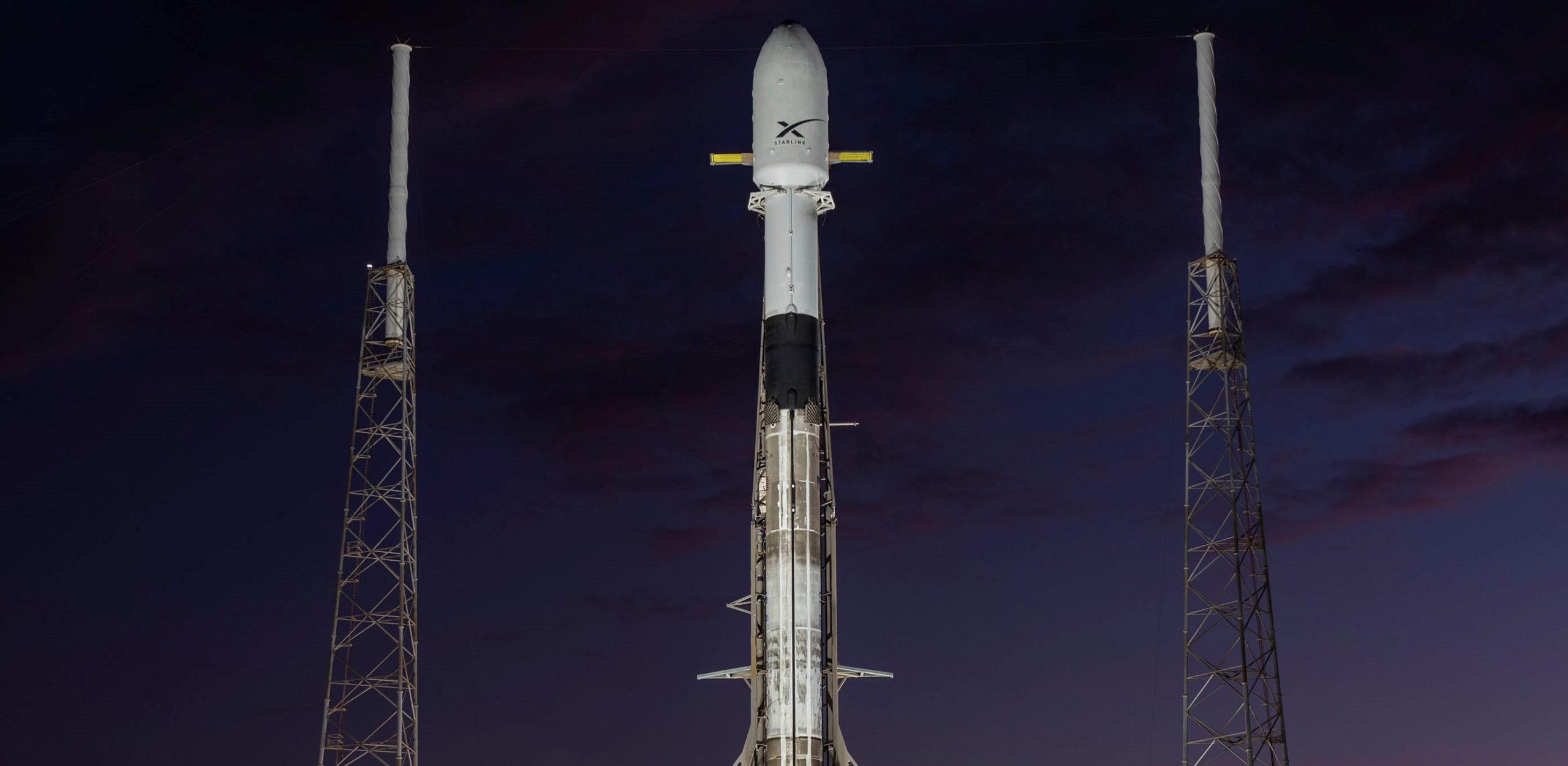
SpaceX has announced its second planned Starlink satellite in two weeks, sticking to a trend that could see the company launch more than a thousand communications satellites over the next 12 months.
Barely two weeks after SpaceX opened media accreditation for Starlink-2, the second launch of finalized ‘v1.0’ satellites and third dedicated launch overall, the company has announced that that late-December mission will be followed by another Starlink launch in January 2020. This tracks almost exactly with SpaceX’s reported plans for as many as 24 dedicated Starlink launches in 2020, a feat that would singlehandedly break SpaceX’s current record of 21 launches performed in a single year.
As previously discussed on Teslarati, SpaceX opened media accreditation for Starlink-2 on November 24th, confirming that the company hopes to complete one more 60-satellite Starlink launch before the end of 2019. That mission is currently targeted no earlier than (NET) late-December and would be SpaceX’s last launch of 2019 if current schedules hold.
Regardless of when it happens, there’s a strong chance that the 60 Starlink-2 satellites will make SpaceX the world’s largest individual satellite operator, potentially raising the number of satellites under the company’s command to ~170. According to SpaceX’s announcement, Starlink-3 – another 60-satellite mission – is now scheduled to launch no earlier than January 2020. If Starlink-2 is successful and no more v0.9 spacecraft drop out of the operational constellation, it can be said with certainty that Starlink-3 will unequivocally make SpaceX the world’s largest satellite operator.
Incredibly, if those schedules hold, SpaceX will have gone from two satellites in orbit to the world’s largest satellite constellation operator – by a large margin – in as few as nine months. In fact, after cresting that peak, it will take nothing short of a miracle for SpaceX to be usurped. The company hopes to launch as many as 24 Starlink missions in 2020 and is simply miles ahead of its competitors in its efforts to make high-performance orbital launches as efficient and affordable as possible.
If SpaceX and its executives are to be believed, as early as the very first dedicated Starlink launch (May 2019), the cost of launching Falcon 9 was already significantly less than the cost of its payload of 60 Starlink v0.9 satellite prototypes. CEO Elon Musk and COO Gwynne Shotwell have strongly implied that the per-satellite cost is already well below $500,000, meaning that the absolute worst-case internal cost of a Falcon 9 launch is less than $30M.
If, for example, each Starlink satellite already costs as little as $250,000 to build, it’s possible that SpaceX can already launch a dedicated 60-satellite mission (including launch costs) at an internal cost of less than $30M ($15M for launch, $15M for 60 satellites). Even in the former scenario, a single Starlink launch might cost SpaceX has little as $60M in total.
In a best-case scenario for megaconstellation competitor OneWeb, the company purchased up to 21 Soyuz launches from Roscosmos for “more than $1 billion”, translating to roughly $50 million per launch (rocket costs only). Meanwhile, OneWeb’s satellite design is far more traditional and Soyuz offers significantly less performance than Falcon 9, resulting in a cap of 34 ~150 kg (330 lb) per launch. Finally, OneWeb hopes to build each satellite for about $1M, translating to a best-case per-launch cost of ~$85 million. OneWeb aims to launch once per month after its first 34-satellite mission, currently NET January 30th, 2020.
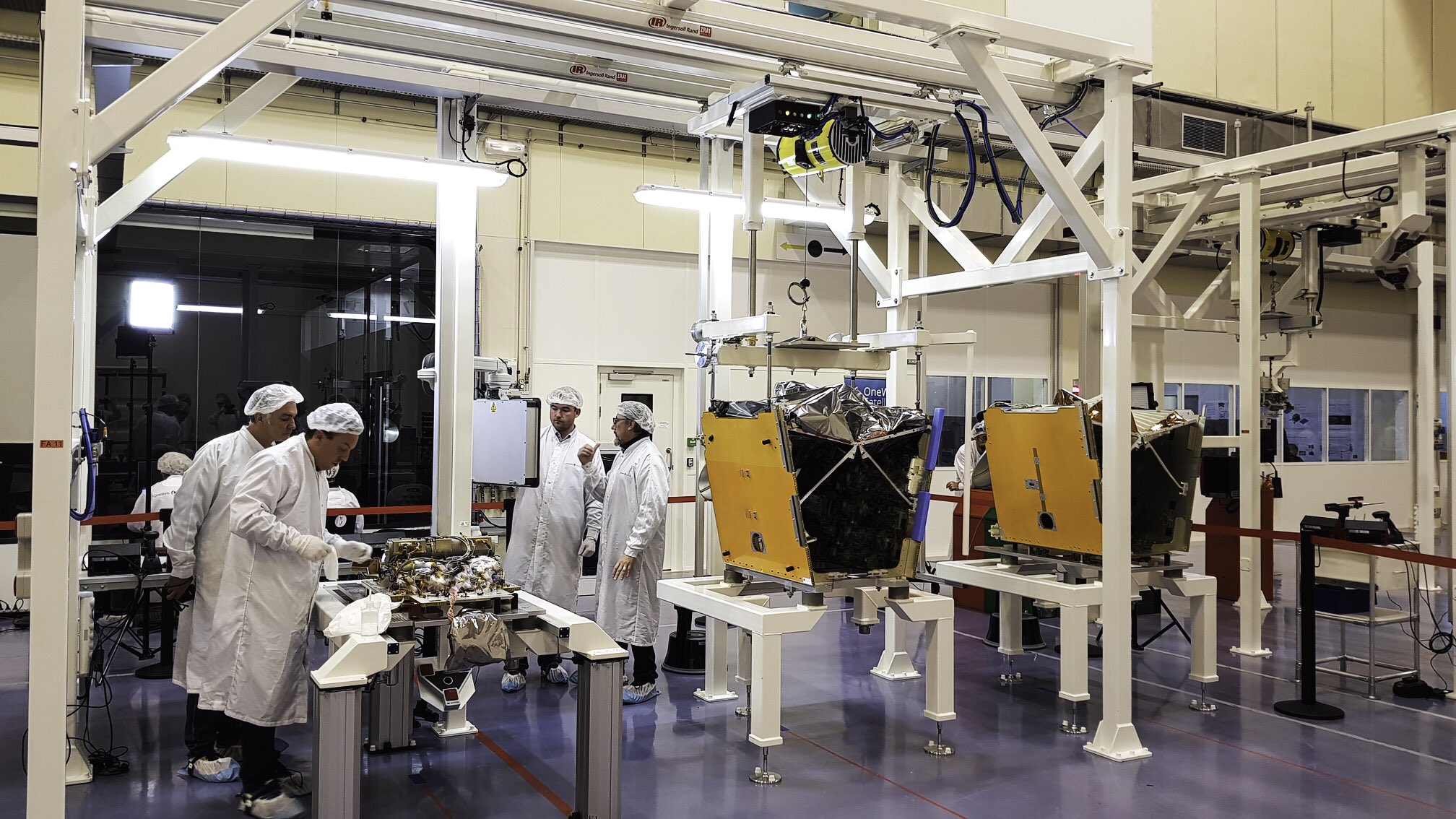
This is all a very roundabout way of illustrating the fact that once SpaceX becomes the world’s largest satellite operator, nothing short of repeated launch failures or the company’s outright collapse will prevent it from retaining that crown for the indefinite future. Once OneWeb has completed all 21 of its planned Soyuz launches, a milestone unlikely to come before mid-2021, it will have a constellation of ~700 satellites.
Even if SpaceX falters and manages a monthly Starlink launch cadence over the next 13 months, the constellation could surpass OneWeb’s Phase 1 plans as early as Q3 2020 – up to as early as June 2020 if SpaceX manages a biweekly cadence. By the time OneWeb’s constellation is complete, SpaceX could potentially have more than 2000 operational satellites in orbit – perhaps ~600 metric tons of spacecraft compared to OneWeb’s ~100 metric tons.
Check out Teslarati’s Marketplace! We offer Tesla accessories, including for the Tesla Cybertruck and Tesla Model 3.


Elon Musk
Tesla confirmed HW3 can’t do Unsupervised FSD but there’s more to the story
Tesla confirmed HW3 vehicles cannot run unsupervised FSD, replacing its free upgrade promise with a discounted trade-in.

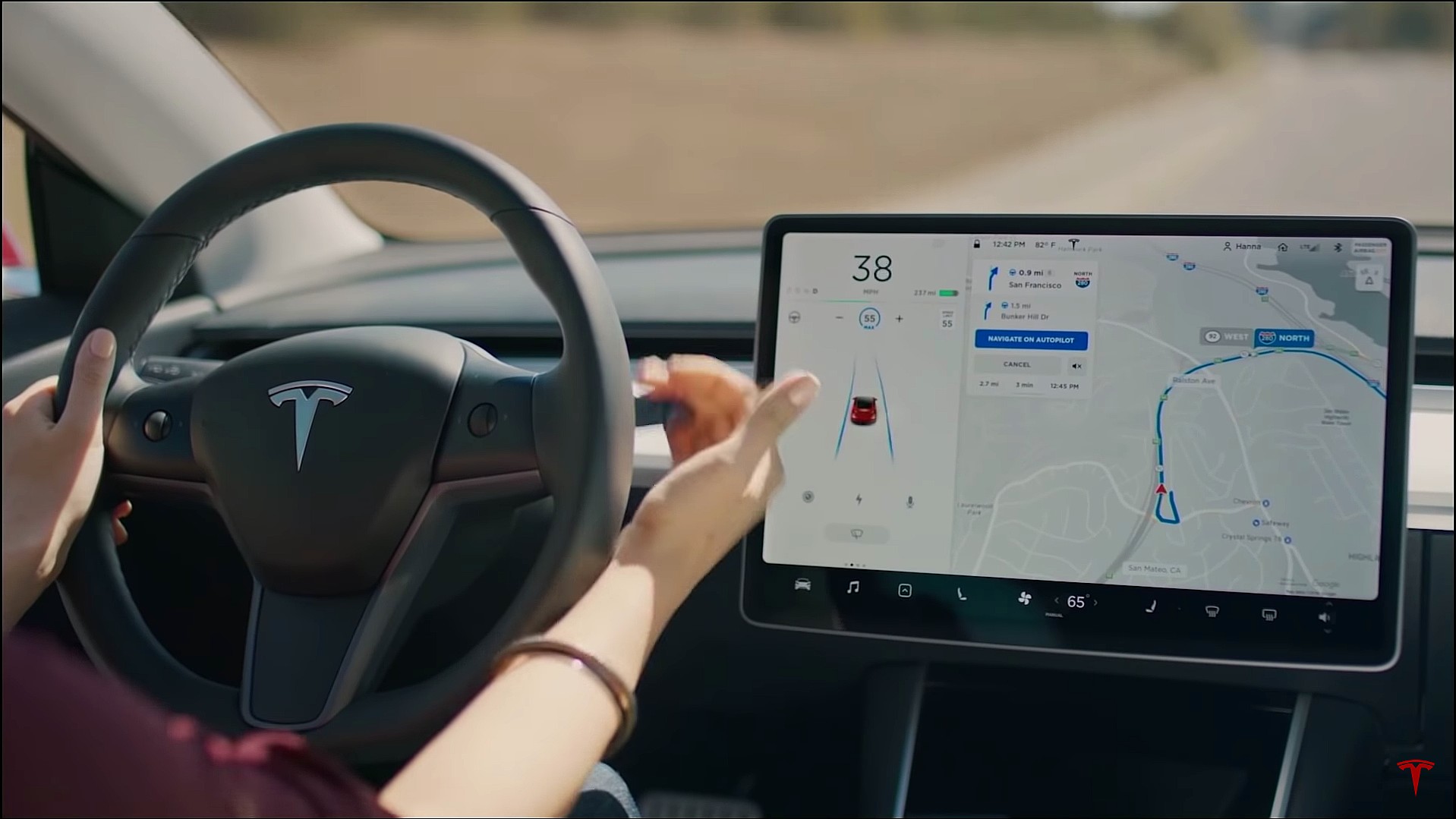
Tesla has officially confirmed that early vehicles with its Autopilot Hardware 3 (HW3) will not be capable of unsupervised Full Self-Driving, while extending a path forward for legacy owners through a discounted trade-in program. The announcement came by way of Elon Musk in today’s Tesla Q1 2026 earnings call.
🚨 Our LIVE updates on the Tesla Earnings Call will take place here in a thread 🧵
Follow along below: pic.twitter.com/hzJeBitzJU
— TESLARATI (@Teslarati) April 22, 2026
The history here matters. HW3 launched in April 2019, and Tesla sold Full Self-Driving packages to owners on the understanding that the hardware was sufficient for full autonomy. Some owners paid between $8,000 and $15,000 for FSD during that period. For years, as FSD’s AI models grew more demanding, HW3 vehicles fell progressively further behind, eventually landing on FSD v12.6 in January 2025 while AI4 vehicles moved to v13 and then v14. When Musk acknowledged in January 2025 that HW3 simply could not reach unsupervised operation, and alluded to a difficult hardware retrofit.
The near-term offering is more concrete. Tesla’s head of Autopilot Ashok Elluswamy confirmed on today’s call that a V14-lite will be coming to HW3 vehicles in late June, bringing all the V14 features currently running on AI4 hardware. That is a meaningful software update for owners who have been frozen at v12.6 for over a year, and it represents genuine effort to keep older hardware relevant. Unsupervised FSD for vehicles is now targeted for Q4 2026 at the earliest, with Musk describing it as a gradual, geography-limited rollout.
For HW3 owners, the over-the-air V14-lite update is welcomed, and the discounted trade-in path at least acknowledges an old obligation. What happens next with the trade-in pricing will define how this chapter ultimately gets written. If Tesla prices the hardware path fairly, acknowledges what early adopters are owed, and delivers V14-lite on the June timeline it committed to today, it has a real opportunity to convert one of the longest-running sore subjects among early adopters into a loyalty story.
Elon Musk
Tesla isn’t joking about building Optimus at an industrial scale: Here we go
Tesla’s Optimus factory in Texas targets 10 million robots yearly, with 5.2 million square feet under construction.
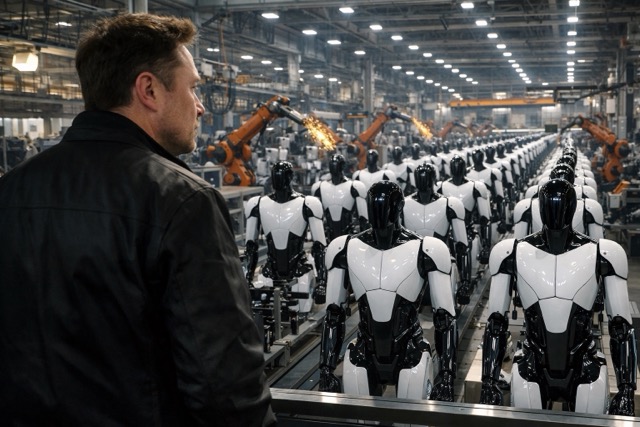
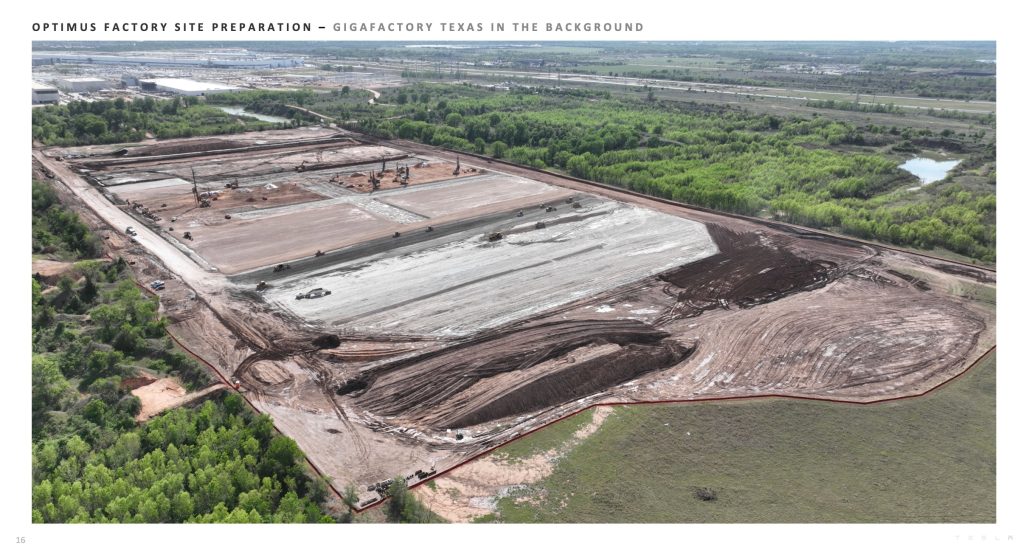
Tesla’s Q1 2026 Update Letter, released today, confirms that first generation Optimus production lines are now well underway at its Fremont, California factory, with a pilot line targeting one million robots per year to start. Of bigger note is a shared aerial image of a large piece of land adjacent to Gigafactory Texas, that Tesla has prominently labeled “Optimus factory site preparation.”
Permit documents show Tesla is seeking to add over 5.2 million square feet of new building space to the Giga Texas North Campus by the end of 2026, at an estimated construction investment of $5 billion to $10 billion. The longer term production target for that facility is 10 million Optimus units per year. Giga Texas already sits on 2,500 acres with over 10 million square feet of existing factory floor, and the North Campus expansion is being built to support multiple projects, including the dedicated Optimus factory, the Terafab chip fabrication facility (a joint Tesla/SpaceX/xAI venture), a Cybercab test track, road infrastructure, and supporting facilities.
Credit: TESLA
Texas makes strategic sense beyond the existing infrastructure. The state’s tax structure, lower labor costs relative to California, and the proximity to Tesla’s AI training cluster Cortex 1 and 2, both located at Giga Texas and now totaling over 230,000 H100 equivalent GPUs, means the Optimus software stack and the factory producing the hardware will share the same campus. Tesla’s Q1 report also confirmed completion of the AI5 chip tape out in April, the inference processor designed specifically to power Optimus units in the field.
As Teslarati reported, the Texas facility is intended to house Optimus V4 production at full scale. Musk told the World Economic Forum in January that Tesla plans to sell Optimus to the public by end of 2027 at a price between $20,000 and $30,000, stating, “I think everyone on earth is going to have one and want one.” He has previously pegged long term demand for general purpose humanoid robots at over 20 billion units globally, citing both consumer and industrial use cases.

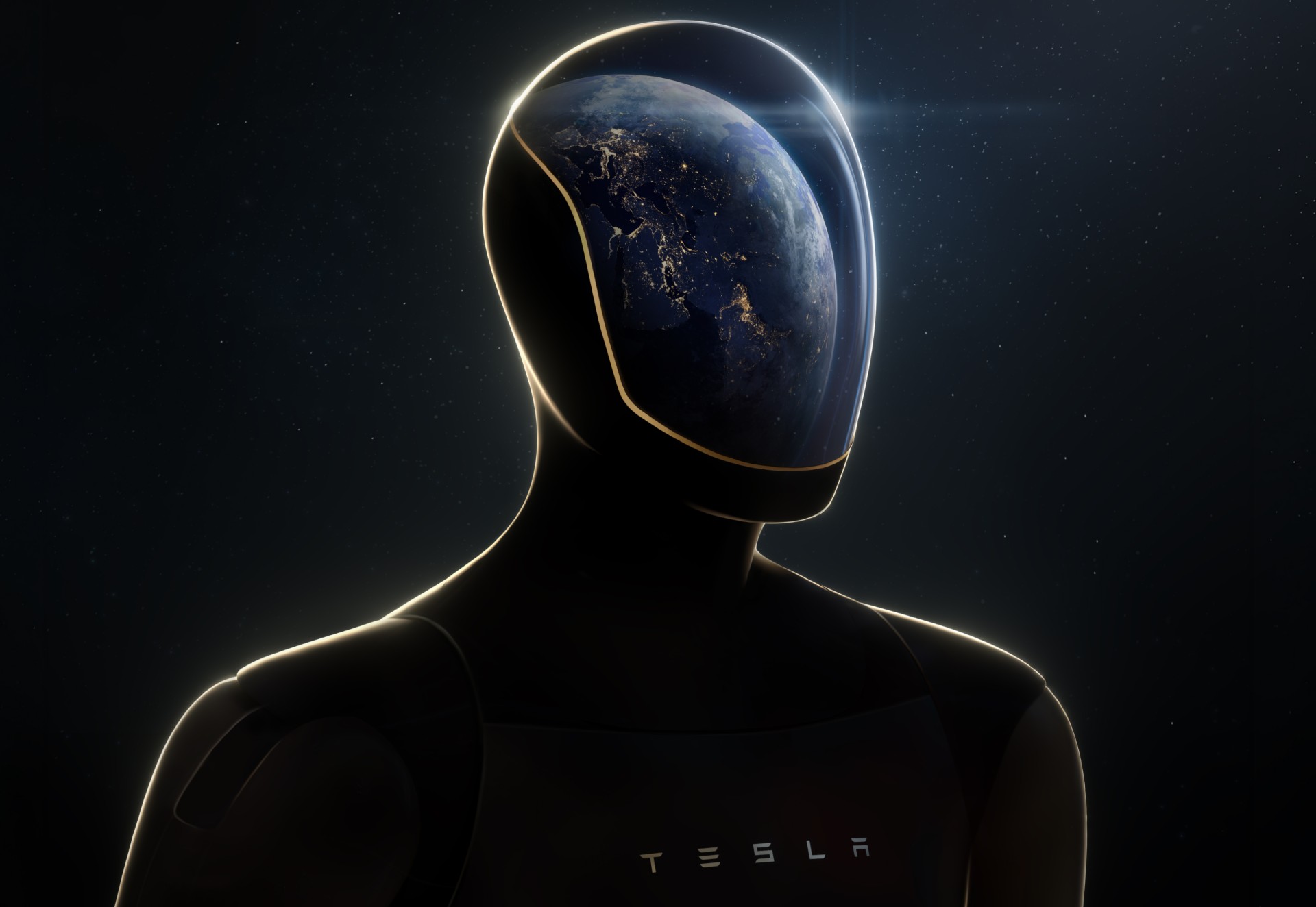
Tesla (NASDAQ: TSLA) reported its earnings for the first quarter of 2026 on Wednesday afternoon. Here’s what the company reported compared to what Wall Street analysts expected.
The earnings results come after Tesla reported a miss on vehicle deliveries for the first quarter, delivering 358,023 vehicles and building 408,386 cars during the three-month span.
As Tesla transitions more toward AI and sees itself as less of a car company, expectations for deliveries will begin to become less of a central point in the consensus of how the quarter is perceived.
Nevertheless, Tesla is leaning on its strong foundation as a car company to carry forward its AI ambitions. The first quarter is a good ground layer for the rest of the year.
Tesla Q1 2026 Earnings Results
Tesla’s Earnings Results are as follows:
- Non-GAAP EPS – $0.41 Reported vs. $0.36 Expected
- Revenues – $22.387 billion vs. $22.35 billion Expected
- Free Cash Flow – $1.444 billion
- Profit – $4.72 billion
Tesla beat analyst expectations, so it will be interesting to see how the stock responds. IN the past, we’ve seen Tesla beat analyst expectations considerably, followed by a sharp drop in stock price.
On the same token, we’ve seen Tesla miss and the stock price go up the following trading session.
Tesla will hold its Q1 2026 Earnings Call in about 90 minutes at 5:30 p.m. on the East Coast. Remarks will be made by CEO Elon Musk and other executives, who will shed some light on the investor questions that we covered earlier this week.
You can stream it below. Additionally, we will be doing our Live Blog on X and Facebook.
Q1 2026 Earnings Call at 4:30pm CT https://t.co/pkYIaGJ32y
— Tesla (@Tesla) April 22, 2026

Tesla confirmed HW3 can’t do Unsupervised FSD but there’s more to the story

Tesla isn’t joking about building Optimus at an industrial scale: Here we go


