Lifestyle
Becoming a Tesla Destination Charging Participant

Last month I shared with you the story of my successful recruitment of a restaurant/brewery into the Tesla Destination Charging program. It was a story I hoped would inspire others to do the same. Some of you asked me questions about what it was like for the business and I was curious myself, so I set out to get answers and hear it from their side.
The long story short? Piece of cake!
How did this all start? Some crazy owner (me) sent an unsolicited email, informed one of the restaurant’s owners of the program and vowed to come for a visit. On Friday, November 27th, that visit occurred. After I left, Mark the owner of Breaker Brewing Company checked on the kitchen and determined he could spare a few moments to contact Tesla’s Destination Charging program and inquire. As with any small, independent business, the biggest question Mark had was how much of an investment joining the program required. His budget for such a non-essential business expense was, in essence, non-existent. Sure he knew they would be on the hook for the cost of electricity for the actual charging, but that nominal amount was not the main concern.
Pretty quickly (Monday or Tuesday of the following week) Tesla responded to Mark’s inquiry. He assumes they checked out the location using mapping software first because right from that first phone conversation, he was immediately informed his location was a good fit. He had provided the address in his first contact and already knew he had an unused parking space along a building where the chargers could be installed.
“We love technology here.”
To be honest, it didn’t take much convincing on my part to get the restaurant on board with this idea. They were really receptive from the beginning and so the rest was smooth sailing. A pair with experience in the engineering field, Mark admitted that he and his co-owner loved technology.
The main questions that he had revolved around their responsibilities. For example, how much up front costs or fees they would be on the hook for, what the program consisted of and whether or not Tesla would assist with getting adequate power to the building where he intended the chargers to be installed.
In order to answer those questions, Tesla instructed Mark to get an estimate from an electrician to run the additional power and install the chargers. Jonathan Katz, Project Manager in the Destination Charging group was Mark’s main contact. One very important thing that Mark wanted to share with me was that from Day 1, Jonathan was phenomenal to work with. His email signature contained a direct phone number which Mark was able to call with questions. Reportedly Jonathan answered every call and reaching out to him never amounted to voicemails or phone tag. He also answered every question, big or small. The same thing applied to the electrician who was hired to do the job. (Praising Tesla for communication is something I don’t see often so this really stood out to me and is a sign of their true commitment to making charging accessible.)
Destination chargers can be found across a variety of hotels, restaurants and shopping centers [Source: Tesla Motors]
The next step in the process was getting an estimate for the electrical work. Tesla had recommended two electricians that were relatively close but not in the same town. Mark asked if he could hire his own because he happened to know of one who was reliable, professional and excellent at fit and finish of his work. Tesla said that it was no problem at all and awaited the estimate. As noted above, the electrician was able to easily contact Jonathan Katz directly to have any questions answered about the process. Once the estimate came in, Mark was ready to get back to Tesla.
The quote was $2,800 for installation of two 80 amp HPWCs including upgrading the building’s service to accommodate that kind of juice. The job also included running the chargers all the way outside the building to the correct placement. When Mark informed his contact at Tesla about the estimate, they confirmed this was within their reimbursement cap so the entire thing would be covered. Breaker Brewery would not have to come out of pocket even one dollar. That made the decision to move forward extremely easy.
Breaker Brewery would not have to come out of pocket even one dollar.
The next part of the process went equally smooth. Tesla had accepted the cost (their cap, which may or may not be negotiable and may or may not be region-specific, was reported to be $3,000) and sent a congratulations email about being accepted into the program. Next Tesla mailed out the chargers, which arrived in about five business days. I am assuming that what made me think this was an ideal location for a destination charger was also noticed by Tesla and thus they accepted the location into the program without any convincing.
The amount of effort and leg work the restaurant had to do to be a part of this program was small. They were required to fill out an application, which was neither long nor complicated. It contained some basic information about their location, business and what they offer. (I’m picturing the wifi and restroom symbols you see on the navigation screen when you touch on a destination charging marker.)
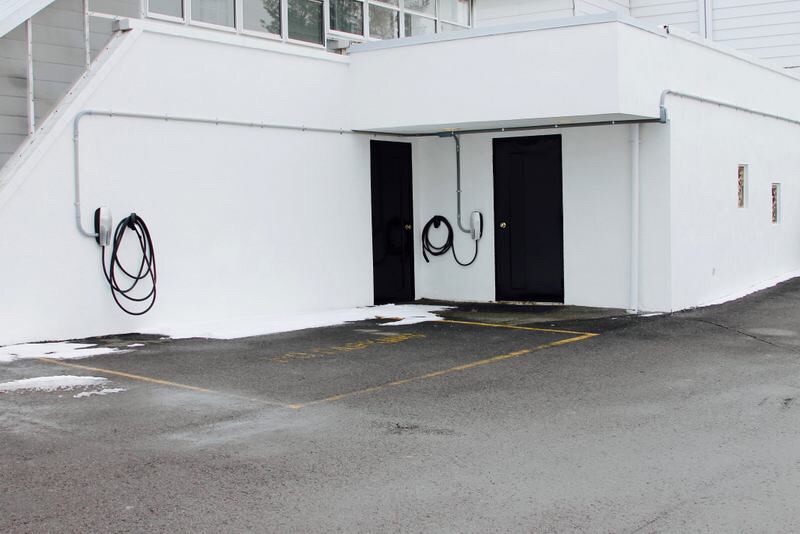
Two Tesla HPWCs installed at Breaker Brewing Company in Wilkes-Barre, PA
Once the chargers were installed and powered up, Tesla had to be informed. At this point the one and only hiccup occurred. For one reason or another, there was a miscommunication that resulted in Tesla not realizing it was done. After some time, Mark reached out to follow up about payment to the electrician. Once Jonathan realized what had occurred, he quickly resolved the issue and sent the payment. Mark estimates that had the miscommunication not occurred, the electrician probably would have only waited 7-10 for payment after completion. It bears repeating that in the case of this installation, everything was reimbursed. The whole job fit into the reimbursement limits and the restaurant had to pay nothing.
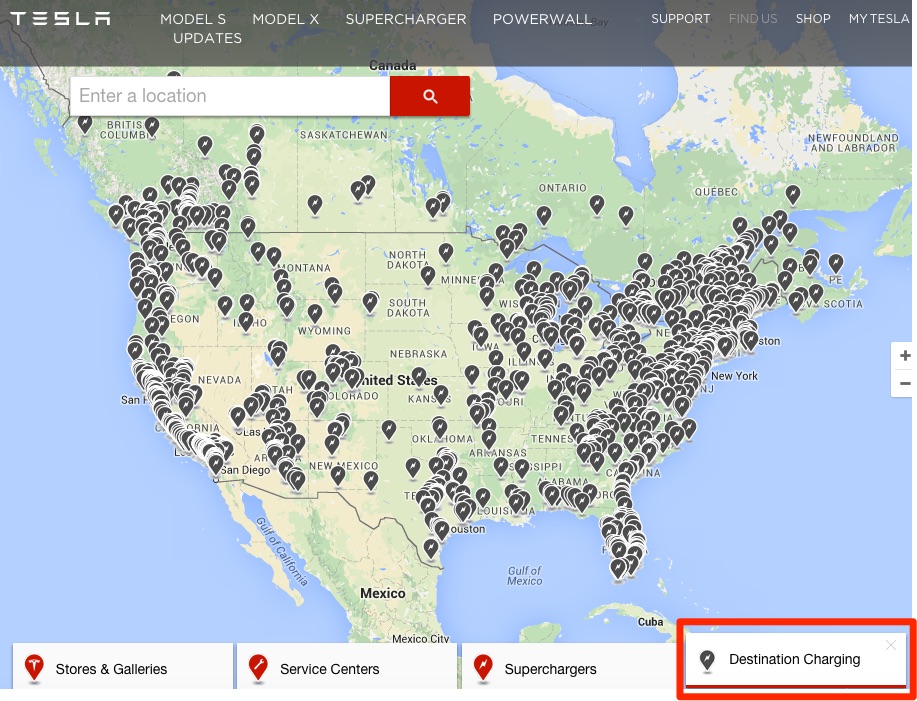
Tesla Destination Charging partners [Source: Tesla Motors charging map]
On January 15, 2016, the chargers were powered up. That means in just 49 days (including the Christmas and New Years holidays!) Breaker Brewery went from asking about the destination charging program to having working chargers. It took 3-5 days for their location to show up on Tesla’s destination charging map. I will assume the in-navigation display took the same but did not verify it was showing until yesterday.
Within the first 10 days or so of operation, which included my post about it as well as sharing on both TMC and the Tesla Forums, three different owners called the restaurant to thank them for installing a charger. (The Tesla community doing what we do.) Thus far only one owner has actually charged but Mark hopes to see an uptick as word spreads. Interestingly enough, the chargers have become a topic of conversation for non-Tesla owning patrons of the restaurant. Every Friday and Saturday someone notices and asks about it. There is a general curiosity that I hope will have far reaching implications with Model 3 and beyond. Certainly people want to know they will be able to charge at various locations before even considering the idea of some day owning an electric vehicle. To Mark’s knowledge, no other EV drivers have attempted to charge. I asked this question because I once saw an electric Smart Car pull into a Tesla Supercharger and attempt to plug in.
Some additional questions I asked were:
- What did you have to negotiate? Nothing
- How much did you come out of pocket? Nothing
- How as finance handled? Tesla mailed the chargers and paid the electrician directly
- Was the process easy? Extremely
- What else? I emailed Nissan and GM to see if they have similar programs. No one ever responded.
- Final notes from the owner: I would recommend this to any business!


Elon Musk
The FCC just said ‘No’ to SpaceX for now
SpaceX is fighting the FCC for spectrum that could put satellites inside every smartphone.

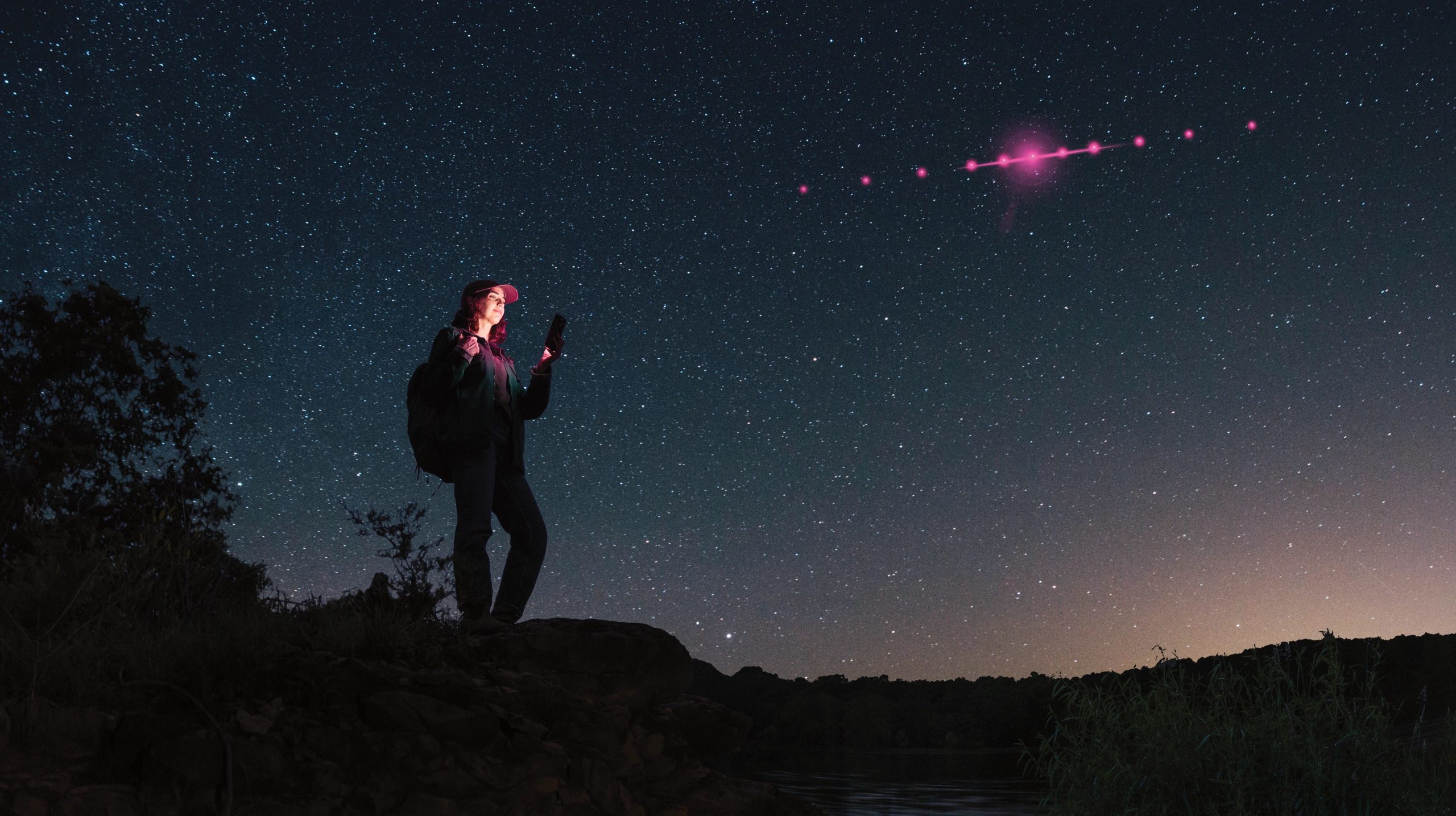
SpaceX was dealt a new setback on April 23, 2006 by the Federal Communications Commission (FCC) after the U.S. government agency dismissed the company’s petition to access a Mobile Satellite Service spectrum that would allow direct-to-device (D2D) capabilities.
The FCC regulates communications by radio, television, wire, and cable, which also includes regulating D2D technology that lets your existing smartphone connect directly to a satellite orbiting Earth, the same way it would connect to a cell tower.
Elon Musk’s SpaceX has been building toward this through its Starlink Mobile service, formerly called Direct-to-Cell, in partnership with T-Mobile. The service officially launched on July 23, 2025, starting with messaging and expanding to broadband data in October of that year.
T-Mobile Starlink Pricing Announced – Early Adopters Get Exclusive Discount
It’s worth noting that SpaceX is not alone in this race. AT&T and Verizon have their own satellite texting deals with AST SpaceMobile, while Verizon separately offers free satellite texting through Skylo on newer phones.
The regulatory foundation for all of this dates to March 14, 2024, when the FCC adopted the world’s first framework for what it called Supplemental Coverage from Space, allowing satellite operators to lease spectrum from terrestrial carriers and fill gaps in their coverage. On November 26, 2024, the FCC granted SpaceX the first-ever authorization under that framework, approving its partnership with T-Mobile to provide service in specific frequency bands. SpaceX then went further, completing a roughly $17 billion acquisition of wireless spectrum from EchoStar, which gave it the ability to negotiate with global carriers more independently.
Starlink’s EchoStar spectrum deal could bring 5G coverage anywhere
This recent ruling by the FCC blocked SpaceX from going further, protecting incumbent spectrum holders like Globalstar and Iridium. But the market momentum is already in motion. As Teslarati reported, SpaceX is targeting peak speeds of 150 Mbps per user for its next generation Direct-to-Cell service, compared to roughly 4 Mbps today, which would bring satellite connectivity close to standard carrier performance.
With a reported IPO targeting a $1.75 trillion valuation on the horizon, each spectrum fight, carrier deal, and regulatory win or loss now carries weight beyond just connectivity. SpaceX is quietly becoming the infrastructure layer underneath the phones of millions of people, and the FCC’s next move will help determine how much further that reach extends.
FCC Satellite Rule Makings can be found here.
Elon Musk
Elon Musk talks Tesla Roadster’s future
Elon Musk confirmed the Roadster as Tesla’s last manually driven car, with a debut coming soon.
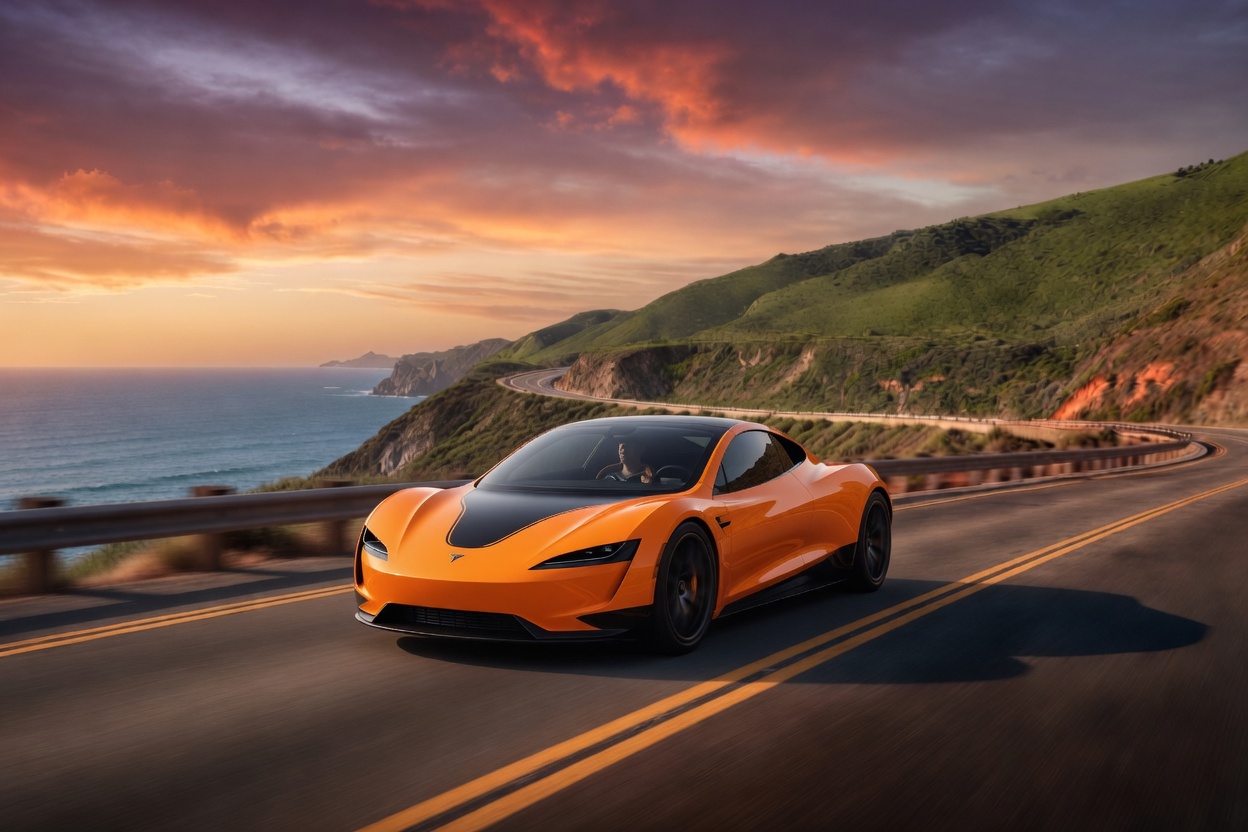
During Tesla’s Q1 2026 earnings call on April 22, Elon Musk made a brief but notable comment about the long-awaited next generation Roadster while describing Tesla’s future vehicle lineup. “Long term, the only manually driven car will be the new Tesla Roadster,” he said. “Speaking of which, we may be able to debut that in a month or so. It requires a lot of testing and validation before we can actually have a demo and not have something go wrong with the demo.”
That single statement is the entire Roadster update from yesterday’s call, and while it represents another timeline shift, it comes as no surprise with Tesla heads-down-at-work on the mass rollout of its Robotaxi service across US cities, and the industrial scale production of the humanoid Optimus.
The fact that Musk specifically framed the Roadster as the last manually driven Tesla is significant on its own. As the rest of the lineup moves toward full autonomy, the Roadster becomes something rare in the Tesla-sphere by keeping the driver in control. Driving enthusiasts who buy a $200,000 supercar are not doing so to be passengers. They want the physical connection to the road, the feel of acceleration under their own input, and the experience of controlling something with that level of performance. FSD, however capable it becomes, removes that entirely. The Roadster signals that Tesla understands this distinction and is building a car specifically for the people who consider driving itself the point.
Tesla isn’t joking about building Optimus at an industrial scale: Here we go
The specs for the Roadster Musk has teased over the years are genuinely unlike anything in production. The base model targets 0 to 60 mph in 1.9 seconds, a top speed above 250 mph, and up to 620 miles of range from a 200 kWh battery. The optional SpaceX package takes it further, rumored to add roughly ten cold gas thrusters operating at 10,000 psi, borrowed directly from Falcon 9 rocket technology. With thrusters, Musk has claimed 0 to 60 mph in as little as 1.1 seconds. In a 2021 Joe Rogan interview he went further, stating “I want it to hover. We got to figure out how to make it hover without killing people.” Tesla filed a patent for ground effect technology in August 2025, suggesting the hover concept has not been abandoned. The starting price remains $200,000, with the Founders Series requiring a $250,000 full deposit. Some reservation holders placed those deposits in 2017 and are approaching a full decade of waiting.
With production now targeted for 2027 or 2028 at the earliest, the Roadster remains Tesla’s most audacious promise and its longest-running delay. But if what Musk is testing lives up to even half of what he has described, the demo alone should be worth waiting for.
Elon Musk says the Tesla Roadster unveiling could be done “maybe in a month or so.”
He said it should be an extraordinary unveiling event. pic.twitter.com/6V9P7zmvEm
— TESLARATI (@Teslarati) April 22, 2026
Elon Musk
Tesla isn’t joking about building Optimus at an industrial scale: Here we go
Tesla’s Optimus factory in Texas targets 10 million robots yearly, with 5.2 million square feet under construction.
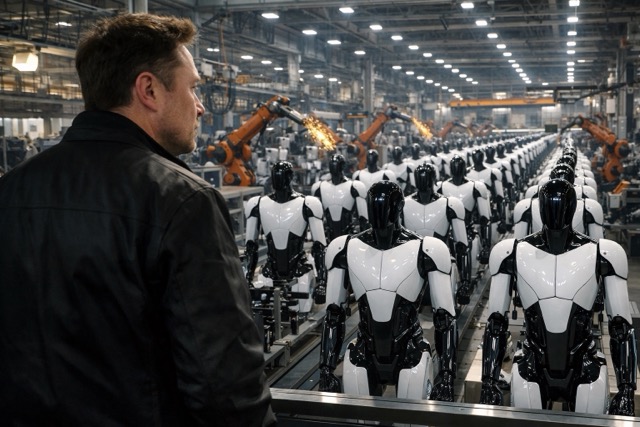
Tesla’s Q1 2026 Update Letter, released today, confirms that first generation Optimus production lines are now well underway at its Fremont, California factory, with a pilot line targeting one million robots per year to start. Of bigger note is a shared aerial image of a large piece of land adjacent to Gigafactory Texas, that Tesla has prominently labeled “Optimus factory site preparation.”
Permit documents show Tesla is seeking to add over 5.2 million square feet of new building space to the Giga Texas North Campus by the end of 2026, at an estimated construction investment of $5 billion to $10 billion. The longer term production target for that facility is 10 million Optimus units per year. Giga Texas already sits on 2,500 acres with over 10 million square feet of existing factory floor, and the North Campus expansion is being built to support multiple projects, including the dedicated Optimus factory, the Terafab chip fabrication facility (a joint Tesla/SpaceX/xAI venture), a Cybercab test track, road infrastructure, and supporting facilities.
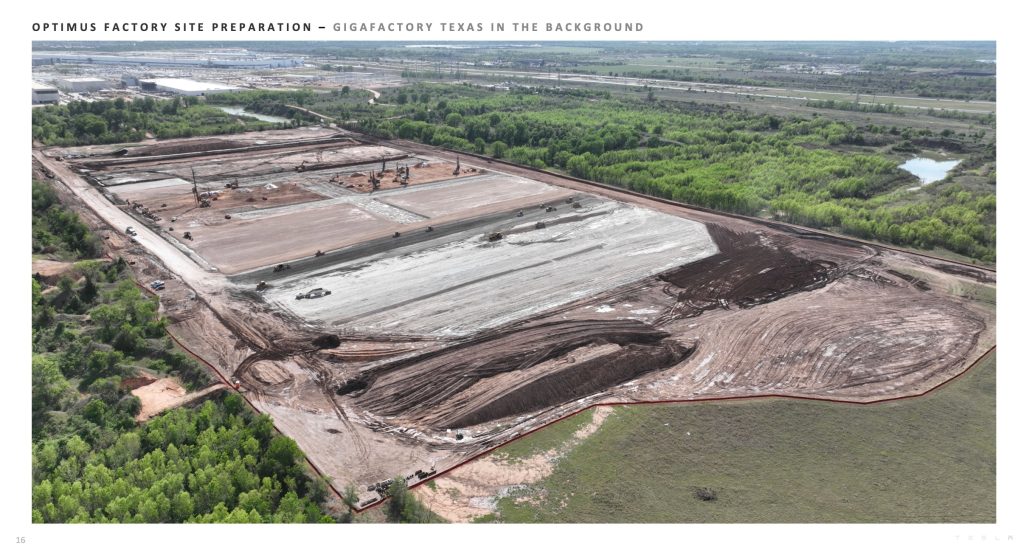
Credit: TESLA
Texas makes strategic sense beyond the existing infrastructure. The state’s tax structure, lower labor costs relative to California, and the proximity to Tesla’s AI training cluster Cortex 1 and 2, both located at Giga Texas and now totaling over 230,000 H100 equivalent GPUs, means the Optimus software stack and the factory producing the hardware will share the same campus. Tesla’s Q1 report also confirmed completion of the AI5 chip tape out in April, the inference processor designed specifically to power Optimus units in the field.
As Teslarati reported, the Texas facility is intended to house Optimus V4 production at full scale. Musk told the World Economic Forum in January that Tesla plans to sell Optimus to the public by end of 2027 at a price between $20,000 and $30,000, stating, “I think everyone on earth is going to have one and want one.” He has previously pegged long term demand for general purpose humanoid robots at over 20 billion units globally, citing both consumer and industrial use cases.

SpaceX Board has set a Mars bonus for Elon Musk

Tesla’s biggest rivals fights charging wait times with a modern approach


