Lifestyle
Fitting a bike into the Tesla Model S

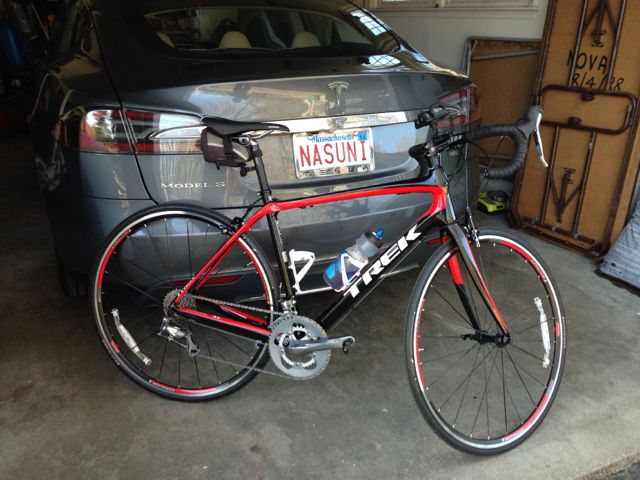
I needed to transport my bike today so it was the perfect opportunity go to do a fit test of the bike in the Tesla Model S. I prepared for the first test by folding down both of the back seats and laying down a pet covering across the entire surface. The covering will minimize abrasion and potential damage to the carpet lined seat backs. I loaded the bike into the rear hatch and found everything to fit really nicely.
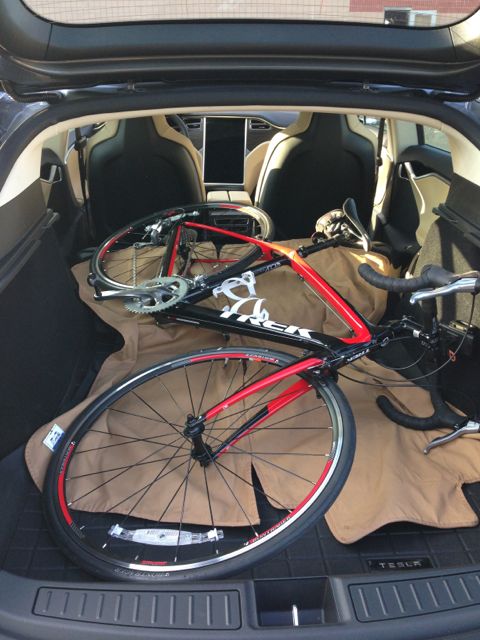 My Trek Domane is an amazingly light bike so lifting it into the Tesla and positioning it correctly was easy. I’m not a big bike person but I do enjoy a ride (for exercise) now and then. After putting about 1,500 miles on my previous Trek hybrid I decided to splurge a bit (seems to be the year for that!) and got this road bike. I prefer not having to remove the bike wheels or add any type of external hitch so I was very pleased to see the bike fit perfectly into the Tesla without needing to make any adjustments.
I decided that it would be easier to load the bike if the rear wheels were to face inwards (towards the front of the car). It was much easier to maneuver and adjust the bike when the steering assembly was facing towards me. Just don’t forget to always keep the chain side up.
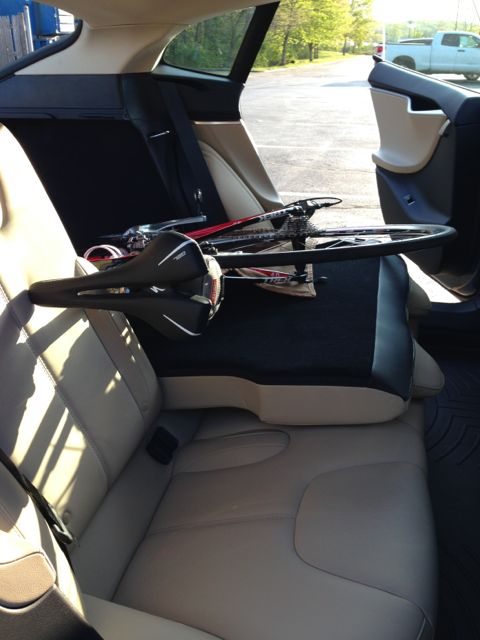 I experimented with another method of loading the bike, but this time with one of the rear seats folded up. By lifting the bike up and over the seat, I could ensure that one of the rear seats could remain upright and still usable.
While someone could potentially sit in the rear seat, its not going to be very comfortable, nor safe, considering a portion of the bike encroaches into the passenger’s territory. And for that reason I don’t think this would be a viable technique for stowing a bike.
Also see: Full Size Folding Electric Bike in a Tesla Model S
In the end, the Tesla Model S is more than capable of carrying a full size bike with at both of the rear seats folded down, however it will lose almost all of its passenger carrying capabilities and essentially become a 2- seater.


Elon Musk
Elon Musk’s Texas ranch to showcase the lifelong work that changed the world
Elon Musk is building a product gallery at his Texas ranch spanning his lifelong inventions.

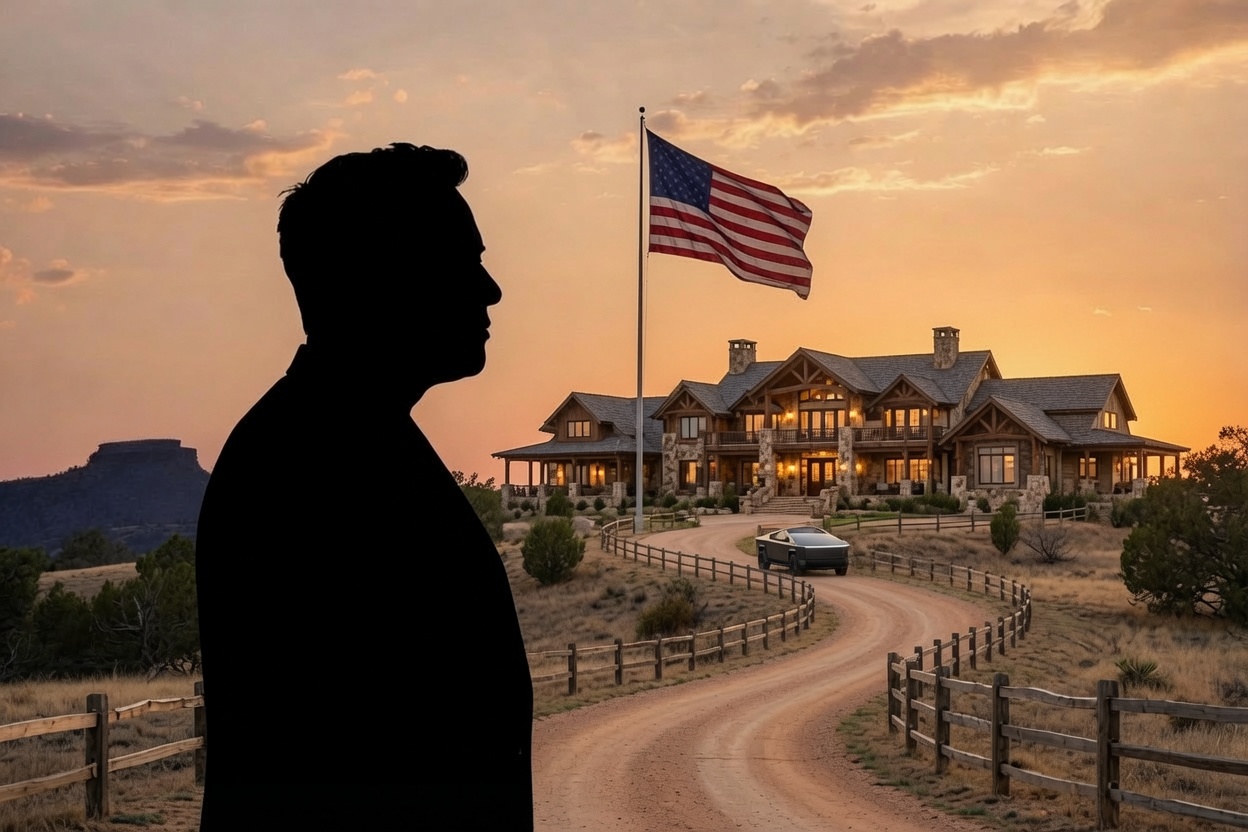
Elon Musk took to X earlier today, noting “Am putting together a product gallery at my ranch in Texas.” in response to a resurfaced famous quote from JPMorgan CEO Jamie Dimon’s wherein he draw parallels of the Tesla CEO to legendary physicist Albert Einstein.
Dimon made the remark at the World Economic Forum in Davos, Switzerland back in January 2025, telling CNBC at the time, “SpaceX, Tesla, Neuralink, I mean, the guy is our Einstein.” The remark seemingly ended a long-time feud between the two high profile execs.
While details are thin about the exact location of Elon Musk’s Texas ranch and any pending projects that would serve as a gallery and homage to his portfolio of revolutionary product inventions spanning from 1984 to 2025, land acquisition records point to roughly a location of several thousand acres in Bastrop County, east of Austin near the Colorado River and held through an LLC called Horse Ranch LLC that’s managed by Musk’s longtime personal friend and family wealth manager Jared Birchall. Birchall also serves as the CEO of Neuralink.
Tesla’s “ecological paradise” in Giga Texas may be larger than expected
The broader Bastrop County footprint surrounding the ranch has grown significantly. Entities tied to Musk have accumulated approximately 2,000 acres in Bastrop County as of mid-2026, up from 700 acres earlier in the year, with possibly as much as 6,000 acres acquired in total across Bastrop and Travis counties based on deed records.
No completion date for the gallery has been announced and Musk has not confirmed whether it will be open to the public. As Teslarati has reported, SpaceX just completed the largest IPO in history raising $75 billion, a milestone that makes this particular moment in Musk’s career a natural inflection point for looking back at what he has built through the years.
Am putting together a product gallery at my ranch in Texas https://t.co/xQf5FRy4uz
— Elon Musk (@elonmusk) July 15, 2026
Starting with Blastar, a simple space shooter game Musk coded at 12 years old and sold to a South African magazine for $500. From there the timeline moves through a commercial career that started with Zip2 in 1995, a city guide software company sold to Compaq for roughly $300 million in 1999. That was followed by X.com in 1999, which merged with Confinity to become PayPal, acquired by eBay in 2002 for $1.5 billion. SpaceX came in 2002, Tesla in 2003, SolarCity in 2006, the Supercharger network in 2012, Neuralink in 2016, The Boring Company in 2016, OpenAI co-founded in 2015, X acquired in 2022, xAI in 2023, Optimus in 2024, the Cybercab in 2026, and most recently SpaceXAI following the SpaceX and xAI merger. The gallery will also likely include items that blur the line between product and cultural artifact, among them The Boring Company’s Not-a-Flamethrower from 2018, Tesla Short Shorts from 2020, and Burnt Hair perfume released under X in 2022.
Lifestyle
Tesla makes the cut on California’s newest EV Rebate program
California just signed a $270 million EV rebate into law and it starts this summer.
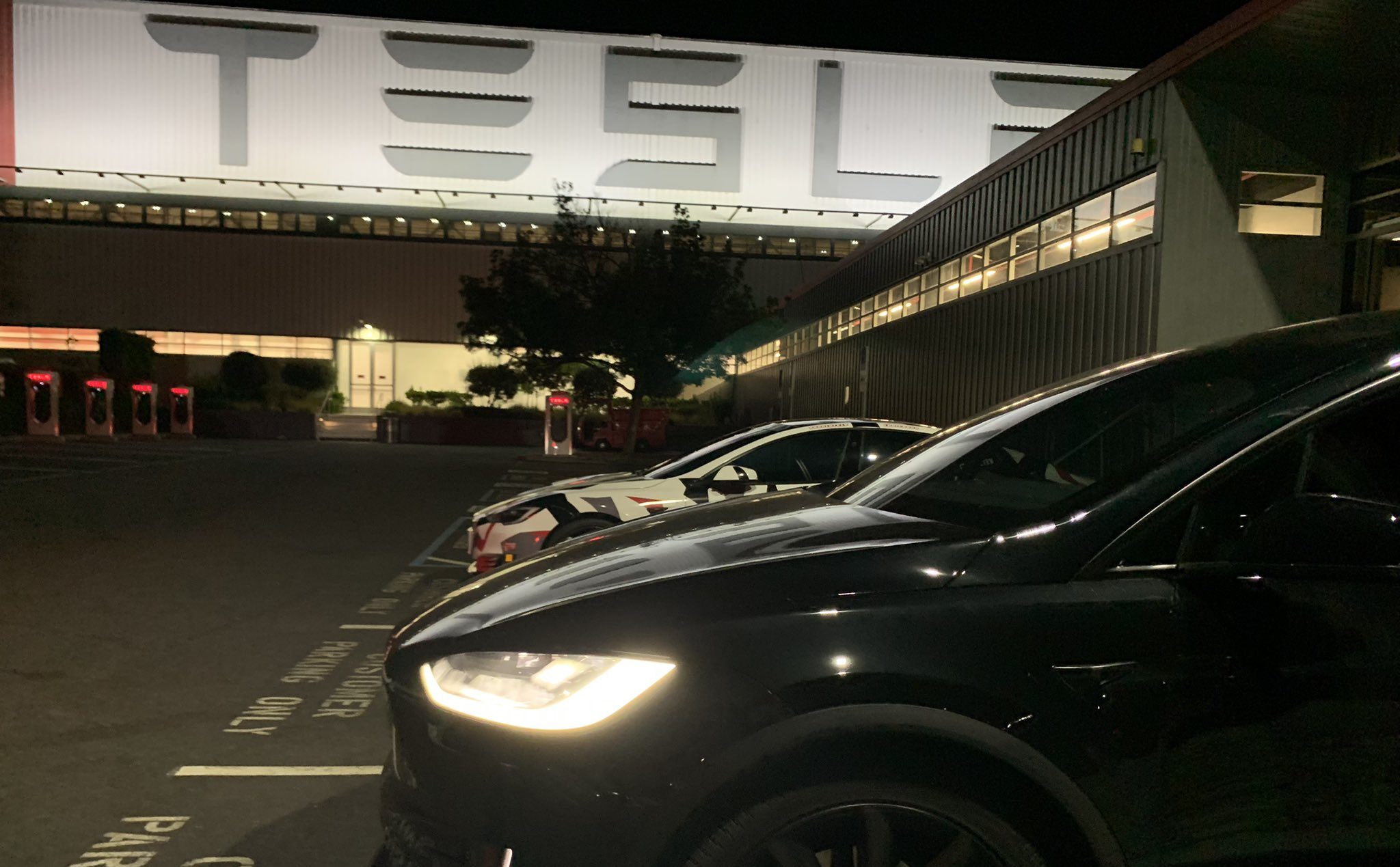
California Governor Gavin Newsom signed SB 168 into law on Monday, July 13, 2026, creating a $270 million EV rebate program that delivers money directly at the dealership rather than as a tax credit applied months later. The program, called MyFirstEV, is funded equally by California’s state budget and participating automakers, with each contributing $135.5 million to make the math work.
The timing is directly tied to the loss of federal support when the $7,500 federal EV tax credit ended, removing the most significant consumer incentive that had driven EV adoption in the U.S. California, which accounts for roughly one-third of all EVs sold nationally, moved to fill that gap with a state-level replacement.
The rebate structure is straightforward. First-time EV buyers can receive $3,500 off any new battery-electric vehicle with an MSRP up to $50,000. Used EVs priced at $25,000 or below qualify for a $1,750 rebate. The credit is applied at the point of sale, which removes the friction of the old federal system where buyers had to wait for tax season to see the benefit. The program goes live later this summer, with the California Air Resources Board expected to release full participation details next month.
California hits Tesla Cybercab and Robotaxi driverless cars with new law
For Tesla buyers, the implications are mixed. The Tesla Model 3 RWD at $42,490 and the Model 3 Long Range at $47,490 both fall under the $50,000 cap and would qualify for the full $3,500 rebate for first-time buyers. The Model Y, which starts at $44,990 after Tesla’s recent price adjustment, also qualifies. The Model X, Model S, and Cybertruck all exceed the cap and receive no benefit. As Teslarati has reported, the program also includes a carve-out exempting California-based automakers like Rivian and Lucid from the price cap entirely, a provision that puts Tesla at a disadvantage since it relocated its headquarters to Texas in 2021.
Other qualifying vehicles include the Chevrolet Equinox EV, Ford Mustang Mach-E, Hyundai Ioniq 5, Kia EV6, and Volkswagen ID.4.
Elon Musk
Tesla FSD is about to know your specific house and neighborhood better than any map
Tesla confirmed it is building a feature that lets you teach your car where to go.
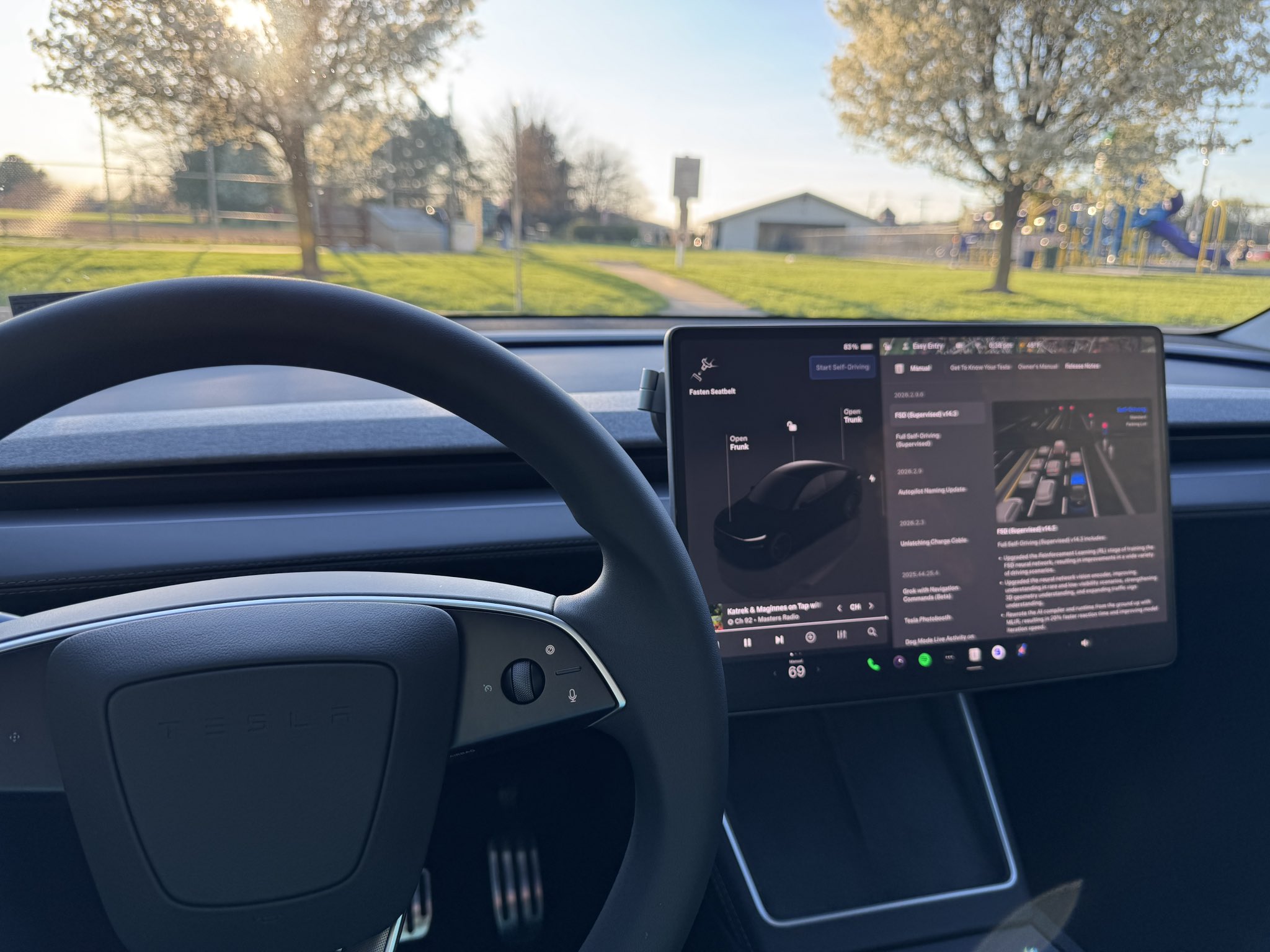
Tesla is building a feature that will let drivers talk to their car in plain language and teach it exactly what to do, with the vehicle remembering those instructions for every future trip. Tesla VP of AI Software Ashok Elluswamy confirmed it this week on X after a user pointed out one of FSD’s most persistent real-world limitations is that the system has no way to receive contextual instructions the way a human driver would.
“FSD would be twice as useful in neighborhoods if I could actually talk to the car and tell it which driveway to pull into, the same way I would with a person driving me home. Right now, there isn’t really an input for telling Tesla what color the house is or giving it specific context like that. Google Maps is also notorious for putting pins on houses that aren’t actually yours.” Tesla owner Chris further noted, “It would be so cool if I could talk to the car while going down my street and say something like, ‘It’s the white house on the left, just past that SUV,’ and then have FSD remember that for next time.”
FSD would be twice as useful in neighborhoods if I could actually talk to the car and tell it which driveway to pull into, the same way I would with a person driving me home.
Right now, there isn’t really an input for telling Tesla what color the house is or giving it specific…
— Chris (@ChrissGPT) July 8, 2026
This feature would carry more weight than it might seem. Grok has been available inside Tesla vehicles since July 2025, expanded to European vehicles in February 2026, and gained a hands-free “Hey Grok” wake word with location-based reminders and natural-language navigation in the Spring 2026 update. But up to this point, Grok has had no authority over how FSD actually drives. Lane changes, braking, speed, and parking maneuvers remain entirely within FSD’s autonomous decision-making loop. What Elluswamy confirmed is that the next step pushes Grok into a supervisor role, one that translates spoken intent directly into driving decisions.
Tesla teases greater Grok FSD integration and ‘Banish’ feature ‘in about 3 months’
Elluswamy acknowledged at a January 2026 conference that while fully integrated voice control is on Tesla’s roadmap, “it opens up an entire area of testing that we have to do. For example, you shouldn’t be able to tell the car to crash, and it shouldn’t crash.” Elon Musk subsequently confirmed on June 23 that Grok voice commands will pass to FSD’s planning layer by September 2026, a three month timeline from confirmation to deployment.
The deeper significance is what this does for Tesla’s AI training flywheel. Every time an owner corrects FSD with a spoken instruction and the car learns and remembers it, that interaction becomes a data point covering an edge case that no simulation or scripted test could have generated. A fleet of millions of Tesla vehicles crowdsourcing hyper-local contextual knowledge, which driveway, which gate entrance, which side of the street, builds a layer of geographic and behavioral intelligence that competitors without a comparable fleet simply cannot replicate at the same speed or scale.
As Teslarati has reported, Tesla’s Cybercab and robotaxi operations have expanded to Miami following the Austin launch, with rider profiles already collecting preference data. Voice-taught contextual instructions linked to individual rider profiles means a Cybercab could eventually know before it arrives exactly which entrance to use, where to wait, and how to navigate the final hundred feet of any trip it has made before.

Elon Musk’s Texas ranch to showcase the lifelong work that changed the world

Lucid CEO dispels any rumors of bankruptcy: ‘So far from the facts’


