Lifestyle
Will Tesla’s autonomous driving technology fix car theft?

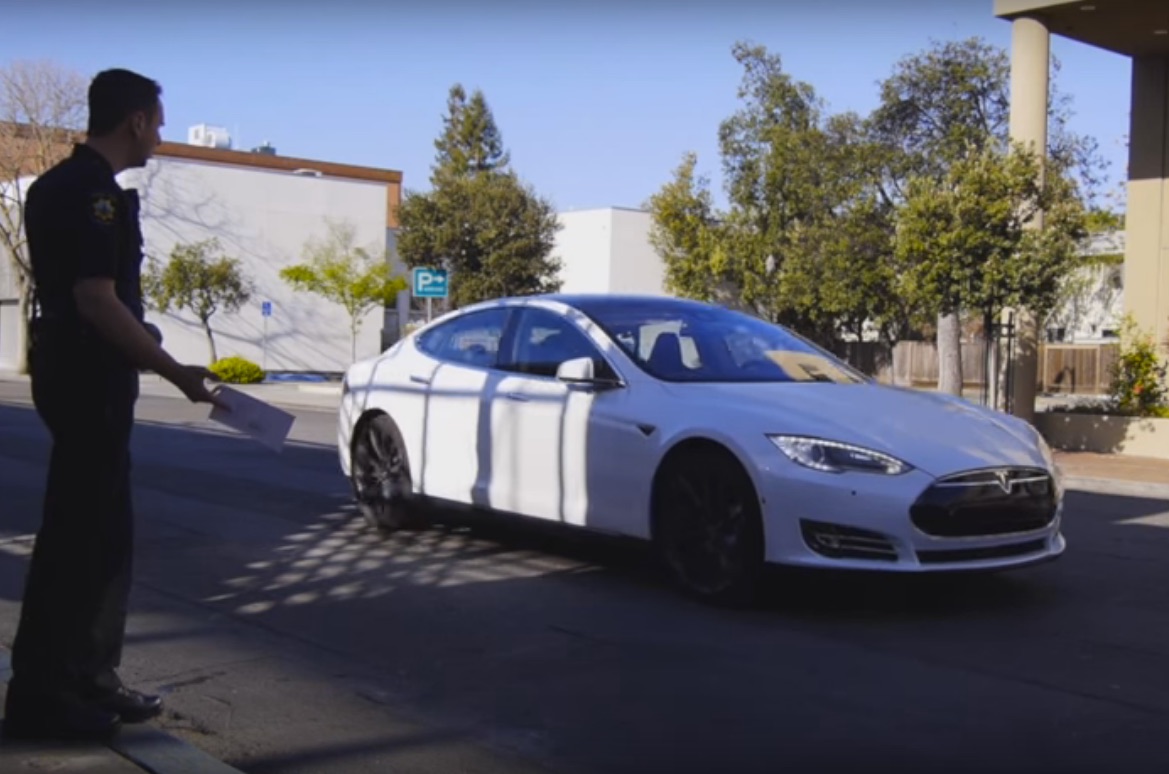
There are too many possible benefits to autonomous driving for anyone to fully realize. It is designed for safety and convenience, but the feature reaches much further than that. I’ve never dealt with it, but I imagine that discovering your car has been stolen is one of the most terrifying violations a car owner may feel. Anger, rage, vulnerability, helplessness. My palms are sweaty just thinking about it.
Anti-theft systems do their best to deter and react to these situations but are often overcome. What will autonomous driving bring to the table? Will the cars become unstealable? Are they even stealable now?
On the other side of this topic, some argue that autonomous, computer-based driving, will open the vehicles up to greater risk of hacking. This has, so far, been a relative non-issue. Recent hacking activity on Tesla’s Model S was performed by ‘professional hackers’ and the holes were quickly patched. Even then the outcome would likely have not been theft.
That said, there’s a few reasons where Tesla’s Full Self-Driving Capability could presumably deter traditional vehicle theft.
- Thieves would be less likely to steal a vehicle if it became common knowledge that autonomous vehicles are actively being tracked and driven by a computer system.
- Owners to the stolen Tesla could potentially ‘Summon’ the thief directly to them or to a police station.
- Fear of technology: hearing about the vehicle being equipped with cameras and sensory equipment, a thief may assume their identity is also being captured by the car.
- How does one ‘drive’ a vehicle if there’s, hypothetically, no steering wheel?
Any other thoughts? Will Tesla vehicles become unstealable?


Elon Musk
Tesla Diner is throwing a birthday party with a Franz-signed special treat
Tesla Diner turns one on July 21 with Optimus, roller skates, and a Franz-signed hat.

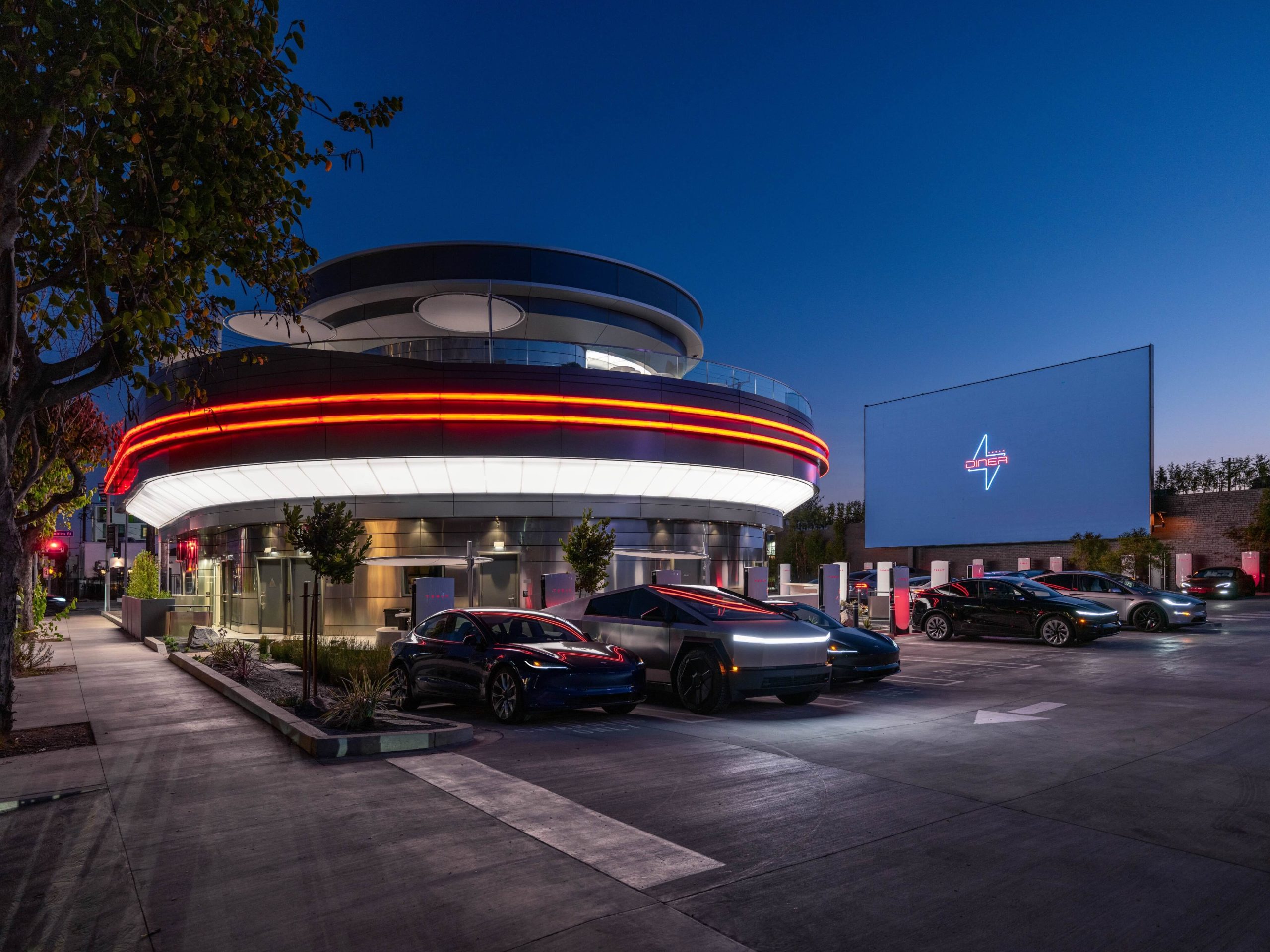
Tesla is throwing its Hollywood Diner a first birthday party on July 21 and the celebration comes with a guest list of unique items, including a limited run of Tesla Diner birthday hats personally signed by Tesla Chief Designer Franz von Holzhausen for the first 50 customers who place an in-car order at midnight.
One year after lines wrapped around the block on Santa Monica Boulevard for a diner that most of the restaurant industry did not take seriously, Tesla is making the case that the concept was worth the years it took to build. The concept had been in Musk’s head since at least 2018, when he floated the idea of “an old school drive-in, roller skates and rock restaurant” on X, describing it years later as “‘Grease’ meets ‘The Jetsons’ with Supercharging.”
Tesla Optimus Gen 3 is coming to the Tesla Diner with new ambitions
What made the diner genuinely different from any restaurant that came before it was not the menu or the nostalgia. It was the ordering model. Tesla owners could place food orders directly from their vehicle’s touchscreen before arriving, a small feature that hints at something much larger on the horizon. As the Cybercab and unsupervised FSD expand across major cities, the diner model becomes a template for an entirely new kind of commerce. A robotaxi pulling in to charge does not need a human to walk up to a counter. The vehicle places the order, the food is ready on arrival, and the passenger never interrupts the experience of being driven somewhere else. It is the first glimpse of what drive-through commerce looks like when the car is doing the driving.
As Teslarati has reported, Musk signaled immediately after opening that the Hollywood location was only the beginning, posting that Tesla would expand the concept to major cities worldwide and along Supercharger corridors on long-distance routes if the first location proved successful. One year in, the birthday celebration on July 21 makes a strong case that it has. Tesla announced a full day of events including a Cybercab on display, a birthday menu, Optimus in attendance, face painting, a photo booth, roller skating servers, a light show, a Skypad DJ, and complimentary collectibles.
If Musk’s ambition holds, the Hollywood diner is year one of something much bigger. The birthday party is the proof of concept. The robotaxi fleet is the business model waiting behind it.
Tesla Diner is turning 1 on July 21st, so we’re throwing a party
Come swing by for a day full of fun:
– Cybercab on display
– Birthday menu
– @Tesla_Optimus
– Face painting for kids & adults
– Photo booth
– Servers on roller skates delivering your order
– Light show
– Skypad DJ… pic.twitter.com/TD8pOjihYs— Tesla North America (@tesla_na) July 18, 2026
Lifestyle
NTSB findings on fatal Tesla crash tell a very different story
The NTSB confirmed the driver, not Tesla’s FSD, caused the fatal Texas house crash.
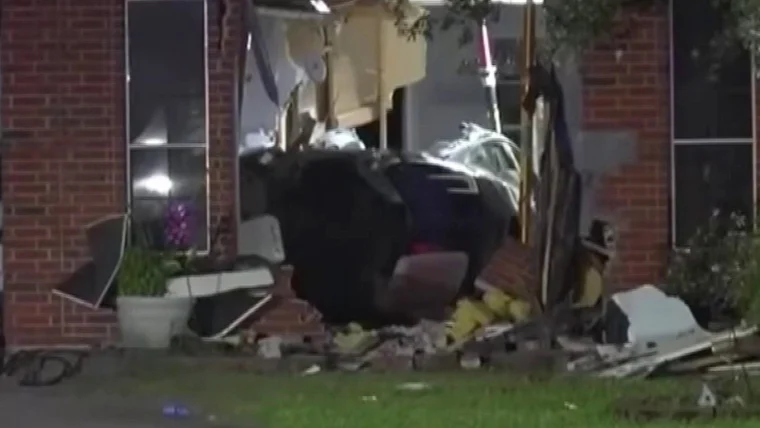
The National Transportation Safety Board released preliminary findings Wednesday confirming that a Tesla driver, not the vehicle’s software, caused a fatal crash in Katy, Texas in June. The driver, 44-year-old Michael Butler, had engaged Full Self-Driving Supervised mode on Rose Hollow Lane, a residential street with a 30 mph speed limit, before manually overriding the system by pressing the accelerator pedal all the way to 100%. Data recovered from the 2025 Tesla Model 3 showed the vehicle was traveling over 70 miles per hour when it struck a home and killed 76-year-old Martha Avila, who was inside. Weather was clear, the road was dry, and it was daylight.
Texas man charged in fatal Tesla crash where he blamed Autopilot
Butler told authorities he had passed out at the wheel. But security camera footage obtained by the NTSB told a different story, and showed the car accelerating through an intersection before leaving the road entirely. Police also found that Butler’s phone had Google searches including the terms “Tesla FSD not aggressive enough 2026” and “Tesla FSD too timid,” raising serious questions about how he was using the system before the crash. Butler has since been charged with manslaughter. The victim’s family has filed a lawsuit against both Butler and Tesla, alleging negligence.
The NTSB findings aligned directly with what Tesla VP of AI Software Ashok Elluswamy had already stated publicly on X in the weeks after the crash, writing that “the driver manually overrode self-driving by pressing the accelerator all the way to 100%.” The data confirmed his account.
Yup. In this case, the driver manually overrode self-driving by pressing the accelerator all the way to 100% of the accel pedal in this residential area. They reached a speed of 73 mph during the crash, and had the accelerator pressed even after the crash.
— Ashok Elluswamy (@aelluswamy) June 22, 2026
Elon Musk
Elon Musk’s Texas ranch to showcase the lifelong work that changed the world
Elon Musk is building a product gallery at his Texas ranch spanning his lifelong inventions.
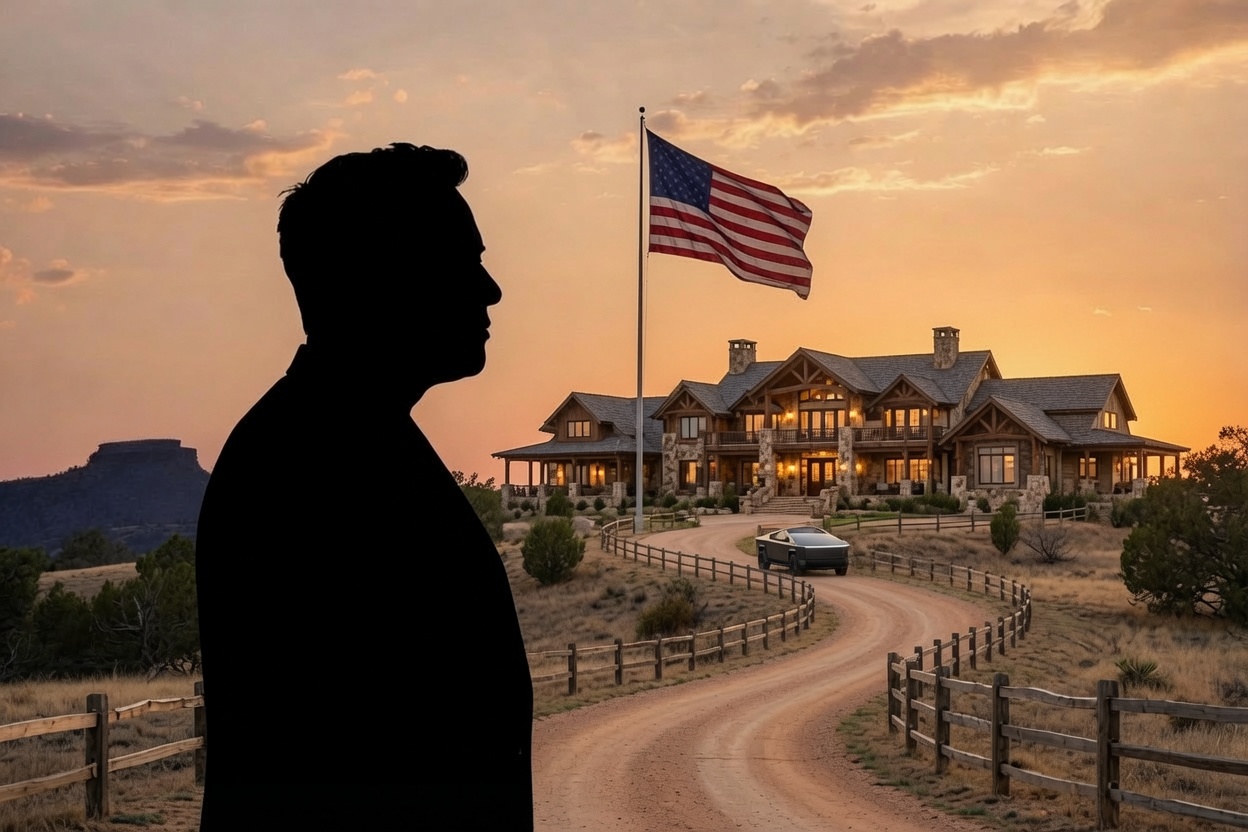
Elon Musk took to X earlier today, noting “Am putting together a product gallery at my ranch in Texas.” in response to a resurfaced famous quote from JPMorgan CEO Jamie Dimon’s wherein he draw parallels of the Tesla CEO to legendary physicist Albert Einstein.
Dimon made the remark at the World Economic Forum in Davos, Switzerland back in January 2025, telling CNBC at the time, “SpaceX, Tesla, Neuralink, I mean, the guy is our Einstein.” The remark seemingly ended a long-time feud between the two high profile execs.
While details are thin about the exact location of Elon Musk’s Texas ranch and any pending projects that would serve as a gallery and homage to his portfolio of revolutionary product inventions spanning from 1984 to 2025, land acquisition records point to roughly a location of several thousand acres in Bastrop County, east of Austin near the Colorado River and held through an LLC called Horse Ranch LLC that’s managed by Musk’s longtime personal friend and family wealth manager Jared Birchall. Birchall also serves as the CEO of Neuralink.
Tesla’s “ecological paradise” in Giga Texas may be larger than expected
The broader Bastrop County footprint surrounding the ranch has grown significantly. Entities tied to Musk have accumulated approximately 2,000 acres in Bastrop County as of mid-2026, up from 700 acres earlier in the year, with possibly as much as 6,000 acres acquired in total across Bastrop and Travis counties based on deed records.
No completion date for the gallery has been announced and Musk has not confirmed whether it will be open to the public. As Teslarati has reported, SpaceX just completed the largest IPO in history raising $75 billion, a milestone that makes this particular moment in Musk’s career a natural inflection point for looking back at what he has built through the years.
Am putting together a product gallery at my ranch in Texas https://t.co/xQf5FRy4uz
— Elon Musk (@elonmusk) July 15, 2026
Starting with Blastar, a simple space shooter game Musk coded at 12 years old and sold to a South African magazine for $500. From there the timeline moves through a commercial career that started with Zip2 in 1995, a city guide software company sold to Compaq for roughly $300 million in 1999. That was followed by X.com in 1999, which merged with Confinity to become PayPal, acquired by eBay in 2002 for $1.5 billion. SpaceX came in 2002, Tesla in 2003, SolarCity in 2006, the Supercharger network in 2012, Neuralink in 2016, The Boring Company in 2016, OpenAI co-founded in 2015, X acquired in 2022, xAI in 2023, Optimus in 2024, the Cybercab in 2026, and most recently SpaceXAI following the SpaceX and xAI merger. The gallery will also likely include items that blur the line between product and cultural artifact, among them The Boring Company’s Not-a-Flamethrower from 2018, Tesla Short Shorts from 2020, and Burnt Hair perfume released under X in 2022.

Elon Musk dispels $52 billion SpaceX-NVIDIA GPU deal: ‘Fake news’

Elon Musk sheds details on Tesla FSD’s upcoming improvements


