News
Tesla Gigafactory Shanghai is aiming to produce 550K vehicles next year: report

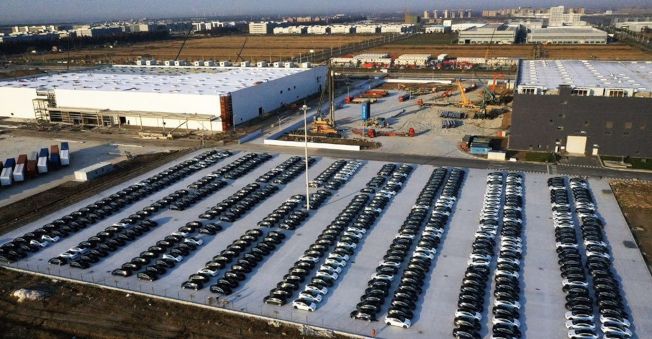
Tesla’s production plans for Gigafactory Shanghai in 2021 appear to have been leaked, and they are very ambitious, with the facility reportedly looking to manufacture 550,000 vehicles next year. The update was related by China-based media outlets, who cited information related by industry insiders familiar with the electric car maker’s operations.
Among the 550,000 vehicles that Tesla China is aiming to produce for 2021, 300,000 will be Model 3 sedans. The remaining 250,000 will be comprised of the Model Y crossover, which is expected to enter mass production at Gigafactory Shanghai early 2021. Speaking to local media outlet 36 Krypton, one of the industry insiders remarked that Tesla has already “issued ordering requirements to core component suppliers.”
Gigafactory Shanghai’s 550,000-vehicle production target, provided that China’s industry insiders prove accurate, will likely provide a massive boost to Tesla’s electric car manufacturing capabilities next year. The facility’s incredibly rapid ramp also completely decimates points argued by Tesla critics, many of whom were convinced that Giga Shanghai would take years to ramp its operations.
With the China-based facility undertaking a larger portion of Tesla’s overall vehicle manufacturing capabilities, Gigafactory Shanghai will reportedly be exporting more of its vehicles to other countries as well. As noted by local media outlet Wall Street CN, about 100,000 Model 3 and about 10,000 Model Y from Gigafactory Shanghai will be shipped abroad in 2021.
Tesla has not issued a comment about its 2021 vehicle production plans as of writing.
The vehicle production ramp of Gigafactory Shanghai is Tesla’s most impressive to date. It should be noted that as late as July 2019, Wall Street analysts such as Morgan Stanley’s Adam Jonas had very conservative estimates for the China-based plant’s output. In a research note, Morgan Stanley stated that it expects Giga Shanghai to produce 35,000 to 40,000 vehicles in 2020 and about 60,000 vehicles in total in 2021. These may look like typos today considering Giga Shanghai’s current output, but these were serious projections just over a year ago.
What is rather remarkable is that Gigafactory Shanghai still has a lot of space for optimization. Even with the ramp of the Made-in-China Model Y next year, Tesla is yet to roll out its 4680 cells and structural battery packs to its Shanghai-based plant. Once these innovations are rolled out, there is a pretty good chance that Gigafactory Shanghai could produce vehicles at rates that would put analysts’ production forecasts to shame.


News
How Tesla’s Roadster fan system and thrusters are built to dominate the corners
Tesla’s Roadster uses fans, active wings and cold gas thrusters to create grip at any speed.

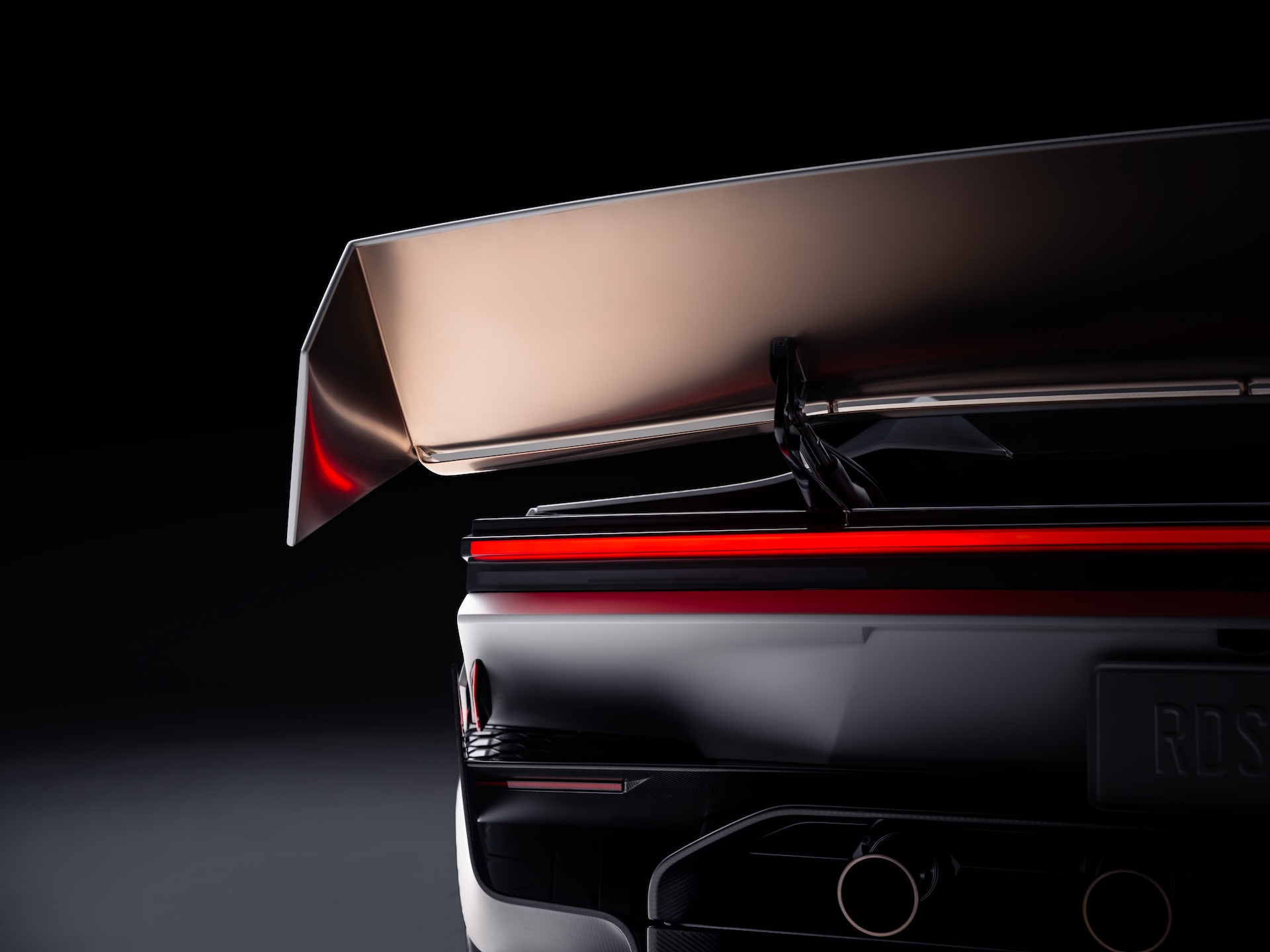
Tesla’s new Roadster is best known for flipping through the air in Texas, but the technology that matters most for a race track is the stuff that keeps it on the ground. Tesla’s Roadster page describes a multi-mode fan and ground sealing system that acts as a downforce generator, pulling air out from beneath the car. Tesla says it provides enough suction to hold the vehicle upside down, even when stationary.
That is the key difference from the wings and diffusers on a normal supercar. Conventional aero only makes downforce when the car is moving, and it grows with speed, so a car has the least grip in the slow corners and under hard braking. A fan system makes downforce at any speed. Tesla’s patent, which we covered last year, describes fans and deployable skirts that create sealed or partially sealed regions under the car, with the fans extracting air to lower the pressure and increase grip and stability.
Still processing this … the most unreal thing I’ve seen. https://t.co/HtEuvnkZjY
— TESLARATI (@Teslarati) October 16, 2026
Tesla pairs that with active wings, a next generation steer by wire system and a Track Mode that lowers the car and changes the suspension, with high downforce and low drag settings for the circuit. To keep weight down, Tesla points to magnesium, titanium and carbon fiber, manual controls and a fixed seat position, which it says lets the car respond to driver inputs almost instantly.
Tesla Roadster: Three configs, one can fly, 0-60 in 0.8 seconds
The cold gas thrusters are the other half. On the Thrust version they sit at the rear and Tesla says they take the car from 0 to 60 mph in under 0.9 seconds, while the Rocket version adds perimeter thrusters for forward, upward and lateral rotational movement. Tesla says the all electric actuators make micro adjustments within a fraction of a second.
Roadster transforms in Track Mode
These aero features aren’t just for looks: they provide the best passive downforce package of any road car (approaching F1 levels!) with wing actuation driven by the @Tesla_Optimus actuator system https://t.co/AqrC4qUga9
— Tesla (@Tesla) October 16, 2026
Musk has been talking about records for years. In June 2019 he said, “We’re going to do things with the new Roadster that are kind of unfair to other cars.” That September, when a follower asked whether the Roadster would beat the Nürburgring production car record, he replied with one word, “Absolutely,” as we reported at the time. In February 2024 he said Tesla had “radically increased the design goals” for the car and that its sub one second 0 to 60 time would be “the least interesting part.”
There are caveats. Tesla has not published a lap time or a verified cornering figure, so the record talk is still a promise rather than a result. Tesla also says the car is not approved for public road use, and the thruster features are limited to the Rocket trim, which is invite only. Fan cars have also been banned or withdrawn before, and getting a sealed underbody to work on a rough public road is a harder problem than on a smooth track. The first real test will be an official lap at a circuit.
Featured
Tesla Roadster: Three configs, one can fly, 0-60 in 0.8 seconds
Tesla’s Roadster comes in Performance, Thrust and Rocket versions, with a claimed 0-60 under 0.59 seconds.
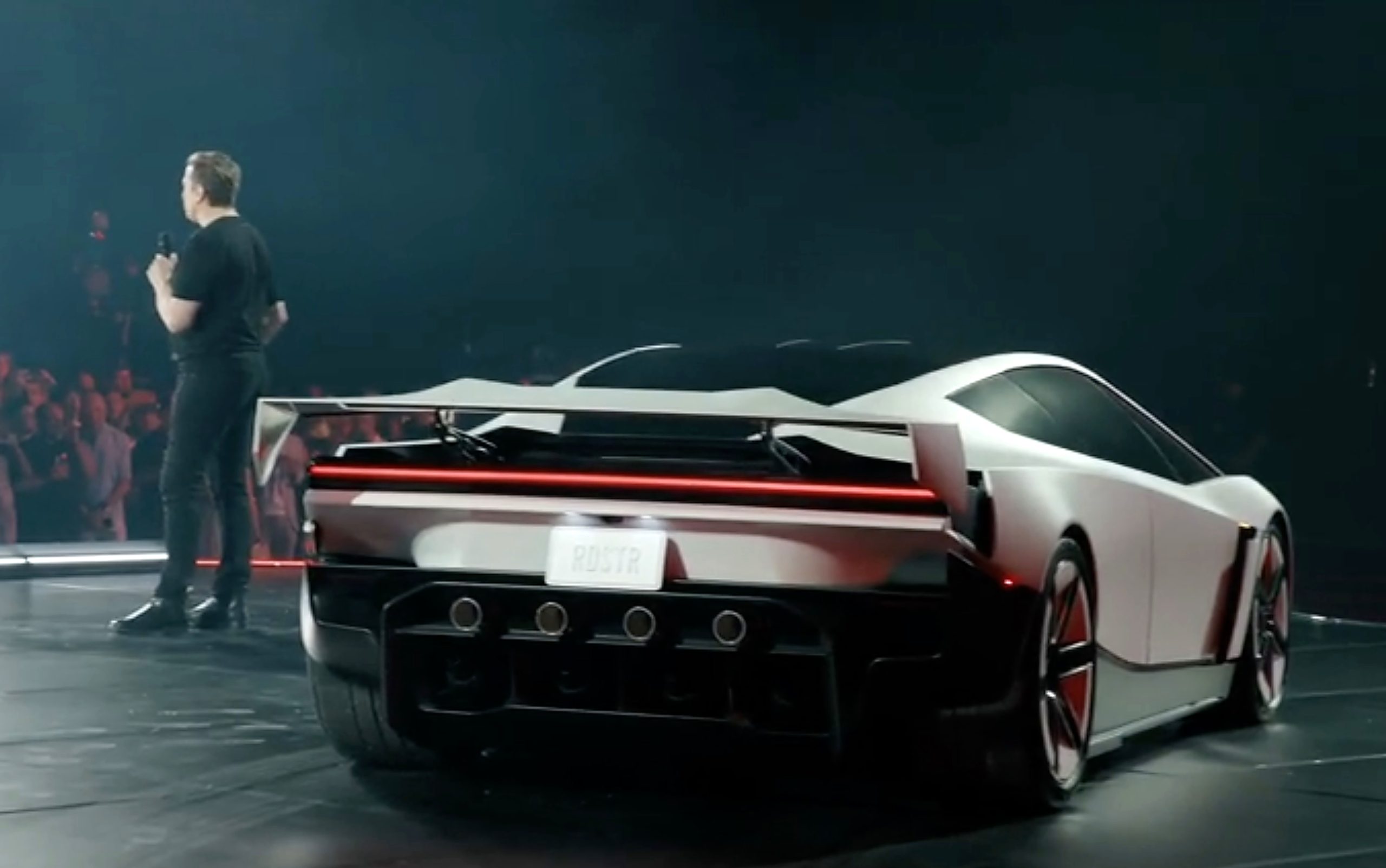
Tesla finally showed the next generation Roadster on Thursday night, and the demo had more in common with a SpaceX test than a track lap. At an event outside Waco, Texas, near SpaceX’s McGregor site, the car used a mix of fans and cold gas thrusters to drive up a curved ramp until it was upside down, then flew off, flipped and landed on the pavement. “Well, it worked,” Elon Musk said. “Flying cars are real.”
The Roadster also hovered itself over a Cybercab, Cybertruck, Tesla Semi, Model Y and Model 3 while moving, and that Tesla showed it going 0 to 60 mph in one second. Musk said “this will be the actual car that’s on the roads” and that it “literally is just going to puff itself up” to perform the maneuvers whenever an owner wants. He called the result a collaboration between Tesla and SpaceX engineers that is “better than any James Bond car,” with Franz von Holzhausen and Lars Moravy on site.
Tesla published new mind-blowing stats for the car that replace the previous targets. The Performance version is road ready and seats two, with active aerodynamics and a multi-mode suction system, and Tesla lists 0 to 60 mph in under 1.6 seconds. The Thrust version is race ready, also seats two, and adds rear-mounted cold gas thrusters for a 0 to 60 time of under 0.9 seconds. The Rocket version is described as air ready, seats one, and uses perimeter-mounted thrusters for forward and upward acceleration plus lateral rotational movement.
| Configuration | Seats | 0 to 60 mph |
|---|---|---|
| Performance | 2 | under 1.6 s |
| Thrust | 2 | under 0.9 s |
| Rocket | 1 | under 0.59 s |
Tesla’s own description: “So…yes, it can fly.” It lists a 0 to 60 time of under 0.59 seconds for Rocket, a top speed of up to more than 230 mph, and range of more than 300 miles. Tesla has not yet given pricing in the information we have seen, but has reopened $50,000 reservations in the newly updated Tesla Roadster configurator. Production is planned for Giga Texas in 2027 or 2028, and Musk has said it would follow the demo by 12 to 18 months.
Every car on the road today is limited by one thing: tire grip
Roadster’s thruster system generates 4–5x the force the tires can.
More force on the same mass means significantly better acceleration – physics does the rest https://t.co/zdPRT2aKwZ
— Tesla (@Tesla) October 16, 2026
Tesla’s Roadster page adds more on how the car works. A multi-mode fan and ground sealing system pulls air from under the car, producing enough suction to hold it upside down even when stationary. Active wings, steer-by-wire with a yoke, and a Track Mode that lowers the car round out the driving setup. The cold gas thrusters use all-electric actuators for micro adjustments to stabilize the car in flight. Tesla says it cut weight with magnesium, titanium and carbon fiber, manual controls and a fixed seat position, and the exterior has hidden headlights, a full-length taillight and Ano White paint inspired by aerospace coatings. Inside are an Ultrawhite interior with gray microsuede, a center touchscreen and two smaller forward displays, and gold tinted glass modeled on spacesuit visors. Availability is tiered: Performance is by reservation, Thrust is a limited release, and Rocket is invite only. Tesla notes the car is not approved for public road use, and that Rocket is not available in all regions.
Tesla Roadster Highlights
- Aero and suction: a multi-mode fan and ground sealing system pulls air from under the car and can hold it upside down even when stationary. There are also active wings and a Track Mode that lowers the car.
- Controls and thrusters: steer-by-wire with a yoke. The cold gas thrusters use all-electric actuators for micro adjustments that stabilize the car in flight.
- Weight: magnesium, titanium and carbon fiber, manual controls and a fixed seat position.
- Design: hidden headlights, a full-length taillight, Ano White paint inspired by aerospace coatings, and gold tinted glass modeled on spacesuit visors.
- Interior: an Ultrawhite interior with gray microsuede, a center touchscreen and two smaller forward displays.
- Availability: Performance is by reservation, Thrust is a limited release, and Rocket is invite only.
- Road use: Tesla notes the car is not approved for public road use, and that Rocket isn’t available in all regions.
Musk has described the Roadster as “the best of the last of the human-driven cars,” and he has been open that it is a halo product. He said he is “not sure it moves the needle massively from a revenue standpoint,” and has warned that anyone whose top priority is safety should not buy it. Tesla reports third quarter earnings on October 21.
Roadster is a true pilot’s car: active aerodynamics, a multi-mode suction system & cold-gas thrusters
Exterior
– Concealed headlights, full-length taillight & flush-mounted surfaces for a minimalist, highly technical form– Super light wheels w/ thin spokes that reinforce structural strength when earthbound
– Ano White paint brings an aerospace-derived finish w/ UV & cryogenic protection, electrostatic dissipation & corrosion resistance
– Gold Glazed tinted glass mimicking the copper coating of spacesuit visors, w/ subtle titanium accents
— Tesla (@Tesla) October 16, 2026
Elon Musk
Amazon shuts out Elon Musk’s Grok Bot so he may just build his own rival store
Musk promises SpaceX will cover Grok Bot purchase errors, tells users to shop beyond Amazon.
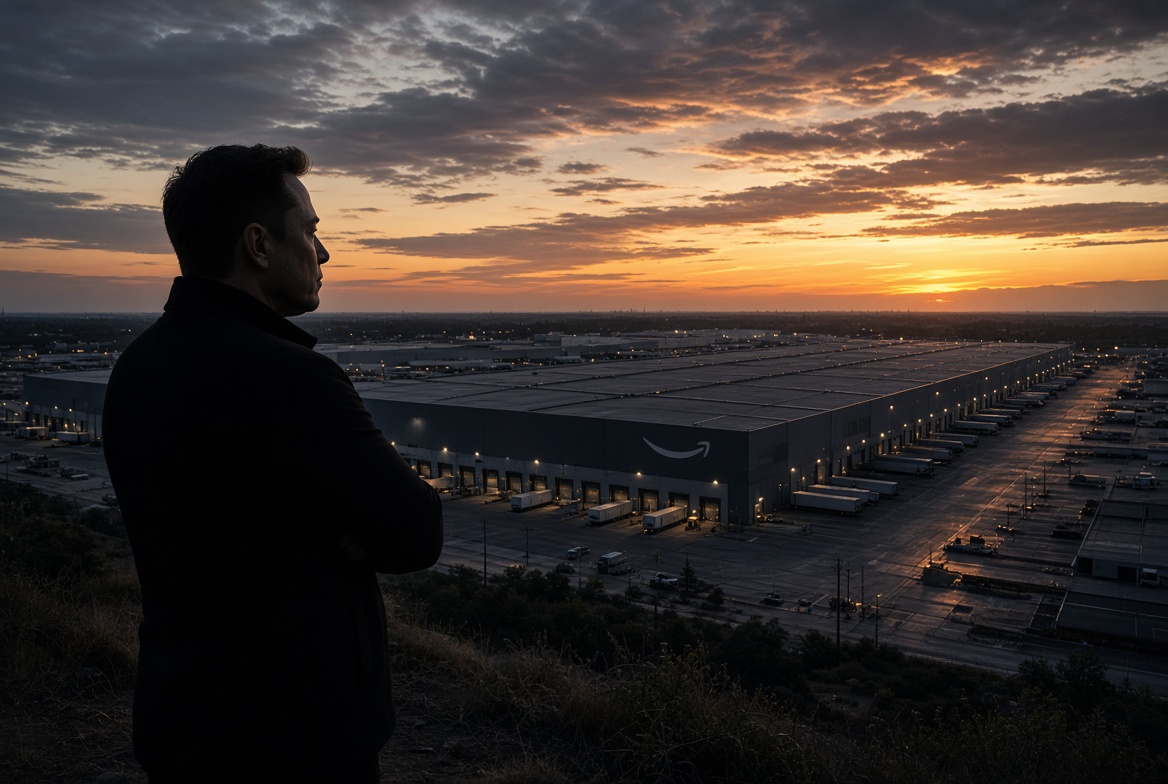
Elon Musk said SpaceX will reimburse users if Grok Bot botches a purchase or leaks their card details. A few hours later he was telling users to take their shopping elsewhere after Amazon shut the agent out.
The first post was a reply to an X user who said Grok Bot booked him a flight after he sent a photo of his credit card. “This works well,” Musk wrote. “If Grok @Bot makes a mistake with a purchase or leaks your card (never happened yet), SpaceX will make you whole,” said Musk.
The second came after another user posted the error his Grok Bot hit on Amazon: “Continued access by an unauthorized AI agent violates Amazon’s Conditions of Use, to which our customers have agreed.” The user said his bots can no longer order from the site. Musk answered, “Just ask Grok @Bot to buy what you want someplace else and get a better deal. There are far more purchasing websites than just Amazon!” He later added, “Maybe we should start a competitor to Amazon,” a possible hint at an X shopping service.
Just ask Grok @Bot to buy what you want someplace else and get a better deal.
There are far more purchasing websites than just Amazon!
— Elon Musk (@elonmusk) October 15, 2026
The Amazon block did not start Thursday. A reply to Musk on October 10 said Amazon was blocking the bot, and Musk responded that Grok would find another way, then showed an order it placed on Lego’s website.
The latest reimbursement promise builds on late August when Musk told a Tesla investor weighing whether to give Grok Bot access to his bank accounts, “If Grok Bot messes up, we will make you whole,” as Teslarati covered when SpaceXAI added its Finance integration. That promise goes further than the company’s consumer terms, which make users responsible for what their agents do and generally cap liability at the greater of fees paid or $100. Neither Thursday post says those terms have changed, so for now it remains a statement on X rather than a published policy.
The two posts matter to Tesla owners because Grok Bot is no longer limited to a phone. Tesla brought it into its vehicles on September 22, and it is now enabled across every Cybercab and the rest of the Model Y Robotaxi fleet, as noted when Teslarati looked at why Grok Bot may be the Cybercab’s real advantage. A rider who asks for groceries or a coffee order is relying on retailers that let the agent in. Amazon has now said it will not, and Musk’s answer is to route around it.
Amazon has not commented publicly on the block in the posts Teslarati reviewed, and it is unclear whether Musk will follow through on a rival store.
So, how many of you do the vast majority of shopping on Amazon and hate that you do? Comment and let us know your thoughts!

How Tesla’s Roadster fan system and thrusters are built to dominate the corners

Tesla Roadster: Three configs, one can fly, 0-60 in 0.8 seconds

Amazon shuts out Elon Musk’s Grok Bot so he may just build his own rival store

The Pentagon taps Elon Musk to design the battlefield of the future

SpaceX reveals how its 1 Million AI satellite network will work and prevent space collisions


