Elon Musk
Elon Musk reiterates why Tesla will never make an electric motorcycle
Tesla CEO Elon Musk preemptively shut down speculations about a Tesla road bike once more.

Tesla CEO Elon Musk preemptively shut down speculations about a Tesla road bike once more, highlighting that the electric vehicle maker has no plans to enter the electric motorcycle market.
Musk posted his clarification in a post on X.
Musk’s reply to a fun AI video
X user @Moandbhr posted an AI video featuring the Tesla CEO on the social media platform, captioning it with “Mr. Elon Musk Just Revealed the Game-Changing Tesla Motorcycle.” The short clip depicted Musk approaching a sleek, single-wheeled vehicle, stepping onto it, and gliding off into the distance amid cheers. The fun video received a lot of traction on X, gaining 3.1 million views as of writing.
Musk replied to the post, stating that a Tesla motorcycle is not going to happen. “Never happening, as we can’t make motorcycles safe. For Community Notes, my near death experience was on a road bike. Dirt bikes are safe if you ride carefully, as you can’t be smashed by a truck,” Musk wrote in his reply.
Musk’s Past Comments on Two-Wheelers
Musk also detailed his reservations about motorcycles in a December 2019 X post while responding to questions about Tesla’s potential ATV. At the time, he responded positively to an electric ATV, though he also opposed the idea of a Tesla road-going motorcycle. Musk did state that electric dirt bikes might be cool, since they do not operate in areas where large vehicles like Class 8 trucks are present.
“Electric dirt bikes would be cool too. We won’t do road bikes, as too dangerous. I was hit by a truck & almost died on one when I was 17,” Musk wrote in his post.
Considering Musk’s comments about dirt bikes, however, perhaps Tesla would eventually offer a road bike as a recreational vehicle. Such a two-wheeler would be a good fit for the Cybertruck, as well as future products like the Robovan, which could be converted into an RV.


Elon Musk
Tesla gives the Roadster an official “Go for launch” demonstration date
Tesla teased an October 1 Roadster reveal, reviving years of delayed SpaceX thruster hover promises.

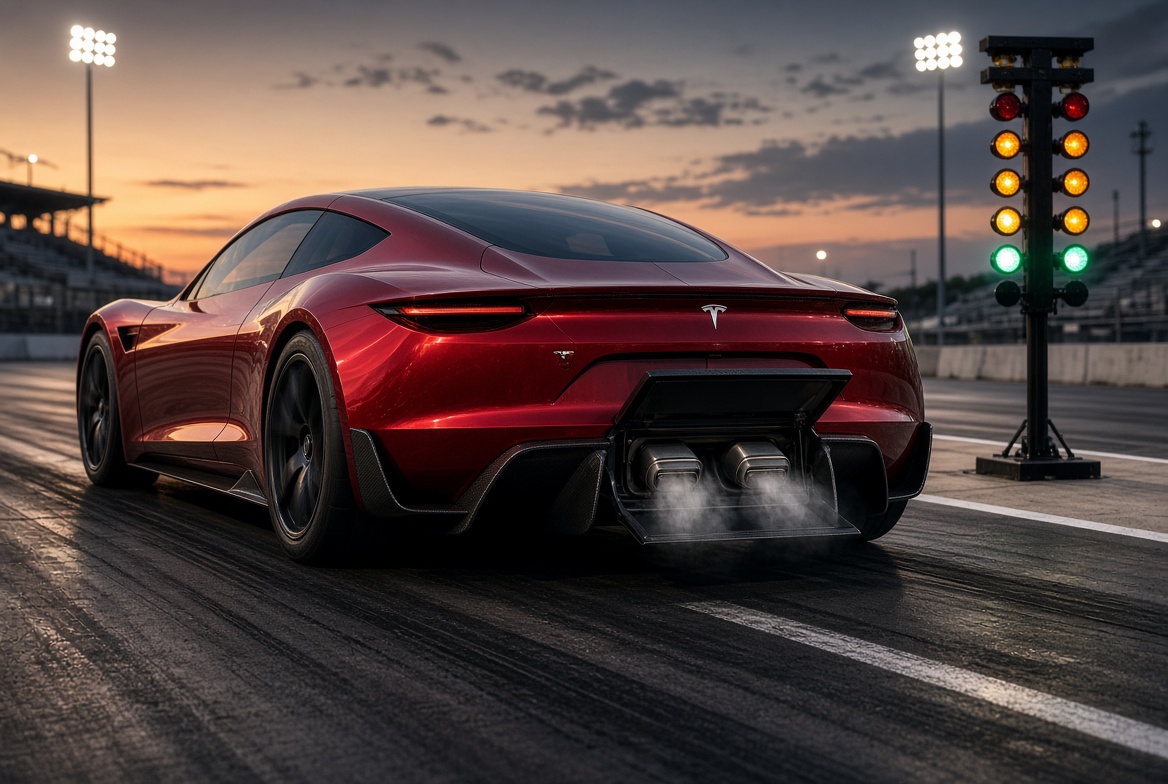
Tesla teased an October 1 event date for its next generation Roadster, posting an image on X Saturday that shows the car lit up like it is sitting on a launch pad, with the date “10.01” stamped across the bottom and the caption “Go for launch.” A countdown clock on Tesla’s Roadster order page now points to the same date, which falls on a Thursday. The company has not said where the event will happen or whether it will be streamed at the moment. Stay with us @Teslarati for live updates.
Go for launch pic.twitter.com/Khu03eiZ04
— Tesla (@Tesla) September 12, 2026
Tesla has since sent formal invitations to reservation holders confirming the event will take place in Waco, Texas, about 90 minutes north of its Austin headquarters, based on a digital ticket shared on X by Sawyer Merritt. Tesla did not name the exact venue, though Waco sits close to SpaceX’s McGregor, Texas, rocket test site, previously reported as the planned location for a Roadster thruster demonstration. The invite sets the reveal for 8:30 p.m. Eastern on October 1, requires RSVPs by midnight on September 16, and limits entry to guests 21 and older. Invitations are non-transferable.
The tease follows nine years of a project defined by unimaginable specs along with slipped dates. Musk first showed the second generation Roadster in November 2017 as a surprise reveal at the end of the Tesla Semi event, promising a 0 to 60 mph time under two seconds, a top speed above 250 mph, 620 miles of range from a 200 kWh battery, and production starting in 2020. At last November’s shareholder meeting, Musk set an April 1 demo date and joked the choice gave him “deniability” if it slipped again, which it did, moving first to late April, then to “a month or so,” then to August.
Tesla Roadster SpaceX Package’s 1.1-second 0-60 mph launch visualized in concept video
Whatever Tesla shows on October 1 is expected to center on the SpaceX developed thruster package Musk has described since 2018. Internally code named A71, a nod to the Lockheed SR-71 Blackbird, the system reportedly uses cold gas thrusters fed by a composite overwrapped pressure vessel, the same tank design SpaceX uses on Falcon 9. Musk has said a thruster equipped Roadster could hit 60 mph in about 1.1 seconds under roughly 2.75 g of launch force, well past the 1.9 second figure quoted for the standard car. That version reportedly will not be street legal and has reportedly been discussed as a limited run sold through a track only program.
The standard Roadster is still expected to carry the original $200,000 base price and $250,000 Founders Series tier, both set when Tesla opened $50,000 and $250,000 reservations in 2017. Tesla VP of Vehicle Engineering Lars Moravy has confirmed production will happen at Gigafactory Texas, with Musk targeting 2027 or 2028, 12 to 18 months after whatever the company demonstrates next month.
Elon Musk
Elon Musk rips ABC News over fatal NYC Tesla crash report
Musk pushed back on NYC Tesla crash coverage, pointing to a pattern of premature blame.
Elon Musk pushed back overnight against media framing of a fatal Tesla crash in Midtown Manhattan, telling a user on X that “it wasn’t the car” and that the vehicle’s Autopilot system had nothing to do with the wreck.
The crash happened just before 3 a.m. Wednesday, when a 2024 Tesla Model Y struck a sidewalk shed outside 315 Madison Ave., a bus stop pole and a mailbox on East 42nd Street, according to the NYPD. The car kept moving several more blocks before stopping near Second Avenue. Both women inside, each 27, were taken to Bellevue Hospital, where the passenger was pronounced dead. The driver was charged with vehicular manslaughter, driving while ability impaired and leaving the scene of an accident.
Police have not attributed the crash to Autopilot or Full Self-Driving in any public statement. The charges point to impairment, not software. Musk’s response followed a since-deleted ABC News post that he said mischaracterized the incident. Replying to a user on X, Musk wrote that if Autopilot had been engaged, “they would not have crashed,” and added that “the legacy media will never forgive Tesla for failing to advertise with them,”
The legacy media will never forgive Tesla for failing to advertise with them
— Elon Musk (@elonmusk) September 9, 2026
It’s a familiar cycle for Tesla. In June, headlines from several national outlets described a fatal crash in Katy, Texas, as happening while the car was “on autopilot,” based on the driver’s own account to police after his Model 3 struck a home and killed a 76-year-old woman. Tesla’s data told a different story when Ashok Elluswamy, Tesla’s head of AI, said the driver had pressed the accelerator to 100% and reached 73 mph in a residential zone. Harris County prosecutors later confirmed the human override and the driver was charged with manslaughter.
Florida Gov. Ron DeSantis pointed to that same Katy crash last month to argue that outlets routinely name Tesla in crash headlines while leaving other automakers unnamed, even after a driver’s own actions are shown to be the cause. A similar pattern played out in 2024, when Musk had to clarify that FSD was never even downloaded onto the Model 3 involved in a fatal Colorado DUI crash, despite a passenger’s claim that an “auto drive feature” was in use.
Tesla has not issued a separate statement on the Manhattan crash beyond Musk’s posts on X. The NYPD’s investigation is ongoing, and no cause for the driver losing control has been released.
Elon Musk
Tesla primes Cybercabs for 4K streaming and high bandwidth gaming with Starlink integration
Tesla is now shipping Cybercabs from Giga Texas with Starlink hardware built in as standard.
Tesla’s Cybercabs are now leaving Gigafactory Texas with Starlink hardware on the rear hatch in significant numbers, according to drone footage captured Tuesday by longtime Austin drone observer Joe Tegtmeyer. Production at the factory ramped back up after the Labor Day weekend, and his flyover of the outbound lot showed rows of gold Cybercabs alongside Model Y Long Wheelbase units, many carrying the satellite module for the first time as standard equipment rather than a one off retrofit.
Giga Texas today is busy with production coming back up following the long weekend. Of interest today in the outbound lot is the appearance of hundreds of Mode; YL’s and many more Cybercabs and for the 1st time equipped with the Starlink module one the hatch in big numbers.
At… pic.twitter.com/G9yl6s51m4
— Joe Tegtmeyer 🚀 🤠🛸😎 (@JoeTegtmeyer) September 8, 2026
Tesla first showed Starlink built into an actual Cybercab on August 10, when the Robotaxi account posted images of a single gold unit with the antenna integrated into the roofline above the taillights and called it the first Cybercab with Starlink integration. That followed a July reveal where Tesla and Starlink jointly posted a cutaway diagram of the antenna placement without a working vehicle to back it up. Ashok Elluswamy, Tesla’s VP of AI software, said at the time that the connection isn’t required for the car to drive itself. It exists mainly for navigation, customer service and keeping tabs on the fleet.
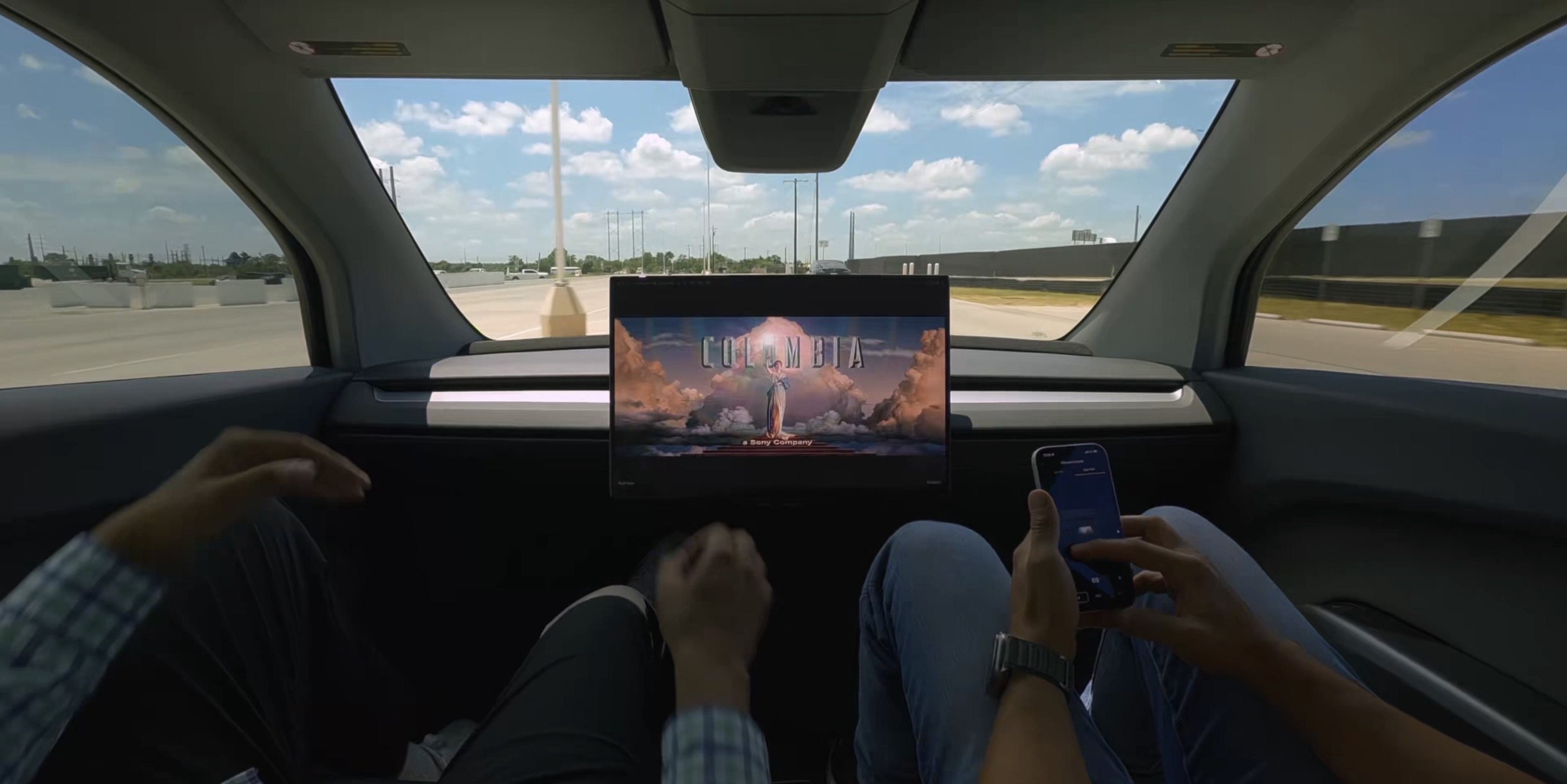
Musk has made a different case in public. During Tesla’s Q2 earnings call, he said the company can’t afford robotaxis stranded in what he called “Bermuda Triangles of lack of cellular connectivity,” and he separately claimed on X that Starlink will eventually reach every Tesla built, calling it the only way to deliver high bandwidth to billions of vehicles. He has also pitched the antenna as an entertainment upgrade, telling riders they would be able to stream 4K video or play games during a trip.
The rollout has moved fast since. Robotaxi service opened to the public in Austin on September 3, and Cybercabs had already been spotted with Starlink hardware in Houston and near Miami International Airport in the weeks before Tuesday’s factory footage showed the module shipping at volume rather than on scattered test units. Whether the satellite link earns its keep is still an open question. Tesla’s unsupervised service currently runs in dense metro geofences in Texas and Florida, markets where cellular coverage is already strong, which is not where the rural dead zones Musk describes tend to show up.

Why SpaceX is finishing another space-internet system that isn’t Starlink

Tesla gives the Roadster an official “Go for launch” demonstration date


