Investor's Corner
Tesla stock (TSLA) one week after Q2 2016 Report

Post Q2 Report Action
As we previously reported, the Q2 quarterly results were “mixed”:
- Revenue matched expectation, a positive for Wall Street;
- Earning losses were higher than anticipated, a negative, but for a company like Tesla, where the stock price is based on future expectations, the earning numbers are really not what counts;
- Slightly increasing gross margins, a positive;
- Practically zero ZEV credits for the quarter, a negative;
- Production and demand on track to support 50,000 deliveries in 2H 2016, a positive;
- Lower production numbers than previously anticipated, a negative.
When you have such a mix of positives and negatives, it is fairly normal for traders to have a “subdued” response, unlike the usually wild responses to results that are big misses or big beats on expectations.
Accordingly, this time around the technical response of the stock market to last week’s Tesla Q2 2016 report has been “muted.” The stock has been in “compression” (a horizontal back and forth) since the report, staying in the $225-$230 range, but overall 12-month Analyst Price Targets have actually decreased with the average dropping from $277 to $244.
Looking at more details of the reactions to the report, this is a small sample from Top Analysts, noting that none of them changed their position.
Alexander Potter of Piper Jaffray says “Teslas untouchable brand helps investors look past million-dollar losses.”
“It’s hard to recommend a cash-burning company with such an uncertain outlook,” said Potter, who reiterated a neutral rating and $223 price target on the stock. But consumers and investors still seem captivated by Tesla’s products, said Potter. And as long as the company “retains this aura,” its stock multiple will “probably stay buoyant,” he said.
Brad Erickson of Pacific Crest says “The risks still outweigh the rewards.”
“Brad rattled off a number of challenges Tesla still needs to tackle in a note to clients. But he reiterated a sector weight rating on the stock, said Tesla’s cash burn wasn’t as bad as expected during the quarter, and maintained the belief that the company’s longer-term vision is “second to none.”
Ben Kallo of Robert W. Baird says “Focus [is] on Tesla (TSLA) Production Ramp and Long Term Goals, Not Q2 Miss.”
Kallo commented, “Q2 revenue was in line with our estimate, but TSLA missed on EPS with higher-than-expected OPEX. Additionally, gross margin missed consensus estimates and was pressured during the quarter with the Model S refresh and X ramp, but automotive gross margin improved sequentially, which was better than we expected. Importantly, TSLA reaffirmed its 2H:16 delivery target of ~50k vehicles, expects margins to ramp in 2H:16 given higher manufacturing efficiency, and the Model 3 remains on track for 2H:17 production.”
Kallo also covers SolarCity (SCTY) and he commented that “Although SCTY has a 45-day go-shop period which could provide additional upside, we believe it is highly likely the TSLA and SCTY merger will go through, and we are moving to the sidelines.”
Colin Rusch of Oppenheimer “noted that Tesla appears to be taking on increasing responsibility when it comes to technology development.”
“Rusch wasn’t surprised by Tesla’s quarter, and the firm remains on the sidelines until Tesla can show some progress toward profitability. It also appears to have taken a hard line with suppliers on timelines, pricing and allocation of resources,” he explained. “While we see potential benefits, we note increasing risk on supplier pushback.”
Ryan Brinkman of J.P. Morgan noted that “JPMorgan cuts Tesla estimates on higher operating expenses.”
“To reflect lower revenue and higher operating expenses following the company’s Q2 results, Brinkman cut his 2016 earnings per share estimate for Tesla to (32c) from $1.60. The analyst notes his 2016 earnings estimate was $4.62 a year ago and $2.74 at the start of this year. This reflects the “degree of consistent ratcheting down of near-term earnings,” Brinkman tells investors in a post-earnings research note. The analyst keeps an Underweight rating on Tesla with a $180 price target.”
Shelby Seyrafi of FBN Securities “reiterated a Buy rating on Tesla Motors (NASDAQ: TSLA), with a price target of $275.”
Seyrafi is a 3-star analyst with an average return of 0.5% and a 51.5% success rate. Seyrafi covers the Technology sector, focusing on stocks such as Hewlett Packard Enterprise, Dot Hill Systems Corp., and Concur Technologies.
Colin Langan of UBS, says “Tesla, SolarCity synergies still cloudy.”
“Colin noted Tesla announced details of its agreement to acquire SolarCity (SCTY) and provided synergy targets with the deal. UBS said they remain cautious on the deal given the lack of compelling synergies and the fact the deal is an unneeded distraction for Tesla management, which already faces challenges with its Model 3 launch and production targets. UBS maintained its Sell rating and $160 price target on Tesla shares.”
The overall consensus of analysts covering Tesl Motors, reported at tipranks.com, is neutral (hold).
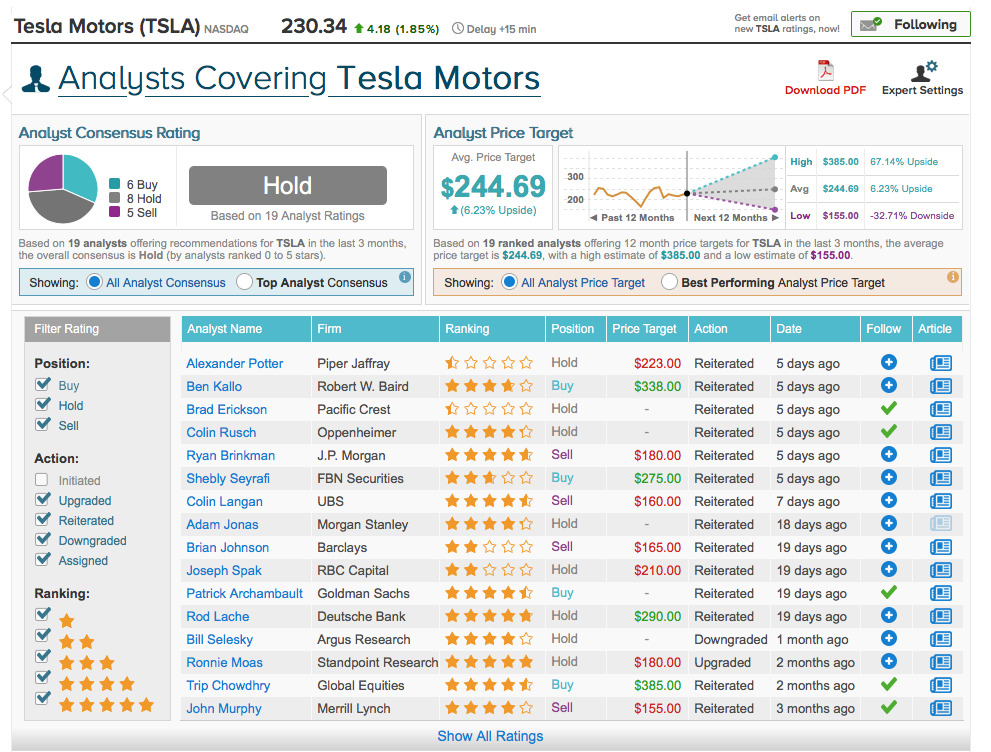
Source: TipRanks
Trade Analysis
Quarterly Reports are usually the catalyst that start or stop actions for swing traders. The Q2 report was no different. I called for a bullish swing trade when the MACD crossed to the bulls on July 1st. The trade closed on August 4th when the MACD crossed to the bears, the day after the Q2 report was released. This was a good trade that gained over $14 in about a month period to traders that went long on the stock (see the shaded band in the chart below). For option traders this was a “fabulous” trade.
A week after the report the market is undecided on what to do with TSLA in the short term. All indicators are “neutral”: the stock has gone sideways for a week; the MACD averages are flat and overlapping; the MACD itself is at zero; both the 50-day moving average (the red line in the chart below) and the 200-day moving average (the yellow line in the chart below) are flat. All of these indicators are showing the absence of a trend. Trading in these conditions is not advisable and fairly risky. I’m personally out of trading TSLA until a trend appears.
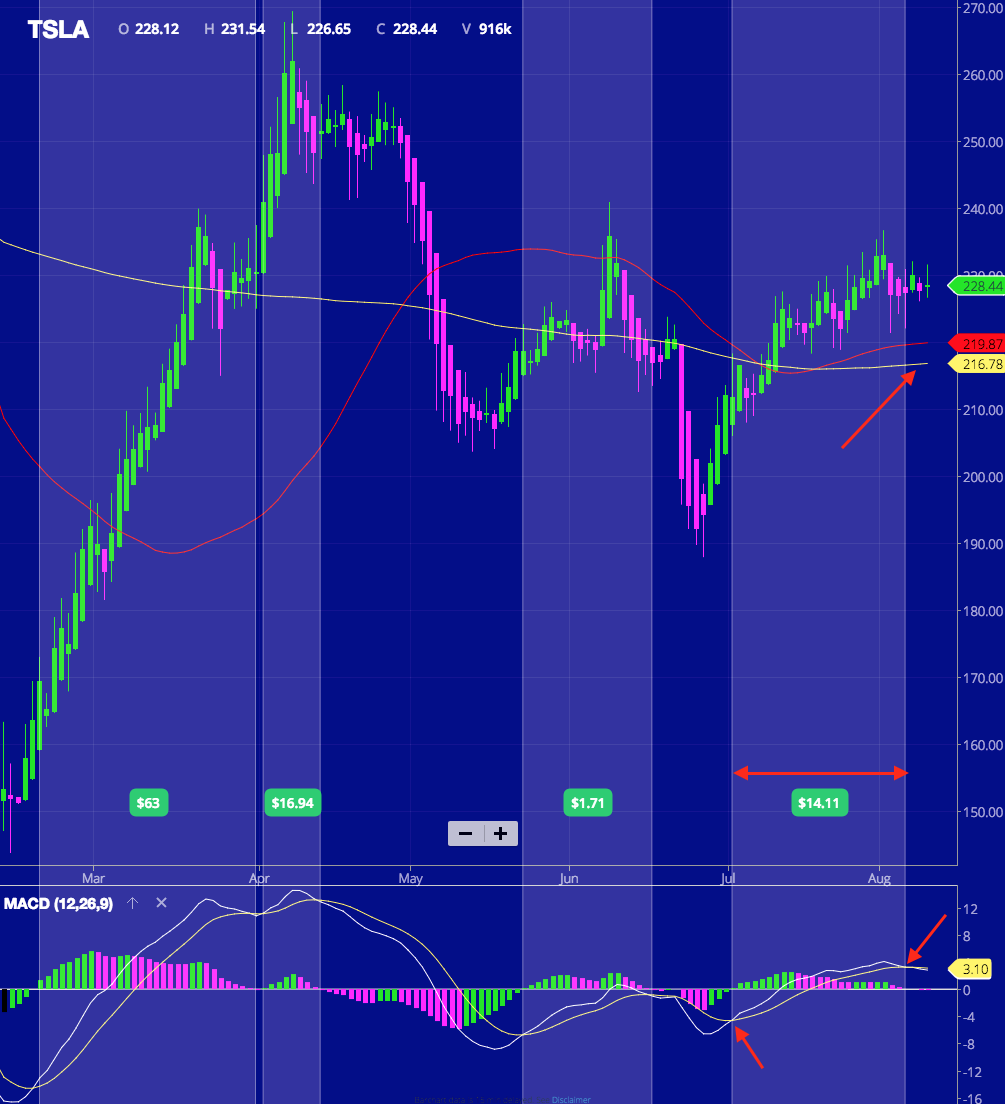
Source: Wall Street I/O



SpaceX (NASDAQ: SPCX) will report its second public earnings call today since its IPO earlier this year, and there are a few things we expect to hear about, as well as Wall Street analysts, who have already outlined their expectations for the call.
Wall Street analysts have a consensus of $12.72 billion in revenue and an earnings per share (EPS) of $0.13. These are broken down into three sectors: Space, Connectivity, and AI/SI, which are perceived in this way:
- Space: $1.41 billion
- Connectivity: $4.84 billion
- AI/SI: $6.47 billion
Other outlets cluster near $12.8 or $12.9 billion in revenue and $0.14 – $0.15 EPS. This implies a roughly 65 percent sequential growth from Q2’s $7.81 billion, driven mostly by AI/SI, with the first post-IPO positive EPS expected.
Here are the three things to watch for on the call:
AI Revenue Ramp and the $100B+ ARR target
AI is truly the swing factor for SpaceX, and analysts expect it to roughly double from Q2’s $2.56 billion and become about half of total revenue. Management previously guided to a $100 billion+ annualized run rate by December, including the Cursor acquisition, which was $60 billion, to close the quarter.
Listen for updates on SpaceX’s compute capacity, especially pertaining to its contracts with Google, Anthropic, and others, revenue per watt, any new deals, and Cursor’s early contribution.
Starlink/Connectivity Metrics and Mobile Expansion
Connectivity remains a main profit engine for SpaceX. Subscriber additions will be something to pay attention to, as Q2 ended at 12 million and previews are looking at 14 million for this quarter. Additionally, ARPU trends, enterprise and government growth, and any commentary on Starlink Mobile will be something to pay attention to, especially following the recent low-band spectrum deal and FCC-related constellation approvals.
Capex Trajectory, Cash Burn/FCF, and Starship/Operational Updates
Q2 capex of roughly $18.4 billion weighed on the stock. Investors will look to scrutinize Q3 spending levels, any guidance on the pace into Q4/2027, free cash flow, backlog, and liquidity. Operational color on Starship (Flight 14 milestones and Flight 15 timing/reusability progress), Falcon cadence, and government/NASA contracts are also in focus.
Of course, there will also be some speculation on the potential Tesla-SpaceX merger, but there was nothing mentioned in the company’s proxy it sent earlier this week.
SpaceX will report earnings after market close today and will stream the call on X.
Watch live as SpaceX discusses our Q3 2026 earnings at 3:30pm CT today → https://t.co/Qrb0qeVG15
— SpaceX (@SpaceX) October 20, 2026
Interested in ordering a Tesla? Use my referral code for three free months of Full Self-Driving (Supervised) here
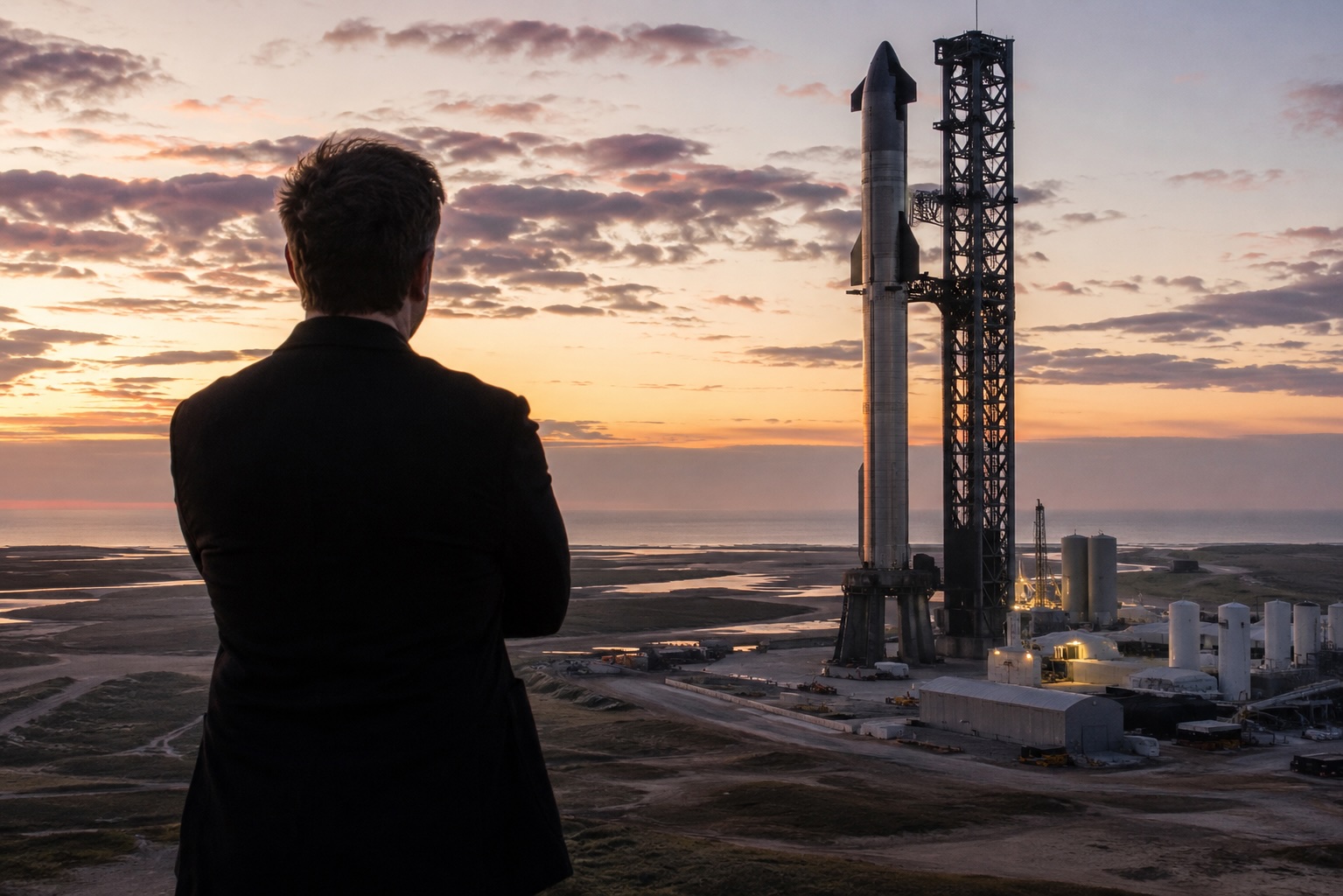
Elon Musk said he is planning to give “every one of his SpaceX shares to every kid in America” in 2027, stating that “this will be the first of many.”
SpaceX went public earlier this year, and its stock price has been relatively stable since leveling off shortly after its IPO. Based on its current price, it’s a gift of just over $10 billion to children across the United States.
It appears to be closely related to President Donald Trump’s bank accounts for children, which were set up earlier this year as Trump Accounts.
Just hours earlier, Anthropic had announced the establishment of its Anthropic Public Benefit Fund, “a new wholly-owned entity dedicated entirely to public benefit.” Musk responded by stating he recommended “giving the shares directly to the public,” and that he would be doing it that way.
Just a little bit later, Musk said children across the U.S. would be getting a share from him:
Next year, I will give one of my SpaceX shares to every kid in America.
This will be the first of many.
— Elon Musk (@elonmusk) October 19, 2026
There are roughly 70 million children, meaning someone under the age of 18, in the United States, according to the Federal Interagency Forum on Child and Family Statistics. Musk’s ownership of SpaceX stock shows he has around 849 million Class A shares of SpaceX stock, according to filings with the SEC.
Investor's Corner
SpaceX’s biggest earnings test yet lands Tuesday, and Tesla shareholders should be watching
SpaceX reports earnings Tuesday as Wall Street watches AI spending, Starlink growth and Tesla merger

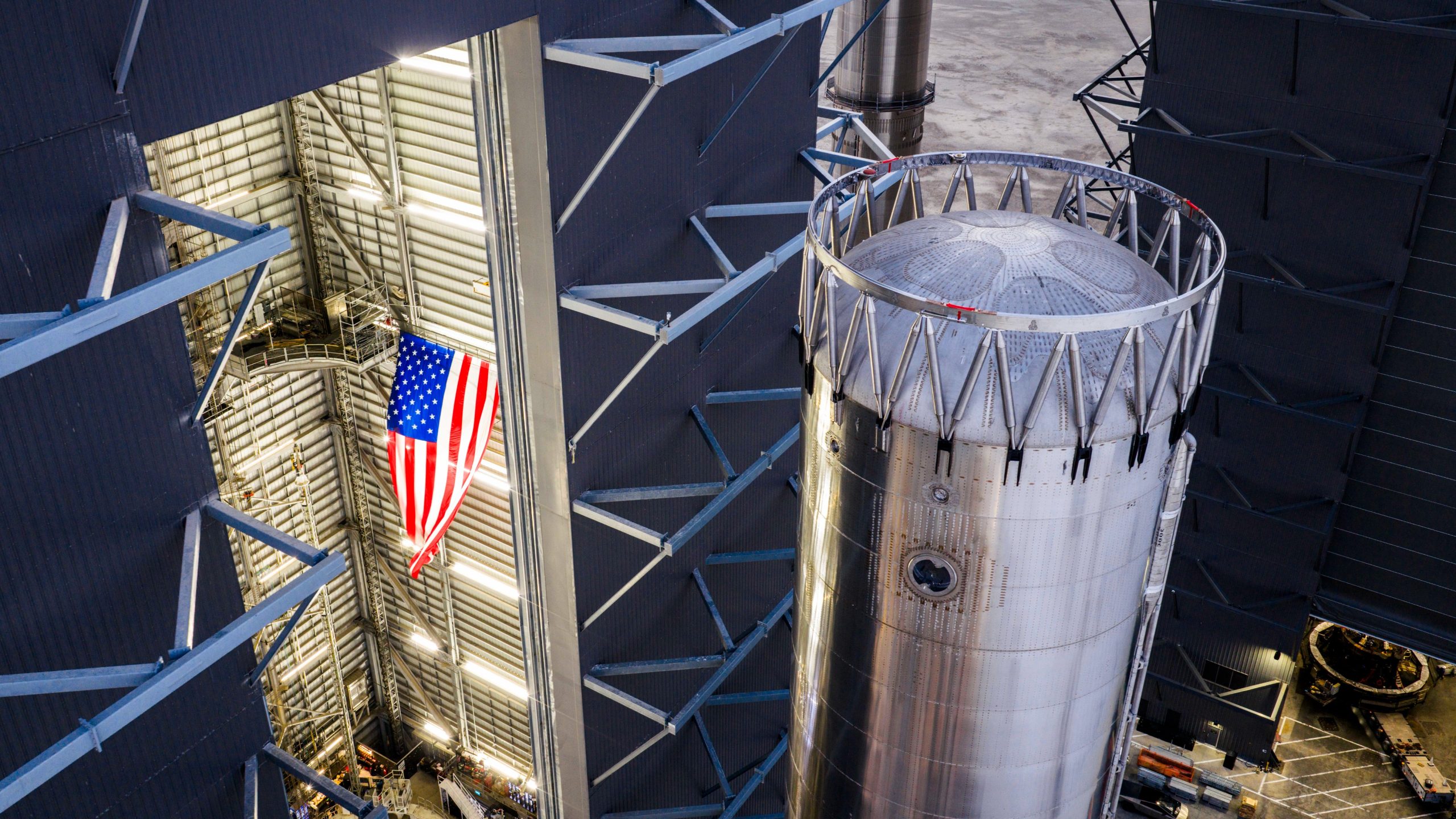
SpaceX reports third quarter results after the market closes Tuesday, with a webcast at 4:30 p.m. ET streamed on X, and Tesla follows a day later. Bloomberg consensus, cited by Pepperstone, calls for revenue of $12.89 billion, adjusted EBITDA of $6.62 billion and adjusted EPS near $0.15. That would be about 65% growth from the second quarter and SpaceX’s first profitable quarter since its IPO. Analysts expect roughly $6.4 billion from AI and $4.9 billion from Starlink, which is projected to reach 14.3 million consumer subscribers. Capital spending is forecast at $19.6 billion, leaving free cash flow near negative $11.6 billion.
The numbers matter because SpaceX has spent months trying to win over a skeptical market. It priced its record IPO at $135, spiked to $225.64, then sank near $105 in early August. Friday’s close of $146.03 sits about 28% below the June high. The Q2 report beat on revenue at $7.8 billion and put Starlink at 12 million subscribers, but $18.4 billion of capex hurt the stock. Since then SpaceX reached orbit on Starship Flight 14 with 26 Starlink V3 satellites, agreed to buy 800 MHz spectrum for about $8 billion as part of its Starlink Mobile push, and signed a fourth compute hosting deal in four months worth roughly $13 billion a year from December. Management is targeting more than 2 gigawatts of compute by year end and a $100 billion annualized revenue run rate. Evercore ISI, which raised its target to $275, said the quarter may be judged more on those targets than the reported figures
All of this sits under the Tesla merger question. Barclays analyst Dan Levy expects an all stock deal in which SpaceX buys Tesla at a premium, using reference values of $2.1 trillion and $1.5 trillion, and said an announcement would need to come by late October or early November to be voted on at Tesla’s December 6 annual meeting. Barclays estimates Musk would hold about 37% of the combined company and 56% of the votes. Musk said in July that combining companies cannot be discussed on an earnings call, but an investor question asking when SpaceX will merge with Tesla is sitting on SpaceX’s Q&A platform, and Teslarati has tracked how the Roadster demo revived the talk.
If a deal happens, Tuesday’s result would effectively set the price Tesla holders would receive. Their shares would convert into SpaceX stock, along with exposure to a company with a heavy investment on AI, while Tesla itself expects 2026 capex above $25 billion. A strong quarter and calmer spending would make that exchange easier to sell. Another round of heavy capex and a falling stock would make it harder.

SpaceX reports its second earnings today: here’s what to expect

SpaceX just launched its secret Starfall saucer again

The Boring Company’s latest Tesla tunnel truck mod “fits like a glove”

SpaceX reveals how its 1 Million AI satellite network will work and prevent space collisions

Tesla Roadster: Three configs, one can fly, 0-60 in 0.8 seconds


