News
Tesla fires female engineer who sued over “pervasive harassment”

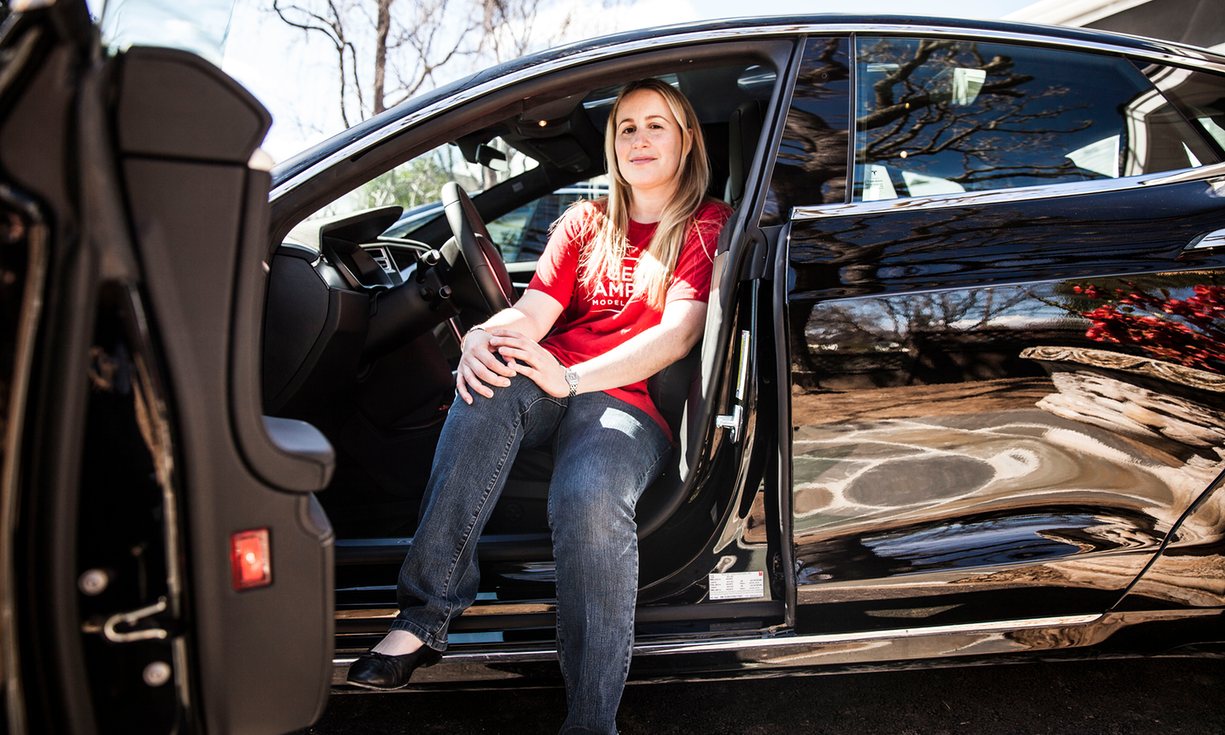
Tesla has fired the female engineer who sued the company for “pervasive harassment.” The Silicon Valley company says AJ Vandermeyden’s termination is justified because her claims were unsubstantiated, however, Vandermeyden’s attorneys allege that her being pink slipped is retaliation for her lawsuit.
Vandermeyden had been with Tesla since April of 2013, and alleged that during her time there she was subjected to behavior including “inappropriate language, whistling, and cat calls” at the hands of the mostly male staff. She further claims that she was paid less than her male colleagues despite performing work “equal in skill, effort, and responsibility.” Vandermeyden also says that her attempts to raise concerns about the quality testing of cars and office behavior toward women were ignored by male superiors.
Tesla confirmed Vandermeyden’s firing to The Verge:
“Despite repeatedly receiving special treatment at the expense of others, Ms. Vandermeyden nonetheless chose to pursue a miscarriage of justice by suing Tesla and falsely attacking our company in the press,” a spokesperson said. “After we carefully considered the facts on multiple occasions and were absolutely convinced that Ms. Vandermeyden’s claims were illegitimate, we had no choice but to end her employment at Tesla.”
Vandermeyden’s lawyer told The Guardian that their client’s termination “proves our case. It’s clear retaliation.” She added “Somebody is trying to instill in employees that when they speak out about matters they are legally allowed to speak out about, they too will be fired.”
Gabrielle Toledano, Tesla’s new global head of Human Resources, personally informed Vandermeyden of her termination. Vandermeyden was fired because she was “behaving in what the evidence indicates is a fundamentally false and misleading manner, not as a result of retaliation for the lawsuit,” the spokesperson said. “It is impossible to trust anyone after they have behaved in such a manner and therefore continued employment is also impossible.”
The story first got national attention when Vandermeyden went public with her lawsuit in February of this year, although the lawsuit was filed in September 2016.
At the time, Tesla said “She sought and was advanced into at least one other new role, evidence of the fact that Tesla is committed to rewarding hard work and talent, regardless of background.”
“Until somebody stands up, nothing is going to change,” she said in an interview with The Guardian about the discrimination lawsuit she filed last year. “I’m an advocate of Tesla. I really do believe they are doing great things. That said, I can’t turn a blind eye if there’s something fundamentally wrong going on.”


Elon Musk
Elon Musk rips ABC News over fatal NYC Tesla crash report
Musk pushed back on NYC Tesla crash coverage, pointing to a pattern of premature blame.

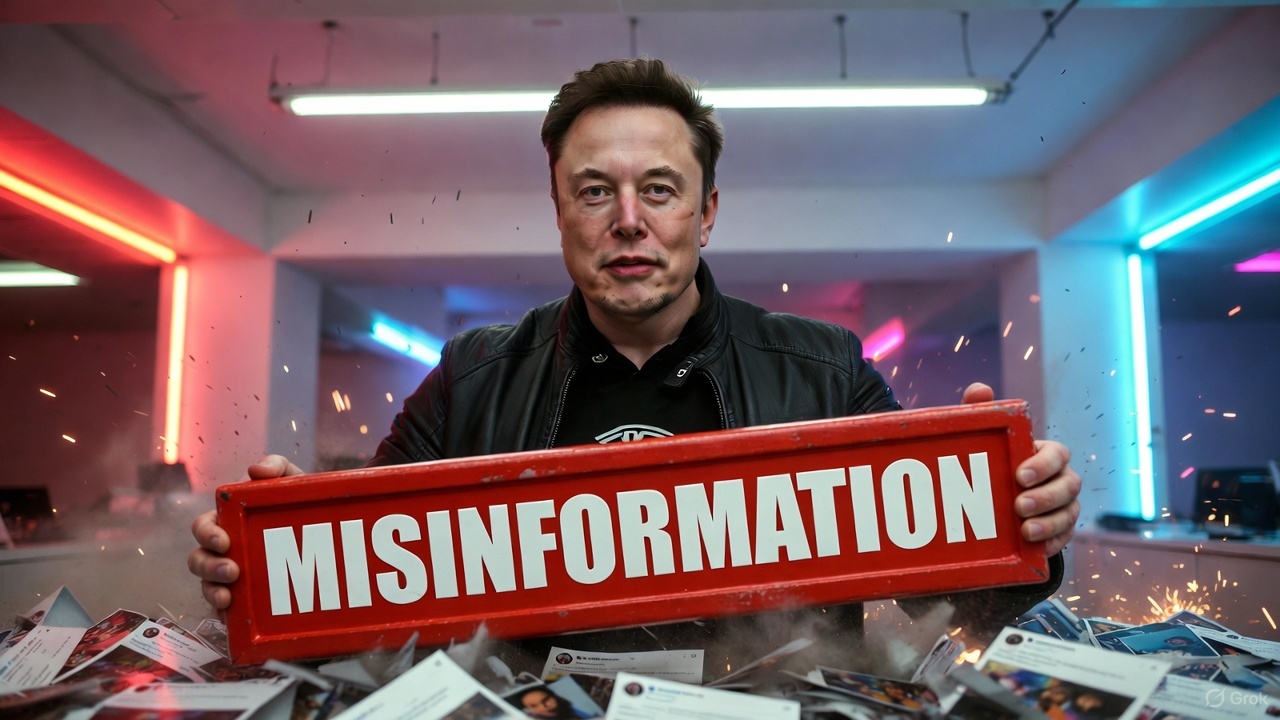
Elon Musk pushed back overnight against media framing of a fatal Tesla crash in Midtown Manhattan, telling a user on X that “it wasn’t the car” and that the vehicle’s Autopilot system had nothing to do with the wreck.
The crash happened just before 3 a.m. Wednesday, when a 2024 Tesla Model Y struck a sidewalk shed outside 315 Madison Ave., a bus stop pole and a mailbox on East 42nd Street, according to the NYPD. The car kept moving several more blocks before stopping near Second Avenue. Both women inside, each 27, were taken to Bellevue Hospital, where the passenger was pronounced dead. The driver was charged with vehicular manslaughter, driving while ability impaired and leaving the scene of an accident.
Police have not attributed the crash to Autopilot or Full Self-Driving in any public statement. The charges point to impairment, not software. Musk’s response followed a since-deleted ABC News post that he said mischaracterized the incident. Replying to a user on X, Musk wrote that if Autopilot had been engaged, “they would not have crashed,” and added that “the legacy media will never forgive Tesla for failing to advertise with them,”
The legacy media will never forgive Tesla for failing to advertise with them
— Elon Musk (@elonmusk) September 9, 2026
It’s a familiar cycle for Tesla. In June, headlines from several national outlets described a fatal crash in Katy, Texas, as happening while the car was “on autopilot,” based on the driver’s own account to police after his Model 3 struck a home and killed a 76-year-old woman. Tesla’s data told a different story when Ashok Elluswamy, Tesla’s head of AI, said the driver had pressed the accelerator to 100% and reached 73 mph in a residential zone. Harris County prosecutors later confirmed the human override and the driver was charged with manslaughter.
Florida Gov. Ron DeSantis pointed to that same Katy crash last month to argue that outlets routinely name Tesla in crash headlines while leaving other automakers unnamed, even after a driver’s own actions are shown to be the cause. A similar pattern played out in 2024, when Musk had to clarify that FSD was never even downloaded onto the Model 3 involved in a fatal Colorado DUI crash, despite a passenger’s claim that an “auto drive feature” was in use.
Tesla has not issued a separate statement on the Manhattan crash beyond Musk’s posts on X. The NYPD’s investigation is ongoing, and no cause for the driver losing control has been released.

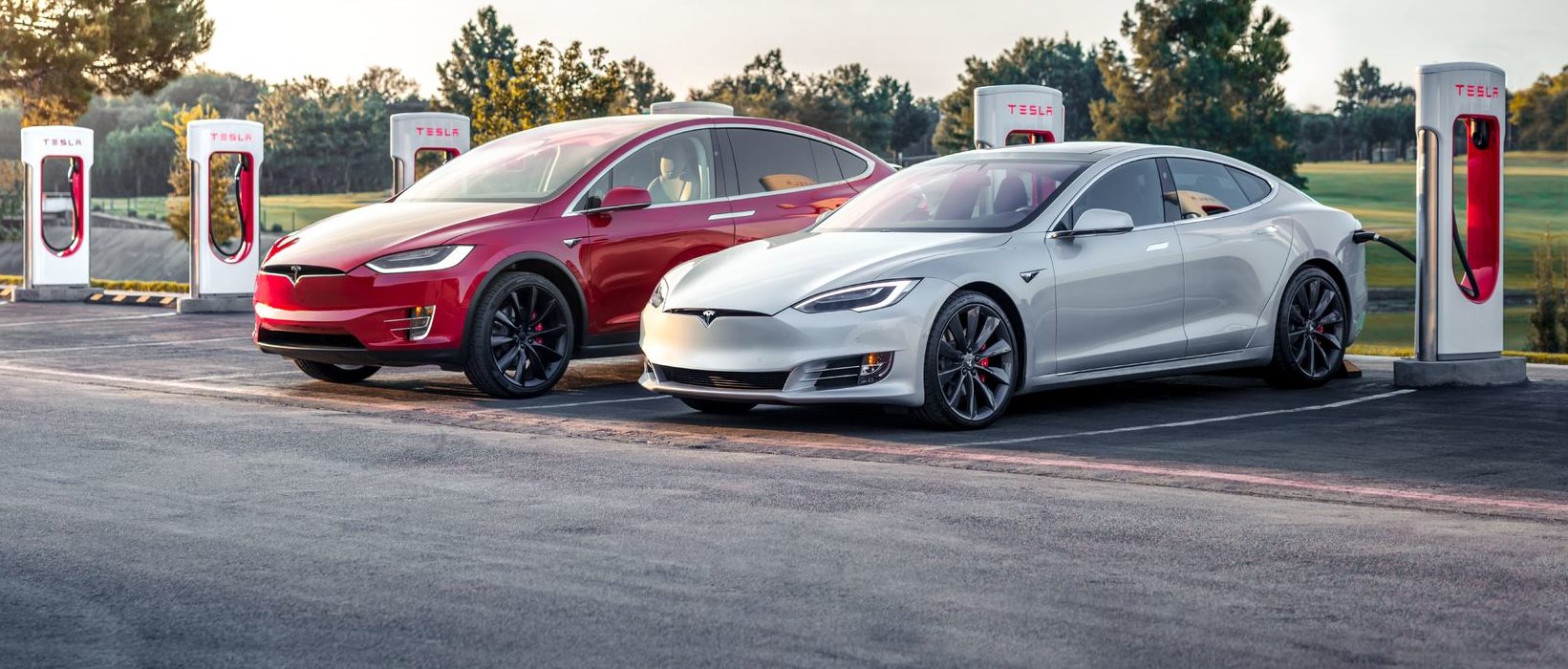
Tesla’s two recently-defunct flagship models, the Model S and Model X, are getting a big upgrade, according to the company’s Head of AI, Ashok Elluswamy.
Older Hardware 3 Model S and Model X vehicles have been the last major holdouts in Tesla’s Full Self-Driving v14 Lite rollout, and that wait now appears to be ending.
Tesla brings closure to flagship ‘sentimental’ models, Musk confirms
At Tesla’s Cybercab launch, AI chief Ashok Elluswamy told Ryan McCaffrey that he thought the S and X build “was supposed to go out last week.” Evidently, Elluswamy expects the suite to be rolled out to those HW3 Model S and Model X very soon:
For my @Tesla friends – and specifically Model S & X owners with HW3 who are waiting on FSD v14 Lite – I spoke to @aelluswamy at the Cybercab launch, & when I asked for an ETA on v14 Lite for S/X owners, he said, “Oh, I thought it was supposed to go out last week.”
So: soon! 🙌
— Ryan McCaffrey (@DMC_Ryan) September 7, 2026
Those cars are not the current Model S and Model X, which already ship with Hardware 4. They are the pre-refresh flagships built around Tesla’s older Autopilot computer, often called HW3 or AI3.
Tesla stopped putting that computer in new vehicles years ago, which is why owners treat these S and X cars as a closed generation. Model 3 and Model Y vehicles on the same computer began receiving v14 Lite in late June 2026 and saw a wider North American expansion in July. South Korea followed as an early international market. The S and X versions of the same software never joined that wave.
v14 Lite is Tesla’s way of squeezing the current v14 driving stack onto hardware that cannot run the full AI 4 model. The company describes the process as distillation: behaviors learned on the newer computer, including reinforcement learning and offline models, are compressed so the older chip and cameras can use them as a guide.
Early descriptions put the distilled network at roughly 15 percent of the original size. The result is still supervised Level 2 driving. Tesla has been clear that HW3 cannot support unsupervised Full Self-Driving or robotaxi operation because of memory and bandwidth limits.
The feature list is what made the wait so frustrating for S and X owners, as plenty of new features are to be shipped with it.
Official notes for the first Lite build, firmware 2026.20.5.1, added parking, unparking, and reversing; arrival options for a parking lot, street, driveway, or curbside; speed profiles that stay available at all times; and start-from-park engagement. Tesla also claimed better handling of merges, forks, pedestrians, traffic lights, and cut-ins, plus fewer false slowdowns and smoother lane centering.
A mid-July follow-on build, 2026.20.6.10, added more of the Hardware 4 interface, including a standalone Self-Driving app and the ability to start a trip from Park without a brake-pedal confirmation.
Elluswamy called that version the one “likely going to wide release.”
That wide release already reached most other HW3 cars in the United States and Canada. International timing still depends on regional validation and regulatory approval. For S and X owners, the remaining work appears to be model-specific validation rather than a new software stack.
There is no official Tesla changelog or build number for those two models yet, only Elluswamy’s offhand timeline. Some HW3 drivers who already have Lite report large gains over v12.6; others have described new indecision or phantom braking. The next test will be whether the same software lands cleanly on the older flagships that have waited the longest.
Yesterday, we reported on Tesla Cybertruck getting some major adjustments from a manufacturing standpoint in an effort to make the all-electric pickup more cost-effective, more reliable, more serviceable, and more easily produced.
Tesla Cybertruck engineer reveals new changes in ‘constantly evolving’ pickup
One of those changes was the addition of a self-reinforcing polypropylene aero shield that sits underneath the truck. Previously, Tesla utilized aluminum for this, but the self-reinforcing polypropylene was more durable while also being cheaper and lighter.
Tesla has revealed another small change it made to the Cybertruck, and it has to do with the side repeater cameras.
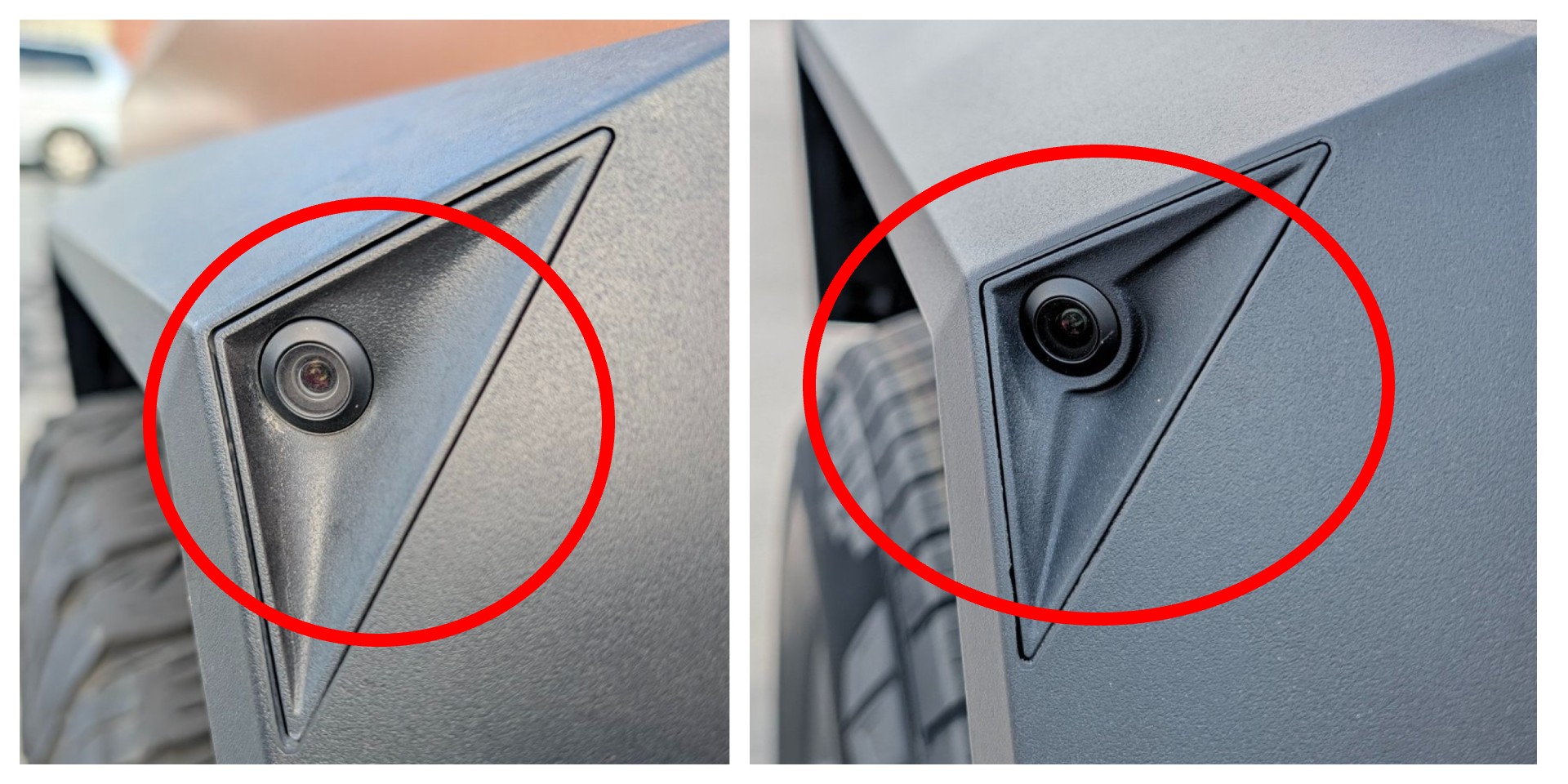
Tesla does not wait for a new model year to improve its vehicles. On September 8, Cybertruck lead engineer Wes Morrill posted side-by-side photos of an updated side repeater camera housing now rolling off the line at Gigafactory Texas.
The triangular camera pod mounted on the front fender looks almost identical at first glance. A closer look reveals a revised contour that uses the air already flowing around the truck to keep the lens clearer in rain and road spray.
The side repeater camera was updated – the version on the left is the newer part which uses passive geometry to create airflow disturbance that better keep water off the lens while driving. No cost penalty, just pure vision improvement. pic.twitter.com/wAbXtcL1Jf
— Wes (@wmorrill3) September 8, 2026
The side repeater cameras sit in an exposed position on the Cybertruck’s angular stainless-steel body.
In wet weather, they readily collect water droplets that can degrade the image Autopilot and Full Self-Driving use for lane changes and blind-spot monitoring. Early production trucks sometimes left owners wiping lenses by hand or accepting temporary restrictions on driver-assistance features.
Tesla has added washers to cameras on certain other models and on Cybercab prototypes, but those active systems add cost, complexity, and extra potential leak points.
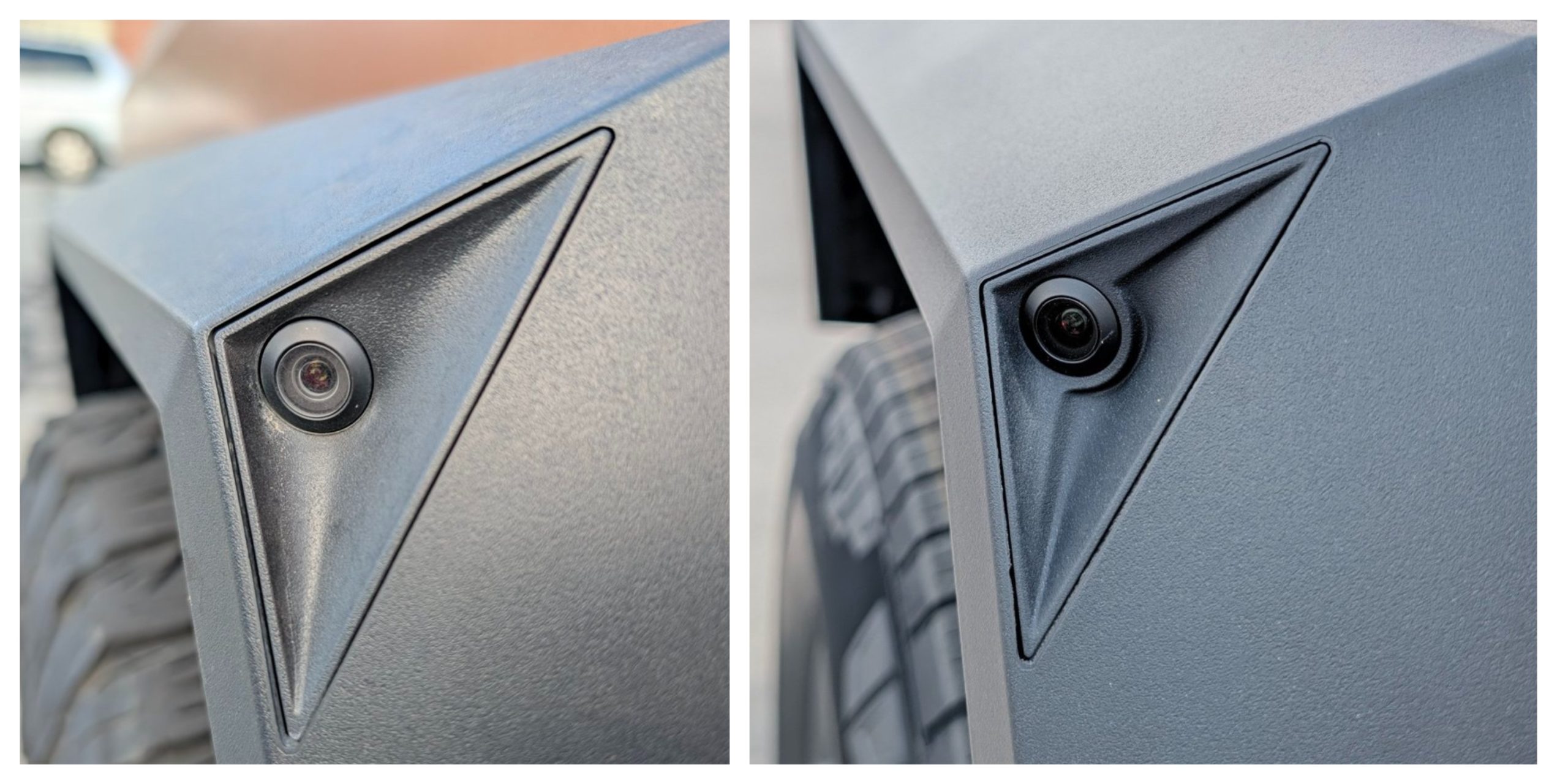
The new housing solves the problem with passive geometry. Subtle changes in the surround create localized airflow disturbances as the vehicle moves. Those eddies physically push water droplets away from the optical surface. Morrill called the result “pure vision improvement” achieved at “no cost penalty.” Once the production mold is updated, every subsequent part costs the same as the original.
The advantages compound quickly. Clearer cameras in rain improve the reliability of driver-assistance features precisely when they are needed most. The design consumes no extra energy and introduces no new failure modes.
New Cybertrucks built after the tooling changeover receive the updated part automatically. Some owners of trucks delivered as late as June 2026 have already confirmed they received the revised housing. Retrofit questions have appeared in replies, and the cameras appear electrically compatible, though Tesla has not announced an official service program.
A few millimeters of reshaped housing will not make headlines the way a new battery pack does, but these changes are incremental and increase the Cybertruck’s effectiveness as a vehicle over time.
This improvement illustrates how Tesla continues to refine the Cybertruck after volume production began. Better wet-weather vision, zero added cost, and no extra hardware add up to a meaningful gain in everyday usability and safety.

Elon Musk rips ABC News over fatal NYC Tesla crash report

Tesla’s two defunct flagship models are getting a big upgrade


