Investor's Corner
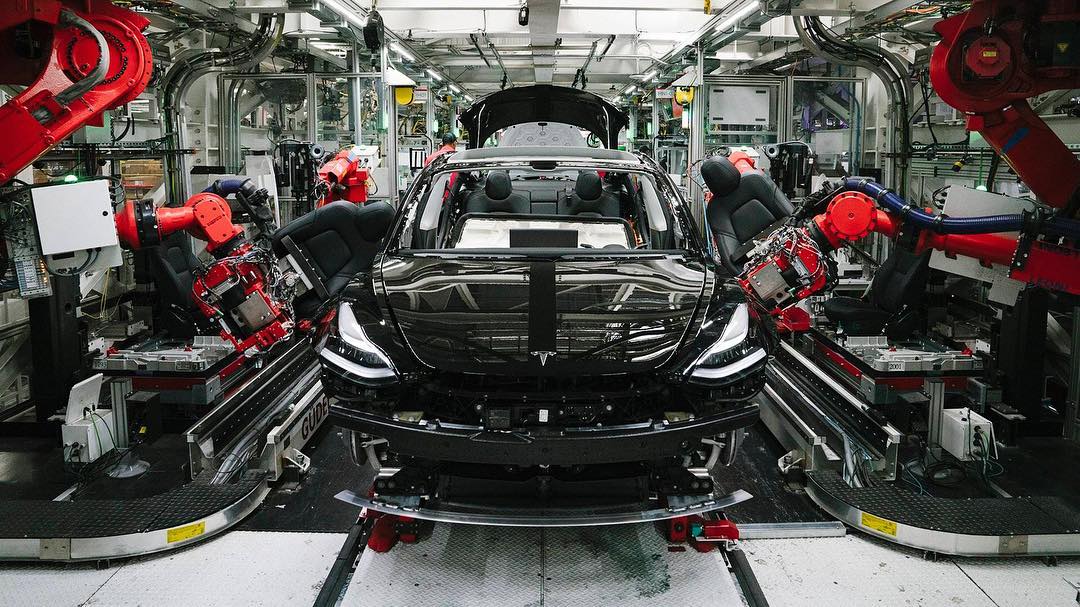
Tesla’s Model 3 production ramp hits overdrive: 61.8k new VIN registrations in Oct so far

Tesla shares (NASDAQ:TSLA) have shown some recovery since the electric car maker pleasantly surprised Wall Street last week, when it posted $6.8 billion in revenue and beat earnings estimates with a GAAP profit of $312 million in the third quarter. The company’s shares, while still volatile, appear to be holding their gains, amidst new signs of an improving Model 3 production ramp and a recent vote of support from a major investor.
Since the beginning of the fourth quarter, Tesla has been exhibiting signs that its production ramp for the Model 3 is becoming even more stable. Immediately after its third-quarter earnings call, for example, Tesla registered a massive batch of 13,629 new Model 3 VINs, all of which are estimated to be RWD vehicles. Within the next two days, Tesla filed VINs for another 10,060 Model 3, this time comprised of both RWD and AWD cars. With these latest registrations, Tesla had registered a total of 61,843 Model 3 VINs in October alone.
It should be noted that Tesla only breached the 61,000-mark in Model 3 VIN filings this past July 1, almost a year into the production of the electric sedan. With this in mind, it appears that Tesla was practically able to register more than 11 months’ worth of Model 3 VINs in the first month of Q4. It should be noted that the company is only around halfway towards its goal of producing 10,000 Model 3 per week. During the third quarter earnings call, Elon Musk noted that a ramp to 7,000 Model 3 per week should be doable just by optimizing its existing lines.
“Yeah, very minimal to get (Model 3 production) to 7,000 a week. And then I mean that’s really just basically solving improving our time of the existing lines, and we can do 7,000 a week. So and then it gets a little harder as you start to go above 7,000, it would need — at least bringing lines down in Fremont for significant upgrades to get to 10k,” Musk said.
The company’s ongoing and improving ramp for the Model 3 comes amidst a vote of support from one of Tesla’s top investors. In a recent statement to Reuters, Nick Thomas, a partner at Baillie Gifford & Co, stated that the Edinburgh-based financial firm would be willing to provide additional investments to Tesla if needed. Baillie Gifford is the electric car maker’s third-largest shareholder, with a 7.72% stake in the company, just behind T. Rowe Price Associates Inc., which owns about 10%, as well as Elon Musk, the company’s biggest shareholder.
“If he (Tesla CEO Elon Musk) needs more capital, we would be willing to back him,” Thomas stated.
Despite being Tesla’s largest shareholder, Elon Musk has nonetheless been increasing his stake in the company. Earlier today, a filing to the Securities and Exchange Commission revealed that Musk had purchased $10 million worth of TSLA stock at prices between $334.24 and $335.932 per share. Musk’s recent $10 million TSLA purchase augments another $20 million worth of shares that he bought in the aftermath of his settlement with the SEC over the agency’s lawsuit, which resulted from his now-infamous “funding secured” tweet last August.
As of writing, Tesla shares are trading 0.79% at $337.50 per share.
Disclosure: I have no ownership in shares of TSLA and have no plans to initiate any positions within 72 hours.



In a new interview on Wednesday, Tesla uber bull Ron Baron said that anyone looking to buy the company’s stock should do so as soon as they can.
Baron, founder and CEO of Baron Capital and one of Tesla’s most persistent institutional bulls, used a CNBC Squawk Box appearance on Wednesday to deliver a familiar message with fresh urgency: In his opinion, Tesla stock is a buy:
“The time to buy the stock is now. FSD is catching on, and it’s going to be bigger and bigger. 55% of new buyers are buying it (Teslas) with FSD. It’s going to be everywhere. It’s safer.”
The Baron Capital frontman’s case is built around Full Self-Driving. Tesla reported 1.48 million active FSD subscriptions in the second quarter, up 56 percent year over year, and company officials have said roughly 55 percent of new North American deliveries left with a subscription enabled.
Baron framed that attach rate as proof the product is moving from enthusiast extra to default expectation, and as a reason software, not just vehicle volume, should drive the next phase of value.
His conviction on Tesla shares is not theoretical, as Baron Capital made its first Tesla investment in 2014, after years of meetings that began around the 2010 IPO roadshow. The firm later built a large SpaceX position starting in 2017.
Ron Baron today in new interview on Tesla:
“The time to buy the stock is now. FSD is catching on, and it’s going to be bigger and bigger. 55% of new buyers are buying it (Teslas) with FSD. It’s going to be everywhere. It’s safer.” pic.twitter.com/Rv5PB0bVZ2
— Sawyer Merritt (@SawyerMerritt) September 16, 2026
Baron said those Musk-led bets have generated about $30 billion of the $71 billion in profits Baron Capital has produced for clients. He put the firm’s current exposure at roughly $25 billion in SpaceX and $5 billion in Tesla. Personally, he described SpaceX as his largest holding, at about $5 billion, with about $1.5 billion in Tesla and additional Tesla exposure through the firm’s funds.
That concentration is also a statement of loyalty. Asked about talk of a SpaceX-Tesla combination, Baron said he had already walked Elon Musk through arguments for and against a deal, then declined to repeat them on air. His public position was simpler: “Whatever you decide is better is what I’m going to support,” he said to Musk.
Baron also said that he picked up the farewell edition of the Model S after Tesla decided to sunset the vehicle earlier this year, calling it his favorite car he’s ever driven.
Elon Musk
Elon Musk gives his most telling Tesla-SpaceX merger conversation yet
Elon Musk hinted a Tesla-SpaceX merger could be coming, and Wall Street is taking notice.

Elon Musk gave his clearest signal yet that Tesla and SpaceX could eventually combine, telling the All-In Summit in Los Angeles that the two companies’ deepening collaboration makes the question worth asking. Sawyer Merritt first surfaced the highlight on X Tuesday.
Asked directly why Tesla and SpaceX remain separate given how closely they already work together, Musk told hosts at the summit: “Great question there. With all this collaboration, on so many levels, who can imagine what action one might take when there’s so much close collaboration in so many areas.” SpaceX President Gwynne Shotwell, who joined Musk on stage, added that SpaceX personnel have already moved into xAI to fill leadership and engineering gaps, saying the businesses are integrating “faster than I thought,” though “not fully integrated yet,”
The comments landed on top of merger speculation that has been building on Wall Street for months. JPMorgan has called a tie-up “strategically coherent on paper,” pointing to overlapping ambitions in AI, robotics, energy, transportation and space. Jefferies went further, estimating Musk could retain roughly 55.3 percent voting control in a deal structured without a premium, a scenario that would still leave room for Tesla shareholders to come out ahead. On Kalshi, traders now put the odds of a merger before 2028 at 66 percent.
Tesla’s stake in SpaceX, still under one percent, traces back to its earlier investment in xAI, which converted to SpaceX equity after SpaceX absorbed the AI company. The two are also jointly building Terafab, a chip facility in Austin meant to serve both Tesla’s AI computing needs and SpaceX’s satellite ambitions. Wedbush analyst Dan Ives has stood by a 2027 merger timeline for months, and Cathie Wood’s ARK Invest recently floated a similar case, an idea Musk pushed back on directly at the time.
Another Tesla SpaceX merger prediction by ARK Invest has Elon Musk talking
The timing adds another layer. Tesla has scheduled an October 1 unveiling for its next generation Roadster at a venue near SpaceX’s McGregor, Texas test site, using the phrase “Go for launch” in its promotional material. Both stocks dipped roughly 2 percent Monday before recovering slightly in premarket trading Tuesday, with SpaceX shares up about 0.4 percent and Tesla essentially flat.
Musk stopped short of confirming anything is in motion. But unlike his past denials of a corporate restructuring, this response didn’t rule one out, and it came with Shotwell sitting next to him describing an integration that’s already underway.
Elon Musk
Tesla Cybercabs narrowly miss deadly Amazon cargo plane crash
An Amazon cargo plane crash near Miami’s airport stopped feet from dozens of Tesla Cybercabs.
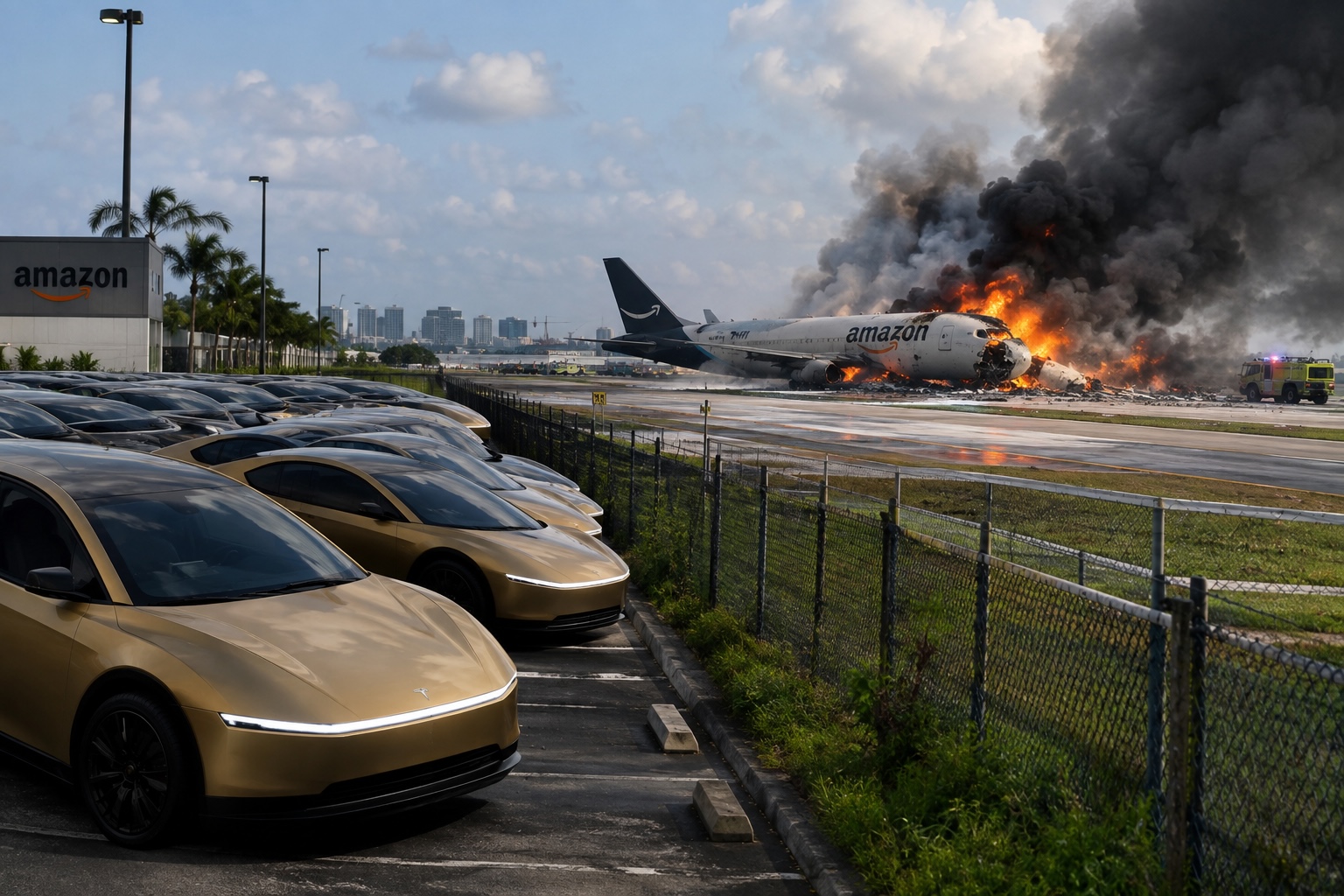
An Amazon Prime Air Boeing 767 cargo jet overran the runway at Miami International Airport on Sunday afternoon, killing five people and injuring five more. The jet, operated by North Carolina based carrier 21 Air as Flight 7598, touched down around 2 p.m. after arriving from San Juan, Puerto Rico, then crossed the airport perimeter, plowed across NW 67th Avenue and struck multiple vehicles before catching fire, according to the Associated Press.
Photos and video from the scene show the aircraft’s nose stopped within meters of a fenced staging lot holding dozens of gold painted Tesla Cybercabs, the steering wheel free robotaxi Tesla began putting on public roads in Austin last week. Miami-Dade Fire Rescue has confirmed the plane struck “multiple vehicles” but has not said whether any Cybercabs were among them, and neither Tesla nor airport officials have addressed the fleet directly.
The Cybercabs had not yet entered commercial service in Miami. Tesla’s existing Robotaxi operation there runs on modified Model Y vehicles and has been unsupervised since Ashok Elluswamy confirmed the detail on X in July.
Footage of the plane crash from earlier today | #ONLYinDADE pic.twitter.com/iGoOtnd6cD
— ONLY in DADE (@ONLYinDADE) September 6, 2026
Elon Musk offered the briefest of reactions. Replying to a Zero Hedge post about the Cybercabs sitting so close to the wreckage, he wrote a single word: “Weird.” He has not commented further, and Tesla has not issued a statement.
The timing puts Tesla’s newest vehicle near an unrelated but highly visible tragedy just days after its Austin debut, a launch that had already drawn scrutiny from federal regulators. The National Highway Traffic Safety Administration opened an audit how Tesla certified the Cybercab as compliant with federal vehicle safety standards, a process Teslarati covered after the vehicle’s September 3 launch event. That inquiry concerns the car’s lack of a steering wheel and pedals, not the Miami crash.
Investigators from the FAA and NTSB are focused on the plane, not the parking lot beside it. Flight data reviewed by outlets including Simple Flying show the 767 touched down around 170 knots, well above the 135 to 140 knot range typical for the aircraft, though investigators have not determined a cause. Amazon said it is working with authorities and that its priority is the safety of everyone affected.
Whether any Cybercabs were damaged, and what Tesla plans for the fleet parked near one of the country’s busiest airports, remain open questions.

NHTSA just escalated its Tesla Cybercab investigation in a big way

Tesla uber bull Ron Baron says ‘the time to buy the stock is now’


