News
Performance Gains after P85D Ludicrous Mode Upgrade
TMC member thimel recently had the Ludicrous mode upgrade installed on his Model S P85D. He carefully measured the performance of his car before and after, and found that Ludicrous mode is worth about a half second to 60 mph and a noticeable increase in power at all speeds up to 80.

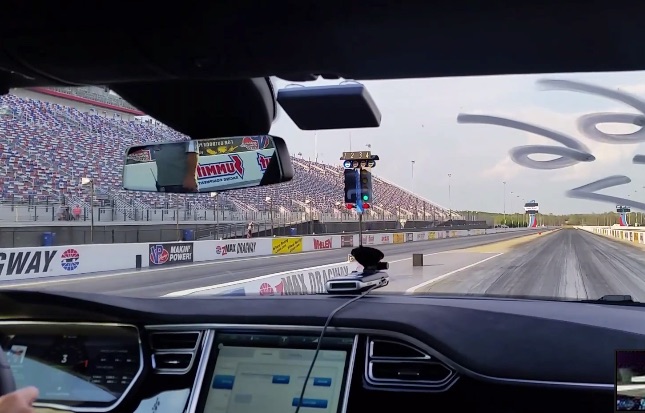
Just how much faster is the the P85D with Ludicrous Mode upgrade? According to Tesla Motors Club (TMC) member thimel, the performance gains are significant, to the tune of 19% more power above 30 mph and a drop in 0-60 time from 3.2 to 2.9 seconds. Quarter mile time also drops from an already quick 11.8 seconds to an astounding 11.5 seconds.
thimel carefully measured the performance of the P85D both before and after the Ludicrous Mode upgrade. The performance data was then meticulously charted and plotted, painting a clear picture of the performance differences from the $5,000 retrofit.
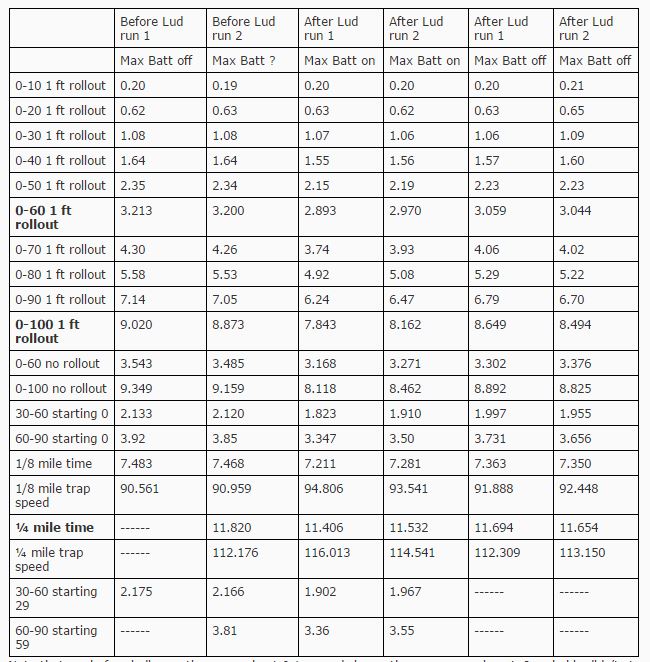
[Image source: thimel via TMC]
According to thimel’s post from the TMC forum, “I started the before Ludicrous tests early in the morning and had not driven the car for many hours, but had charged it that night. The ambient temperature in my garage that morning was 59 degrees and it was 50 degrees outside during the tests. I started with a 90% charge and by the time I was done the charge was 70%. Creep mode was off to help avoid a very slow start. Insane mode was on of course. Climate control was off.
“I drove a few miles before starting the first test but did nothing else to warm the battery. I drove 5 miles at moderate acceleration and speeds between acceleration passes. This was both to give a chance for things to cool down and to return me to the same starting point for each acceleration pass.data shows the Ludicrous mode upgrade it worth nearly a half second in the sprint to 60 mph and several more miles per hour at the end of the quarter mile. ”
Next he charted his power and speed against time and found power to range from 380 kW, before the Ludicrous upgrade, to 451 kW after the upgrade with the Max Battery Power setting on. The setting heats the Tesla battery to a higher temperature thereby reducing its impedance and increasing current to provide short term acceleration and performance gains.
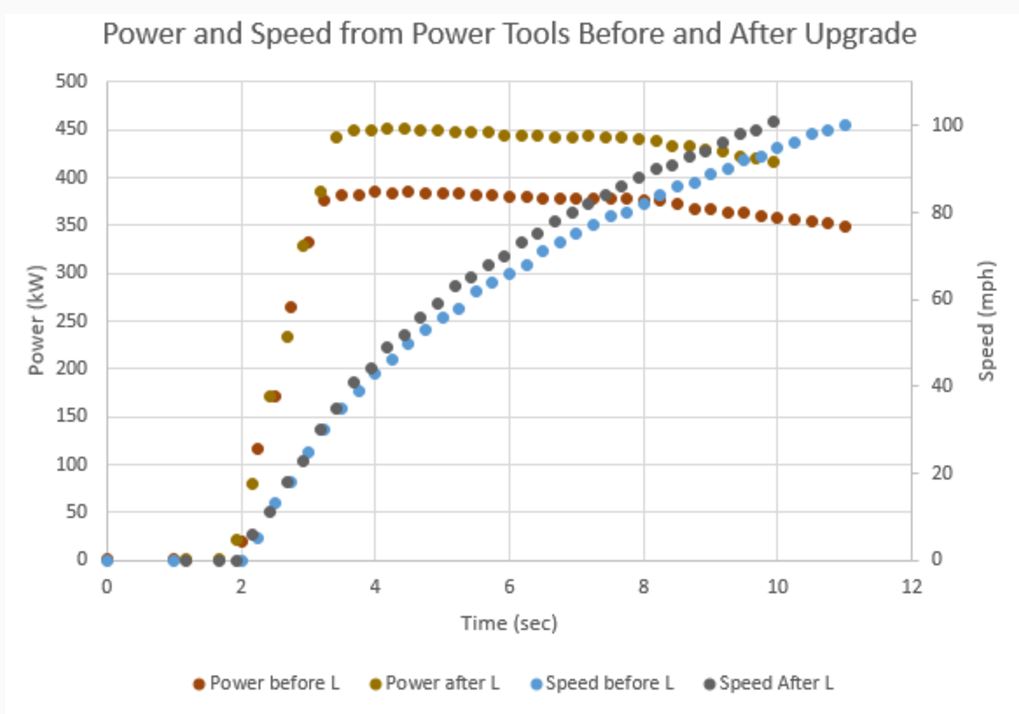
The biggest boost in performance after the Ludicrous upgrade happens above 30 mph. Below that, performance is about the same. But with Ludicrous mode engaged, there is a sizable increase in available torque. Before the upgrade, lateral acceleration reaches approximately 1.15 g at 15 mph, then falls below 1 g after 25 mph. After the upgrade, lateral acceleration peaks at 1.1 g and continues to pull over 1 g until slightly past 30+ mph. Most notably, the acceleration is consistently above the pre-Ludicrous Mode upgrade all the way until 80 mph.
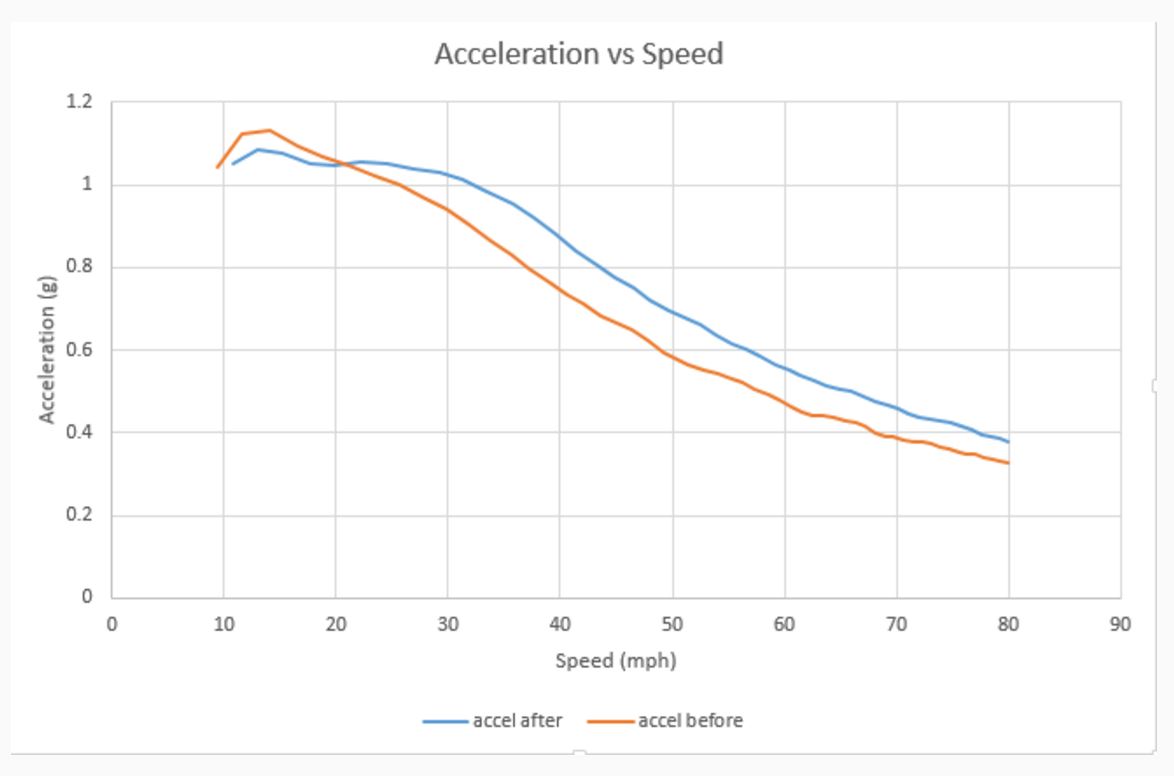
[Image source: thimel via TMC]
In his notes, thimel makes some interesting points. “Above 30 mph, ludicrous clearly has more power. This is seen directly with the PowerTools readout…..which shows the maximum power increased from 380 to 451 kW, a 19% increase and by the shorter times to achieve speeds above 30 mph. The max power measured from the battery was 451 kW. This compares to 458 kW that Pete90D measured on his P90DL. So the battery doesn’t make much of a difference. The 0-60 time I got of 2.89 is also nearly identical to that Pete90D got of 2.901.”
He ends his post with this conclusion: “The P85D with ludicrous upgrade is significantly faster than without. There is 19% more power above 30 mph, 0-60 time drops from 3.2 to 2.9 seconds and the quarter mile time drops from 11.8 to 11.5. So it was fast before and is faster now. You get about two-thirds of the improvement if you don’t heat the battery with max battery power.”



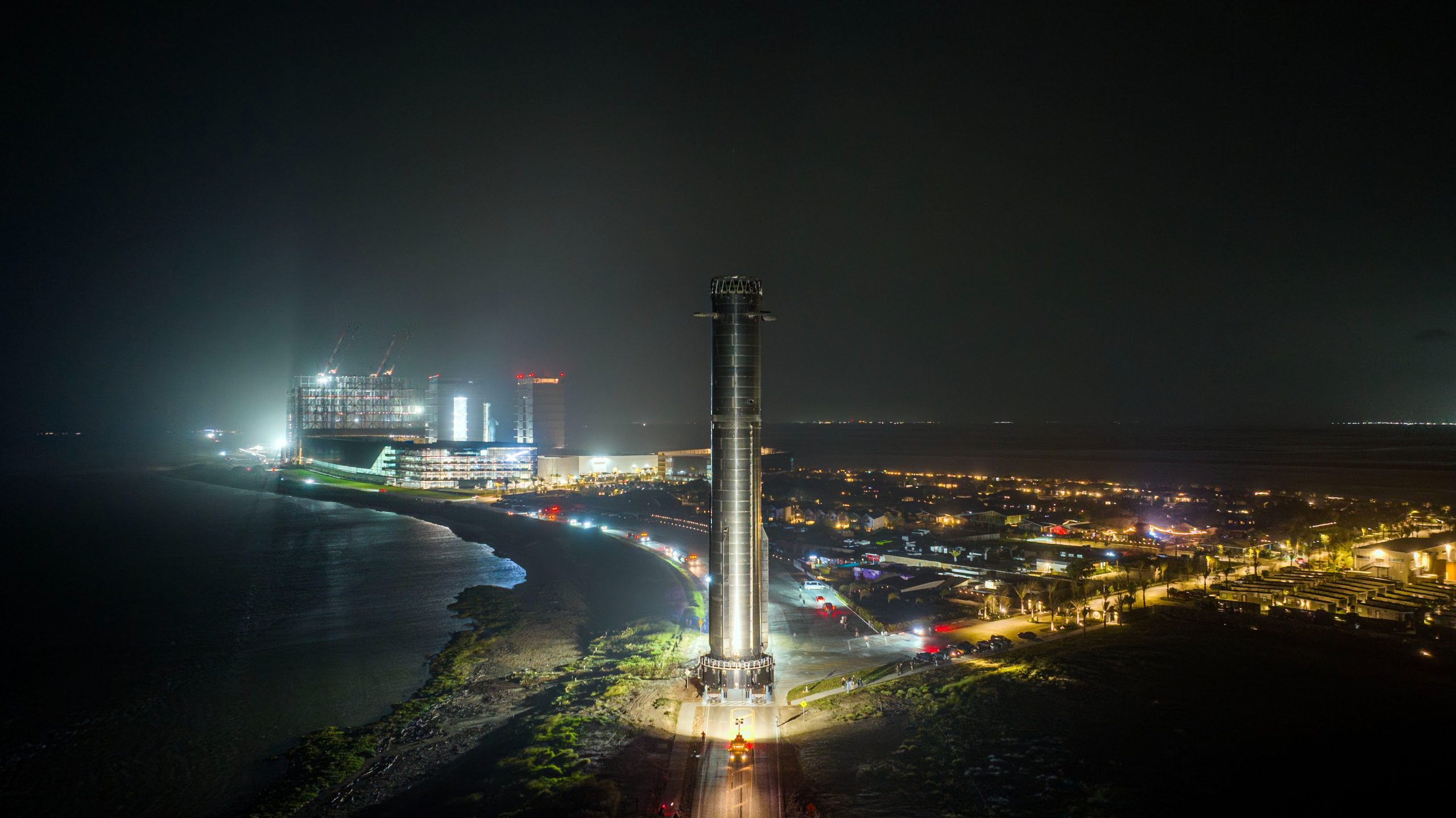
SpaceX has decided to stand down from what was supposed to be the first test launch of Starship’s v3 rocket tonight after a minor issue with a hydraulic pin delayed the flight once more.
The company scrubbed its first test flight of the upgraded Starship v3 on May 21 in the final minutes of the countdown. SpaceX CEO Elon Musk quickly took to social media platform X, explaining that a hydraulic pin on the launch tower’s “chopsticks” arm failed to retract properly.
Musk added that the company would fix the issue this evening. SpaceX will attempt another launch tomorrow night at 5:30 p.m. CT, 6:30 p.m. ET, and 3:30 p.m. PT.
The hydraulic pin holding the tower arm in place did not retract.
If that can be fixed tonight, there will be another launch attempt tomorrow at 5:30 CT. https://t.co/DJAdvDYQpH
— Elon Musk (@elonmusk) May 21, 2026
The countdown for Starship Flight 12 — featuring the taller and more capable V3 stack with Booster 19 and Ship 39 — had been progressing smoothly until the late-stage issue surfaced. The Mechazilla tower arm, designed to secure the vehicle on the pad and eventually catch returning boosters, could not complete its retraction sequence.
SpaceX teams immediately began troubleshooting the hydraulic system for an overnight repair.
Starship V3 introduces several significant upgrades over earlier versions. These include greater propellant capacity, more powerful Raptor 3 engines, larger grid fins, enhanced heat shielding, and an improved fuel transfer system.
We covered the changes that were announced just days ago by SpaceX:
SpaceX unveils sweeping Starship V3 upgrades ahead of May 19 launch
The changes are intended to increase payload performance, support higher flight rates, and advance the vehicle toward operational missions, including Starlink deployments, NASA Artemis lunar landings, and future crewed Mars flights. The debut flight from Starbase’s new Launch Pad 2 marked an important milestone in scaling up the fully reusable Starship system.
This stand-down highlights the intricate challenges of preparing the world’s most powerful rocket for flight. Despite extensive pre-launch checks, a single component in the ground support equipment can force a scrub.
The incident aligns with Starship’s proven iterative development approach. Previous test flights have encountered both successes and setbacks, each providing critical data that refines hardware and procedures. Some outlets may call some of these flights “failures,” when in reality, they are all opportunities for SpaceX to learn for the next attempt.
With V3, SpaceX aims to reduce ground-system dependencies and increase launch cadence to meet ambitious long-term goals.
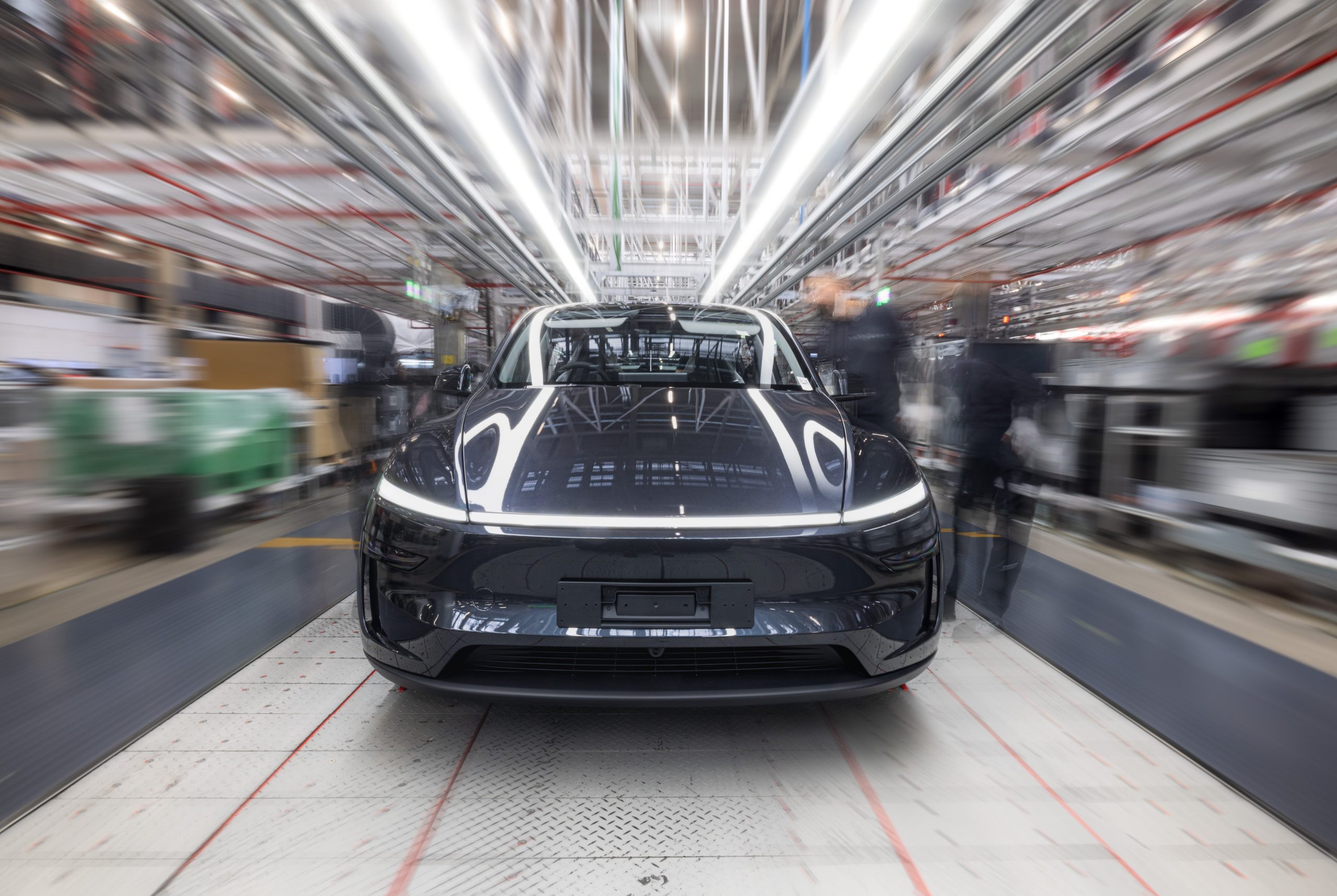
The Tesla Model Y became the first-ever car to reach a legendary Norwegian milestone, surpassing 100,000 new registrations after gaining a reputation as one of the most popular vehicles in the country and the world.
As of May 20, Norwegian authorities have registered 100,224 units of the electric SUV, according to data from local outlet Opplysningsrådet for veitrafikken (OFV).
By population, roughly one in every 29 passenger cars on Norwegian roads is now a Model Y, underscoring its rapid rise as a national favorite.
Since the first deliveries in August 2021, the Model Y has transformed from a newcomer to a staple in Norwegian traffic.
Tesla back on top as Norway’s EV market surges to 98% share in February
Geir Inge Stokke, the Managing Director of OFV, described the achievement as “remarkable,” noting that few single models have gained such traction so quickly. “Tesla Model Y has hit the Norwegian market spot on, and the numbers illustrate how fast the EV market has developed here,” Stokke said.
The Model Y’s success reflects Norway’s aggressive push toward electrification. Nearly nine out of ten units, 87.6 percent, to be exact, are privately registered, with the remaining 12.4 percent on company plates. Owners span the country, from major cities to smaller municipalities, proving it is no longer just an urban or niche vehicle but a true “people’s car.
Who is Buying Tesla Model Ys in Norway?
Typical Model Y drivers are men in their early 40s. The average registered user age is 44, with 83 percent male and 17 percent female. Stokke noted that household usage often extends beyond the primary registrant, broadening the vehicle’s real-world appeal.
Geographically, adoption concentrates in urban centers with strong charging infrastructure. Oslo leads with 16,861 registrations (16.82 percent of the national total), followed by Bergen (7,450), Bærum (4,313), and Trondheim (4,240).
The top five municipalities—Oslo, Bergen, Bærum, Trondheim, and Asker—account for 35,463 units, or about 35 percent of all Model Ys. Yet the vehicle’s presence outside big cities highlights its broad acceptance.
Growth Trajectory and Popularity
Tesla built a lot of sales momentum in a short amount of time. In 2021, registrations closed out at 8,267, but more than doubled to more than 17,000 units in 2022 and more than 23,000 units in 2023. 2025 was the company’s strongest year yet, as Tesla managed to record 27,621 registrations.
Through 2026, Tesla already has 7,036 registrations.
Tesla’s Global Success with the Model Y
Tesla has tasted so much success with the Model Y; it has been the best-selling car in the world three times, it has dominated EV sales in numerous countries, and contributed to a mass adoption of electric vehicles across the planet.
As Stokke emphasized, the Model Y’s journey from newcomer to icon mirrors Norway’s broader success story. With robust incentives that push sales, excellent infrastructure, and consumer eagerness to transition to sustainable powertrains, the country continues setting global benchmarks in sustainable mobility.
The Tesla Model Y stands as a shining example of how quickly change can happen when conditions align.
SpaceX has disclosed the full financial details of its groundbreaking agreement with Anthropic, confirming that the AI company will pay $1.25 billion per month for dedicated high-performance computing resources.
The revelation came through SpaceX’s latest securities filing in preparation for its initial public offering, shedding light on one of the largest compute deals in the artificial intelligence sector to date. The prospectus was released last night, as SpaceX is heading toward its IPO.
This arrangement underscores the fierce demand for specialized infrastructure as frontier AI models require unprecedented levels of processing power to train and operate effectively. Industry analysts see the disclosure as a significant milestone, highlighting how top AI labs are locking in massive capacity to stay ahead in a rapidly accelerating field.
For SpaceX, it feels like a massive move that pushes its perception as a company from space exploration to artificial intelligence.
SpaceX is following in Tesla’s footsteps in a way nobody expected
The comprehensive deal grants Anthropic exclusive access to SpaceX’s Colossus clusters, encompassing Colossus I and the substantially expanded Colossus II, which together deliver hundreds of megawatts of power along with more than 200,000 NVIDIA GPUs.
Payments extend through May 2029, totaling nearly $45 billion overall; capacity is scheduled to ramp up during May and June 2026 at an initial discounted rate to facilitate seamless integration. Both companies retain the option to terminate the agreement with ninety days’ notice, so there is definitely some flexibility for both.
This pact not only enhances Anthropic’s ability to scale usage limits for Claude users but also injects substantial recurring revenue into SpaceX, bolstering its expansion into advanced data center operations and future orbital computing initiatives.
Observers describe the collaboration between the two companies as strategically advantageous because it gives Anthropic cutting-edge AI development the opportunity to collaborate with SpaceX’s expertise in rapid, large-scale infrastructure deployment.
This disclosure arrives at a pivotal moment when computing resources have become the primary bottleneck for AI progress.
As leading organizations compete to build more powerful systems, securing reliable, high-density facilities has emerged as a key differentiator.
SpaceX’s sites, such as those in Memphis, offer superior power availability and advanced cooling solutions that set them apart from conventional providers. For Anthropic, the added capacity is expected to deliver tangible improvements, including extended context windows, quicker inference times, and innovative features that appeal to both enterprise clients and individual users.
Looking ahead, the partnership paves the way for ambitious joint projects, including potential space-based AI compute platforms designed to overcome terrestrial limitations on energy and thermal management. Such efforts could redefine sustainable computing at massive scales.
Financially, the deal solidifies SpaceX’s diverse revenue profile ahead of its public market debut, extending beyond traditional aerospace activities. The massive check SpaceX will cash each month opens up the idea that additional
While some experts question the sustainability of these enormous expenditures given ongoing efficiency gains in AI architectures, the commitment reflects a strong belief in sustained demand growth.
The agreement also exemplifies productive synergies across sectors, with aerospace engineering insights optimizing AI hardware performance. As global attention on technology concentration increases, arrangements of this nature may help shape equitable access to critical resources.

SpaceX reveals reason for Starship v3 stand down, announces next launch date

Tesla Model Y becomes first-ever car to reach legendary milestone


