News
Tesla Full Self-Driving v14.2 – Full Review, the Good and the Bad


Tesla rolled out Full Self-Driving version 14.2 yesterday to members of the Early Access Program (EAP). Expectations were high, and Tesla surely delivered.
With the rollout of Tesla FSD v14.2, there were major benchmarks for improvement from the v14.1 suite, which spanned across seven improvements. Our final experience with v14.1 was with v14.1.7, and to be honest, things were good, but it felt like there were a handful of regressions from previous iterations.
While there were improvements in brake stabbing and hesitation, we did experience a few small interventions related to navigation and just overall performance. It was nothing major; there were no critical takeovers that required any major publicity, as they were more or less subjective things that I was not particularly comfortable with. Other drivers might have been more relaxed.
With v14.2 hitting our cars yesterday, there were a handful of things we truly noticed in terms of improvement, most notably the lack of brake stabbing and hesitation, a major complaint with v14.1.x.
However, in a 62-minute drive that was fully recorded, there were a lot of positives, and only one true complaint, which was something we haven’t had issues with in the past.
The Good
Lack of Brake Stabbing and Hesitation
Perhaps the most notable and publicized issue with v14.1.x was the presence of brake stabbing and hesitation. Arriving at intersections was particularly nerve-racking on the previous version simply because of this. At four-way stops, the car would not be assertive enough to take its turn, especially when other vehicles at the same intersection would inch forward or start to move.
This was a major problem.
However, there were no instances of this yesterday on our lengthy drive. It was much more assertive when arriving at these types of scenarios, but was also more patient when FSD knew it was not the car’s turn to proceed.
Can report on v14.2 today there were ZERO instances of break stabbing or hesitation at intersections today
It was a significant improvement from v14.1.x
— TESLARATI (@Teslarati) November 21, 2025
This improvement was the most noticeable throughout the drive, along with fixes in overall smoothness.
Speed Profiles Seem to Be More Reasonable
There were a handful of FSD v14 users who felt as if the loss of a Max Speed setting was a negative. However, these complaints will, in our opinion, begin to subside, especially as things have seemed to be refined quite nicely with v14.2.
Freeway driving is where this is especially noticeable. If it’s traveling too slow, just switch to a faster profile. If it’s too fast, switch to a slower profile. However, the speeds seem to be much more defined with each Speed Profile, which is something that I really find to be a huge advantage. Previously, you could tell the difference in speeds, but not in driving styles. At times, Standard felt a lot like Hurry. Now, you can clearly tell the difference between the two.
It seems as if Tesla made a goal that drivers should be able to tell which Speed Profile is active if it was not shown on the screen. With v14.1.x, this was not necessarily something that could be done. With v14.2, if someone tested me on which Speed Profile was being used, I’m fairly certain I could pick each one.
Better Overall Operation
I felt, at times, especially with v14.1.7, there were some jerky movements. Nothing that was super alarming, but there were times when things just felt a little more finicky than others.
v14.2 feels much smoother overall, with really great decision-making, lane changes that feel second nature, and a great speed of travel. It was a very comfortable ride.
The Bad
Parking
It feels as if there was a slight regression in parking quality, as both times v14.2 pulled into parking spots, I would have felt compelled to adjust manually if I were staying at my destinations. For the sake of testing, at my first destination, I arrived, allowed the car to park, and then left. At the tail-end of testing, I walked inside the store that FSD v14.2 drove me to, so I had to adjust the parking manually.
This was pretty disappointing. Apart from parking at Superchargers, which is always flawless, parking performance is something that needs some attention. The release notes for v14.2. state that parking spot selection and parking quality will improve with future versions.
Any issues with parking on your end? 14.1.7 didn’t have this trouble with parking pic.twitter.com/JPLRO2obUj
— TESLARATI (@Teslarati) November 21, 2025
However, this was truly my only complaint about v14.2.
You can check out our full 62-minute ride-along below:


Investor's Corner
Tesla Optimus Gen 3 shows off a cleaner, factory-ready design in new app discovery
Renders hidden inside Tesla’s Android app show Optimus Gen 3’s design before any official reveal.

![Tesla Optimus Gen 3 [Credit: Tesla]](https://www.teslarati.com/wp-content/uploads/2026/03/tesla-optimus-gen3-diner.jpg)
Tesla may have accidentally given a first look at its newest Optimus Gen 3 humanoid robot when photos were found in the Tesla smartphone app.
Design files tucked inside a recent Android version of the Tesla app appear to show the third generation humanoid robot next to the older Gen 2.5 prototype. The assets were extracted from the app package by Tesla community member @wholemars, who posted the renders on X late Tuesday night before deleting them. The Tesla Newswire reshared the side by side comparison on Wednesday, and the images have circulated widely since.
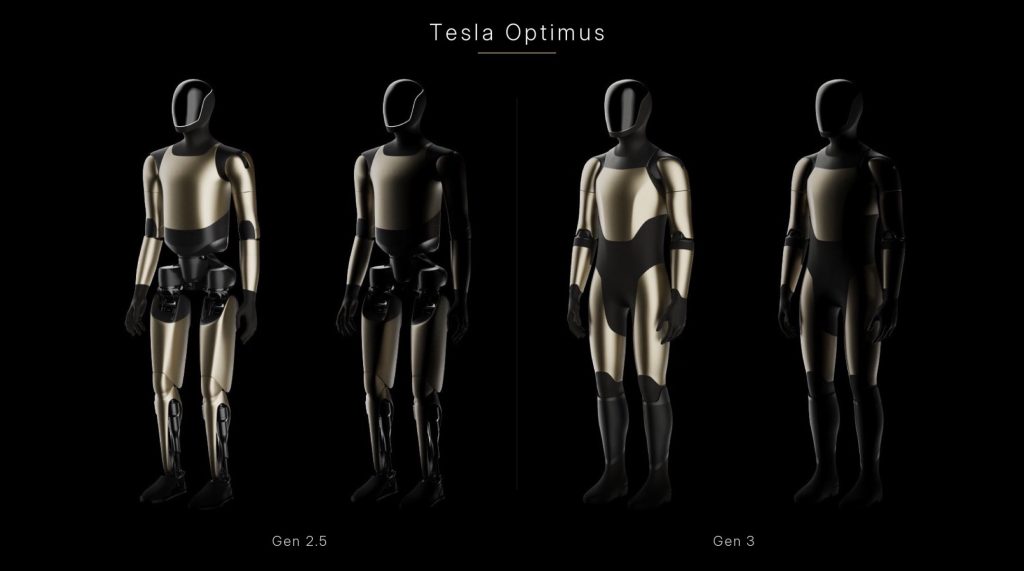
Tesla Optimus Gen 2.5 vs Gen 3 comparison via @WholeMars on X
The files are labeled “gen3” and were built as models for Tesla app’s own interface, as validated directly by Grok to be official.
The comparison shows a robot that looks built for a factory line rather than a lab bench. Gen 2.5’s exposed mechanical linkages and gold plating on the knees and shins are gone. In their place, Gen 3 uses matte black fairings on the lower legs, paired with a more contoured champagne gold body. Flexible covers now seal the joint where the torso meets the upper thighs, keeping bearings and moving parts sealed from debris and unnecessary contact.
The body panels fit more tightly, and the hands, which Tesla has said carry 22 degrees of freedom, look far more refined than those on earlier units.
This most recent leak fills a gap Tesla has left open for most of the year. Elon Musk said on March 31 that Optimus 3 was walking around but needed “some finishing touches” before it could be shown, a delay Teslarati covered when Tesla missed its first quarter reveal target. Musk later said Tesla would hold the design back until closer to production, partly to keep competitors from copying it. No reveal date has been announced.
The app itself has been preparing for Optimus for months. In July, code in the Tesla app pointed to a dedicated robot phone key, a consent screen for collecting video and spatial data while Optimus works inside a home, and an alert system for low battery and mechanical faults. Finished 3D models of Gen 3 suggest the interface owners will eventually use is moving past placeholder code toward something Tesla intends to ship.
Manufacturing is moving in parallel. Tesla tore out the original Model S and Model X lines at Fremont this summer to make room for Optimus production, with a planned capacity of one million robots a year. At Giga Texas, the steel frame of a dedicated Optimus factory is nearing completion ahead of a targeted 2027 start, with Musk pointing to an eventual output of 10 million units annually.
News
Tesla Semi lands the biggest electric truck deal in U.S. history
Tesla leads a record 2,500 truck order, but not every truck will be a Semi.
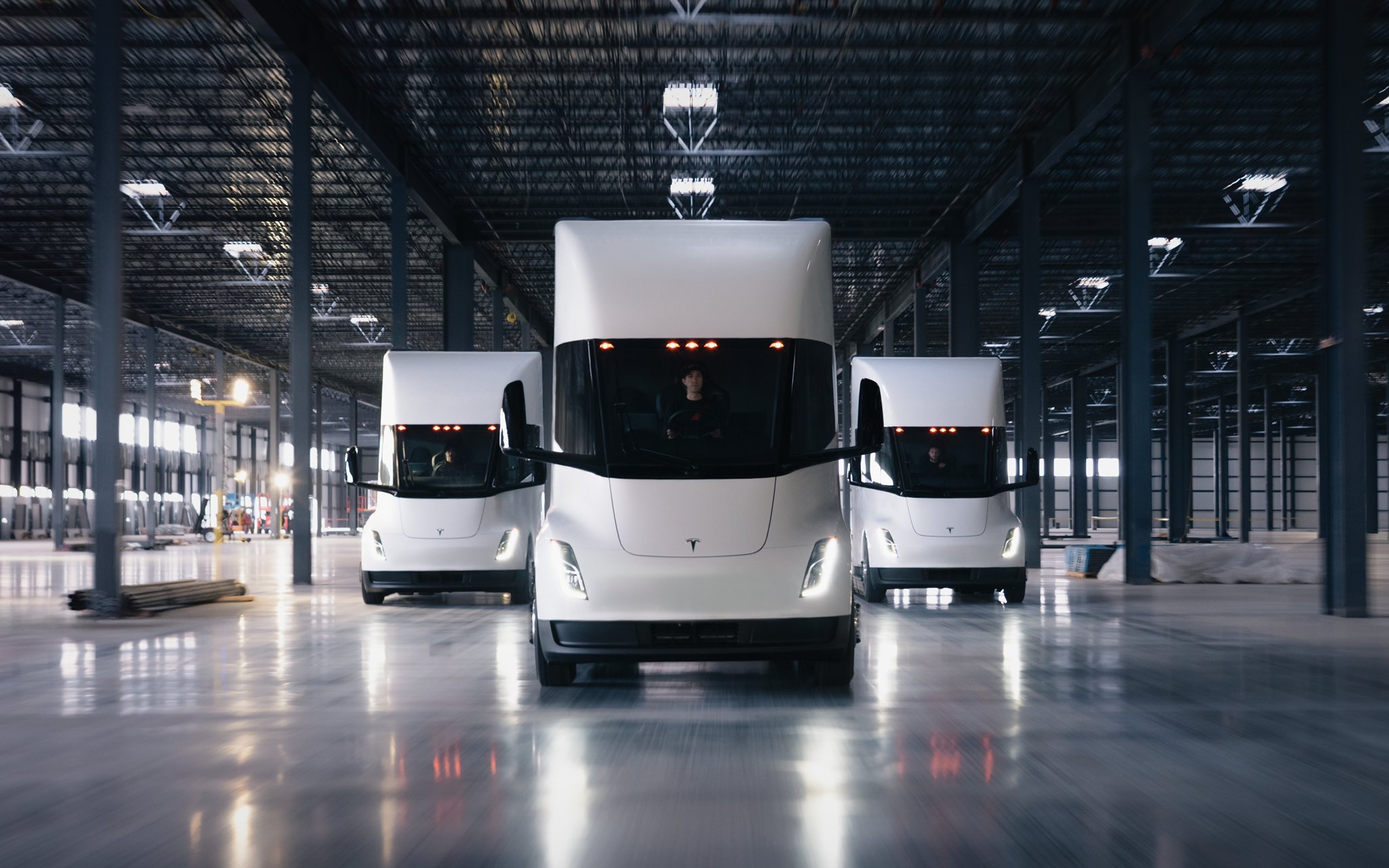
Tesla has landed the largest electric truck order in U.S. history. ZET SCALE, a new alliance of shippers and carriers, named Tesla its primary manufacturer on Tuesday for an initial order of 2,500 electric Class 8 trucks. The deal alone would nearly double the number of electric heavy trucks operating in the country.
According to the press release from Catalyst Mobility, the nonprofit formerly known as CALSTART, Kenworth, RIDE and Volvo were also selected as secondary manufacturers that carriers can pick if their operations call for it. No split between the four brands has been published, so the exact number of Semis in the order is not yet known.
Tesla was selected as the primary OEM for the largest electric Class 8 order in the US by ZET SCALE, a new shippers’ alliance
With 2,500 Semis on order, this will double the entire US electric Class 8 fleet
We’re serious about scale, and ZET SCALE is too!… pic.twitter.com/IiTAdzgken
— Tesla Semi (@tesla_semi) September 22, 2026
Tesla won the top slot through a competitive request for proposals. The alliance, which Catalyst Mobility runs with the Smart Freight Centre, scored bidders on price, range, charging capability and production capacity. Pooling freight demand from founding shippers, including Microsoft and PepsiCo, let every truck maker bid lower than it would for a single fleet. “The Tesla Semi is designed for lower cost per mile operations than diesel,” said Dan Priestley, director of the Tesla Semi program, as noted in the press release.
The financing is built to pull in carriers who have avoided electric trucks. ZET Financial is issuing the purchase order for all 2,500 units and will place them with fleets through a fair market value lease. The trucks will be deployed over the next few years across 10 freight hubs in Los Angeles, Stockton, Bakersfield, Seattle and Tacoma, Houston, Dallas, San Antonio, Chicago, Atlanta, and the Newark and New York area. ZET SCALE says the first order is only the opening round, with a longer term goal of 10,000 trucks or more.
Even if Tesla ends up with only a majority share, it would still be the biggest Semi deal to date. Einride’s 500 unit order in August was the previous record, and WattEV’s 370 truck order in May was the largest California deal at the time. Einride’s CEO has since said he expects all 500 trucks delivered by the end of 2027.
The announcement lands two days before Tesla formally inaugurates its Semi factory in Nevada on September 24. The 1.7 million square foot plant sits next to Gigafactory Nevada’s 4680 cell lines and is designed for 50,000 trucks a year.
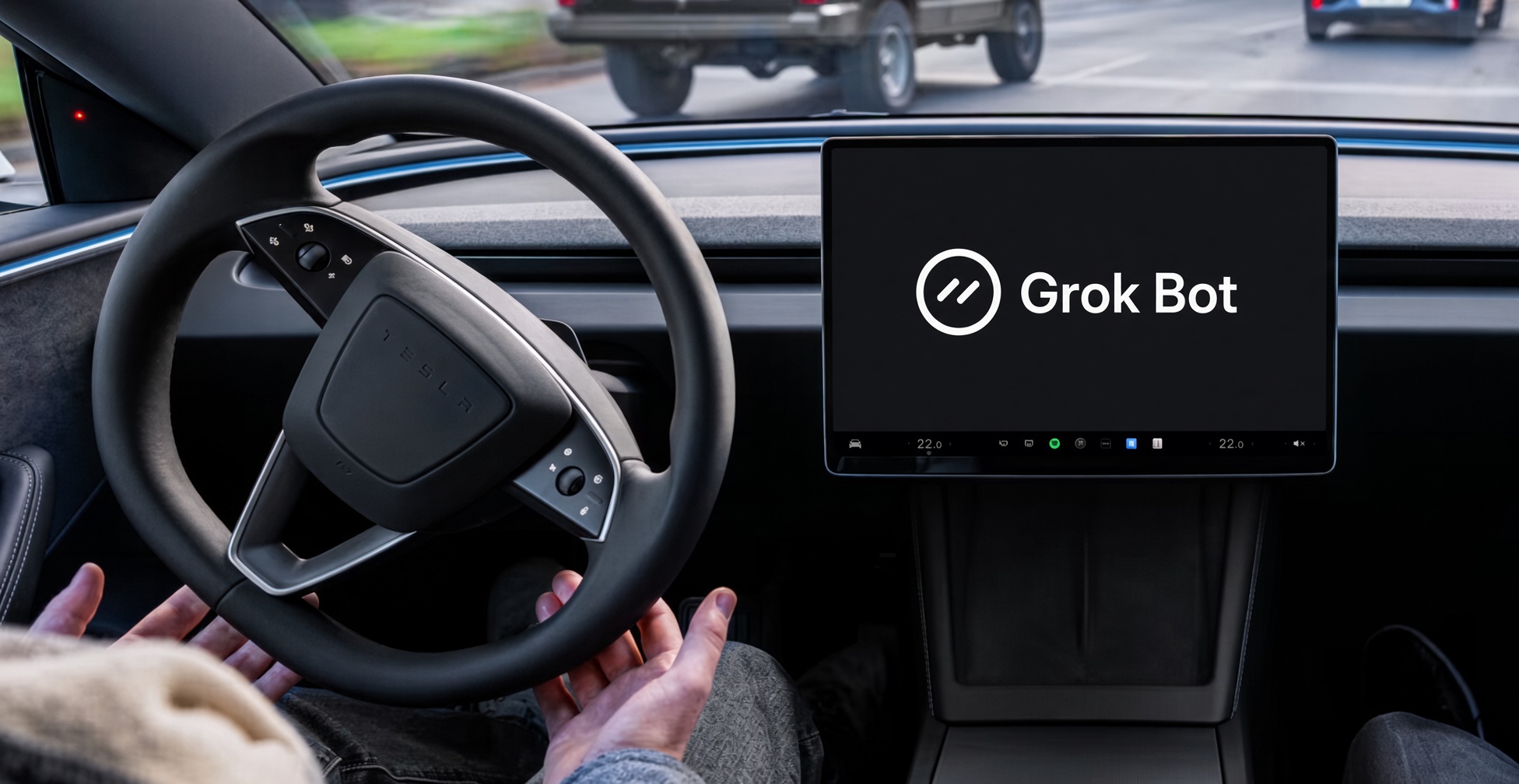
Tesla has expanded Grok from an in-car chatbot into a hands-free work assistant. On September 22, Tesla officially launched Grok Bot capability, confirming that drivers can now manage email, calendars, files, chats, and tasks by voice and then hand more ambitious errands to the AI-fueled productivity cheat code.
Grok itself is built by xAI. The new car features split into two layers: Connectors link Grok to outside accounts. Grok Bot, currently limited to SuperGrok Heavy subscribers, can complete multi-step tasks such as placing a usual coffee order, booking a reservation, or scheduling an appointment. It truly puts the driver in a nearly complete hands-free driving and productivity setting, with ironically the only task truly requiring your hands being to touch the “Start Self-Driving” button.
We were granted access to Grok Bot’s Tesla integration a few weeks back, and we’ve been able to do a handful of things with it. On a handful of occasions, we’ve used it to order food and have it ready for pickup slightly later into the evening; we’ve managed to pick up groceries after a day of errands with Grok Bot, and outside of the car, it’s helped with budgeting and even my fantasy football draft.
We’ve been using @Grok Bot in Tesla for a few weeks after gaining Early Access, which we thank the awesome engineers for
Grok Bot makes things much easier across your entire life. From the Tesla, I’ve used it to place pickup orders for my Fiancée and I, we’ve ordered groceries… https://t.co/ZJSLieG1s5
— TESLARATI (@Teslarati) September 22, 2026
Tesla shows another way to utilize it: in their demo, a driver says “Hey Grok,” asks the assistant to check an inbox, and hears that a message concerns a weekend reservation. Grok then scans the calendar, reports no conflicts, and confirms the Tahoe trip is clear. It can also add check-in details to a road-trip itinerary. The point is not novelty chat. It is keeping eyes on the road, or on Full Self-Driving, while the car handles the paperwork of a trip:
.@Grok in your Tesla can now do meaningful work for you
With Connectors, you can manage your inbox, clean up your calendar, or talk through existing files/chat/tasks – all hands-free pic.twitter.com/W1LuybQh0P
— Tesla (@Tesla) September 22, 2026
This Grok rollout is not a gadget add-on as much as it is Tesla’s thesis in software form: the car should stop being a machine you operate and start being a room you occupy.
Connectors and Grok Bot treat the cabin as an office that happens to move, and that has truly been Tesla’s intention for years now. The car has slowly become an extension of a home more than a vehicle. Inbox, calendar, groceries, takeout, and reservations become voice work, not dashboard chores that you need to do before you get in your car.
Responsibility shifts from the driver to the stack, and as many Tesla owners rely on FSD for travel, Grok Bot now handles the monotony of dinner reservations or appointments.
![Tesla Optimus Gen 3 [Credit: Tesla]](https://www.teslarati.com/wp-content/uploads/2026/03/tesla-optimus-gen3-diner-80x80.jpg)
Tesla Optimus Gen 3 shows off a cleaner, factory-ready design in new app discovery

Tesla Semi lands the biggest electric truck deal in U.S. history


