Lifestyle
Tesla Hacker reveals impressive ‘off-grid’ home powered by Model S batteries

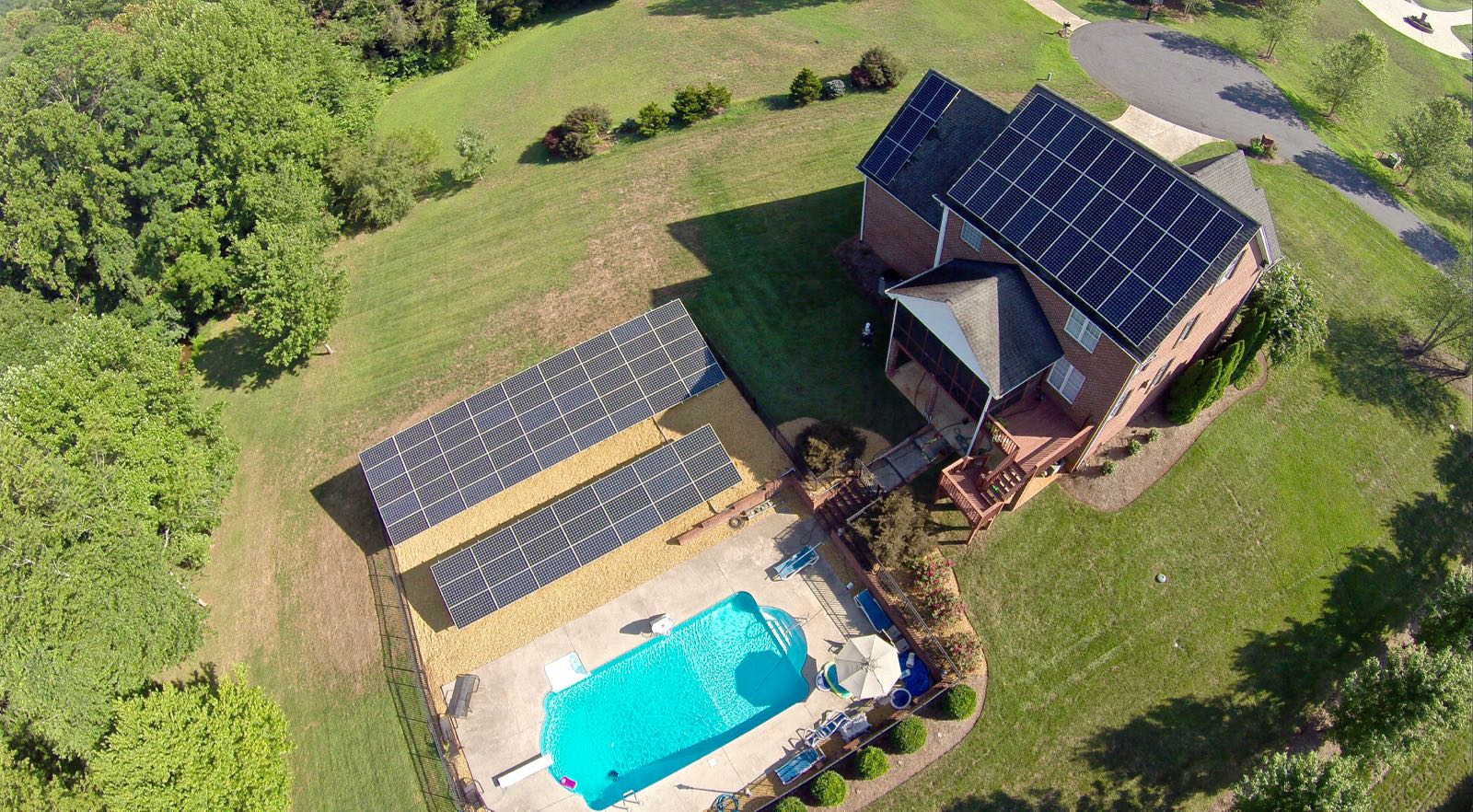
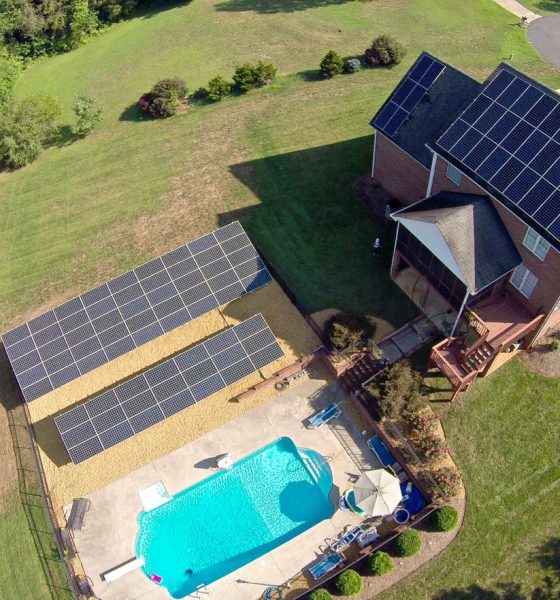
Jason Hughes, white hat hacker who’s perhaps best known as the man who leaked Tesla’s plans for a P100D a half year ahead of the company’s actual announcement, has revealed photos of his impressive Tesla battery powered compound in North Carolina. The 4,500 square-foot home utilizes 102 commercial-grade solar panels to capture energy from the sun which then gets stored into a home battery storage unit composed of battery modules ripped from two Tesla Model S 85 kWh packs.
The 44.4 kW home solar system produces enough energy to not only power the entire home and all of its electrical appliances, but also provides enough energy to charge a pair of his and hers Model S each day. The end result is an elaborate home-engineered system that took roughly a year to design and build, and has allowed Hughes and his family to remain 99% ‘off-grid’ for the past year. A measly $200 was paid to the utility company for the entire year, most of which, according to Hughes, was a base connection fee to keep the meters operational.
The battery banks used for storing solar energy are derived from battery packs found from a salvaged Model S. Hughes dismantled the packs to create a stacked array of battery modules. A total of 36 modules are used in the home set up which equates to 2.25x Model S 85 kWh battery packs. Here’s a video of Hughes performing a teardown of one of the Model S battery packs.
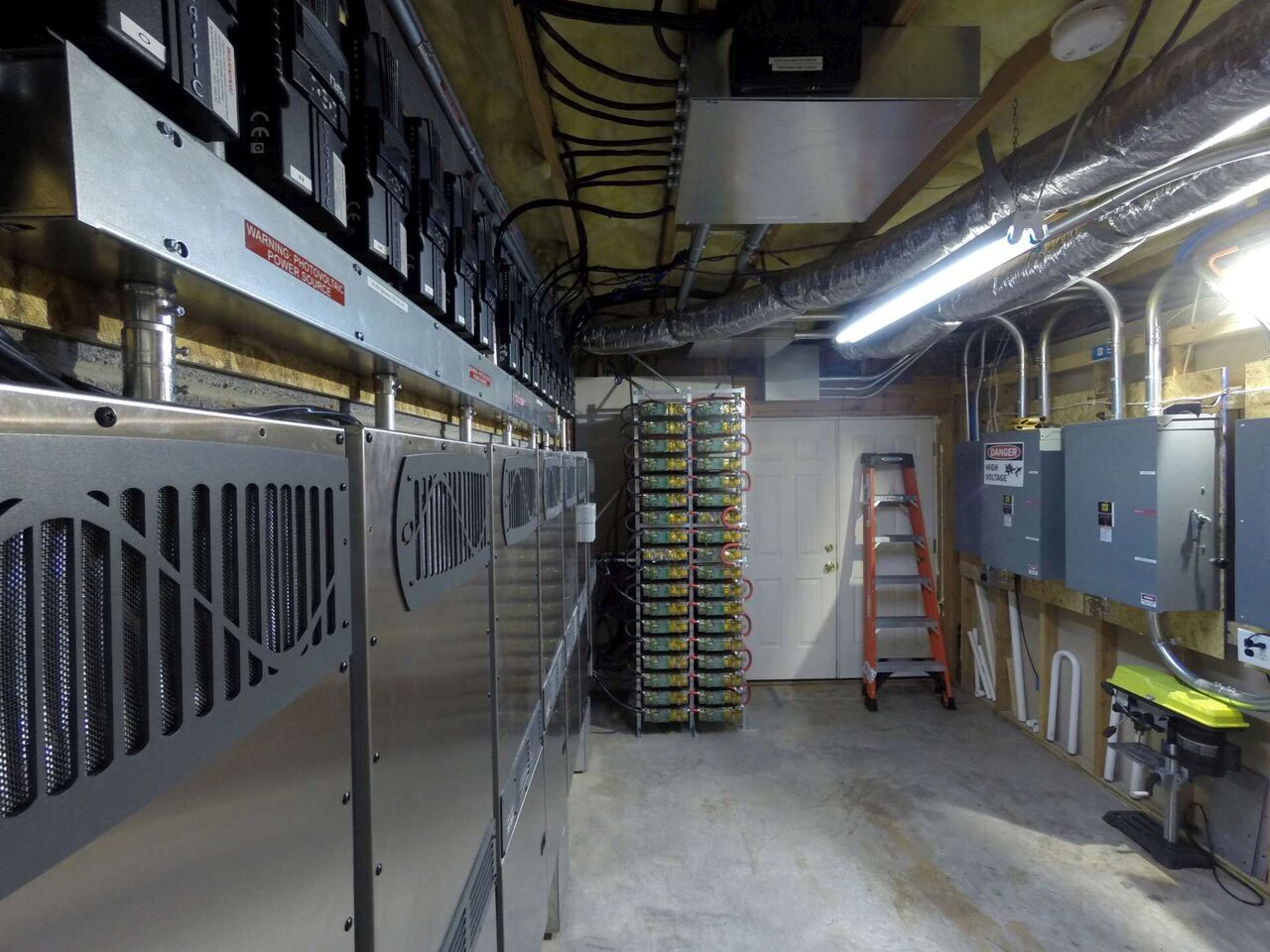
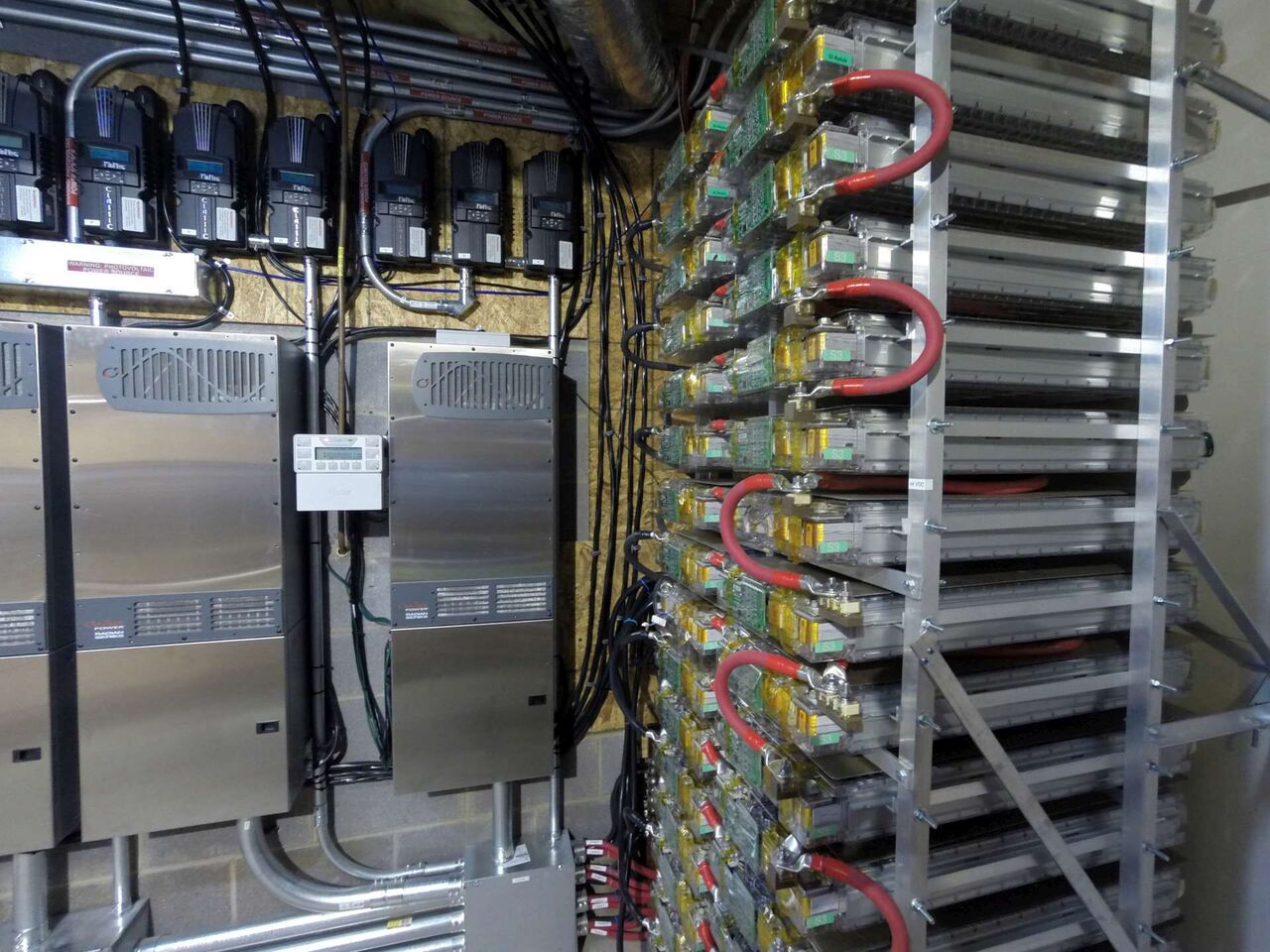
Source: skie.net
Hughes tells us that inquiries on cost are probably the number one question he gets asked. A large portion of the overall expenditure went to the $40k cost in Tesla batteries. He admits that the project likely doesn’t make sense from a financial perspective given that his utility rate is only billed at a flat $.11/kWh, but it’s important to understand that the value of his project goes beyond what a cost benefit analysis may yield.
Beyond being able to show that living solely off of sustainable energy is possible, the main inspiration behind his yearlong project was his father who taught him at a young age of 9 how to build a small off-grid solar system that produced enough energy to power his bedroom light, a small TV and a PC. That became the catalyst to what would become a lifelong dream to design an off-grid system capable of powering an entire house, along with electric vehicles.
Home Solar System with Tesla Battery
- 36 modules from 2.25x Tesla 85kWh packs
- 191.25 kWh (DC side)
- ~4,200 Ah
- 43.2V nominal @ 3.6V per cell
- 15,984 cells (!)
- Inverters: 8x Outback Radian GS8048A
- 240VAC @ 60Hz w/neutral
- 64kW continuous AC output
- 30 minute surge: 72kW; 5 second surge: 96kW; 100ms surge: 135.76kW
- Grid->Battery Charging Capacity: 57kW
- Expected AC output from pack after safe SoC window and efficiency considerations: ~160 kWh usable AC power
- PV: 102 Sunpower Commercial Panels @ 435W (20% efficiency) for 44,370 Watts DC
- Split into 17 sets of 6 panels (3 parallel of 2 in series)
- 17 individual MPPT charge controllers (Midnite Solar Classic 200)


Cybertruck
Chattanooga Charge: Tesla and EV fans ready for the Southeast’s wildest Tesla party
From Cybertruck Convoys to Kid-Friendly Fun Zones: The Chattanooga Charge Has Something for Everyone
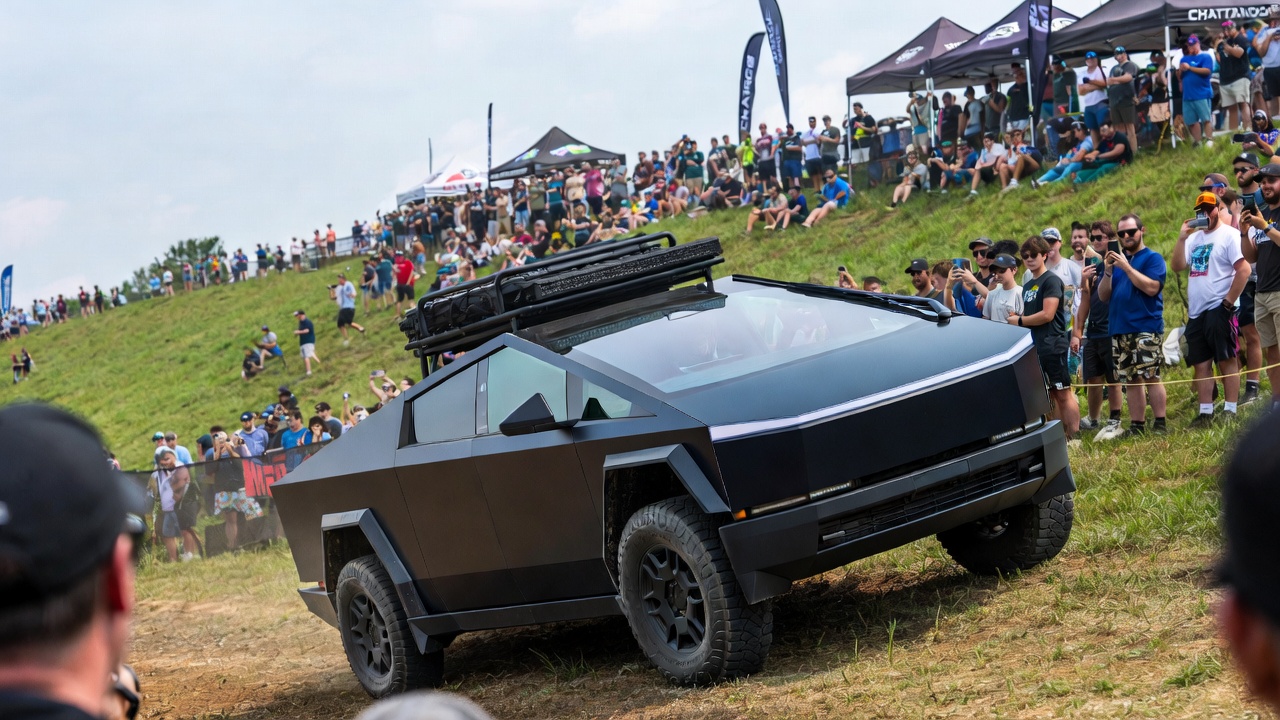
Hundreds of like-minded Tesla and EV enthusiasts are descending on Chattanooga Charge this weekend for the largest Tesla meet in the Southeast. Taking place on March 20–22, 2026 at the stunning Tennessee Riverpark.
If you were there last year, you’ll know that it’s the ultimate experience to see the wildest Teslas in action, see the best in EV tech, and arguably the most fun – finally put a name to the face and connect with those social media buddies IRL! Oh, and that epic night time Tesla light show is a once-in-a-lifetime experience that will transform the Riverpark into something out of a sci-fi film that’s remarkably unforgettable and must be seen in person.
This year’s event takes everything up a notch, with over 100 Cybertrucks expected to be on display, many sporting jaw-dropping modifications and custom wraps that push the boundaries of what these stainless steel beasts can look like.
Whether you’re a diehard Tesla fan, EV supporter, or just EV-mod-curious, the sheer spectacle is worth the drive.
The Chattanooga Charge doesn’t wait until Saturday morning to get started. The weekend technically kicks off Friday, March 20th, and the venue sets the tone immediately. Come share roadtrip stories over drinks at the W-XYZ Rooftop Bar on the top floor of the Aloft Chattanooga Hamilton Place Hotel, with sunset views over the city.
Come morning, nurse your hangover with a some good coffee, and convoy with hundreds of other Tesla and EV drivers through Chattanooga to the event for some morning meet and greets before the speaker panel starts and the food trucks fire up.
Tesla owner clubs travel from across the country to be here, not just to show off their vehicles,, but to connect, share, and celebrate a shared passion for the future of driving.
Sounds like a plan to me. See you there, guys. Don’t miss it. Get your tickets at ChattanoogaCharge.com and join the charge. 🔋⚡
Chattanooga Charge is a premier Tesla and EV gathering inspired by the X Takeover, known as one of the largest Tesla event gatherings. What began as a bold idea from the team at DIY Wraps/TESBROS, hosted in their hometown of Chattanooga, Tennessee, the event quickly became a movement across social media. The first annual Chattanooga Charge united over 16 Tesla clubs from 16 states, proof that the EV community was hungry for something big in the South. Year after year, the event has grown in scale, ambition, and heart.
Lifestyle
Tesla Model S Plaid battles China’s 1500 hp monster Nurburgring monster, with surprising results
There is just something about Tesla’s tuning and refinement that makes raw specs seem not as game-changing.

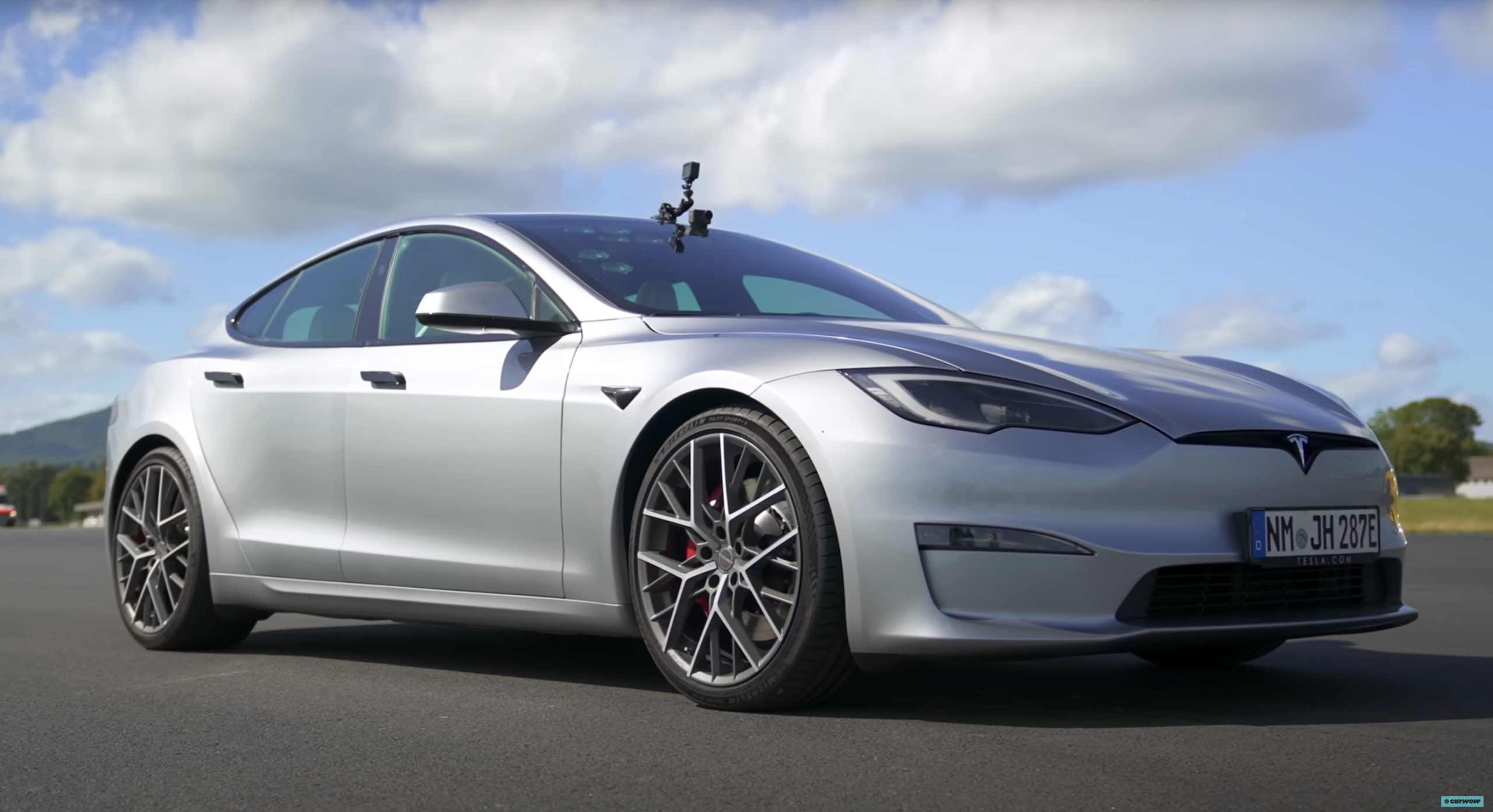
The Tesla Model S Plaid has been around for some time. Today, it is no longer the world’s quickest four-door electric sedan, nor is it the most powerful. As per a recent video from motoring YouTube channel Carwow, however, it seems like the Model S Plaid is still more than a match for some of its newer and more powerful rivals.
The monster from China
The Xiaomi SU7 Ultra is nothing short of a monster. Just like the Model S Plaid, it features three motors. It also has 1,548 hp and 1,770 Nm of torque. It’s All Wheel Drive and weighs a hefty 2,360 kg. The vehicle, which costs just about the equivalent of £55,000, has been recorded setting an insane 7:04.957 at the Nurburgring, surpassing the previous record held by the Porsche Taycan Turbo GT.
For all intents and purposes, the Model S Plaid looked outgunned in Carwow’s test. The Model S Plaid is no slouch with its three motors that produce 1,020 hp and 1,420 Nm of torque. It’s also a bit lighter at 2,190 kg despite its larger size. However, as the Carwow host pointed out, the Model S Plaid holds a 7:25.231 record in the Nurburgring. Compared to the Xiaomi SU7 Ultra’s record, the Model S Plaid’s lap time is notably slower.
Real-world tests
As could be seen in Carwow’s drag races, however, Tesla’s tech wizardry with the Model S Plaid is still hard to beat. The two vehicles competed in nine races, and the older Model S Plaid actually beat its newer, more powerful counterpart from China several times. At one point in the race, the Xiaomi SU7 Ultra hit its power limit due to its battery’s temperature, but the Model S Plaid was still going strong.
The Model S Plaid was first teased five years ago, in September 2020 during Tesla’s Battery Day. Since then, cars like the Lucid Air Sapphire and the Xiaomi SU7 Ultra have been released, surpassing its specs. But just like the Model Y ended up being the better all-rounder compared to the BYD Sealion 7 and the MG IM6, there is just something about Tesla’s tuning and refinement that makes raw specs seem not as game-changing.
Check out Carwow’s Model S Plaid vs Xiaomi SU7 drag race video below.
Lifestyle
500-mile test proves why Tesla Model Y still humiliates rivals in Europe
On paper, the BYD Sealion 7 and MG IM6 promised standout capabilities against the Model Y.
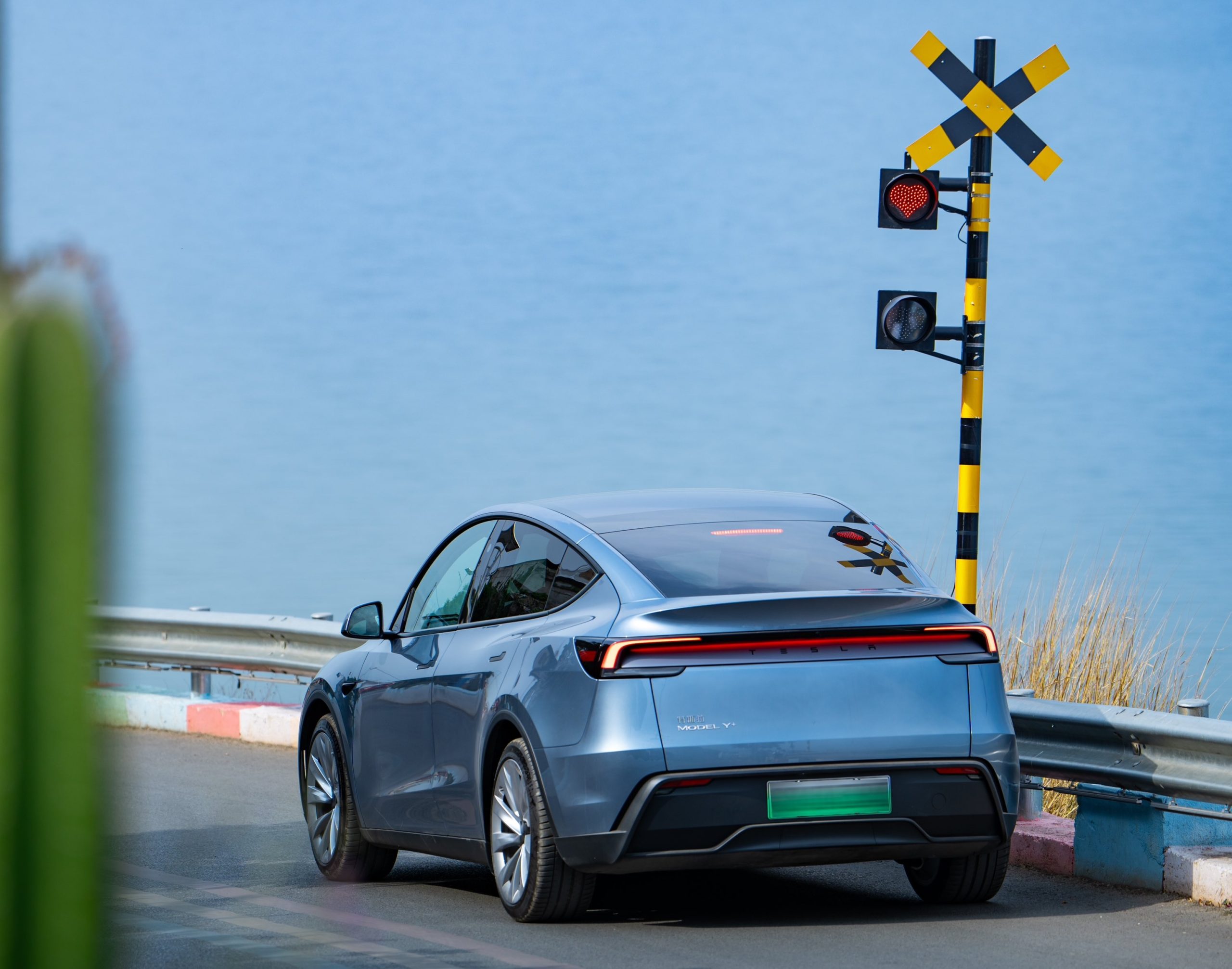
BYD is seeing a lot of momentum in Europe, so much so that mainstream media has taken every opportunity to argue that the Chinese automaker has beaten Tesla in the region. But while BYD sales this year in Europe are rising and Tesla’s registrations remain challenged, the raw capabilities of vehicles like the Model Y are difficult to deny.
This was highlighted in a 500-mile challenge by What Car? magazine, which showed that the new Tesla Model Y is more efficient, cheaper to run, and more reliable than rivals like the BYD Sealion 7, and even the nearly 400 KW-charging MG IM6.
Range and charging promises
On paper, the BYD Sealion 7 and MG IM6 promised standout capabilities against the Model Y. The Sealion 7 had more estimated range and the IM6 promised significantly faster charging. When faced with real-world conditions, however, it was still the Model Y that proved superior.
During the 500-mile test, the BYD nearly failed to reach a charging stop, arriving with less range than its display projected, as noted in a CarUp report. MG fared better, but its charging speeds never reached its promised nearly-400 kW charging speed. Tesla’s Model Y, by comparison, managed energy calculations precisely and arrived at each stop without issue.
Tesla leads in areas that matter
Charging times from 25% to 80% showed that the MG was the fastest at 17 minutes, while Tesla and BYD were close at 28 and 29 minutes, respectively. Overall efficiency and cost told a different story, however. The Model Y consumed 19.4 kWh per 100 km, compared to 22.2 for MG and 23.9 for BYD. Over the full trip, Tesla’s charging costs totaled just £82 thanks to its supercharger network, far below BYD’s £130 and MG’s £119.
What Car? Magazine’s testers concluded that despite BYD’s rapid sales growth and the MG IM6’s seriously impressive charging speeds, Tesla remains the more compelling real-world choice. The Model Y just offers stability, efficiency, and a proven charging infrastructure through its Supercharging network. And as per the magazine’s hosts, the Model Y is even the cheapest car to own among the three that were tested.
Watch What Car? Magazine’s 500-mile test in the video below.

SpaceX is quietly becoming the U.S. Military’s only reliable rocket

Tesla Full Self-Driving gets huge breakthrough on European expansion


