Lifestyle
Tesla loves Veterans: Here’s how the company has honored military heroes

On this Veteran’s Day 2020, Teslarati thanks all of the heroes who have sacrificed their freedoms to protect ours. In the theme of the day, we decided to take a look back at how Tesla has honored the heroes who have served in the military over the years. From camo-inspired EVs to Veteran’s hiring programs, the electric automaker has portrayed an appreciation for those who fought to keep us free.
2014: The Camo Model S and a heartfelt “Thank You”
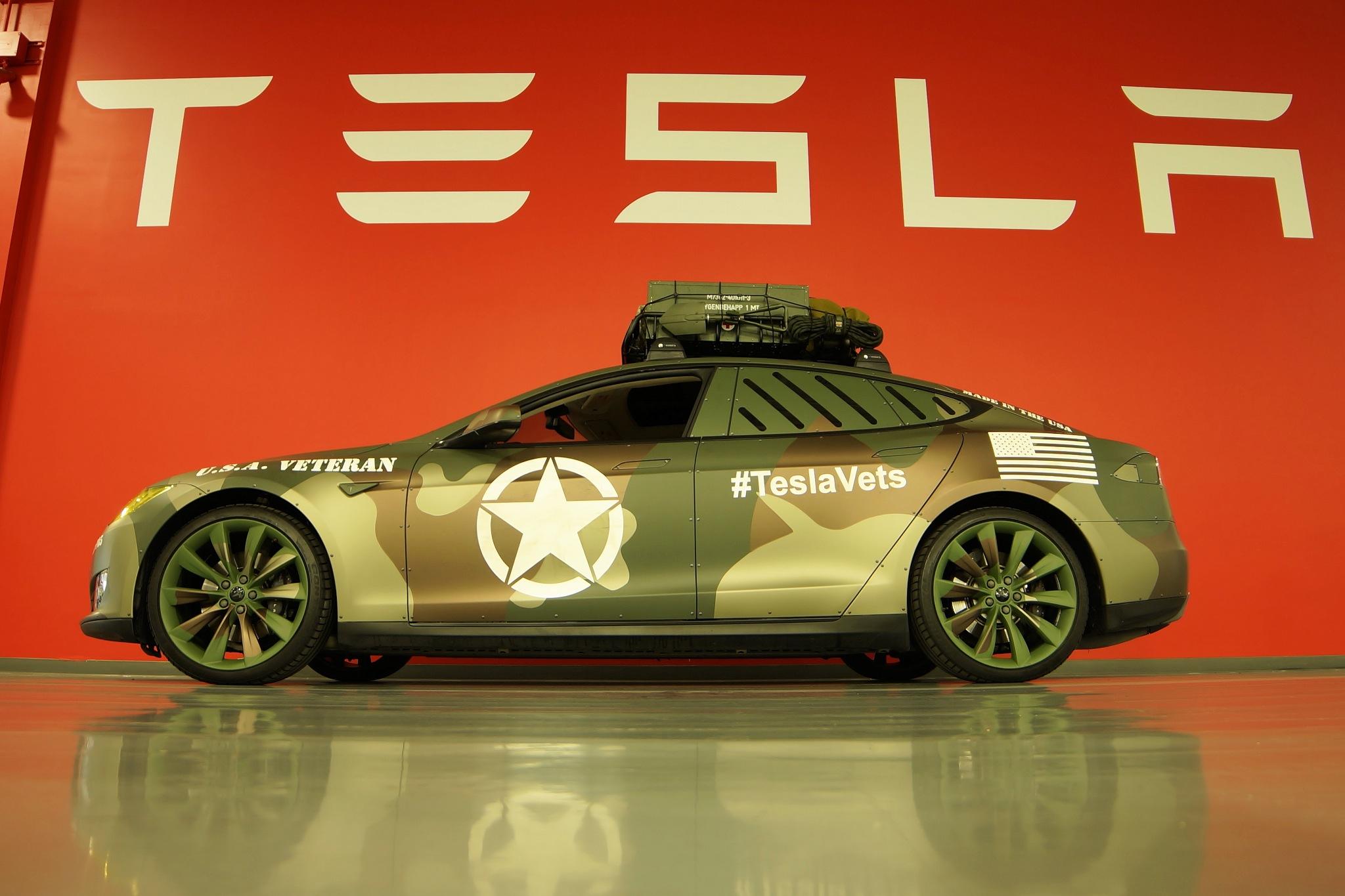
In 2014, Tesla tweeted several photographs of a military-inspired Model S, dawning images of American flags and spelling the words “U.S.A. Veteran,” “Made in the USA,” and “#TeslaVets.” The camo Model S hasn’t made an appearance since then. However, the message is still present on Tesla’s official Twitter page, reminding everyone that the company is overwhelmingly supportive of our Veterans.
A heartfelt Veterans Day thank you to all who have served. #TeslaVets #VeteransDay pic.twitter.com/Eynq2wzXr7
— Tesla (@Tesla) November 11, 2014
2017: A collaboration with SS Customs, Unplugged Performance, and EVannex
Like its 2014 shoutout to veterans, Tesla designed a new Model S with a digital camo-themed wrap thanks to SS Customs and special aftermarket parts from Unplugged Performance and EVannex. The vehicle arrived at San Francisco National Cemetery on Memorial Day in 2017, honoring the fallen heroes who gave the ultimate sacrifice to protect our freedoms.
https://twitter.com/DrTaras_TESLA/status/869287469149114368?s=20
Veteran Employment Program
Military.com reported that Tesla’s hiring ramp of veterans was taking off as their experience made them a “perfect fit” for Tesla. Former Director of Communications for Tesla, Camille Ricketts, stated:
“Veterans are the perfect fit for Tesla because many of them gained incredibly advanced technical, electrical, and mechanical skills in the service that are directly applicable to manufacturing electric vehicles. Veterans are taught to be leaders within the context of a cooperative team, and that is exactly how Tesla works – allowing employees to think outside the box while working hard toward a common goal. Hiring veterans is very complementary to Tesla’s other mission to move the world toward energy security and independence.”
The company also launched a video that outlined its Veterans Program in 2017.
The company wrote:
“At Tesla, you will utilize your military skillset to the fullest: dedication to mission success, technical expertise, leadership acumen, ability to thrive under pressure, recognizing the value of teamwork, among the countless other strengths you forged in the service.”
Tesla Veterans Program from Tesla, Inc on Vimeo.


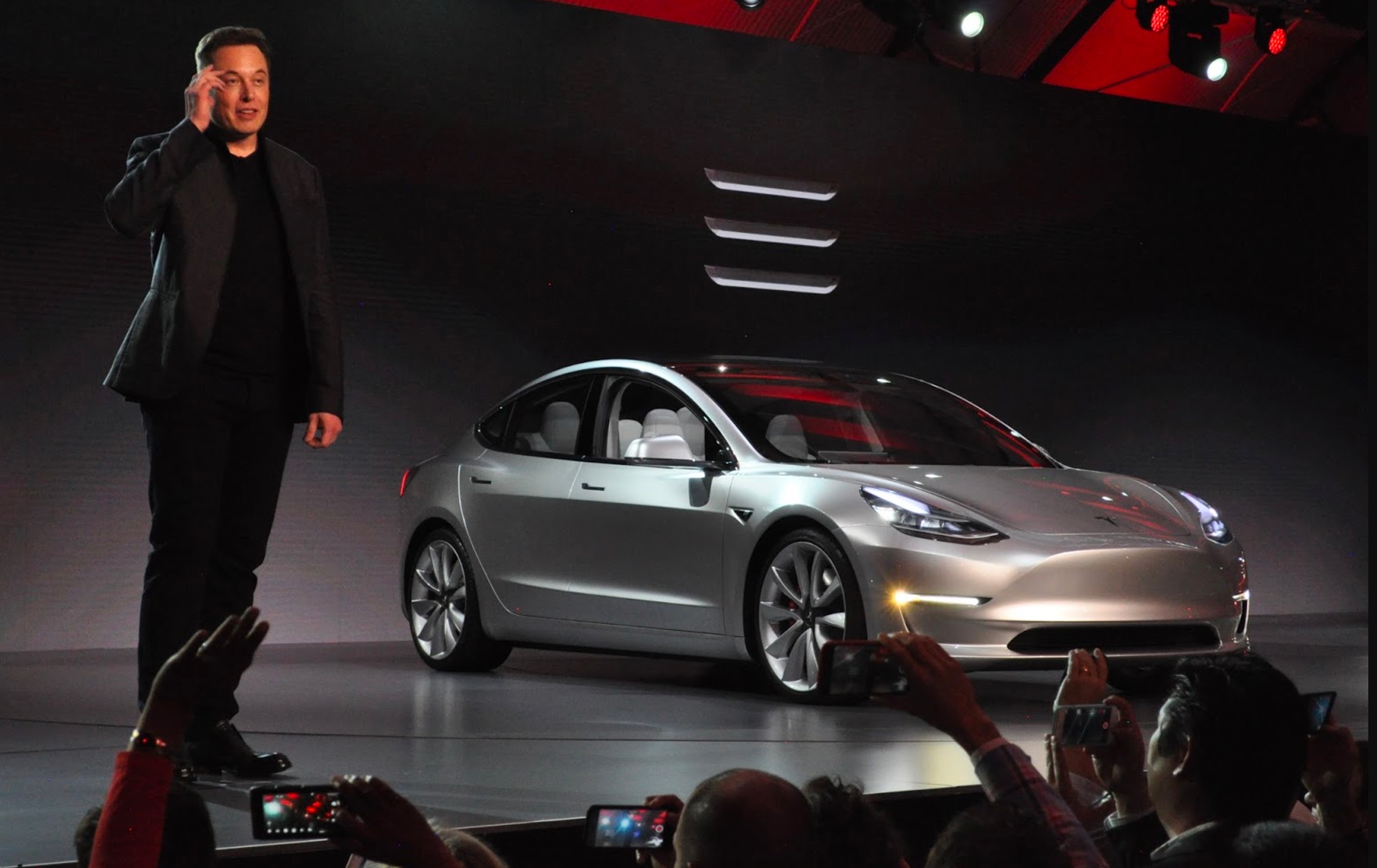
Tesla has taken home the “Overall Loyalty to Make” award from S&P Global Mobility for the fourth consecutive year, reinforcing Tesla owners’ willingness to come back. The 2025 awards are based on S&P Global Mobility’s analysis of 13.6 million new retail vehicle registrations in the U.S. from October 2024 through September 2025. The complete list of 2025 winners includes General Motors for Overall Loyalty to Manufacturer, Tesla for Overall Loyalty to Make, Chevrolet Equinox for Overall Loyalty to Model, Mini for Most Improved Make Loyalty, Subaru for Overall Loyalty to Dealer, and Tesla again for both Ethnic Market Loyalty to Make and Highest Conquest Percentage.
Tesla’s streak in this category started in 2022, and the brand has now won the Highest Conquest Percentage award for six straight years, meaning it keeps pulling buyers away from other brands at a rate no competitor has matched. Tesla’s retention among Asian households reached 63.6% and among Hispanic households 61.9%, rates that significantly outpace national averages for those groups. That breadth of appeal across demographics adds a layer of significance to a win that some might dismiss as routine.
The timing matters too. After several consecutive quarters of decline, Tesla’s share of U.S. EV sales jumped to 59% in Q4 2025. That rebound, arriving just as competitors were flooding the market with new models and incentives, suggests Tesla’s loyalty numbers are not simply the result of limited alternatives. Buyers are still choosing it when they have plenty of other options.
What keeps Tesla owners coming back has a lot to do with the and convenience of charging. The Supercharger network is the most straightforward example. With over 65,000 Superchargers globally, it remains the largest and most reliable fast-charging network in the world, and owners who have built their routines around it face a real practical cost when considering a switch. Competitors have made progress, but the consistency, speed, and availability of Tesla’s network is still the benchmark the rest of the industry is chasing. Then there is the software side. Tesla has built a model where the car you own today is functionally different from the car you bought two years ago, through over-the-air updates that add continuous game-changing improvements such as Full Self-Driving that has moved from a driver-assist feature to an increasingly capable autonomous system. For many Tesla owners, leaving the brand means starting over with a car that will not get meaningfully better over time, and that is a trade-off fewer and fewer are willing to make.
Cybertruck
Tesla Cybercab just rolled through Miami inside a glass box
Tesla paraded a Cybercab in a glass display at Miami’s F1 Grand Prix event this week.

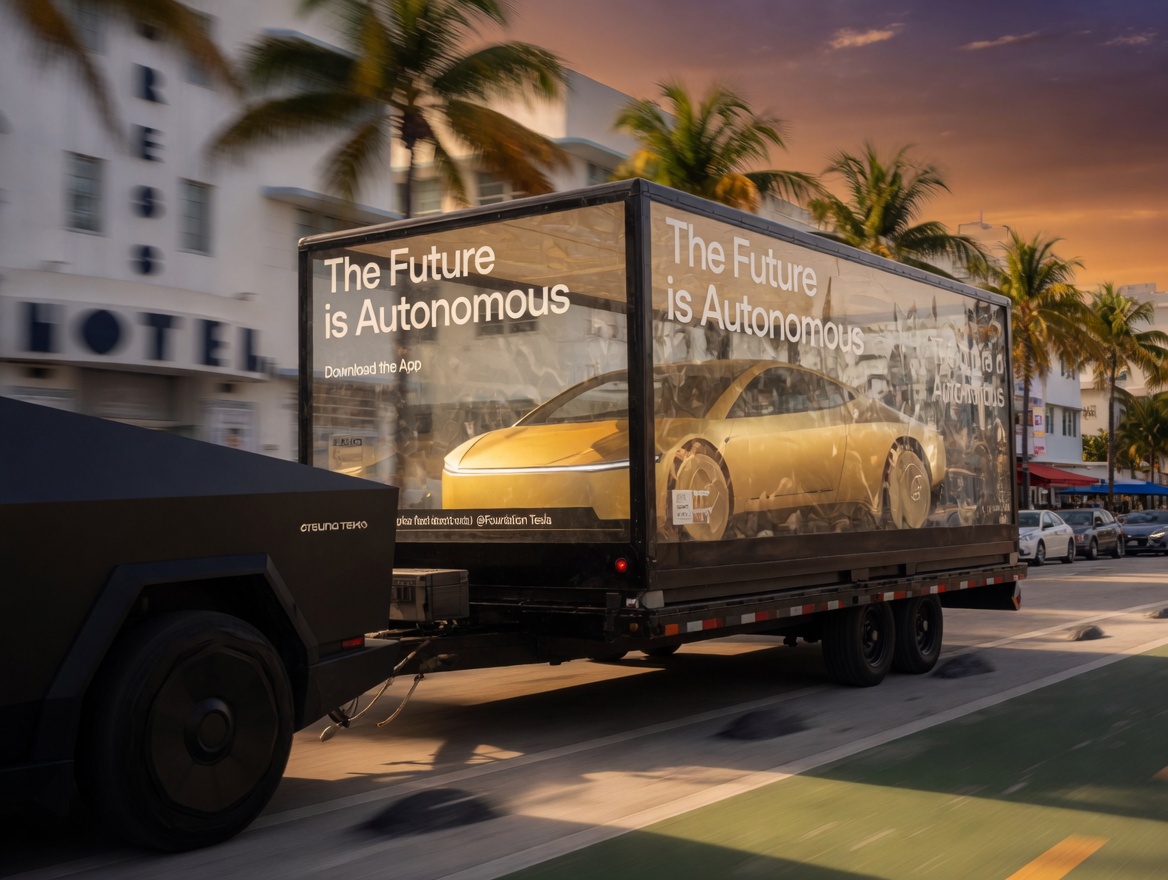
Tesla set up an “Autonomy Pop-Up” at Lummus Park in Miami Beach from April 29 through May 3, 2026, embedded within the official F1 Miami Grand Prix Fan Fest. The centerpiece was a Cybertruck towing the Cybercab inside a glass display case marked “Future is Autonomous,” rolling through the beachfront crowd.
Miami is on Tesla’s confirmed list of cities for robotaxi expansion in the first half of 2026, making the promotion a strategic promotion that lays groundwork in a target market.
This was not Tesla’s first time using Miami as a showcase city. In December 2025, Tesla hosted “The Future of Autonomy Visualized” at its Miami Design District showroom, coinciding with Art Basel Miami Beach. That event featured the Cybercab prototype and Optimus robots interacting with attendees. The F1 pop-up this week marks Tesla’s return to Miami and follows a pattern Tesla has been running since early 2026. Just two weeks before Miami, Tesla stationed Optimus at the Tesla Boston Boylston Street showroom on April 19 and 20, directly on the final stretch of the Boston Marathon, letting tens of thousands of runners and spectators meet the robot for free, generating massive earned media at zero advertising cost.
Tesla is sending its humanoid Optimus robot to the Boston Marathon
Tesla has confirmed plans to expand its robotaxi service to seven cities in the first half of 2026, including Dallas, Houston, Phoenix, Miami, Orlando, Tampa, and Las Vegas, building on the unsupervised service already running in Austin. Musk has said he expects robotaxis to cover between a quarter and half of the United States by end of year. On the production side, Musk told shareholders that the Cybercab manufacturing process could eventually produce up to 5 million vehicles per year, targeting a cycle time of one unit every ten seconds. Scaling robotaxis to 10 million operational units over the next ten years is a key condition of his compensation package, alongside selling 20 million passenger vehicles.
As for the Cybercab’s price, Musk has said buyers will be able to purchase one for under $30,000, with an average operating cost around $0.20 per mile. Whether those numbers hold through full production remains to be seen.
Cybercab at F1 Fan Fest in Miami
by
u/Joshalander in
teslamotors
Lifestyle
California hits Tesla Cybercab and Robotaxi driverless cars with new law
California just gave police power to ticket driverless cars, including Tesla’s Cybercab fleet.
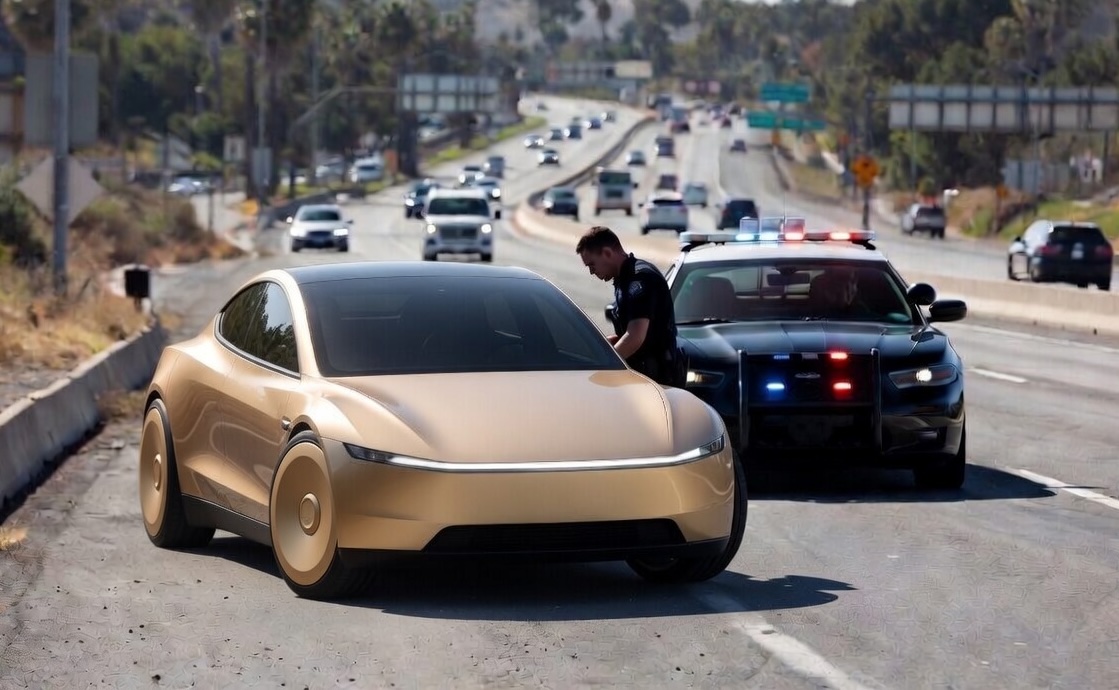
California DMV formally adopted new rules on April 29, 2026 that allow law enforcement to issue “notices of noncompliance”, or in other words ticket autonomous vehicle companies when their cars commit moving violations. The rules take effect July 1, 2026 and officially closes a regulatory gap that previously let driverless cars operate on public roads with nearly no traffic enforcement consequences.
Until now, state traffic laws only applied to human “drivers,” which meant that when no person was behind the wheel, police had no mechanism to issue a ticket. Officers were limited to citing driverless vehicles for parking violations only. A well-known example came in September 2025, when a San Bruno officer watched a Waymo robotaxi execute an illegal U-turn and could do nothing but notify the company.
Under the new framework, when an officer observes a violation, the autonomous vehicle company is effectively treated as the driver. Companies must report each incident to the DMV within 72 hours, or 24 hours if a collision is involved. Repeated violations can result in fleet size restrictions, operational suspensions, or full permit revocation. Local officials also gained new authority to geofence driverless vehicles out of active emergency zones within two minutes and require a live emergency response line answered within 30 seconds.
Tesla Cybercab ramps Robotaxi public street testing as vehicle enters mass production queue
California’s new enforcement rules arrive at a pivotal moment for Tesla. The company is ramping Cybercab production at Giga Texas toward hundreds of units per week, targeting at least 2 million units annually at full capacity, while simultaneously pushing to expand its Robotaxi service to dozens of U.S. cities by end of 2026. Unsupervised FSD for consumer vehicles is currently targeted for Q4 2026, and when it arrives, Tesla’s fleet may not have a human to absorb legal accountability, under the July 1 rules.
Tesla has confirmed plans to expand its Robotaxi service to seven new cities in the first half of 2026, including Dallas, Houston, Phoenix, Miami, Orlando, Tampa, and Las Vegas, with the service already running without safety drivers in Austin. Musk has said he expects robotaxis to cover between a quarter and half of the United States by end of year.

Tesla gets a massive order for the Semi: 370 units and $100M

Tesla begins factoring international designs in Full Self-Driving visualization


