Elon Musk
Tesla investors will be shocked by Jim Cramer’s latest assessment
Jim Cramer is now speaking positively about Tesla, especially in terms of its Robotaxi performance and its perception as a company.

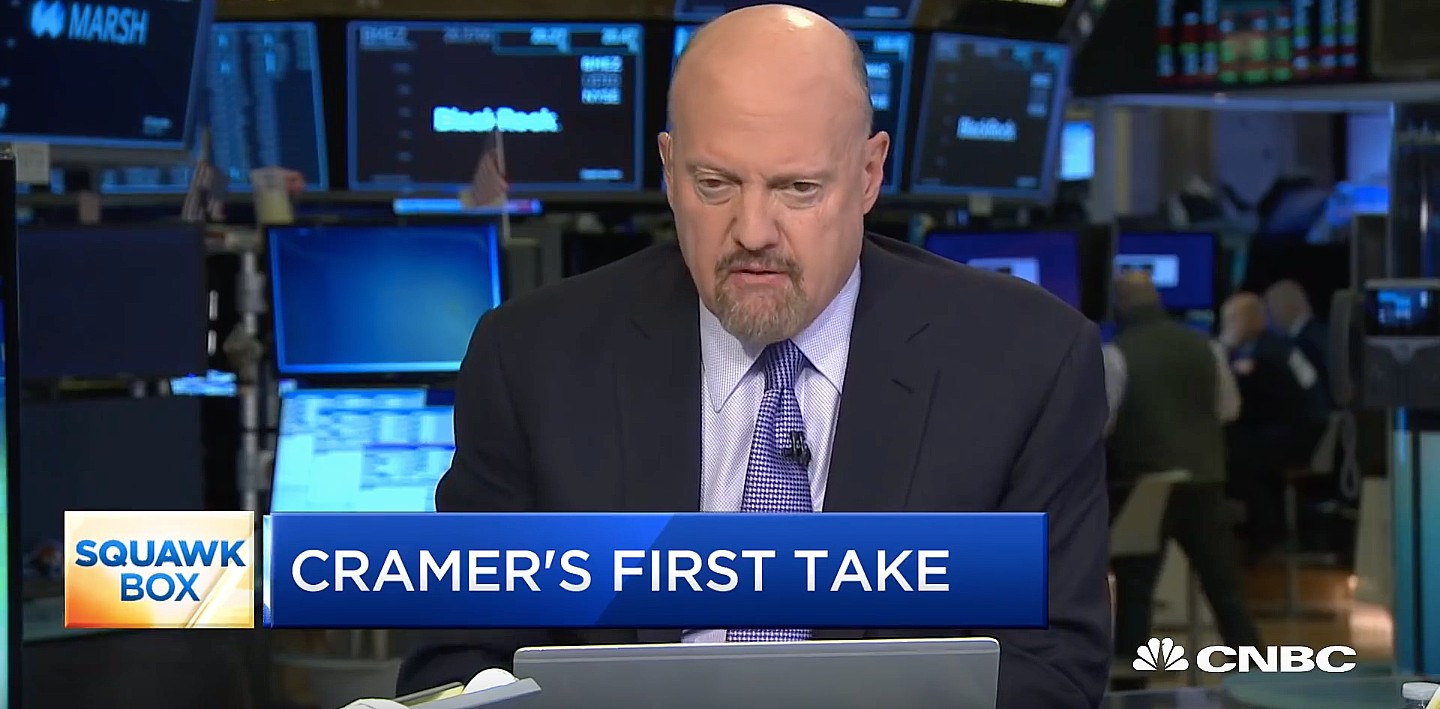
Tesla investors will be shocked by analyst Jim Cramer’s latest assessment of the company.
When it comes to Tesla analysts, many of them are consistent. The bulls usually stay the bulls, and the bears usually stay the bears. The notable analysts on each side are Dan Ives and Adam Jonas for the bulls, and Gordon Johnson for the bears.
Jim Cramer is one analyst who does not necessarily fit this mold. Cramer, who hosts CNBC’s Mad Money, has switched his opinion on Tesla stock (NASDAQ: TSLA) many times.
He has been bullish, like he was when he said the stock was a “sleeping giant” two years ago, and he has been bearish, like he was when he said there was “nothing magnificent” about the company just a few months ago.
Now, he is back to being a bull.
Cramer’s comments were related to two key points: how NVIDIA CEO Jensen Huang describes Tesla after working closely with the Company through their transactions, and how it is not a car company, as well as the recent launch of the Robotaxi fleet.
Jensen Huang’s Tesla Narrative
Cramer says that the narrative on quarterly and annual deliveries is overblown, and those who continue to worry about Tesla’s performance on that metric are misled.
“It’s not a car company,” he said.
He went on to say that people like Huang speak highly of Tesla, and that should be enough to deter any true skepticism:
“I believe what Musk says cause Musk is working with Jensen and Jensen’s telling me what’s happening on the other side is pretty amazing.”
Tesla self-driving development gets huge compliment from NVIDIA CEO
Robotaxi Launch
Many media outlets are being extremely negative regarding the early rollout of Tesla’s Robotaxi platform in Austin, Texas.
There have been a handful of small issues, but nothing significant. Cramer says that humans make mistakes in vehicles too, yet, when Tesla’s test phase of the Robotaxi does it, it’s front page news and needs to be magnified.
He said:
“Look, I mean, drivers make mistakes all the time. Why should we hold Tesla to a standard where there can be no mistakes?”
It’s refreshing to hear Cramer speak logically about the Robotaxi fleet, as Tesla has taken every measure to ensure there are no mishaps. There are safety monitors in the passenger seat, and the area of travel is limited, confined to a small number of people.
Tesla is still improving and hopes to remove teleoperators and safety monitors slowly, as CEO Elon Musk said more freedom could be granted within one or two months.


Elon Musk
SpaceX showcases exactly how it plans to catch Starship next month
SpaceX played a new Starship Flight 15 simulation showing the ship caught by tower chopsticks.

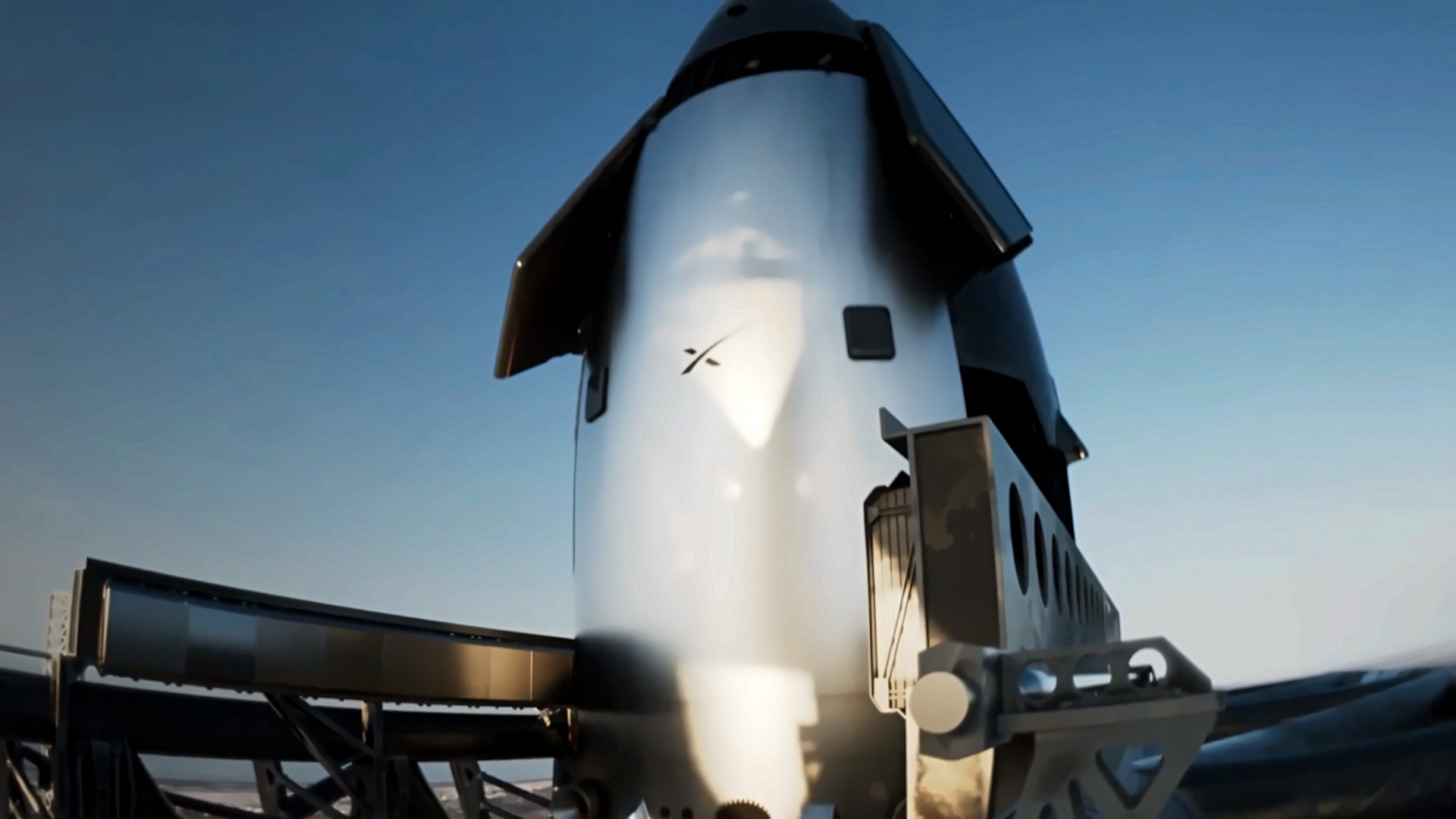
SpaceX gave its clearest look yet at how it plans to catch a Starship upper stage, playing a roughly 80 second animation of the maneuver during its third quarter earnings webcast on Tuesday. The clip ran under an “Up Next: Ship Catch” banner moments after Elon Musk confirmed that Flight 15, expected next month, will try to catch both the Super Heavy booster and the ship with the launch tower.
The animation opens at ground level, looking up through the launch mount at a tower with its chopstick arms spread wide. It then cuts to the ship gliding back through the atmosphere in its horizontal belly flop position, with its forward and aft flaps steering the descent. A wide shot from the Starbase shoreline follows, where the ship is a small dot in the sky before it swings vertical and drops toward the launch towers. The final shots show the ship sliding down past the top of the tower, a close view of the hardware along its side meeting the arms, and the vehicle hanging in the chopsticks.
SpaceX has released a new Starship tower catch animation for the upcoming Flight 15! https://t.co/kStn01Da8u — Truthful🛰️ (@Truthful_ast) October 20, 2026
Musk called the catch the step that closes Starship’s reuse loop. “If we succeed, it will be the first time that an orbital launch vehicle has been fully recovered,” he said. He put the odds of success on the first attempt at “more likely than not,” and said SpaceX has “a steady stream of Starship flight attempts through the end of this year” if Flight 15 falls short.
The sequence mirrors work SpaceX has already done with real hardware. In September, Ship 42, the vehicle assigned to Flight 15, was lifted by the Pad 2 chopsticks into a simulated catch position, where crews cycled the arms and connected the ship quick disconnect arm while it hung from the tower. NASASpaceflight has since reported that SpaceX removed Ship 42’s engines before its static fire and sent it back for another cryogenic test.
Gwynne Shotwell covered the regulatory side on the same call. After what she called “significant constructive engagement with the FAA,” SpaceX expects the Flight 15 license “to include return to launch site and tower catch for both stages.” Bringing the ship home means reentering toward land instead of the open ocean, which Musk said in February would only happen once the chance of the ship breaking up over land was very low, after two perfect soft landings at sea.
SpaceX has caught Super Heavy with the tower three times, on Flights 5, 7 and 8, but the ship returns from orbit at far higher speed and has never been caught. Flight 14 on September 28 was the first Starship to reach orbit, and it deployed 26 Starlink V3 satellites before splashing down, a mission SpaceX counted as its first revenue flight in the Q3 results it reported Tuesday.
The timing lines up with what Musk told the crowd at Giga Texas earlier this month, when he said Flight 15 would probably launch a little before Thanksgiving and that Flight 16 could refly both stages. On Tuesday’s call he went further, saying Starship should fly weekly at some point in the first half of 2027 and twice weekly or more by the end of next year as SpaceX works toward landing a rocket and launching it again with no refurbishment.
Elon Musk
Elon Musk just confirmed the Tesla and SpaceX merger step everyone was waiting for
Tesla and SpaceX formed special committees to weigh a merger, and Elon Musk supports it.
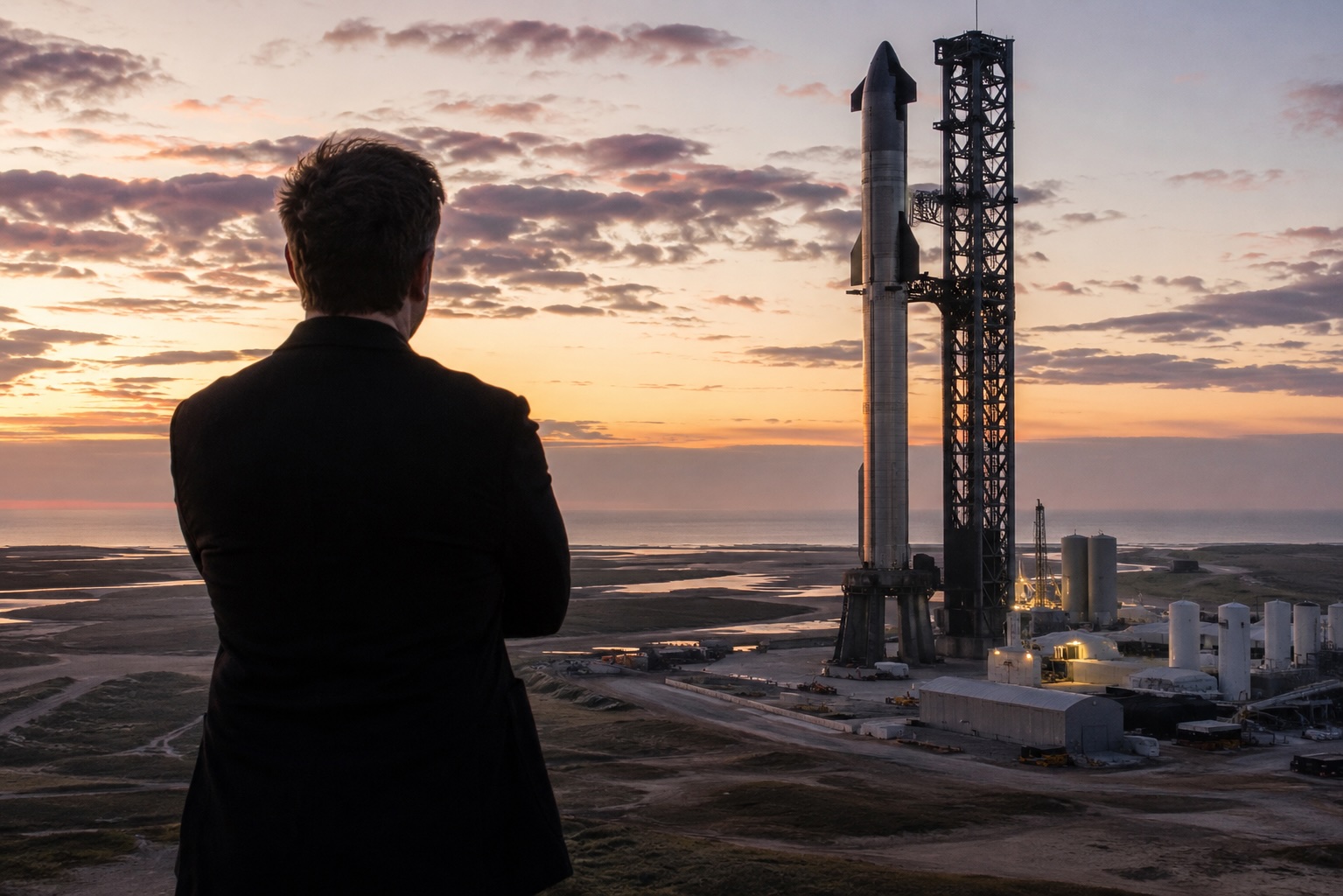
Elon Musk confirmed Tuesday that Tesla and SpaceX have each formed special committees of independent directors to study a possible merger, the first formal step toward combining the two companies after months of speculation.
Musk made the disclosure during SpaceX’s third quarter earnings call. “Both SpaceX and Tesla have formed special committees to discuss this idea at the request of shareholders,” he said. “Because I’m a conflicted party, I can’t actually be in the discussions of the special committees.” He described the setup as “an odd kabuki dance where two groups of people are talking and I can’t be in the conversation.”
Musk did not hide where he stands. “Do I think it would be a good idea? Yes,” he said, pointing to shared work on super intelligence software, chip design, the Terafab facility in Austin, robotics, mass to orbit and connectivity. “I do think there’s a lot of merit to combining the companies as we are pretty much in the super intelligence singularity.”
He also tried to cool expectations. The committees have not agreed on terms for any transaction, and Musk said assuming a merger is a certainty “would be overstating it.” Any deal would go to shareholders, and on the Tesla side it would need approval from 50 percent of all outstanding shares, not just the shares that are voted. Musk called that “quite a high hurdle.”
That bar has tripped Tesla up before. The company’s 2025 attempt to declassify its board won support from only 39.4 percent of outstanding shares and failed. Musk’s own voting stake sits near 20 percent after he exercised his 2018 options in June, so a deal would need broad backing from institutions and a retail base that often leaves votes uncast.
Timing is another open question. Tesla filed its proxy statement Monday for its December 3 annual meeting, and the ballot has only three items: director elections for Musk, Robyn Denholm and JB Straubel, a say on pay vote and auditor ratification. Barclays analyst Dan Levy had argued that an announcement would need to land by late October or early November to make the annual meeting, as Teslarati noted in its SpaceX earnings preview. With no terms agreed, any vote would likely require its own special meeting.
Elon Musk gives his most telling Tesla-SpaceX merger conversation yet
Musk has been edging toward this for weeks. At the All-In Summit in September, he asked “who can imagine what action one might take when there’s so much close collaboration,” Teslarati reported. Last week’s Roadster unveil, built around SpaceX derived cold gas thrusters, pushed the talk further. The two companies already share the Terafab chip project, and Tesla holds a small SpaceX stake that came from its earlier investment in xAI.
SpaceX brought strong numbers to the conversation. It reported Q3 revenue of $14.58 billion, up 161 percent year over year, with its Super Intelligence segment now its largest at $7.56 billion. A higher SpaceX valuation would shape any exchange ratio Tesla holders are offered.
Tesla reports its own third quarter results after the close on Wednesday, October 21. Investors had already ranked merger timing among the top retail questions for SpaceX’s call, and the committees will almost certainly come up again on Tesla’s.
Elon Musk
The Boring Company’s latest Tesla tunnel truck mod “fits like a glove”
The Boring Company has modified a Tesla powered tunnel truck to carry freight containers underground.
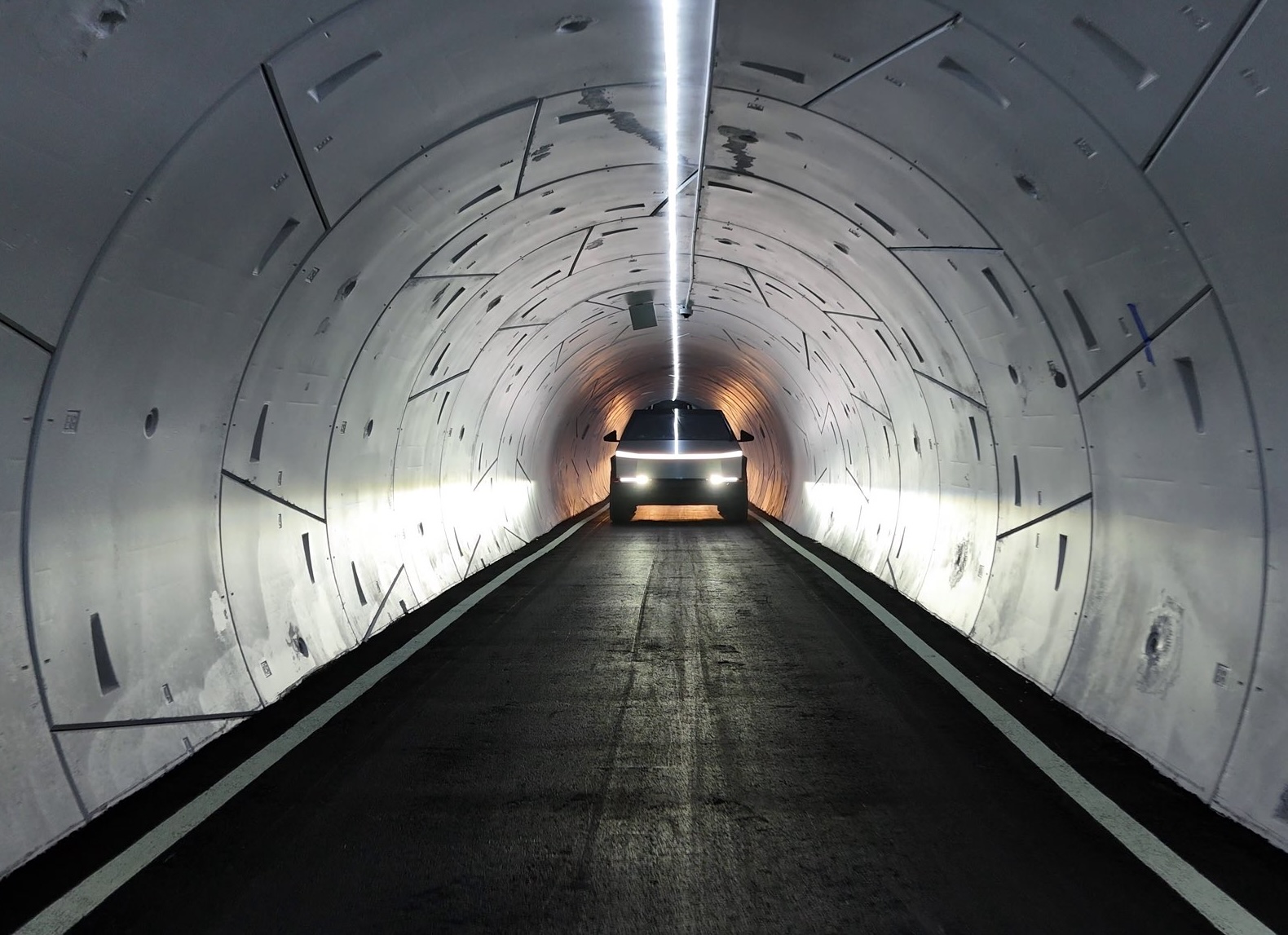
The Boring Company has found a second job for the Tesla hardware it already runs underground. In a post on X, Elon Musk’s tunneling company showed its latest Prufrock Liner Truck modified to carry a standard 20 foot shipping container. “Using TBC tunnels to transport freight,” the company wrote. “The latest Prufrock Liner Truck (using Tesla Model 3 batteries and drive units) has been modified to carry a standard 20′ shipping container. Fits like a glove!”
The photo shows a red container sitting on a long, low white chassis parked outside, with drive hardware visible at one end. The Boring Company did not say where or when freight hauling would start, which customers it has in mind, or how many trucks it is converting.
Using TBC tunnels to transport freight.
The latest Prufrock Liner Truck (using Tesla Model 3 batteries and drive units) has been modified to carry a standard 20’ shipping container.
Fits like a glove! https://t.co/VV0phWK4fc
— The Boring Company (@boringcompany) October 19, 2026
Until now, the liner trucks have hauled concrete. Teslarati reported in August on Liner Truck 3, which uses Model 3 battery packs and drive units to move more than 22,000 pounds of precast tunnel segments to the boring machine. It has 28 miles of range, tops out at 12 mph, and is piloted remotely from the company’s operations center in Texas. The freight version appears to be the same platform with a different bed, and The Boring Company has not said whether it will also be remotely piloted.
Freight has been on the company’s menu for years. When TBC updated its product lineup in 2021, its freight tunnel was described as sized to fit a standard shipping container, “barely.” The company later used the idea at Tesla’s own factory, where Prufrock 3 dug a tunnel to Giga Texas that now moves finished Cybertrucks away from the production line.
The Boring Company closed a $3 billion Series D in September at a $23 billion valuation, and Teslarati has covered how that money is tied to a UAE tunneling push and a faster Nashville build. In Nashville, Prufrock MB1 and MB2 are mining at the same time, and a third machine is expected to launch in late October. Each machine needs a steady supply of liner trucks, so any design that works for segments and containers alike gives the company more use out of the same Tesla parts.
The Vegas Loop remains the only Boring Company system open to the public, and it moves passengers in Tesla vehicles. A freight service would be a separate product, and the post gave no indication that one is close to launch. For now, it is a truck, a container and a short caption saying they fit together.

SpaceX showcases exactly how it plans to catch Starship next month

Elon Musk just confirmed the Tesla and SpaceX merger step everyone was waiting for

SpaceX delivers blockbuster Q3 results as Super Intelligence segment booms

SpaceX reveals how its 1 Million AI satellite network will work and prevent space collisions

Tesla Roadster: Three configs, one can fly, 0-60 in 0.8 seconds


