Investor's Corner
$TSLA action leading up to Tesla’s reveal of Master Plan, Part Deux

It has not been an easy two weeks for Tesla in the news. Lately all the news has been fairly negative:
- Negative response to the Tesla – SolarCity merger from the great majority of brokerage firms covering Tesla.
- First driver killed in an accident involved with a Tesla vehicle operating on autopilot.
- Start of preliminary evaluation from NHTSA of various Tesla accidents involving autopilot.
- Start of National Transportation Safety Board (NTSB) investigation, independent of the NTSA’s inquiry into the collision that killed 2015 Model S driver Joshua Brown.
- Start of Securities and Exchange Commission (SEC) probe over fatal autopilot crash and whether it was “material” and Tesla was at fault for failing to inform its shareholders prior to the last stock offering.
- Request by Sen. John Thune (R-S.D.), the chairman of the Senate Commerce Committee, for Tesla to “brief Committee staff on the details of this incident, including the technology that was in use at the time, Tesla’s actions in response, and the company’s cooperation with NHTSA.”
That mass of negative reporting would normally kill any stock. But what was the effect on $TSLA for the past couple of weeks? Not much.
We had one week of still higher highs on the stock, followed by flat “compression” last week. This week $TSLA stock is back up again, especially Wednesday ahead of the company’s release of its “Masterplan Part 2”. The stock shot up by $1 in the span of 10 minutes, after CEO Elon Musk tweeted that the plans would be released later in the day.
Now that the Master Plan Part Deux has been published, it will be interesting to see Thursday what will be the response to the Plan from the broad market.
Stock Action
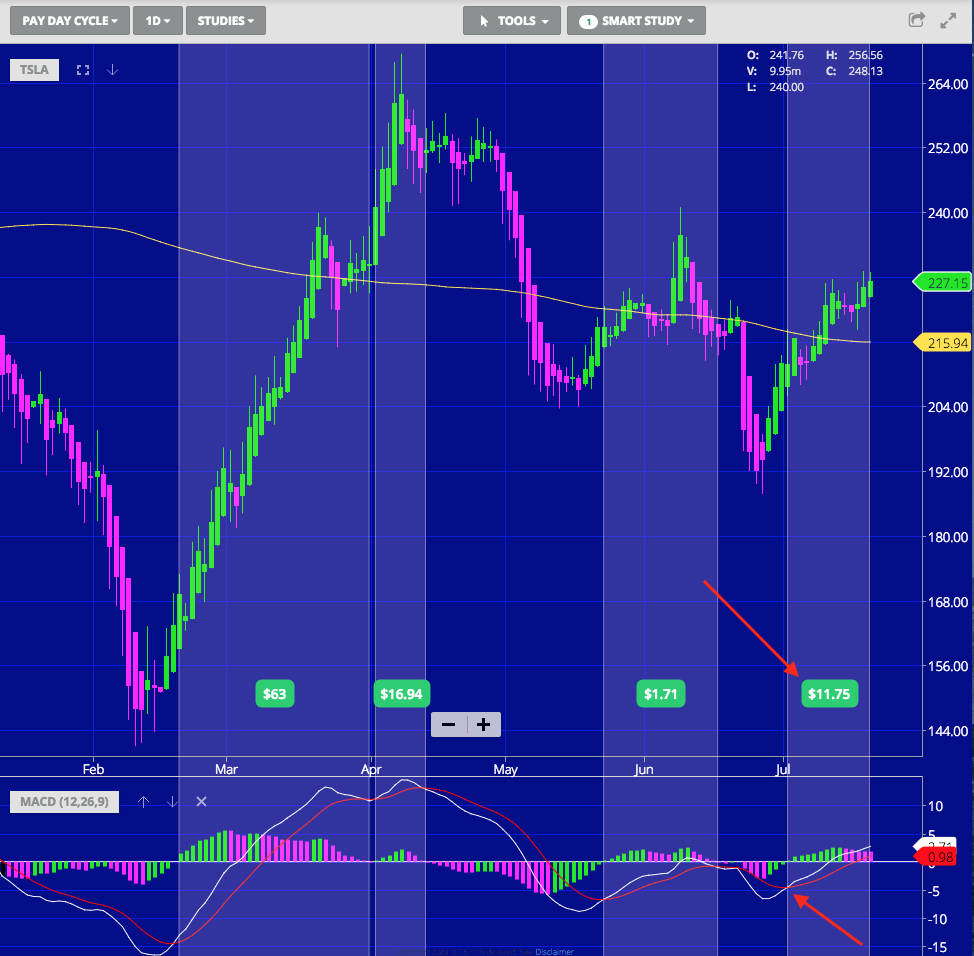
Looking at the $TSLA stock chart for the past couple of weeks, the technicals are still greatly in its favor. The latest Heikin Ashi – MACD “swing” has provided already an upside of over $11 since the MACD crossed to the bulls on June 30. Anyone that pulled the trigger on that day on the buy side is now sitting happy on a nice gain. Anyone trading options is sitting happy on huge gains.
Right now $TSLA stock is all fired up: Heikin Ashi green for 13 out of the past 17 sessions, stock above the 200-day moving average, MACD positive and still crossed to the bulls.
Source: Wall Street I/O
By the way, the charts from Wall Street I/O have an unique “smart study” that back-calculates all the effects of indicators like the MACD over a period of time. As one can see from the chart above, $TSLA is a wonderful stock for MACD “swing” traders.
Master Plan 2.0
I, like everybody, am anxiously waiting for the street’s response to Tesla’s Master Plan 2.0.
Today Jim Cramer was quoted on TheStreet as saying that “Tesla’s New Master Plan Won’t Matter, the Stock is ‘Heavily Shorted’.”
“It doesn’t really matter — this stock is so heavily shorted ,” Cramer said on Wednesday. “It can’t be borrowed, thank you Doug Kass for giving me that information.”
Q2 2016 Financial Results Date
Lastly, on July 19 Tesla sent a letter to investors indicating that “Tesla will post its financial results for the second quarter ended June 30, 2016, after market close on Wednesday, August 3, 2016. ” According to the letter, “Tesla management will hold a live question & answer webcast that day at 2:30pm Pacific Time (5:30pm Eastern Time) to discuss the Company’s financial and business results and outlook.” These are the details of the Q&A Webcast:
What: Date of Tesla Q2 2016 Financial Results and Q&A Webcast
When: Wednesday, August 3, 2016
Time: 2:30pm Pacific Time / 5:30pm Eastern Time
Webcast: http://ir.tesla.com (live and replay)
Update: Early morning Thursday pre-market action
$TSLA stock is off by $3 at $225. The initial reaction to the second iteration of the master plan from Wall Street analysts “seems to have failed to assuage investor’s fears”, as reported by TheStreet.com.



Elon Musk said he is planning to give “every one of his SpaceX shares to every kid in America” in 2027, stating that “this will be the first of many.”
SpaceX went public earlier this year, and its stock price has been relatively stable since leveling off shortly after its IPO. Based on its current price, it’s a gift of just over $10 billion to children across the United States.
It appears to be closely related to President Donald Trump’s bank accounts for children, which were set up earlier this year as Trump Accounts.
Just hours earlier, Anthropic had announced the establishment of its Anthropic Public Benefit Fund, “a new wholly-owned entity dedicated entirely to public benefit.” Musk responded by stating he recommended “giving the shares directly to the public,” and that he would be doing it that way.
Just a little bit later, Musk said children across the U.S. would be getting a share from him:
Next year, I will give one of my SpaceX shares to every kid in America.
This will be the first of many.
— Elon Musk (@elonmusk) October 19, 2026
There are roughly 70 million children, meaning someone under the age of 18, in the United States, according to the Federal Interagency Forum on Child and Family Statistics. Musk’s ownership of SpaceX stock shows he has around 849 million Class A shares of SpaceX stock, according to filings with the SEC.
Investor's Corner
SpaceX’s biggest earnings test yet lands Tuesday, and Tesla shareholders should be watching
SpaceX reports earnings Tuesday as Wall Street watches AI spending, Starlink growth and Tesla merger

SpaceX reports third quarter results after the market closes Tuesday, with a webcast at 4:30 p.m. ET streamed on X, and Tesla follows a day later. Bloomberg consensus, cited by Pepperstone, calls for revenue of $12.89 billion, adjusted EBITDA of $6.62 billion and adjusted EPS near $0.15. That would be about 65% growth from the second quarter and SpaceX’s first profitable quarter since its IPO. Analysts expect roughly $6.4 billion from AI and $4.9 billion from Starlink, which is projected to reach 14.3 million consumer subscribers. Capital spending is forecast at $19.6 billion, leaving free cash flow near negative $11.6 billion.
The numbers matter because SpaceX has spent months trying to win over a skeptical market. It priced its record IPO at $135, spiked to $225.64, then sank near $105 in early August. Friday’s close of $146.03 sits about 28% below the June high. The Q2 report beat on revenue at $7.8 billion and put Starlink at 12 million subscribers, but $18.4 billion of capex hurt the stock. Since then SpaceX reached orbit on Starship Flight 14 with 26 Starlink V3 satellites, agreed to buy 800 MHz spectrum for about $8 billion as part of its Starlink Mobile push, and signed a fourth compute hosting deal in four months worth roughly $13 billion a year from December. Management is targeting more than 2 gigawatts of compute by year end and a $100 billion annualized revenue run rate. Evercore ISI, which raised its target to $275, said the quarter may be judged more on those targets than the reported figures
All of this sits under the Tesla merger question. Barclays analyst Dan Levy expects an all stock deal in which SpaceX buys Tesla at a premium, using reference values of $2.1 trillion and $1.5 trillion, and said an announcement would need to come by late October or early November to be voted on at Tesla’s December 6 annual meeting. Barclays estimates Musk would hold about 37% of the combined company and 56% of the votes. Musk said in July that combining companies cannot be discussed on an earnings call, but an investor question asking when SpaceX will merge with Tesla is sitting on SpaceX’s Q&A platform, and Teslarati has tracked how the Roadster demo revived the talk.
If a deal happens, Tuesday’s result would effectively set the price Tesla holders would receive. Their shares would convert into SpaceX stock, along with exposure to a company with a heavy investment on AI, while Tesla itself expects 2026 capex above $25 billion. A strong quarter and calmer spending would make that exchange easier to sell. Another round of heavy capex and a falling stock would make it harder.
Investor's Corner
Tesla’s flying Roadster just revealed something bigger than the car
Analysts say the Roadster demo puts a Tesla and SpaceX merger back on the table.
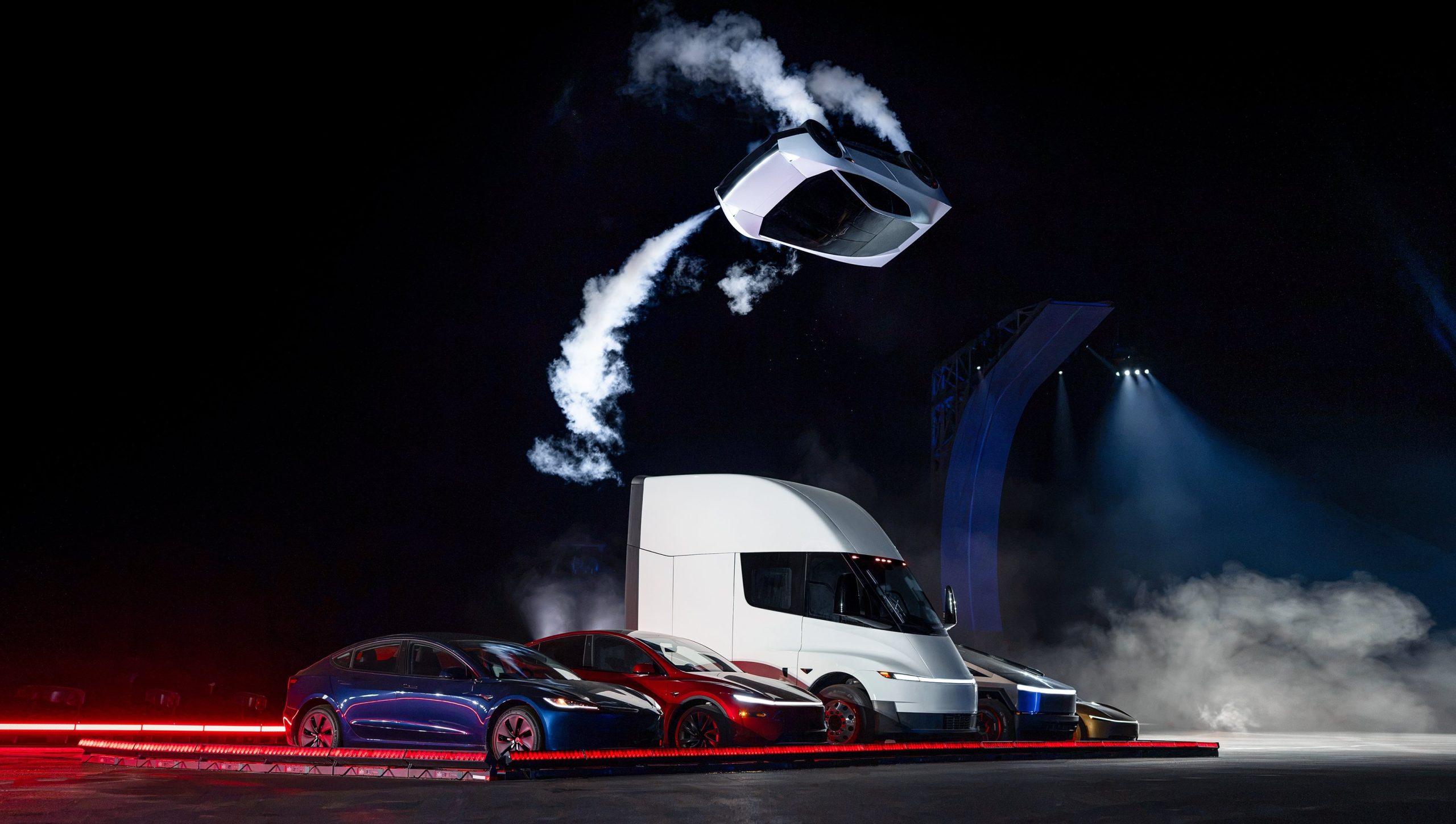
The Roadster unveiling near Waco ended Thursday night, and by Friday morning much of the investor reaction had less to do with the car than with who owns the rocket technology inside it.
Wedbush analyst Dan Ives said the event “puts the Tesla/SpaceX relationship on the table in a tangible way,” pointing to the propulsion, pressure vessel and control hardware sitting on a Tesla product. Gene Munster of Deepwater Asset Management called the demo “a ridiculous display of engineering” with “no commercial value” beyond embarrassing traditional automakers, though he said it showed Musk wants the two companies together.
The more specific forecast came a day earlier from Barclays. Analyst Dan Levy told clients a deal could be announced before Tesla’s annual meeting, which must happen by December 6, and that an announcement in late October or early November could make shareholder approval harder. Barclays expects SpaceX to be the buyer in an all stock deal, with Tesla holders receiving SpaceX shares at a premium, based on market values of roughly $2.1 trillion for SpaceX and $1.5 trillion for Tesla. If nothing lands around the meeting, the bank still sees an announcement within 6 to 12 months.
The Roadster demo just added more weight to merger speculations. Tesla’s demo used cold gas thrusters and pressure tanks of the kind SpaceX uses on Falcon 9, and Musk described the car as a collaboration between Tesla and SpaceX engineers, as we mentioned in our breakdown of the three Roadster configurations.
Musk has not publicly addressed a deal since the event, as far as we have seen. His most direct answer remains the one he gave at the All In Summit, when he said that with so much collaboration, “who can imagine what action one might take” without ruling anything out. Ives has held to a 2027 timeline since his March note, and Musk pushed back on the China piece of the speculation when ARK floated a year end announcement in August.
The next test is Tesla’s third quarter earnings call on October 21. However, we recall in July that Musk told analysts, “we can’t talk about combining companies and that kind of thing on an earnings call,” so a clear answer wouldn’t be expected.

Elon Musk will give ‘every kid in America’ a SpaceX share in 2027

Tesla CEO Elon Musk reminds everyone about Roadster’s true meaning

SpaceX’s biggest earnings test yet lands Tuesday, and Tesla shareholders should be watching

SpaceX reveals how its 1 Million AI satellite network will work and prevent space collisions
Tesla Roadster: Three configs, one can fly, 0-60 in 0.8 seconds


