Lifestyle
A road trip without Tesla Autopilot is akin to torture

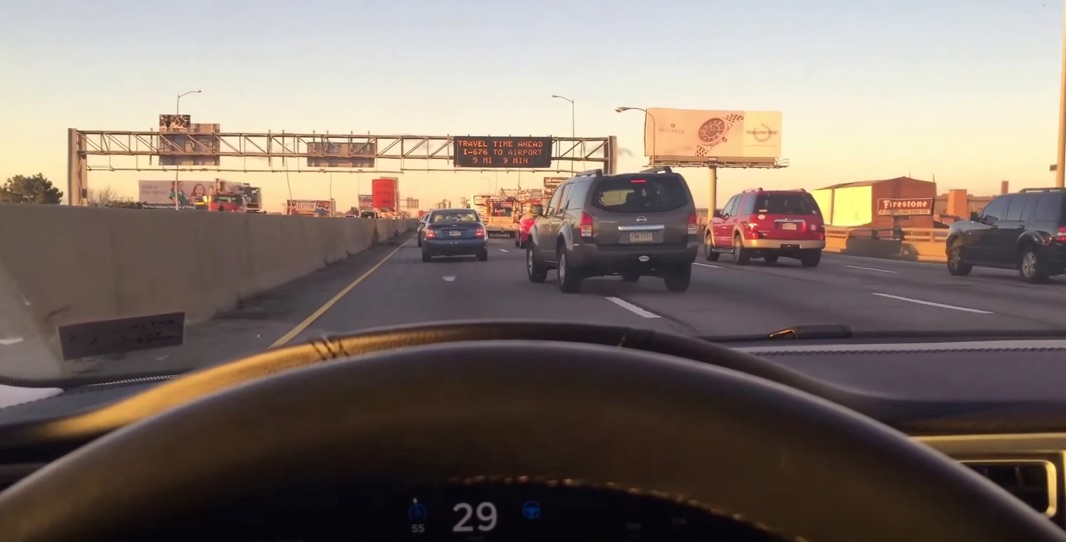
I’ve recently returned from a family beach vacation that required about 600 miles of road travel. As an avid enthusiast and follower of the developments of Tesla, I am very aware of Autopilot’s capabilities and limitations and I hope it is one of the last times I have to cover such distance without its assistance. At the time of this writing, the current abilities of the system would have made the drive immeasurably better. 600 miles may not seem like a huge journey to some people, but compared to my regular travel diet, it may as well have been a million.
Let me set the tone. It has become an annual tradition for my in-laws to invite my family along to their beach vacation. The travel portion alone is a 1-2 day micro-convoy, typically lead by the father-in-law. Starting around Hershey, Pennsylvania, and enduring a passive Civil War history lesson on our way to Myrtle Beach, South Carolina. It always amazes me how regional diction can vary so much with a slight change in latitude. The normal traffic volume obstacles generally steal years from your life around Washington DC and Richmond, Virgina if you choose to take the I-95 straight shot down. Stopped traffic with no exit in sight is not a good match for our tiny-bladdered precious cargo. Therefore, we take the long way around and hope for thinner crowds.
In my younger years, before children, corrective lenses and normal bodily wear and tear, I would go as far to say that I enjoyed the long drive. My undivided attention to the road and surroundings must have added a layer of control and ease that I no longer feel. Now I am responsible for more lives. Ironically, the same lives that I am constantly trying to protect are also unintentionally adding sensory distractions, exponentially diluting the focus that needs to be dedicated to the road.
“Holding onto the wheel as you generally progress in a straight line forward seems more akin to torture.”
I still enjoy driving, but I hardly consider highway travel to be true driving. Holding onto the wheel as you generally progress in a straight line forward seems more akin to torture. Winding local roads that provide constant stimulation and driving dynamics are much more enjoyable. I’m not sure what the statistics would say, but I am a safer, more alert, driver on roads like this.
While the task of following the leader may seem incredibly simple on the surface, a deeper evaluation reveals why the assistance of Autopilot would excel in all the areas that a human might struggle. Attention, fatigue, refined control, and response time are common weaknesses that every person has to some extent. This type of driving can be quite dangerous, and it’s important to not lose respect for that.
It is extremely difficult to devote complete attention to the road for the entirety of 600 miles. There is a pretty good chance that most drivers will find themselves looking around occasionally. We passed a couple of crashes along the way and observed a few near misses from people rubbernecking. Even if you had unbroken focus, unexpected events can happen during a quick blind-spot check.
Autopilot cannot see infinitely in all directions, but it is still able to constantly maintain its views in normal traffic. It won’t look away for a moment. As a machine, it’s programmed to perform its given task and cannot be distracted or break focus.
Fatigue is a very real risk that grows more dangerous with every mile. It can seemingly creep up and at any moment. While it helps to have company in the vehicle, if conversation wanes, things can get dicey.
Again, Autopilot cannot grow tired over time. There is no way that it can fall asleep.
I think it is safe to assume that nearly everyone has wandered onto the rumble strips on the edge of the lane at some point – often causing a slight overreaction to correct. Or maybe you just seem to drift along within your lane, visiting each side from time to time. I have to admit, despite my acknowledgment of drifting, it sometimes seems that a conscious effort to correct it is temporarily not effective. I don’t want to quickly veer back into alignment in a big action that would seem like I lost control or attention, but my attempts to make a slow move back to the middle of the lane are not working. Can I blame the car or the road for this? Perhaps it’s the trend of the car in front of me and my mental ‘autopilot’ is just following the same path. Maybe I’m being hypnotized and lured in by the rhythmic dashed lines sweeping by. Whatever the cause, soon the neighboring semi’s graceful forward stampede gets a bit too close for comfort and I snap out of it as my heart goes into momentary adrenaline mode. A good anxiety recipe for the travelers around me. It is important for people like me to admit that we are crappy drivers. At least I’m not the moron that is too lazy to flick the turn signal wand for lane shifts.
As Autopilot matures, so does its ability to stay centered within a lane. As soon as I get assistance from Autopilot, the road and people around me will become that much safer. Like a train fixed to a track, it can’t be hypnotized or anxious through my own or neighboring human error. And it certainly will not shift from one to another without the driver initiating via a signal.
Among the most important benefits of Autopilot has to be the response time. The scenario that comes to mind is sudden deceleration events. Maybe your eyes are focused on a roadside sight or the neighboring lane when the vehicle in front of yours begins to slow. Even if you catch it in time to slow before a collision, a sudden slowing of your own vehicle reduces the reaction time for the drivers behind you. It gets exponentially more dangerous for a driver to the rear and often ends in contact. Reaction time circles back to the fact that autopilot is always paying attention.
My travels would have been far less stressful if I had the aid of Autopilot. The closest experience I had to an Autopilot environment took place while I was in the passenger seat while my wife drove. I was able to take in some truly breathtaking views that I may have missed if I were safely focused on traffic. Who knew that the Virginian Appalachian mountains were so beautiful? A scenic overlook that could easily be missed since the highway wound around bends in a clearing.
Full autonomy will be the ultimate protection against me and my driving tendencies. For now, the beta Autopilot can serve as the perfect supplement to my inadequacies.
Not to undersell the importance of safety, but I want to be able to enjoy a long road trip again. I want to feel comfortable enough to pry just one hand off the wheel so that I can annihilate a can of Pringles while the kids are too engrossed in Finding Nemo to notice I should have shared. I want to feel like I’m no longer terrorizing my wife and the drivers around me with my inexplicable tendency to grind and ping pong the edges of my lane.
I fantasize about this incredible sense of ease that Autopilot would add to a trip of this sort. The desire for more frequent and further road trips may find welcome. Road travel once defined an era of adventure and exploration. It powered local tourism and small business economies. Before highways became monsters and gas pumps robbed us of our planet’s future in addition to hard-earn money, there was a sense of unbound geographical freedom. It sparked the imagination of the children in the back seat while giving adults conquered goals. I want that. I need that. I need Autopilot.


Lifestyle
Tesla’s mirrorless Cybercab will give riders a visibility upgrade
Tesla engineer confirms Cybercab update letting riders pull up rear and repeater cameras on demand.

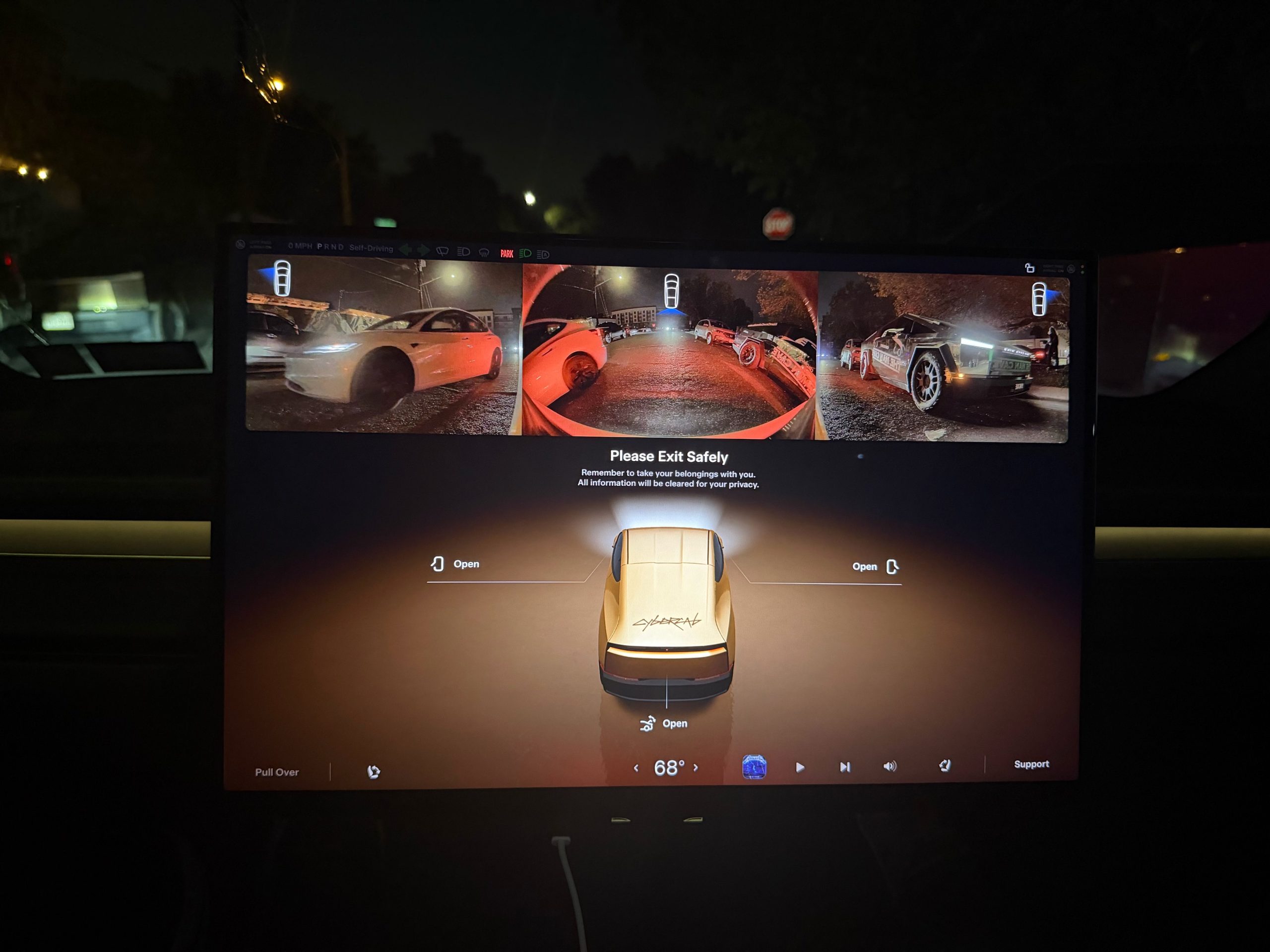
Tesla is working on a Cybercab update that would let passengers pull up the vehicle’s rear and side cameras on demand, and the request came straight from a rider.
The exchange played out on X late Friday. Cybercab rider Dan Burkland shared photos of the two-seater’s cabin screen after an evening ride, praised the UI team’s work, and left one request: let riders open the rear and repeater cameras whenever they want, “especially for peace of mind.” Tesla UI software engineer Evan (@CarCoder) answered with two words: “In development.”
The Tesla UI team absolutely crushed it with the infotainment software. Nicely done @CarCoder!
One feature request: Allow folks to pull up the rear & repeater cameras on demand. This would be great especially for peace of mind. https://t.co/mNAOSLx6pE
— Dan Burkland (@DBurkland) October 10, 2026
The idea fits a pattern Teslarati has tracked since public rides began. Days after paid Cybercab service opened in Austin, Tesla sent riders a survey that asked them to rate the touchscreen, the app and the cabin, and to pick the features they wanted most. We reported on that survey in September, and a camera view is the kind of small software change Tesla can push quickly if riders keep asking.
It also speaks to something unique about the vehicle. With no steering wheel, no pedals and no driver, passengers have no mirror to check and no way to see behind them. The hardware is clearly built for camera awareness, from the repeater cameras to the rear camera. Letting a passenger look through those same cameras would give a nervous first time rider a way to confirm what is around the car.
The timing matters because the fleet is growing fast. Tesla’s Robotaxi account said on Saturday that more than 300 Cybercabs are now serving Austin, an eightfold increase in 30 days, and Tesla AI chief Ashok Elluswamy named Dallas as the next city. More cars and more cities mean more people riding in a driverless vehicle for the first time, which is exactly when small trust features carry weight.
For now, the feature is confirmed only as in development. If Tesla follows its usual pattern with Cybercab software, riders could see it appear in a point release without any announcement, and Teslarati will watch for it.
Elon Musk
Elon Musk’s surprise addition to the X Takeover lineup has fans talking
Elon Musk will join Saturday’s X Takeover at Giga Texas for a live virtual interview.
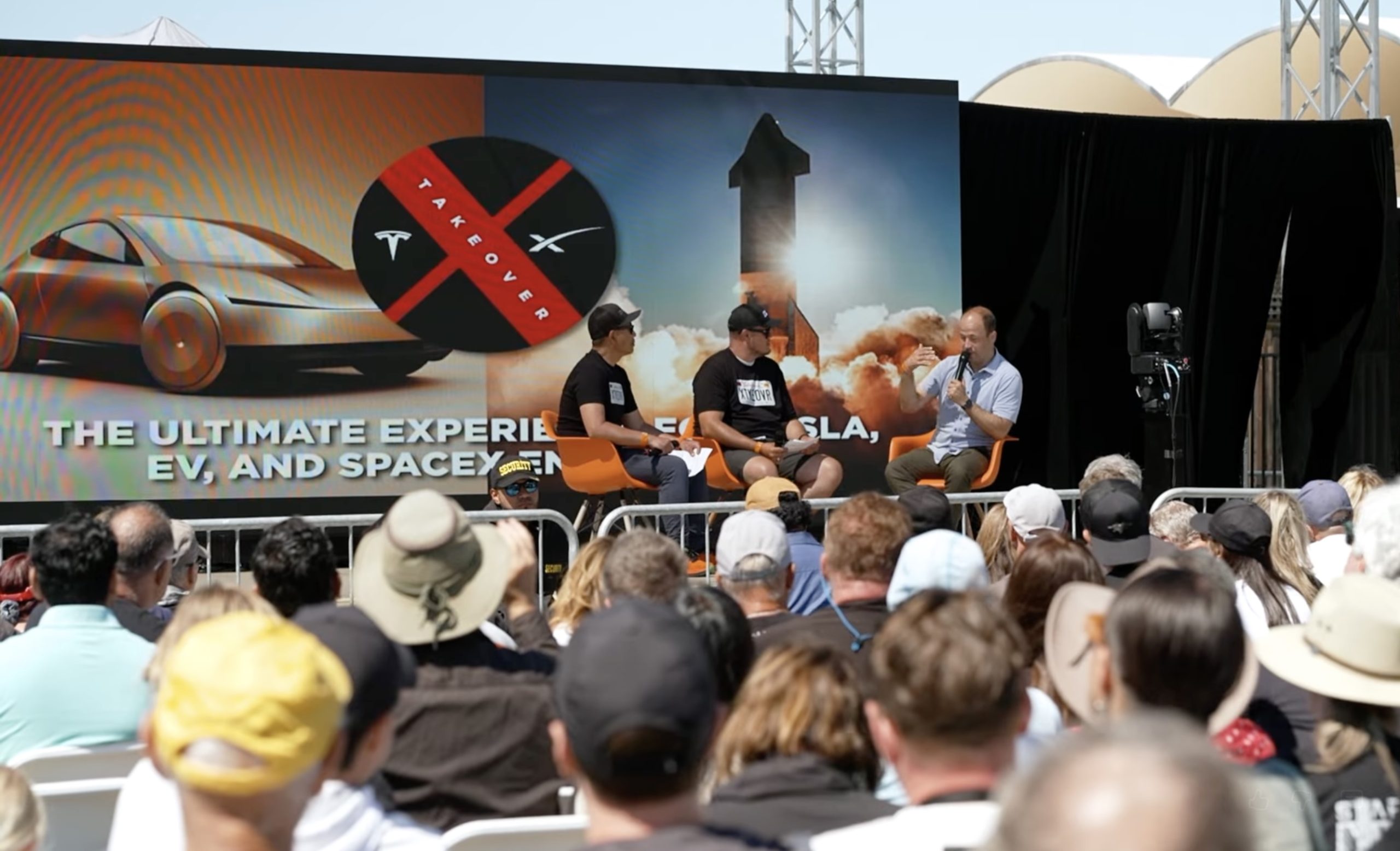
Elon Musk will join X Takeover at Giga Texas on Saturday for a live virtual interview, according to Sawyer Merritt, who shared the news late Thursday. Musk will not be on stage in Austin. The conversation is set to stream for free on the @teslaownersSV account on X.
Organizers had kept expectations in check. In a September update, Tesla Owners Silicon Valley said Musk had appeared at the event twice before but was not promising a third appearance, even as fans hoped he would walk the Giga Texas grounds in person. A virtual spot matches 2024, when Musk gave a surprise interview of about an hour to the crowd in San Luis Obispo, as Teslarati reported at the time.
Wasn’t expecting this 🫡
— Tesla Owners Silicon Valley (@teslaownersSV) October 9, 2026
This year’s edition is a first in several ways. It is the first X Takeover held outside California and the first at a Tesla facility, with tickets selling out in eight days. Tesla provides the venue, but the event is produced independently by Tesla Owners Silicon Valley. The main event runs from 10 a.m. to 6 p.m. CT, followed by a drone and light show at 9 p.m. Maye Musk is the keynote speaker, Franz von Holzhausen is set for a virtual keynote, and Nicki Minaj is the special guest. Joe Tegtmeyer, whose drone footage Teslarati used to track the Optimus factory steel frame at Giga Texas, is also on the speaker list.
Musk’s interview topics have not been revealed, but the backdrop is busy. Tesla doubled its Cybercab fleet in Austin in late September, and last week Musk explained why Robotaxi hours only moved from 10 p.m. to 11 p.m.. Merritt also reported Thursday that Texas DMV records now show 319 registered Cybercabs, up from 169. NHTSA’s deadline for Tesla’s sworn answers on Cybercab certification is October 30, and Tesla reports third quarter earnings on October 21.
Fans who cannot make it to Austin can watch the livestream on X. Musk tends to say more in unscripted settings than he does in prepared remarks, which is the reason this one is worth having open on Saturday.
Elon Musk
Elon Musk’s Boring Company lands a new Middle East deal, and Nashville is about to get faster
The Boring Company signs Abu Dhabi tunnel agreement while adding more Prufrock machines in Nashville.
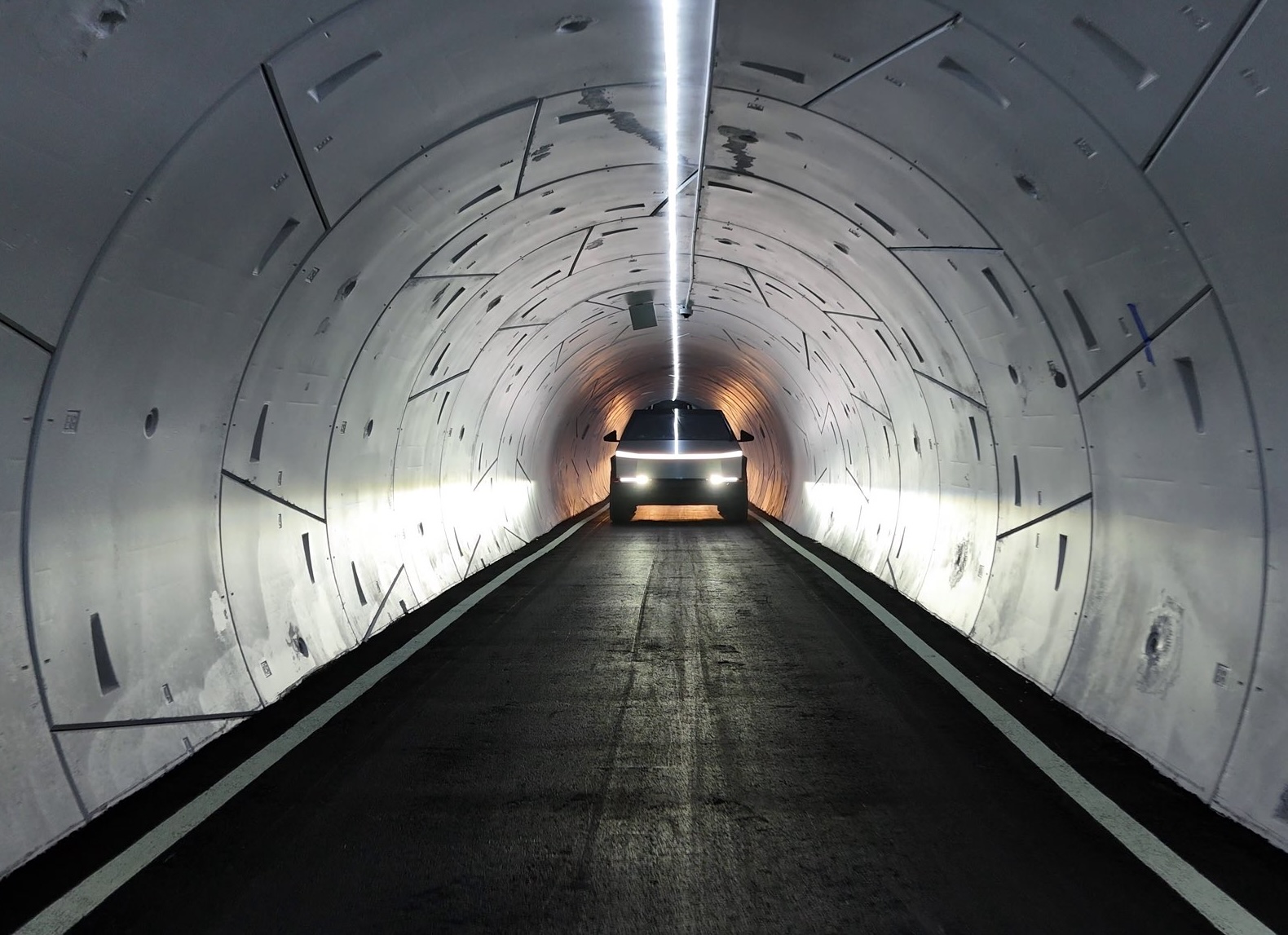
The Boring Company has signed an agreement with Abu Dhabi to study underground transport and utility tunnels across the emirate, adding a second UAE city to its pipeline as it prepares to also scale up tunneling back home in Nashville.
The deal was signed Thursday at the Liveability and Investment Exhibition (LIVEX 2026) by Boring Company President Steve Davis and Maysarah Mahmoud Salim Eid, director general of the Abu Dhabi Projects and Infrastructure Centre (ADPIC), according to the Abu Dhabi Media Office. Mohamed Ali Al Shorafa, chairman of the emirate’s Department of Municipalities and Transport, attended the signing.
Under the agreement, the two sides will assess feasibility, delivery and operating models for tunnels that could carry passengers or utilities. They will also look at Abu Dhabi’s potential as a regional hub for tunneling work. The current phase is exploratory, and no construction commitment or project budget has been announced.
“Abu Dhabi provides an ideal environment to explore the next generation of underground infrastructure solutions, supported by its ambitious growth vision and strong commitment to advanced technologies,”
Davis said. He added that the company wants to assess how tunnels can “expand urban capacity more efficiently, and enable better use of available space.”
The timing lines up with the money, considering last month, The Boring Company closed a $3 billion Series D led by the UAE and affiliated investors, valuing the company at $23 billion, as Teslarati reported. That round came with a commitment to build more than 150 kilometers of tunnel across the UAE, separate from the Dubai Loop pilot already under contract with Dubai’s Roads and Transport Authority. That pilot covers 6.4 kilometers and four stations linking DIFC and Dubai Mall at a cost of about $154 million.
Back home, The Boring Company projects in Nashville are also scaling up, with the company telling local NewsChannel 5 that a third Prufrock machine could start digging the Music City Loop in late October. A fourth is also targeted before the end of the year. Two machines are already mining Nashville limestone at the same time, and work is underway on a new launch site for the third.
The company said it has made more than 300 design and performance upgrades to its original Nashville machine. It is also working with property owners on more than 40 planned stations, with approvals in place for a future Nashville International Airport connection, a downtown station near the Music City Center, and stops at residential towers and the JW Marriott.
Construction on the Music City Loop began the same evening Tennessee and federal regulators approved the project’s lease in February, and the company targeted its first operational segment for late 2026. Back in Las Vegas, The Boring Company has said it plans to double its Vegas Loop station count by year’s end.

Tesla’s mirrorless Cybercab will give riders a visibility upgrade

Tesla’s Cybercab fleet jumped 8x in a month, with Dallas up next

Elon Musk roasts India’s billionaire Mukesh Ambani as Starlink fight heats up

The Pentagon taps Elon Musk to design the battlefield of the future

Tesla Roadster’s new patent preps white-knuckle speeds, keeping it grounded


