Lifestyle
Why Tesla owners embrace having a high mileage car

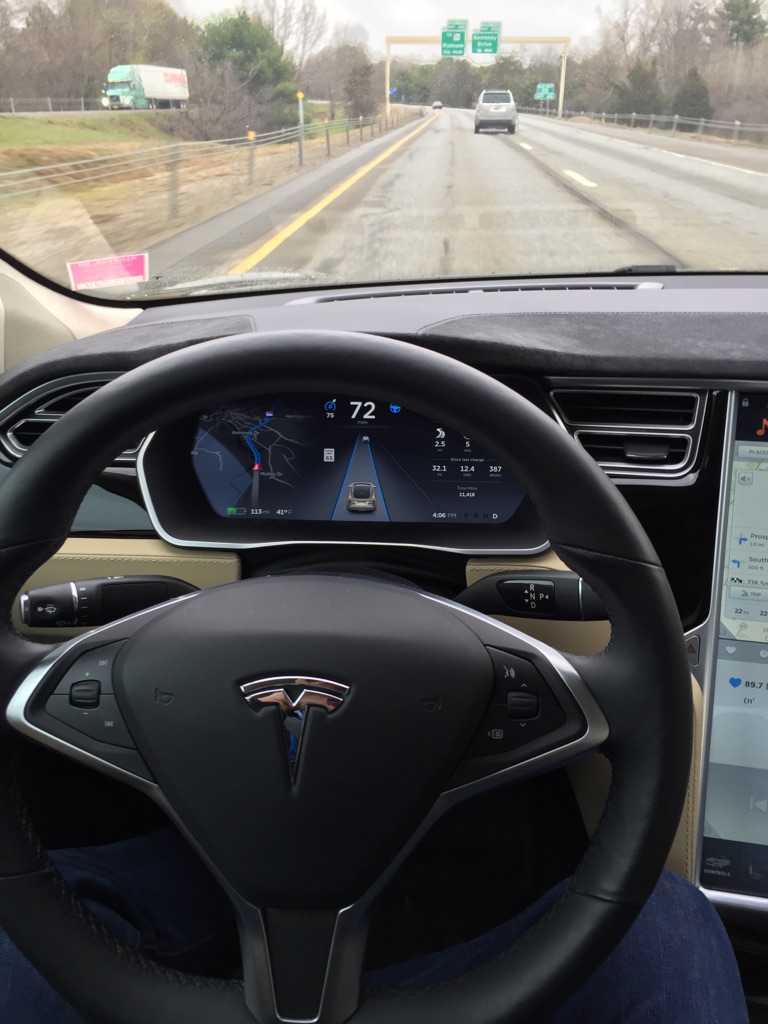
Low miles! Like new! Runs great! These phrases on neon stickers adorn windshields in used car lots everywhere. When shopping for any car other than brand new, mileage is about the first thing buyers want to know. The reasons why are obvious: cars and their many components break down over time and mileage is the best indicator of which parts may fail or may have already. Warranties are largely based on mileage as well, so there are plenty of incentives to buy a car with low mileage and to keep your cars as low possible. At least, those cars you intend to trade-in or sell at some point. Bonus points to those awesome, adventurous ICE drivers who keep their cars well past when the odometer hits six digits!
One of the many amazing things about electric vehicles is their lack of complicated mechanical systems. Tesla takes this to the extreme, with a relatively simple copper coil motor design. Unlike the EV version of a Volkswagen Golf for example, when you open the hood of a Tesla, you see open space. In fact, Tesla is so confident in the simple and low-maintenance mechanical systems of their cars, all new ones come with an 8 year/unlimited mile battery and drive unit warranty.
Combine these facts with the wide availability of a reliable fast charging network and a car that is an absolute joy to drive and you end up with a whole lot of miles on your Tesla. The paradigm is so different that when I came up on a Model S at a stop light yesterday, I couldn’t help but blurt out “I have over 30,000 miles on my Model S!” Of course I was driving a different car yesterday, but I digress. Almost as proud a badge of honor I wear my inclusion in the Tesla owners’ club, I wear my relatively high mileage proudly. It won’t be long before the odometer surpasses that of the ICE I brought home in December of 2012, two full year earlier than our Tesla. All of the issues we have had with our Model S have been completely unrelated to driving. We’ve had two door handle problems and a panoramic roof drip, neither of which made the car unsafe, unreliable or unable to be driven. The car drives every bit today like it did the day we brought it home. Actually, that’s a lie. It drives better thanks to over-the-air software updates.
My point is that for all the ways a Tesla drives just like any other car, it’s also the complete opposite. You don’t care about how much gas you’re burning through, how quickly your next oil change will be due, or how the more you drive, the most costly repairs will be required sooner.
I can’t wait to embark on an 1,800 mile road trip next weekend. It’ll be the longest trip on wheels my husband or I have ever driven. I can’t wait to see the ultimate effects this trip has on the odometer, or the official number it will read as of our 2nd anniversary of ownership on December 4th. It’s a bit of a crazy notion but high mileage on a Tesla is awesome.
Actually, I can’t wait for the trip in general. I always knew I’d get to see Chicago some day. After all, it’s the last major city I haven’t. I just always assumed I’d fly there. I don’t even rent cars when I travel, I just hop on a plane from my hometown to some other city, stay in the center of it all, and get around on foot. I used to fly right over most states without giving a second thought to what those states look like but Tesla ownership changes more than just your opinion on racking up a lot of miles. It changes long distance road travel by making it easy and convenient. It means my trip to Chicago and back will actually take me into five distinct additional cities; 4 of which I’ve also never been to.
Don’t blink. You don’t want to miss Tesla turning the car ownership experience on its head… again.


Elon Musk
The Boring Company just doubled its tunneling power in Nashville
The Boring Company’s Prufrock MB2 is commissioned and ready to mine beneath Nashville’s streets.

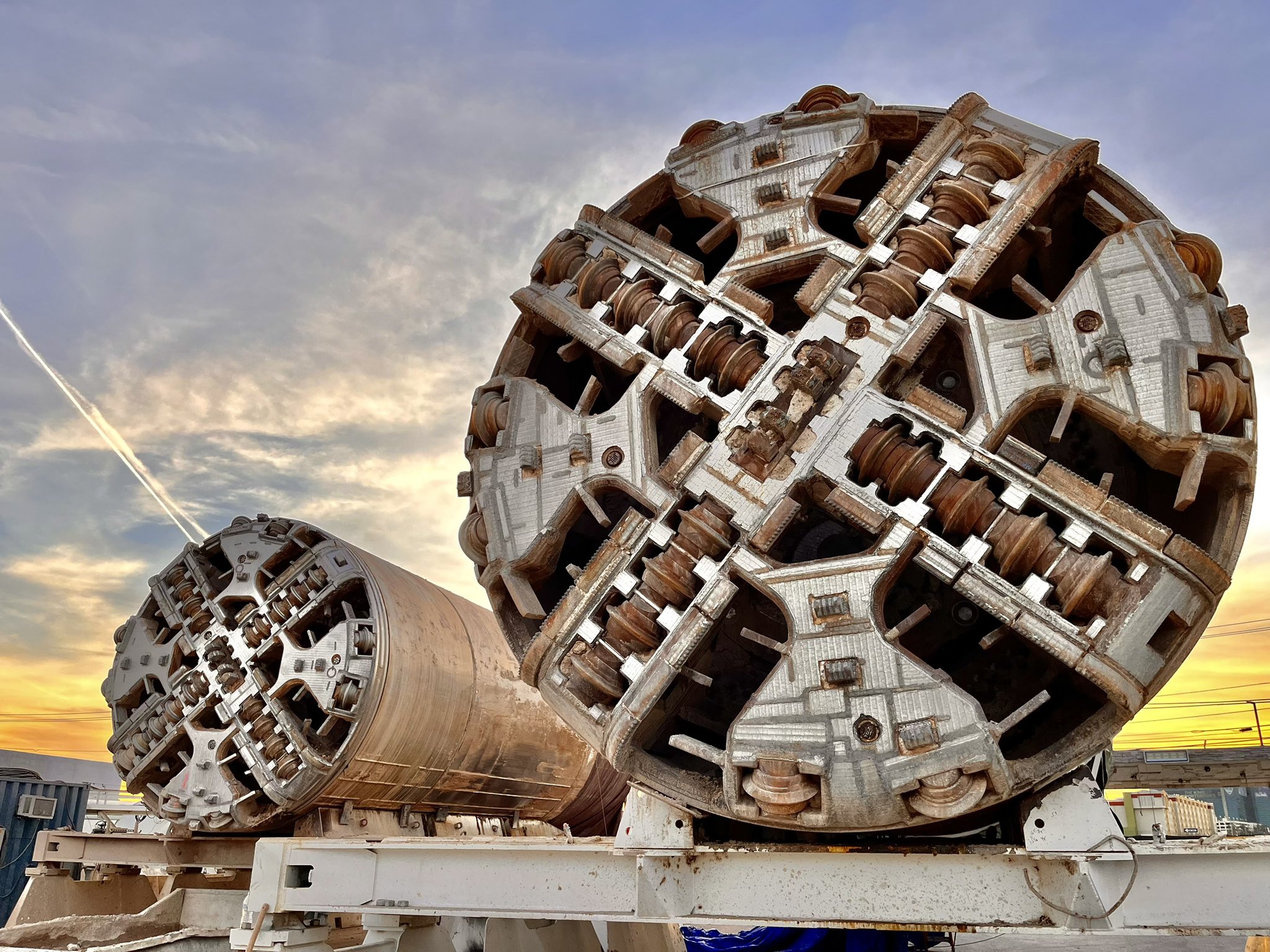
The Boring Company’s second tunnel boring machine, Prufrock MB2, is officially ready to dig in Nashville. The company confirmed the news on X, posting: “Prufrock-MB2 is ready to mine in Nashville! MB2 commissioning is complete, including the brief 11 rpm rotation shown here. Will MB2 catch up to MB1, who had quite the head start? And Prufrock-MB3 ships in August!”
MB2 arrives with meaningful improvements over its predecessor. Lessons learned from the launch and operation of MB1 have already been applied to MB2 to improve efficiency and prepare the machine for launch.
Traditional tunnel boring machines operate in a stop-and-go cycle, digging roughly five feet, halt, erect precast concrete segments to line the tunnel wall, then resume. That repeated interruption is one of the main reasons conventional tunneling is slow and expensive. Prufrock is designed to install the tunnel liner simultaneously with mining, eliminating the need to stop every five feet. The machine also skips the need for excavated launch pits. Prufrock arrives on a truck, tilts down, and launches into the ground within 24 hours. And when the tunnel is complete, it emerges from the ground and drives to its next launch site on a trailer, eliminating the need for expensive cranes or pit excavation. The machine is also fully electric and runs with zero people in the tunnel during normal operations, controlled remotely from a surface operations center.
Prufrock-MB2 is ready to mine in Nashville! MB2 commissioning is complete, including the brief 11 rpm rotation shown here.
Will MB2 catch up to MB1, who had quite the head start?
And Prufrock-MB3 ships in August! pic.twitter.com/TTrMql2aRg
— The Boring Company (@boringcompany) June 17, 2026
It won’t be long before we hear of another major update on The Boring Company’s Music City Loop project – a planned underground transit network beneath Nashville that would move passengers in electric vehicles through a series of tunnels at highway speeds, and bypassing surface traffic entirely. Nashville was selected in part because of its strong rock conditions that suits the Prufrock machines well, and relatively less regulatory hurdles.
Progress has been steady on multiple fronts. All 37 permits and approvals required ahead of tunneling have been obtained, out of 45 total. Key wins include a fully executed TDOT tunnel permit authorizing 25 miles of tunnel, unanimous airport authority approval for a Nashville International Airport station, and the city’s first residential station agreement serving downtown tower residents.
With MB1 already tunneling, MB2 now commissioned, and MB3 shipping in August, Nashville is becoming something of a live proving ground for scaled tunnel boring. The broader ambition is not limited to one city. The Boring Company’s stated goal is to make underground transportation a practical alternative to surface roads across major metro areas. Nashville is one of many cities, including a successful Las Vegas tunnel system, where that idea is being put to the test at real speed.
Investor's Corner
Tesla unfolded its first European “folding Supercharger”
Tesla’s folding Supercharger just arrived in Europe and it changes how fast charging expands.
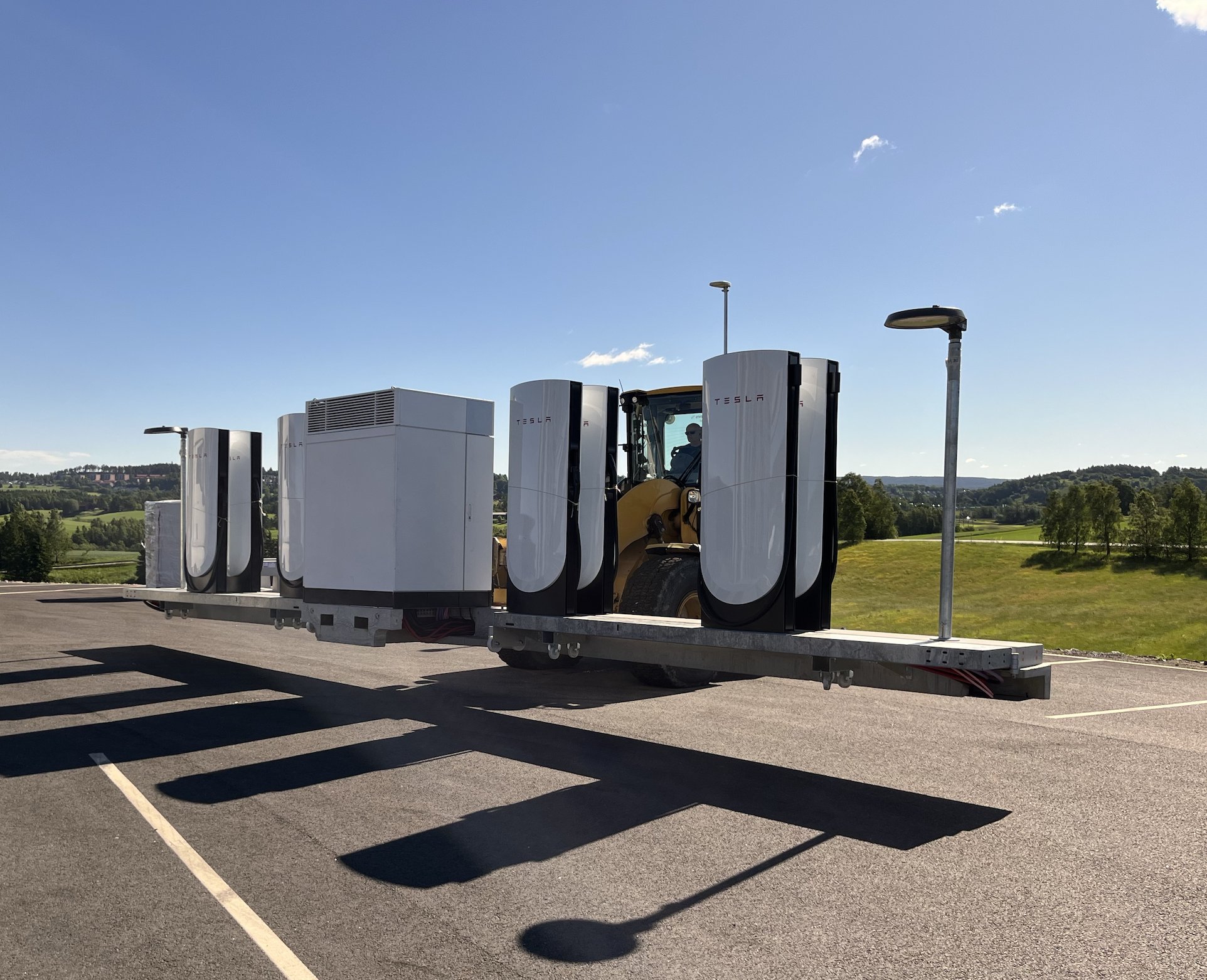
Tesla’s Folding Unit Supercharger has officially landed in Europe, with the company teasing a new installation in its effort for a broader rollout targeting major motorway rest stops across the European continent in Q3 2026. The arrival marks a notable shift in how Tesla is thinking about network expansion, moving from hardware performance alone to engineering the logistics chain itself.
While Tesla did not reveal the exact location for the new folding Supercharger in Europe, the photo shared on X heavily suggests that this maybe somewhere in Norway. Historically, whenever Tesla rolls out an entirely new infrastructure architecture in Europe, whether it was the original Supercharger stalls years ago or these brand-new modular V4 “Folding Units”, Norway is almost always the designated launch pad because of its unmatched EV adoption rate and supportive infrastructure
The Folding Unit, introduced in March 2026, is a factory pre-assembled V4 charging station built on an industrial hinge system mounted to a heavy-duty concrete base. The entire assembly arrives on site ready to unfold and connect. Tesla confirmed the units feature telescopic light poles specifically designed for easy transportation and fast on-site deployment, a detail that signals how carefully the logistics chain has been engineered alongside the hardware itself. The design allows 33% more stalls per delivery truck, cuts installation time roughly in half, and reduces overall deployment costs by more than 20% compared to traditional installations.
Tesla’s newest “Folding V4 Superchargers” are key to its most aggressive expansion yet
Tesla also noted telescopic light poles which provide benefits over traditional Supercharger installations that require fixed-height poles that are awkward to ship, slow to position on site, and often require separate crews and equipment to erect before charging hardware can even be staged. By engineering poles that compress for transit and extend on arrival, Tesla has removed one of the quieter bottlenecks in the physical deployment process. Every hour saved on a light pole installation is an hour redirected toward getting stalls energized. At scale, across dozens of new sites per quarter, those hours add up to a meaningful acceleration in how quickly a location goes from approved permit to serving its first customer.
Each Folding Unit pairs a single V4 power cabinet with eight charging posts. The V4 cabinet delivers up to 500 kW per stall for passenger vehicles and up to 1.2 MW for the Tesla Semi, supporting twice the stalls per cabinet at three times the power density of its predecessor. Longer cables make every new station immediately usable by non-Tesla vehicles, a priority as Tesla continues opening its network to Ford, GM, Rivian, Hyundai, Stellantis, and others.
As Teslarati reported when the Folding Unit was first unveiled, Tesla’s Gigafactory New York produced its final V3 Supercharger cabinet in March 2026 after more than seven years and 15,000 units, completing a full pivot to V4 production. The European arrival of the folding design is the next chapter in that transition.
Faster and cheaper deployment means Tesla can justify building in markets and corridors that were previously too expensive to serve, filling the coverage gaps that have slowed EV adoption outside major urban centers.
First Folding Unit Superchargers in Europe 🇪🇺 https://t.co/KNfYWJukkL pic.twitter.com/YR1udIpH1i
— Tesla Charging (@TeslaCharging) June 10, 2026
Elon Musk
SpaceXAI just launched into your kitchen with their new app
SpaceXAI just powered its first consumer app and it predicts what you want to buy.
SpaceXAI just made its first move into consumer AI, and it involves your grocery cart. On June 3, 2026, Gopuff and SpaceXAI announced the launch of Go, a Grok-powered shopping assistant built directly into the Gopuff app that predicts what you need before you even start searching for it.
Gopuff is an instant delivery platform that operates more than 400 micro-fulfillment centers across the U.S., delivering everyday essentials, snacks, drinks, and household items in as little as 15 minutes. It is not a restaurant delivery app or a marketplace. It owns its inventory, controls its warehouses, and handles its own logistics, which means it has built one of the most detailed consumer behavior datasets in retail over its 13-year history.
Go combines SpaceXAI’s advanced reasoning, voice, and image generation models with Gopuff’s dataset of hundreds of millions of orders and real-time cultural signals from X to prepare a suggested cart the moment a customer opens the app. It learns each shopper’s habits and automatically builds a personalized cart based on time of day, location, order history, and real-time indicators. Returning customers can check out with a single tap.
Rather than searching for specific items, users can describe a situation like a game-day party or the desire for a healthy breakfast and Go will assemble a cart automatically. It can also predict when shoppers are running low on items like coffee or paper towels and have them packed and delivered in under 15 minutes. Grok voice integration lets users talk to the app in plain conversational language and check out completely hands-free.
Gopuff co-founder and co-CEO Yakir Gola said: “Today, we believe the greatest friction left in commerce is not delivery or instantaneous access to the essentials customers need. It’s the moment before: the thinking, the deciding, the remembering. We’re combining Gopuff’s demand intelligence with xAI’s frontier reasoning to create an everyday shopping experience that feels like a true extension of you.”
Why SpaceX just made a $60 billion bet on AI coding ahead of historic IPO
The timing carries context beyond the product launch. SpaceXAI was formed after SpaceX completed an all-stock merger with Elon Musk’s xAI earlier this year, folding one of the most advanced AI labs in the world into the same corporate structure as the company preparing what could be the largest IPO in history. SpaceXAI is dipping into consumer-focused AI just as it prepares for its public debut, and while Musk has openly discussed building an everything app, this launch uses Grok to power another company’s product rather than launching a standalone consumer platform. Every consumer-facing deployment of Grok ahead of the IPO roadshow adds tangible evidence that SpaceXAI is not just an infrastructure play but a direct competitor in the AI application layer where OpenAI and Google are already fighting for dominance.

SpaceX’s newest Starmind will make earth data centers obsolete

Tesla pushes back against unfair reporting of accidents


