Lifestyle
Choosing Model 3 configuration options when it’s your second Tesla

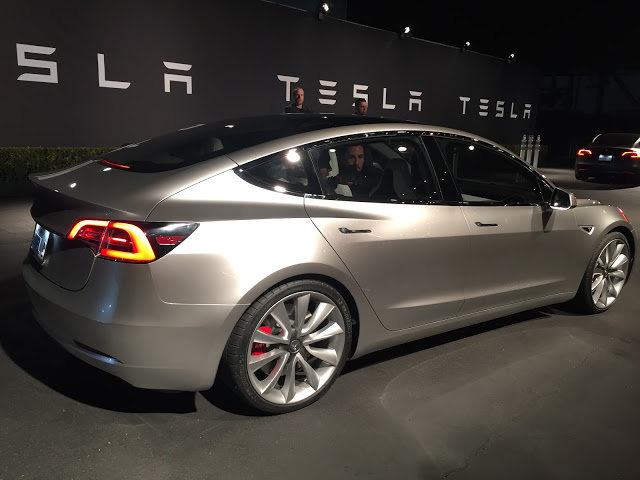
In case any of you have heard me both praise my Tesla and bash my Hyundai, here’s the scoop: “My” Model S is really “our” Model S. In fact, it’s mostly “his” Model S. Depending on the week, I get to drive the Tesla 1-3 days. I feel a lot more connected to the car than most people would in my situation but there is good reason. I’m a lifelong car enthusiast who first saw a Model S in November of 2012, read more about it on vacation in 2013, and convinced my husband we should test drive it in early 2014. As many of you know, once you test drive it’s game over. It took nearly 3 months to decide whether to take the plunge or not, with incessant research and meeting fellow owners needed before finally clicking reserve. It took another 3 months for the car to be delivered, and already I was hooked. My new obsession didn’t fade once delivered and in October of 2015 when I rushed out to make a video at 7am after receiving the Autopilot update, it got even stronger.
Needless to say, I am counting down the gas fill ups until our household becomes a fully Tesla household. What will need to happen before that date, however, is deciding which options to order for my (really mine) Model 3. Here is my opinion, as of today, on what I think I will want. I’m basing the costs on the following two assumptions: battery and motor upgrades will cost 50% of what they are on a Model S and feature upgrades will cost roughly 75% of what they are on a Model S. These are wild guesses of course, as are my proposed battery sizes.
- Model 3 base (45 kWh, rear wheel drive): $35,000
- Model 3 60D (+15 kWh range/duel motor upgrade – prerequisite for P): $7,500
- Model 3 P60D (adding P to the above): $10,000
- Supercharger access (free with 60D upgrade): $0
- Piano black interior: $0
- Black textile seats: $0
- Standard 18″ slip stream wheels: $0
- Matte Gray paint: $1,200
- All glass roof (stationary): $1,000
- Autopilot convenience features: $1,875
Total price excluding destination/doc fees: $56,575
That, folks, is my dream car. I actually dislike leather seats and wood trims, care not for premium sound or special interior lighting, and will get by just fine without a heated steering wheel. What I really want is for it to be the Performance version. Insane mode is just fine, I have no need to shave off another few tenths and won’t upgrade beyond that. There’s one big problem though – it’s a bit more than I want to spend. Our Model S is a of the 85 variety. Its RWD handles wonderfully in the wintry mix or snow situations we get a few times a year where I live. I also adore the larger frunk. For that reasons, I’d opt for a RWD Model 3 if available, but I fear that the P version will only be offered in a dual motor configuration. I also fear that it will only be offered with the largest battery option. That being said, the P upgrade over the base model in my estimation costs as much as a Corolla. Ouch! If Tesla pulls of a manufacturing miracle and it looks like I will be eligible for the full tax credit on this car, I will probably go P. The same holds true if my estimates are wrong and it costs much less. My better half also advocates for a P, since we may very well end up sharing the two cars 50/50.
If, however, I’m correct about the above prices and the tax credit happens to be already gone, I’ll probably skip the P. That’s a bit disappointing to think about, but it also begs the question whether or not to upgrade beyond the base at all. If that model gets 215 miles of ideal range and costs $35,000, it’s way more than enough to be a second car. I could very easily get to and from work 4 times on a single charge and we’d just opt to take our Model S long distance trips. It has more room for luggage anyway and is the more appropriate car to bring a dog. (My preference is not to have dogs in the seats.) My configuration would probably look something like this:
Model 3 base (45 kWh, rear wheel drive): $35,000
- Supercharger access: $1,500
- Piano black interior: $0
- Black textile seats: $0
- Standard 18″ slip stream wheels: $0
- Metallic blue paint: $1,000
- All glass roof (panoramic opening): $1,500
- Autopilot convenience features: $1,875
- Subzero cold weather package: $750
Total price excluding destination/doc fees: $41,625.
You’ll notice I treated myself to the panoramic roof (if that’s a thing) and cold weather package. We know access to Superchargers will cost something and even if I plan not to use this car for road trips, I will enable Supercharging. I believe in the network and am happy to contribute to its cost as one time fee rather than pay-per-use. I’ve also decided that only a performance version is worthy of the sick matte gray color I saw at the reveal, so blue it is. Make no mistake that this car as configured is amazing. I expect it to still have head-whipping acceleration and sturdy handling like our S85 does. I expect it to be beautiful and uniquely Tesla. It will turn heads on the street and draw crowds at car shows. It will make a BMW 3-series look like a foolish car choice. (In fact, it’ll make any sedan over $35,000 look like a foolish car choice.) It will save me from keeping a glove in the car to handle nasty gas pumps, spare me getting oil changes and rescue me from the time consuming and infuriating process of buying a car at a dealership. Even more than when I wrote the first paragraph, I can not wait for this car.
But Tesla, if you’re listening, let them eat cake! If you truly want to annihilate the competition, please uncouple the performance upgrade with a mandatory range and D upgrade. I’ll let you figure out the logistics, but upgrading to a single, larger rear motor for $5,000 would be a no-brainer.
What options do you hope to order? Tell me in the comments!


Lifestyle
Tesla hit by Iranian missile debris in Israel
A Tesla in Israel absorbed a direct hit from missile debris, and the glassroof held.

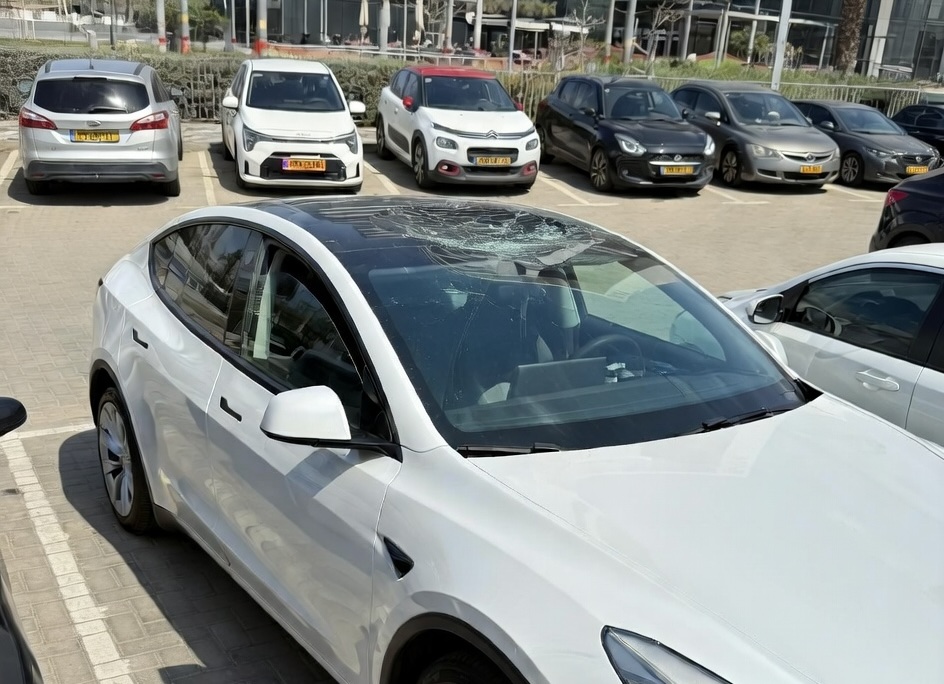
On March 30, 2026, Lara Shusterman was in Netanya, Israel when Iranian ballistic missiles triggered air raid sirens across the city. While she remained in safety, her 2024 Tesla Model Y did not escape untouched. A heavy piece of missile debris struck the car’s massive glass roof, leaving a deep crater but without shattering. In a Facebook post to the Tesla Israel community the following morning, Shusterman described what happened: “The glass did not shatter into dangerous shards. She stopped the damage and pushed the metal part to the ground.” She closed by thanking Elon Musk and the Tesla team for building what she called “security and a sense of trust even in extreme situations.”
Netanya is a coastal city in central Israel, roughly 18 miles north of Tel Aviv and has been among the areas most frequently struck during Iran’s ongoing missile campaign, following coordinated U.S. and Israeli strikes on Iranian military infrastructure. Falling shrapnel from intercepted missiles is a common occurrence.
-
- Tesla Model Y glass roof shattered from a piece of falling Iranian missile debris
-
- A piece of Iranian missile debris that struck Lara Shusterman’s Tesla Model Y in Netanya, Israel on March 30, 2026, after being intercepted by Israeli air defenses.
-
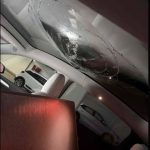
- Tesla Model Y glass roof shattered from a piece of falling Iranian missile debris
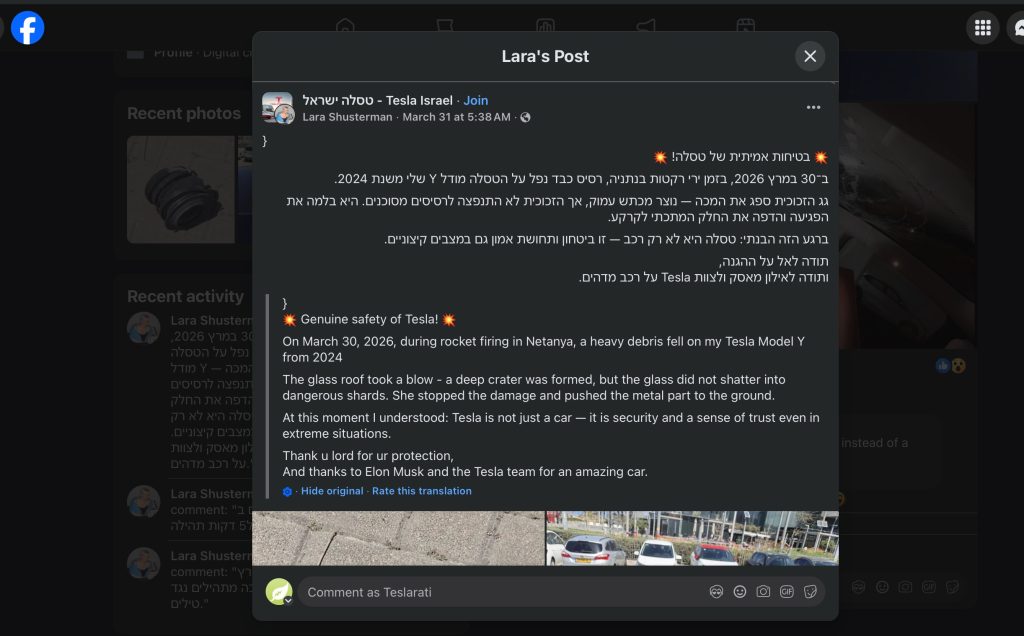
Source: Tesla Israel Facebook Group
The incident is a testament to Tesla’s structural engineering. Tesla’s glass roof is designed to support over four times the vehicle’s own weight. That strength has shown up in real-world accidents too. In 2021, a Model Y in California was struck by a falling tree during a storm, with the glass roof holding firm and the cabin remaining intact. In another widely reported incident, a Tesla Model Y plunged 250 feet off the cliff at Devil’s Slide in California in January 2023, with all four occupants, including two young children, surviving.
Disturbing details about Tesla’s 250-foot cliff drop emerge amid initial investigation
Tesla officially launched sales in Israel in early 2021 and captured over 60 percent of Israel’s EV market in the first year. The brand’s foothold in Israel remains significant. Tens of thousands of Teslas are now on Israeli roads, making incidents like Shusterman’s easy to corroborate. On the same week her Model Y took the hit, the U.S. Space Force awarded SpaceX a $178.5 million contract to launch missile tracking satellites, a separate but fitting reminder of how intertwined the Musk ecosystem has become with the realities of modern conflict.
Elon Musk
NASA sends humans to the Moon for the first time since 1972 – Here’s what’s next
NASA’s Artemis II launched four astronauts toward the Moon on the first crewed lunar mission since 1972.
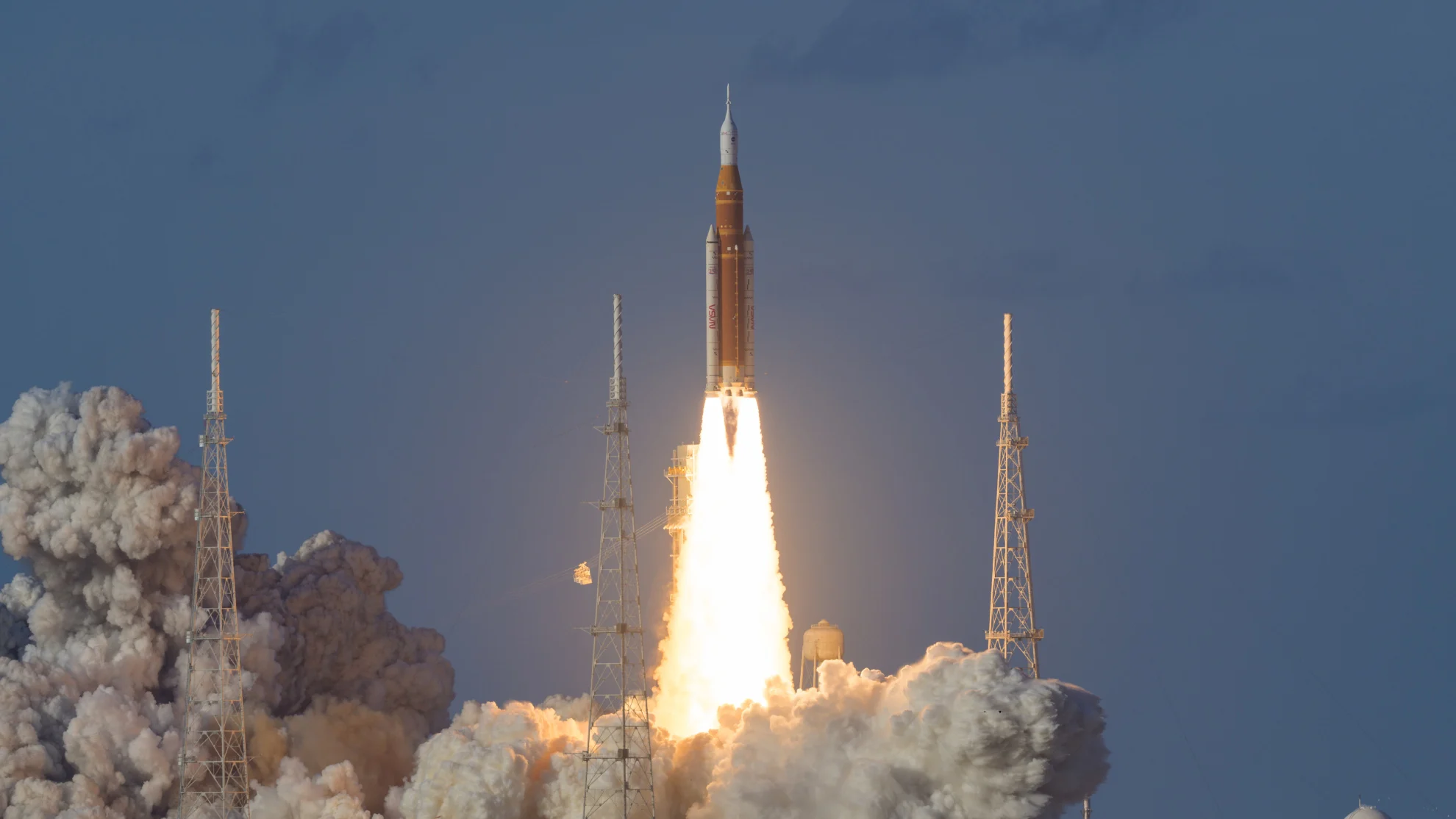
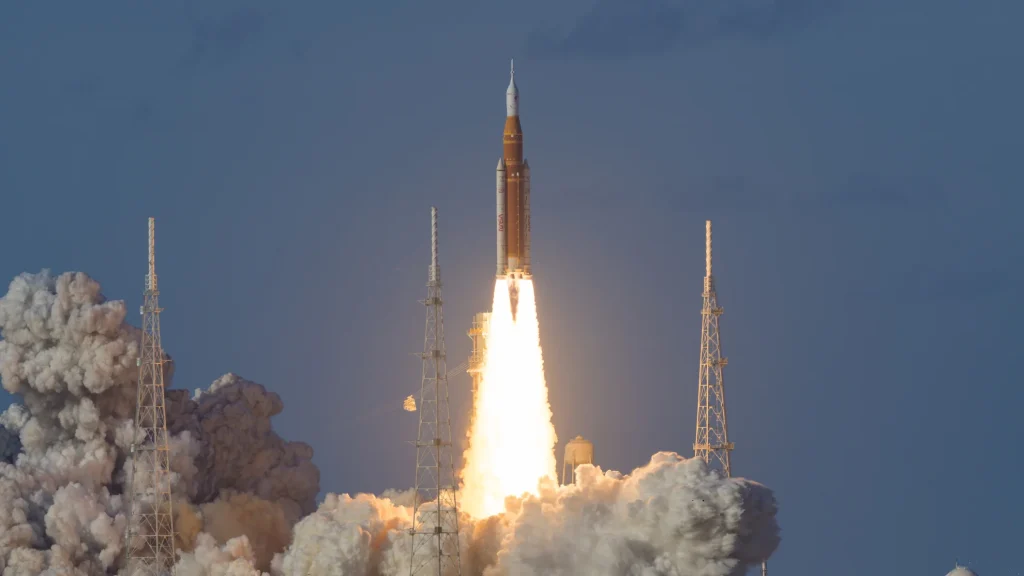
NASA’s Space Launch System rocket launches carrying the Orion spacecraft with NASA astronauts Reid Wiseman, commander; Victor Glover, pilot; Christina Koch, mission specialist; and CSA (Canadian Space Agency) astronaut Jeremy Hansen, mission specialist on NASA’s Artemis II mission, Wednesday, April 1, 2026, from Operations and Support Building II at NASA’s Kennedy Space Center in Florida. NASA’s Artemis II mission will take Wiseman, Glover, Koch, and Hansen on a 10-day journey around the Moon and back aboard SLS rocket and Orion spacecraft launched at 6:35pm EDT from Launch Complex 39B. (NASA/Bill Ingalls)
NASA launched four astronauts toward the Moon on April 1, 2026, marking the first crewed lunar mission since Apollo 17 in December 1972. The Artemis II mission lifted off from Kennedy Space Center aboard the Space Launch System rocket at 6:35 p.m. EDT, sending commander Reid Wiseman, pilot Victor Glover, mission specialist Christina Koch, and Canadian astronaut Jeremy Hansen on a 10-day journey around the far side of the Moon and back.
The mission does not include a lunar landing. It is a test flight designed to validate the Orion spacecraft’s life support systems, navigation, and communications in deep space with a crew aboard for the first time. If the crew reaches the planned distance of 252,000 miles from Earth, they will set a new record for the farthest any human has ever traveled, surpassing even the Apollo 13 distance record.
As Teslarati reported, SpaceX holds a central role in what comes next. The Starship Human Landing System is under contract to carry astronauts to the lunar surface for Artemis IV, now targeting 2028, after NASA restructured its mission sequence due to delays in Starship’s orbital refueling demonstration. Before any Moon landing happens, SpaceX must prove it can transfer propellant between two Starships in orbit, something no rocket program has done at this scale.
The last time humans left Earth’s orbit was 53 years ago. Gene Cernan and Harrison Schmitt of Apollo 17 were the final people to walk on the Moon, a record that stands to this day. Elon Musk has long argued that returning is not optional. “It’s been now almost half a century since humans were last on the Moon,” Musk said. “That’s too long, we need to get back there and have a permanent base on the Moon.”
The Artemis program involves 60 countries signed onto the Artemis Accords, and this mission sets several firsts beyond distance. Glover becomes the first person of color to travel beyond low Earth orbit, Koch the first woman, and Hansen the first non-American astronaut to reach the Moon’s vicinity. According to NASA’s live mission updates, the spacecraft’s solar arrays deployed successfully after liftoff and the crew completed a proximity operations demonstration within the first hours of flight.
Artemis II is step one. The Moon landing and the permanent lunar base come later. But after more than five decades, humans are heading back.
Elon Musk
Tesla Optimus Gen 3 is coming to the Tesla Diner with new ambitions
Tesla’s Optimus robot left the Hollywood Diner within months of opening. Now Musk is planning its return with a bigger role and a major Gen 3 upgrade underway.
![Tesla Optimus Gen 3 [Credit: Tesla]](https://www.teslarati.com/wp-content/uploads/2026/03/tesla-optimus-gen3-diner.jpg)
Tesla’s Optimus robot was one of the most talked-about features when the Tesla Diner opened on Santa Monica Boulevard in Hollywood on July 21, 2025. Dubbed “Poptimus” by Tesla fans, the Gen 2 robot stood upstairs at the retro-futuristic, drive-in theater and Tesla Supercharging station, scooping popcorn into bags and handing them to guests with a wave.
The diner itself had been years in the making. Elon Musk first floated the idea in 2018 with a tweet about building an “old-school drive-in, roller skates & rock restaurant” at a Hollywood Supercharger. What eventually opened was a unique two-story neon-lit space, with 80 EV charging stalls, and Optimus serving as a live demonstration of where Tesla’s ambitions were headed.
If our retro-futuristic diner turns out well, which I think it will, @Tesla will establish these in major cities around the world, as well as at Supercharger sites on long distance routes.
An island of good food, good vibes & entertainment, all while Supercharging! https://t.co/zmbv6GfqKf
— Elon Musk (@elonmusk) July 21, 2025
But Optimus did not stay long, and was gone by December 2025.
Now, the robot is set to return with a more demanding job. Musk has ambitions for Optimus to take on a food runner role in 2026, delivering meals directly to cars at the Supercharger stalls. While the latest Gen 3 Optimus is likely to initially take on its previous popcorn-serving role, it wouldn’t be out of the question for Optimus to see a quick promotion. With improved hand dexterity that features 50 total actuators and 22 degrees of freedom per hand, and significantly more powerful processing through Tesla’s latest AI5 chip that includes Grok-powered voice interaction, Musk described Optimus at the Abundance Summit on March 12, 2026, as “by far the most advanced robot in the world, Nothing’s even close.”
Back to work
See you at Tesla Diner tomorrow pic.twitter.com/H3tTajrUbu
— Tesla Optimus (@Tesla_Optimus) March 30, 2026
That confidence is backed by a major manufacturing shift. At the Q4 2025 earnings call in January, Musk announced Tesla would discontinue the Model S and Model X and convert those Fremont production lines to build Optimus. “It’s time to basically bring the Model S and X programs to an end,” he said, calling for a pivot that reflects where the Tesla’s future lies.

Tesla stock gets hit with shock move from Wall Street analysts

Tesla Full Self-Driving feature probe closed by NHTSA


