Lifestyle
What Tax Incentives Are Available When Buying My Tesla?

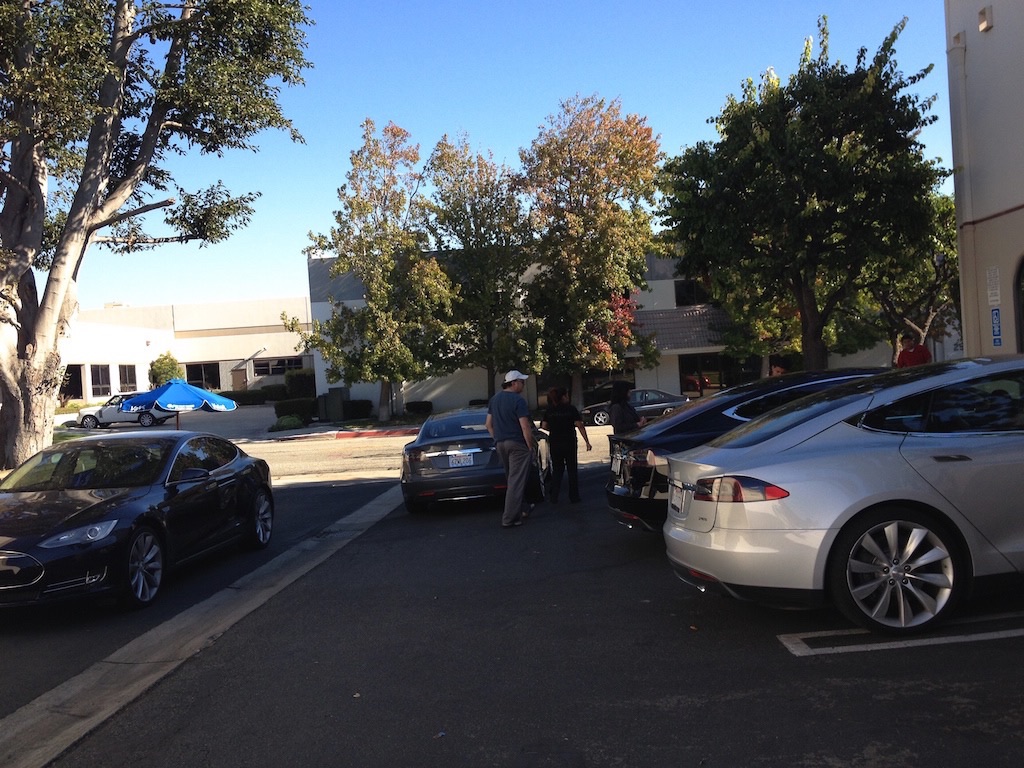
There are a number of tax incentives available when purchasing your Tesla depending on which model you choose and where you live. Here’s my overview of incentives available to US residents. Please note that I’m not a tax advisor, so be sure to do your own research and consult a tax professional.
Federal Tax Incentives
When I purchased my Tesla Model S back in 2014, I received a $7,500 Federal tax credit, an incentive that’s still available to new car buyers as of today (not available to CPO models). But what are the rules behind it and what does the credit mean to me?
According to the Internal Revenue Code Section 30D entitled “Plug-In Electric Drive Vehicle Credit”,
For vehicles acquired after December 31, 2009, the credit is equal to $2,500 plus, for a vehicle which draws propulsion energy from a battery with at least 5 kilowatt hours of capacity, $417, plus an additional $417 for each kilowatt hour of battery capacity in excess of 5 kilowatt hours. The total amount of the credit allowed for a vehicle is limited to $7,500.”
The smallest size battery for the Model S, at the time of this writing, is 70 kWh and will max out the federal credit at $7,500, not to be mistaken for a rebate or refund.
Too bad there’s a $7,500 cap! Just for fun, and assuming there weren’t a cap, a 70 kWh Model S would receive $417 for every kWh exceeding 5 kWh resulting in over $27,000 in tax credits! A 90 kWh Tesla would receive an additional $8,340 in credits making for a grand total of over $35,000 in tax credits.
These credits are issued by the Fed to incentivize adoption of clean energy vehicles and will go into a phase out period once 200,000 vehicles are manufactured by that automaker.
Qualified Plug-In Electric Drive Motor Vehicle Credit (IRC 30D) Phase Out
The qualified plug-in electric drive motor vehicle credit phases out for a manufacturer’s vehicles over the one-year period beginning with the second calendar quarter after the calendar quarter in which at least 200,000 qualifying vehicles manufactured by that manufacturer have been sold for use in the United States (determined on a cumulative basis for sales after December 31, 2009) (“phase-out period”). Qualifying vehicles manufactured by that manufacturer are eligible for 50 percent of the credit if acquired in the first two quarters of the phase-out period and 25 percent of the credit if acquired in the third or fourth quarter of the phase-out period.
With Tesla’s leading production and sales figures, it will be interesting to see what happens to Federal incentives once Tesla crosses the 200,000 vehicles manufactured threshold.
There are implications on which year the tax credit applies to based on when you took delivery of your vehicle. If you were one of the lucky people that took delivery of a Model X in 2015, be sure to have read the fine print on IRC 30D when you file your taxes.
State Incentives
In addition to the Federal tax credit, some states offer state rebates for qualifying battery electric vehicle (BEV) and plug-in hybrid electric vehicle (PHEV) purchases. The following states provide BEV incentives in the form of a refund for your qualifying purchase of a Tesla:
- California – $2,500
- Delaware – $2,200
- Colorado – $6,000
- Louisiana – $8,000
- Massachusetts – $2,500
- Maryland – $3,000
- Pennsylvania – $2,000
- Tennessee – $2,500
- Utah – $1,500
Note that each one of these programs can have its own nuances. There are minimum ownership periods (3 years in Massachusetts), income caps ($500K for joint filers in CA) and other qualifying circumstances to consider. Before you count your money, check the rules for your specific state and make sure you qualify.
For example, when I purchased my Model S in 2014 the current MA state tax credit was no longer available. Since then it’s been put back in place. That was certainly bad timing on my part!
Business Deductions
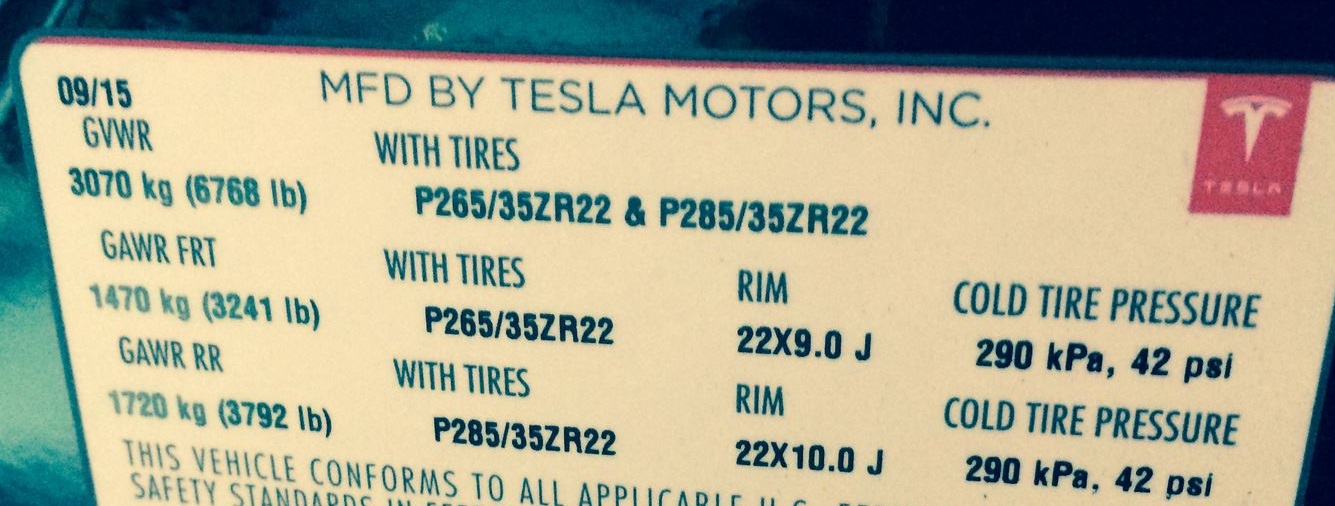
The door sticker of Model X VIN #001, owned by Tesla CEO Elon Musk. Photo via Twitter, posted by @kalud.
You may have heard about a “$25,000 Hummer Tax Loophole” especially as it relates to the Model X, but what is that and does it apply to you?
Tax Section 179 allows businesses to take deductions for equipment and investments that are put into service. For vehicles, there’s a specific section that states cars used for 50% or more in your business can deduct up to $11,060, and slightly more for trucks.
SUVs or Crossover Vehicles with GVWR above 6,000 lbs. get an even larger deduction of $25,000. This is the “Hummer Tax Loophole” as the Hummer weighed in at somewhere around 6,500 pounds. GVWR is the weight of the vehicle with passengers and/or equipment. The Model X has a curb weight of 5,334 lbs. but it turns out that its GVWR is 6,768 pounds hence it qualifies for the Section 179 deduction.
That said, if you buy or lease a Model X and use it 50% or more for business you could deduct up to $25,000 in depreciation in the first year you acquire the vehicle versus depreciating it over time. The rationale is that businesses are incentivized to take the tax deductions up front there by allowing them to invest more into the business, earlier.
Note that the Section 179 deduction applies to both new and used vehicles, although I think we’ll see few used Model Xs in 2016.


Lifestyle
Tesla’s newest feature lets you floor it out of a Supercharger while plugged in
Tesla’s new Emergency Drive Away feature lets owners flee a Supercharger while still plugged in.

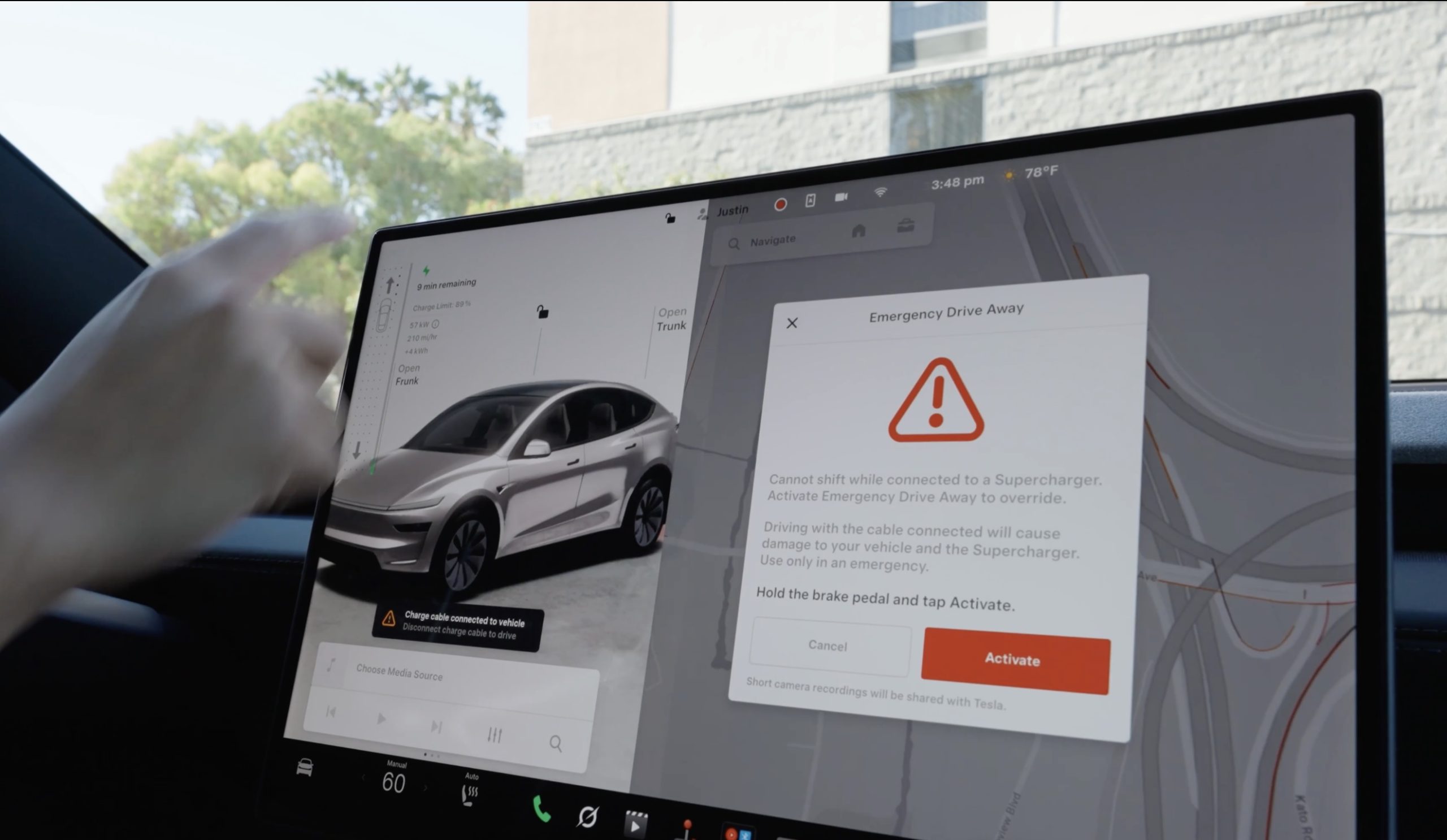
Tesla has given drivers a way to escape while a vehicle is plugged-in at a Supercharger, in the event of an emergency. The company’s charging team announced a new feature on X called Emergency Drive Away, which lets a driver shift into Drive and pull away while the charging cable is still connected to the car.
Until now, a Tesla would not leave Park with a charge cable plugged in. Drivers had to release the latch from the touchscreen, the Tesla app, or the button on the charge handle, then wait for the port to let go. Emergency Drive Away removes that lockout, but Tesla is clear that it comes at a cost. “Use of this feature will damage your vehicle and the Supercharger,” the company wrote, adding that the function is meant for emergencies only and that deliberate misuse will lead to “additional penalties.” Tesla did not say what those penalties are.
Emergency Drive Away lets you shift into Drive while still plugged into a Supercharger pic.twitter.com/40GSzyP4lG
— Tesla Charging (@TeslaCharging) October 1, 2026
The in-car prompt is just as direct, with the warning reading: “Driving with the cable connected will cause damage to your vehicle and the Supercharger. Short camera recordings will be shared with Tesla.” That footage gives Tesla a way to separate a real emergency from someone who simply did not want to wait for the latch.
The feature requires software update 2026.38.3, and Tesla said in replies to owners that it works at every Supercharger in the United States without new stall hardware. Model S and Model X vehicles built before 2021 are not supported, and the company says the feature applies to U.S. Superchargers “for now,” leaving Canada and other markets out at launch.
Tesla Supercharger argument leads to tragic shooting incident
Tesla did not tie the announcement to any specific event, but it arrives two months after a gunman opened fire at an In-N-Out in Twin Falls, Idaho, on August 1, targeting three people in two Teslas at the neighboring Supercharger. One of them, a 66 year old man from Salt Lake City, was killed. Superchargers have been the scene of violence before, including a fatal shooting at a station near Denver in 2023.
In the weeks after Twin Falls, owners pushed Tesla for a native way to escape a stall, and many pointed back to EVject, the aftermarket breakaway connector Tesla sued in 2024 over claims it lacked overtemperature protection. The two companies later reached an agreement that led EVject to recall its earlier connectors in favor of a version with thermal sensors.
Our mission has always been about providing peace of mind and eliminating sitting duck scenarios.
We patented the built-in breakaway charger tip on Feb 15, 2023. Awarded Jan 30, 2024. Then shared the designs with @TeslaCharging
Thank you @Tesla for rolling out a solution. This… https://t.co/djOzswLw9N
— EVject (@EVject) October 2, 2026
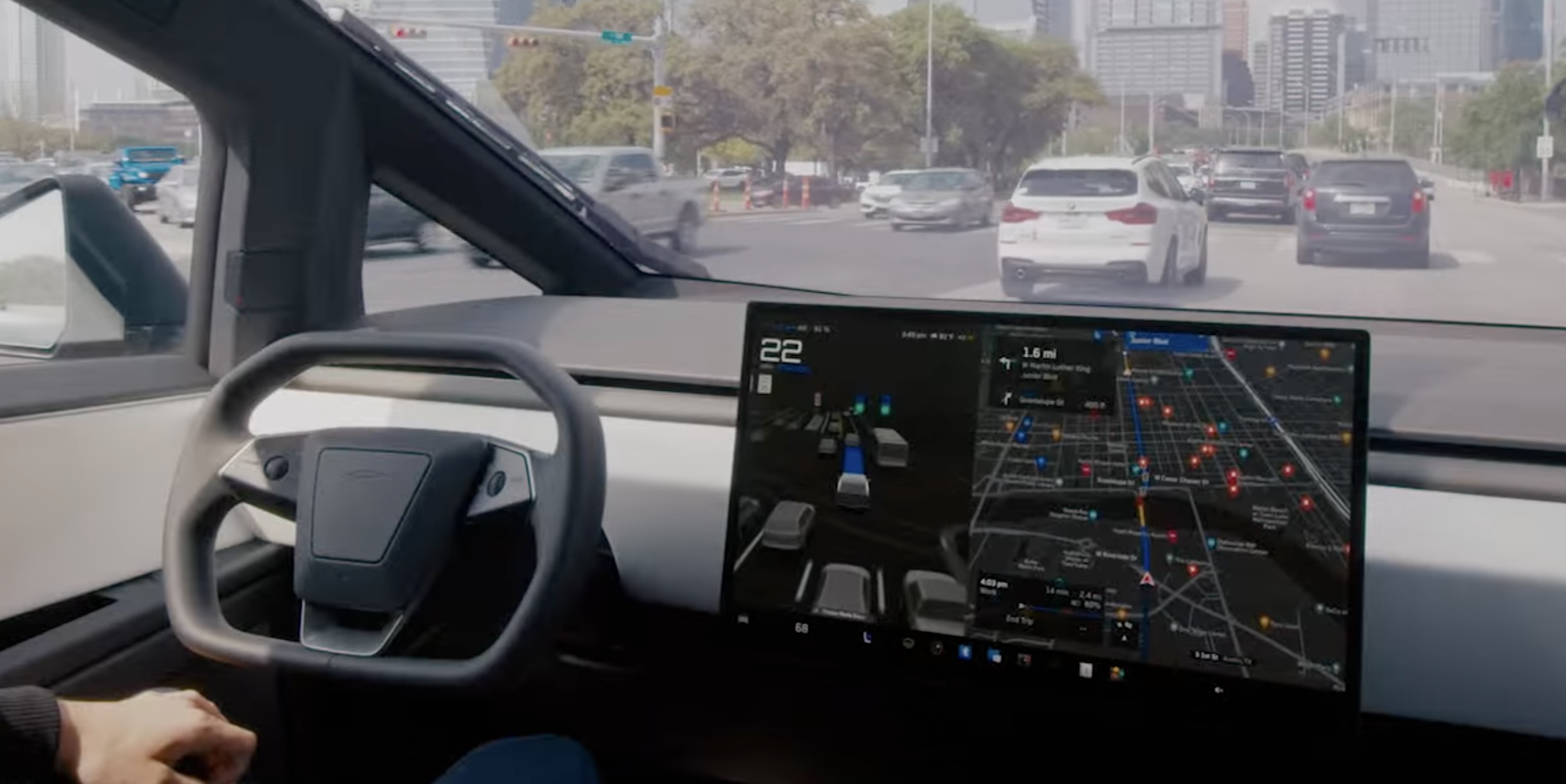
Tesla’s Automatic Collision Evasion feature can be seen in one of the first owner videos of it in action.
Tesla owner Spencer (@scotsrule08) posted on Monday that the feature “worked flawlessly,” saying FSD reengaged itself just as he was about to hit a curb. Ashok Elluswamy, who leads Tesla’s AI team, shared the clip and wrote, “A guardian angel always looking out for you.”
The video arrives in the middle of a staged rollout. Tesla first shipped Automatic Collision Evasion with FSD (Supervised) v14.3.9 in software update 2026.27.6 earlier this month, which Teslarati covered as it reached cars. Update 2026.27.10, which began going out on September 19, carried the feature improvements with FSD v14.3.10, according to release notes tracked by Not a Tesla App. The newer 2026.27.11 build is now reaching another wave of vehicles.
The new Automatic Collision Evasion feature worked flawlessly! FSD reengaged itself just as I was about to hit a curb.
Kudos @Tesla_AI team! 👏 pic.twitter.com/Fbp15HhpL2
— Spencer (@scotsrule08) September 28, 2026
The feature only runs on HW4 vehicles, and it requires an active FSD purchase or subscription with both FSD (Supervised) and Automatic Emergency Braking enabled. HW3 owners receive FSD v14.2 Lite in the same updates, but that build does not include collision evasion.
Tesla’s release notes describe two triggers. The first is an imminent frontal collision that braking alone may not prevent, in which case the car can activate FSD to steer, brake or accelerate around the hazard. That scenario is limited to highways below 85 mph, with no pedestrians or cyclists detected and no slippery road surface. The second covers a driver who appears inattentive, such as reaching into the back seat, or who seems to have switched off FSD by accident. Spencer’s curb clip appears to fall into that second category.
Tesla plans big safety improvements for Full Self-Driving v15
Once the system takes over, the accelerator is muted and light brake input will not cancel the maneuver. Drivers need to apply firm, deliberate steering force to take back control, and the car chimes to hand control back once the danger has passed.
Elluswamy recently noted that earlier hazard prediction, faster reaction time and better collision avoidance would arrive with FSD v15, the next major version.
Elon Musk
Elon Musk drops a surprise update on Boring Company’s next big dig
Musk says Boring Company could shrink the Austin to San Antonio drive to just minutes.

Elon Musk says The Boring Company is working on what he called “a simple, precursor Hyperloop” tunnel connecting Austin and San Antonio, targeting speeds above 200 mph and cutting a drive that can take up to two and a half hours down to a consistent under 30 minutes. Musk posted the idea on X Sunday, in a reply to a repost of an AI generated video imagining a science fiction future with human colonies on other worlds, which he shared with the line “This is the future we shall bring into being.”
This is the future we shall bring into being pic.twitter.com/8aD0w8MDVc
— Elon Musk (@elonmusk) September 20, 2026
The Boring Company’s own account picked up the idea in the same thread, adding a detail about how the trip would actually work: “Because Loop/Hyperloop is express (i.e. no intermediate stops), one could travel from an Austin parking lot to a favorite San Antonio restaurant in about 30 minutes. As long as they both have Loop stations.” That framing ties the proposed intercity link to the same station model the company already runs in Las Vegas, where riders enter the tunnel network through small, garage style stops rather than one central terminal.
This is not the company’s first run at the Austin to San Antonio corridor. Boring Company floated tunnels between the two cities as far back as 2021, and later competed for a separate San Antonio Loop project tied to the airport before that specific bid stalled. Pitches for tunnels in Chicago, Los Angeles, and a New York to Washington corridor have followed a similar pattern of big announcement without a shovel in the ground.
What is different this time is the balance sheet, especially since The Boring Company closed a 3 billion dollar funding round led by investors in the United Arab Emirates earlier this month at a valuation near 23 billion dollars, giving the tunneling company more capital to chase speculative projects than it had during its earlier Texas pitches. The company is also mid-build on two other intercity systems it has actually broken ground on, inc;luding a Nashville tunnel linking downtown to the airport, where a second boring machine finished commissioning in June, and its Las Vegas network, where the station count keeps climbing on paper faster than tunnels get dug.
That gap between announcement and execution is the reason to treat Sunday’s post as an opening bid rather than a project. A tunnel spanning roughly 80 miles between two metro areas, running at speeds Boring Company has not demonstrated over any real distance, would dwarf anything the company has built. For now, the Austin to San Antonio Hyperloop exists as a caption under an AI generated space video.

Tesla’s newest feature lets you floor it out of a Supercharger while plugged in

Why Tesla Roadster unveiling delay might have nothing to do with it flying


