Elon Musk
SpaceX Starship V3 gets launch date update from Elon Musk
The first flight of Starship Version 3 and its new Raptor V3 engines could happen as early as March.

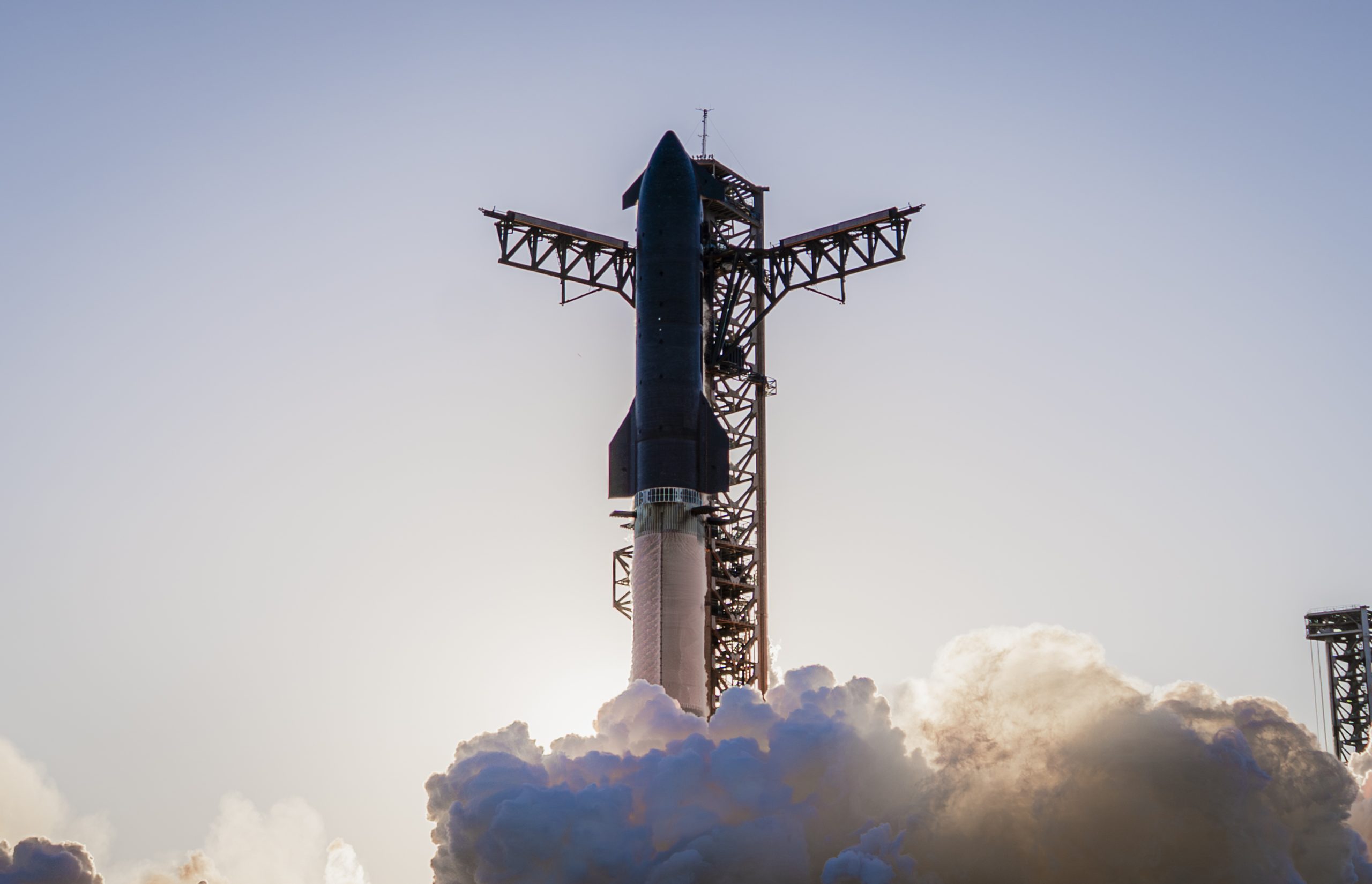
Elon Musk has announced that SpaceX’s next Starship launch, Flight 12, is expected in about six weeks. This suggests that the first flight of Starship Version 3 and its new Raptor V3 engines could happen as early as March.
In a post on X, Elon Musk stated that the next Starship launch is in six weeks. He accompanied his announcement with a photo that seemed to have been taken when Starship’s upper stage was just about to separate from the Super Heavy Booster. Musk did not state whether SpaceX will attempt to catch the Super Heavy Booster during the upcoming flight.
The upcoming flight will mark the debut of Starship V3. The upgraded design includes the new Raptor V3 engine, which is expected to have nearly twice the thrust of the original Raptor 1, at a fraction of the cost and with significantly reduced weight. The Starship V3 platform is also expected to be optimized for manufacturability.
The Starship V3 Flight 12 launch timeline comes as SpaceX pursues an aggressive development cadence for the fully reusable launch system. Previous iterations of Starship have racked up a mixed but notable string of test flights, including multiple integrated flight tests in 2025.
Interestingly enough, SpaceX has teased an aggressive timeframe for Starship V3’s first flight. Way back in late November, SpaceX noted on X that it will be aiming to launch Starship V3’s maiden flight in the first quarter of 2026. This was despite setbacks like a structural anomaly on the first V3 booster during ground testing.
“Starship’s twelfth flight test remains targeted for the first quarter of 2026,” the company wrote in its post on X.


Elon Musk
Elon Musk rips ABC News over fatal NYC Tesla crash report
Musk pushed back on NYC Tesla crash coverage, pointing to a pattern of premature blame.

Elon Musk pushed back overnight against media framing of a fatal Tesla crash in Midtown Manhattan, telling a user on X that “it wasn’t the car” and that the vehicle’s Autopilot system had nothing to do with the wreck.
The crash happened just before 3 a.m. Wednesday, when a 2024 Tesla Model Y struck a sidewalk shed outside 315 Madison Ave., a bus stop pole and a mailbox on East 42nd Street, according to the NYPD. The car kept moving several more blocks before stopping near Second Avenue. Both women inside, each 27, were taken to Bellevue Hospital, where the passenger was pronounced dead. The driver was charged with vehicular manslaughter, driving while ability impaired and leaving the scene of an accident.
Police have not attributed the crash to Autopilot or Full Self-Driving in any public statement. The charges point to impairment, not software. Musk’s response followed a since-deleted ABC News post that he said mischaracterized the incident. Replying to a user on X, Musk wrote that if Autopilot had been engaged, “they would not have crashed,” and added that “the legacy media will never forgive Tesla for failing to advertise with them,”
The legacy media will never forgive Tesla for failing to advertise with them
— Elon Musk (@elonmusk) September 9, 2026
It’s a familiar cycle for Tesla. In June, headlines from several national outlets described a fatal crash in Katy, Texas, as happening while the car was “on autopilot,” based on the driver’s own account to police after his Model 3 struck a home and killed a 76-year-old woman. Tesla’s data told a different story when Ashok Elluswamy, Tesla’s head of AI, said the driver had pressed the accelerator to 100% and reached 73 mph in a residential zone. Harris County prosecutors later confirmed the human override and the driver was charged with manslaughter.
Florida Gov. Ron DeSantis pointed to that same Katy crash last month to argue that outlets routinely name Tesla in crash headlines while leaving other automakers unnamed, even after a driver’s own actions are shown to be the cause. A similar pattern played out in 2024, when Musk had to clarify that FSD was never even downloaded onto the Model 3 involved in a fatal Colorado DUI crash, despite a passenger’s claim that an “auto drive feature” was in use.
Tesla has not issued a separate statement on the Manhattan crash beyond Musk’s posts on X. The NYPD’s investigation is ongoing, and no cause for the driver losing control has been released.
Elon Musk
Tesla primes Cybercabs for 4K streaming and high bandwidth gaming with Starlink integration
Tesla is now shipping Cybercabs from Giga Texas with Starlink hardware built in as standard.
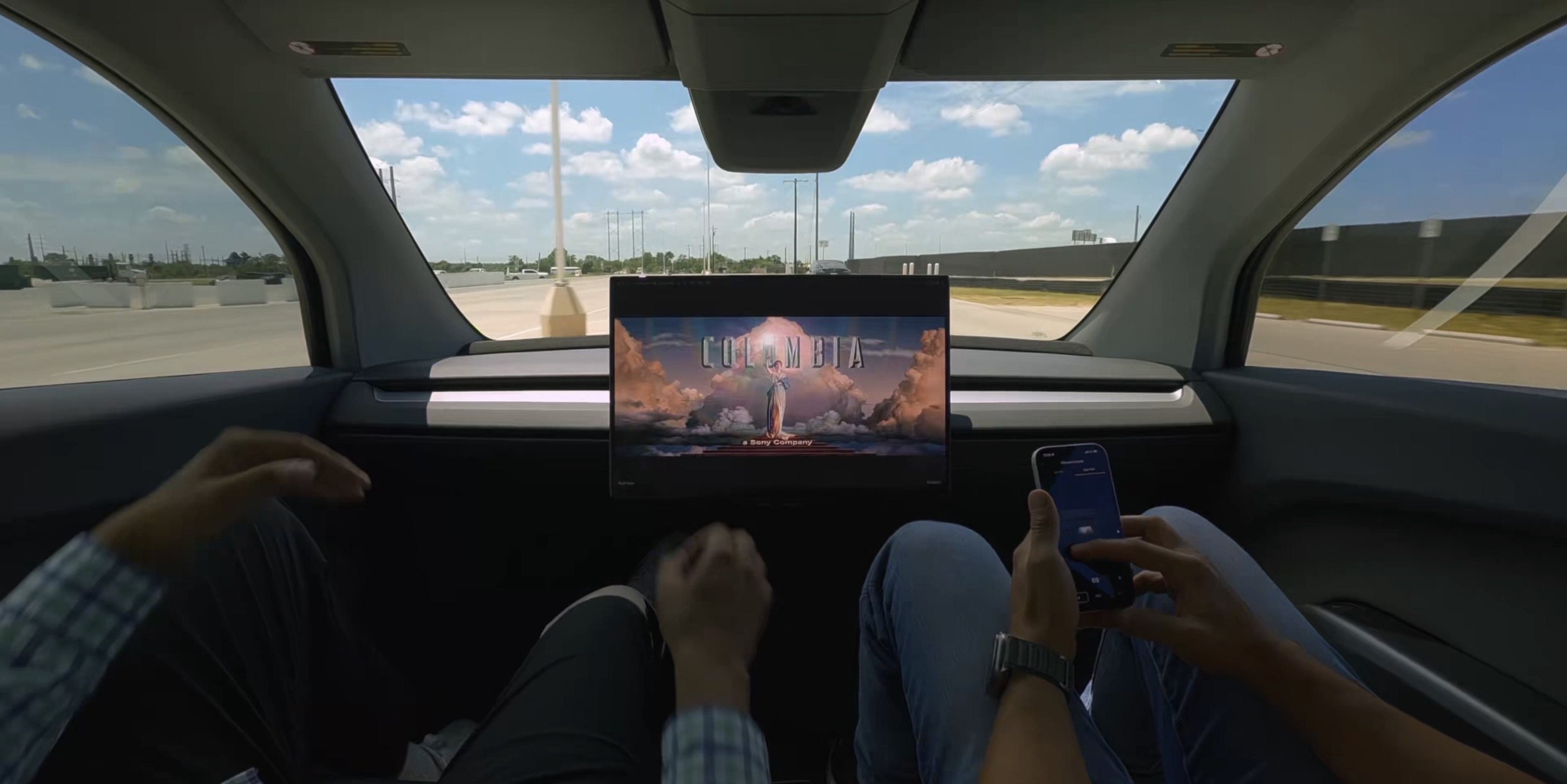
Tesla’s Cybercabs are now leaving Gigafactory Texas with Starlink hardware on the rear hatch in significant numbers, according to drone footage captured Tuesday by longtime Austin drone observer Joe Tegtmeyer. Production at the factory ramped back up after the Labor Day weekend, and his flyover of the outbound lot showed rows of gold Cybercabs alongside Model Y Long Wheelbase units, many carrying the satellite module for the first time as standard equipment rather than a one off retrofit.
Giga Texas today is busy with production coming back up following the long weekend. Of interest today in the outbound lot is the appearance of hundreds of Mode; YL’s and many more Cybercabs and for the 1st time equipped with the Starlink module one the hatch in big numbers.
At… pic.twitter.com/G9yl6s51m4
— Joe Tegtmeyer 🚀 🤠🛸😎 (@JoeTegtmeyer) September 8, 2026
Tesla first showed Starlink built into an actual Cybercab on August 10, when the Robotaxi account posted images of a single gold unit with the antenna integrated into the roofline above the taillights and called it the first Cybercab with Starlink integration. That followed a July reveal where Tesla and Starlink jointly posted a cutaway diagram of the antenna placement without a working vehicle to back it up. Ashok Elluswamy, Tesla’s VP of AI software, said at the time that the connection isn’t required for the car to drive itself. It exists mainly for navigation, customer service and keeping tabs on the fleet.
Musk has made a different case in public. During Tesla’s Q2 earnings call, he said the company can’t afford robotaxis stranded in what he called “Bermuda Triangles of lack of cellular connectivity,” and he separately claimed on X that Starlink will eventually reach every Tesla built, calling it the only way to deliver high bandwidth to billions of vehicles. He has also pitched the antenna as an entertainment upgrade, telling riders they would be able to stream 4K video or play games during a trip.
The rollout has moved fast since. Robotaxi service opened to the public in Austin on September 3, and Cybercabs had already been spotted with Starlink hardware in Houston and near Miami International Airport in the weeks before Tuesday’s factory footage showed the module shipping at volume rather than on scattered test units. Whether the satellite link earns its keep is still an open question. Tesla’s unsupervised service currently runs in dense metro geofences in Texas and Florida, markets where cellular coverage is already strong, which is not where the rural dead zones Musk describes tend to show up.
Elon Musk
Tesla Cybercabs narrowly miss deadly Amazon cargo plane crash
An Amazon cargo plane crash near Miami’s airport stopped feet from dozens of Tesla Cybercabs.
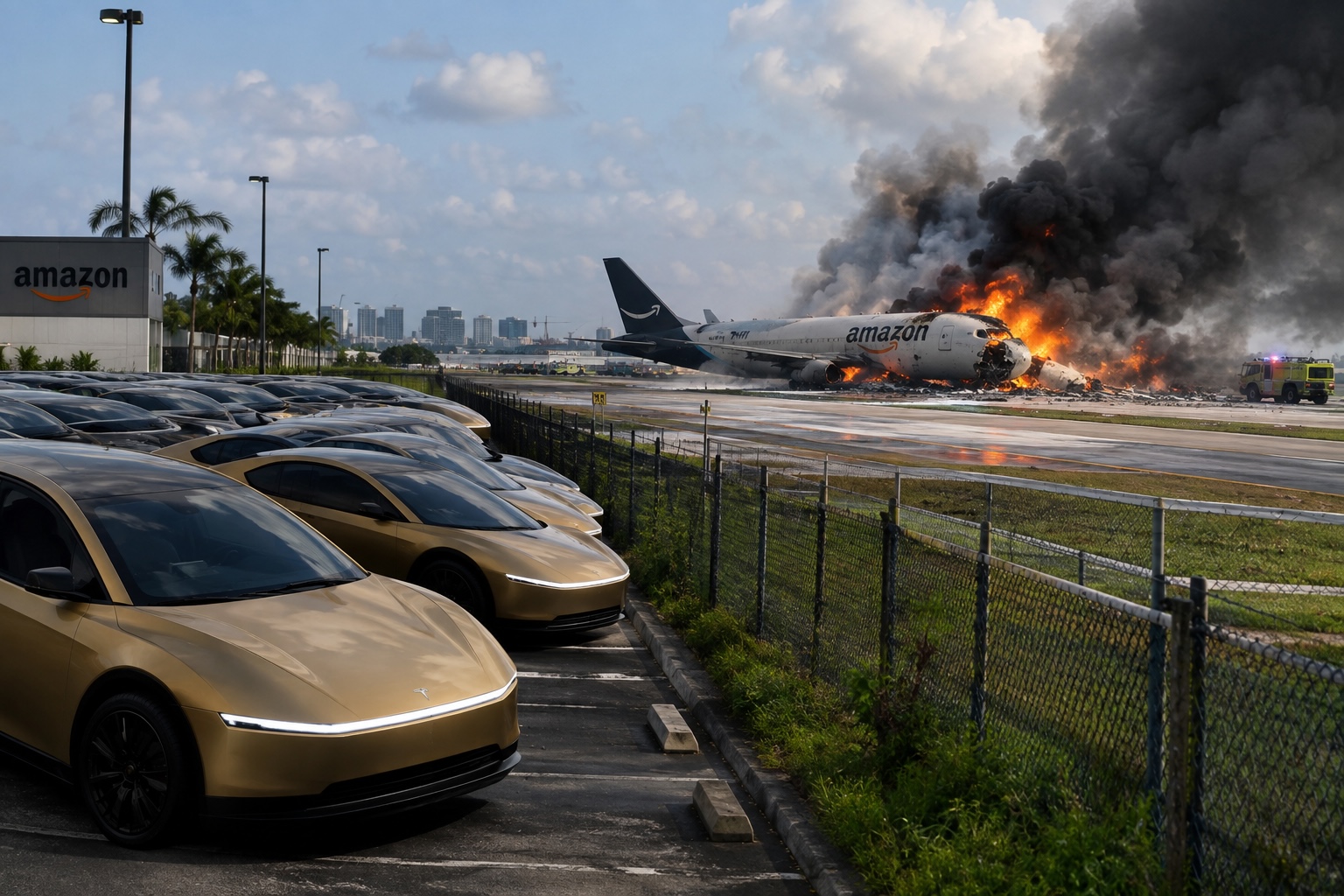
An Amazon Prime Air Boeing 767 cargo jet overran the runway at Miami International Airport on Sunday afternoon, killing five people and injuring five more. The jet, operated by North Carolina based carrier 21 Air as Flight 7598, touched down around 2 p.m. after arriving from San Juan, Puerto Rico, then crossed the airport perimeter, plowed across NW 67th Avenue and struck multiple vehicles before catching fire, according to the Associated Press.
Photos and video from the scene show the aircraft’s nose stopped within meters of a fenced staging lot holding dozens of gold painted Tesla Cybercabs, the steering wheel free robotaxi Tesla began putting on public roads in Austin last week. Miami-Dade Fire Rescue has confirmed the plane struck “multiple vehicles” but has not said whether any Cybercabs were among them, and neither Tesla nor airport officials have addressed the fleet directly.
The Cybercabs had not yet entered commercial service in Miami. Tesla’s existing Robotaxi operation there runs on modified Model Y vehicles and has been unsupervised since Ashok Elluswamy confirmed the detail on X in July.
Footage of the plane crash from earlier today | #ONLYinDADE pic.twitter.com/iGoOtnd6cD
— ONLY in DADE (@ONLYinDADE) September 6, 2026
Elon Musk offered the briefest of reactions. Replying to a Zero Hedge post about the Cybercabs sitting so close to the wreckage, he wrote a single word: “Weird.” He has not commented further, and Tesla has not issued a statement.
The timing puts Tesla’s newest vehicle near an unrelated but highly visible tragedy just days after its Austin debut, a launch that had already drawn scrutiny from federal regulators. The National Highway Traffic Safety Administration opened an audit how Tesla certified the Cybercab as compliant with federal vehicle safety standards, a process Teslarati covered after the vehicle’s September 3 launch event. That inquiry concerns the car’s lack of a steering wheel and pedals, not the Miami crash.
Investigators from the FAA and NTSB are focused on the plane, not the parking lot beside it. Flight data reviewed by outlets including Simple Flying show the 767 touched down around 170 knots, well above the 135 to 140 knot range typical for the aircraft, though investigators have not determined a cause. Amazon said it is working with authorities and that its priority is the safety of everyone affected.
Whether any Cybercabs were damaged, and what Tesla plans for the fleet parked near one of the country’s busiest airports, remain open questions.

Elon Musk rips ABC News over fatal NYC Tesla crash report

Tesla’s two defunct flagship models are getting a big upgrade


