News
Tesla gives its biggest hint that Full Self-Driving in Europe is imminent

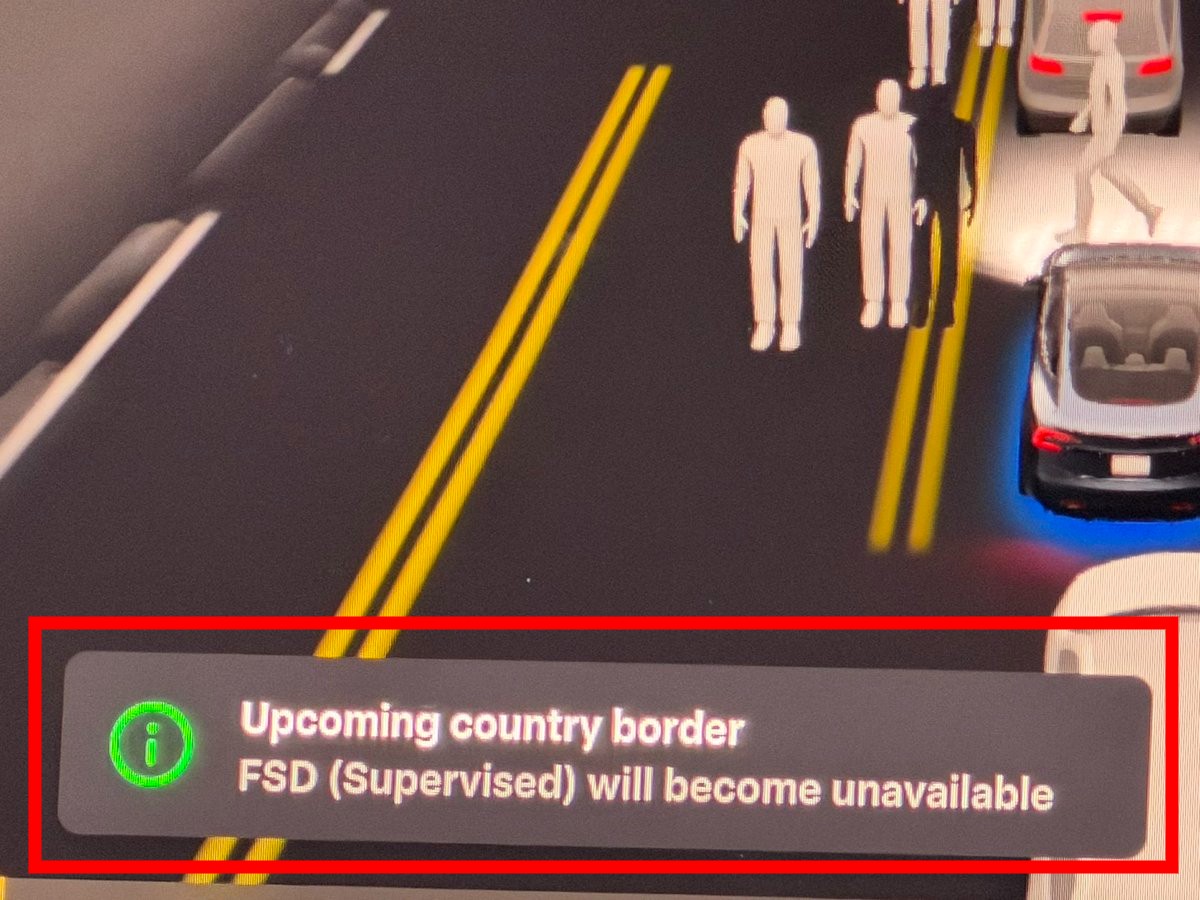
Tesla has given its biggest hint that Full Self-Driving in Europe is imminent, as a new feature seems to show that the company is preparing for frequent border crossings.
Tesla owner and influencer BLKMDL3, also known as Zack, recently took his Tesla to the border of California and Mexico at Tijuana, and at the international crossing, Full Self-Driving showed an interesting message: “Upcoming country border — FSD (Supervised) will become unavailable.”
FSD now shows a new message when approaching an international border crossing.
Stayed engaged the whole way as we crossed the border and worked great in Mexico! pic.twitter.com/bDzyLnyq0g
— Zack (@BLKMDL3) January 26, 2026
Due to regulatory approvals, once a Tesla operating on Full Self-Driving enters a new country, it is required to comply with the laws and regulations that are applicable to that territory. Even if legal, it seems Tesla will shut off FSD temporarily, confirming it is in a location where operation is approved.
This is something that will be extremely important in Europe, as crossing borders there is like crossing states in the U.S.; it’s pretty frequent compared to life in America, Canada, and Mexico.
Tesla has been working to get FSD approved in Europe for several years, and it has been getting close to being able to offer it to owners on the continent. However, it is still working through a lot of the red tape that is necessary for European regulators to approve use of the system on their continent.
This feature seems to be one that would be extremely useful in Europe, considering the fact that crossing borders into other countries is much more frequent than here in the U.S., and would cater to an area where approvals would differ.
Tesla has been testing FSD in Spain, France, England, and other European countries, and plans to continue expanding this effort. European owners have been fighting for a very long time to utilize the functionality, but the red tape has been the biggest bottleneck in the process.
Tesla Europe builds momentum with expanding FSD demos and regional launches
Tesla operates Full Self-Driving in the United States, China, Canada, Mexico, Puerto Rico, Australia, New Zealand, and South Korea.


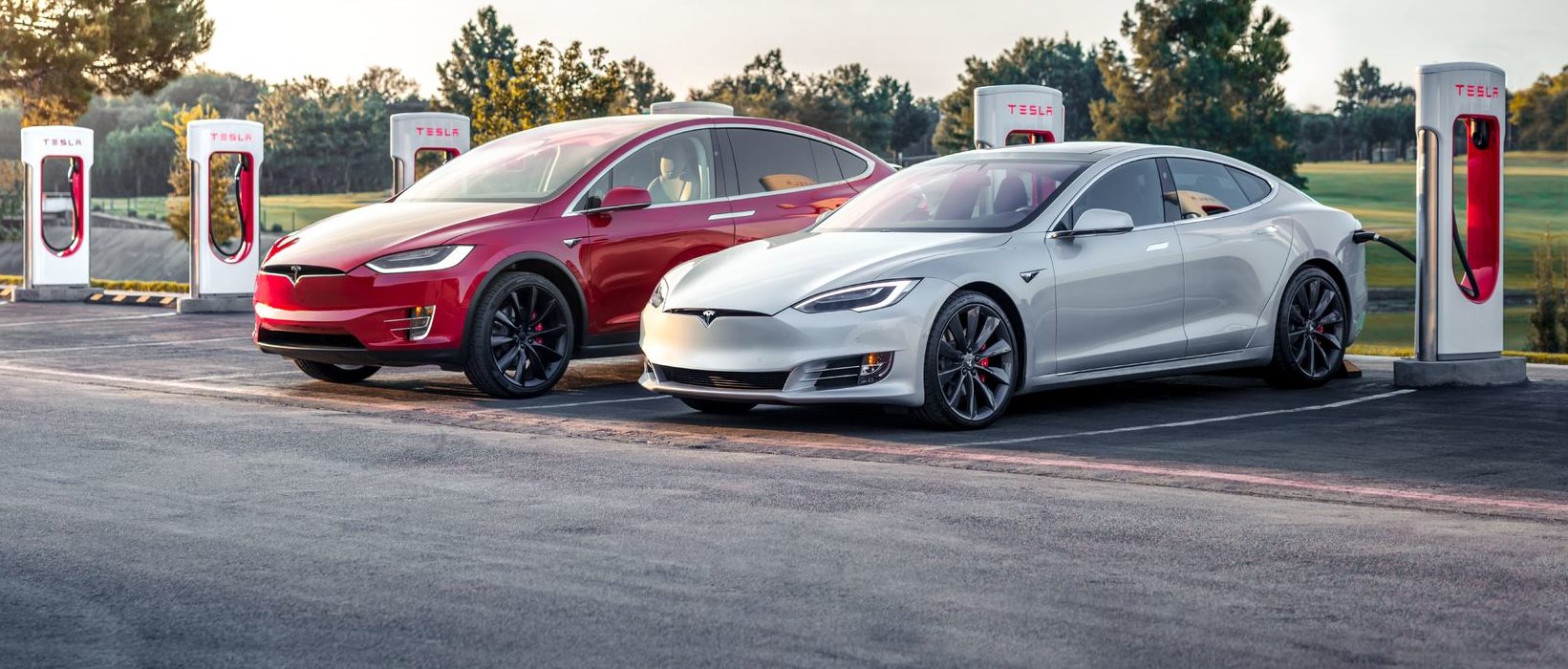
Tesla’s two recently-defunct flagship models, the Model S and Model X, are getting a big upgrade, according to the company’s Head of AI, Ashok Elluswamy.
Older Hardware 3 Model S and Model X vehicles have been the last major holdouts in Tesla’s Full Self-Driving v14 Lite rollout, and that wait now appears to be ending.
Tesla brings closure to flagship ‘sentimental’ models, Musk confirms
At Tesla’s Cybercab launch, AI chief Ashok Elluswamy told Ryan McCaffrey that he thought the S and X build “was supposed to go out last week.” Evidently, Elluswamy expects the suite to be rolled out to those HW3 Model S and Model X very soon:
For my @Tesla friends – and specifically Model S & X owners with HW3 who are waiting on FSD v14 Lite – I spoke to @aelluswamy at the Cybercab launch, & when I asked for an ETA on v14 Lite for S/X owners, he said, “Oh, I thought it was supposed to go out last week.”
So: soon! 🙌
— Ryan McCaffrey (@DMC_Ryan) September 7, 2026
Those cars are not the current Model S and Model X, which already ship with Hardware 4. They are the pre-refresh flagships built around Tesla’s older Autopilot computer, often called HW3 or AI3.
Tesla stopped putting that computer in new vehicles years ago, which is why owners treat these S and X cars as a closed generation. Model 3 and Model Y vehicles on the same computer began receiving v14 Lite in late June 2026 and saw a wider North American expansion in July. South Korea followed as an early international market. The S and X versions of the same software never joined that wave.
v14 Lite is Tesla’s way of squeezing the current v14 driving stack onto hardware that cannot run the full AI 4 model. The company describes the process as distillation: behaviors learned on the newer computer, including reinforcement learning and offline models, are compressed so the older chip and cameras can use them as a guide.
Early descriptions put the distilled network at roughly 15 percent of the original size. The result is still supervised Level 2 driving. Tesla has been clear that HW3 cannot support unsupervised Full Self-Driving or robotaxi operation because of memory and bandwidth limits.
The feature list is what made the wait so frustrating for S and X owners, as plenty of new features are to be shipped with it.
Official notes for the first Lite build, firmware 2026.20.5.1, added parking, unparking, and reversing; arrival options for a parking lot, street, driveway, or curbside; speed profiles that stay available at all times; and start-from-park engagement. Tesla also claimed better handling of merges, forks, pedestrians, traffic lights, and cut-ins, plus fewer false slowdowns and smoother lane centering.
A mid-July follow-on build, 2026.20.6.10, added more of the Hardware 4 interface, including a standalone Self-Driving app and the ability to start a trip from Park without a brake-pedal confirmation.
Elluswamy called that version the one “likely going to wide release.”
That wide release already reached most other HW3 cars in the United States and Canada. International timing still depends on regional validation and regulatory approval. For S and X owners, the remaining work appears to be model-specific validation rather than a new software stack.
There is no official Tesla changelog or build number for those two models yet, only Elluswamy’s offhand timeline. Some HW3 drivers who already have Lite report large gains over v12.6; others have described new indecision or phantom braking. The next test will be whether the same software lands cleanly on the older flagships that have waited the longest.
Yesterday, we reported on Tesla Cybertruck getting some major adjustments from a manufacturing standpoint in an effort to make the all-electric pickup more cost-effective, more reliable, more serviceable, and more easily produced.
Tesla Cybertruck engineer reveals new changes in ‘constantly evolving’ pickup
One of those changes was the addition of a self-reinforcing polypropylene aero shield that sits underneath the truck. Previously, Tesla utilized aluminum for this, but the self-reinforcing polypropylene was more durable while also being cheaper and lighter.
Tesla has revealed another small change it made to the Cybertruck, and it has to do with the side repeater cameras.
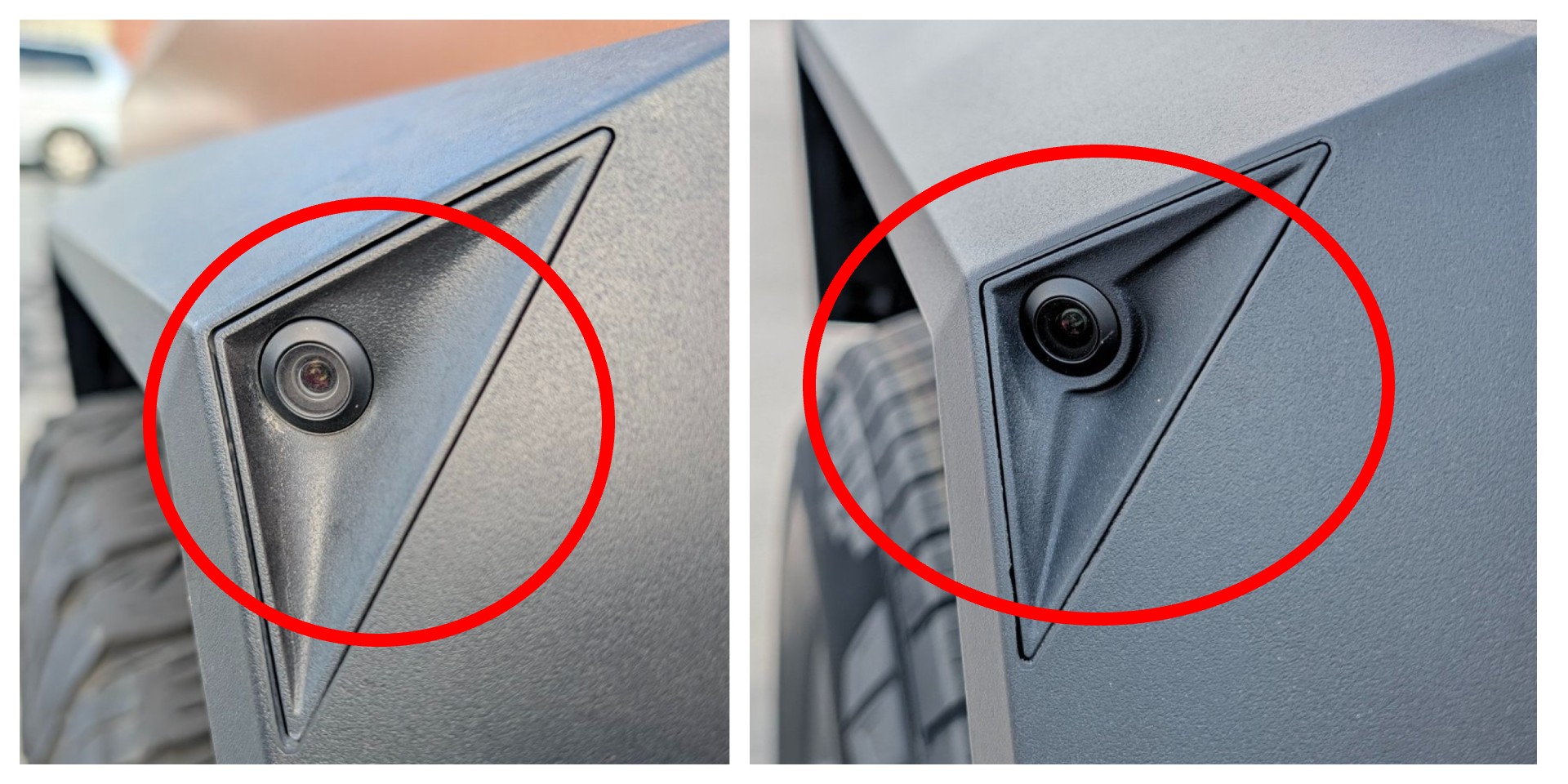
Tesla does not wait for a new model year to improve its vehicles. On September 8, Cybertruck lead engineer Wes Morrill posted side-by-side photos of an updated side repeater camera housing now rolling off the line at Gigafactory Texas.
The triangular camera pod mounted on the front fender looks almost identical at first glance. A closer look reveals a revised contour that uses the air already flowing around the truck to keep the lens clearer in rain and road spray.
The side repeater camera was updated – the version on the left is the newer part which uses passive geometry to create airflow disturbance that better keep water off the lens while driving. No cost penalty, just pure vision improvement. pic.twitter.com/wAbXtcL1Jf
— Wes (@wmorrill3) September 8, 2026
The side repeater cameras sit in an exposed position on the Cybertruck’s angular stainless-steel body.
In wet weather, they readily collect water droplets that can degrade the image Autopilot and Full Self-Driving use for lane changes and blind-spot monitoring. Early production trucks sometimes left owners wiping lenses by hand or accepting temporary restrictions on driver-assistance features.
Tesla has added washers to cameras on certain other models and on Cybercab prototypes, but those active systems add cost, complexity, and extra potential leak points.
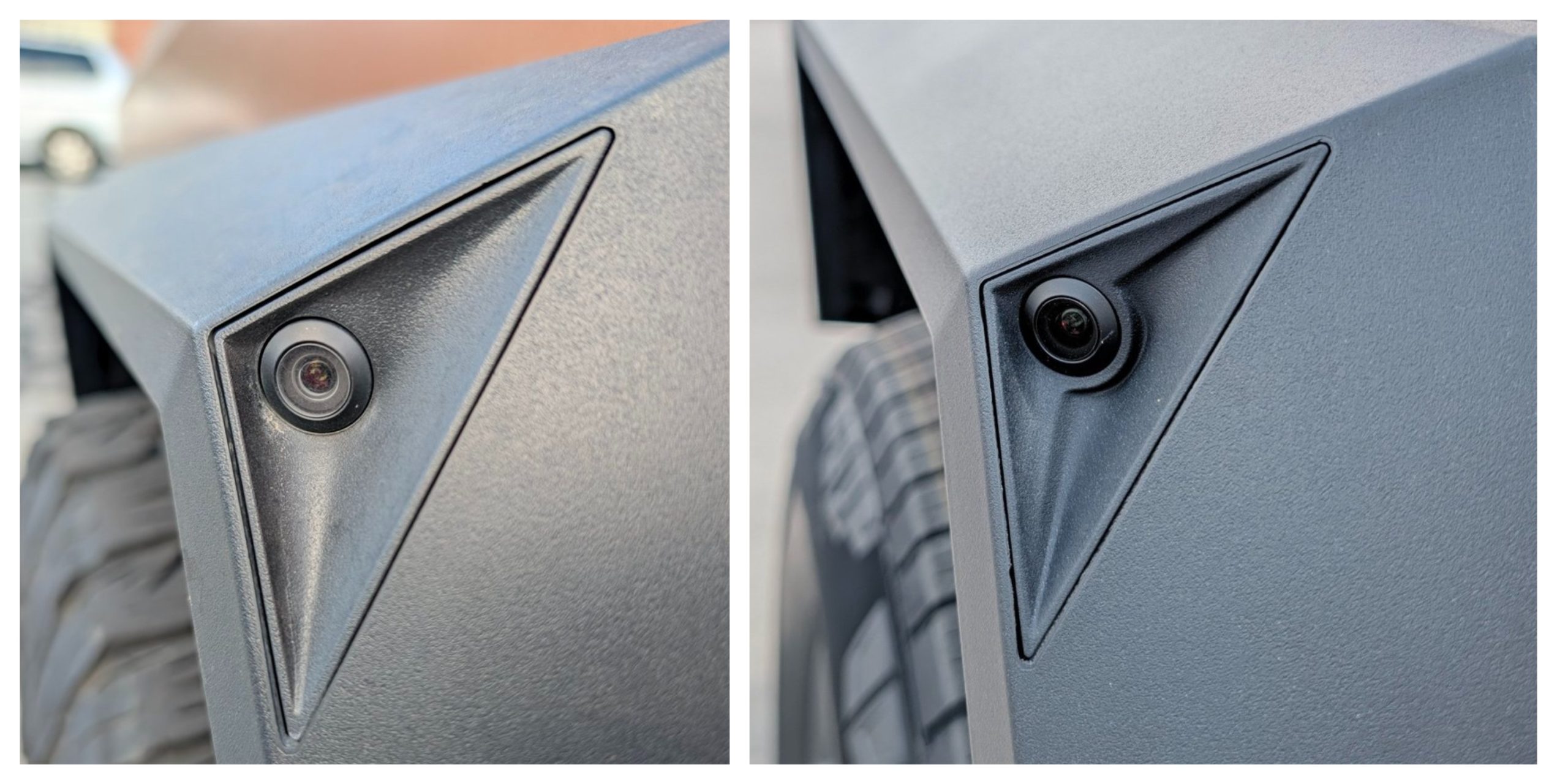
The new housing solves the problem with passive geometry. Subtle changes in the surround create localized airflow disturbances as the vehicle moves. Those eddies physically push water droplets away from the optical surface. Morrill called the result “pure vision improvement” achieved at “no cost penalty.” Once the production mold is updated, every subsequent part costs the same as the original.
The advantages compound quickly. Clearer cameras in rain improve the reliability of driver-assistance features precisely when they are needed most. The design consumes no extra energy and introduces no new failure modes.
New Cybertrucks built after the tooling changeover receive the updated part automatically. Some owners of trucks delivered as late as June 2026 have already confirmed they received the revised housing. Retrofit questions have appeared in replies, and the cameras appear electrically compatible, though Tesla has not announced an official service program.
A few millimeters of reshaped housing will not make headlines the way a new battery pack does, but these changes are incremental and increase the Cybertruck’s effectiveness as a vehicle over time.
This improvement illustrates how Tesla continues to refine the Cybertruck after volume production began. Better wet-weather vision, zero added cost, and no extra hardware add up to a meaningful gain in everyday usability and safety.
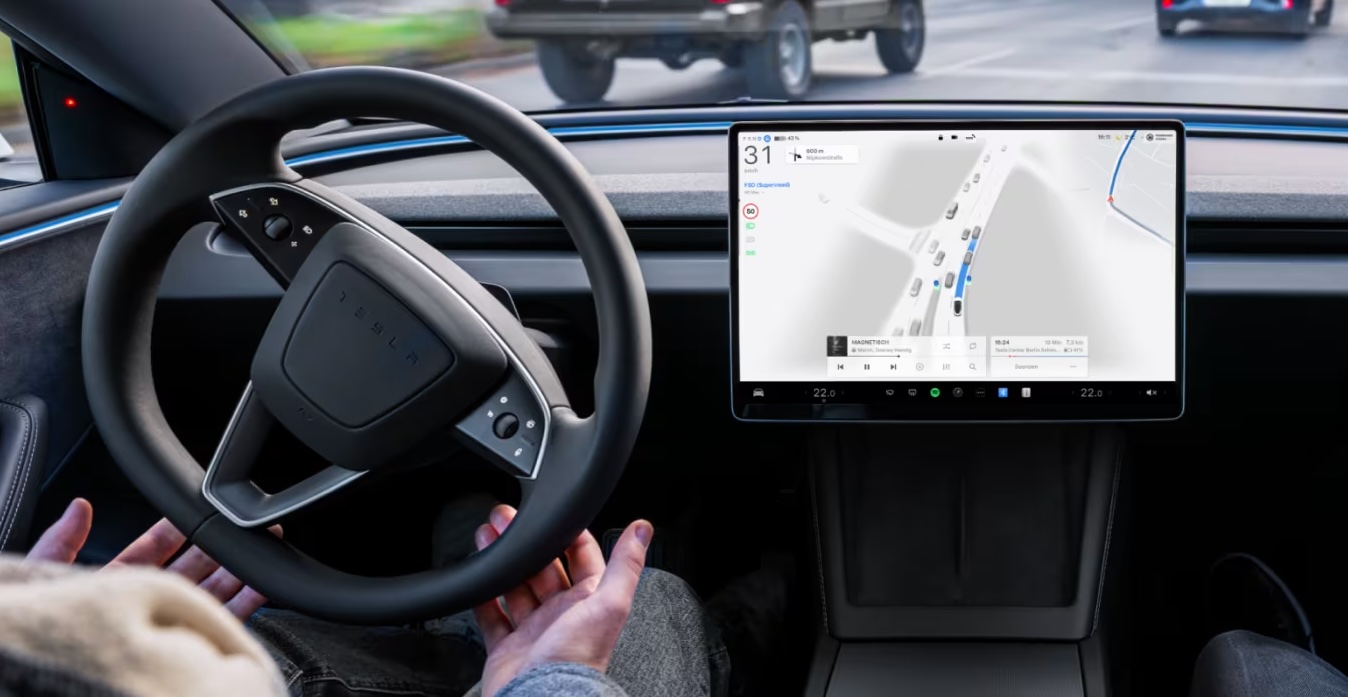
Tesla is rolling out a new version of its Full Self-Driving suite to some owners that comes with the massive addition of a safety feature.
Tesla is rolling out Automatic Collision Evasion with the 2026.27.6 Software Update, which started rolling out to some vehicles last night. We received the update, along with Full Self-Driving v14.3.9, as well as v14.2 Lite, which has identical release notes as the previous version and seems to have some refinements and improvements in behavior and performance.
🚨 Tesla FSD v14.3.9 is rolling out as well as 2026.27.6 which includes Automatic Collision Evasion
Brand new safety features from a software update. My Tesla gets better everytime I get one of these pic.twitter.com/ctrMiQXWhM
— TESLARATI (@Teslarati) September 8, 2026
However, most of the attention has fallen on the Automatic Collision Evasion feature, which we covered in an article last week.
The function will activate Full Self-Driving to “try to keep your vehicle safe and then continue driving. It can engage in the following situations while you are driving manually:
- Scenario 1: A frontal collision is imminent and braking alone may not avoid it.
- Scenario 2: Your vehicle detects that you are not sufficiently attentive to the road (for example, reaching toward the back seat), or that Full Self-Driving (Supervised) may have been unintentionally disengaged.”
Essentially, FSD will take over when the vehicle determines you are not paying sufficient attention or are heading toward a potential collision. The addition of this feature is incredibly useful as distracted driving is a major issue in today’s world.
Along with the new safety feature is Tesla FSD v14.3.9, which has no additional release notes compared to the previous version, but in my first drives, my first impression is that operation is great, and parking is still sort of a pain point.
Just took a 15-mile round trip to the gym and back
Pretty on par with what FSD is nowadays – really good. Not enough time to see what’s good and what’s bad, but these first rides on any version feel shockingly good. They’re all pretty identical https://t.co/WN1qTg4bhE
— TESLARATI (@Teslarati) September 9, 2026
Additionally, Tesla v14.2. Lite has arrived. A great review of that is available here:
— Zack (@BLKMDL3) September 9, 2026
The addition of an Automatic Collision Evasion feature is similar to that of other collision avoidance systems that are used by companies like Hyundai, Kia, and Genesis. These programs typically utilize radar and camera sensors to apply emergency brakes autonomously, though evasive steering in a manual driving mode is pioneered primarily by Tesla’s newest addition.

Tesla’s two defunct flagship models are getting a big upgrade

This tiny Tesla Cybertruck adjustment has big advantages


