Elon Musk
Elon Musk signals expansion of Tesla’s unique side business
Long envisioning the Tesla Diner as more than a charging stop, Musk has clearly adopted the idea that the Supercharger and Restaurant combo is a good thing for the company to have. It’s a blend of classic American drive-in culture with futuristic Tesla flair, complete with a 1950s-inspired design, movie screens, and on-site dining.

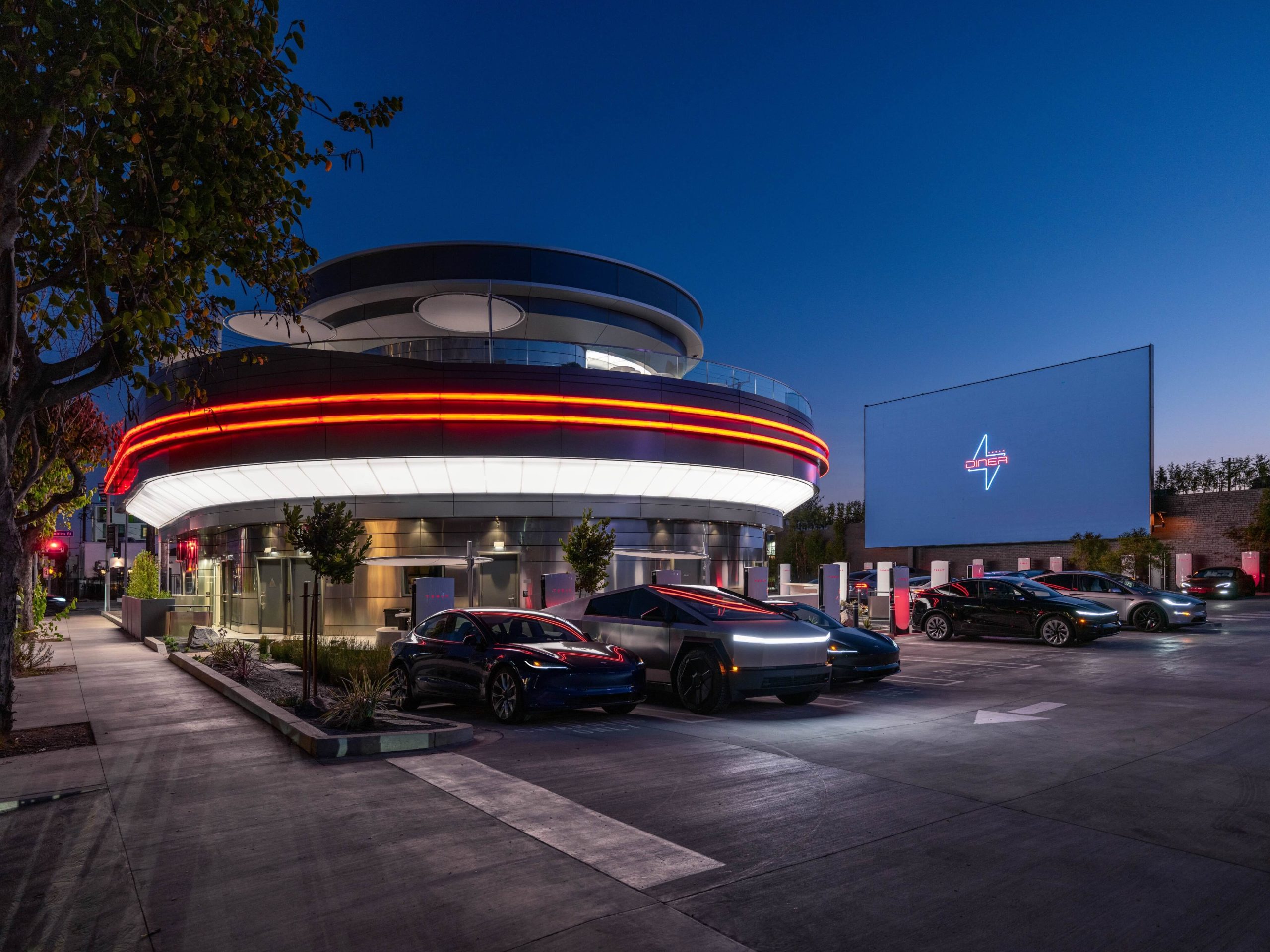
Elon Musk has signaled an expansion of Tesla’s unique side business, something that really has nothing to do with cars or spaceships, but fans of the company have truly adopted it as just another one of its awesome ventures.
Musk confirmed on Wednesday that Tesla would build a new Diner location in Palo Alto, Northern California. After hinting last October that it “probably makes sense to open one near our Giga Texas HQ in Austin and engineering HQ in Palo Alto,” it seems one of those locations is being set into motion.
Sure
— Elon Musk (@elonmusk) April 15, 2026
Long envisioning the Tesla Diner as more than a charging stop, Musk has clearly adopted the idea that the Supercharger and Restaurant combo is a good thing for the company to have. It’s a blend of classic American drive-in culture with futuristic Tesla flair, complete with a 1950s-inspired design, movie screens, and on-site dining.
He first floated broader expansion plans shortly after the LA opening in July 2025, noting that if the prototype succeeded, Tesla would roll out similar venues in major cities worldwide and along long-distance Supercharger routes.
Earlier hints included a confirmed second site at Starbase in Texas, tied to SpaceX operations, underscoring the Diner’s role in enhancing Tesla’s ecosystem behind vehicles.
The Los Angeles location on Santa Monica Boulevard in West Hollywood has served as a high-profile test case. Opened in July 2025 at 7001 Santa Monica Blvd., it features the world’s largest urban Supercharging station with 80 V4 stalls open to all NACS-compatible EVs, over 250 dining seats, rooftop views, and 24/7 service.
The retro-futuristic building replaced a former Shakey’s and quickly became a destination. Tesla reported selling 50,000 burgers in the first 72 days—an average of over 700 daily—drawing crowds with Cybertruck-shaped packaging, breakfast extensions until 2 p.m., and movie screenings.
Palo Alto stands out as a logical next step for several reasons. As Tesla’s longstanding engineering headquarters in the heart of Silicon Valley, the city is home to thousands of Tesla employees, engineers, and executives who could benefit from a convenient, branded gathering spot.
The area boasts high EV adoption rates, dense tech talent, and heavy traffic along key corridors, making a large Supercharger-diner an ideal fit for both daily commuters and long-haul travelers.
Proximity to Stanford University and the innovation ecosystem would amplify its appeal, potentially serving as a showcase for Tesla’s vision of integrated mobility and lifestyle experiences. It could be a great way for Tesla to recruit new talent from one of the country’s best universities.
If Tesla and Musk decide to move forward with a Palo Alto diner, it would build directly on the LA prototype’s momentum while addressing Musk’s earlier calls for expansion near core Tesla hubs.
Whether it materializes as a full confirmation or evolves from these hints remains to be seen, but the pattern is clear: Tesla is testing ways to make charging stops memorable. For EV drivers and enthusiasts alike, a Silicon Valley outpost could blend cutting-edge tech with nostalgic comfort, further embedding Tesla into everyday culture. As Musk’s comments suggest, the future of the Diner looks promising.


Elon Musk
Elon Musk follows Trump’s lead, says a SpaceX name change is coming
Elon Musk says SpaceXAI will become SpaceXSI, marking its second rebrand in under three months.

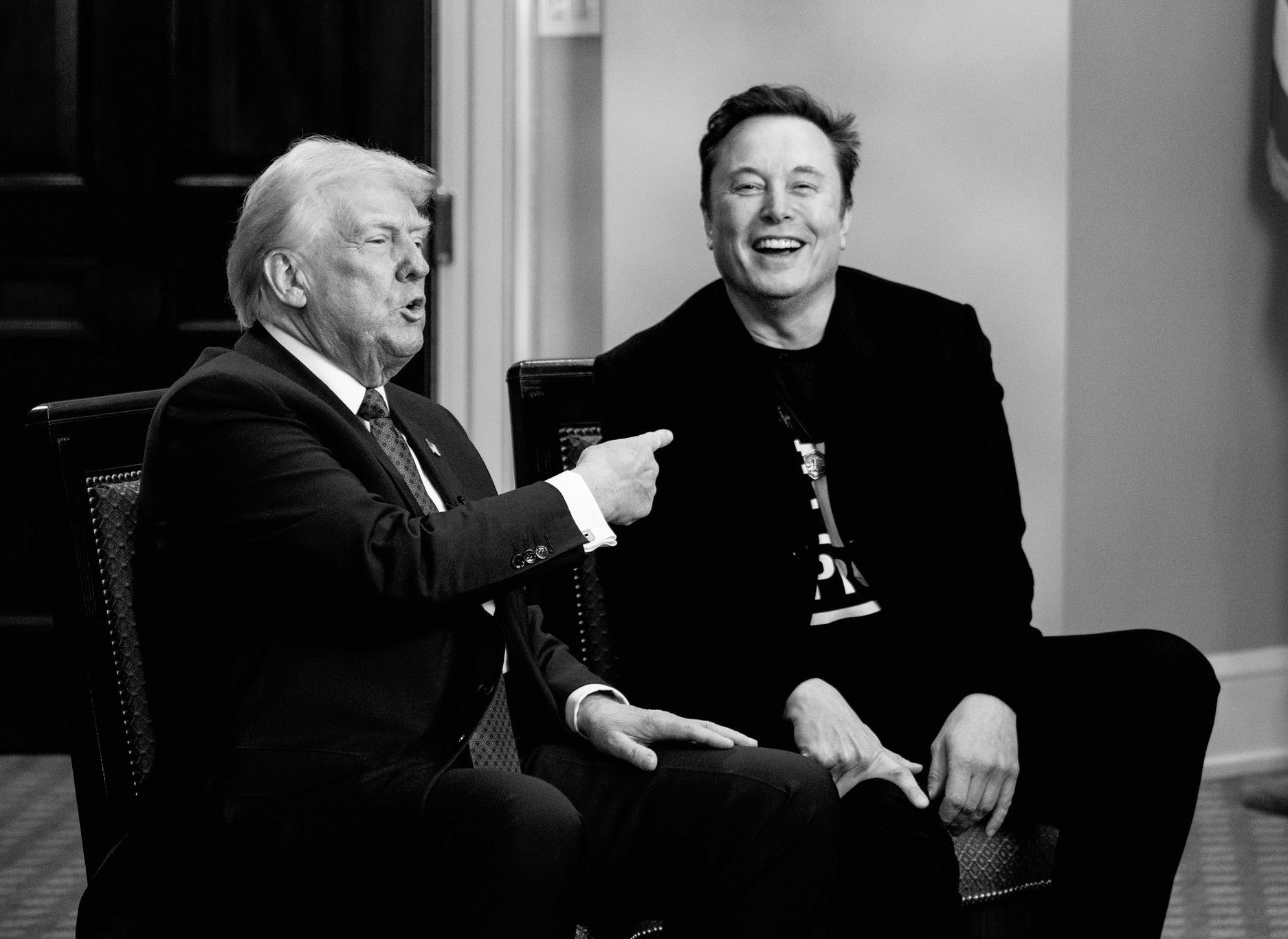
Elon Musk wants to rename his artificial intelligence company again, less than three months after its last rebrand.
In a string of posts on X early Sunday morning, Musk wrote “No more AI,” followed by “SI” and “It’s better.” He then added, “SpaceX is a super intelligence company.” When a user asked whether SpaceXAI could become SpaceXSI, Musk replied, “Yes, we will make that change.”
The posts extend a terminology push that began at the White House last week. On September 29, President Donald Trump signed an executive order directing federal agencies to replace “artificial intelligence” and “AI” with “Super Intelligence” and “SI” on government websites, policy documents and press releases. The same day, Musk sat beside Trump as the heads of the largest AI companies signed a voluntary safety accord, as Teslarati reported. Speaking to reporters afterward, Musk caught himself mid sentence: “I think it is worth highlighting the positive benefits of A.I. … S.I., pardon me.”
Elon Musk and Trump are closer than ever, and Tesla could be the big winner
SpaceXSI would be the third name for the business since February. SpaceX acquired xAI on February 2 in a deal that valued the combined company at $1.25 trillion. In May, Musk said xAI would be dissolved as a separate company, and on July 6 the division adopted the SpaceXAI name and a new logo that placed the xAI letters inside the SpaceX identity.
Musk gave no timeline. He did not say whether SpaceXSI would be a legal name change or a branding update, whether the @SpaceXAI handle on X would change, or how the shift would apply to products like Grok. The company had not issued a formal announcement as of Sunday morning.
The change would reach well beyond a chatbot. SpaceXAI now houses Grok, the X platform, the Colossus training clusters in Memphis and the coding tool Cursor, which SpaceX acquired in August. It also runs the orbital compute effort SpaceX is building around Nvidia hardware, which Musk said during the company’s first earnings call would be exclusive to Nvidia.
It’s unclear if rivals like Anthropic, OpenAI, Google, Meta and Nvidia have plans to also rename their companies or products. OpenAI CEO Sam Altman has continued to say “AI” in public, while Nvidia CEO Jensen Huang has gone partway, describing data centers as “super intelligence factories.”
The rename would also line up SpaceX’s AI branding with the federal government’s language as Musk takes on a new advisory role at the Pentagon, where he is helping lead the Project Meridian study on the future of warfare.
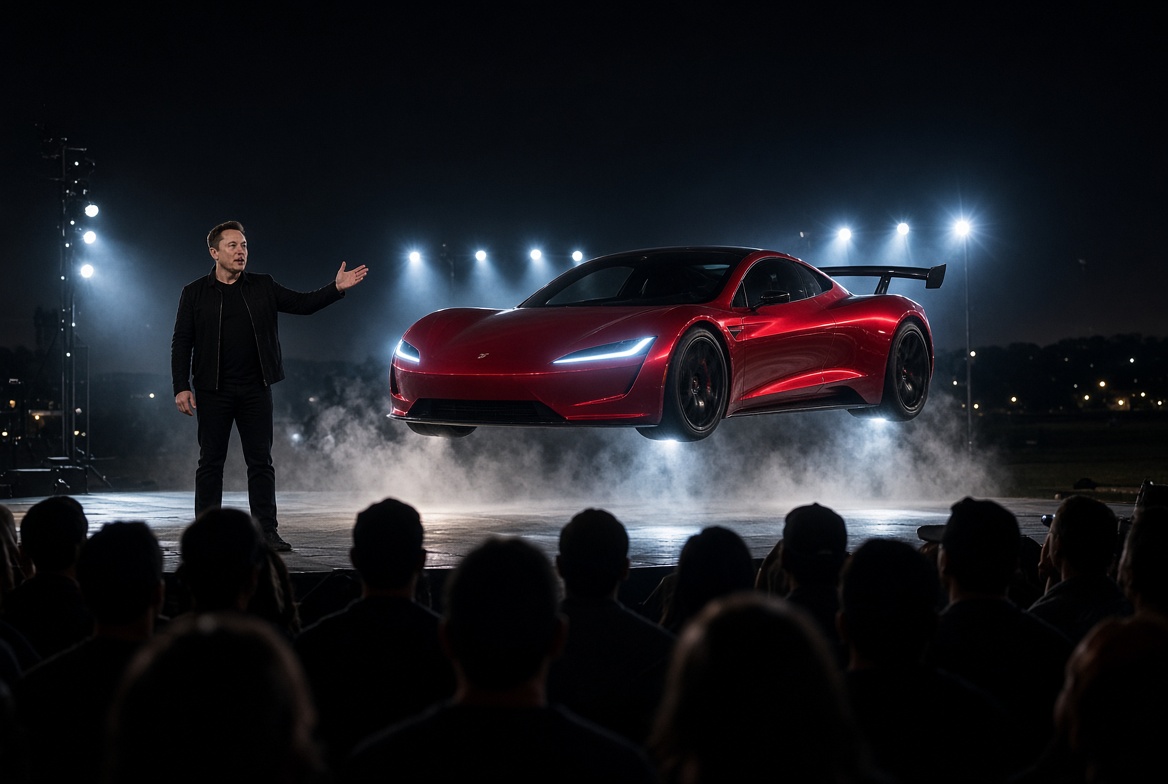
Tesla announced on Monday that the Roadster event scheduled for today would be postponed due to the need for it to be held outside.
Less than 24 hours later, CEO Elon Musk broadened that by stating it was due to high winds, immediately sending everyone into a frenzy over the Roadster’s potential ability to fly.
And realistically, it could definitely have to do with it flying, hovering, or hopping; whatever Tesla has in mind for this demonstration could not be impacted by wind. However, it might have nothing to do with the vehicle flying whatsoever, and instead could be a simple precaution, as the Roadster is a very unique vehicle with some already official specs that are just mind-blowing.
Tesla will very, very likely be showcasing both the acceleration rate and potentially even a top speed demo at the event in Waco. Both of these demonstrations, performed with a vehicle that has such incredibly fast metrics, could easily be impacted by wind as well.
Tesla Roadster event requires restricted airspace, and the FAA obliges
Top Speed Demo
At high speeds, aerodynamic forces are already overwhelmingly present. A crosswind or sudden gust adds a layer of sideways force that the tires must counter with slip angle. On a short demo course, that force can shove the car off the intended line, especially in a light car with a low frontal area and little mass to resist the push.
Electric cars, due to their battery packs, have an advantage of an extremely low center of gravity, giving them extra stability. However, the speeds at which the Roadster could travel at the demo could spell some issues if crosswinds are present.
Gusts are worse than a steady wind because the load changes faster than a driver can smoothly correct. That shows up as weaving or a late correction. Headwinds and tailwinds can also spell disaster. Headwinds cut a measured top speed but raise the power needed to get there or maintain it. Meanwhile, a tailwind can inflate the top speed, and downforce issues could become more noticeable.
Wind also loads the body unevenly. A low car can feel light on the upwind side or see a sudden change in downforce if the gust hits a wing or diffuser at an angle. Tire temperature and pressure might stay near a normal level, but lateral grip can be lost as the vehicle is spent fighting the wind.
Acceleration Demo
Launch and 0-60 MPH runs are shorter, so the car spends less time exposed to forces that could cause things to go awry. However, the first second is very sensitive, as a crosswind at launch could yaw the car before speed builds and prior to aerodynamic impact being too great. The driver will be required to correct traction control or manage how much the wheels are spinning, which will likely be corrected automatically by some sort of traction control system within the Roadster (we are fairly certain Tesla will implement something brilliant with it).
These things could cause an unstable run.
A headwind would increase drag as speed rises, while a tailwind would do the opposite. Meanwhile, surface effects, like wind-driven dust, light debris, or even rain, could reduce grip at the exact moment the tires are asked for peak longitudinal force. Standing water plus a crosswind is a common reason an acceleration attempt might be scrapped.
Flying or Not
No matter what Tesla has in store for the Roadster, waiting for ideal conditions is a great idea. People who follow and support the company, along with the engineers involved in the Roadster program, have been waiting nine years since the last unveiling for this moment. Everything should be ideal.
Some speculate that it’s just not ready, and that’s ridiculous. Why would Tesla even schedule the event — albeit prematurely — after nine years if it was not ready? Why would they jump the gun now?
We were all excited for today, but it truly is the most ideal thing in the world to wait two more weeks so everything, including the weather, can be perfect. The delay is simply worth it. But Tesla, seriously, make this the last one.
Elon Musk
SpaceX nails “Lucky 13” astronaut launch, leaning into Tesla tradition and superstition
SpaceX launched Crew-13 astronauts to the ISS Thursday, setting up a record fast Dragon docking.
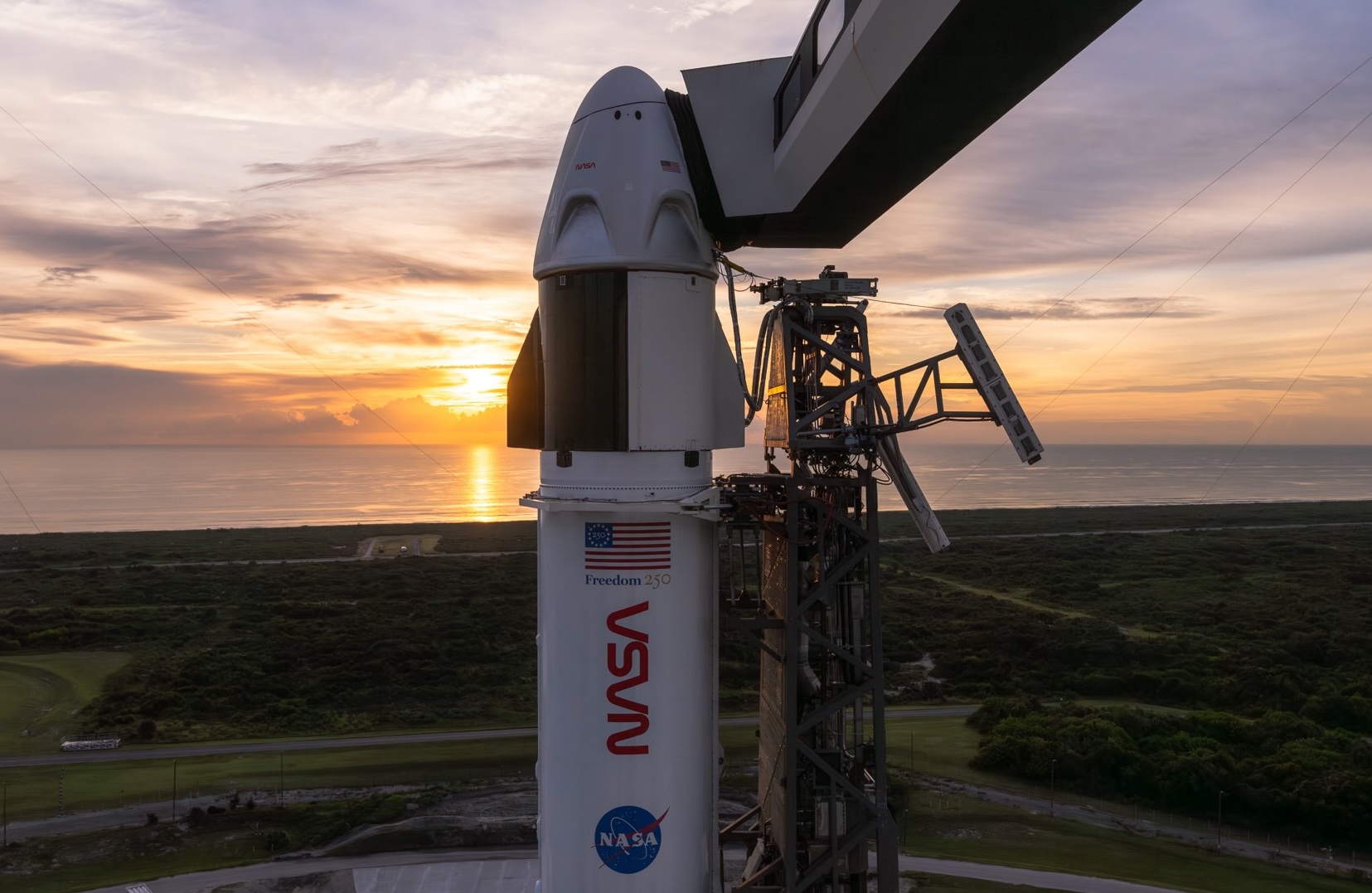
SpaceX launched NASA’s Crew-13 mission to the International Space Station on Thursday morning, getting four astronauts to orbit despite a forecast of thunderstorms and gusty winds that had threatened to push the flight to Friday.
Falcon 9 lifted off from Space Launch Complex 40 at Cape Canaveral Space Force Station at 11:10 a.m. ET carrying Dragon Grace, NASA confirmed. On board are NASA commander Jessica Watkins, NASA pilot Luke Delaney, Canadian Space Agency astronaut Joshua Kutryk and Roscosmos cosmonaut Sergey Teteryatnikov. The first stage booster, B1101, landed at Landing Zone 40 beside the pad on its third flight after previously supporting Crew-12 and a Starlink mission.
Liftoff of Crew-13! pic.twitter.com/vteT0DXMTh
— SpaceX (@SpaceX) October 1, 2026
It was the first spaceflight for Delaney, Kutryk and Teteryatnikov. Watkins, who flew on Crew-4 in 2022, became the first NASA astronaut to launch aboard a Crew Dragon twice.
Before launch, the crew rode to the pad in Teslas, a tradition on NASA’s SpaceX crew flights since 2020. This time the cars carried specialty plates reading “Lucky 13.” Watkins said the mission patch leans into the number on purpose, as a nod to Apollo 13 and the resilience of that crew.
Grace is now on a short trip to the station. Docking at the forward port of the Harmony module is scheduled for about 7 p.m. ET, roughly 7 hours and 50 minutes after liftoff, which Space.com notes would be the fastest Crew Dragon transit to the ISS yet. Most Dragon flights take around 15 to 24 hours to catch the station. Hatch opening is planned for 8:25 p.m. ET.
The launch came more than two weeks later than originally planned. An oxidizer leak was found in Grace’s propulsion system in August, and NASA and SpaceX added time for tests. That pushed back the return of Crew-12, which has been aboard the station since February and is now set to splash down off Southern California next week. Crew-13 is expected to stay about six months.
SpaceX rescue mission for stranded ISS astronauts nears end — Here’s when they’ll return home
SpaceX already holds NASA orders for crew rotations through Crew-17, while Boeing is preparing an uncrewed Starliner flight to the station as early as December.
Crew-13 was only the first of three SpaceX launches planned for Thursday, as Teslarati previewed on Wednesday. A Falcon 9 launched its Transporter-18 mission from California today, where Google will be launching its first orbital artificial intelligence (AI) test satellite. Meanwhile, Falcon Heavy is set to launch the classified NROL-97 mission for the National Reconnaissance Office from Launch Complex 39A at 11:53 p.m. ET. Its two side boosters will return to Landing Zones 1 and 2, which means Central Florida could hear up to three sonic booms in a single day. The busy stretch follows Starship’s Flight 14 on Monday, which reached orbit for the first time.

Elon Musk follows Trump’s lead, says a SpaceX name change is coming

Starlink launches Communities Program for passive income through internet sharing


