Investor's Corner
Debunking the story that Elon Musk “kept cash” from the recent stock offering

On Monday May 23, 2016, Tesla Motors e-mailed to TSLA registered investors a link to Elon Musk’s Form 4 SEC Filing, a.k.a. the Statement of Changes in Beneficial Ownership, detailing the transactions that are part of the recent stock offering that relate to Elon Musk.
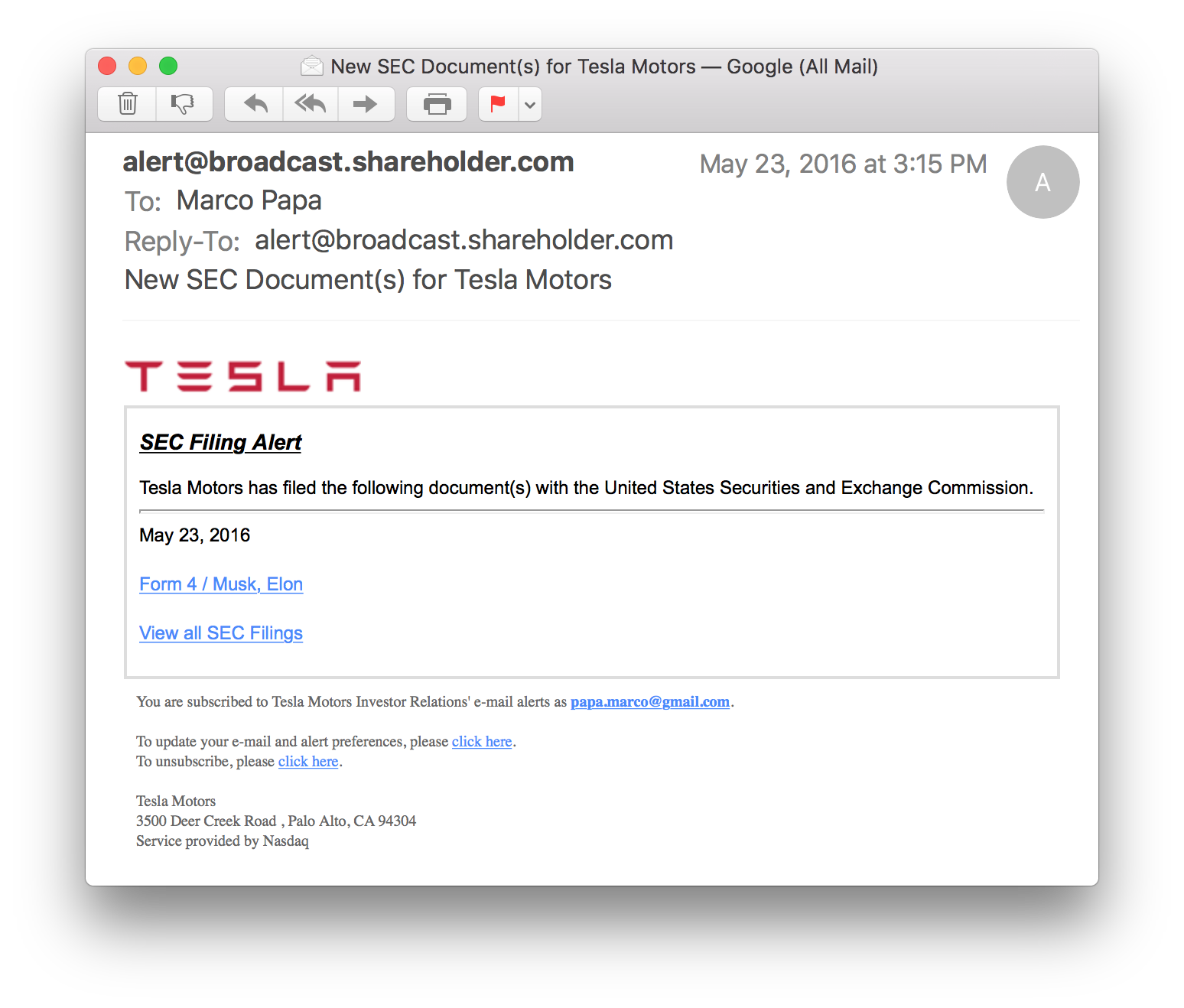
Source: Tesla Motors
The Form is available also at Tesla Motors Investors website.
I will go through the major details shown in the form to understand how the transactions were executed. For the inquiring minds, the various SEC codes listed in FORM 4 can be found here.
First an assumption: prior to the offering and the changes in beneficial ownership of the listed securities, Elon Musk held 29,579,342 shares of stock in TSLA.
The first and second transactions (Table I, column 1, line 1 and 2) report the exercise of stock options (options that were awarded to Elon in previous years as part of a Non-Qualified Stock Options plan) to acquire 5,503,972 shares of Tesla’s common stock (2,147,986 + 3,355,986 shares). The options were originally awarded at $6.63, and Elon paid $36,491,334 or about $36 million to exercise them. After this purchase, Elon owned at total of 35,083,314 shares (Table I, column 5, line 2).
While the original offering was supposed to be priced at about $204 per share, the eventual offering price was raised to $215 per share. At the $215 stock value at the time of the offering, the value of the acquired shares was a whopping $1.18 billion!
Before actually paying for the option exercise transactions, Elon did two things.
First it disposed of 1.2 million shares as a “bona file gift to charity” (Table I, line 3 and Explanation of Responses (3)). This gift reduced Elon’s shares down to 33,883,314 shares (Table I, column 5, line 3).
Second, Elon disclosed that he intended to sell 2,782,670 of the purchased shares in the “registered offering solely in order to pay income tax related to these stock option exercises” (see Explanation of Responses (2) in FORM 4). The sale reduced Elon’s shares further down to 31,100,644 shares. At $215 / share, Elon Musk’s Tesla shares are worth a bit over $13 billion.
Interestingly, if these were Incentive Stock Options (ISO), the ones usually awarded to Executives, vs. Non-qualified Stock Options (NSO), usually awarded to regular employees, these options would have received special federal tax treatment, and there would be no taxable event reported at exercise, except for any exercised shares that were sold immediately after the exercise. But as one can see in Table II, Elon received “non-qualified stock options” like any other employee, that do not qualify for special tax treatment.
The gain or “bargain element” in a stock option exercise is calculated by subtracting the exercise price ($6.63) from the market price ($215) of the company stock on the date the option is exercised. So the gain per share is $208.70. The total bargain element (gain) in the options exercise transactions is $1,148,679,000 or about $1.14 billion, which is the “taxable gain.”
For the 2,782,670 shares that Elon sold in the registered offering, Elon collected $598,274,050 or about $580 million after accounting for the price paid for the shares. Since these shares were sold immediately after exercise, the gain will be reported as a short-term capital gain and will be subject to tax at ordinary income tax rates. Assuming 39.6% ordinary federal income tax rate, and a 12.30% top individual rate for California, Elon would have to pay $596 million in tax, or 51.9% of the “taxable gain.”
Notice that the $580 and $596 million numbers above are close enough for the company to state in the FORM 8-K filing that “Mr. Musk will owe a significant amount of taxes from exercising these stock options and will fund this task obligation by selling only the amount of shares needed to do so.”
But we are not done. The rest of the stock exercised by Elon Musk, 2,731,302 shares, can be treated as long-term capital gain (with better tax treatment, likely at the 20% long-term capital gain rate, rather than at the 39.6% personal income tax rate) if the stock is held for 12 months after exercise. Assuming that Elon is smart (I think he is), he will wait, to get a combined Federal + California 32.3% tax rate, resulting in an additional $184 million in taxes (2,731,302 times $208.70 times 32.3%).
Finally, we need to consider the gift of 1.2 million shares of Tesla’s common stock given to charity (Table I, column 1, line 3). By donating shares, Elon avoids paying the capital gains tax, which would have to be paid if the shares were first sold and then the cash proceeds donated to charity.
Moreover, Elon can get a tax deduction for the current fair market value of the gifted shares. In general, the amount of the deduction is limited to 20%-30% of the adjusted gross income, but one can carry forward amounts above that for up to five years. Without knowing Elon’s adjusted gross income, it is difficult to guess what the deduction would amount to. The fair market value of the donated shares is $250 million. That would be the best case scenario for a charitable deduction, which is extremely unlikely, while 20% of the taxable gain is more likely ($218 million).
Summarizing the transactions:
- Cost of exercising options: $36 million
- Taxes on short-term capital gain for shares sold at offering: $596 million
- Taxes on long-term capital gains for shares held 12-months: $184 million
Total outlay: $ 816 million
- Registered offering sale: $580 million
- Gifted shares tax deduction (max): $250 million, (likely): $218 million
So after all is said and done, Elon will still owe Uncle Sam between $18 and $236 million. I have seen reports from “TSLA bears” (or TSLA haters, same thing) indicating that Elon would actually “keep cash” on this sale.
Obviously he does not, and I would expect that he would eventually have to sell a portion of the remaining $1.5 million (to be exact 1,521,302 shares) from the offering that Elon is not selling or donating to charity, to cover the additional tax, unless he’s got cash in the bank to pay for it.
This offering dilutes the total outstanding shares of TSLA with an additional 1.4 million from Tesla Motors and the 5.5 million from Elon Musk (for a total on 6.9 million new shares diluting the TSLA public pool of shares), while Elon adds about 1.5 million to his total, ending with about 31 million shares (to be exact 31,100,644). So Elon adds some shares but loses a bit in Tesla ownership percentage, from 26.2% to 22.7%.
Technical Analysis
Looking at this week TSLA action, we are now after my predicted breakout, looking at bullish pay-day-cycles (6 consecutive green Heikin Ashi bars), the MACD gone positive, and the MACD moving averages “crossed to the bulls”.
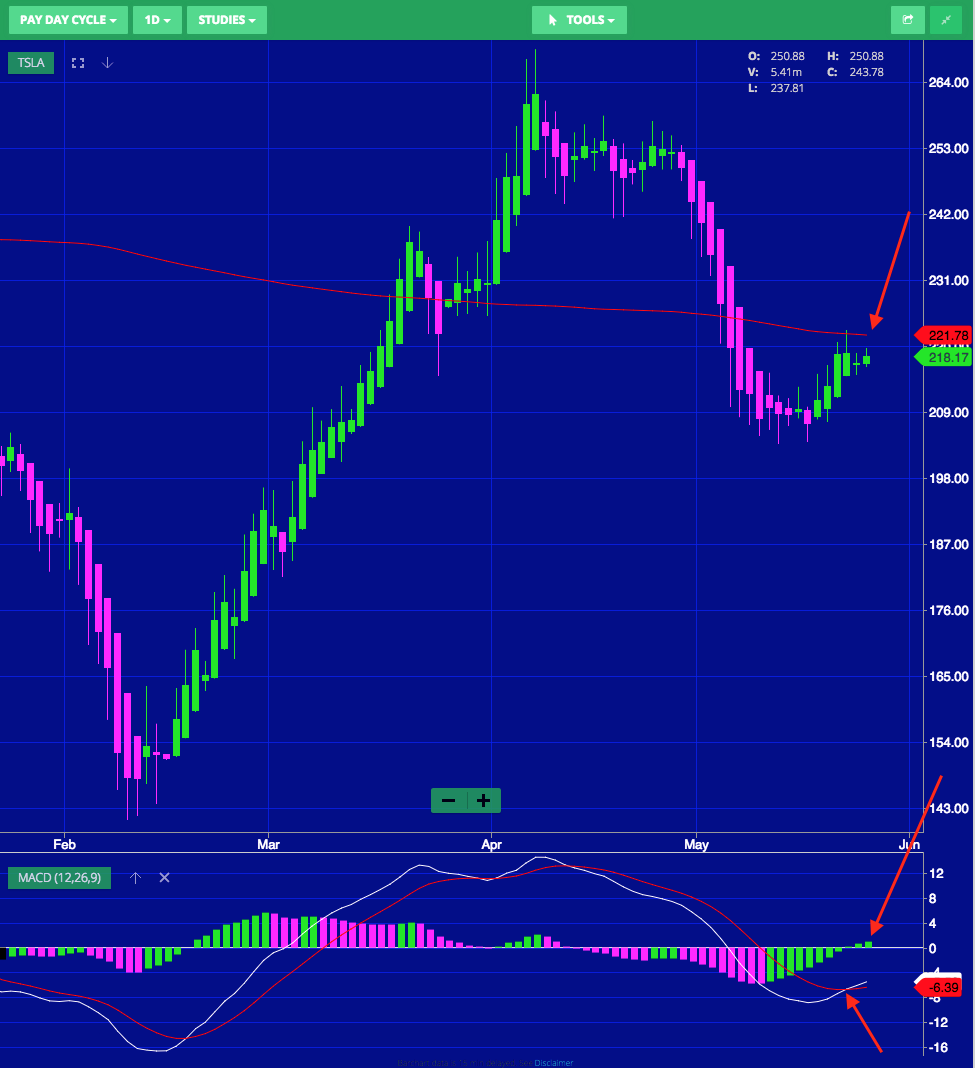
Source: Wall Street I/O
We are coming close to an important point: the stock price is advancing toward the 200-day moving average (around $221.90), which will act as “resistance”. If the stock fails to cross the 200-day moving average, it would usually move down and fast afterwards (“bounce” off the average); this morning it traded as high as $220.75 and “bounced”. If otherwise it eventually crosses the 200-day moving average, we will have an additional bullish indicator and the stock will be header for new tops.
I entered my option trades last week (Sept. 215 calls), before the breakout and have added and cashed in already once to take profits. I have also progressively moved up my conditional stop from 205, to 210 and 215, to protect my profits, and will likely move it even higher as the stock approaches the 221 level and tests the resistance. If the stock crosses the 200-day moving average, I will add again to my TSLA calls holdings, as I will have 4 bullish indicators flying high. Obviously not a good time for short sellers in $TSLA.


Investor's Corner
Elon Musk drops a Thanksgiving hint about Starship’s biggest test yet
Elon Musk says Starship Flight 15 will try to catch the ship itself, a first.

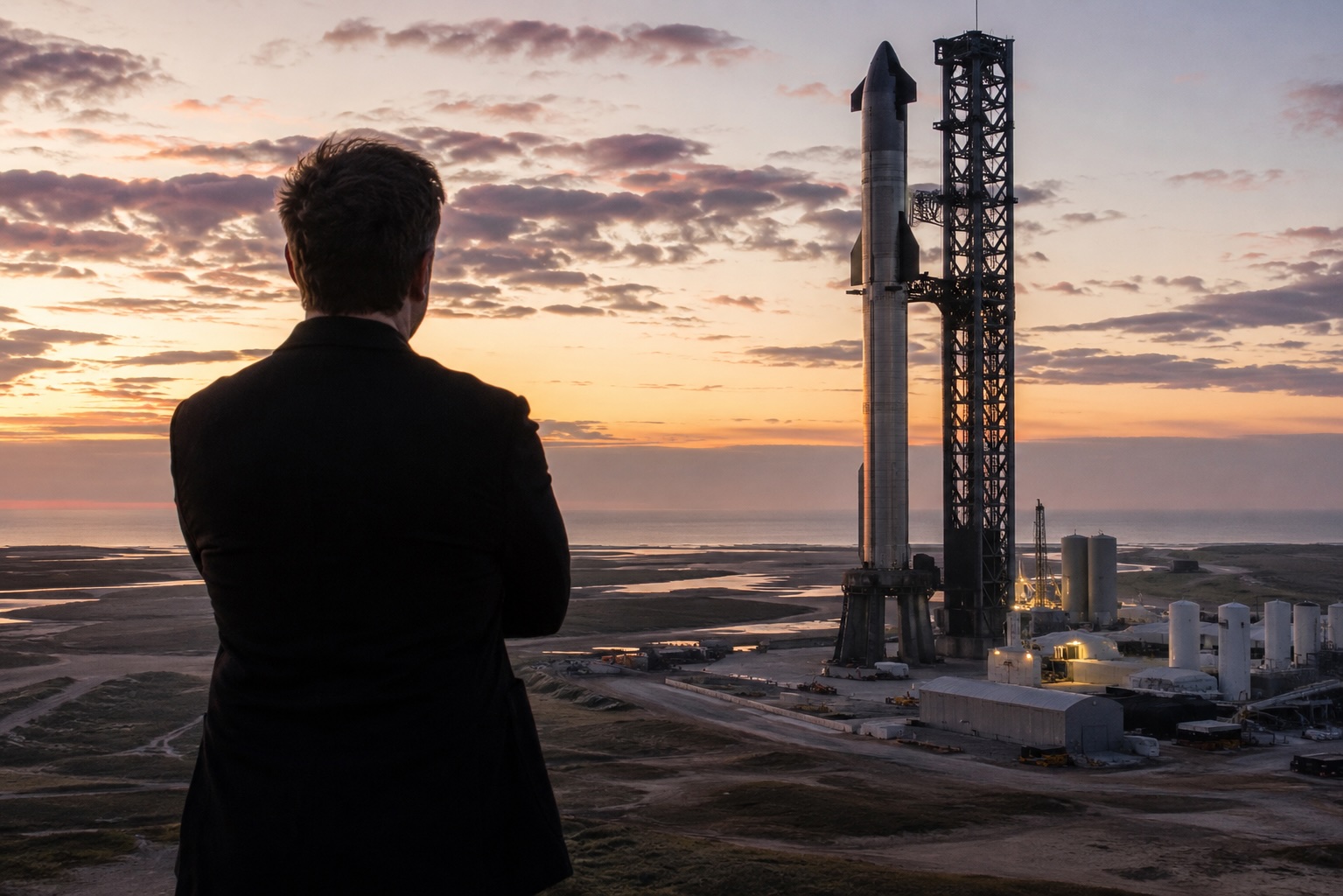
Elon Musk says SpaceX’s next Starship flight will try something nobody has done before, by catching the ship itself. Speaking to roughly 2,000 people at the X Takeover event at Giga Texas on Saturday, Musk said Flight 15 is about four to six weeks away and “probably launches a little bit before Thanksgiving, is my guess.”
That is a slip from earlier reporting, which had pointed to a launch as early as October 19. Musk explained why the date keeps moving. “We’re making a bunch of improvements to the rocket between every flight,” he said, adding that there are often hundreds, sometimes thousands, of small changes. This time the list is short, “but some of them take a fair bit of work and we’ve got to go inside the tank to make some of these changes.”
“We’re going to try to catch the ship, which is a super big deal,” Musk said. “If we do so, that’ll be the first time that there’s been full recovery of an orbital class rocket.” SpaceX has already caught the Super Heavy booster with the tower’s mechanical arms, and has talked about catching the ship since late 2025, but the upper stage has never been caught.
Musk also laid out what comes after. “The next big milestone would be to refly both the booster and the ship,” he said, describing a Flight 16 where “all parts of an orbital rocket are reflown.”
The reason SpaceX wants this comes down to cost and cadence. Every Starship ship so far has ended its flight in the ocean, and SpaceX expects most of those water landings to end in fireballs. A ship that returns to Starbase intact can be inspected and flown again. SpaceX’s IPO filing, says Starship V3 is designed to deliver 100 metric tons to orbit in a fully reusable configuration, that SpaceX aims to cut the cost to reach orbit by 99% or more versus the historical average, and that tower catches should allow “multiple launches per day.”
The payoff goes beyond cheaper launches. The next generation Starlink V3 satellites are too large for Falcon 9 and can only fly on Starship, which can carry up to 60 per flight. Flight 14 on September 28 deployed the first 26 of them after Starship reached orbit despite an early engine shutdown, as Teslarati reported. Musk blamed engine computer software, and said the heat shield “was extremely robust,” which he claimed in August had solved Starship’s biggest challenge.
NASA’s Moon plans depend on the same capability. NASA’s inspector general has described a lander mission that needs a propellant depot in low Earth orbit and more than 10 tanker flights, with SpaceX targeting one tanker launch every six days. That schedule only works if ships and boosters come back fast and fly again. Also, ship to ship propellant transfer has not been attempted yet.
One interesting hurdle yet to be explored is bringing the ship back to the launch site, with reentry over land, which will undoubtedly come with a lot of aviation safety reviews.
Investor's Corner
SpaceX reveals how its 1 Million AI satellite network will work and prevent space collisions
SpaceX reveals plans for one million Starmind AI satellites and calls out operators hiding maneuvers.
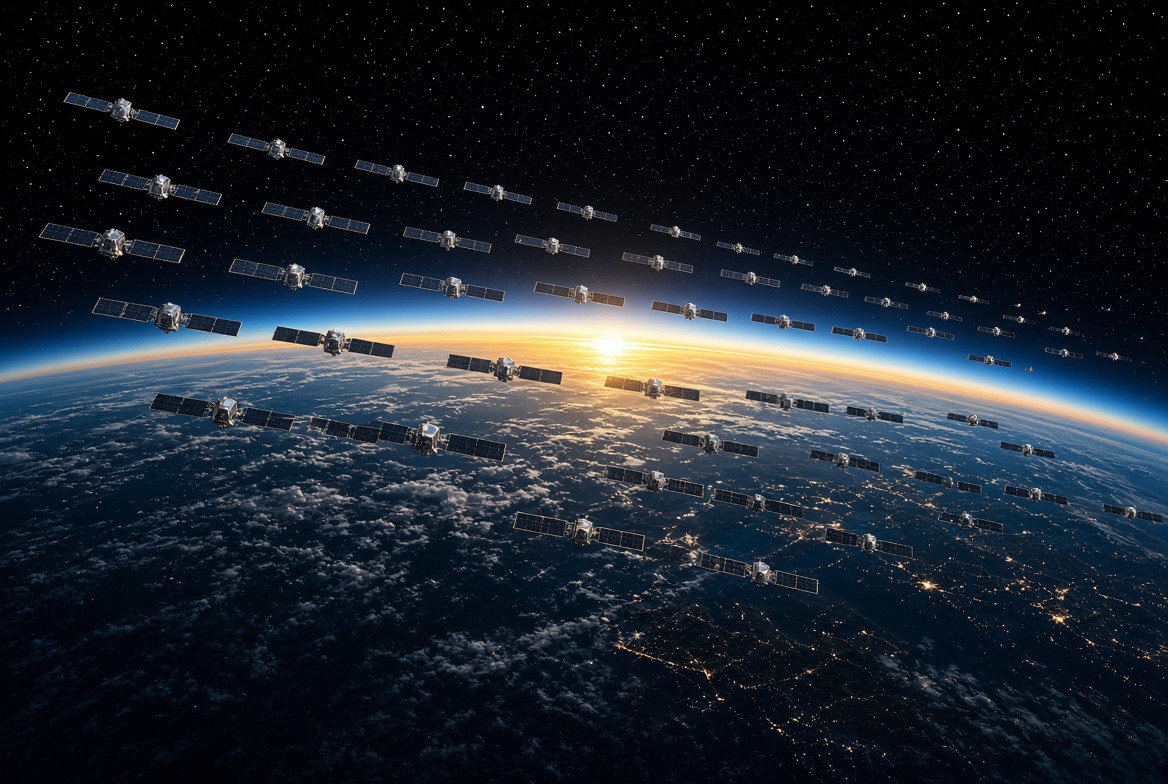
SpaceX has put the largest satellite count it has ever published into writing, and it says that plan only works if every other operator in orbit starts sharing what it knows.
In a new Space Safety page highlighted Tuesday morning by Sawyer Merritt on X, SpaceX said it “plans to operate up to 100,000 Starlink satellites and up to 1 million Starmind AI satellites to meet the growing demand for broadband and supercompute.” Starlink has a little over 11,000 satellites in orbit today, so the target alone implies roughly a ninefold expansion of the broadband network.
Starmind is SpaceX’s orbital AI compute constellation. Elon Musk confirmed the Starmind name in June after an xAI trademark filing surfaced, and in August SpaceX said it was working with Nvidia on the compute payload. The FCC accepted the filing for up to one million satellites back in February.
FCC accepts SpaceX filing for 1 million orbital data center plan
SpaceX also released a new render of what a full Starmind constellation could look like. Alongside it, SpaceX VP Michael Nicolls explained why the satellites will not operate on their own. “We need to operate clusters of satellites in tight formation to get enough coherent compute to run AI models efficiently,” Nicolls said. “A cluster will be 10-ish satellites connected with 10 terabits or so of bandwidth between them, and interconnected to the broader constellation.”
That is the most specific detail SpaceX has given on how Starmind will be built. Instead of a million independent servers, the network would work as tightly packed groups of about 10 satellites acting as one compute unit, with Starlink’s laser links carrying results back to Earth.
There is a bright and exciting future for humanity ahead – and space is fundamental to that future.
To achieve this, space safety must be done right. We encourage every operator to not only share ephemeris data proactively the same way Starlink already does, but to also adopt the high standards of space safety that SpaceX and Starlink use every day → https://t.co/QizAkQZvEm
— Starlink (@Starlink) October 6, 2026
Packing satellites that close together, at that scale, makes collision avoidance the central problem, and most of the Space Safety page is aimed at other operators. SpaceX said Starlink encountered collision risks with about 650 unique maneuvering third party satellites in 2026, and only about half of them shared data. Over six months, Starlink recorded roughly 164,000 more collision risks where the closest approach came within four hours of an unannounced maneuver.
Some operators keep maneuver plans private over proprietary concerns, while others cannot get government permission to share them. SpaceX called those policies “counterproductive,” saying they “largely only serve to create preventable collision risk between satellites.” Starlink is also offering a free ephemeris sharing and screening platform that returns risk results within a minute, backed by its Stargaze network of 30,000 optical sensors.
The push comes as the Starmind application draws opposition from astronomers and environmental groups. In a September filing with the FCC, SpaceX said each Starmind satellite could weigh up to 4,000 kg, nearly seven times the mass of a Starlink V2 Mini. Musk has brushed off crowding concerns before, telling viewers in June that “space is enormous” and that SpaceX already knows how to run very large constellations safely.
SpaceX’s Starmind page says its Gigasat factory in Bastrop, Texas, is designed to produce AI satellites at scale, with deployment of thousands of units starting as soon as late 2027.


Tesla (NASDAQ: TSLA) reported strong delivery figures that beat Wall Street guesses, and they were revealed alongside the company’s second-best quarter in terms of energy deployments ever.
Tesla announced this morning that it delivered 486,532 cars in Q3, while producing 464,391, exceeding analyst consensus, which sat around 462,000 units.
Meanwhile, Tesla reported 13.7 GWh of energy storage deployed for the quarter. That’s the second-best quarter Tesla has ever reported on that side of things.
🚨 Tesla delivered 486,532 vehicles in Q3, beating expectations at 464,391.
Big Q from the Tesla team, also 13.7 GWh of energy was deployed. pic.twitter.com/olioLWgG7a
— TESLARATI (@Teslarati) October 2, 2026
Vehicle Deliveries
Deliveries were strong, and it was another quarter when Tesla had the opportunity to outshine the Wall Street pundits who are quick to criticize and slow to give credit. Tesla saw a slight decrease in deliveries compared to Q3 2025, but Tesla still had the $7,500 EV Tax Credit to use to help incentivize consumers to pick an EV.
A small decrease of 2.1 percent is pretty telling because it shows Tesla does not need massive federal credits to convince consumers to purchase its vehicles.
It was also the company’s third-best performance all-time in terms of deliveries, trailing that of Q3 2025 with 497,099 deliveries and Q4 2024, when the company handed over 495,570 cars.
We reported several days ago that Tesla Showrooms across the United States were completely bare of inventory or unclaimed units. Many locations also removed Demo Drive units, which had been bought by customers looking to take delivery sooner.
Tesla showrooms picked clean ahead of Q3 end as demand looks strong
Energy Generation
Tesla’s Energy Generation performance in Q3 was also very strong, as the company deployed 13.7 GWh of energy storage over the past three months. The only quarter when Tesla reported stronger energy deployment figures was Q4 2025, when 14.2 GWh of energy storage was deployed.
Tesla’s Q3 performance in energy generation has continued to grow each quarter, with the company increasing its deployments by ten-fold since Q3 2021, when just 1.3 GWh was deployed.
It is also nearly double what it was in Q3 2024, when the company reported 6.9 GWh. This is one of Tesla’s quickest-growing divisions, and it flies under the radar with fans and analysts, as many are focused on self-driving or the vehicles themselves.
Tesla Stock
Shares rose 5.07 percent to $372.06 at just after 10 a.m. on the East Coast. This is a rarity for Tesla after a strong delivery report, as positive news usually brings the stock down. Many quarters with extremely robust delivery reports have not been as kind to the Teslanaires of the world.

SpaceX just combined Grok, Cursor, and X into one mega plan

Taiwan power firm bets big on Tesla Megapacks as AI data center thirst grows

Tesla Cybercab and Robotaxi’s real advantage won’t be the ride service

The Pentagon taps Elon Musk to design the battlefield of the future

Tesla Roadster’s new patent preps white-knuckle speeds, keeping it grounded


