Lifestyle
A Tesla is greener than you think and getting greener – a look at manufacturing

An electric vehicle is more than just a new form of technology. It’s part of a shift in our entire way of life. From a consumables based civilization to a renewable one. My last article focused on the environmental benefits of driving an electric vehicle, but what about manufacturing? Is it also sustainable?
One of the main themes from my previous article is that the data surrounding electric vehicles has been quickly changing. Our electricity grid is getting greener, batteries are increasing in energy density, and costs are falling. This rapid advancement is the reason for many misconceptions about electric vehicles and it holds true of manufacturing as well. This article dives into the manufacturing impact, to give you a better feel for its significance, and show how much better it can get.
First though I want to be clear, an electric vehicle is without a doubt the better environmental choice. To get a good snapshot of this just take a look at the lifecycle greenhouse gas emissions in the graph below. These emissions include everything from raw material extraction, to vehicle manufacturing, through operation, and finally to end of life. It’s clear that the reductions from driving far exceed any emissions from vehicle production. The savings are huge.
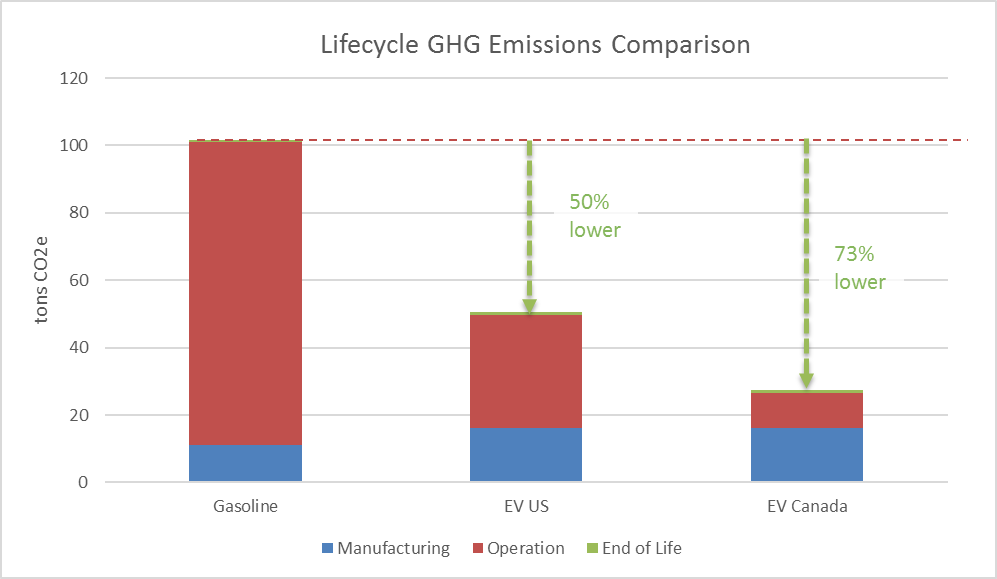
*Based on 180,000 miles of lifetime driving of a large electric sedan (85kWh), batteries manufactured in China, vehicles made in Germany or USA, IPCC median data of lifecycle emissions factors for electricity sources, 2016 electricity source mix from Canada and the USA for EV charging, and EPA data for a 26 mpg vehicle.
But what is the manufacturing based on you say? A fair question. Manufacturing emissions depend on many factors like: which materials are used, the source of those materials, technologies incorporated into the manufacturing processes, material transportation needs, and the type of energy used at each stage of production. The manufacturing data in the graph above is based on batteries produced on a carbon intensive grid (like China) with final vehicle assembly in Germany or the US. For a large 85kWh Tesla battery weighing around 550 kg, the battery would account for 6 tons of greenhouse gas emissions. I’ve seen this as the typical scenario in many research papers but with electricity grids getting cleaner every year the data quickly falls out of date. Still, it serves as a good baseline scenario. You may have seen higher numbers reported elsewhere, but frankly they are based on old data and often use the poor metric of kgCO2e/kWh, which doesn’t hold true as energy density rapidly improves. A better metric is kgCO2e/kg of battery but even that must be continually updated.
What may not be immediately clear from the graph, is that the savings from driving an electric vehicle will very quickly payback the emissions from manufacturing the entire vehicle. In Canada the payback would occur after about 55,000 kms, and the USA at 77,000 kms. So, if you’re already driving, the most environmentally friendly thing you can do is replace your combustion vehicle with an electric vehicle today!
That’s great…..but can we do better?
Remember that the blue bar in the graph assumes batteries are made in China and the vehicles are made in Germany or the USA. Not exactly low carbon electricity grids. It’s also based on studies using electricity data already a few years old and doesn’t account for the specific manufacturing facilities that are already better than the average electricity grids in those countries. Many manufacturers have also incorporated on site renewable energy and better recycling practices.
Manufacturer Highlights
- Tesla currently manufacturers vehicles in California and batteries in Nevada. The Nevada battery Gigafactory will be 100% renewably powered with a 70MW solar array and have on site recycling. The Freemont California grid is actually already very clean with 70% from non-fossil fuels (which partially explains the lack of solar there).
- Chevy’s Bolt is manufactured by GM in Michigan. 54% of the facility’s energy comes from a combination of a 350kW solar array and landfill gas. The batteries are made by LG batteries in Holland Michigan, predominately powered by a natural gas power plant. There is no solar integration in that LG facility but satellite imagery appears to show solar installed on some of their international facilities (oddly this is not mentioned in their sustainability reports). GM also has a plan to use 100% renewable energy by 2050 but that’s almost meaningless because almost everything should be 100% renewably powered by then or we’re going to be in big trouble.
- The Ford Focus EV is also made in Michigan factory which incorporates a 500kW solar array. Their batteries are also made by LG.
- Nissan has a solar array on the Leaf factory in Japan, but they don’t have one on the USA factory. Their batteries are also made by LG.
That’s a good look at today but manufacturers will continue to improve. In fact that’s a recurring theme in all my research, that what was true 5 years ago for electric vehicles is not the reality today and that in turn won’t be representative of the future. Electricity is getting cleaner, cars are getting lighter, recycling is improving, and batteries are becoming more energy dense. All of this makes manufacturing an EV more sustainable. The big question is how quickly and how much can they improve?
There are a variety of papers published on how individual factors can benefit the sustainability of electric vehicle manufacturing. What I’ve done is combine the impacts, as graphed below. The key takeaway from the graph is that Tesla, and possible others, are making EVs with low embodied manufacturing emissions and that this will only improve as time goes on.
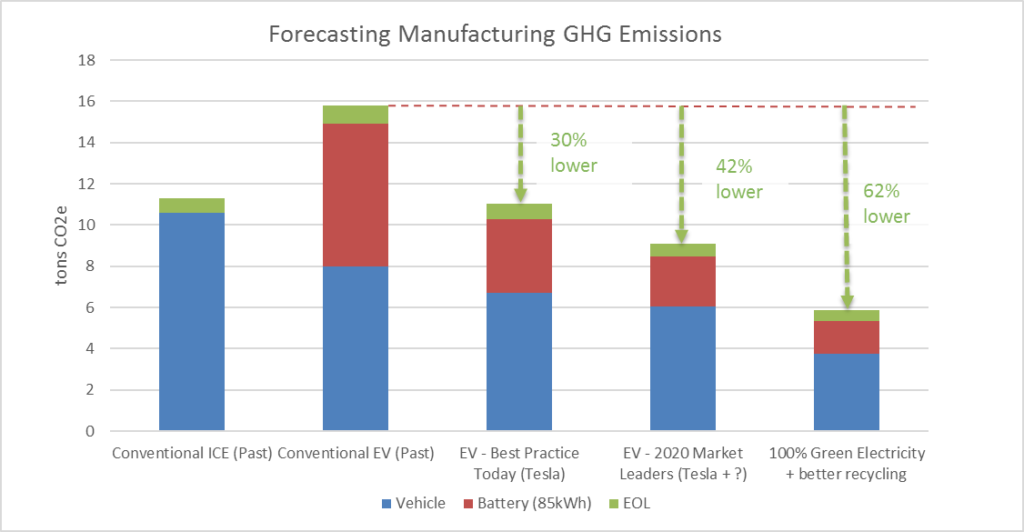
The graph compares the emissions from conventional manufacturing practices for a large combustion sedan and a large EV sedan, and then compares that to sustainability leaders like Tesla today, in 2020, and then into the future. Please remember this is representative data based on many research reports, manufacturing practices, battery density forecasts, some estimations of future conditions, and some interpolation of data.
How are these results achieved?
1: Selecting Clean Electricity Sources
Electricity is used extensively to produce both the materials used in vehicles and the assembled vehicles themselves, but there’s a huge variation in how ‘clean’ electricity grids are. China, Germany, and Michigan, are all locations big on vehicle manufacturing. China also has a huge chunk of the world’s battery production and will continue to do so. By 2020, worldwide production capacity is expected to expand five-fold, with China and South Korea producing 75% of world’s batteries.
In China coal use is down but still accounts for over 60% of electricity production, while in the USA it’s been dropping even faster, now at 30%. Germany, South Korea, and Michigan still get about 40% of their electricity from coal. Coal is a dirty fuel and manufacturers should avoid it to improve their sustainability. Then there’s the issue of climate change, driven by greenhouse gas emissions. Even though natural gas is cleaner to burn than coal, it still creates a lot of greenhouse gas and is responsible for significant methane leaks. For comparison purposes I’ve graphed the greenhouse gas emissions factors for relevant electricity grids and highlighted some specific manufacturer information to account for on-site renewable energy. It makes for an interesting comparison, showing that both the Chevy Bolt and Tesla facilities use electricity sources far greener than even their state grids.
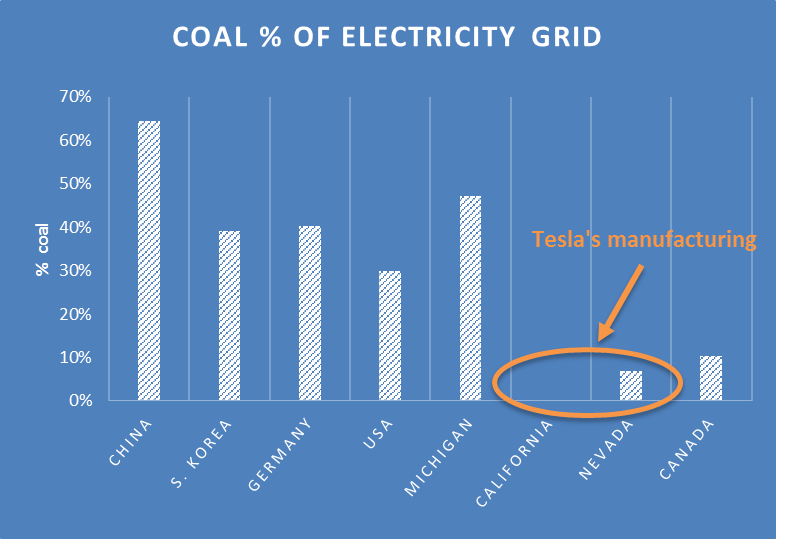
Why is coal considered dirty? Consider that natural gas produces approximately 50% less GHG emissions than coal, 99% less SOx, 90% less NOx, and 99% less particulates.
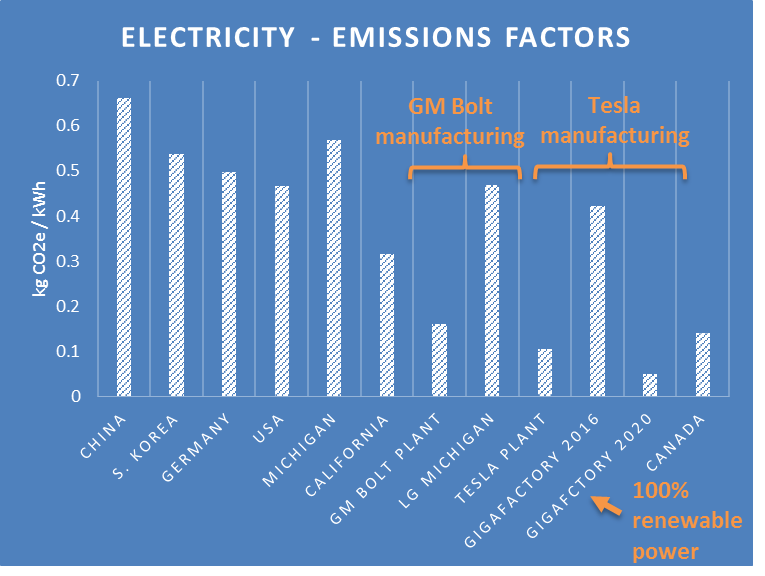
Data uses IPCC median emissions factors for electricity sources, not emission data from the individual plants or regions. It’s important to recognize that many of the components are not made by GM or Tesla at the facilities noted (i.e. airbags, engine blocks, etc). Electricity contributes 29% of the greenhouse gas emissions in the USA and industry is responsible for 21%. That means there’s a lot of room for manufacturing to go green with low-carbon electricity.
Look at the Gigafactory in 2020, what a difference a green electron makes! A recent study from the Norwegian University of Science and Technology found that using renewable electricity could drop production emissions by more than half. That’s for an entire Tesla Model S sized vehicle. With Tesla on the verge of expanding their manufacturing into China, it would be both surprising and disappointing if they didn’t make all new factories 100% renewably powered. It is the new benchmark that they themselves have set for sustainable manufacturing.
2: Light-weighting
You may have noticed a lot of manufacturers using more aluminum in their vehicles. There’s good reason for this. An aluminum body can be 40% lighter than a steel body, according to Audi, and Tesla’s Model S and X use aluminum exclusively in their construction. The push for longer range EVs is resulting in a push for lighter weight vehicles that use less materials. That’s great for the environment.
3: Longer Lasting Cars and Materials
Electric vehicles will last longer than conventional combustion cars today. Aluminum doesn’t rust, electric cars have far fewer moving parts to wear out and few disposable fluids to maintain, and the vehicles get over-the-air updates. But eventually they will wear-out, and this is where recycling comes in.
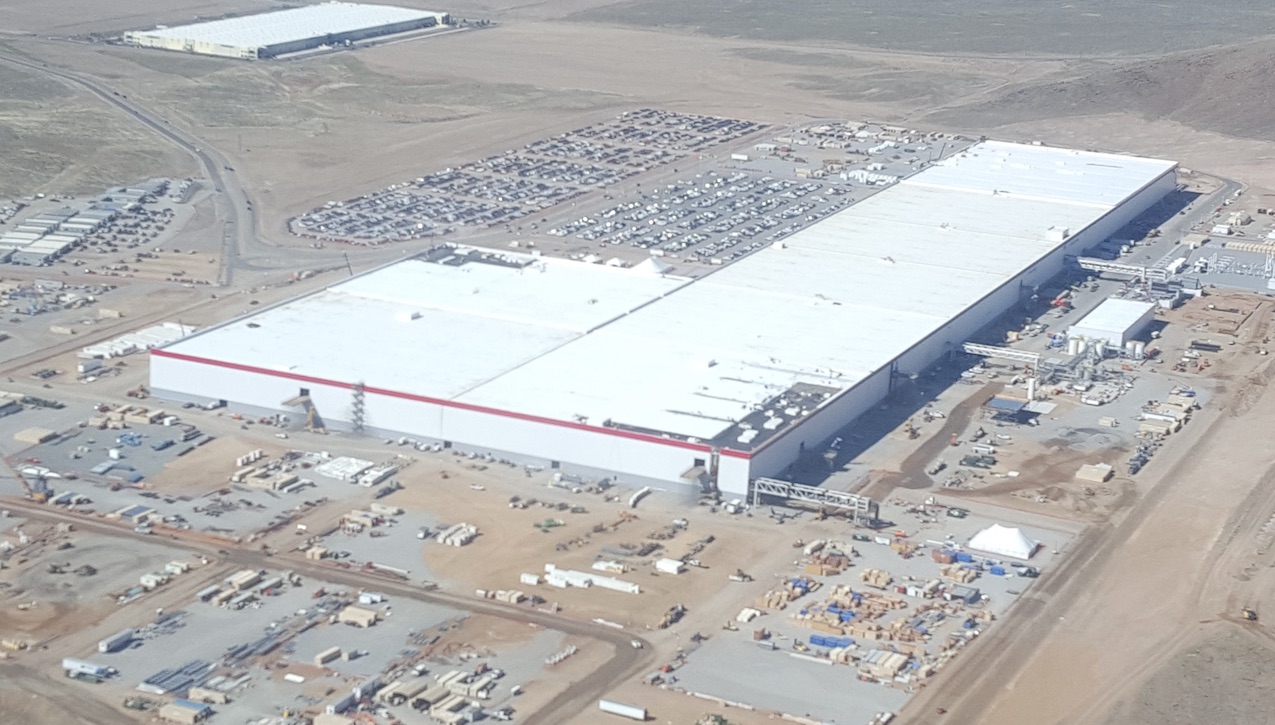
Tesla Gigafactory flyover March, 2017 [Source: NMGroup]
4: Recycling
Today material recovery rates for steel and aluminum in vehicles are very high, at about 90%. For aluminum this is a big deal because recycled aluminum uses only 5% of the electricity for processing, compared to processing from raw materials. I reached out to Tesla to get information on how much recycled content they use and where their aluminum comes from but they’ve yet to get back to me.
Batteries also benefit from recycling as they are composed mostly of valuable metals like aluminum, copper, nickel, cobalt, and lithium (there’s also the graphite anode to consider). Studies indicate a possible 50% reduction in total battery emissions from recycling. Tesla’s current battery recycler in Europe, Umicore, states that through their recycling they can already recover 70% of the GHG emissions that were produced during the original material extraction and refining stages. Large scale lithium-ion battery recycling won’t be needed for several years. Batteries today are expected to last a decade or more and that is continually improving. Just recently Tesla’s battery research division achieved a doubling of battery lifespans for NMC batteries used in their energy storage (their cars use the NCA chemistry). That was just one year into their work.
Imagine a vehicle that was produced entirely from recycled materials using 100% renewable energy, powered by renewable energy, driving quietly down the road with zero pollution. That’s the future. A truly closed loop, because once the materials are extracted, they can be used again and again. It’s not like gasoline which is used only once.
5: Ethical and local sourcing
The results discussed so far have included the emissions from extracting and processing materials, but what about the ethical and moral considerations? Ensuring that vehicles are produced ethically should be required of every manufacturer. Most of the manufacturers have ethical material sourcing reports, to varying degrees of diligence, and some is mandated of publicly traded companies. Tesla has also reaffirmed their commitment to ethically and locally sourced materials, on a number of occasions.
“Imagine a vehicle that was produced entirely from recycled materials using 100% renewable energy, powered by renewable energy, driving quietly down the road with zero pollution. That’s the future.”
Cobalt and graphite are potentially two of the biggest issues right now. Today 65% of the world’s cobalt comes from the Democratic Republic of Congo and most of the flake natural graphite is coming from China. Using less of these contentious materials is a good place to start. The NCA battery chemistry used by Tesla/Panasonic requires far less cobalt than the NMC chemistry commonly used by other manufacturers. They have also committed to sourcing cobalt from non-conflict zones. Canada seems to have a role to play here. Canada sits third in world production of cobalt and third in nickel production. It’s not a coincidence as cobalt is often the byproduct of nickel production. For graphite Tesla has previously stated that artificially produced graphite from Europe may be used and there are other anode materials in development.
Lithium is probably the most discussed material but accounts for ~10% of the battery by weight. It is overwhelmingly extracted from salt brines, pumped from under dried up salt flats in politically stable countries. It’s a pretty clean process but I do have issue with the evaporation process, as it depletes groundwater aquifers. Thankfully there are companies working to create new processes that don’t rely on evaporation to concentrate the minerals. But even with current methods, extracting a recyclable material like lithium has to be better than fracking for a consumable product like oil.
Conclusion:
Manufacturing electric vehicles today is comparable to or better than a combustion vehicle. This will only get better, especially if it’s something customers care about. It’s time to look beyond operational benefits and pay attention to which manufacturers are sustainability leaders. Vote with your dollars and call on manufacturers to make positive changes.
Tesla is undoubtedly one of the leaders. They are using clean electricity in their production today and their massive battery Gigafactory will be 100% renewably powered once complete. Their batteries have a low environmental impact relative to their peers due to the material composition, high energy densities, and clean electricity used in production. They are also have good recycling practices and will improve that with on-site battery recycling in the future. Their cars are long lasting, made of lightweight materials, and they have a good material sourcing strategy. If they can continue to be leaders in this way and push the industry forward, it may just transform all of manufacturing. That’s not to say Tesla is the only one. There are other manufacturers doing some of these good things, but no one seems to be as thorough or have the complete vision of the best possible future like Tesla does. But hey, if those other manufacturers can prove me wrong, all the better.


Lifestyle
Tesla teases “Halloween Mode” update with Optimus rising from a graveyard
Tesla’s Halloween teaser hides a covered vehicle and an Optimus hand rising from the ground.


Tesla has started teasing a Halloween software update for its vehicles, with a short clip on X that reads, “Halloween is coming.” The clip opens on a glowing pumpkin before pulling back to the car’s center touchscreen, where the usual parked visualization has been replaced by a graveyard scene, and the vehicle draped with a white sheet so it reads as a cartoon ghost.
Halloween is coming pic.twitter.com/lM3ASUeOqX
— Tesla (@Tesla) October 1, 2026
The second detail is a robotic hand clawing its way out of the dirt like a zombie, which looks to be the hand of Tesla’s latest Optimus V3 humanoid robot. While Tesla still has not formally shown Optimus Gen 3 walking around in service, renders pulled from Tesla’s Android app last month gave the clearest look yet, including far more refined hands that Tesla has said carry 22 degrees of freedom. The hand has been the hardest part of the program. Musk has called it the majority of the robot’s engineering difficulty, and Tesla’s patents describe a design driven by tendons with the actuators moved into the forearm.
Tesla Optimus V3 hand and arm details revealed in new patents
Optimus also has a Halloween track record. Last October the robot handed out candy in Times Square, and a costumed “zombie” Optimus shuffled around the Tesla Diner in Los Angeles on Halloween night.
On the software side, Tesla’s 2025 Holiday Update expanded Santa Mode with a Santa sleigh, snowmen, snow effects, and a festive lock chime, so it wouldn’t be too far fetched if we saw something similar but themed for a Halloween Mode.
Lifestyle
Tesla’s newest feature lets you floor it out of a Supercharger while plugged in
Tesla’s new Emergency Drive Away feature lets owners flee a Supercharger while still plugged in.
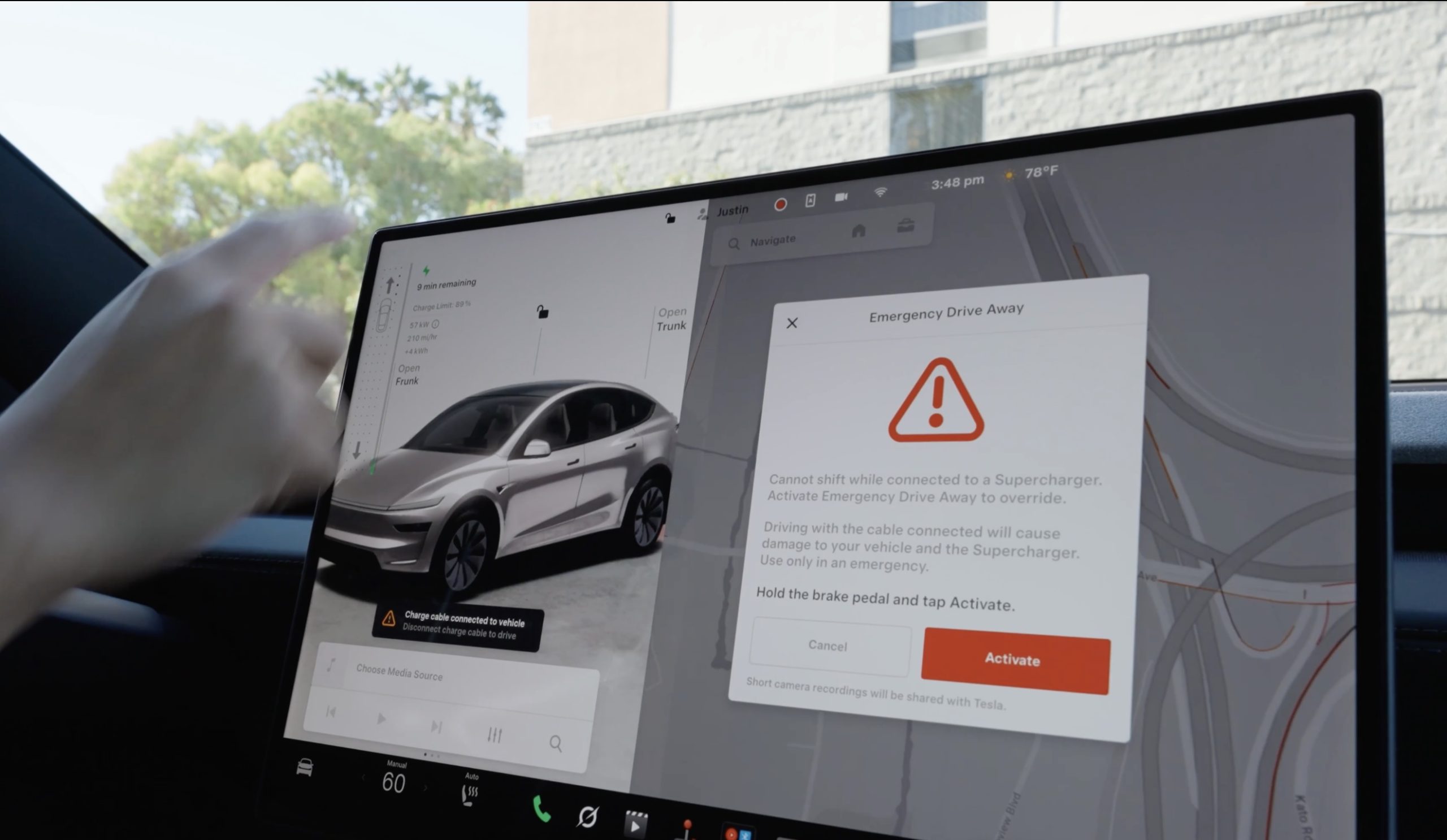
Tesla has given drivers a way to escape while a vehicle is plugged-in at a Supercharger, in the event of an emergency. The company’s charging team announced a new feature on X called Emergency Drive Away, which lets a driver shift into Drive and pull away while the charging cable is still connected to the car.
Until now, a Tesla would not leave Park with a charge cable plugged in. Drivers had to release the latch from the touchscreen, the Tesla app, or the button on the charge handle, then wait for the port to let go. Emergency Drive Away removes that lockout, but Tesla is clear that it comes at a cost. “Use of this feature will damage your vehicle and the Supercharger,” the company wrote, adding that the function is meant for emergencies only and that deliberate misuse will lead to “additional penalties.” Tesla did not say what those penalties are.
Emergency Drive Away lets you shift into Drive while still plugged into a Supercharger pic.twitter.com/40GSzyP4lG
— Tesla Charging (@TeslaCharging) October 1, 2026
The in-car prompt is just as direct, with the warning reading: “Driving with the cable connected will cause damage to your vehicle and the Supercharger. Short camera recordings will be shared with Tesla.” That footage gives Tesla a way to separate a real emergency from someone who simply did not want to wait for the latch.
The feature requires software update 2026.38.3, and Tesla said in replies to owners that it works at every Supercharger in the United States without new stall hardware. Model S and Model X vehicles built before 2021 are not supported, and the company says the feature applies to U.S. Superchargers “for now,” leaving Canada and other markets out at launch.
Tesla Supercharger argument leads to tragic shooting incident
Tesla did not tie the announcement to any specific event, but it arrives two months after a gunman opened fire at an In-N-Out in Twin Falls, Idaho, on August 1, targeting three people in two Teslas at the neighboring Supercharger. One of them, a 66 year old man from Salt Lake City, was killed. Superchargers have been the scene of violence before, including a fatal shooting at a station near Denver in 2023.
In the weeks after Twin Falls, owners pushed Tesla for a native way to escape a stall, and many pointed back to EVject, the aftermarket breakaway connector Tesla sued in 2024 over claims it lacked overtemperature protection. The two companies later reached an agreement that led EVject to recall its earlier connectors in favor of a version with thermal sensors.
Our mission has always been about providing peace of mind and eliminating sitting duck scenarios.
We patented the built-in breakaway charger tip on Feb 15, 2023. Awarded Jan 30, 2024. Then shared the designs with @TeslaCharging
Thank you @Tesla for rolling out a solution. This… https://t.co/djOzswLw9N
— EVject (@EVject) October 2, 2026
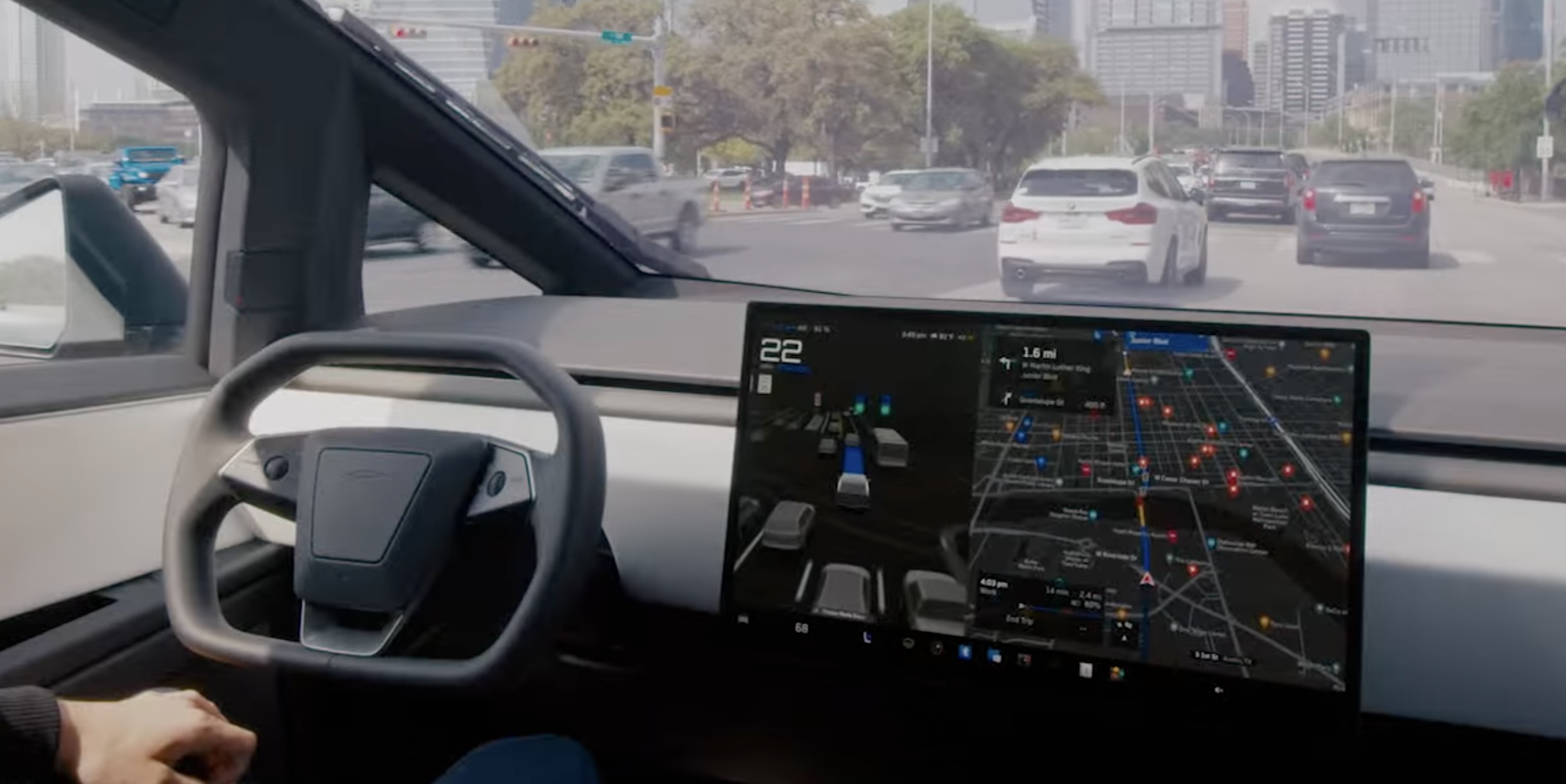
Tesla’s Automatic Collision Evasion feature can be seen in one of the first owner videos of it in action.
Tesla owner Spencer (@scotsrule08) posted on Monday that the feature “worked flawlessly,” saying FSD reengaged itself just as he was about to hit a curb. Ashok Elluswamy, who leads Tesla’s AI team, shared the clip and wrote, “A guardian angel always looking out for you.”
The video arrives in the middle of a staged rollout. Tesla first shipped Automatic Collision Evasion with FSD (Supervised) v14.3.9 in software update 2026.27.6 earlier this month, which Teslarati covered as it reached cars. Update 2026.27.10, which began going out on September 19, carried the feature improvements with FSD v14.3.10, according to release notes tracked by Not a Tesla App. The newer 2026.27.11 build is now reaching another wave of vehicles.
The new Automatic Collision Evasion feature worked flawlessly! FSD reengaged itself just as I was about to hit a curb.
Kudos @Tesla_AI team! 👏 pic.twitter.com/Fbp15HhpL2
— Spencer (@scotsrule08) September 28, 2026
The feature only runs on HW4 vehicles, and it requires an active FSD purchase or subscription with both FSD (Supervised) and Automatic Emergency Braking enabled. HW3 owners receive FSD v14.2 Lite in the same updates, but that build does not include collision evasion.
Tesla’s release notes describe two triggers. The first is an imminent frontal collision that braking alone may not prevent, in which case the car can activate FSD to steer, brake or accelerate around the hazard. That scenario is limited to highways below 85 mph, with no pedestrians or cyclists detected and no slippery road surface. The second covers a driver who appears inattentive, such as reaching into the back seat, or who seems to have switched off FSD by accident. Spencer’s curb clip appears to fall into that second category.
Tesla plans big safety improvements for Full Self-Driving v15
Once the system takes over, the accelerator is muted and light brake input will not cancel the maneuver. Drivers need to apply firm, deliberate steering force to take back control, and the car chimes to hand control back once the danger has passed.
Elluswamy recently noted that earlier hazard prediction, faster reaction time and better collision avoidance would arrive with FSD v15, the next major version.

Starlink launches Communities Program for passive income through internet sharing

Tesla just made its headlights even better through a software update


