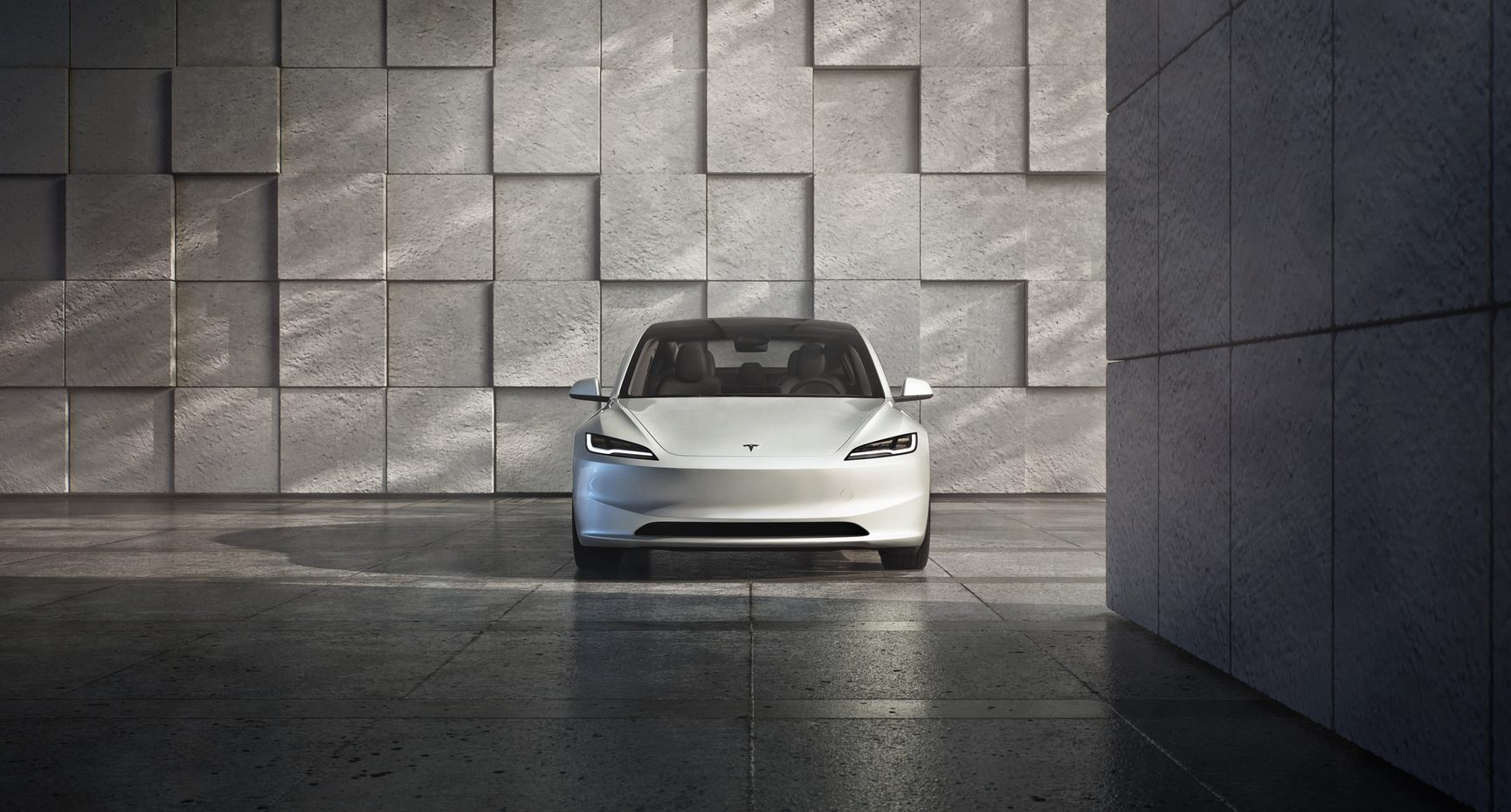

Tesla China’s zero-interest loan promotion seems to have been successful, so much so that the electric vehicle maker has announced that it would be extending the popular program for the Giga Shanghai-made Model 3 sedan and Model Y crossover for another month.
Tesla China’s domestic sales this 2024 have been lagging behind the company’s numbers from 2023. In what appears to be an effort to drive more domestic sales in China, Tesla started offering zero-interest loans in April, provided that customers could take delivery of their vehicles by the end of the second quarter.
The program seemed to be a success. In the latter half of June, Tesla China saw its new vehicle registrations rise to 17,500 units, a new high for 2024. Reports also suggested that Tesla China is looking to bolster its sales and service teams by rehiring some of the workers that were laid off during CEO Elon Musk’s recent round of workforce reductions.
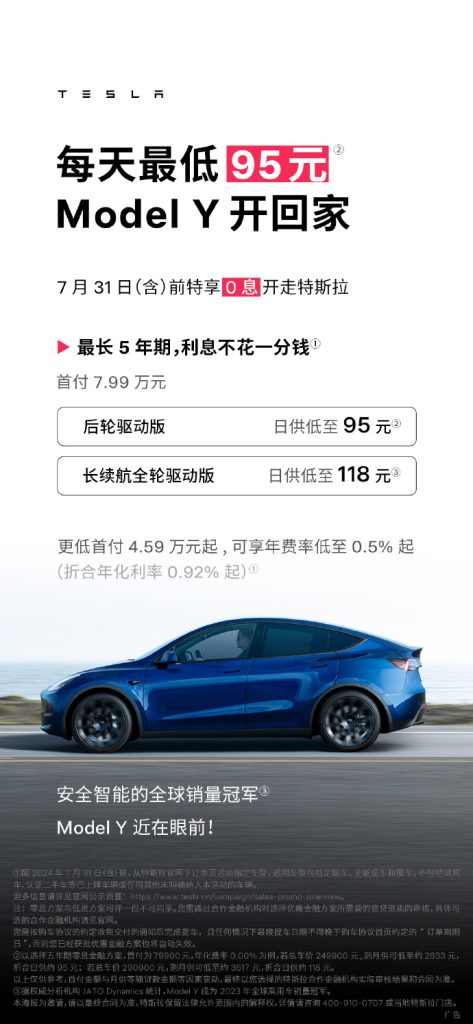
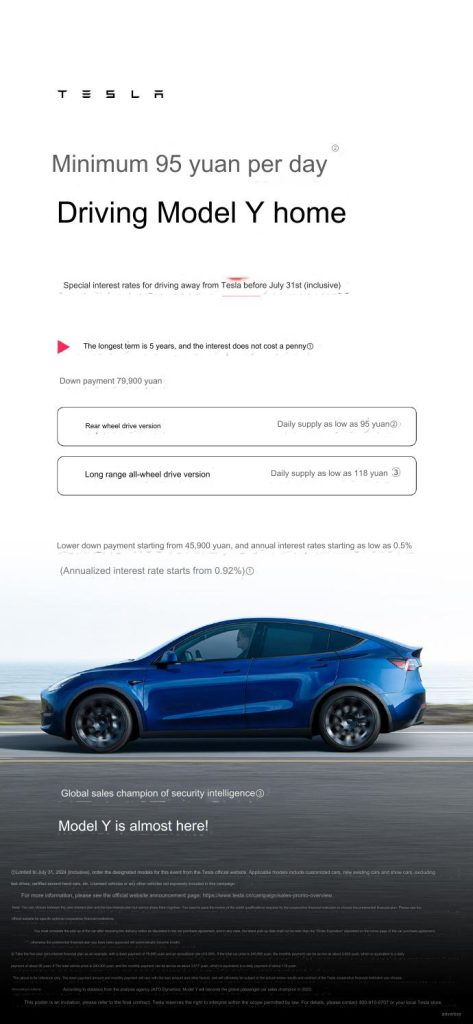
As could be seen in Tesla China’s official Weibo account, customers who opt to purchase a Tesla Model 3 sedan or Tesla Model Y crossover could get a zero-interest loan for up to five years, provided that they take delivery of their vehicles on or before July 31, 2024.
Tesla China highlighted the advantage of such a promotion in posters that the company posted on Weibo. As per the EV maker, the Tesla Model Y can be acquired for as low as RMB 95 ($13) per day and the Model 3 can be acquired for as low as RMB 85 ($11) per day under its zero-interest, five-year plan. Customers simply need to pay a downpayment of RMB 79,900 ($11,000) to qualify for the promotion.
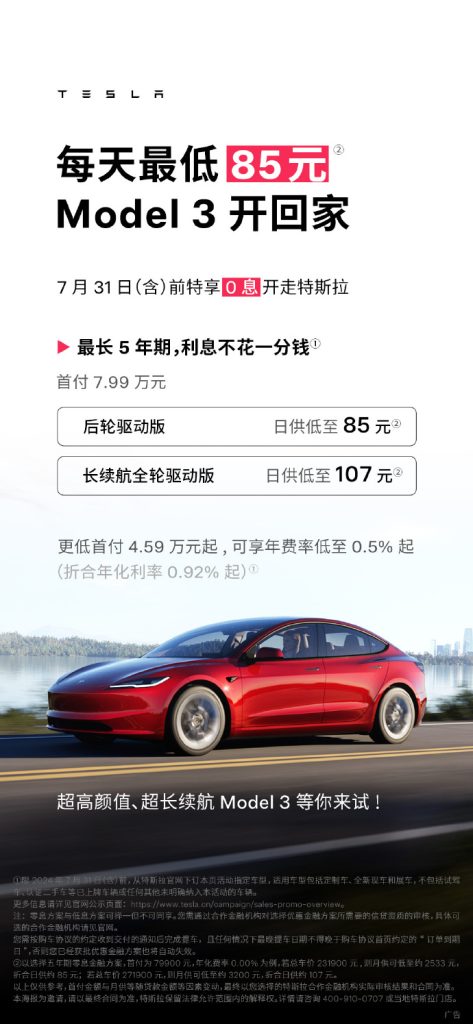
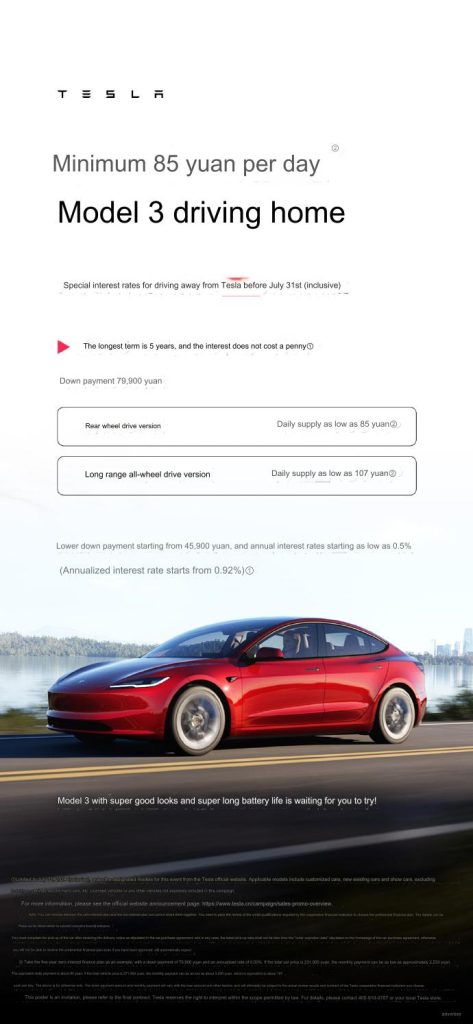
Tesla China also provided another option for customers if they do not wish to utilize the company’s zero-interest promotion. As per the EV maker, Giga Shanghai-made Model 3 and Model Y customers could also go for a low downpayment plan instead, which requires a downpayment of just RMB 45,900 ($6,300). With this promotion, customers could see annualized interest rates starting at 0.92%, as noted in a CNEV Post report.
$TSLA ??
BREAKING: Tesla China extends zero-interest promotion to July after June sales hit new record.
If you order a Model 3/Y RWD or a long-range vehicle before July 31, you'll get a five-year interest-free financial plan for a limited time. https://t.co/xFUxGMygIJ pic.twitter.com/ugGB8ZQppZ— Tsla Chan (@Tslachan) July 1, 2024
Considering that the reengineered Tesla Model 3 Performance has started local deliveries in China, it would not be surprising if the electric vehicle maker starts catching up to its 2023 numbers in the coming months. It would also be quite interesting to see how Tesla China’s zero-interest offer affects the company’s export strategy, as the promotion will likely result in a wave of domestic deliveries in July. Tesla China typically spends the first month of a quarter exporting vehicles to foreign territories.
Don’t hesitate to contact us with news tips. Just send a message to simon@teslarati.com to give us a heads up.



There are a lot of Tesla bulls out there who have astronomical expectations for the company, especially as its arm of reach has gone well past automotive and energy and entered artificial intelligence and robotics.
However, some of the most bullish Tesla investors believe the company could become worth $100 trillion, and CEO Elon Musk does not believe that number is completely out of the question, even if it sounds almost ridiculous.
To put that number into perspective, the top ten most valuable companies in the world — NVIDIA, Apple, Alphabet, Microsoft, Amazon, TSMC, Meta, Saudi Aramco, Broadcom, and Tesla — are worth roughly $26 trillion.
Will Tesla join the fold? Predicting a triple merger with SpaceX and xAI
Cathie Wood of ARK Invest believes the number is reasonable considering Tesla’s long-reaching industry ambitions:
“…in the world of AI, what do you have to have to win? You have to have proprietary data, and think about all the proprietary data he has, different kinds of proprietary data. Tesla, the language of the road; Neuralink, multiomics data; nobody else has that data. X, nobody else has that data either. I could see $100 trillion. I think it’s going to happen because of convergence. I think Tesla is the leading candidate [for $100 trillion] for the reason I just said.”
Musk said late last year that all of his companies seem to be “heading toward convergence,” and it’s started to come to fruition. Tesla invested in xAI, as revealed in its Q4 Earnings Shareholder Deck, and SpaceX recently acquired xAI, marking the first step in the potential for a massive umbrella of companies under Musk’s watch.
SpaceX officially acquires xAI, merging rockets with AI expertise
Now that it is happening, it seems Musk is even more enthusiastic about a massive valuation that would swell to nearly four-times the value of the top ten most valuable companies in the world currently, as he said on X, the idea of a $100 trillion valuation is “not impossible.”
It’s not impossible
— Elon Musk (@elonmusk) February 6, 2026
Tesla is not just a car company. With its many projects, including the launch of Robotaxi, the progress of the Optimus robot, and its AI ambitions, it has the potential to continue gaining value at an accelerating rate.
Musk’s comments show his confidence in Tesla’s numerous projects, especially as some begin to mature and some head toward their initial stages.
Elon Musk
Tesla director pay lawsuit sees lawyer fees slashed by $100 million
The ruling leaves the case’s underlying settlement intact while significantly reducing what the plaintiffs’ attorneys will receive.
The Delaware Supreme Court has cut more than $100 million from a legal fee award tied to a shareholder lawsuit challenging compensation paid to Tesla directors between 2017 and 2020.
The ruling leaves the case’s underlying settlement intact while significantly reducing what the plaintiffs’ attorneys will receive.
Delaware Supreme Court trims legal fees
As noted in a Bloomberg Law report, the case targeted pay granted to Tesla directors, including CEO Elon Musk, Oracle founder Larry Ellison, Kimbal Musk, and Rupert Murdoch. The Delaware Chancery Court had awarded $176 million to the plaintiffs. Tesla’s board must also return stock options and forego years worth of pay.
As per Chief Justice Collins J. Seitz Jr. in an opinion for the Delaware Supreme Court’s full five-member panel, however, the decision of the Delaware Chancery Court to award $176 million to a pension fund’s law firm “erred by including in its financial benefit analysis the intrinsic value” of options being returned by Tesla’s board.
The justices then reduced the fee award from $176 million to $70.9 million. “As we measure it, $71 million reflects a reasonable fee for counsel’s efforts and does not result in a windfall,” Chief Justice Seitz wrote.
Other settlement terms still intact
The Supreme Court upheld the settlement itself, which requires Tesla’s board to return stock and options valued at up to $735 million and to forgo three years of additional compensation worth about $184 million.
Tesla argued during oral arguments that a fee award closer to $70 million would be appropriate. Interestingly enough, back in October, Justice Karen L. Valihura noted that the $176 award was $60 million more than the Delaware judiciary’s budget from the previous year. This was quite interesting as the case was “settled midstream.”
The lawsuit was brought by a pension fund on behalf of Tesla shareholders and focused exclusively on director pay during the 2017–2020 period. The case is separate from other high-profile compensation disputes involving Elon Musk.
Investor's Corner
Tesla (TSLA) Q4 and FY 2025 earnings call: The most important points
Executives, including CEO Elon Musk, discussed how the company is positioning itself for growth across vehicles, energy, AI, and robotics despite near-term pressures from tariffs, pricing, and macro conditions.
Tesla’s (NASDAQ:TSLA) Q4 and FY 2025 earnings call highlighted improving margins, record energy performance, expanding autonomy efforts, and a sharp acceleration in AI and robotics investments.
Executives, including CEO Elon Musk, discussed how the company is positioning itself for growth across vehicles, energy, AI, and robotics despite near-term pressures from tariffs, pricing, and macro conditions.
Key takeaways
Tesla reported sequential improvement in automotive gross margins excluding regulatory credits, rising from 15.4% to 17.9%, supported by favorable regional mix effects despite a 16% decline in deliveries. Total gross margin exceeded 20.1%, the highest level in more than two years, even with lower fixed-cost absorption and tariff impacts.
The energy business delivered standout results, with revenue reaching nearly $12.8 billion, up 26.6% year over year. Energy gross profit hit a new quarterly record, driven by strong global demand and high deployments of MegaPack and Powerwall across all regions, as noted in a report from The Motley Fool.
Tesla also stated that paid Full Self-Driving customers have climbed to nearly 1.1 million worldwide, with about 70% having purchased FSD outright. The company has now fully transitioned FSD to a subscription-based sales model, which should create a short-term margin headwind for automotive results.
Free cash flow totaled $1.4 billion for the quarter. Operating expenses rose by $500 million sequentially as well.
Production shifts, robotics, and AI investment
Musk further confirmed that Model S and Model X production is expected to wind down next quarter, and plans are underway to convert Fremont’s S/X line into an Optimus robot factory with a capacity of one million units.
Tesla’s Robotaxi fleet has surpassed 500 vehicles, operating across the Bay Area and Austin, with Musk noting a rapid monthly expansion pace. He also reiterated that CyberCab production is expected to begin in April, following a slow initial S-curve ramp before scaling beyond other vehicle programs.
Looking ahead, Tesla expects its capital expenditures to exceed $20 billion next year, thanks to the company’s operations across its six factories, the expansion of its fleet expansion, and the ramp of its AI compute. Additional investments in AI chips, compute infrastructure, and future in-house semiconductor manufacturing were discussed but are not included in the company’s current CapEx guidance.
More importantly, Tesla ended the year with a larger backlog than in recent years. This is supported by record deliveries in smaller international markets and stronger demand across APAC and EMEA. Energy backlog remains strong globally as well, though Tesla cautioned that margin pressure could emerge from competition, policy uncertainty, and tariffs.

SpaceX strengthens manufacturing base with Hexagon Purus aerospace deal

Tesla’s Sweden standoff draws UAW support as unions widen pressure campaign


