Lifestyle
Tesla owner takes Model 3 on the ultimate 115,000-mile road trip across US

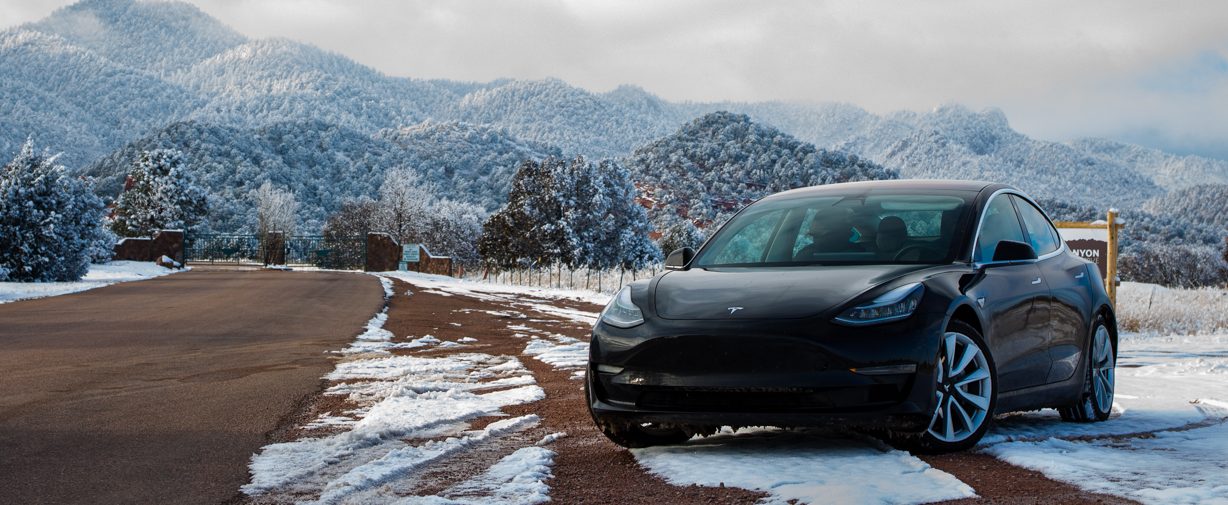
One Tesla Model 3 owner recently hit a milestone after taking his Long Range rear-wheel drive electric sedan on an epic six-month-long, 115,000 road trip throughout the United States.
Los Angeles-based Tesla owner Arthur Driessen documented his journey across the U.S. in his blog Maiden Voyage: A Voyage Without Carbon and recently shared his thoughts after covering a distance that could be the farthest one done in a Model 3.
Driessen has used and practically abused the electric vehicle on almost all kinds of terrains through different seasons. According to Driessen, he drove the vehicle through sand, snow, streams, creeks and all and the car has got him through challenging terrain and weather every single time.
-
- Tesla Model 3 – Maiden Voyage 3(Source: @MCarbon via Twitter)
-
- Tesla Model 3 – Maiden Voyage 2 (Source: @MCarbon via Twitter)
-
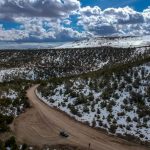
- Tesla Model 3 – Maiden Voyage 1 (Source: @MCarbon via Twitter)
“I’ve seen tons of different types of terrain. You go off into the mountains. You go to Native American reservations and you’re gonna see roads that really are supposed to have 4×4 vehicles,” he said.
Through his adventure riding the Model 3 he actually only had two control arms and a door hinge replaced but they were practically self-inflicted damage. He also changed tires when his set of OEM shoes went bald after 10,000 miles and every 20K to 25K miles after that but he confessed that it was expected as he drove heavy and drove off-road.
“I think that’s pretty amazing. Over 115,000 miles, you know no oil changes, no nothing,” he exclaimed.
Probably most people would ask how much Driessen spent to operate the Model 3 during the road trip and how the electric car’s battery might have degraded.
“The savings have been just phenomenal and then you can factor in, you know, gas savings comparatively… with supercharging. I average everything out at about six cents per mile which means $6,000 over a hundred thousand miles and you can take that number and you can apply it to whatever car you would be driving,” he said. The Model 3 owner estimated that he saved around $10,000 on gas, comparing the cost if he drove his Civic.
With regard to battery range and degradation, the EV adventurer said he did not lose much battery at all. He also praised the charging infrastructure of Tesla throughout the country as he only struggled when he was near the Texas border and up along the Canadian border.
“The last time I charged 100 percent, which was a couple of weeks ago, I still had 308 miles.. and I think that’s pretty good,” he revealed. For context, Driessen’s Model 3 had an original rate range of 310 miles.
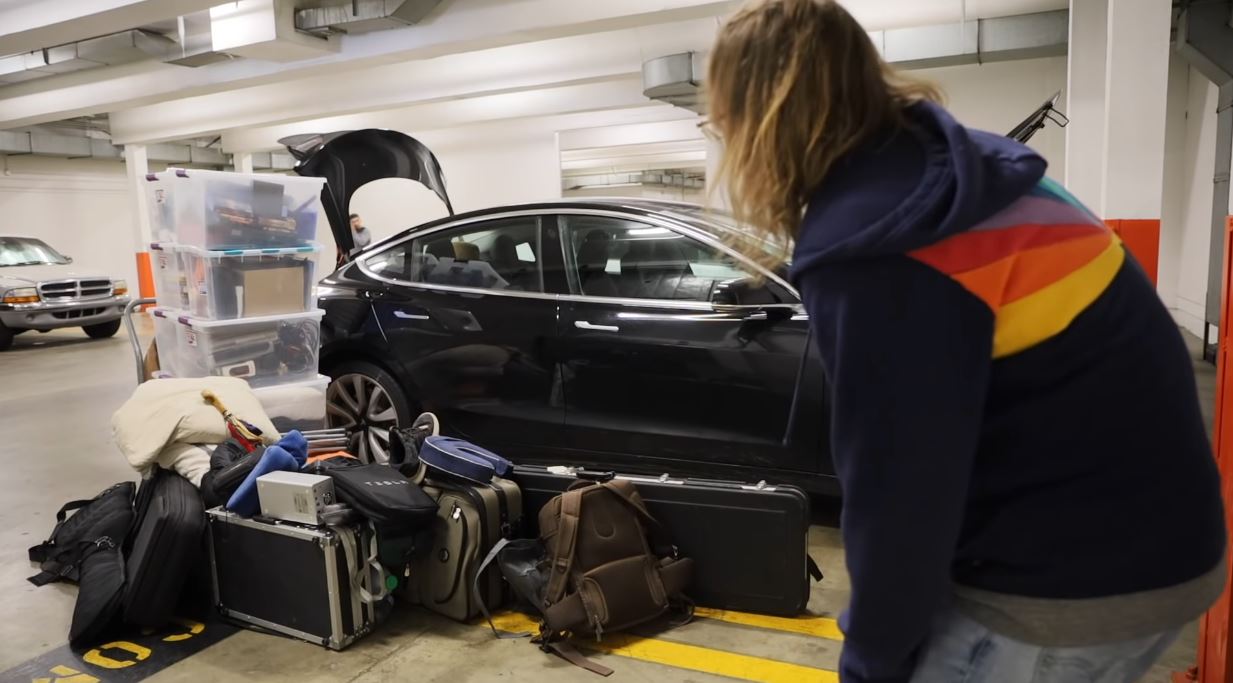
In terms of Model 3 storage, this snapshot from his vlog when he emptied out the car’s passenger cabin, trunk, and frunk sum up how much you can carry on Tesla’s mass-produced electric sedan.
Driessen also brought up issues he encountered with the vehicle such as the Autopilot choosing the slower left lane during some points of his trip, forcing other vehicles to pass through his right. He also shared the problems he had with Smart Summon, seeing the feature as a rushed piece of software after encountering issues with it at some parking lots. The Model 3 owner also raised an issue about the car’s navigation not working when one’s not online. Nevertheless, the Model 3 owner acknowledges the capability of Tesla in pushing software updates to improve the ride to address such issues.
Driessen’s adventure across the United States on his Tesla Model 3 is not just a testimony, but his experience is concrete proof that the popular electric sedan can deliver beyond its perceived limits.
Check out the video footage of Maiden Voyage: A Voyage Without Carbon below:


Tesla has taken home the “Overall Loyalty to Make” award from S&P Global Mobility for the fourth consecutive year, reinforcing Tesla owners’ willingness to come back. The 2025 awards are based on S&P Global Mobility’s analysis of 13.6 million new retail vehicle registrations in the U.S. from October 2024 through September 2025. The complete list of 2025 winners includes General Motors for Overall Loyalty to Manufacturer, Tesla for Overall Loyalty to Make, Chevrolet Equinox for Overall Loyalty to Model, Mini for Most Improved Make Loyalty, Subaru for Overall Loyalty to Dealer, and Tesla again for both Ethnic Market Loyalty to Make and Highest Conquest Percentage.
Tesla’s streak in this category started in 2022, and the brand has now won the Highest Conquest Percentage award for six straight years, meaning it keeps pulling buyers away from other brands at a rate no competitor has matched. Tesla’s retention among Asian households reached 63.6% and among Hispanic households 61.9%, rates that significantly outpace national averages for those groups. That breadth of appeal across demographics adds a layer of significance to a win that some might dismiss as routine.
The timing matters too. After several consecutive quarters of decline, Tesla’s share of U.S. EV sales jumped to 59% in Q4 2025. That rebound, arriving just as competitors were flooding the market with new models and incentives, suggests Tesla’s loyalty numbers are not simply the result of limited alternatives. Buyers are still choosing it when they have plenty of other options.
What keeps Tesla owners coming back has a lot to do with the and convenience of charging. The Supercharger network is the most straightforward example. With over 65,000 Superchargers globally, it remains the largest and most reliable fast-charging network in the world, and owners who have built their routines around it face a real practical cost when considering a switch. Competitors have made progress, but the consistency, speed, and availability of Tesla’s network is still the benchmark the rest of the industry is chasing. Then there is the software side. Tesla has built a model where the car you own today is functionally different from the car you bought two years ago, through over-the-air updates that add continuous game-changing improvements such as Full Self-Driving that has moved from a driver-assist feature to an increasingly capable autonomous system. For many Tesla owners, leaving the brand means starting over with a car that will not get meaningfully better over time, and that is a trade-off fewer and fewer are willing to make.
Cybertruck
Tesla Cybercab just rolled through Miami inside a glass box
Tesla paraded a Cybercab in a glass display at Miami’s F1 Grand Prix event this week.

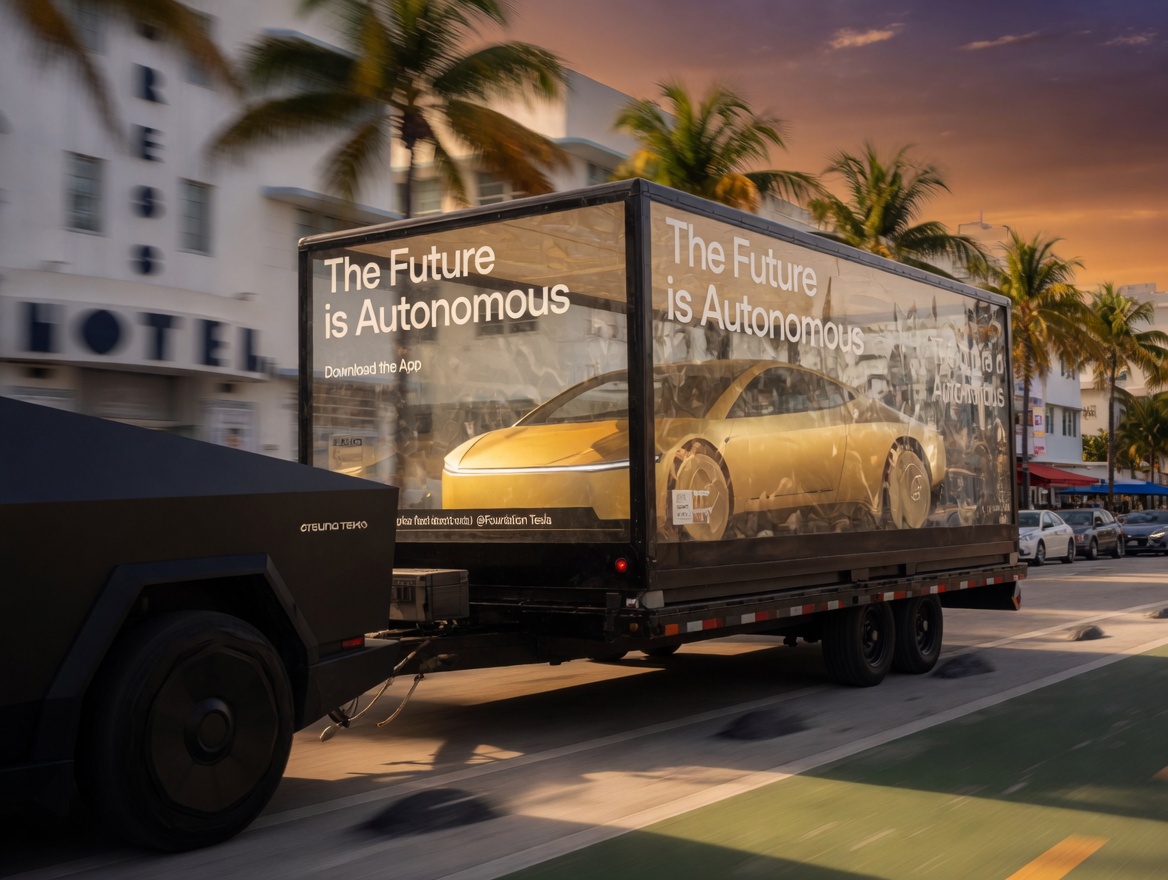
Tesla set up an “Autonomy Pop-Up” at Lummus Park in Miami Beach from April 29 through May 3, 2026, embedded within the official F1 Miami Grand Prix Fan Fest. The centerpiece was a Cybertruck towing the Cybercab inside a glass display case marked “Future is Autonomous,” rolling through the beachfront crowd.
Miami is on Tesla’s confirmed list of cities for robotaxi expansion in the first half of 2026, making the promotion a strategic promotion that lays groundwork in a target market.
This was not Tesla’s first time using Miami as a showcase city. In December 2025, Tesla hosted “The Future of Autonomy Visualized” at its Miami Design District showroom, coinciding with Art Basel Miami Beach. That event featured the Cybercab prototype and Optimus robots interacting with attendees. The F1 pop-up this week marks Tesla’s return to Miami and follows a pattern Tesla has been running since early 2026. Just two weeks before Miami, Tesla stationed Optimus at the Tesla Boston Boylston Street showroom on April 19 and 20, directly on the final stretch of the Boston Marathon, letting tens of thousands of runners and spectators meet the robot for free, generating massive earned media at zero advertising cost.
Tesla is sending its humanoid Optimus robot to the Boston Marathon
Tesla has confirmed plans to expand its robotaxi service to seven cities in the first half of 2026, including Dallas, Houston, Phoenix, Miami, Orlando, Tampa, and Las Vegas, building on the unsupervised service already running in Austin. Musk has said he expects robotaxis to cover between a quarter and half of the United States by end of year. On the production side, Musk told shareholders that the Cybercab manufacturing process could eventually produce up to 5 million vehicles per year, targeting a cycle time of one unit every ten seconds. Scaling robotaxis to 10 million operational units over the next ten years is a key condition of his compensation package, alongside selling 20 million passenger vehicles.
As for the Cybercab’s price, Musk has said buyers will be able to purchase one for under $30,000, with an average operating cost around $0.20 per mile. Whether those numbers hold through full production remains to be seen.
Cybercab at F1 Fan Fest in Miami
by
u/Joshalander in
teslamotors
Lifestyle
California hits Tesla Cybercab and Robotaxi driverless cars with new law
California just gave police power to ticket driverless cars, including Tesla’s Cybercab fleet.
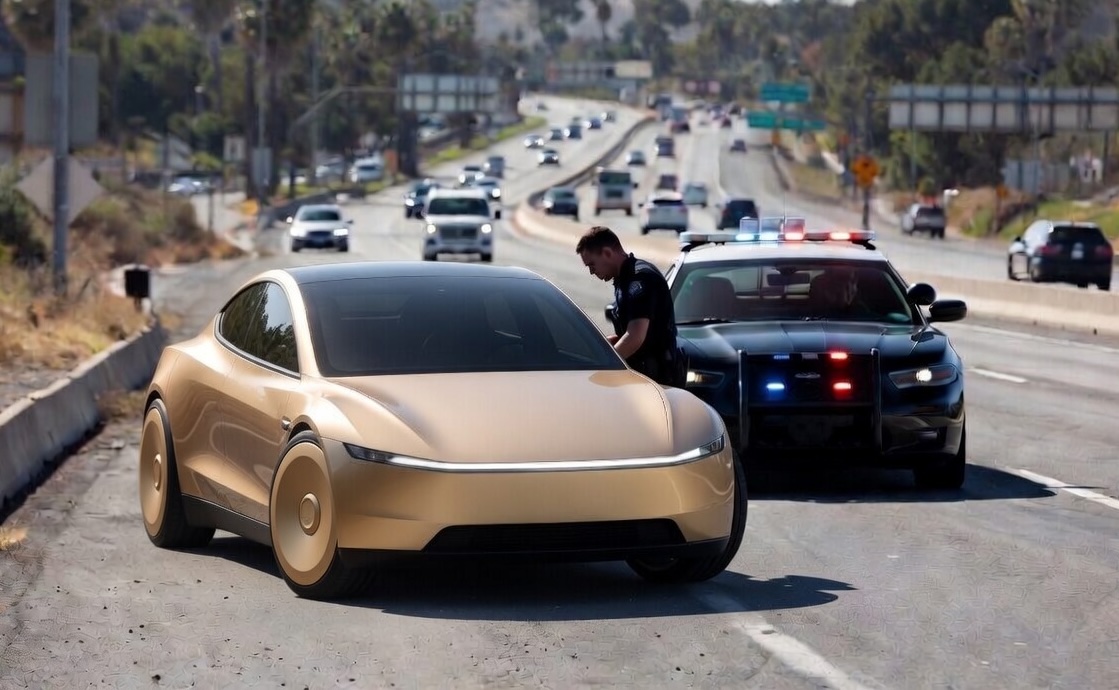
California DMV formally adopted new rules on April 29, 2026 that allow law enforcement to issue “notices of noncompliance”, or in other words ticket autonomous vehicle companies when their cars commit moving violations. The rules take effect July 1, 2026 and officially closes a regulatory gap that previously let driverless cars operate on public roads with nearly no traffic enforcement consequences.
Until now, state traffic laws only applied to human “drivers,” which meant that when no person was behind the wheel, police had no mechanism to issue a ticket. Officers were limited to citing driverless vehicles for parking violations only. A well-known example came in September 2025, when a San Bruno officer watched a Waymo robotaxi execute an illegal U-turn and could do nothing but notify the company.
Under the new framework, when an officer observes a violation, the autonomous vehicle company is effectively treated as the driver. Companies must report each incident to the DMV within 72 hours, or 24 hours if a collision is involved. Repeated violations can result in fleet size restrictions, operational suspensions, or full permit revocation. Local officials also gained new authority to geofence driverless vehicles out of active emergency zones within two minutes and require a live emergency response line answered within 30 seconds.
Tesla Cybercab ramps Robotaxi public street testing as vehicle enters mass production queue
California’s new enforcement rules arrive at a pivotal moment for Tesla. The company is ramping Cybercab production at Giga Texas toward hundreds of units per week, targeting at least 2 million units annually at full capacity, while simultaneously pushing to expand its Robotaxi service to dozens of U.S. cities by end of 2026. Unsupervised FSD for consumer vehicles is currently targeted for Q4 2026, and when it arrives, Tesla’s fleet may not have a human to absorb legal accountability, under the July 1 rules.
Tesla has confirmed plans to expand its Robotaxi service to seven new cities in the first half of 2026, including Dallas, Houston, Phoenix, Miami, Orlando, Tampa, and Las Vegas, with the service already running without safety drivers in Austin. Musk has said he expects robotaxis to cover between a quarter and half of the United States by end of year.

Tesla gets a massive order for the Semi: 370 units and $100M

Tesla begins factoring international designs in Full Self-Driving visualization


