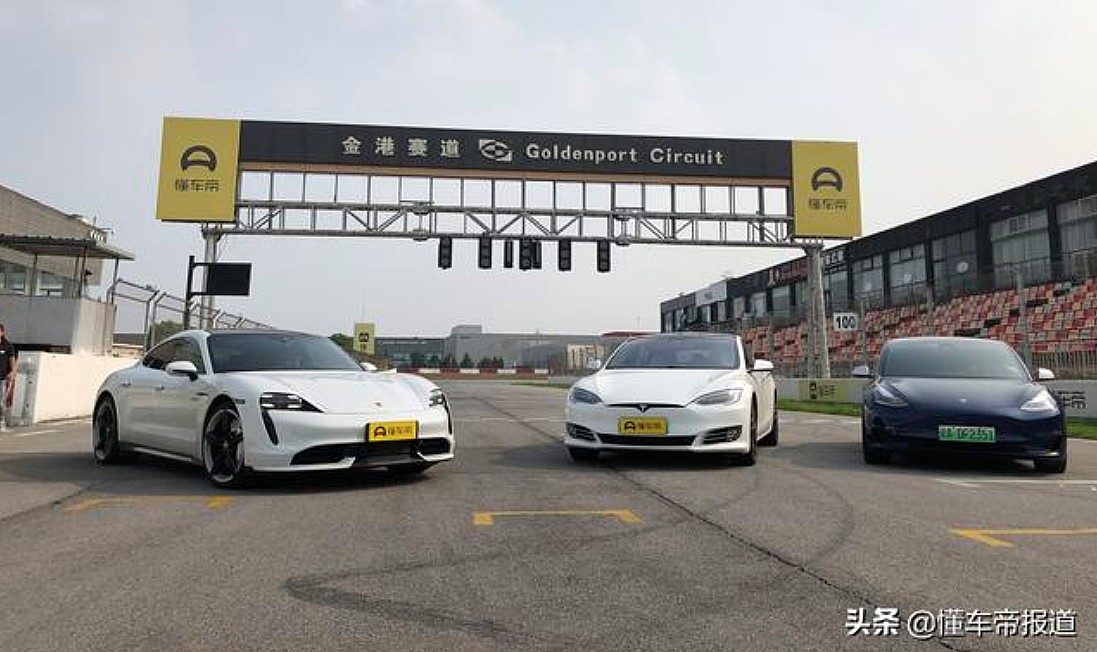
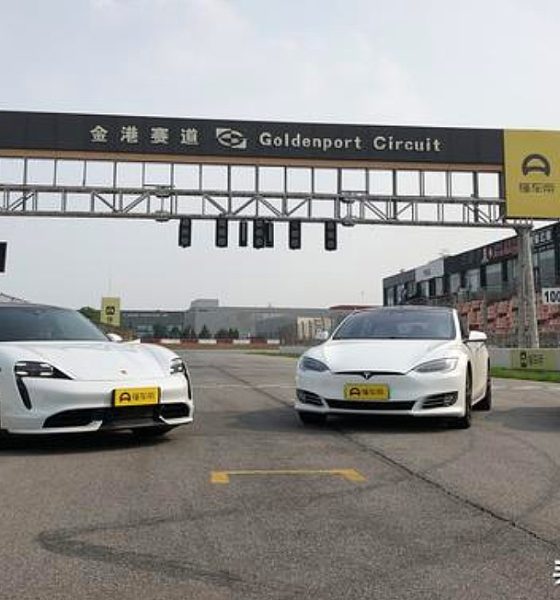

There’s no denying that the Porsche Taycan Turbo is an incredible electric car on the track. Refined on the cruel turns of the Nurburgring, the Taycan embodies Porsche’s racing pedigree in an all electric package. This is why it was quite surprising to see such a vehicle bow down to a far more affordable and understated adversary: the Tesla Model 3 Performance.
China’s premier motoring site, Dongchedi, recently conducted a 24-hour test of the Porsche Taycan Turbo, benchmarking the vehicle against the Tesla Model S Performance and Model 3 Performance with Track Package. The news agency performed three main tests for the Taycan, which included a drag race and endurance test against the Model S and a time attack track run against the Model 3 Performance.
The Taycan Turbo is one of the most expensive electric cars in China. Commanding a price of RMB 1,498,000 (around USD 214,238) in the local market, the Taycan Turbo is over three times more expensive than the Model 3 Performance, which is priced at RMB 419,800 (around USD 60,038). It should be noted that the Model 3 Performance is still quite pricey in China, seeing as it is not yet being locally produced at Gigafactory Shanghai.
As noted by the motoring site, the Porsche Taycan Turbo actually performed really well during its test. Professional drivers who tested the vehicle over the 24 hour period praised the electric sedan for its driving dynamics, which showcases the best that Porsche has to offer. That being said, the Taycan did bow to the Model S Performance in the drag race, as it finished the quarter mile run in 10.99 seconds, just behind the Model S Performance, which completed the race in 10.56 seconds.
The Taycan Turbo also did well on its battery endurance test, running 452 km in one charge and impressively close to its NEDC rating of 462 km. In contrast, Tesla’s flagship sedan was able to run 505 km before it ran out of battery, 145 km less than its NEDC rating of 650 km.
For the Porsche Taycan Turbo’s track test, the Dongchedi team brought the vehicle to its closed circuit for a hot lap time attack test. But this time around, the Taycan Turbo had an additional competitor: the Tesla Model 3 Performance with Track Package. The Taycan Turbo showed its racing pedigree in the test, decimating the Model S Performance’s track time of 1:19:26 with its impressive 1:15:97 run.
However, the German made electric car’s win was short lived, as the much more affordable Model 3 was able to complete its hot lap in 1:15:78. Granted, the gap between the time attack results of the Porsche Taycan Turbo and the Model 3 Performance was very slim. Despite this, it is difficult not to be impressed by Tesla’s most affordable performance branded car.
There are very few cars out there in the Model 3 Performance’s price range that could give the Taycan Turbo some competition, after all, and there are even fewer that can actually humble the proud German made EV in an area that it’s designed to dominate. With such results, it would not be surprising if the Model 3 Performance becomes the vehicle of choice for the country’s mainstream racing enthusiasts, seeing as it offers performance that can compete with a Porsche on the track — at a fraction of the price.


Elon Musk
Tesla Megapack powers $1.1B AI data center project in Brazil
By integrating Tesla’s Megapack systems, the facility will function not only as a major power consumer but also as a grid-supporting asset.
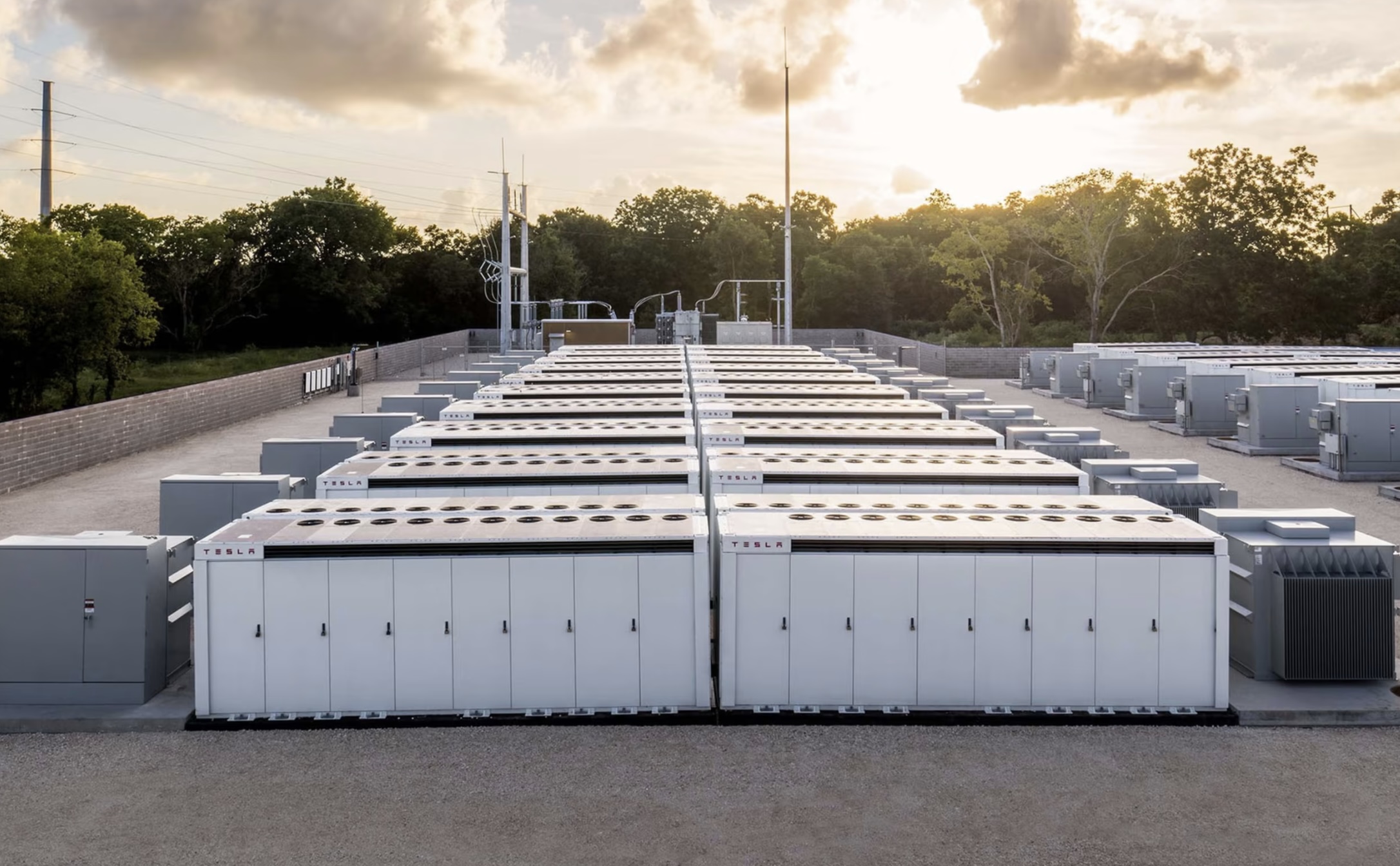
Tesla’s Megapack battery systems will be deployed as part of a 400MW AI data center campus in Uberlândia, Brazil. The initiative is described as one of Latin America’s largest AI infrastructure projects.
The project is being led by RT-One, which confirmed that the facility will integrate Tesla Megapack battery energy storage systems (BESS) as part of a broader industrial alliance that includes Hitachi Energy, Siemens, ABB, HIMOINSA, and Schneider Electric. The project is backed by more than R$6 billion (approximately $1.1 billion) in private capital.
According to RT-One, the data center is designed to operate on 100% renewable energy while also reinforcing regional grid stability.
“Brazil generates abundant energy, particularly from renewable sources such as solar and wind. However, high renewable penetration can create grid stability challenges,” RT-One President Fernando Palamone noted in a post on LinkedIn. “Managing this imbalance is one of the country’s growing infrastructure priorities.”
By integrating Tesla’s Megapack systems, the facility will function not only as a major power consumer but also as a grid-supporting asset.
“The facility will be capable of absorbing excess electricity when supply is high and providing stabilization services when the grid requires additional support. This approach enhances resilience, improves reliability, and contributes to a more efficient use of renewable generation,” Palamone added.
The model mirrors approaches used in energy-intensive regions such as California and Texas, where large battery systems help manage fluctuations tied to renewable energy generation.
The RT-One President recently visited Tesla’s Megafactory in Lathrop, California, where Megapacks are produced, as part of establishing the partnership. He thanked the Tesla team, including Marcel Dall Pai, Nicholas Reale, and Sean Jones, for supporting the collaboration in his LinkedIn post.
Elon Musk
Starlink powers Europe’s first satellite-to-phone service with O2 partnership
The service initially supports text messaging along with apps such as WhatsApp, Facebook Messenger, Google Maps and weather tools.
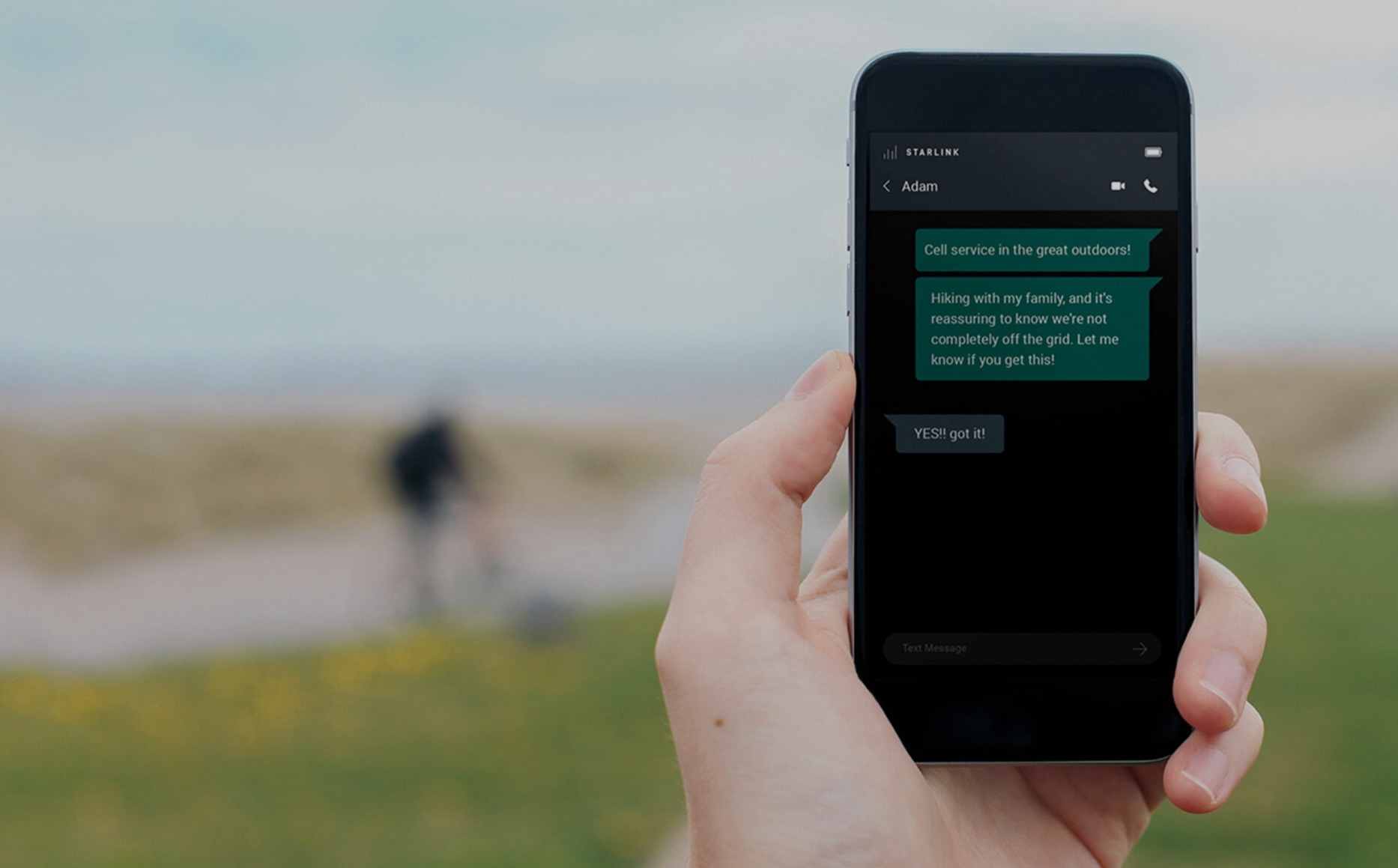
Starlink is now powering Europe’s first commercial satellite-to-smartphone service, as Virgin Media O2 launches a space-based mobile data offering across the UK.
The new O2 Satellite service uses Starlink’s low-Earth orbit network to connect regular smartphones in areas without terrestrial coverage, expanding O2’s reach from 89% to 95% of Britain’s landmass.
Under the rollout, compatible Samsung devices automatically connect to Starlink satellites when users move beyond traditional mobile coverage, according to Reuters.
The service initially supports text messaging along with apps such as WhatsApp, Facebook Messenger, Google Maps and weather tools. O2 is pricing the add-on at £3 per month.
By leveraging Starlink’s satellite infrastructure, O2 can deliver connectivity in remote and rural regions without building additional ground towers. The move represents another step in Starlink’s push beyond fixed broadband and into direct-to-device mobile services.
Virgin Media O2 chief executive Lutz Schuler shared his thoughts about the Starlink partnership. “By launching O2 Satellite, we’ve become the first operator in Europe to launch a space-based mobile data service that, overnight, has brought new mobile coverage to an area around two-thirds the size of Wales for the first time,” he said.
Satellite-based mobile connectivity is gaining traction globally. In the U.S., T-Mobile has launched a similar satellite-to-cell offering. Meanwhile, Vodafone has conducted satellite video call tests through its partnership with AST SpaceMobile last year.
For Starlink, the O2 agreement highlights how its network is increasingly being integrated into national telecom systems, enabling standard smartphones to connect directly to satellites without specialized hardware.
Elon Musk
Elon Musk’s Starbase, TX included in $84.6 million coastal funding round
The funds mark another step in the state’s ongoing beach restoration and resilience efforts along the Gulf Coast.
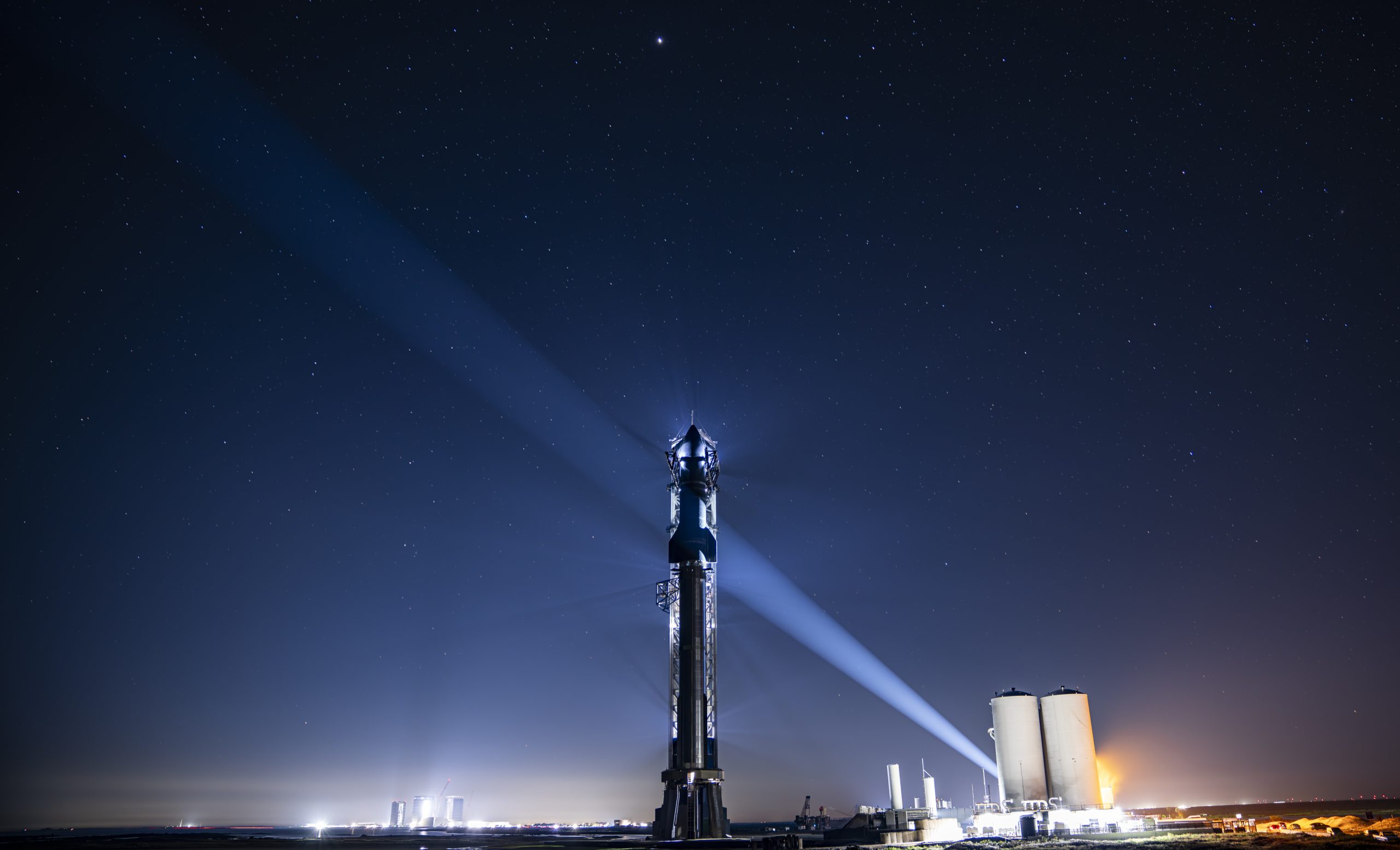
Elon Musk’s Starbase, Texas has been included in an $84.6 million coastal funding round announced by the Texas General Land Office (GLO). The funds mark another step in the state’s ongoing beach restoration and resilience efforts along the Gulf Coast.
Texas Land Commissioner Dawn Buckingham confirmed that 14 coastal counties will receive funding through the Coastal Management Program (CMP) Grant Cycle 31 and Coastal Erosion Planning and Response Act (CEPRA) program Cycle 14. Among the Brownsville-area recipients listed was the City of Starbase, which is home to SpaceX’s Starship factory.
“As someone who spent more than a decade living on the Texas coast, ensuring our communities, wildlife, and their habitats are safe and thriving is of utmost importance. I am honored to bring this much-needed funding to our coastal communities for these beneficial projects,” Commissioner Buckingham said in a press release.
“By dedicating this crucial assistance to these impactful projects, the GLO is ensuring our Texas coast will continue to thrive and remain resilient for generations to come.”
The official Starbase account acknowledged the support in a post on X, writing: “Coastal resilience takes teamwork. We appreciate @TXGLO and Commissioner Dawn Buckingham for their continued support of beach restoration projects in Starbase.”
The funding will support a range of coastal initiatives, including beach nourishment, dune restoration, shoreline stabilization, habitat restoration, and water quality improvements.
CMP projects are backed by funding from the National Oceanic and Atmospheric Administration and the Gulf of Mexico Energy Security Act, alongside local partner matches. CEPRA projects focus specifically on reducing coastal erosion and are funded through allocations from the Texas Legislature, the Texas Hotel Occupancy Tax, and GOMESA.
Checks were presented in Corpus Christi and Brownsville to counties, municipalities, universities, and conservation groups. In addition to Starbase, Brownsville-area recipients included Cameron County, the City of South Padre Island, Willacy County, and the Willacy County Navigation District.

Tesla Megapack powers $1.1B AI data center project in Brazil

Starlink powers Europe’s first satellite-to-phone service with O2 partnership


