Investor's Corner
Tesla ‘Model Q’ gets bold prediction from Deutsche Bank that investors will love
Tesla’s Model Q could be on the way soon, and a new note from Deutsche Bank thinks it will contribute to Q4 deliveries.

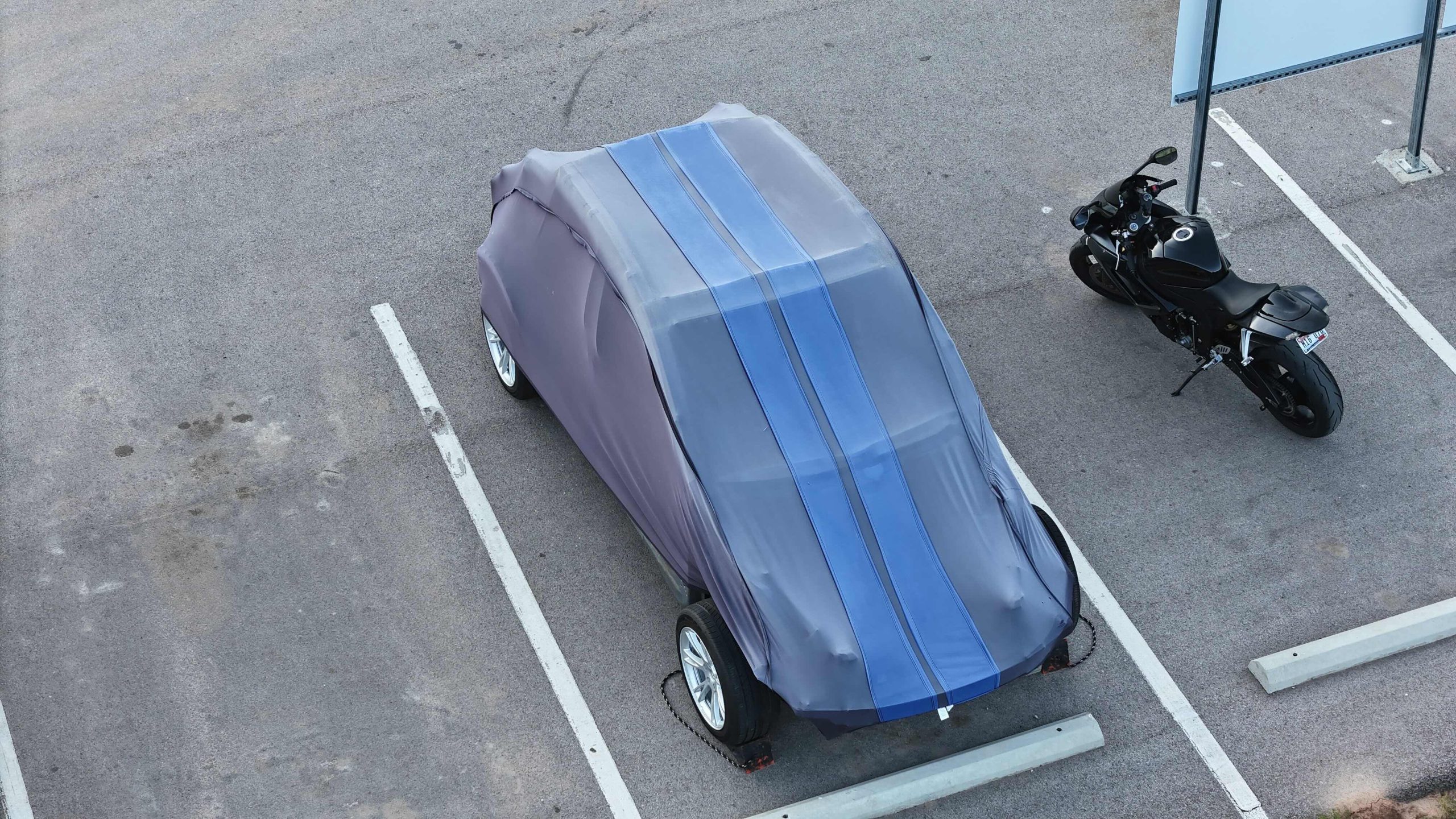
The Tesla “Model Q” has been in the rumor mill for the company for several years, but a recent note from Wall Street firm Deutsche Bank seems to indicate that it could be on its way in the near future.
This comes as Tesla has been indicating for several quarters that its development of affordable models was “on track” for the first half of 2025. The company did not say it would unveil the vehicles in the first half, but many are anticipating that more cost-friendly models could be revealed to the public soon.
Potential affordable Tesla “Model 2/Model Q” test car spotted anew in Giga Texas
The Deutsche Bank note refers to one of the rumored affordable models as the “Model Q,” but we’ve also seen it referred to as the “Model 2,” amongst other names. Tesla has not officially coined any of its upcoming vehicles as such, but these are more of a universally accepted phrase to identify them, at least for now.
The rumors stem from sentiments regarding Tesla’s 2025 delivery projections, which are tempered as the company seeks to maintain a steady pace compared to 2023 and 2024, when it reported 1.8 million deliveries.
Deutsche Bank’s analysts believe the deliveries could be around 1.58 million, but they state this is a cautious stance that could be impacted by several things, including the potential launch of the Model Q, which they believe will make its way to market in Q4:
“Looking at the rest of the year, we maintain a cautious stance on volume calling for 1.58m vehicle deliveries (-12% YoY) vs. consensus +1.62m, with the timing of Model Q rollout as the key swing factor (we now assume only 25k in Q4). In China, Tesla will introduce the Model Y L this fall (6 inch longer wheel base allowing for larger 3-row seating with six seats).”
Interestingly, the same firm also predicted that the Model Q would launch in the first half of the year based on a note that was released in early December 2024.
Those estimations came from a reported meeting that Deutsche Bank had with Tesla late last year, where it said it aimed to launch the Model Q for less than $30,000 and aimed for it to compete with cars like the Volkswagen ID.3 and BYD Dolphin.
Tesla’s Q2 Earnings Call is slated for this Wednesday and could reveal some additional details about the affordable models.


Elon Musk
Tesla FSD in Europe vs. US: It’s not what you think
Tesla FSD is approved in the Netherlands, but the European version differs from what US drivers use.

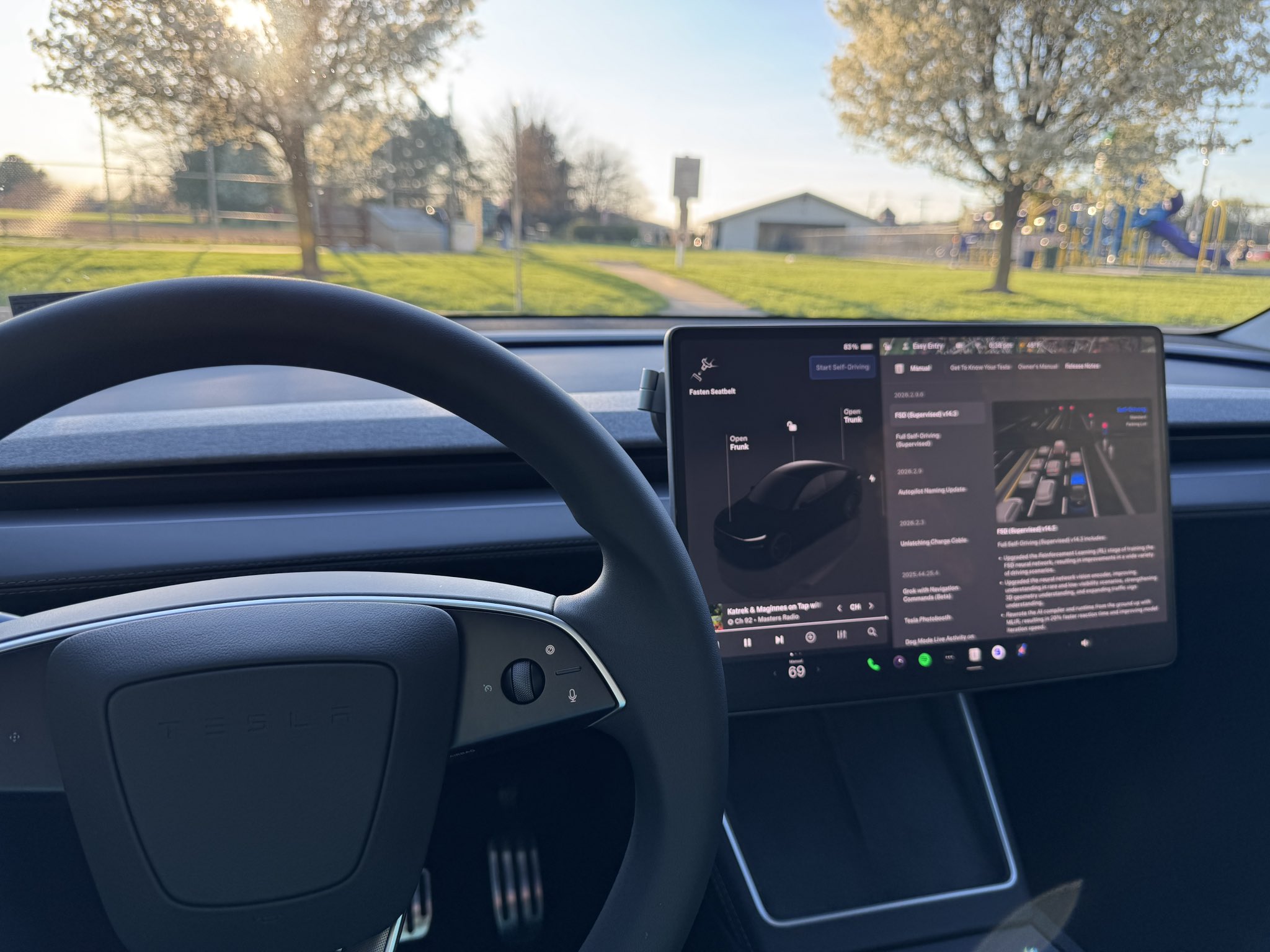
On April 10, 2026, the Dutch vehicle authority RDW granted Tesla the first European type approval for Full Self-Driving Supervised, making the Netherlands the first country on the continent to authorize Tesla’s semi-autonomous system for customer use on public roads.
As Teslarati reported, the RDW approval followed 18 months of testing, more than 1.6 million kilometers driven on EU roads, 13,000 customer ride-alongs, and documentation covering over 400 compliance requirements. Tesla Europe had been running public demo drives through cities like Amsterdam and Eindhoven since early 2026, giving passengers their first experience of the system on European streets.
The European version of FSD is not the same software US drivers use. The RDW’s own statement is direct, noting that the software versions and functionalities in the US and Europe “are therefore not comparable one-to-one.” We’ve compile a table below that captures the most significant differences between US-based Tesla FSD vs. European Tesla FSD that’s based on what regulators and Tesla have publicly confirmed.
| Feature | FSD US | FSD Europe (Netherlands) |
| Regulatory framework | Self-certification, post-market oversight | Pre-market type approval required (UN R-171 + Article 39) |
| Hands requirement | Hands-off permitted on highway | Hands must be available to take over immediately |
| Auto turning from stop lights | Available — navigates intersections, turns, and traffic signals autonomously | Available in EU build — confirmed in Amsterdam demo footage handling unprotected turns and signalized intersections |
| Driving modes | Multiple profiles including a more aggressive “Mad Max” mode | EU build is more conservative by default and errs on the side of restraint when it cannot confirm the limit |
| Summon | Available — Smart Summon navigates parking lots to driver | Status unclear — not confirmed as part of the RDW-approved feature set; urban FSD approval targeted separately for 2027 |
| Driver monitoring | Camera-based eye tracking | Stricter continuous monitoring with more frequent intervention alerts |
| Software version | FSD v14.3 | EU-specific builds that must be separately validated by RDW |
| Geographic restriction | US, Canada, China, Mexico, Australia, NZ, South Korea | Netherlands only; EU-wide vote pending summer 2026 |
| Subscription price | $99/month | €99/month |
| Full urban FSD scope | Available | Partial — separate urban application planned for 2027 |
The approval comes as Tesla is under real pressure to grow FSD subscriptions globally. Musk’s 2025 CEO compensation package, approved by shareholders, includes a milestone requiring 10 million active FSD subscriptions as one condition for his stock awards to vest. Tesla hit one million subscriptions during its Q4 2025 earnings call, which is a meaningful start, but still a long way from the target. Opening Europe as a market for subscriptions, rather than just hardware sales, directly accelerates that number.
Tesla has said it anticipates EU-wide recognition of the Dutch approval during summer 2026, which would extend FSD access to Germany, France, and other major markets through a mutual recognition process without each country repeating the full 18-month review. That timeline is Tesla’s projection, not a confirmed regulatory outcome. As Musk acknowledged at Davos in January 2026, “We hope to get Supervised Full Self-Driving approval in Europe, hopefully next month.”
Elon Musk
Tesla Supercharger for Business exposes jaw-dropping ROI gap between best and worst locations
Tesla’s new Supercharger for Business calculator reveals an eye-opening all-in cost and location-based ROI projections.
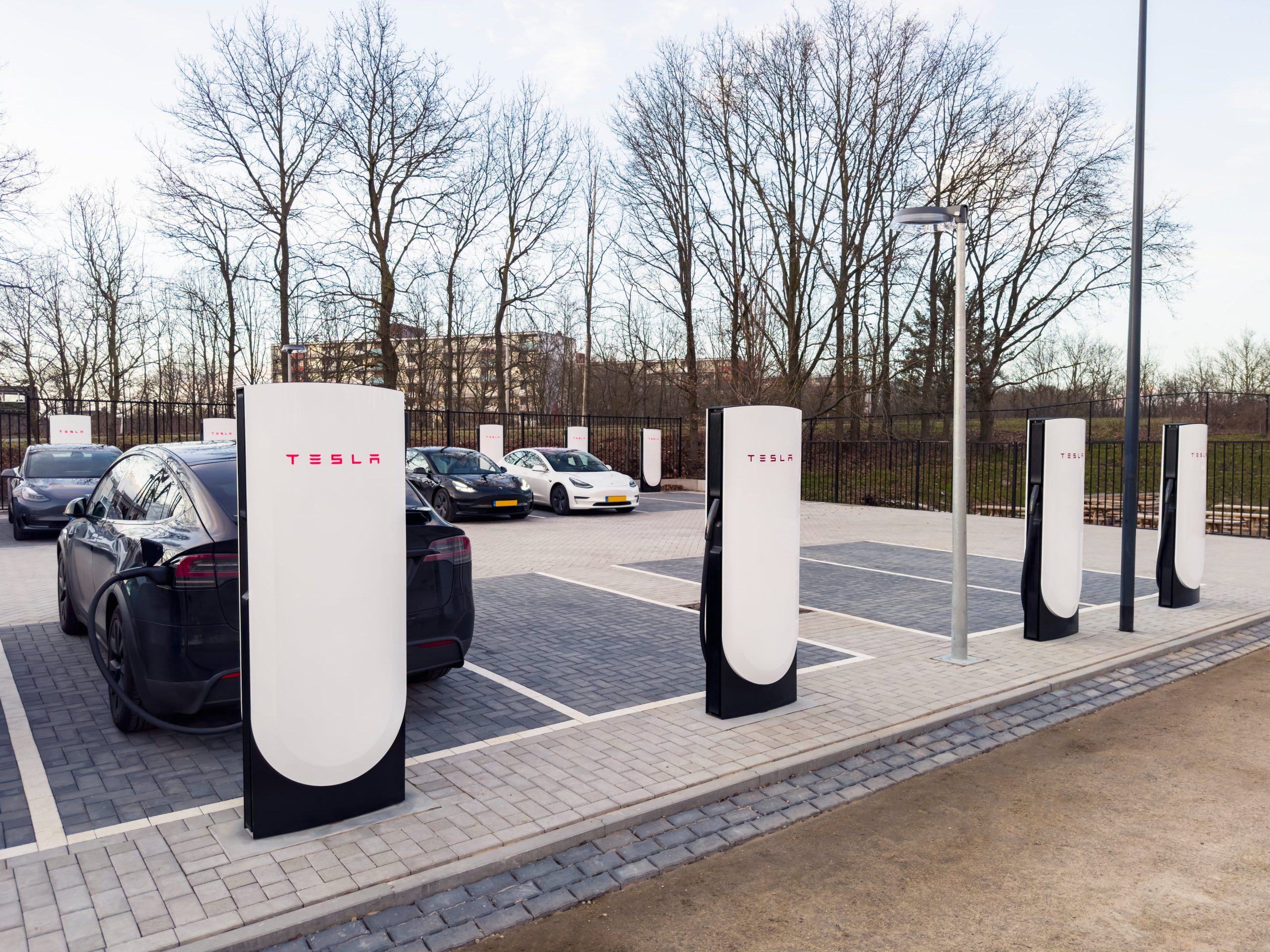
Tesla has launched an online calculator for its Supercharger for Business program, giving property owners their first transparent look at what it really costs to install Superchargers on site and what kind of return they can expect.
The program itself launched in September 2025, allowing businesses to purchase and operate Supercharger hardware on their own property while Tesla handles installation, maintenance, software, and 24/7 driver support. As Teslarati reported at launch, hosts also get their logo placed on the chargers and their location integrated into Tesla’s in-car navigation, meaning drivers are actively routed there. The stalls are open to all EVs, not just Teslas.
We launched Supercharger for Business in 2025 to help companies get charging right. We found simplicity and transparency to be a problem in this industry.
We’re now sharing pricing and a financial calculator to help make informed decisions. The goal is to accelerate investments,…
— Tesla Charging (@TeslaCharging) April 8, 2026
The new online calculator, announced by Tesla on Wednesday with the note that “simplicity and transparency” have been a problem in the industry, lets any business enter a U.S. address and get a real cost and revenue model. A standard 8-stall V4 Supercharger site runs approximately $500,000 in hardware and $55,000 per post for installation, bringing an all-in price just shy of $1 million. Tesla charges a flat $0.10 per kWh fee to cover software, billing, and network operations. Businesses set their own retail price and keep the margin above that fee.
Taking a look at Tesla’s Supercharger for Business online calculator, we can see that ROI is not uniform, and the gap between a strong location and a poor one can stretch the breakeven point by several years.
The biggest driver is foot traffic and how long people stay. A busy rest station, hotel, or outlet mall brings in repeat visitors who need to charge while they’re already stopped, pushing utilization numbers higher and shortening payback time.
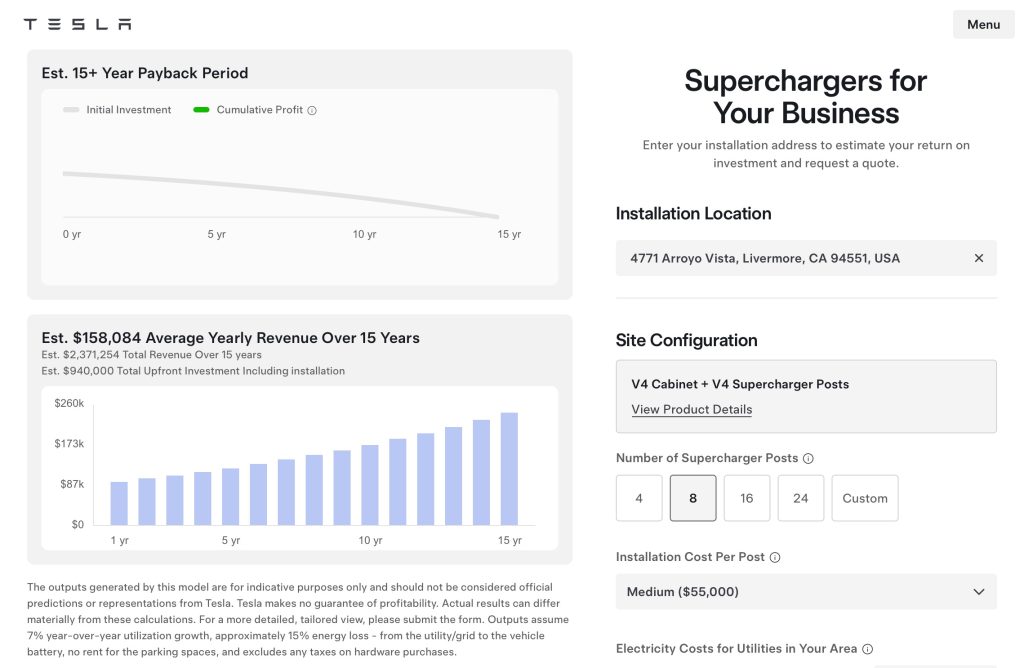
Tesla Supercharger for Business ROI calculator
Local electricity rates matter just as much on the cost side. Markets like California carry some of the highest commercial electricity rates in the country, which eats into the margin between what a host pays per kWh and what they charge drivers. At the same time, dense urban areas with high EV adoption tend to support higher retail charging prices, which can offset that cost if demand is strong enough. Weather also plays a role. Cold climates reduce battery efficiency and increase charging frequency, but they can also suppress utilization in winter months if drivers avoid stopping in exposed outdoor locations. Suburban and rural sites face a different problem: lower baseline EV traffic, which means a site with cheaper power and lower operating costs can still take longer to pay back simply because the stalls sit idle more often. Tesla’s calculator uses real fleet data to pre-fill utilization estimates by ZIP code, so businesses can run their specific address against these variables rather than relying on averages.
The program has seen real adoption. Wawa, already the largest host of Tesla Superchargers with over 2,100 stalls across 223 locations, opened its first fully owned and branded site in Alachua, Florida earlier this year. Francis Energy of Oklahoma and the city of Alpharetta, Georgia have also deployed branded stations through the program, as Teslarati covered in January.
Tesla now exceeds 80,000 Supercharger stalls worldwide, and the calculator makes the economic case for accelerating that number through private investment rather than company-owned sites alone.
Investor's Corner
Tesla stock gets hit with shock move from Wall Street analysts
Despite Tesla not being an automotive company exclusively, the Wall Street firms and analysts covering its shares are widely dialed in on its performance regarding quarterly deliveries. While it holds some importance, Tesla, from an internal perspective, is more focused on end-to-end AI, Robotaxi, self-driving, and its Optimus robot.
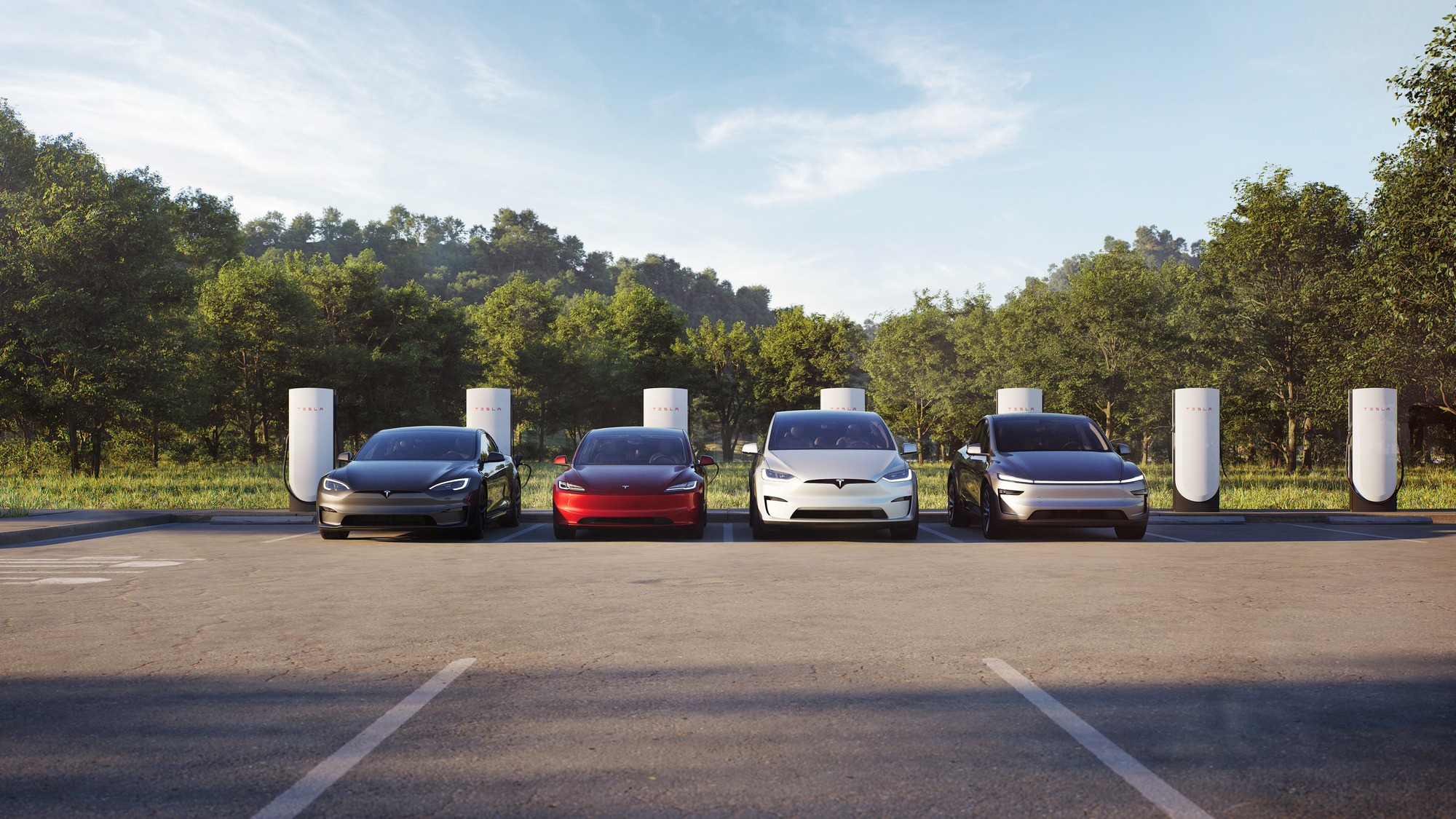
Tesla price targets (NASDAQ: TSLA) have received several cuts over the past few days as Wall Street firms are adjusting their forecast for the company’s stock following a miss in quarterly delivery figures for the first quarter.
Despite Tesla not being an automotive company exclusively, the Wall Street firms and analysts covering its shares are widely dialed in on its performance regarding quarterly deliveries. While it holds some importance, Tesla, from an internal perspective, is more focused on end-to-end AI, Robotaxi, self-driving, and its Optimus robot.
In a notable shift underscoring mounting caution on Wall Street, three prominent investment banks slashed their price targets on Tesla Inc. shares over the past two weeks following the electric-vehicle giant’s disappointing first-quarter 2026 delivery numbers. The revisions highlight softening EV sales figures and, according to some, execution challenges.
Tesla delivered 358,023 vehicles in the January-to-March period, a 14 percent sequential decline and a miss versus consensus forecasts of roughly 365,000 to 370,000 units.
Production hit 408,000 vehicles, yet the delivery shortfall, paired with limited updates on autonomous-driving progress and new-model timelines, rattled investors. Shares fell about 8.7 percent since April 1.
Wall Street analysts are now adjusting their forecasts accordingly, as several firms have made adjustments to price targets.
Goldman Sachs
Goldman Sachs cut its target from $405 to $375 while maintaining a Hold rating. Analyst Mark Delaney pointed to soft EV sales trends and margin pressures.
Truist Financial followed on April 2, lowering its target from $438 to $400 (Hold unchanged), with analyst William Stein citing misses in both auto deliveries and energy-storage deployments, plus a lack of fresh details on AI initiatives and upcoming vehicles.
It is a strange drop if using AI initiatives and upcoming vehicles as a justification is the primary focus here. Tesla has one of the most optimistic outlooks in terms of AI, and CEO Elon Musk recently hinted that the company is developing something for the U.S. market that will be good for families.
Baird
Baird’s Ben Kallo made a very modest trim, reducing its target from $548 to $538, keeping and maintaining the ‘Outperform’ rating it holds on shares. Kallo said the price target adjustment was a prudent recalibration tied to near-term risks.
Truist
Truist analyst William Stein pointed to deliveries and energy storage missing expectations, and cut his price target to $400 from $438. He maintained the ‘Hold’ rating the firm held on the stock previously.
JPMorgan
Adding to the bearish tone on Monday, April 6, JPMorgan’s Ryan Brinkman reiterated an Underweight (Sell) rating and $145 price target, implying roughly 60 percent downside from recent levels.
Brinkman highlighted a “record surge in unsold vehicles” that adds to free-cash-flow woes, with inventory swelling to an estimated 164,000 units.
Tesla’s comfort level taking risks makes the stock a ‘must own,’ firm says
He lowered his Q1 2026 EPS estimate to $0.30 from $0.43 and full-year 2026 EPS to $1.80 from $2.00, both below consensus. Brinkman noted that expectations for Tesla’s performance have “collapsed” across financial and operating metrics through the end of the decade, yet the stock has risen 50 percent, and average price targets have increased 32 percent.
This disconnect, he argued, prices in an unrealistic sharp pivot to stronger results beyond the decade, while near-term realities remain materially weaker.
He advised investors to approach TSLA shares with a “high degree of caution,” citing elevated execution risk, competition, and valuation concerns in lower-price, higher-volume segments.
The revisions have pulled the overall consensus lower. Aggregators show the average 12-month price target now ranging from approximately $394 to $416 across roughly 32 analysts, with a prevailing Hold rating and a mixed split of Buy, Hold, and Sell recommendations.
Brinkman’s $145 target stands as a notable outlier on the bearish side.
Not Everyone Has Turned Bearish on Tesla Shares
Not all firms turned more pessimistic. Wedbush Securities held its bullish $600 target, stressing that AI and full self-driving technology represent the core value drivers, with current delivery softness viewed as temporary.
These moves reflect a broader Wall Street recalibration: near-term EV demand faces pressure from high interest rates, intensifying competition, especially from lower-cost Chinese rivals, and slower adoption.
At the same time, many analysts continue to see Tesla’s technology leadership in software-defined vehicles, autonomy, robotaxis, and energy storage as pathways to outsized long-term gains once macro conditions ease and new models launch.
With Tesla’s first-quarter earnings report due later this month, upcoming details on cost discipline, Cybertruck ramp-up, and AI roadmaps will likely shape whether these target adjustments prove prescient or overly cautious. Investors remain divided between immediate delivery realities and the company’s ambitious vision.
Tesla shares are trading at $348.82 at the time of publishing.

Tesla launches 200mph Model S “Gold” Signature in invite-only purchase

Tesla FSD in Europe vs. US: It’s not what you think


