Lifestyle
S in the City: Model S Owner Experience in the Big City

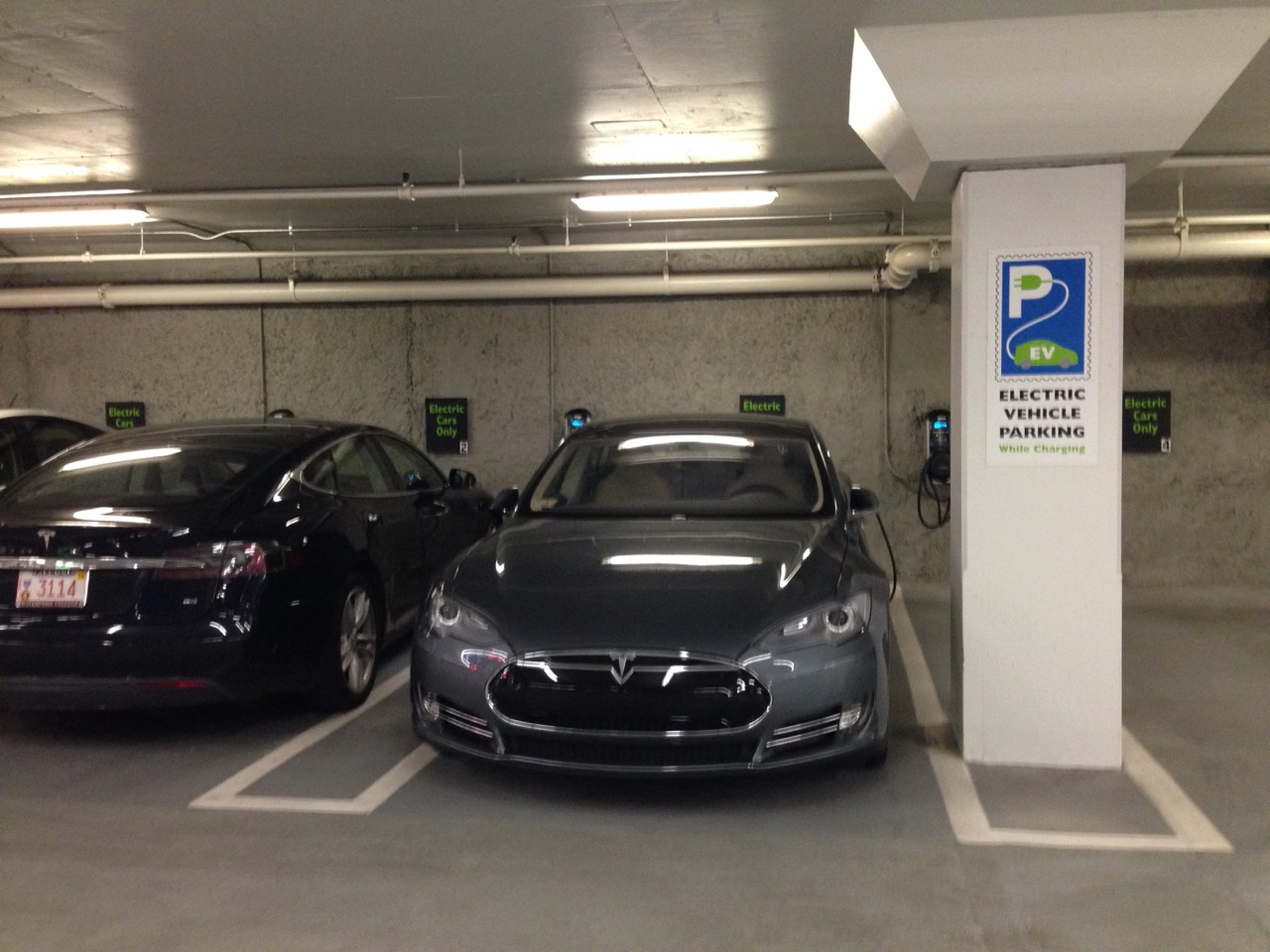
Whether you live or work in the city, or drive in for entertainment, there are notable nuances with driving a Tesla Model S into a busy metropolitan area. Finding parking, navigating tight streets, locating public charging stations and learning etiquettes with charging overnight are areas that I’m quickly adjusting to.
Driving into the City
 I drive my Model S as much as humanly possible and under most circumstances. Whether it’s taking long road trips or navigating through narrow city streets, there hasn’t been many situation which I’ve shied away from. Driving into the city (Boston) for dinner was no different.
Since I didn’t know the city streets very well, I posted to the local New England forum on TMC and asked for help. TMC is a great resource for Tesla owners that are looking for advice from other Tesla owners. My quest to find a “Tesla owner approved” local parking spot directed me to a garage not too far from the restaurant – Boston’s Post Office Square.
Parking was tight, as expected, but I managed to find comfort knowing that I parked next to another Model S owner. I plugged the car into a ChargePoint unit, went off to my long dinner and came back to an extra 60 miles of range. Best of all this was all free since Massachusetts law prohibits re-sale of electricity.
I didn’t need the extra 60 miles of extra range to get home, but because there were several open EV spots available, I didn’t feel as bad using one for a longer duration of time. It’s important to note that this wouldn’t be the case during the day when charging stalls are a more sought after commodity. Keep this in mind and don’t occupy an EV charging stall when there’s only one available and you’re not in need of a charge.
Overnight in the City
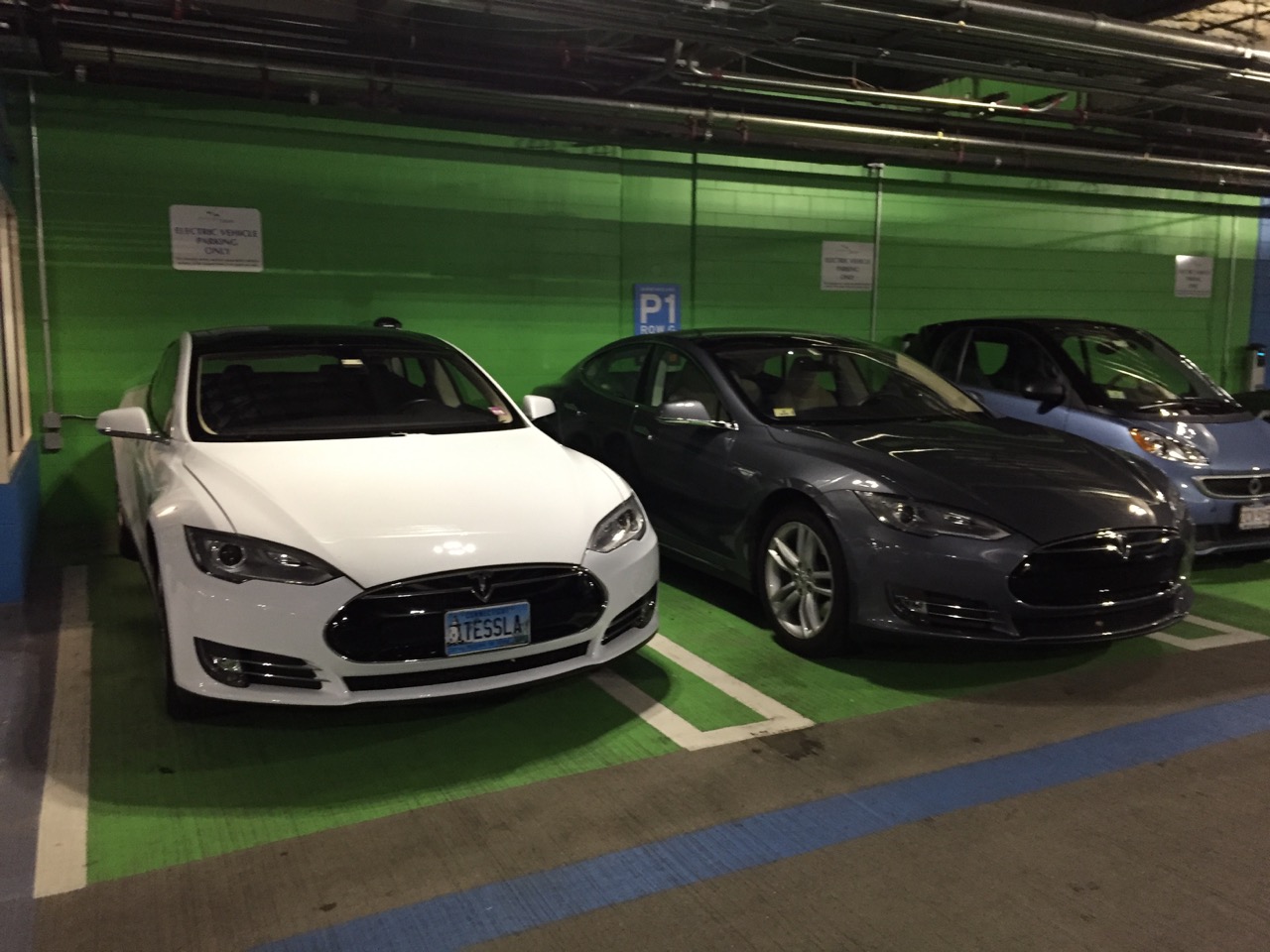 My second experience with the Model S in the city came by way of a conference held at the Boston Seaport Hotel. The conference required me to stay overnight so I did my own research via Plugshare and found a charging location with five J1772 chargers. It turned out there were only three Chargepoint systems installed for the five EV parking spots. Parking was extremely tight but I was able to take my time, as there was no other cars around, and get the Model S placed perfectly into the parking spot.
I couldn’t help but wonder why there were three ChargePoint systems but five EV specific parking spaces. The ChargePoint system claimed to have two chargers on each post. There was clearly a J1772 plug on each of the systems but they were all in use.
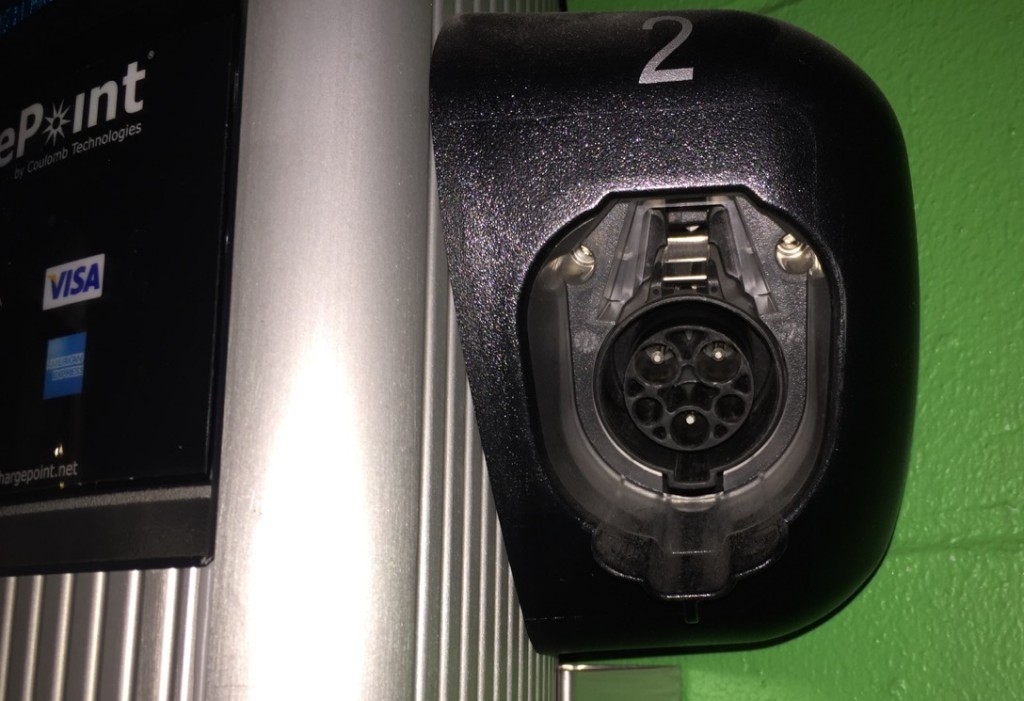
Upon further inspection I could see a label for “Charger #2” but unfortunately I had no adapter that would work for it. I later realized that this was just the receiving end for the J1772 plug and meant to be a holder for the plug. I poked around a bit more and swiped my ChargePoint card on the scanner for “Charger #1”. A secret door popped open and provided a standard NEMA 5-15 outlet (standard US wall charger).
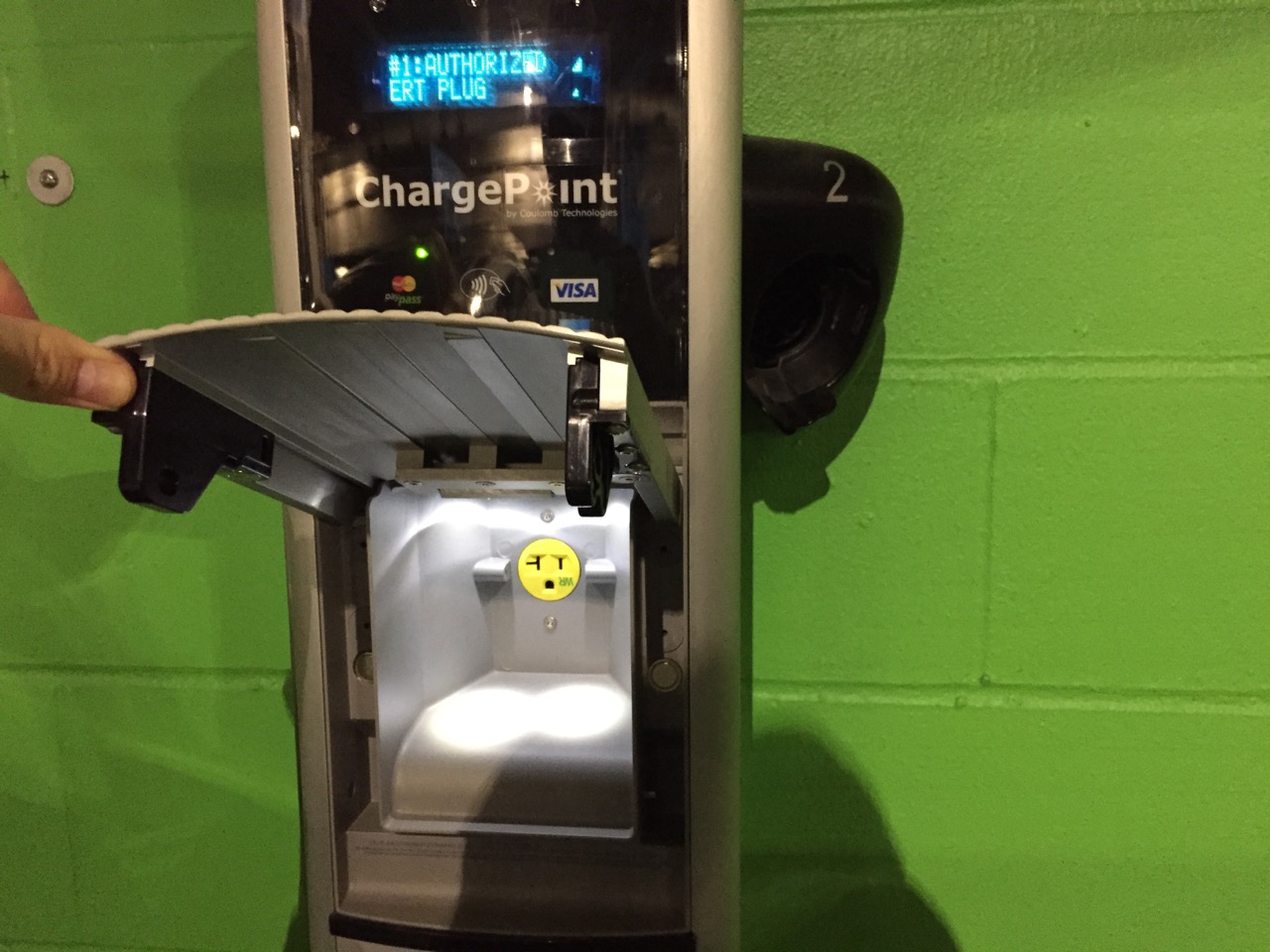
Fortunately I came prepared with an extra UMC. I didn’t have much of a choice with my charging options so I decided to plug into the very slow charging NEMA 5-15 and leave it overnight. I’m not quite sure why ChargePoint decided to name the higher power charging solution “Charger #2”, or why the NEMA 5-15 is hidden, but having a sticker or signage explaining these details could go a long way.
Lessons Learned
Driving into the city with a Model S comes with a few lessons learned as follows:
- ChargePoint seems to be the prevailing charging network provider (at least for much of Boston).
- Charging can be free depending on local laws governing re-sale of electricity.
- EV parking spaces are generally placed at very premium locations and reside on the floor your entering the parking garage from.
- City parking spots are tight to begin with so the additional size and width of the Model S makes it even more difficult to maneuver. Be careful when parking!
- City parking structures are usually underground so cell phone service is generally inaccessible. Don’t rely on keyless entry when parking in the city.
Do you have your own strategy when taking the Model S into the city? I’d love to hear it in the comments below.


Lifestyle
Tesla hit by Iranian missile debris in Israel
A Tesla in Israel absorbed a direct hit from missile debris, and the glassroof held.

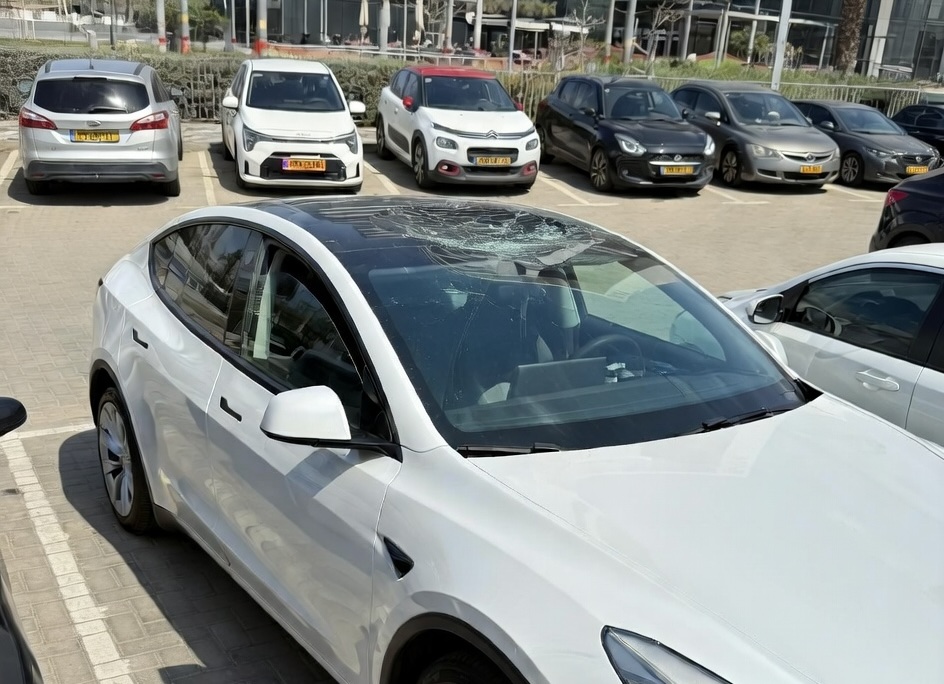
On March 30, 2026, Lara Shusterman was in Netanya, Israel when Iranian ballistic missiles triggered air raid sirens across the city. While she remained in safety, her 2024 Tesla Model Y did not escape untouched. A heavy piece of missile debris struck the car’s massive glass roof, leaving a deep crater but without shattering. In a Facebook post to the Tesla Israel community the following morning, Shusterman described what happened: “The glass did not shatter into dangerous shards. She stopped the damage and pushed the metal part to the ground.” She closed by thanking Elon Musk and the Tesla team for building what she called “security and a sense of trust even in extreme situations.”
Netanya is a coastal city in central Israel, roughly 18 miles north of Tel Aviv and has been among the areas most frequently struck during Iran’s ongoing missile campaign, following coordinated U.S. and Israeli strikes on Iranian military infrastructure. Falling shrapnel from intercepted missiles is a common occurrence.
-
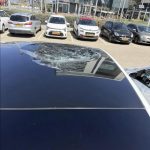
- Tesla Model Y glass roof shattered from a piece of falling Iranian missile debris
-
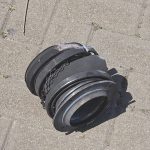
- A piece of Iranian missile debris that struck Lara Shusterman’s Tesla Model Y in Netanya, Israel on March 30, 2026, after being intercepted by Israeli air defenses.
-
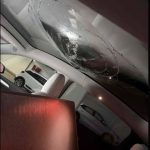
- Tesla Model Y glass roof shattered from a piece of falling Iranian missile debris
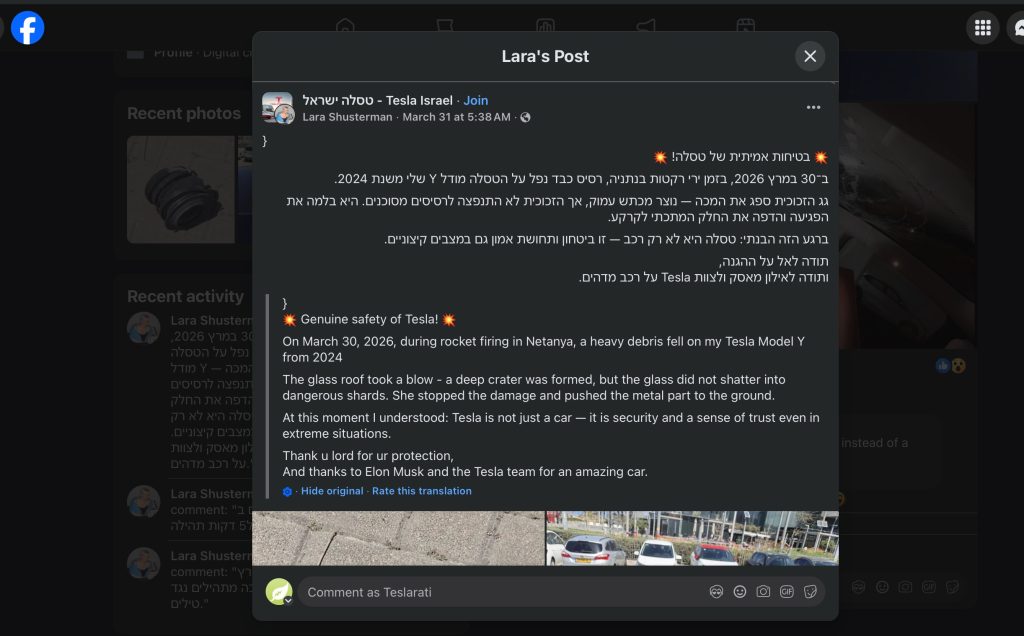
Source: Tesla Israel Facebook Group
The incident is a testament to Tesla’s structural engineering. Tesla’s glass roof is designed to support over four times the vehicle’s own weight. That strength has shown up in real-world accidents too. In 2021, a Model Y in California was struck by a falling tree during a storm, with the glass roof holding firm and the cabin remaining intact. In another widely reported incident, a Tesla Model Y plunged 250 feet off the cliff at Devil’s Slide in California in January 2023, with all four occupants, including two young children, surviving.
Disturbing details about Tesla’s 250-foot cliff drop emerge amid initial investigation
Tesla officially launched sales in Israel in early 2021 and captured over 60 percent of Israel’s EV market in the first year. The brand’s foothold in Israel remains significant. Tens of thousands of Teslas are now on Israeli roads, making incidents like Shusterman’s easy to corroborate. On the same week her Model Y took the hit, the U.S. Space Force awarded SpaceX a $178.5 million contract to launch missile tracking satellites, a separate but fitting reminder of how intertwined the Musk ecosystem has become with the realities of modern conflict.
Elon Musk
NASA sends humans to the Moon for the first time since 1972 – Here’s what’s next
NASA’s Artemis II launched four astronauts toward the Moon on the first crewed lunar mission since 1972.
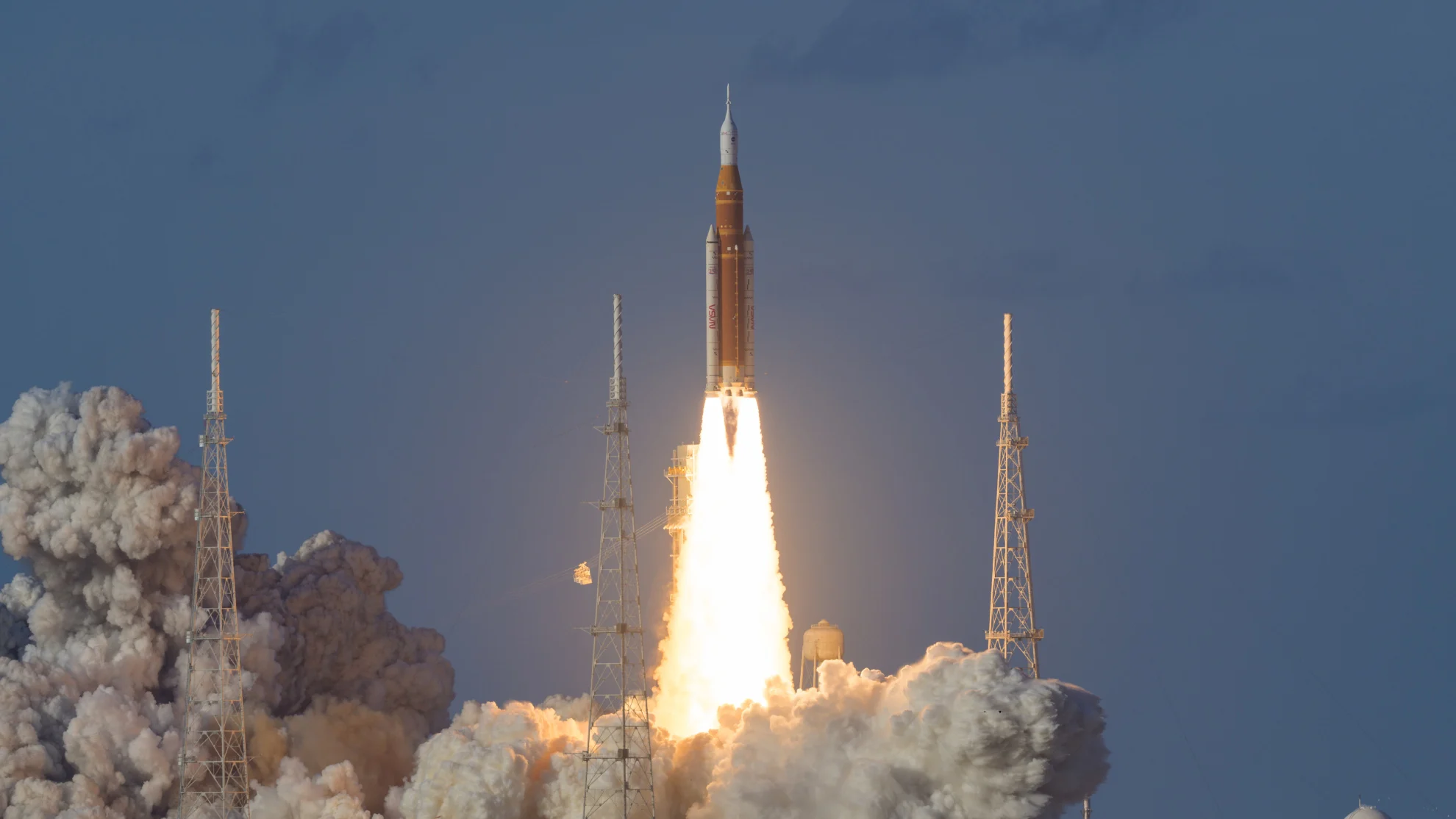
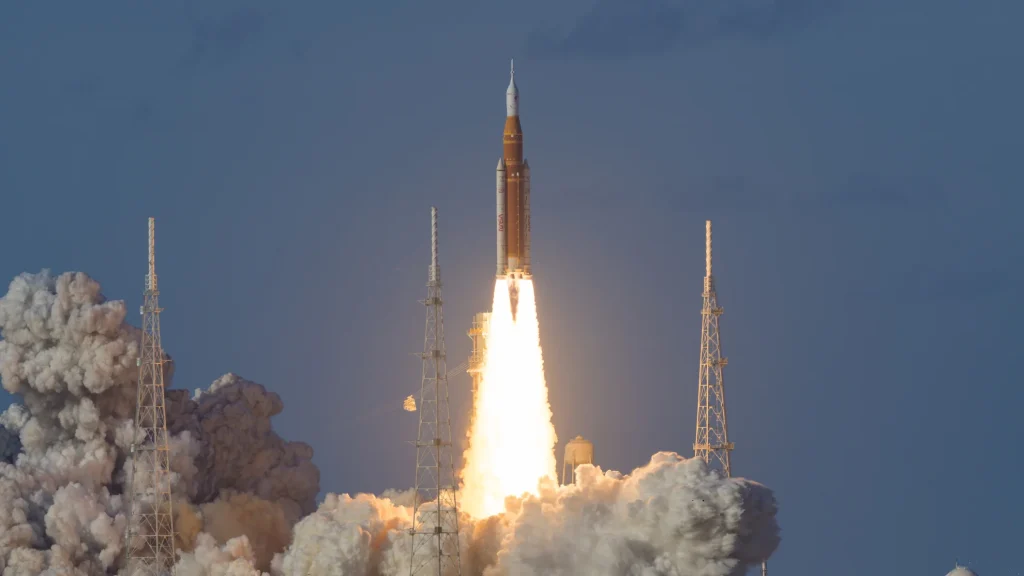
NASA’s Space Launch System rocket launches carrying the Orion spacecraft with NASA astronauts Reid Wiseman, commander; Victor Glover, pilot; Christina Koch, mission specialist; and CSA (Canadian Space Agency) astronaut Jeremy Hansen, mission specialist on NASA’s Artemis II mission, Wednesday, April 1, 2026, from Operations and Support Building II at NASA’s Kennedy Space Center in Florida. NASA’s Artemis II mission will take Wiseman, Glover, Koch, and Hansen on a 10-day journey around the Moon and back aboard SLS rocket and Orion spacecraft launched at 6:35pm EDT from Launch Complex 39B. (NASA/Bill Ingalls)
NASA launched four astronauts toward the Moon on April 1, 2026, marking the first crewed lunar mission since Apollo 17 in December 1972. The Artemis II mission lifted off from Kennedy Space Center aboard the Space Launch System rocket at 6:35 p.m. EDT, sending commander Reid Wiseman, pilot Victor Glover, mission specialist Christina Koch, and Canadian astronaut Jeremy Hansen on a 10-day journey around the far side of the Moon and back.
The mission does not include a lunar landing. It is a test flight designed to validate the Orion spacecraft’s life support systems, navigation, and communications in deep space with a crew aboard for the first time. If the crew reaches the planned distance of 252,000 miles from Earth, they will set a new record for the farthest any human has ever traveled, surpassing even the Apollo 13 distance record.
As Teslarati reported, SpaceX holds a central role in what comes next. The Starship Human Landing System is under contract to carry astronauts to the lunar surface for Artemis IV, now targeting 2028, after NASA restructured its mission sequence due to delays in Starship’s orbital refueling demonstration. Before any Moon landing happens, SpaceX must prove it can transfer propellant between two Starships in orbit, something no rocket program has done at this scale.
The last time humans left Earth’s orbit was 53 years ago. Gene Cernan and Harrison Schmitt of Apollo 17 were the final people to walk on the Moon, a record that stands to this day. Elon Musk has long argued that returning is not optional. “It’s been now almost half a century since humans were last on the Moon,” Musk said. “That’s too long, we need to get back there and have a permanent base on the Moon.”
The Artemis program involves 60 countries signed onto the Artemis Accords, and this mission sets several firsts beyond distance. Glover becomes the first person of color to travel beyond low Earth orbit, Koch the first woman, and Hansen the first non-American astronaut to reach the Moon’s vicinity. According to NASA’s live mission updates, the spacecraft’s solar arrays deployed successfully after liftoff and the crew completed a proximity operations demonstration within the first hours of flight.
Artemis II is step one. The Moon landing and the permanent lunar base come later. But after more than five decades, humans are heading back.
Elon Musk
Tesla Optimus Gen 3 is coming to the Tesla Diner with new ambitions
Tesla’s Optimus robot left the Hollywood Diner within months of opening. Now Musk is planning its return with a bigger role and a major Gen 3 upgrade underway.
![Tesla Optimus Gen 3 [Credit: Tesla]](https://www.teslarati.com/wp-content/uploads/2026/03/tesla-optimus-gen3-diner.jpg)
Tesla’s Optimus robot was one of the most talked-about features when the Tesla Diner opened on Santa Monica Boulevard in Hollywood on July 21, 2025. Dubbed “Poptimus” by Tesla fans, the Gen 2 robot stood upstairs at the retro-futuristic, drive-in theater and Tesla Supercharging station, scooping popcorn into bags and handing them to guests with a wave.
The diner itself had been years in the making. Elon Musk first floated the idea in 2018 with a tweet about building an “old-school drive-in, roller skates & rock restaurant” at a Hollywood Supercharger. What eventually opened was a unique two-story neon-lit space, with 80 EV charging stalls, and Optimus serving as a live demonstration of where Tesla’s ambitions were headed.
If our retro-futuristic diner turns out well, which I think it will, @Tesla will establish these in major cities around the world, as well as at Supercharger sites on long distance routes.
An island of good food, good vibes & entertainment, all while Supercharging! https://t.co/zmbv6GfqKf
— Elon Musk (@elonmusk) July 21, 2025
But Optimus did not stay long, and was gone by December 2025.
Now, the robot is set to return with a more demanding job. Musk has ambitions for Optimus to take on a food runner role in 2026, delivering meals directly to cars at the Supercharger stalls. While the latest Gen 3 Optimus is likely to initially take on its previous popcorn-serving role, it wouldn’t be out of the question for Optimus to see a quick promotion. With improved hand dexterity that features 50 total actuators and 22 degrees of freedom per hand, and significantly more powerful processing through Tesla’s latest AI5 chip that includes Grok-powered voice interaction, Musk described Optimus at the Abundance Summit on March 12, 2026, as “by far the most advanced robot in the world, Nothing’s even close.”
Back to work
See you at Tesla Diner tomorrow pic.twitter.com/H3tTajrUbu
— Tesla Optimus (@Tesla_Optimus) March 30, 2026
That confidence is backed by a major manufacturing shift. At the Q4 2025 earnings call in January, Musk announced Tesla would discontinue the Model S and Model X and convert those Fremont production lines to build Optimus. “It’s time to basically bring the Model S and X programs to an end,” he said, calling for a pivot that reflects where the Tesla’s future lies.

Tesla hits FSD hackers with surprise move

Tesla developing small, affordable SUV, report claims


