Lifestyle
Top 5 Tips to Maintaining EV Battery Life

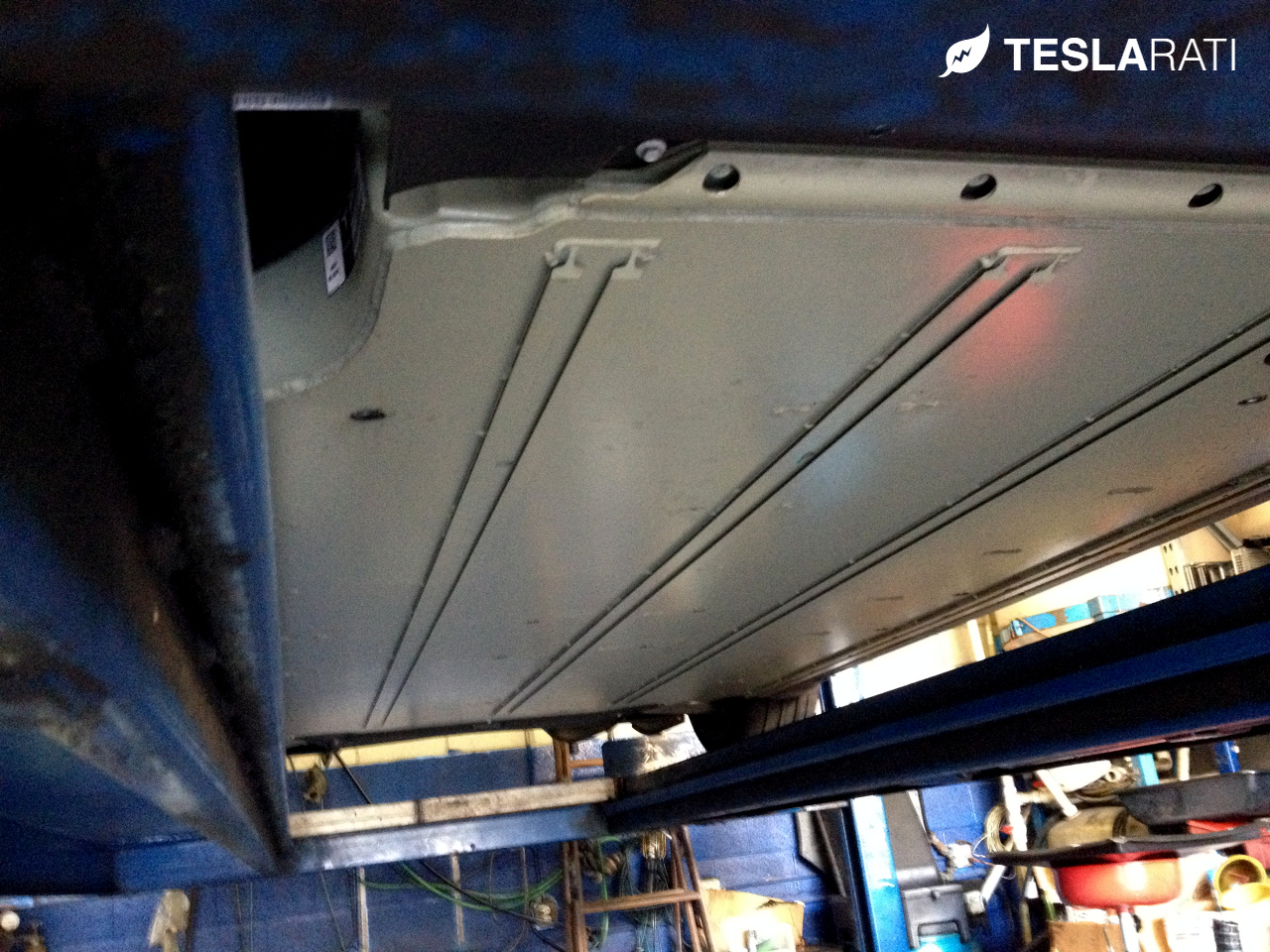
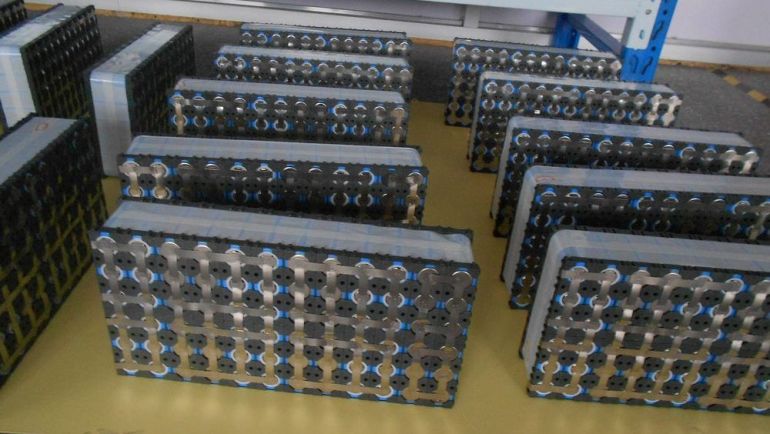 Electric vehicles are a joy to own but this new technology using advanced Lithium-ion battery packs requires a different type of maintenance than your traditional gasoline engine.
We countdown the top 5 maintenance steps that can be taken to extend the life of your EV battery.
5. Don’t leave your battery sit at a 100% state of charge
Most EVs have an option for a “Standard” charge or a “Range” or “Max” charge. By all means, do the maximum charge when you need it, but do it right before you start using the battery for the trip. Most EVs have charge timers to help you plan for this. If your EV doesn’t have that, do an overnight standard charge and then charge the last 10-20% in the AM before departure. Leaving a battery pack at max charge for even relatively short periods of time can possibly affect its life. As a rule of thumb, try to never let your battery sit at maximum state of charge for longer than 8 hours.
While you may be able to time your max charge and departure times well, daily charging to 100% is stressful to your battery. This is why most vendors offer “standard” or “normal” charge levels which wont help you achieve the maximum EPA range rated for your vehicle. If you don’t need the max charge, then don’t use it. Generally lithium-ion batteries do best when they operate in the 30% to 90% range for state of charge. Although a bit extreme, prolonging the time spent above or below that range theoretically may lead to a shorter pack life
Tesla Model S TIP: For overnight charging that requires a 100% MAX charge (ie prior to a Tesla road trip), set your “start charge time” to a time that will result in a full charge roughly 60 minutes before your departure.
4. Avoid deep discharging of the battery pack
Conversely, leaving your battery in a discharged state for an extended period may also impact its life. Most vendors protect batteries from becoming completely discharged as that can effectively “brick” the battery and leave it completely useless. The general rule of thumb is to plug in and charge whenever you can. That doesn’t mean going out of your way for a few kW of charge, but it does mean plugging your car in nightly and maintaining a reasonable charge level. What is a low state of charge? Under 30% charge is generally considered low and thus you should not let your EV sit at that low state of charge for an extended period.
MUST SEE: Decoding Your Tesla Battery Pack Version
Also beware that EVs consume power even when not being driven. With the Model S, it loses about 1% of its charge per day.
3. Be mindful of extreme temperature conditions
This is less applicable to the Tesla Model S which has its own built in thermal management system that pre-conditions the battery (ie. warms the pack when too cold and vice versa), but the general rule of thumb for batteries of Lithium-ion composition is to keep the battery pack between 20F – 85F.
Heat is the enemy of Lithium-ion and may increase battery degradation when consistently exposed to high temperatures. This phenomenon was enough to motivate Nissan to produce a “hot climate battery” for their LEAF after owners within hotter climates complained of battery loss.
Conversely, extreme cold weather can impact performance for a battery of lithium-ion chemistry while lowering the discharge capacity.
2. Plan ahead for extended storage
If you’re going away on vacation or for a business trip the best thing for your car is to set the charge level to 50% and leave it plugged in. If you’re leaving your EV at the airport or somewhere where you can’t leave it plugged in beware that you’re going to lose some charge per day. Charge to a level where you can get to the airport, let it sit for the trip and then still have enough charge with buffer to get home. Don’t let it sit unplugged at an airport for days on end at a 90% charge state if possible. Still, leaving it at 90% is better for the battery (and you) than leaving it at 10% and coming back to find the battery completely discharged.
1. Periodically fully charge and “balance” your battery
Lithium-ion batteries are designed to minimize the “memory” issues often found in older battery technologies, however the battery packs in EVs are more complex and often comprised of multiple individual batteries packed together into removable modules. There’s as many as 7,000 individual cells in the Model S.
Battery balancing is about maximizing your battery’s capacity and evening out the charge distribution. Modern EV battery packs include an automatic battery balancing component, but there’s steps that you can take to help the process along.
While you may never need the maximum range that your battery can provide and you may never take long trips, a periodic range or max charge is helpful to your battery’s management system. I’d suggest doing this about once every 3 months or so and keep in mind that after you fully charge you should not let it sit, that would be a violation of battery management rule #5.
Disclaimer: We’re dealing with expensive components. Read the manual for your EV, search your EV forums, develop your own rules, be consistent, but adjust as needed. The rules above are general rules for any EV that may help extend the life and health of your battery. Your own mileage (range!) may vary.


Lifestyle
Tesla hit by Iranian missile debris in Israel
A Tesla in Israel absorbed a direct hit from missile debris, and the glassroof held.

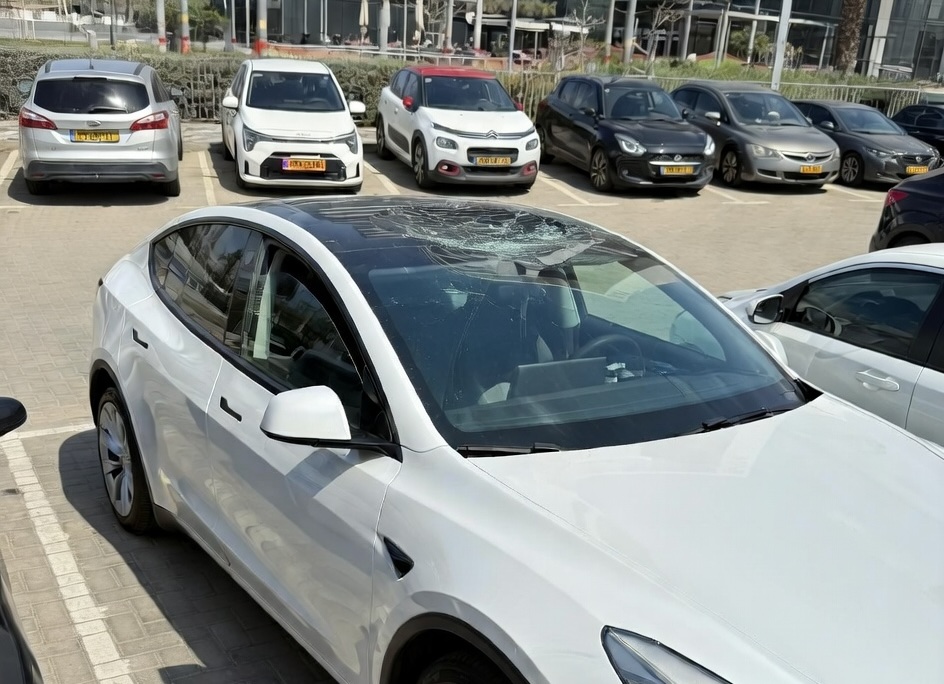
On March 30, 2026, Lara Shusterman was in Netanya, Israel when Iranian ballistic missiles triggered air raid sirens across the city. While she remained in safety, her 2024 Tesla Model Y did not escape untouched. A heavy piece of missile debris struck the car’s massive glass roof, leaving a deep crater but without shattering. In a Facebook post to the Tesla Israel community the following morning, Shusterman described what happened: “The glass did not shatter into dangerous shards. She stopped the damage and pushed the metal part to the ground.” She closed by thanking Elon Musk and the Tesla team for building what she called “security and a sense of trust even in extreme situations.”
Netanya is a coastal city in central Israel, roughly 18 miles north of Tel Aviv and has been among the areas most frequently struck during Iran’s ongoing missile campaign, following coordinated U.S. and Israeli strikes on Iranian military infrastructure. Falling shrapnel from intercepted missiles is a common occurrence.
-
- Tesla Model Y glass roof shattered from a piece of falling Iranian missile debris
-

- A piece of Iranian missile debris that struck Lara Shusterman’s Tesla Model Y in Netanya, Israel on March 30, 2026, after being intercepted by Israeli air defenses.
-
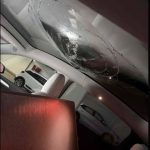
- Tesla Model Y glass roof shattered from a piece of falling Iranian missile debris
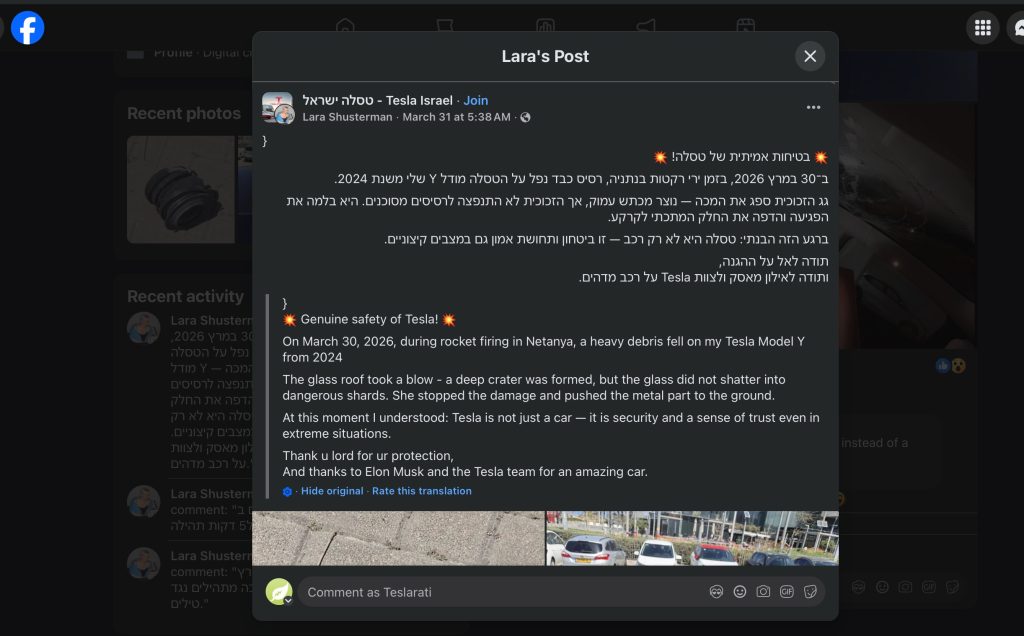
Source: Tesla Israel Facebook Group
The incident is a testament to Tesla’s structural engineering. Tesla’s glass roof is designed to support over four times the vehicle’s own weight. That strength has shown up in real-world accidents too. In 2021, a Model Y in California was struck by a falling tree during a storm, with the glass roof holding firm and the cabin remaining intact. In another widely reported incident, a Tesla Model Y plunged 250 feet off the cliff at Devil’s Slide in California in January 2023, with all four occupants, including two young children, surviving.
Disturbing details about Tesla’s 250-foot cliff drop emerge amid initial investigation
Tesla officially launched sales in Israel in early 2021 and captured over 60 percent of Israel’s EV market in the first year. The brand’s foothold in Israel remains significant. Tens of thousands of Teslas are now on Israeli roads, making incidents like Shusterman’s easy to corroborate. On the same week her Model Y took the hit, the U.S. Space Force awarded SpaceX a $178.5 million contract to launch missile tracking satellites, a separate but fitting reminder of how intertwined the Musk ecosystem has become with the realities of modern conflict.
Elon Musk
NASA sends humans to the Moon for the first time since 1972 – Here’s what’s next
NASA’s Artemis II launched four astronauts toward the Moon on the first crewed lunar mission since 1972.
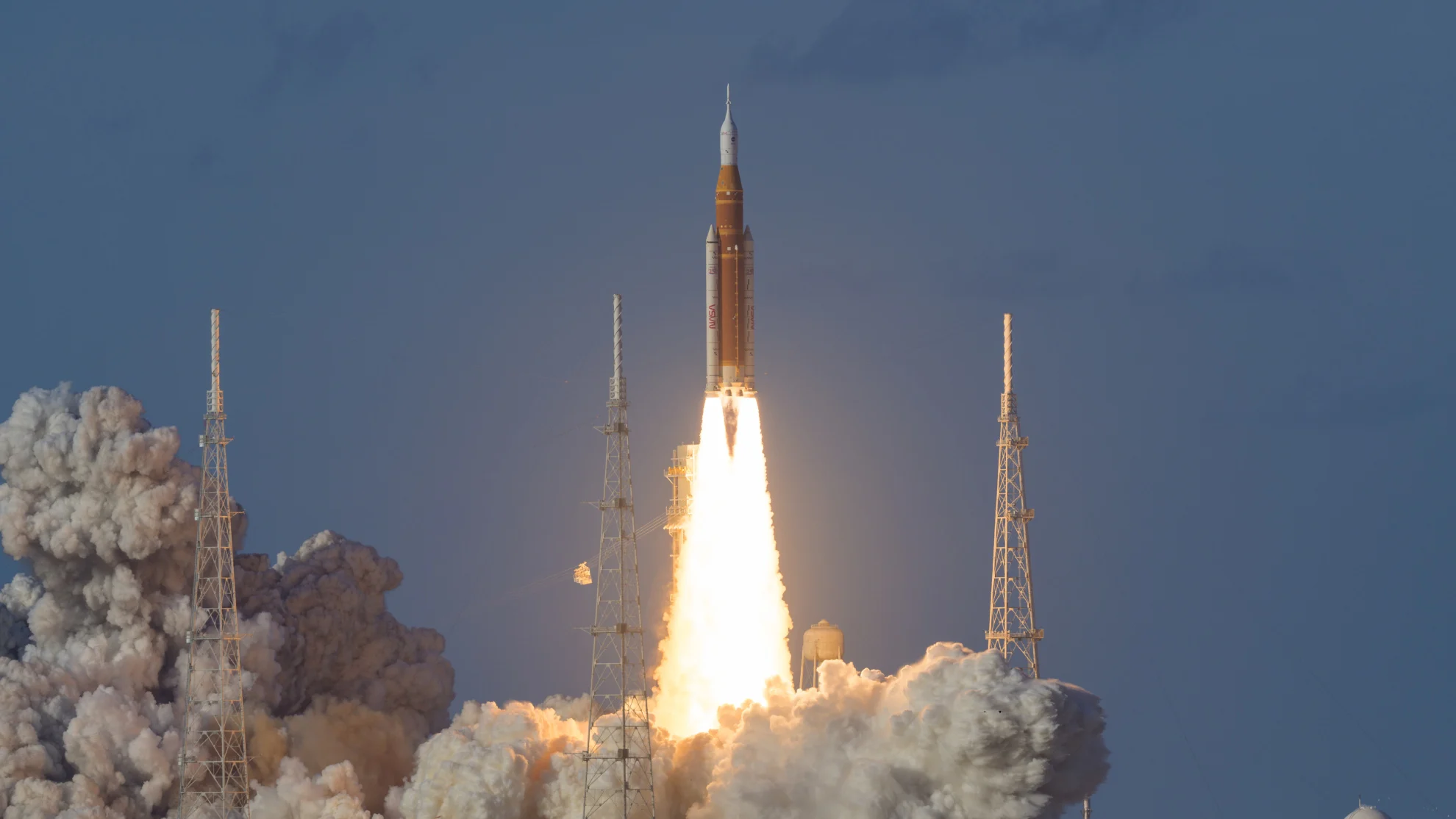
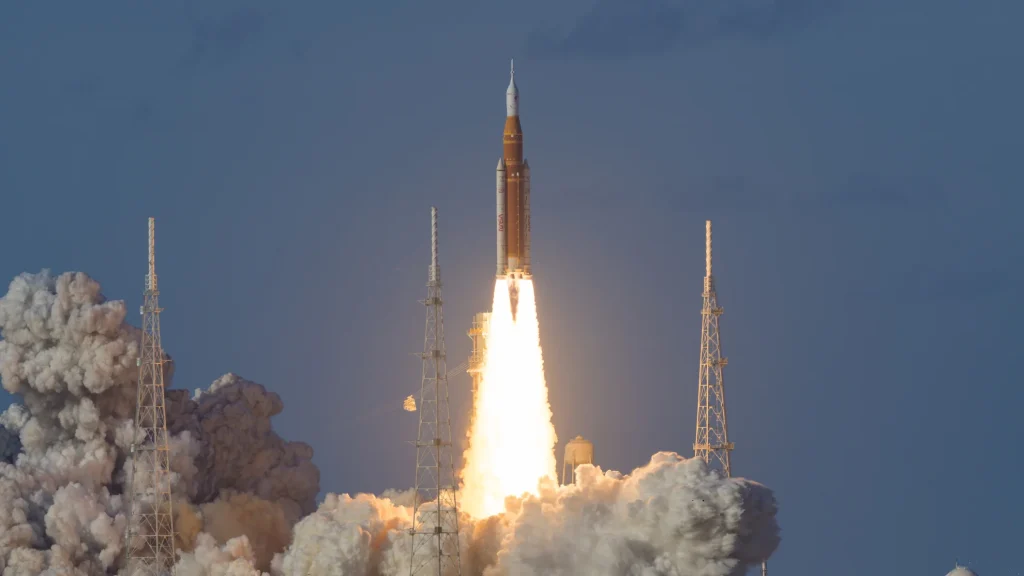
NASA’s Space Launch System rocket launches carrying the Orion spacecraft with NASA astronauts Reid Wiseman, commander; Victor Glover, pilot; Christina Koch, mission specialist; and CSA (Canadian Space Agency) astronaut Jeremy Hansen, mission specialist on NASA’s Artemis II mission, Wednesday, April 1, 2026, from Operations and Support Building II at NASA’s Kennedy Space Center in Florida. NASA’s Artemis II mission will take Wiseman, Glover, Koch, and Hansen on a 10-day journey around the Moon and back aboard SLS rocket and Orion spacecraft launched at 6:35pm EDT from Launch Complex 39B. (NASA/Bill Ingalls)
NASA launched four astronauts toward the Moon on April 1, 2026, marking the first crewed lunar mission since Apollo 17 in December 1972. The Artemis II mission lifted off from Kennedy Space Center aboard the Space Launch System rocket at 6:35 p.m. EDT, sending commander Reid Wiseman, pilot Victor Glover, mission specialist Christina Koch, and Canadian astronaut Jeremy Hansen on a 10-day journey around the far side of the Moon and back.
The mission does not include a lunar landing. It is a test flight designed to validate the Orion spacecraft’s life support systems, navigation, and communications in deep space with a crew aboard for the first time. If the crew reaches the planned distance of 252,000 miles from Earth, they will set a new record for the farthest any human has ever traveled, surpassing even the Apollo 13 distance record.
As Teslarati reported, SpaceX holds a central role in what comes next. The Starship Human Landing System is under contract to carry astronauts to the lunar surface for Artemis IV, now targeting 2028, after NASA restructured its mission sequence due to delays in Starship’s orbital refueling demonstration. Before any Moon landing happens, SpaceX must prove it can transfer propellant between two Starships in orbit, something no rocket program has done at this scale.
The last time humans left Earth’s orbit was 53 years ago. Gene Cernan and Harrison Schmitt of Apollo 17 were the final people to walk on the Moon, a record that stands to this day. Elon Musk has long argued that returning is not optional. “It’s been now almost half a century since humans were last on the Moon,” Musk said. “That’s too long, we need to get back there and have a permanent base on the Moon.”
The Artemis program involves 60 countries signed onto the Artemis Accords, and this mission sets several firsts beyond distance. Glover becomes the first person of color to travel beyond low Earth orbit, Koch the first woman, and Hansen the first non-American astronaut to reach the Moon’s vicinity. According to NASA’s live mission updates, the spacecraft’s solar arrays deployed successfully after liftoff and the crew completed a proximity operations demonstration within the first hours of flight.
Artemis II is step one. The Moon landing and the permanent lunar base come later. But after more than five decades, humans are heading back.
Elon Musk
Tesla Optimus Gen 3 is coming to the Tesla Diner with new ambitions
Tesla’s Optimus robot left the Hollywood Diner within months of opening. Now Musk is planning its return with a bigger role and a major Gen 3 upgrade underway.
![Tesla Optimus Gen 3 [Credit: Tesla]](https://www.teslarati.com/wp-content/uploads/2026/03/tesla-optimus-gen3-diner.jpg)
Tesla’s Optimus robot was one of the most talked-about features when the Tesla Diner opened on Santa Monica Boulevard in Hollywood on July 21, 2025. Dubbed “Poptimus” by Tesla fans, the Gen 2 robot stood upstairs at the retro-futuristic, drive-in theater and Tesla Supercharging station, scooping popcorn into bags and handing them to guests with a wave.
The diner itself had been years in the making. Elon Musk first floated the idea in 2018 with a tweet about building an “old-school drive-in, roller skates & rock restaurant” at a Hollywood Supercharger. What eventually opened was a unique two-story neon-lit space, with 80 EV charging stalls, and Optimus serving as a live demonstration of where Tesla’s ambitions were headed.
If our retro-futuristic diner turns out well, which I think it will, @Tesla will establish these in major cities around the world, as well as at Supercharger sites on long distance routes.
An island of good food, good vibes & entertainment, all while Supercharging! https://t.co/zmbv6GfqKf
— Elon Musk (@elonmusk) July 21, 2025
But Optimus did not stay long, and was gone by December 2025.
Now, the robot is set to return with a more demanding job. Musk has ambitions for Optimus to take on a food runner role in 2026, delivering meals directly to cars at the Supercharger stalls. While the latest Gen 3 Optimus is likely to initially take on its previous popcorn-serving role, it wouldn’t be out of the question for Optimus to see a quick promotion. With improved hand dexterity that features 50 total actuators and 22 degrees of freedom per hand, and significantly more powerful processing through Tesla’s latest AI5 chip that includes Grok-powered voice interaction, Musk described Optimus at the Abundance Summit on March 12, 2026, as “by far the most advanced robot in the world, Nothing’s even close.”
Back to work
See you at Tesla Diner tomorrow pic.twitter.com/H3tTajrUbu
— Tesla Optimus (@Tesla_Optimus) March 30, 2026
That confidence is backed by a major manufacturing shift. At the Q4 2025 earnings call in January, Musk announced Tesla would discontinue the Model S and Model X and convert those Fremont production lines to build Optimus. “It’s time to basically bring the Model S and X programs to an end,” he said, calling for a pivot that reflects where the Tesla’s future lies.

Tesla’s Semi truck factory is open with a detail that changes everything

Tesla Full Self-Driving gets first-ever European approval


