News
Tesla bails on crucial piece of India production, aims to rely on imports
Tesla is not keen on establishing an entire production facility in India, and will instead focus on importing.

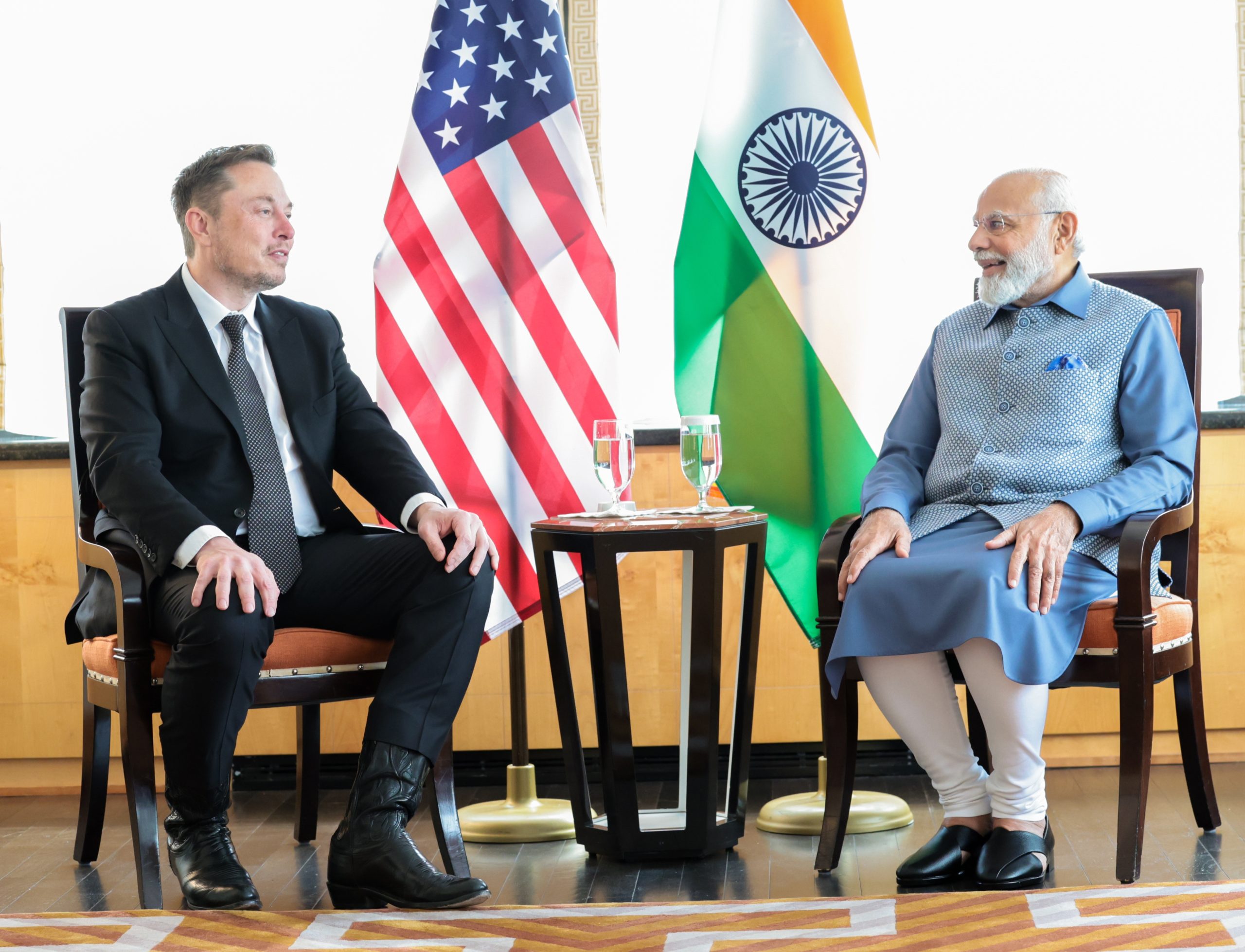
Tesla is bailing on a crucial piece of the puzzle that would likely enable the production of its vehicles in India, and will instead rely on imports, a bold strategy in the broader scheme, as the country has prioritized local manufacturing in an effort to bolster its economy.
The automaker has dragged its feet to commit to a localized production strategy in India, something that seemed to be the only pathway to a mass market presence in what is the most populous country in the world.
However, Tesla has evidently made a decision on what its plans for the market will be. It seems apparent that it still wants to sell vehicles in India and establish a presence there, but it will not do it in what many would consider a more traditional sense: building vehicles domestically. This is something the company has sparred with the Indian government on for several years.
Now, it’s made up its mind.
During a press conference earlier today, India’s Heavy Industry Minister, Shri Kumaraswamy, confirmed Tesla’s plans for how it will penetrate the massive Indian market, and it will not be doing so through domestic manufacturing:
🚨 India’s Heavy Industry Minister, Shri Kumaraswamy, says Tesla is not interested in local manufacturing in the country: pic.twitter.com/O03fqkAMQ0
— TESLARATI (@Teslarati) June 2, 2025
Kumaraswamy indicated that Tesla has no interest in building cars in India, but it wants to establish some presence there, especially with showrooms, allowing citizens to see and drive the cars they could buy from the company.
The move comes as India has made major progress in reducing the import duties that have frightened many automakers from doing business as importers. India’s massive import duties on vehicles built in other countries doubled prices, which is a significant reason for Tesla’s delay in entering the market.
India is considering a reduction to just 10 percent from 100 percent, which would be significant for companies like Tesla, which are doing whatever they can to enter the market without feeling the impact of the duties.
Electric vehicles made up just 2.5 percent of sales in 2024. There were 4.3 million vehicle purchases in India last year.


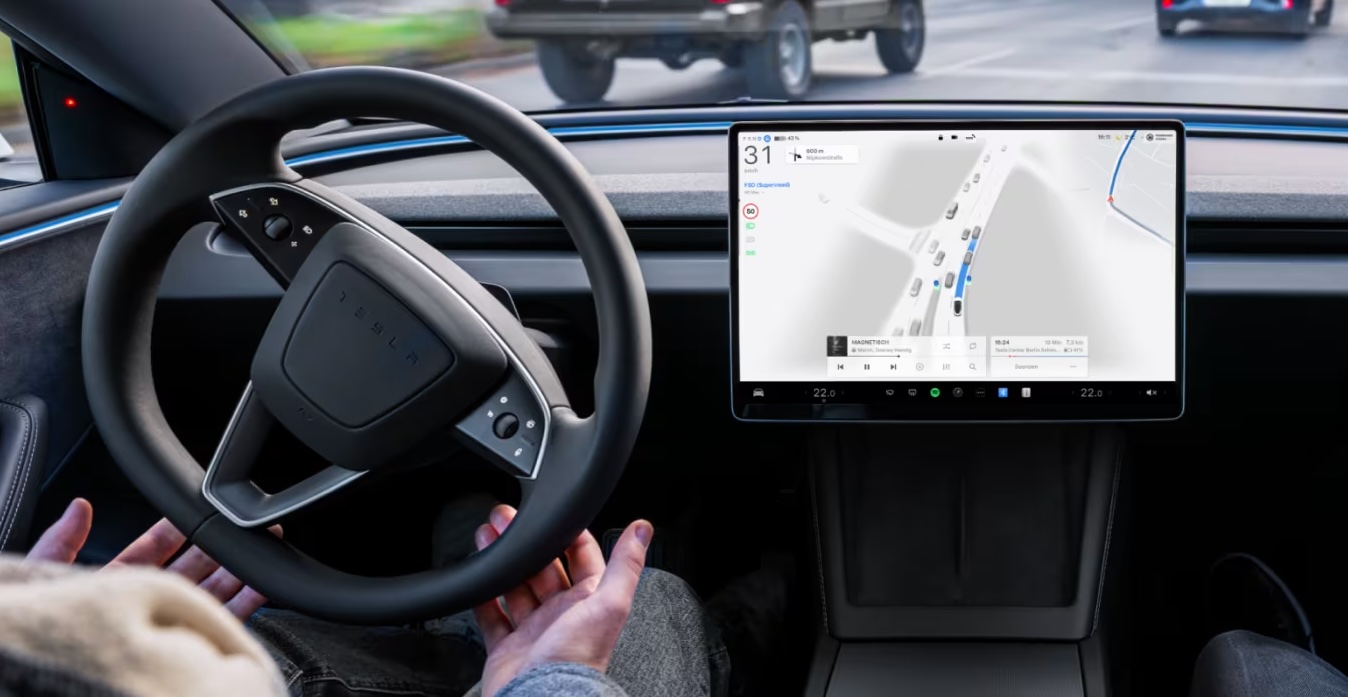
Tesla is rolling out a new version of its Full Self-Driving suite to some owners that comes with the massive addition of a safety feature.
Tesla is rolling out Automatic Collision Evasion with the 2026.27.6 Software Update, which started rolling out to some vehicles last night. We received the update, along with Full Self-Driving v14.3.9, as well as v14.2 Lite, which has identical release notes as the previous version and seems to have some refinements and improvements in behavior and performance.
🚨 Tesla FSD v14.3.9 is rolling out as well as 2026.27.6 which includes Automatic Collision Evasion
Brand new safety features from a software update. My Tesla gets better everytime I get one of these pic.twitter.com/ctrMiQXWhM
— TESLARATI (@Teslarati) September 8, 2026
However, most of the attention has fallen on the Automatic Collision Evasion feature, which we covered in an article last week.
The function will activate Full Self-Driving to “try to keep your vehicle safe and then continue driving. It can engage in the following situations while you are driving manually:
- Scenario 1: A frontal collision is imminent and braking alone may not avoid it.
- Scenario 2: Your vehicle detects that you are not sufficiently attentive to the road (for example, reaching toward the back seat), or that Full Self-Driving (Supervised) may have been unintentionally disengaged.”
Essentially, FSD will take over when the vehicle determines you are not paying sufficient attention or are heading toward a potential collision. The addition of this feature is incredibly useful as distracted driving is a major issue in today’s world.
Along with the new safety feature is Tesla FSD v14.3.9, which has no additional release notes compared to the previous version, but in my first drives, my first impression is that operation is great, and parking is still sort of a pain point.
Just took a 15-mile round trip to the gym and back
Pretty on par with what FSD is nowadays – really good. Not enough time to see what’s good and what’s bad, but these first rides on any version feel shockingly good. They’re all pretty identical https://t.co/WN1qTg4bhE
— TESLARATI (@Teslarati) September 9, 2026
Additionally, Tesla v14.2. Lite has arrived. A great review of that is available here:
— Zack (@BLKMDL3) September 9, 2026
The addition of an Automatic Collision Evasion feature is similar to that of other collision avoidance systems that are used by companies like Hyundai, Kia, and Genesis. These programs typically utilize radar and camera sensors to apply emergency brakes autonomously, though evasive steering in a manual driving mode is pioneered primarily by Tesla’s newest addition.
Elon Musk
Tesla primes Cybercabs for 4K streaming and high bandwidth gaming with Starlink integration
Tesla is now shipping Cybercabs from Giga Texas with Starlink hardware built in as standard.

Tesla’s Cybercabs are now leaving Gigafactory Texas with Starlink hardware on the rear hatch in significant numbers, according to drone footage captured Tuesday by longtime Austin drone observer Joe Tegtmeyer. Production at the factory ramped back up after the Labor Day weekend, and his flyover of the outbound lot showed rows of gold Cybercabs alongside Model Y Long Wheelbase units, many carrying the satellite module for the first time as standard equipment rather than a one off retrofit.
Giga Texas today is busy with production coming back up following the long weekend. Of interest today in the outbound lot is the appearance of hundreds of Mode; YL’s and many more Cybercabs and for the 1st time equipped with the Starlink module one the hatch in big numbers.
At… pic.twitter.com/G9yl6s51m4
— Joe Tegtmeyer 🚀 🤠🛸😎 (@JoeTegtmeyer) September 8, 2026
Tesla first showed Starlink built into an actual Cybercab on August 10, when the Robotaxi account posted images of a single gold unit with the antenna integrated into the roofline above the taillights and called it the first Cybercab with Starlink integration. That followed a July reveal where Tesla and Starlink jointly posted a cutaway diagram of the antenna placement without a working vehicle to back it up. Ashok Elluswamy, Tesla’s VP of AI software, said at the time that the connection isn’t required for the car to drive itself. It exists mainly for navigation, customer service and keeping tabs on the fleet.
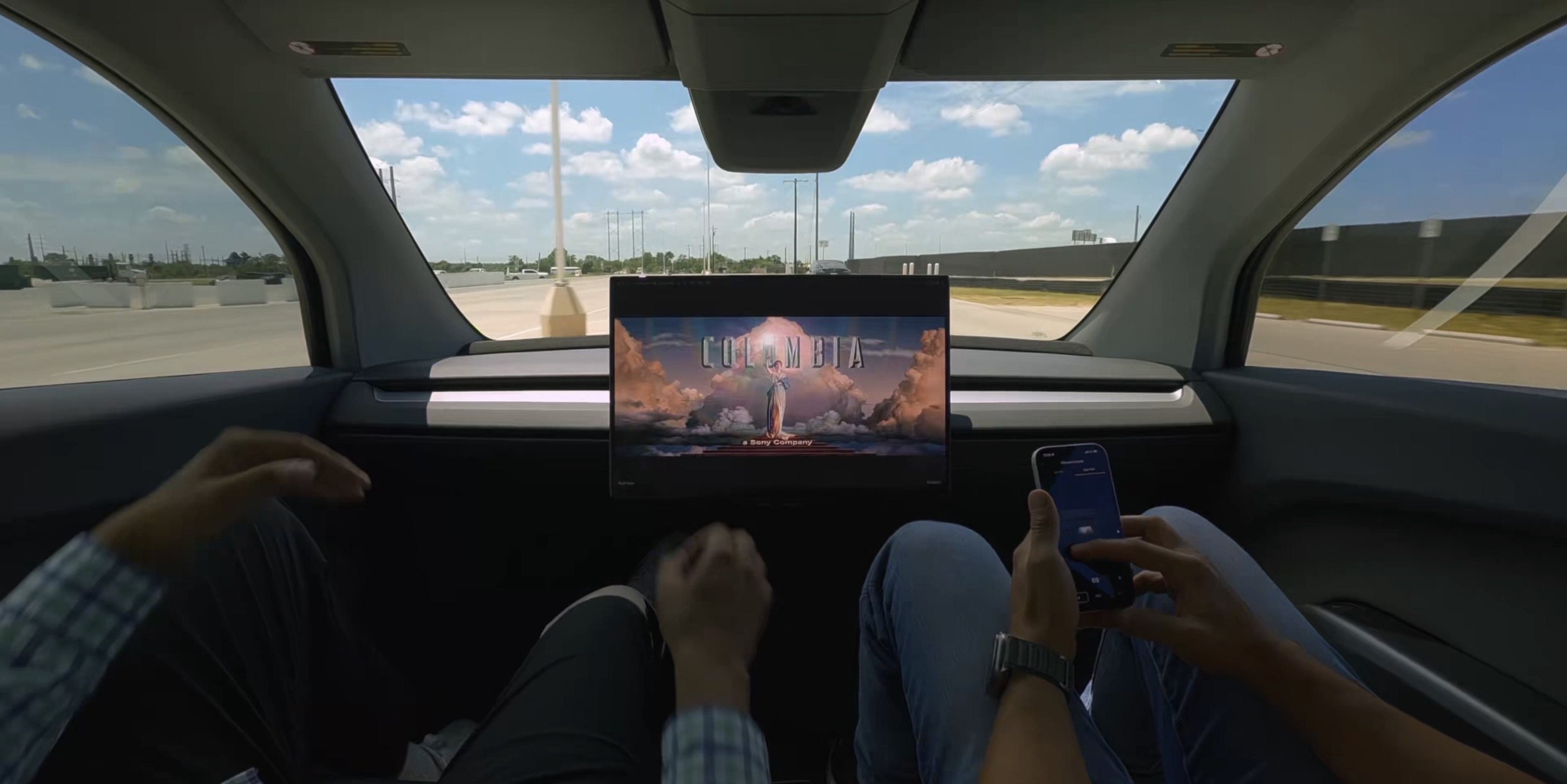
Musk has made a different case in public. During Tesla’s Q2 earnings call, he said the company can’t afford robotaxis stranded in what he called “Bermuda Triangles of lack of cellular connectivity,” and he separately claimed on X that Starlink will eventually reach every Tesla built, calling it the only way to deliver high bandwidth to billions of vehicles. He has also pitched the antenna as an entertainment upgrade, telling riders they would be able to stream 4K video or play games during a trip.
The rollout has moved fast since. Robotaxi service opened to the public in Austin on September 3, and Cybercabs had already been spotted with Starlink hardware in Houston and near Miami International Airport in the weeks before Tuesday’s factory footage showed the module shipping at volume rather than on scattered test units. Whether the satellite link earns its keep is still an open question. Tesla’s unsupervised service currently runs in dense metro geofences in Texas and Florida, markets where cellular coverage is already strong, which is not where the rural dead zones Musk describes tend to show up.
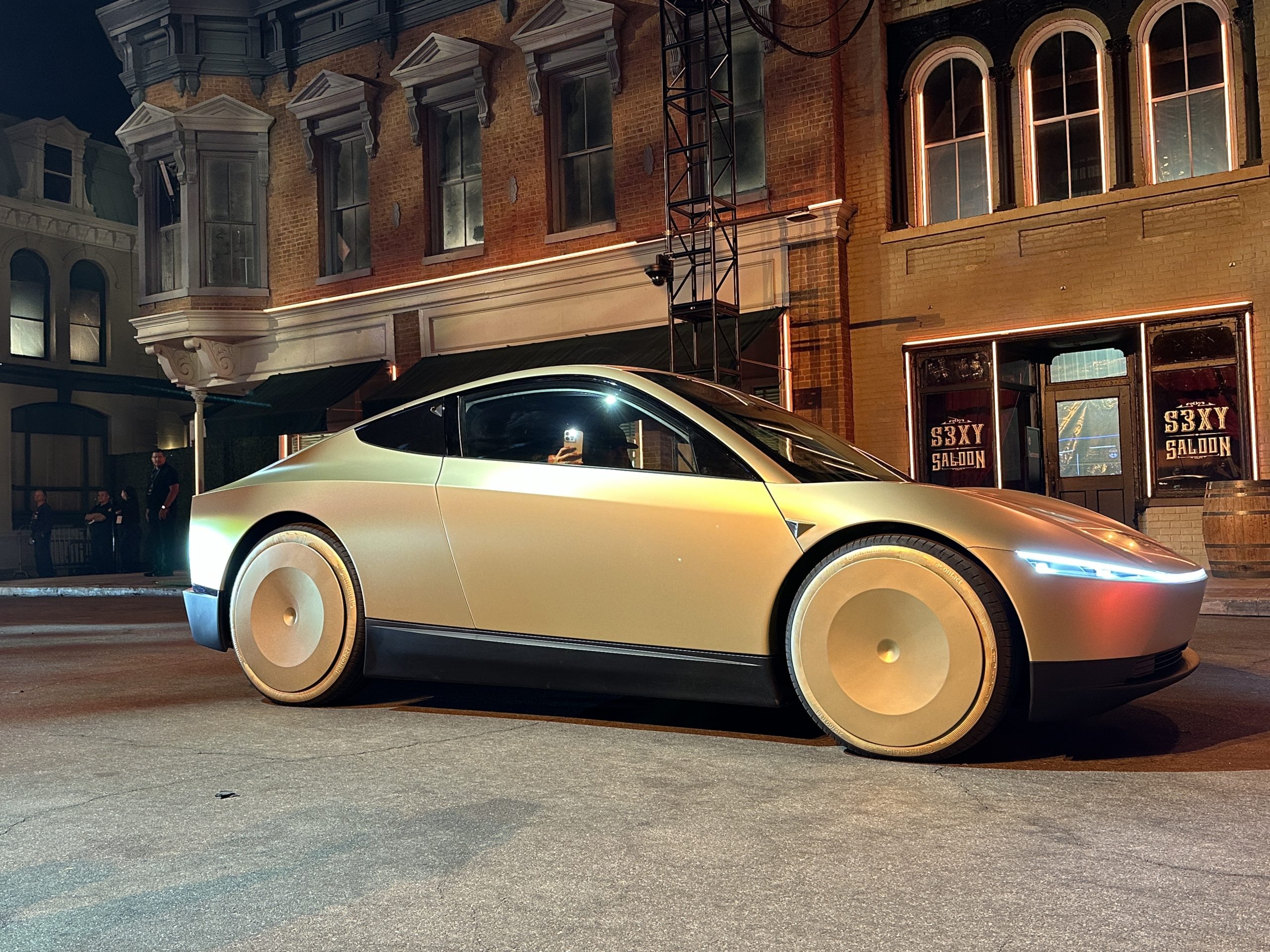
After launching in Austin, Texas, last week, Tesla is looking to expand the Cybercab to new parts of the United States in an effort that will see the driverless, steering wheel-less, and pedal-less vehicle chauffeur people around as part of the Robotaxi ride-hailing service.
However, the expansion will go far beyond the United States, and CEO Elon Musk revealed he hopes Europe will be the next market where Cybercab will be operational.
Musk has publicly expressed hope that Tesla’s Cybercab robotaxi will reach Europe in the near future.
On September 8, Tesla’s Chief Executive quoted a German rider who had just completed a trip in Austin, Texas, and wrote that he hoped the vehicle would not take years to arrive in Germany. Musk replied with a short but notable message: “Hopefully soon in Europe too.”
Hopefully soon in Europe too https://t.co/vqQ69bLJuN
— Elon Musk (@elonmusk) September 8, 2026
The comment arrived only days after Tesla opened Cybercab ride-hailing to the public in Austin. The two-seat vehicle has no steering wheel or pedals and relies entirely on Tesla’s Full Self-Driving software. Early passengers have described the rides as quiet, smooth, and more stylish than competing robotaxis such as Waymo.
Austin is currently the only city where members of the public can hail a Cybercab through Tesla’s Robotaxi app. The initial fleet is small; Texas registration records show only a few dozen of the purpose-built vehicles on the road.
Tesla set to open Cybercab rides to the public, with no steering wheel or pedals
Tesla has also been operating a larger number of conventional Model Y robotaxis in the same area, but the Cybercab itself represents the company’s first dedicated, controls-free taxi design.
Europe presents a different regulatory picture. The European Union does not permit manufacturers to self-certify vehicles the way Tesla did in the United States.
Type-approval rules and a small-series limit of 1,500 automated vehicles per type per year apply across the bloc.
Supervised Full Self-Driving has gained provisional approval in several member states through national recognition of Dutch certification, yet unsupervised robotaxi operation remains a separate and more distant step. Tesla has not announced a European launch city, date, or approval pathway for the Cybercab.
Musk himself has previously cautioned that the company does not control European regulators. In an earnings call earlier in 2026, he noted that even supervised FSD took an “immense amount of time” to clear and that unsupervised service would be “somewhat at the mercy of the governments in Europe and the EU.”
The latest social-media remark therefore functions more as an expression of intent than a timetable.
If the Cybercab eventually reaches European streets, it would mark a significant expansion of Tesla’s robotaxi ambitions beyond the United States. For now, the vehicle remains an Austin-only experience, and the gap between Musk’s hope and actual deployment will be decided by regulators rather than by engineering alone.

Tesla is rolling out a new FSD version with a massive safety addition

Tesla primes Cybercabs for 4K streaming and high bandwidth gaming with Starlink integration


