Elon Musk
Elon Musk’s xAI gains first access to Saudi supercluster with 600k Nvidia GPUs
The facility will deploy roughly 600,000 Nvidia GPUs, making it one of the world’s most notable superclusters.

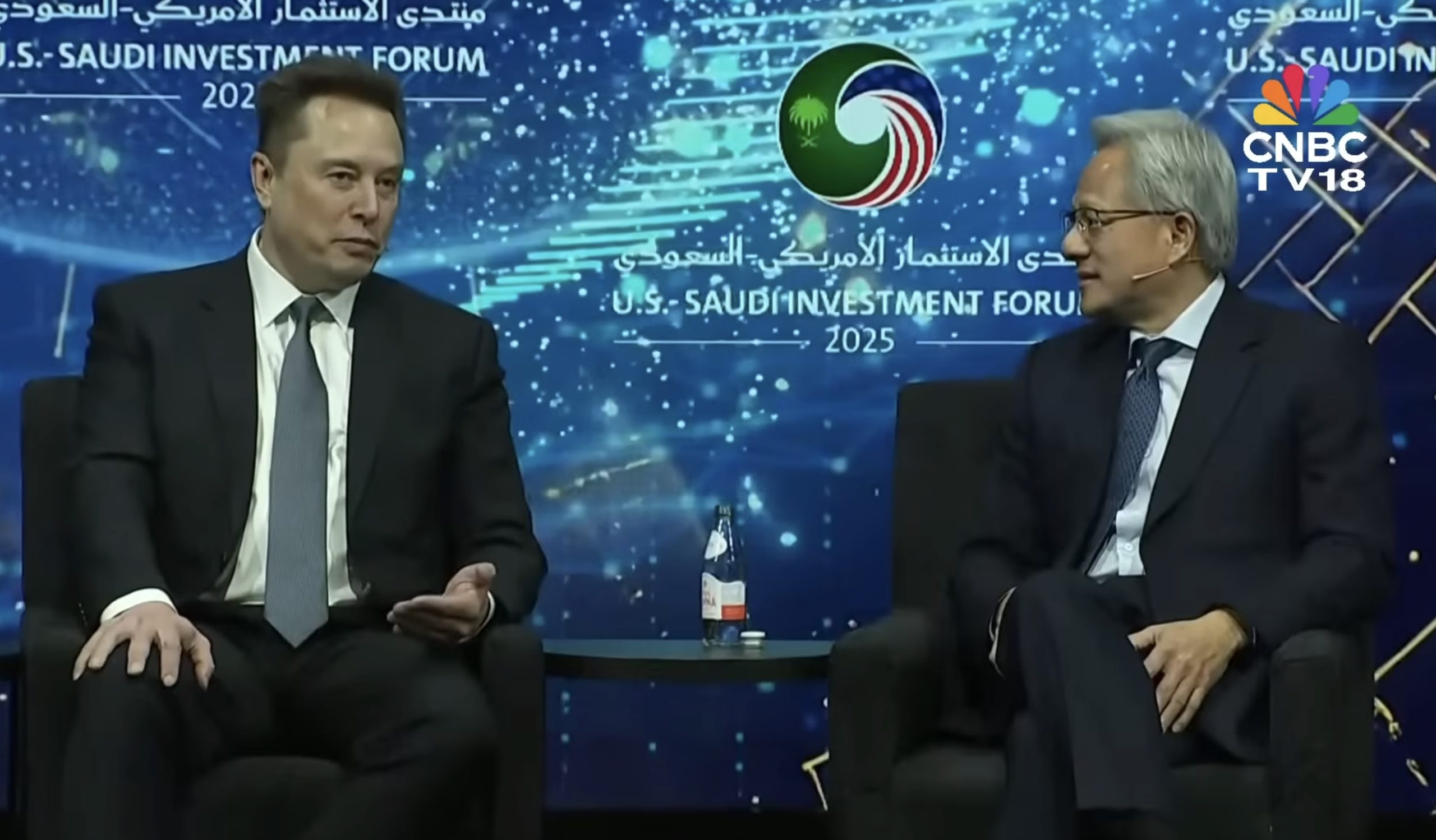
A Saudi-backed developer is moving forward with one of the world’s largest AI data centers, and Elon Musk’s xAI will be its first customer. The project, unveiled at the U.S.–Saudi Investment Forum in Washington, D.C., is being built by Humain, a company supported by Saudi Arabia’s Public Investment Fund.
The facility will deploy roughly 600,000 Nvidia GPUs, making it one of the world’s most notable superclusters.
xAI secures priority access
Nvidia CEO Jensen Huang stated that the planned data center marks a major leap not just for the region but for the global AI ecosystem as a whole. Huang joked about the sheer capacity of the build, emphasizing how unusual it is for a startup to receive infrastructure of such magnitude. The facility is designed to deliver 500 megawatts of Nvidia GPU power, placing it among the world’s largest AI-focused installations, as noted in a Benzinga report.
“We worked together to get this company started and off the ground and just got an incredible customer with Elon. Could you imagine a startup company, approximately $0 billion in revenues, now going to build a data center for Elon? 500 megawatts is gigantic. This company is off the charts right away,” Huang said.
Global Chipmakers Join Multi-Vendor Buildout To Enhance Compute Diversity
While Nvidia GPUs serve as the backbone of the first phase, Humain is preparing a diversified hardware stack. AMD will supply its Instinct MI450 accelerators, which could draw up to 1 gigawatt of power by 2030 as deployments ramp. Qualcomm will also contribute AI200 and AI250 data center processors, accounting for an additional 200 megawatts of compute capacity. Cisco will support the networking and infrastructure layer, helping knit the multi-chip architecture together.
Apart from confirming that xAI will be the upcoming supercluster’s first customer, Musk also joked about the rapid scaling needed to train increasingly large AI models. He joked that a theoretical expansion one thousand times larger of the upcoming supercluster “would be 8 bazillion, trillion dollars,” highlighting the playful exaggeration he often brings to discussions around extreme compute demand.


Elon Musk
Tesla’s Semi truck factory is open with a detail that changes everything
Tesla’s dedicated Nevada Semi factory has opened, targeting 50,000 trucks per year as fleet adoptions accelerate nationwide.

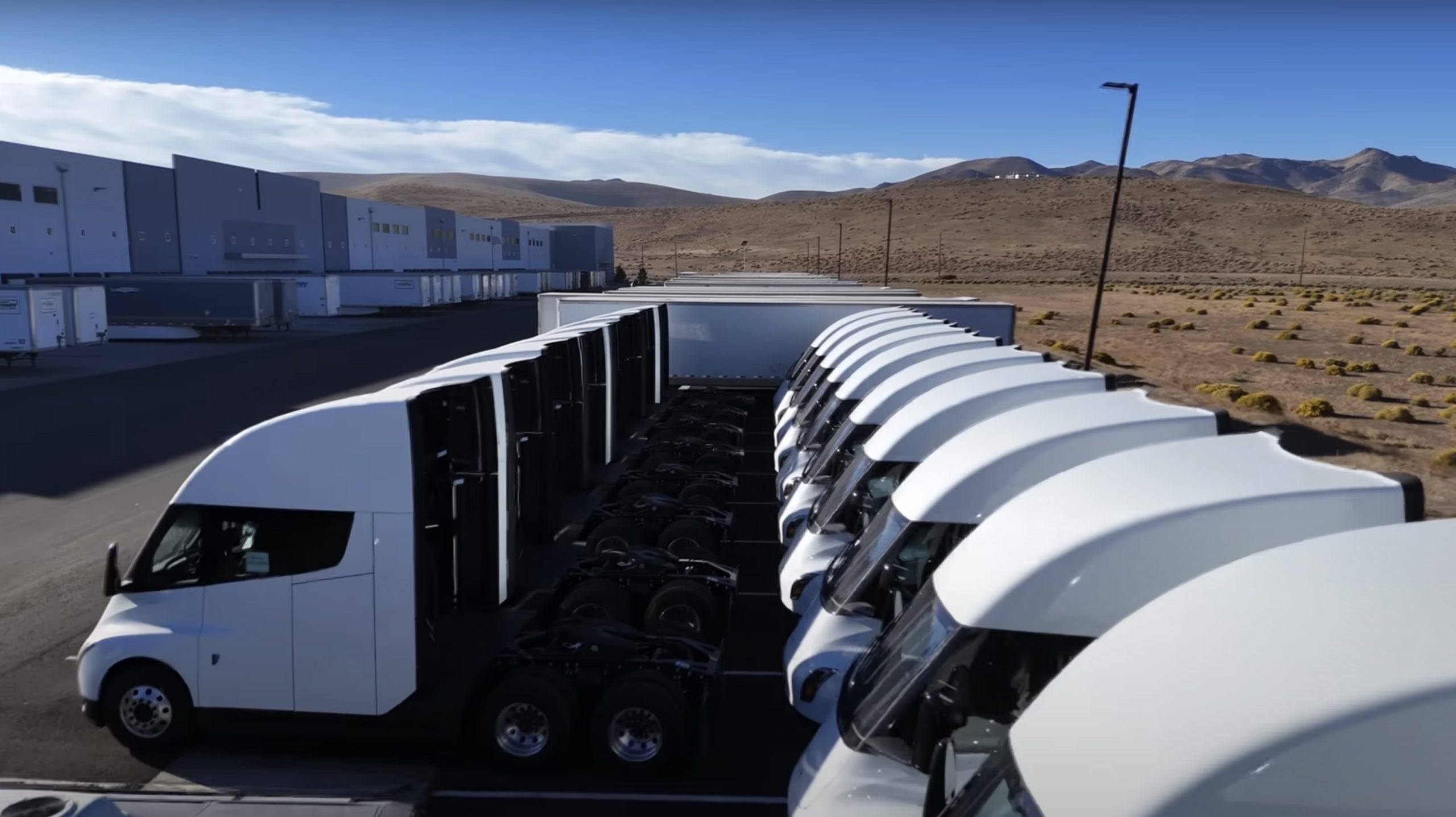
Nearly nine years after Elon Musk unveiled the Tesla Semi in November 2017, the company is now opening a dedicated factory just outside of Reno, Nevada, and ramping toward mass production of 50,000 trucks per year.
Volume production began in March 2026 at the new Tesla Semi factory, with the competitive advantage not being the factory itself. Rather, it’s where Tesla built it. By constructing the 1.7 million square foot facility directly adjacent to Gigafactory Nevada in Sparks, Tesla closed the one supply chain loop that had delayed the Semi program for years. The 4680 battery cells that power the Semi are manufactured in the same complex, which significantly streamlines supply logistics. That single decision eliminates the bottleneck that forced Tesla to prioritize battery supply for passenger cars over the Semi throughout 2020, 2021, and 2022, which is precisely why the first deliveries slipped three years past the original target. Every other electric truck manufacturer sources its battery cells from a separate supplier, ships them to a separate factory, and absorbs the cost and delay that comes with that. Tesla built its Semi factory around its battery factory, and that vertical integration is what makes 50,000 trucks per year a realistic number rather than an aspirational one.
At the 2025 Annual Shareholder Meeting, Musk was direct about where things stood, stating “Starting next year, we will manufacture the Tesla Semi. We already have a lot of prototype Semis in operation – PepsiCo and other companies have been using them for some time. But in 2026, we’ll begin volume production at our Northern Nevada factory.” Full ramp to volume output is targeted before June 30, 2026.
🚨 Awesome new video showing the new Tesla Semi factory in Sparks, Nevada
The future of sustainable logistics is being built here: pic.twitter.com/dbiGV8FYn3
— TESLARATI (@Teslarati) April 10, 2026
The first limited deliveries happened in December 2022 to PepsiCo, which eventually doubled its fleet to 50 trucks out of its California distribution facility. Since then the Semi has been showing up in more corporate fleets. As Teslarati noted in March, a Ralph’s Supermarkets branded Semi was spotted on a Los Angeles highway, confirming Kroger’s partnership with Tesla to deploy up to 500 electric Semis. Walmart, Costco, Sysco, US Foods, DHL, Hight Logistics and WattEV are among the companies actively running or receiving units. DHL logged real-world efficiency of 1.72 kWh per mile under a full 75,000 pound load over 388 miles, matching Tesla’s targets closely.
The 2026 production model arrives with meaningful upgrades over the original, with a 1,000 pound weight reduction, updated aerodynamics, and support for 1.2 MW Megacharger speeds that can restore 60% of range in around 30 minutes during a mandatory driver rest break. Tesla opened its first public Megacharger in Ontario, California in March, positioned near the I-10 and I-15 interchange serving the Ports of Los Angeles and Long Beach. The company plans 37 Megacharger sites by end of 2026 and 66 total across 15 states by early 2027, with construction beginning at the nation’s largest truck stop operator in the first half of this year.
Tesla reveals various improvements to the Semi in new piece with Jay Leno
Musk has described the Semi’s economics as a straightforward case. “The Semi is a TCO no-brainer,” he said, noting the total cost of ownership is “much, much cheaper than any other transportation you could have.” At under $300,000, the truck costs roughly double a comparable diesel, but California’s $200,000 per vehicle subsidy has driven over 1,000 state orders alone. As Teslarati has tracked, the prototype fleet accumulated over 13.5 million miles with 95% fleet uptime before production ever scaled. The factory opening now turns that proof of concept into a production program.
Elon Musk
SpaceX is keeping the Space Station alive again this weekend
SpaceX’s Falcon 9 launches Northrop Grumman’s Cygnus NG-24 to the ISS with 11,000 pounds of cargo Saturday.
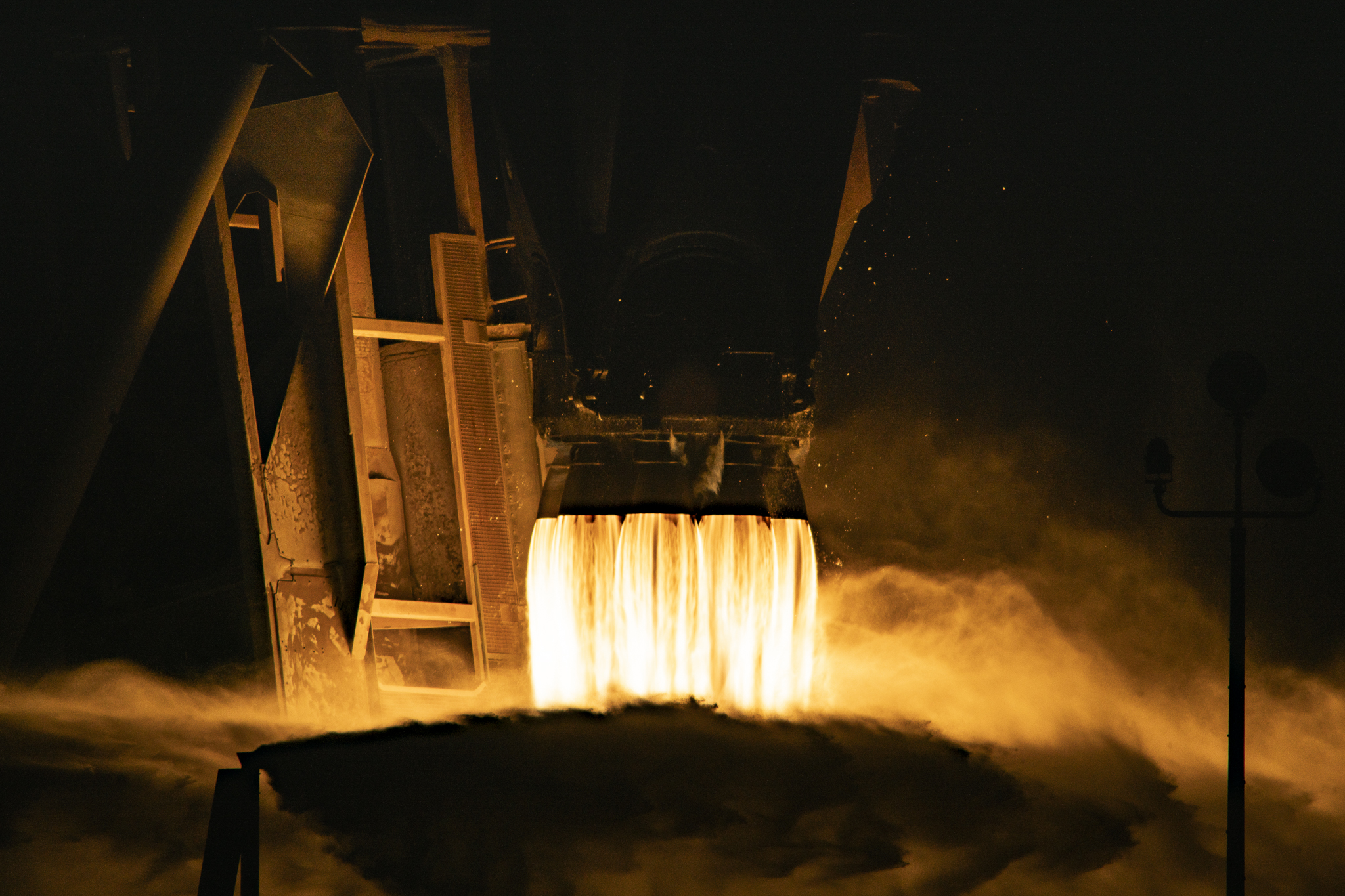
SpaceX is targeting April 11 for the launch of Northrop Grumman’s Cygnus XL cargo spacecraft to the International Space Station, carrying over 11,000 pounds of supplies, science hardware, and equipment for the Expedition 73 crew aboard. Liftoff is set for 7:41 a.m. ET from Space Launch Complex 40 at Cape Canaveral Space Force Station, with a backup window available April 12 at 7:18 a.m. ET.
The mission, officially designated NG-24 under NASA’s Commercial Resupply Services program, names its spacecraft the S.S. Steven R. Nagel in honor of the NASA astronaut who flew four Space Shuttle missions and logged over 723 hours in space before his death in 2014. Unlike SpaceX’s own Dragon capsule, which docks autonomously, Cygnus relies on NASA astronauts to capture it using a robotic arm before it is berthed to the space station’s module for unloading. When the mission wraps up around October, the Cygnus will depart loaded with station trash and burn up on reentry.
Countdown: America is going back to the Moon and SpaceX holds the key to what comes after
This is the second flight of the Cygnus XL configuration, which debuted on NG-23 in September 2025 and offers a roughly 20% increase in cargo capacity over the previous design. Northrop Grumman switched to Falcon 9 launches after its own Antares 230+ rocket was retired in 2023 following supply chain disruptions from the war in Ukraine.
The upcoming cargo includes a new module to advance quantum research, and an investigation studying blood stem cell production in microgravity with potential therapeutic applications on Earth.
The NG-24 mission is one piece of a much larger picture for SpaceX and the U.S. government. As Teslarati reported, SpaceX has become an indispensable launch provider for U.S. national security missions, picking up a $178.5 million Space Force contract in April 2026 to launch missile tracking satellites, while also holding roughly $4 billion in NASA contracts tied to the Artemis lunar program.
At a time when no other American rocket can match the Falcon 9’s combination of reliability, cost, and launch cadence, Saturday’s mission is a straightforward reminder of how much the U.S. government now depends on a single commercial provider to keep its astronauts supplied and its satellites flying.
Elon Musk
Tesla Supercharger for Business exposes jaw-dropping ROI gap between best and worst locations
Tesla’s new Supercharger for Business calculator reveals an eye-opening all-in cost and location-based ROI projections.
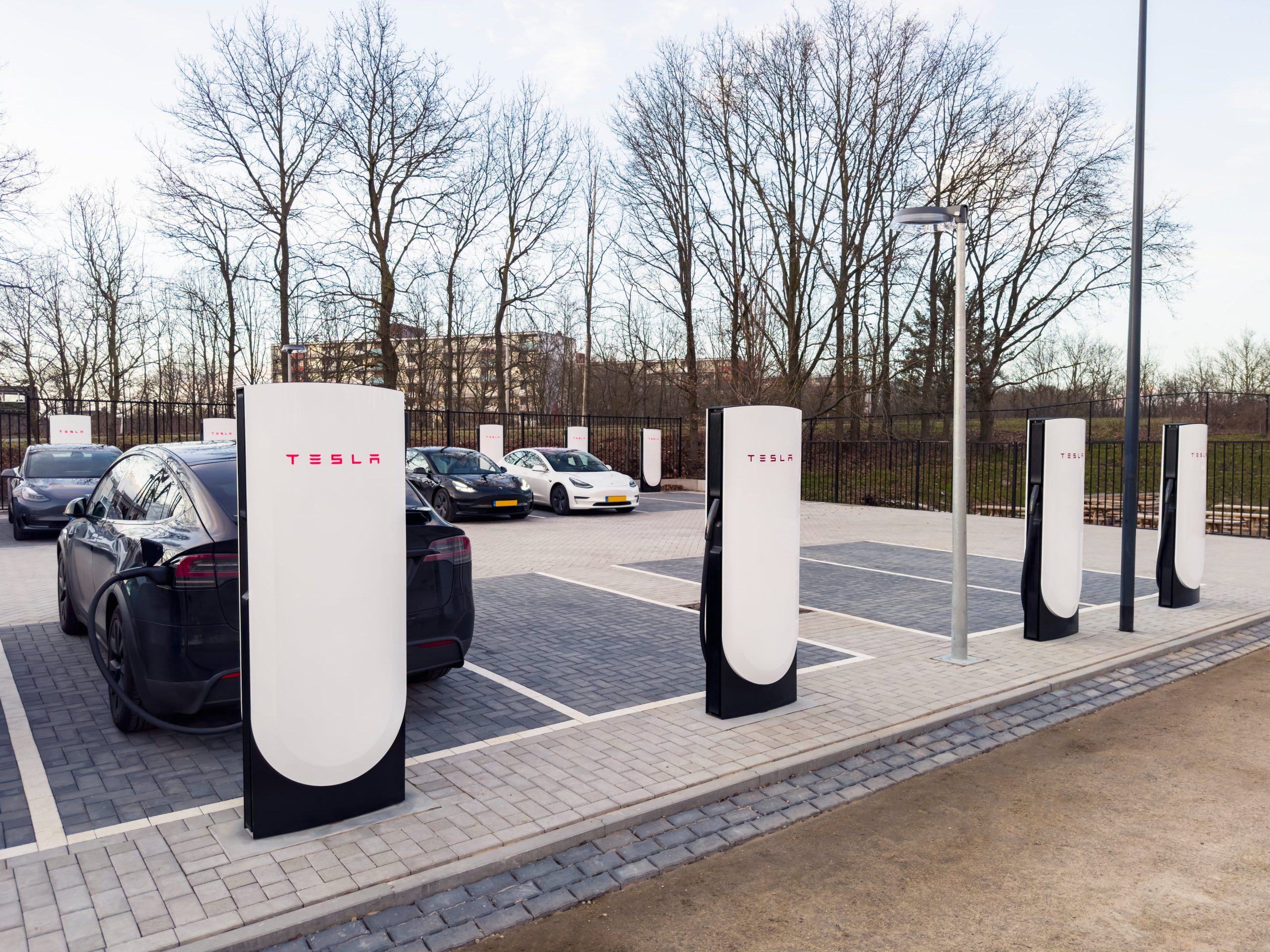
Tesla has launched an online calculator for its Supercharger for Business program, giving property owners their first transparent look at what it really costs to install Superchargers on site and what kind of return they can expect.
The program itself launched in September 2025, allowing businesses to purchase and operate Supercharger hardware on their own property while Tesla handles installation, maintenance, software, and 24/7 driver support. As Teslarati reported at launch, hosts also get their logo placed on the chargers and their location integrated into Tesla’s in-car navigation, meaning drivers are actively routed there. The stalls are open to all EVs, not just Teslas.
We launched Supercharger for Business in 2025 to help companies get charging right. We found simplicity and transparency to be a problem in this industry.
We’re now sharing pricing and a financial calculator to help make informed decisions. The goal is to accelerate investments,…
— Tesla Charging (@TeslaCharging) April 8, 2026
The new online calculator, announced by Tesla on Wednesday with the note that “simplicity and transparency” have been a problem in the industry, lets any business enter a U.S. address and get a real cost and revenue model. A standard 8-stall V4 Supercharger site runs approximately $500,000 in hardware and $55,000 per post for installation, bringing an all-in price just shy of $1 million. Tesla charges a flat $0.10 per kWh fee to cover software, billing, and network operations. Businesses set their own retail price and keep the margin above that fee.
Taking a look at Tesla’s Supercharger for Business online calculator, we can see that ROI is not uniform, and the gap between a strong location and a poor one can stretch the breakeven point by several years.
The biggest driver is foot traffic and how long people stay. A busy rest station, hotel, or outlet mall brings in repeat visitors who need to charge while they’re already stopped, pushing utilization numbers higher and shortening payback time.
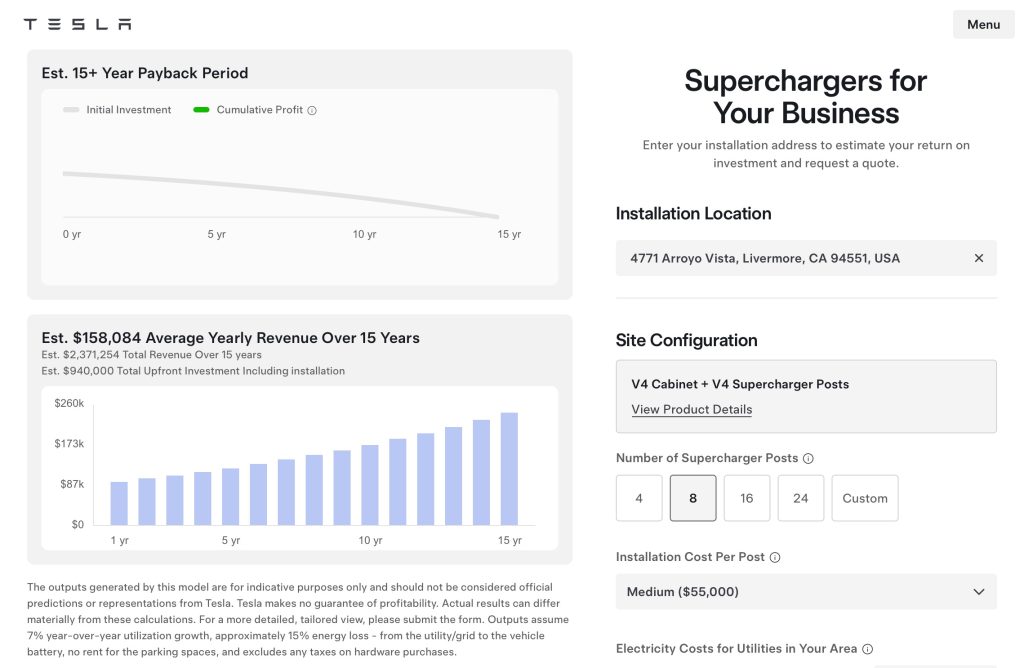
Tesla Supercharger for Business ROI calculator
Local electricity rates matter just as much on the cost side. Markets like California carry some of the highest commercial electricity rates in the country, which eats into the margin between what a host pays per kWh and what they charge drivers. At the same time, dense urban areas with high EV adoption tend to support higher retail charging prices, which can offset that cost if demand is strong enough. Weather also plays a role. Cold climates reduce battery efficiency and increase charging frequency, but they can also suppress utilization in winter months if drivers avoid stopping in exposed outdoor locations. Suburban and rural sites face a different problem: lower baseline EV traffic, which means a site with cheaper power and lower operating costs can still take longer to pay back simply because the stalls sit idle more often. Tesla’s calculator uses real fleet data to pre-fill utilization estimates by ZIP code, so businesses can run their specific address against these variables rather than relying on averages.
The program has seen real adoption. Wawa, already the largest host of Tesla Superchargers with over 2,100 stalls across 223 locations, opened its first fully owned and branded site in Alachua, Florida earlier this year. Francis Energy of Oklahoma and the city of Alpharetta, Georgia have also deployed branded stations through the program, as Teslarati covered in January.
Tesla now exceeds 80,000 Supercharger stalls worldwide, and the calculator makes the economic case for accelerating that number through private investment rather than company-owned sites alone.

Tesla Cabin Camera gets an incredible new feature for added driver safety

Tesla’s Semi truck factory is open with a detail that changes everything


