Elon Musk
SpaceX Starship launches face pushback in Florida over noise, flights—and nudists
SpaceX is seeking permission to fly its fully reusable Starship system from Launch Complex 39A.

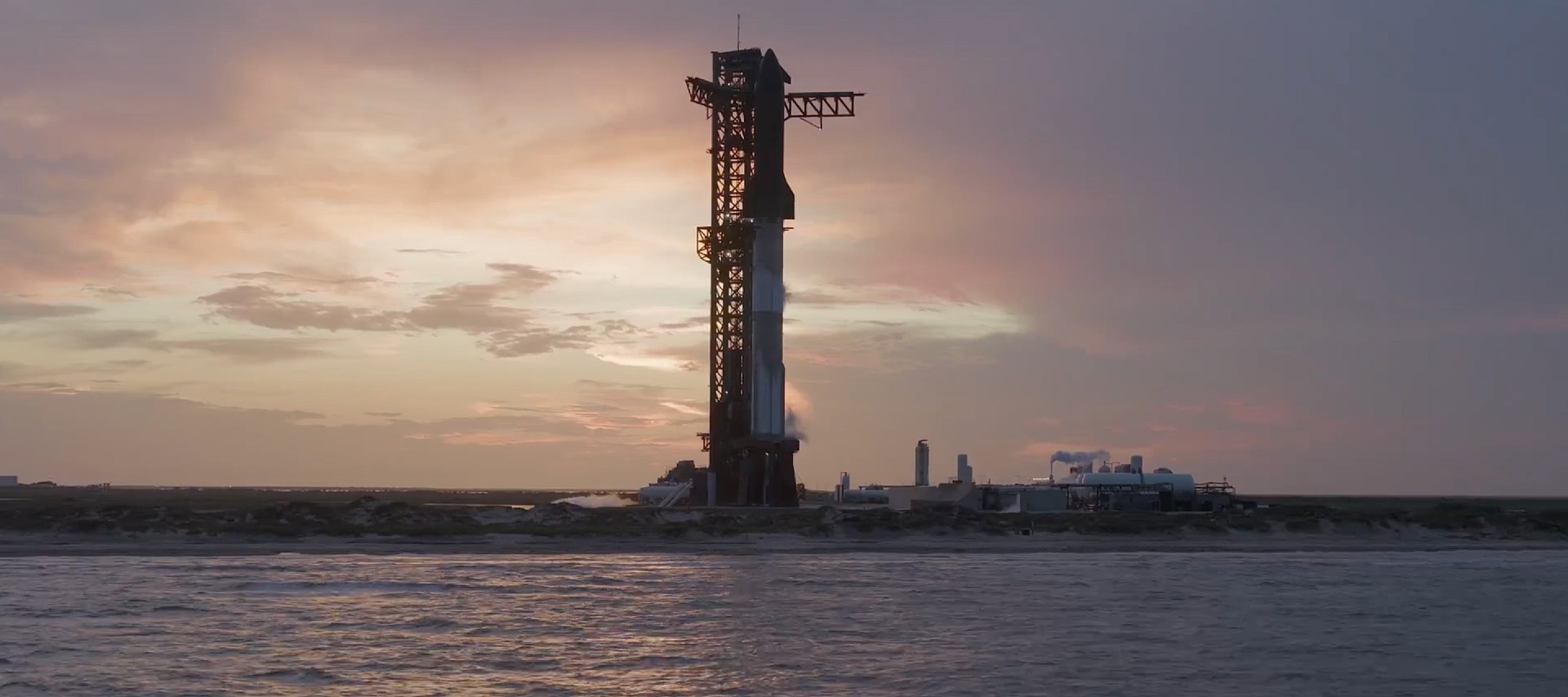
The Federal Aviation Administration (FAA) has wrapped up a series of public hearings on SpaceX’s proposal to launch its Super Heavy Starship rocket from NASA’s Kennedy Space Center (KSC).
The sessions, held both in-person and online, form part of the draft environmental impact statement (EIS) review that will determine whether SpaceX would be cleared to conduct Starship launches and landings from Florida’s Space Coast.
FAA review and Starship launch plans
According to the FAA’s draft EIS, SpaceX seeks permission to fly its fully reusable Starship system from Launch Complex 39A, where construction of a dedicated tower and infrastructure has already begun. Proposed operations could involve landings at KSC or droneships positioned across the Atlantic, Pacific, and Indian Oceans. The FAA emphasized that final approval is not guaranteed with the completion of the EIS, as safety and financial requirements must still be met, as noted in a Space.com report.
Starship’s larger scale compared to Falcon 9 means expanded exclusion zones for air, sea, and beach access. The analysis also projected more than 60 annual closures of Playalinda Beach, alongside potential flight delays across Florida airports lasting 40 minutes to two hours. Port Canaveral would also be affected by maritime restrictions.
Local concerns
Public comments reflected a mix of optimism and unease. Aviation officials, such as Tampa International Airport COO John Tiliacos, warned of significant disruption to commercial flights. “There is the potential that there’s going to be significant impact to commercial aviation and the traveling public. That’s something that certainly the FAA needs to give consideration to and, frankly, come up with a plan to mitigate,” he stated.
Others raised health concerns, noting that chronic sleep disruption from launch noise could impact veterans and trauma survivors. Robyn Memphis, a neuroscience and psychology graduate student, stated that sleep disruptions from launch noise and sonic booms could carry lasting effects. “Chronic sleep disruption is not just inconvenient. This is directly linked to depression, anxiety… cardiovascular disease, even suicide risk. And being in Florida, we have many veterans and trauma survivors in the community,” she said.
Nudist protests and responses
Erich Schuttauf, the executive director of the American Association for Nude Recreation, also argued that places like Playalinda Beach, a nudist beach, are crucial for people who travel to places where public nudity is legal. His sentiments were echoed by fellow nudist Sue Stevens, who noted that “It’s probably a quarter million people that travel and think like I do, who look for destinations that are beautiful and surrounded by like-minded people.”
Photographer Max West, who plans to move to Florida to photograph Starship, noted that the spacecraft presents a notable step forward for humanity. And while its impact to communities is not marginal, the progress it offers is well worth it. “I’m not going to say that there is zero environmental impact there,” he said, though he also stated that there has to be some “little sacrifices along the way. “The turtles and the nudists will have to migrate. That’s the cost that you have to pay for this incredible stuff that’s happening.”


Elon Musk
The Boring Company clears final Nashville hurdle: Music City loop is full speed ahead
The Boring Company has cleared its final Nashville hurdles, putting the Music City Loop on track for 2026.

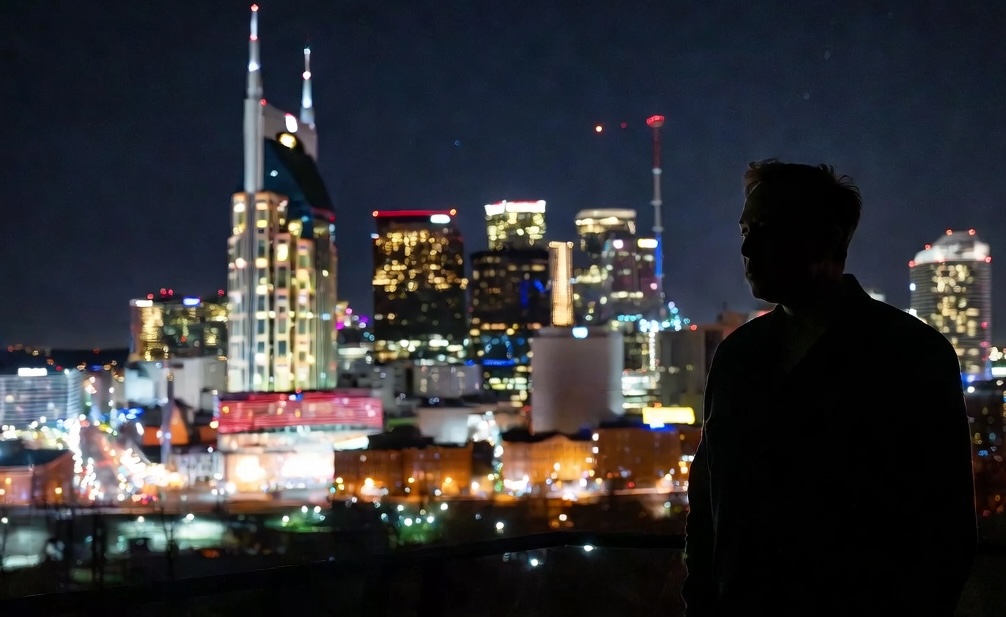
The Boring Company has cleared one of its most significant regulatory milestones yet, securing a key easement from the Music City Center in Nashville just days ago, the latest in a series of approvals that have pushed the Music City Loop project firmly into construction reality.
On March 24, 2026, the Convention Center Authority voted to grant The Boring Company access to an easement along the west side of the Music City Center property, allowing tunneling beneath the privately owned venue. The move follows a unanimous 7-0 vote by the Metro Nashville Airport Authority on February 18, and a joint state and federal approval from the Tennessee Department of Transportation and the Federal Highway Administration on February 25. Together, these green lights have cleared the path for a roughly 10-mile underground tunnel connecting downtown Nashville to Nashville International Airport, with potential extensions into midtown along West End Avenue.
Music City Loop could highlight The Boring Company’s real disruption
Nashville was selected by The Boring Company largely because of its rapid population growth and the strain that growth has placed on surface infrastructure. Traffic has become a persistent problem for residents, convention visitors, and airport travelers alike. The Music City Loop promises an approximately 8-minute underground transit time between downtown and the Nashville International Airport (BNA), removing thousands of vehicles from surface roads daily while operating as a fully electric, zero-emissions system at no cost to taxpayers.
The project fits squarely within a broader vision Musk has championed for years. In responding to a breakdown of the Loop’s construction costs, Musk posted on X: “Tunnels are so underrated.” The comment reflected a longstanding belief that underground transit represents one of the most cost-effective and scalable infrastructure solutions available. The Boring Company has claimed it can build 13 miles of twin tunnels in Nashville for between $240 million and $300 million total, a fraction of what comparable projects cost elsewhere in the country.
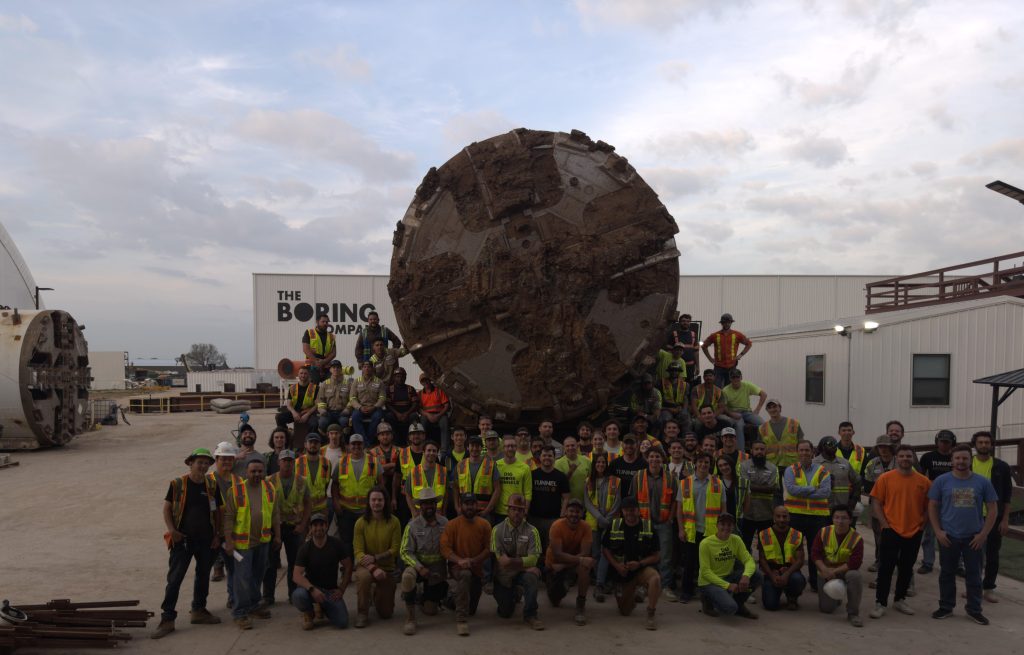
Image Credit: The Boring Company/Twitter
The Las Vegas Loop, The Boring Company’s first operational system, has served as a proof of concept. During the CONEXPO trade show in March 2026, the Vegas Loop transported approximately 82,000 passengers over five days at the Las Vegas Convention Center, demonstrating the system’s capacity during large-scale events. Nashville draws millions of convention visitors and tourists each year, and local business leaders have pointed to that same capacity as a major draw for supporting the project.
The Music City Loop was first announced in July 2025. Construction began within hours of the February 25 state approval, with The Boring Company’s Prufrock tunneling machine already in the ground the same evening. The first operational segment is targeted for late 2026, with the full route expected to be complete by 2029. The project represents one of the largest privately funded infrastructure efforts currently underway in the United States.
Elon Musk
Elon Musk demands Delaware Judge recuse herself after ‘support’ post celebrating $2B court loss
A banner on the post read “Katie McCormick supports this,” using LinkedIn’s heart-in-hand “support” icon, an endorsement stronger than a simple “like.” Musk’s lawyers argue the action creates “a perception of bias against Mr. Musk,” warranting immediate recusal to preserve judicial impartiality.

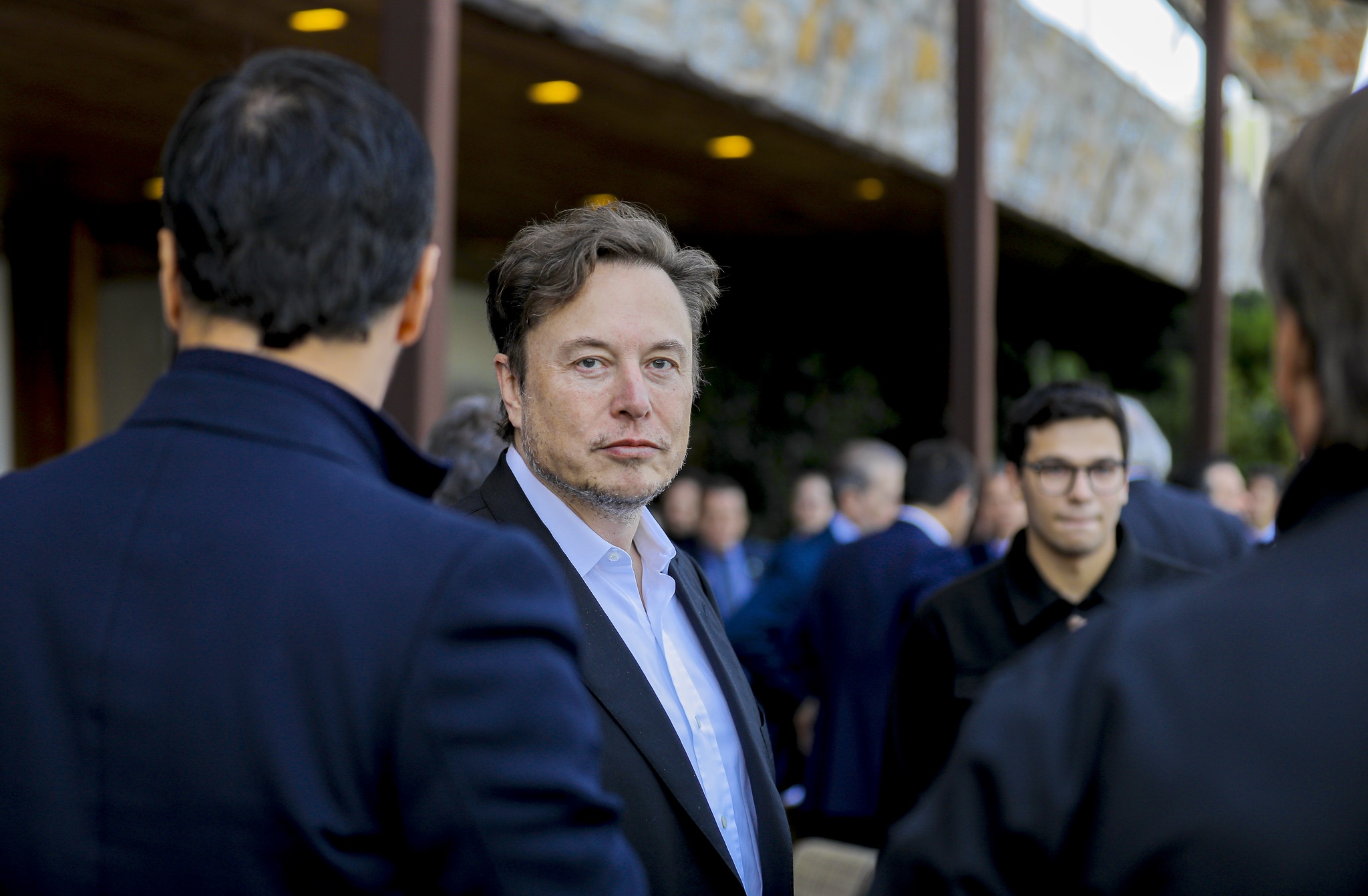
Tesla CEO Elon Musk’s legal team has filed a motion demanding that Delaware Chancellor Kathaleen McCormick disqualify herself from an ongoing high-stakes Tesla shareholder lawsuit.
The filing, submitted March 25, cites an apparent LinkedIn “support” reaction from McCormick’s account to a post celebrating a $2 billion jury verdict against Musk in a separate California securities-fraud case.
The move escalates long-simmering tensions between Musk, Tesla, and the Delaware judiciary, where McCormick previously presided over the landmark challenge to Musk’s record $56 billion 2018 compensation package.
Delaware Supreme Court reinstates Elon Musk’s 2018 Tesla CEO pay package
The LinkedIn post was written by Harry Plotkin, a Southern California jury consultant who assisted the plaintiffs who sued Musk over 2022 tweets about his Twitter acquisition. Plotkin praised the trial team for “standing up for the little guy against the richest man in the world.”
The New York Post initially reported the story.
A banner on the post read “Katie McCormick supports this,” using LinkedIn’s heart-in-hand “support” icon, an endorsement stronger than a simple “like.” Musk’s lawyers argue the action creates “a perception of bias against Mr. Musk,” warranting immediate recusal to preserve judicial impartiality.
This appears to be unequivocal proof she denied the pay package because of her own personal beliefs and not the law.
Corruption. https://t.co/8dvgcfYuvh
— TESLARATI (@Teslarati) March 25, 2026
McCormick swiftly denied intentional endorsement. In a letter to attorneys, she stated she was unaware of the interaction until LinkedIn notified her. She wrote:
“I either did not click the ‘support’ icon at all, or I did so accidentally. I do not believe that I did it accidentally.”
The chancellor maintains the reaction was inadvertent, but critics, including Musk allies, call the explanation implausible given the platform’s deliberate interface.
McCormick’s central role in the Tesla pay-package litigation underscores the stakes. In Tornetta v. Musk, in January 2024, she ruled the 2018 performance-based stock-option grant, potentially worth $56 billion at the time and now valued far higher, was invalid.
The package consisted of 12 tranches of options, each vesting only after Tesla achieved ambitious market-cap and operational milestones. McCormick found Musk exercised “transaction-specific control” over Tesla as a controlling stockholder, the board lacked sufficient independence, and proxy disclosures to shareholders were materially deficient.
Applying the entire-fairness standard, she concluded defendants failed to prove the deal was fair in process or price and ordered full rescission, an “unfathomable” remedy she described as necessary to deter fiduciary breaches.
After the ruling, Tesla shareholders ratified the package a second time in June 2024. McCormick rejected that ratification in December 2024, holding that post-trial votes could not cure defects.
Tesla appealed. On December 19 of last year, the Delaware Supreme Court unanimously reversed the rescission remedy while largely leaving McCormick’s liability findings intact. The high court deemed total unwinding inequitable and impractical, restoring the package but awarding the plaintiff only nominal $1 damages plus reduced attorneys’ fees. Musk ultimately received the full award.
The current recusal motion arises in yet another Tesla derivative suit before McCormick. Legal observers say granting it could signal heightened scrutiny of judicial social-media activity; denial might reinforce perceptions of an insular Delaware bench.
Broader fallout includes accelerated corporate migration out of Delaware, Musk himself moved Tesla’s incorporation to Texas after the first ruling, and renewed debate over whether the state’s specialized courts remain the gold standard for corporate governance disputes.
A decision is expected soon; whichever way it lands, the episode highlights the fragile balance between judicial independence and public confidence in high-profile litigation.
Elon Musk
Elon Musk says Tesla is developing a new vehicle: ‘Way cooler than a minivan’
It sounds as if Tesla could be considering a new vehicle to fit the mold of what a larger family would need, and as fans have been demanding it for several years and the company is phasing out the Model X, its only family-geared vehicle, it sounds as if it could be the perfect time.
Tesla CEO Elon Musk said the company is developing a new vehicle, and it will be “way cooler than a minivan.”
It sounds as if Tesla could be considering a new vehicle to fit the mold of what a larger family would need, and as fans have been demanding it for several years and the company is phasing out the Model X, its only family-geared vehicle, it sounds as if it could be the perfect time.
There are a handful of things Musk could be talking about, and as many Tesla owners have wanted a vehicle along the lines of a minivan for hauling around their family, speculation has persisted about what the company would do in terms of developing something for that exact use case.
There were several options, and some of them seemed to be already available. Musk posted on X yesterday that the Cybertruck has three sets of isofix attachments and could fit three child seats or three adults, and it seemed to be a way to deflect plans for a new, larger vehicle as a Model Y L appeared to be present at Giga Texas.
There is also the Robovan, the large people mover that Tesla unveiled at the “We, Robot” back in 2024.
Something way cooler than a minivan is coming
— Elon Musk (@elonmusk) March 25, 2026
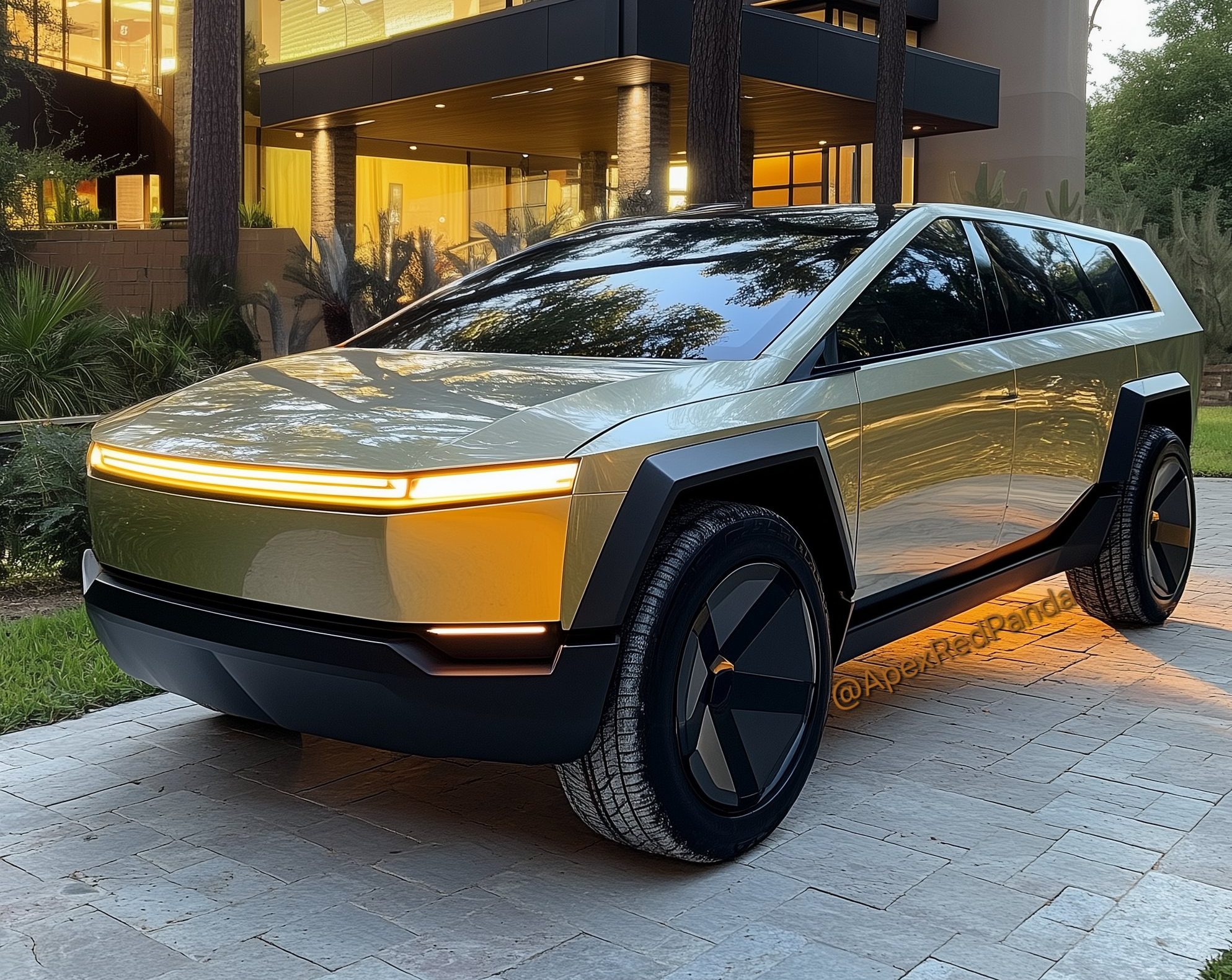
However, it seems Tesla could be developing something like a CyberSUV, something that is going to be large enough to haul around a car full of kids, but could be developed with the company’s aesthetic of the company’s most recent releases: this would likely include a light bar and a more sleek, futuristic look.
We’ve mocked up some potential looks for Tesla’s speculative vehicle in the past:
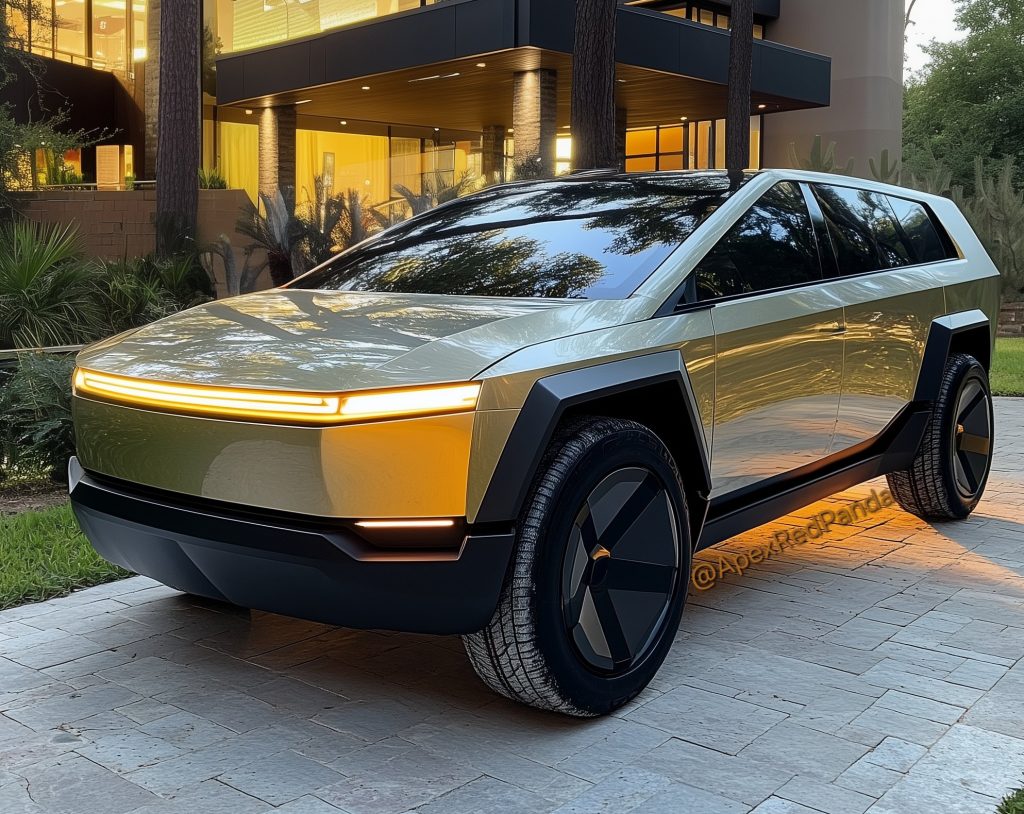
Tesla has teased the potential of a CyberSUV in the past, showing off clay models that it developed back in September in a teaser video called “Sustainable Abundance.”
Fans and owners have been calling for this development for a very long time, and it seems like Tesla might be ready to finally answer the call on a large SUV. With the segment being dominated by combustion engine vehicles, Tesla could truly disrupt the large SUVs that have been mainstays.
The Chevrolet Tahoe and GMC Yukon would feel some additional pressure, and it would be possible for Tesla to infiltrate some of those sales and pull consumers to electric powertrains.
As the Model S and Model X sunset process is truly hitting full swing, it might be time to consider Tesla’s next option in terms of vehicle development.

Tesla’s newest “Folding V4 Superchargers” are key to its most aggressive expansion yet

The Boring Company clears final Nashville hurdle: Music City loop is full speed ahead

Elon Musk demands Delaware Judge recuse herself after ‘support’ post celebrating $2B court loss

Elon Musk says Tesla is developing a new vehicle: ‘Way cooler than a minivan’

What is Digital Optimus? The new Tesla and xAI project explained


