News
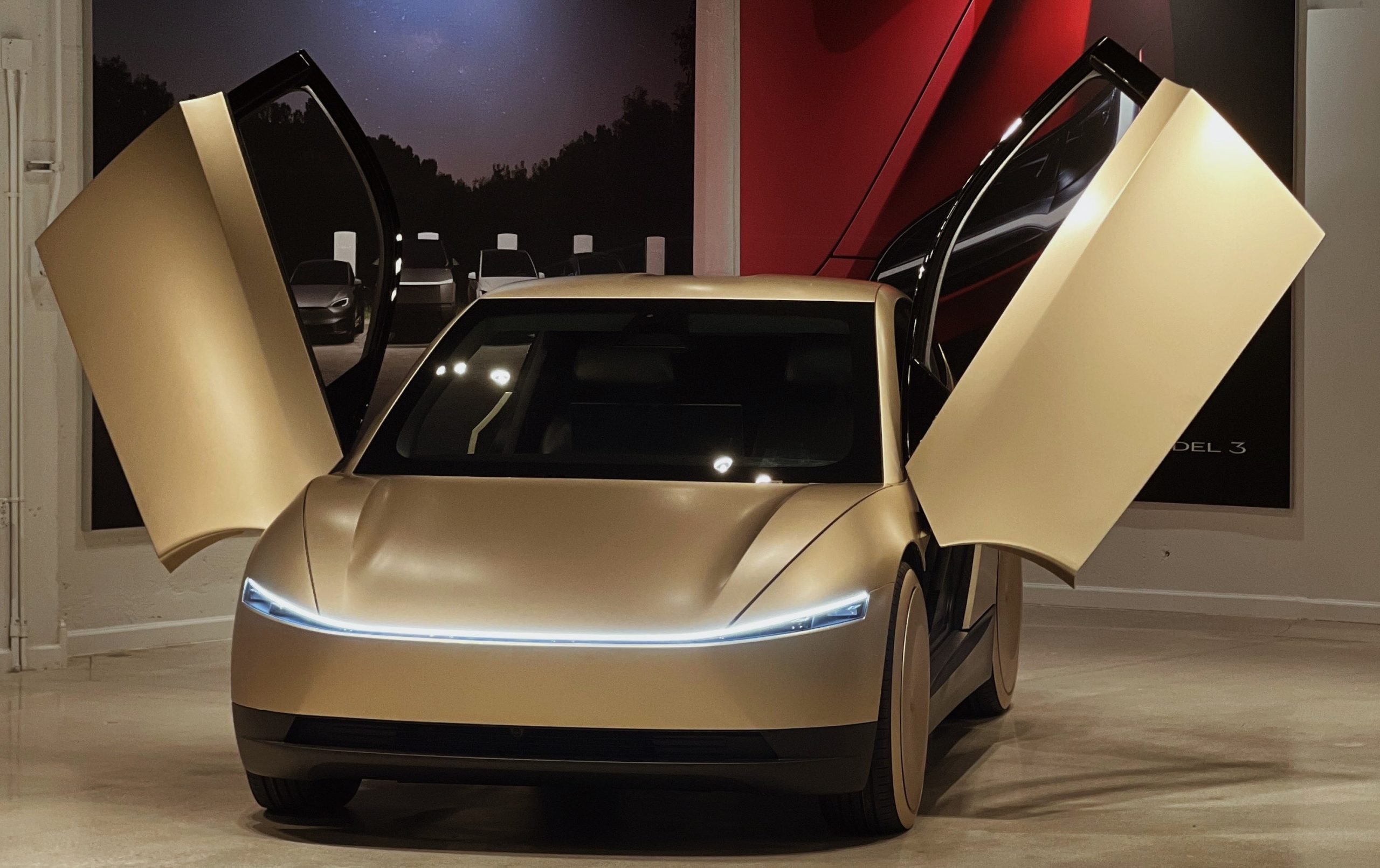
The secret behind Tesla’s Cybercab Gold goes well beyond just the color

Tesla has spent years trying to engineer its way out of the automotive paint shop, one of the most expensive, space-consuming, and environmentally costly steps in vehicle manufacturing. With the Cybercab, Tesla confirmed on X this week that a new reaction injection molding process will embed color directly into the panel itself during production.
“Our new reaction injection molding (RIM) process shrinks Cybercab paint cycles from hours to minutes. This cuts those parts’ manufacturing and supply chain emissions by 35% and eliminating 100% of paint volatile organic compounds (VOCs) emitted in traditional paint methods.” noted Tesla.
While the RIM process isn’t necessarily new and has existed since the 1960s, what makes Tesla’s application notable is how it is being used specifically for exterior body panels that traditionally required a separate paint process after forming.
Tesla’s RIM approach integrates the color directly into the panel material during the molding process itself. The pigment is part of the polymer mix injected into the mold, meaning the panel comes out of the mold already colored, with no separate paint application required. The clear coat or protective layer can be applied at the mold stage or through a much faster post-process than traditional multi-stage painting. Tesla claims this compresses what was a multi-hour paint cycle into minutes per panel.
Tesla’s obsession with killing the paint shop is one of the most consistent threads running through the company’s manufacturing philosophy going back years. As far back as 2018, Musk was trimming paint color options to simplify production, tweeting at the time: “Moving 2 of 7 Tesla colors off menu on Wednesday to simplify manufacturing.” Two years later, in a 2020 Automotive News interview, Musk laid out his broader vision, saying he believed Tesla factories could one day be 1,000 times more efficient than conventional plants, and pointing to the paint shop as one of the biggest sources of waste, cost, and complexity. The Cybertruck was the most extreme expression of that thinking. Tesla chose an unpainted stainless steel exterior partly because it would eliminate the need for a $200 million paint facility at Gigafactory Texas. The stainless approach proved harder and more expensive than anticipated, but the underlying ambition never changed. The Cybercab is what happens when that same ambition meets a manufacturing process that delivers on it.


Elon Musk
Elon Musk will give every American kid a SpaceX share every year
Elon Musk’s SpaceX stock giveaway to American kids just became something that repeats every year.
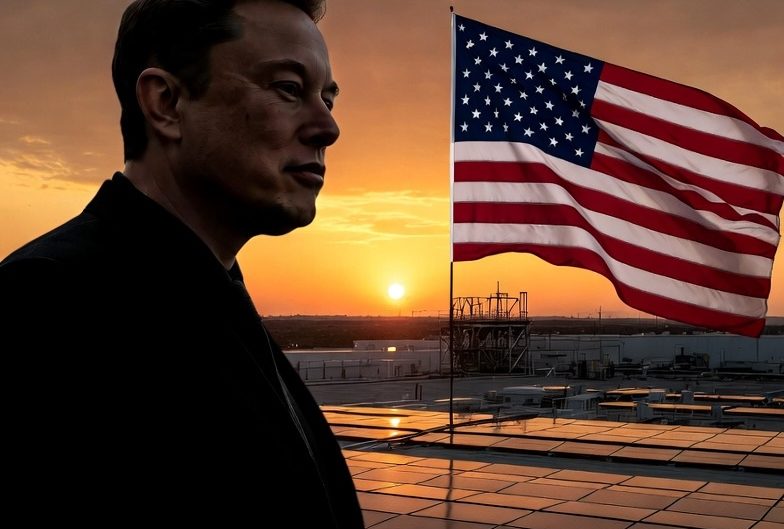
Elon Musk says the SpaceX shares headed to American children will not be a one time gift.
“I will be donating another share of SpaceX to all kids in America every year,” Musk wrote on X on Thanksgiving. He later quoted Sawyer Merritt’s estimate that the pledge covers about 70 million children, adding, “Vital that children have a stake in the future.”
At Wednesday’s closing price of $127.44, one share for 70 million children works out to roughly $9 billion a year, a figure that would rise or fall with SpaceX’s stock. Musk did not say how the annual shares would be distributed or whether they would also flow through Trump Accounts.
Vital that children have a stake in the future — Elon Musk (@elonmusk) November 27, 2026
The yearly pledge builds on an announcement made a day earlier. SpaceX said Wednesday it will donate one newly issued class A share to every currently active Trump Account, with Musk personally matching the gift. “Every child in America will receive two SpaceX shares, one from the company and one from me personally,” Musk wrote.
Combined with President and COO Gwynne Shotwell’s pledge of more than 2 million shares, that first round totals about 142 million shares worth roughly $18.1 billion. Musk said SpaceX’s share will be transferred next month, while “the share directly from me will be transferred when my lockup expires in June next year.”

Musk also offered the new shareholders some advice. “If SpaceX succeeds in making life multiplanetary and harnessing even a millionth of the Sun’s energy, it will be worth about a million times the current global economy,” he wrote, calling the goals “absurdly difficult” before adding, “I recommend holding on to your shares.”
The giveaway has grown quickly since October, when Musk first promised a SpaceX share to “every kid in America” in 2027. Shotwell had already committed her own stock to Trump Accounts, with those shares due to reach eligible children in December.
Trump Accounts, also known as 530A accounts, are tax advantaged investment accounts open to any U.S. child under 18 with a Social Security number. The White House said in October that nearly 70 million had been opened, more than 60 million of them through automatic enrollment, though it is unclear how many count as active.
The first gift was announced hours after the FCC authorized SpaceX to deploy up to 1 million Starmind data center satellites. It also arrives as Tesla and SpaceX special committees negotiate a possible all stock merger, which would make every child holding SpaceX stock an owner of the combined company if a deal closes.

Tesla removed the most annoying part of Full Self-Driving with its latest v15 release. The suite, which aims to reduce critical interventions by 25-times, is no longer looking for input on why you took over.
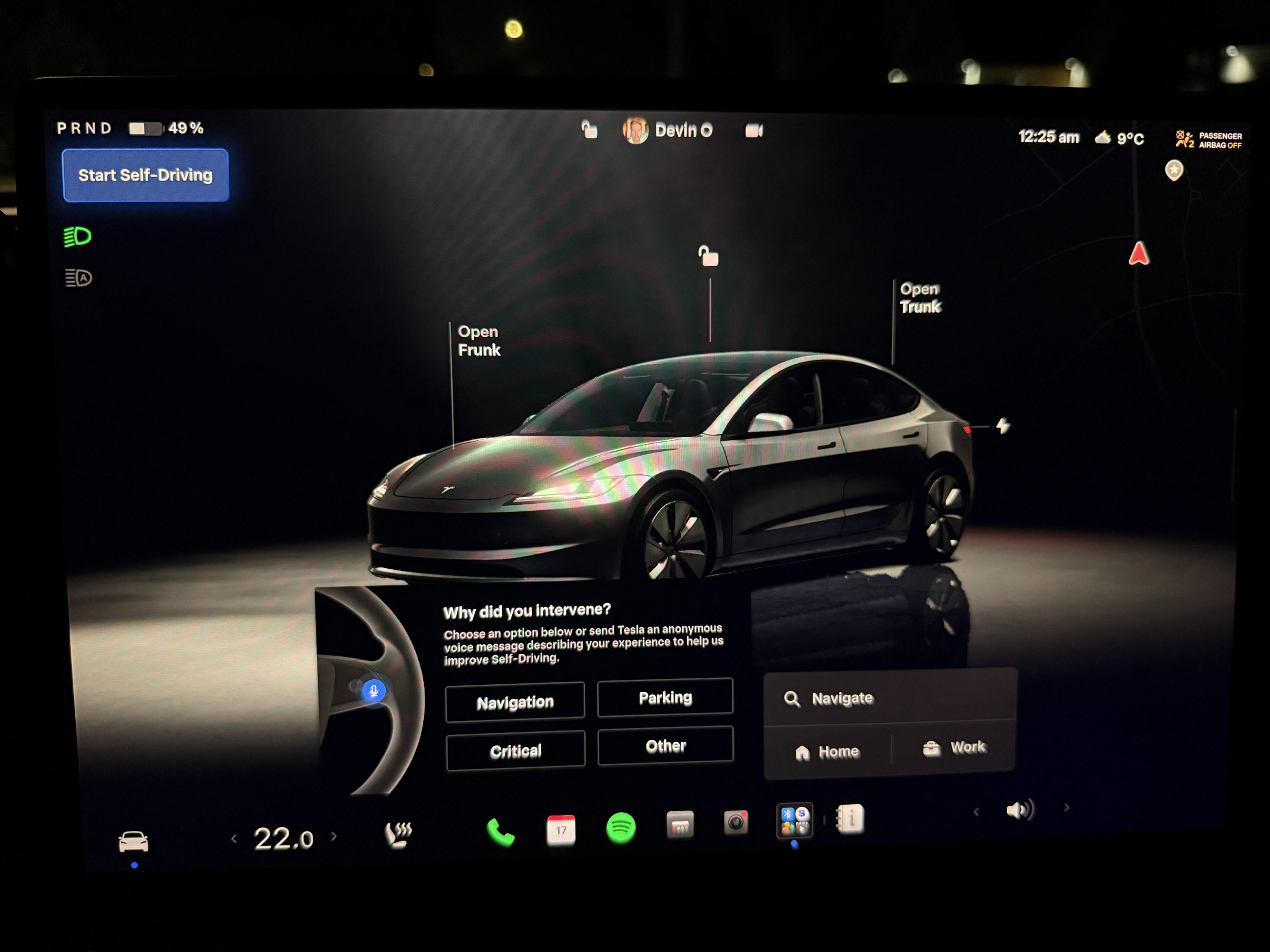
As FSD v15 rolled out last weekend, perhaps one of the first things I noticed as an Early Access Program (EAP) member is that Tesla had finally removed the Interventions Menu:
🚨 Tesla has removed the Interventions Menu when you take over FSD: https://t.co/H3YGhnAy1c
— TESLARATI (@Teslarati) November 22, 2026
With the Full Self-Driving v14 update, Tesla implemented an Interventions Menu, a short list of four options; Parking, Navigation, Critical, and Other. These were the options given to drivers to give immediate feedback directly to Tesla as to why their FSD suite was interrupted from operation.
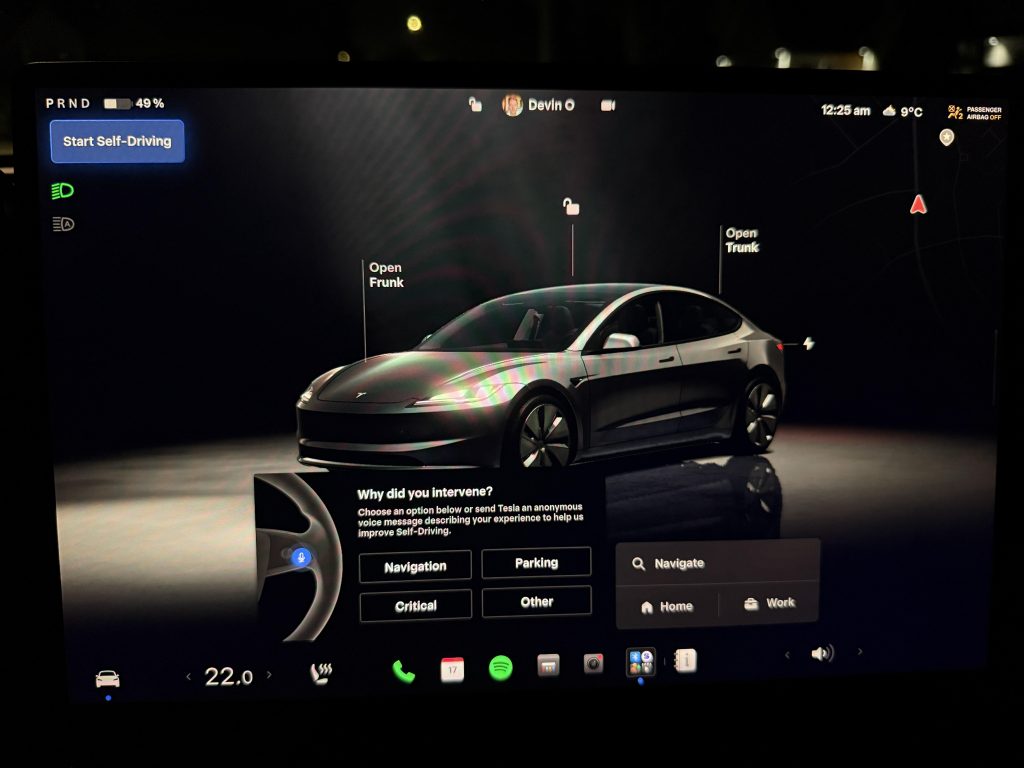
Credit: Devin Olsen
The issue with the menu was it did not go away without an input. The only way to truly avoid it was to be on a phone call when taking over, as it would not appear. However, many owners indicated they were so annoyed with the menu, they would simply input each reason as “Critical,” which is usually reserved for major instances.
It is unclear whether Tesla removed the Intervention Menu because of the complaints owners gave about its required nature, differing from past input methods that were totally optional, or if the company is simply taking it away because it feels it does not need it.
The FSD v15 suite is already incredibly robust in terms of performance, as it comes with a variety of new features including pothole and debris avoidance, Navigation fixes, and the new Reality View function that has truly stolen the show.
Overall, the removal of the Interventions Menu is a welcome change and I believe many owners will also find that FSD is simply more pleasant to use when you do not have to justify why you took over. It seems to me that Tesla will be able to utilize its SI to determine the cause of the intervention, instead of having owners, in a fit of annoyance, simply press whichever option their finger happens to land on first.
Elon Musk
SpaceX rejects $738M fed subsidy, betting on Starlink alone
SpaceX gave up hundreds of millions in broadband grants, yet Starlink is still showing up.
SpaceX is walking away from roughly $738 million in federal broadband subsidies while still committing to connect the rural homes and businesses Starlink won under the program.
The National Telecommunications and Information Administration (NTIA) said SpaceX will serve every location awarded to it under the Broadband Equity, Access, and Deployment (BEAD) program at no cost to the program. A senior NTIA official told Broadband Breakfast that SpaceX approached the agency with the idea after struggling with differing contract terms across all 50 states, including state demands for financial reporting and penalties for defaulting.
“I am pleased this new agreement has the potential to save taxpayers hundreds of millions of dollars while getting more Americans connected faster,” NTIA Administrator Arielle Roth said. Telecompetitor, citing administration officials, put the forgone amount lower, at about $636 million.
Under NTIA’s new model agreement, SpaceX must still meet BEAD’s minimum speeds of 100 Mbps down and 20 Mbps up, pass the program’s performance testing, and file a report every six months. New subscribers at covered locations will receive the Starlink dish and router at no cost, and SpaceX must offer a low cost service plan. The monthly subscription itself is not waived.
The deal drops BEAD’s financial audit, procurement, and reporting provisions. States also cannot levy penalties if SpaceX falls short, and their only remedy is to return those locations to the program for a new award.
State broadband offices now have two options: sign the model agreement or rebid the SpaceX locations at a cost in line with their already approved plans. Some states had already signed contracts with SpaceX, but the NTIA official said those agreements are no longer on the table. Two state officials told Broadband Breakfast the directive caught states by surprise.
SpaceX still gains something by staying in. Holding its BEAD locations with a $0 award keeps other federal broadband money from flowing to competitors in those rural areas, according to the NTIA official.
Starlink’s role in BEAD expanded after NTIA’s 2025 “Benefit of the Bargain” overhaul dropped the program’s preference for fiber and opened awards to low Earth orbit satellite providers. Arizona, for example, awarded SpaceX $17.1 million to cover 10,749 locations, while Virginia awarded $3.3 million for 5,579.
Elon Musk reshared Sawyer Merritt’s summary of the NTIA terms on X, adding a single word: “Starlink.” The move comes a week after Musk said the FAA turned down a free Starlink offer before a nationwide ground stop, a claim that drew a public rebuttal from Transportation Secretary Sean Duffy. Musk has also hinted that Starlink could come to every Tesla as the company pursues Unsupervised FSD.

Elon Musk will give every American kid a SpaceX share every year

Tesla removed the most annoying part of Full Self-Driving


