Investor's Corner
Tesla shares show resilience amid longtime TSLA bull’s more conservative outlook

Tesla stock (NASDAQ:TSLA) is proving quite resilient on Thursday morning, maintaining its gains despite the release of a more conservative outlook from one of the company’s most notable bulls. In a recent note, Baird analyst Ben Kallo, who has long held a bullish outlook on the company, adopted a more conservative price target and earnings per share estimate on Tesla.
In a note, Kallo lowered his price target for TSLA stock from $465 to $400, which is more conservative but still about 25% above FactSet’s average of $318 per share. The Baird analyst explained that Tesla’s lower-than-expected first-quarter deliveries proved insufficient to change the negative sentiments against the company today. “We were wrong. Disappointing first-quarter deliveries were not sufficient to improve what we believed was overly negative sentiment,” he wrote.
Apart from his more conservative $400 per share price target, Kallo also adjusted his earnings per share estimates for 2019 and 2020 to $1.82 and $6.92, respectively, from $3.67 and $12.15. These new estimates are closer to current Wall Street consensus. Yet, despite his more cautious stance in the near-term, Kallo maintained that his long-term expectations for Tesla remain optimistic. The Baird analyst noted that Tesla is still poised to be a “major disruptor,” though it might take some time before sentiments for the company improve.
“We continue to view Tesla as a major disrupter and think new product introductions, production ramps, and further development of innovative technologies will drive growth. While we acknowledge it may take time for sentiment to improve, over time we think shares will move higher as the company executes on its growth strategy,” Kallo wrote.
Tesla stock has been weighed down by the results of its Q1 2019 vehicle delivery and production report, which saw electric car deliveries fall by around 30% compared to Q4 2018. Production in the first quarter was also around 12% lower than the previous quarter’s figures, with the company producing a total of 77,100 vehicles. These figures, together with continuing questions about the demand for the company’s electric cars, have resulted in a notable slide for TSLA stock this month.
Some of these reservations will hopefully be addressed this coming April 24, when Tesla is expected to hold its first-quarter earnings call. Elon Musk has proven conservative about Tesla’s chances in Q1, stating during the introduction of the Standard Model 3 that he does not expect the company to be profitable in the first quarter. “Given that there is a lot happening in Q1, and we are taking a lot of one time charges, there are a lot of challenges getting cars to China and Europe, we do not expect to be profitable. We do think that profitability in Q2 is likely,” Musk said.
As of writing, Tesla stock is trading (+0.62%) at $272.92 per share.
Disclosure: I have no ownership in shares of TSLA and have no plans to initiate any positions within 72 hours.



Tesla has its answer to grow its automotive sales over the next few years, TD Cowen analyst Itay Michaeli says, but it just has to bring it to the U.S.
On Thursday, Michaeli reiterated his $490 price target and the ‘Buy’ rating he already held on Tesla stock (NASDAQ: TSLA). However, its automotive division has struggled to show sequential growth over the past few years, mostly due to its focus on AI and Full Self-Driving. Tesla already axed two of its lower-volume vehicles with the Model S and Model X earlier this year.
However, Tesla does not need to engineer an entire new vehicle to trigger an upward tick in sales; it just has to bring it from China to the U.S., Michaeli said.
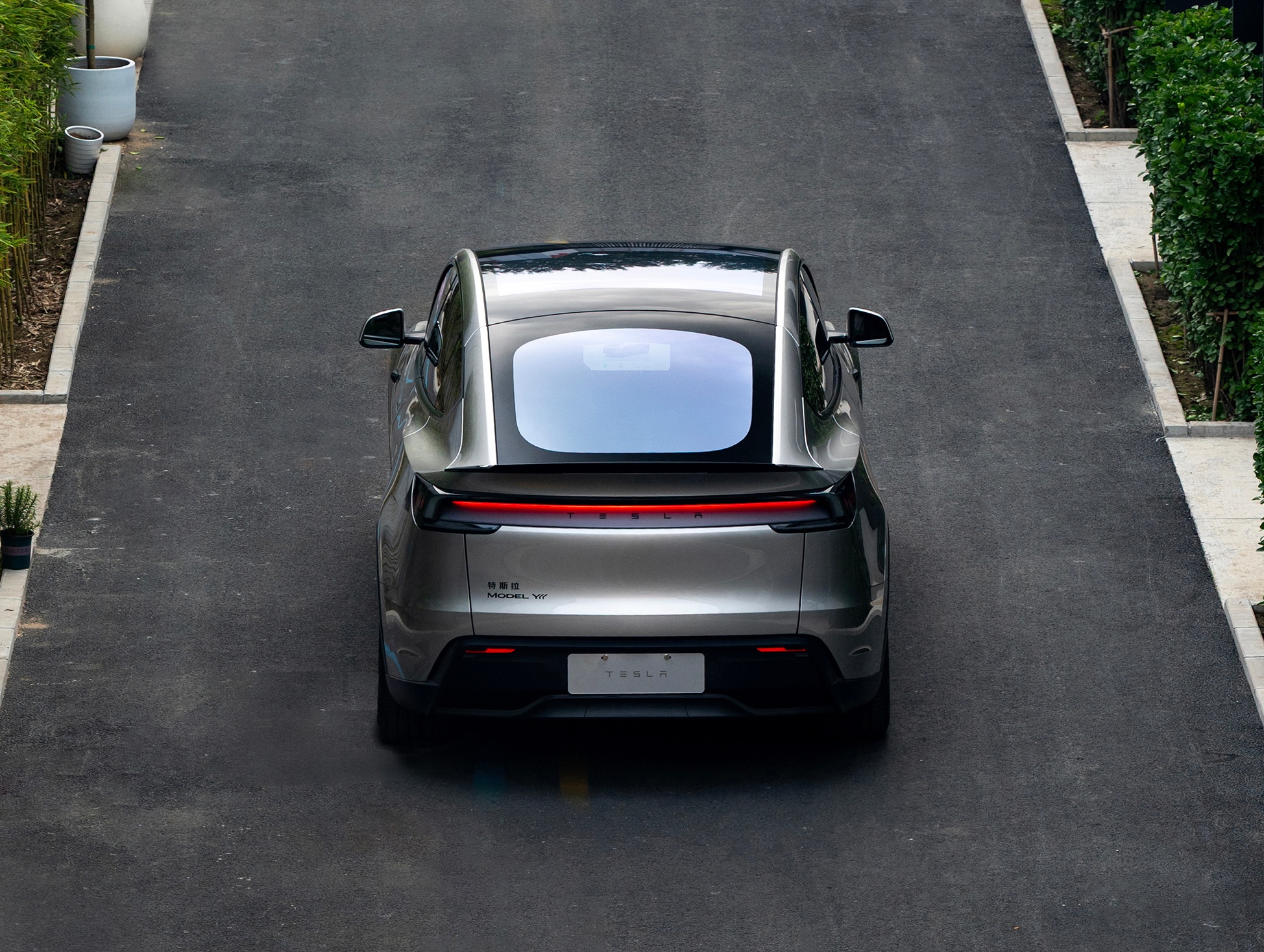
He is talking about the Model Y L, a slightly larger version of the all-electric crossover that is already available in China. U.S. customers have been pleading with CEO Elon Musk to bring it to the country since its launch in Asia last year, but he’s not convinced of it because of the advent of self-driving and its importance in this particular market.
The problem is that Tesla owners have been requesting something larger that could fit a typical American family. The Model Y L is slightly larger than the standard Model Y, but some are concerned that it could still be too small to fit what most people might need.
Instead, they have asked for a full-size SUV from Tesla.
Tesla gives big hint that it will build Cyber SUV, smaller Cybertruck
Nevertheless, the Model Y L still presents a great opportunity for Tesla in the U.S., and Michaeli says that there is an additional sales opportunity of about 100,000 units, with demand potential falling somewhere between 60,000 and 135,000 units.
TD Cowen’s note to investors also analyzed that Tesla’s growth could come from a stock perspective as well, positively impacting the stock price, as it has been widely reliant on vehicle sales, even though Tesla has truly phased itself away from that being an important metric.
Tesla stands to gain greatly from the introduction of the Model Y L in the U.S., but only if Elon Musk sees it as a viable fit for the market. Families may need to see Tesla bring something larger to the U.S., or they might be forced to buy from another automaker that offers something that fits is needs for more interior space to haul around the kids.
Elon Musk
SpaceXAI just launched into your kitchen with their new app
SpaceXAI just powered its first consumer app and it predicts what you want to buy.

SpaceXAI just made its first move into consumer AI, and it involves your grocery cart. On June 3, 2026, Gopuff and SpaceXAI announced the launch of Go, a Grok-powered shopping assistant built directly into the Gopuff app that predicts what you need before you even start searching for it.
Gopuff is an instant delivery platform that operates more than 400 micro-fulfillment centers across the U.S., delivering everyday essentials, snacks, drinks, and household items in as little as 15 minutes. It is not a restaurant delivery app or a marketplace. It owns its inventory, controls its warehouses, and handles its own logistics, which means it has built one of the most detailed consumer behavior datasets in retail over its 13-year history.
Go combines SpaceXAI’s advanced reasoning, voice, and image generation models with Gopuff’s dataset of hundreds of millions of orders and real-time cultural signals from X to prepare a suggested cart the moment a customer opens the app. It learns each shopper’s habits and automatically builds a personalized cart based on time of day, location, order history, and real-time indicators. Returning customers can check out with a single tap.
Rather than searching for specific items, users can describe a situation like a game-day party or the desire for a healthy breakfast and Go will assemble a cart automatically. It can also predict when shoppers are running low on items like coffee or paper towels and have them packed and delivered in under 15 minutes. Grok voice integration lets users talk to the app in plain conversational language and check out completely hands-free.
Gopuff co-founder and co-CEO Yakir Gola said: “Today, we believe the greatest friction left in commerce is not delivery or instantaneous access to the essentials customers need. It’s the moment before: the thinking, the deciding, the remembering. We’re combining Gopuff’s demand intelligence with xAI’s frontier reasoning to create an everyday shopping experience that feels like a true extension of you.”
Why SpaceX just made a $60 billion bet on AI coding ahead of historic IPO
The timing carries context beyond the product launch. SpaceXAI was formed after SpaceX completed an all-stock merger with Elon Musk’s xAI earlier this year, folding one of the most advanced AI labs in the world into the same corporate structure as the company preparing what could be the largest IPO in history. SpaceXAI is dipping into consumer-focused AI just as it prepares for its public debut, and while Musk has openly discussed building an everything app, this launch uses Grok to power another company’s product rather than launching a standalone consumer platform. Every consumer-facing deployment of Grok ahead of the IPO roadshow adds tangible evidence that SpaceXAI is not just an infrastructure play but a direct competitor in the AI application layer where OpenAI and Google are already fighting for dominance.
Elon Musk
SpaceX’s amended S-1 is sparking a major Tesla merger conversation
A single line in SpaceX’s amended S-1 just sent Tesla stock down 5% in one day.
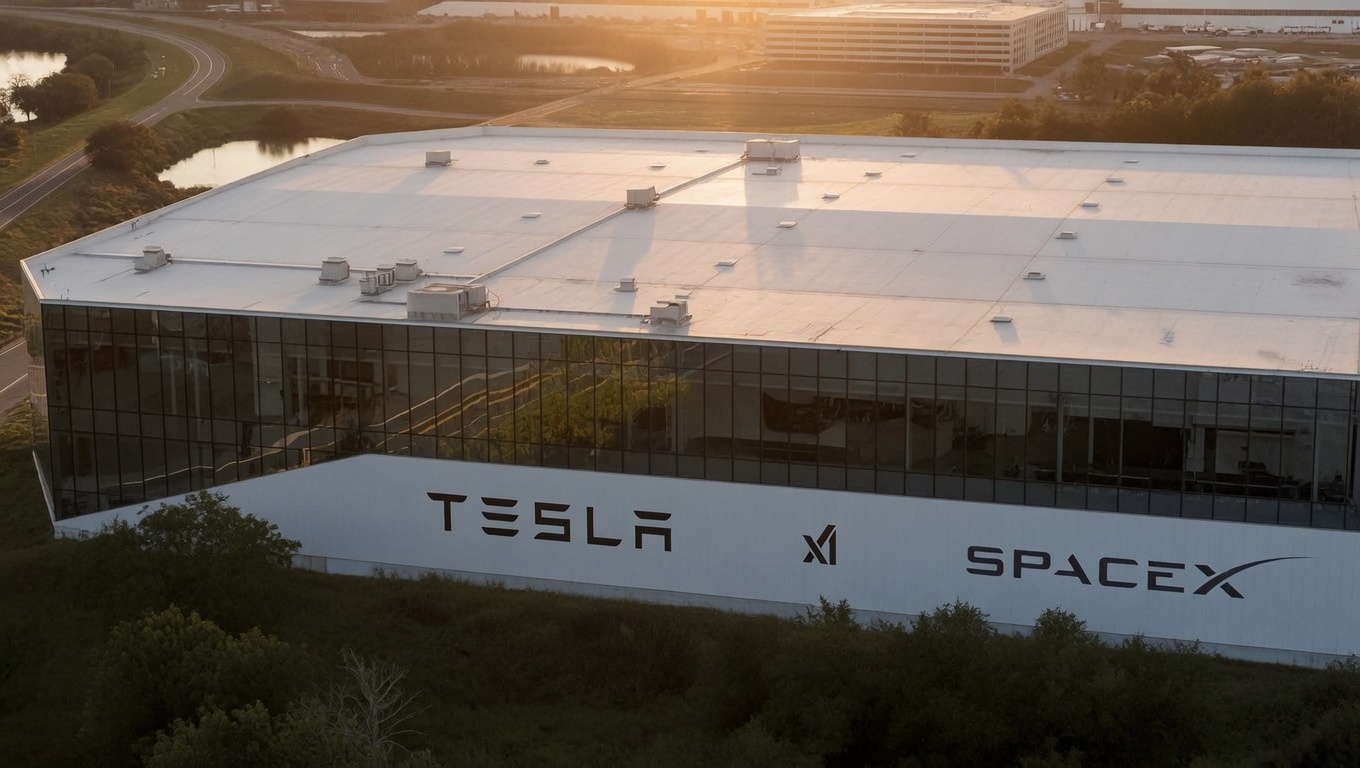
A single line buried in SpaceX’s amended S-1 filing is doing more to move Tesla’s stock price than anything Tesla itself has announced in months. The clause, disclosed as SpaceX prepares for what could be the largest IPO in Wall Street history, states that the company “may issue a significant amount of equity in connection with future transactions.” While this may be seen as boilerplate language in S-1 filings, the historical ties between SpaceX and Tesla, and with Elon Musk reportedly discussing a possible merger with close colleagues, investors are interpreting it as something closer to a signal.
The concern among institutional investors like Gary Black, managing director of The Future Fund, pointed directly to the amended filing on X, saying it “strongly suggests more SPCX equity will be issued,” which could potentially be used to acquire Tesla. He estimated such a deal could be 28% dilutive to Tesla shareholders since SpaceX would likely command a significantly higher valuation multiple. Black added that institutional investors he knows hate the idea of a combination because they prefer pure plays over conglomerates, which he said “nearly always gravitate to the lowest common multiple.”
The Tesla and SpaceX merger everyone is talking about is quietly building
The bull case runs the math differently. Tesla influencer and retail shareholder advocate AleXandra Merz pushed back on what she called a widespread misunderstanding of how merger-of-equals deals actually work. Rather than simply splitting the difference between two market caps, a merger exchange ratio is negotiated based on relative fair market values, meaning the lower valued company typically sees its stock reprice upward toward the deal value.
Under her model, SpaceX enters at a $2.5 trillion valuation and Tesla at $1.6 trillion, producing a combined entity worth $4.1 trillion split evenly between both shareholder groups. That implies Tesla’s side of the deal would be valued at $2.05 trillion, a gain of roughly $450 billion from its current market cap. She cited Dow-DuPont and CBS-Viacom as historical examples of how markets reprice both companies toward the announced exchange ratio after a deal is unveiled.
What does a Merger of Equals mean to Elon’s compensation packages?
Well, it changes everything.
Enjoy https://t.co/uekCldyITw pic.twitter.com/kolq1C9qTu
— AleXandra Merz 🇺🇲 (@TeslaBoomerMama) June 1, 2026
The SpaceX S-1 amendments also revealed just how much financial infrastructure already binds the two companies together. As Teslarati has reported, SpaceX purchased $697 million in Tesla Megapacks, $131 million in Cybertrucks, and the two companies have shared supply chain resources, and semiconductor fabrication plans since well before any merger conversation became public. A retail poll by Tesla influencer Sawyer Merritt is finding that 36% of respondents do not plan to buy SpaceX shares at IPO and 15.3% saying their decision depends on the valuation.
Do you plan on buying @SpaceX stock at its IPO?
— Sawyer Merritt (@SawyerMerritt) June 1, 2026
Whether the merger happens or not, the amended filing is seemingly moving markets and sharpened a debate that is no longer theoretical. SpaceX is weeks away from trading publicly, and Tesla shareholders are now watching every word of every filing for clues about what Musk plans to do next.

Tesla has its answer to auto growth, it just has to bring it to the U.S.: analyst

Tesla Hardware 3 owners could be made whole this month


