Lifestyle
Tesla Model S Roof Rack System (Whispbar) Review

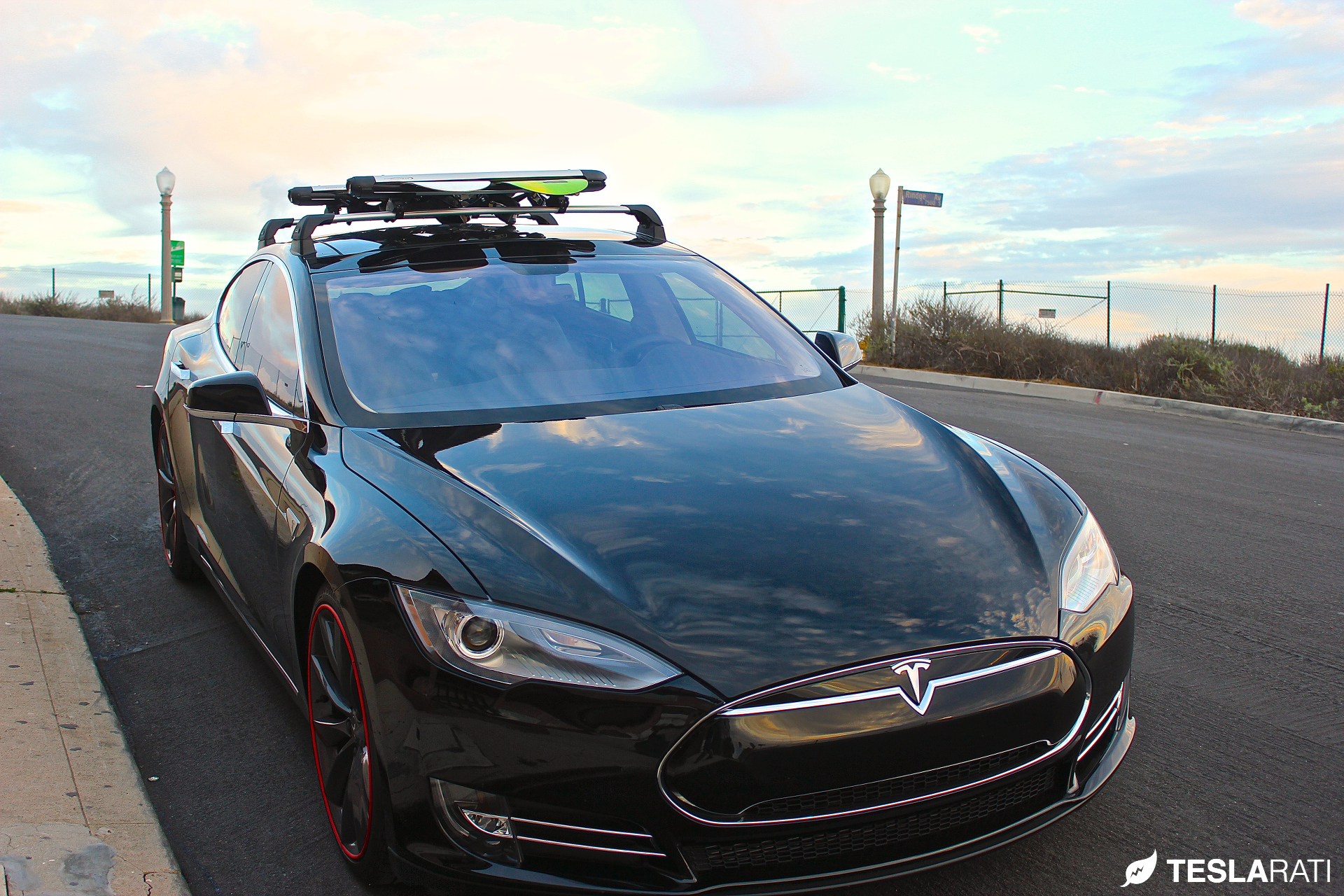
The Tesla Model S Whispbar Roof Rack System is hands down the most technological and elegant roof rack system on the planet, period.
The designers and scientists behind Whispbar, a brand now under the Yakima umbrella, have long been known for designing the world’s quietest roof rack system through relentless pursuit of engineering perfection. We had a chance to review the new Whispbar Tesla Model S Roof Rack System over the last 500+ miles and came up with some findings that may surprise you.
Tesla Model S Roof Rack System by Whispbar
Initial Impression
The Whispbar Tesla Model S Roof Rack System is comprised of two individually packaged components – a universal Whispbar Flush Bar and a Tesla Model S specific mounting kit that secures the Flush Bar to four fixed-point mounts on the roof of the vehicle. Packaging is near Apple caliber and all around superb, with full color printed boxes psychologically gesturing that an amazing road adventure awaits. It worked. Before we knew it, the Whispbar components were unboxed, installed and off on an epic journey.
Features
- Aerodynamic design reduces wind drag and noise up to 70%
- Low drag results in negligible impact on EV battery range
- Low profile and tapered-wing shape makes for an ultra-quiet ride
- Super-lightweight and corrosion resistant aluminum construction
- Quick disconnect and built-in channel technology lets you mount a variety of carriers and accessories onto the Flush Bar
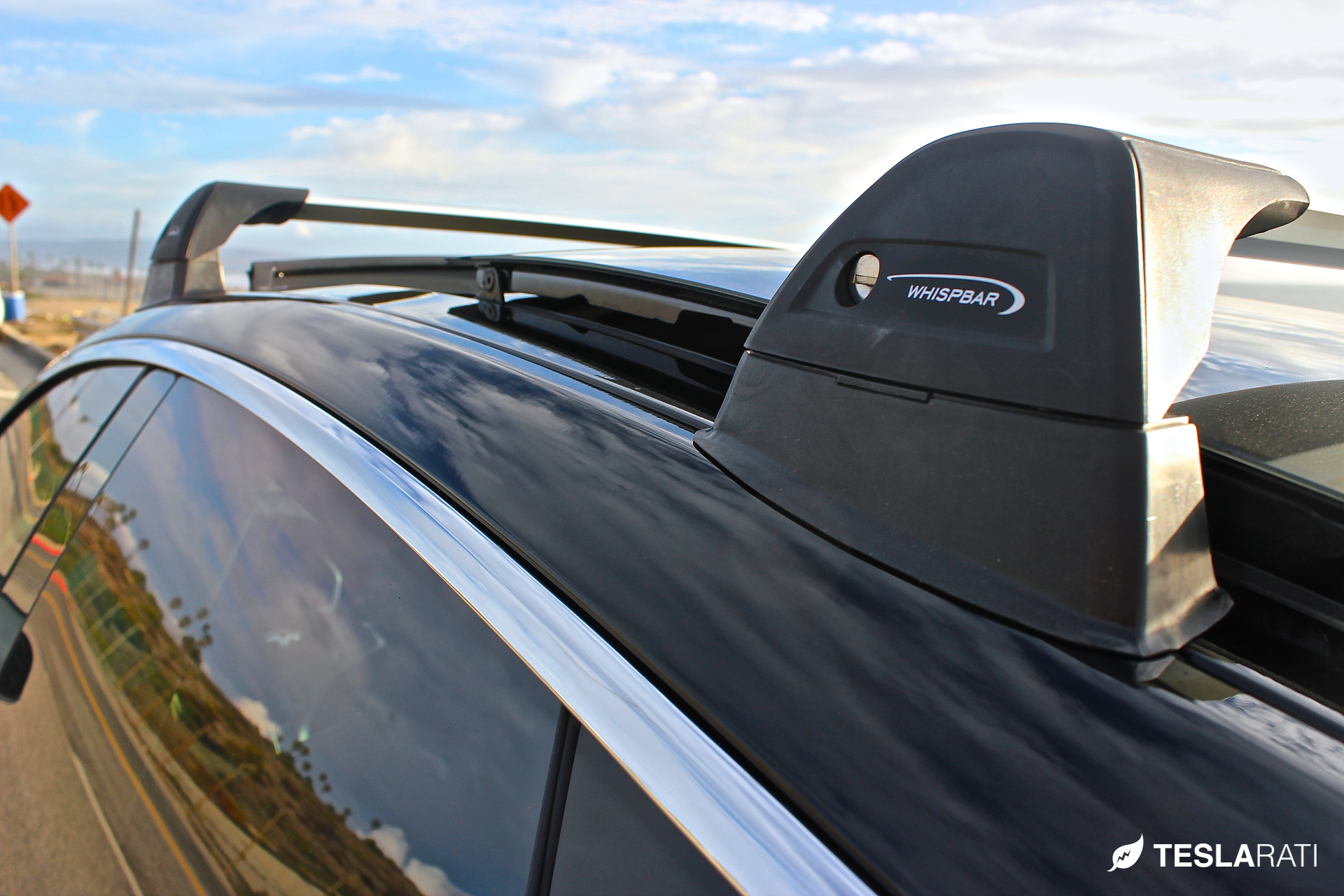
- Innovative SmartFoot towers ensure quick and easy installation on your roof
- Patented Yakima Same Key System (SKS) technology uses lock cores that lock and unlock with the same key, eliminating the hassle of multiple keys.
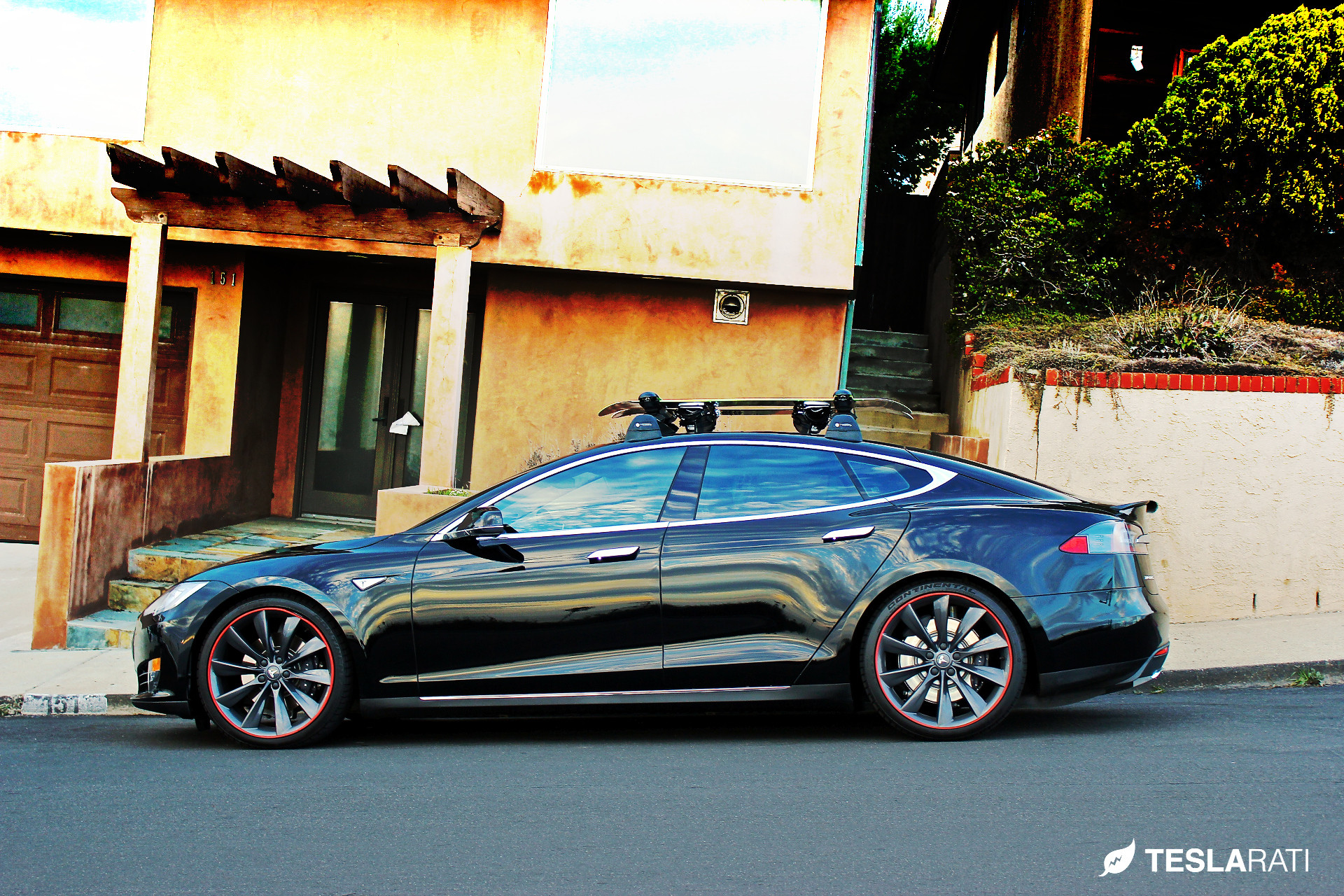
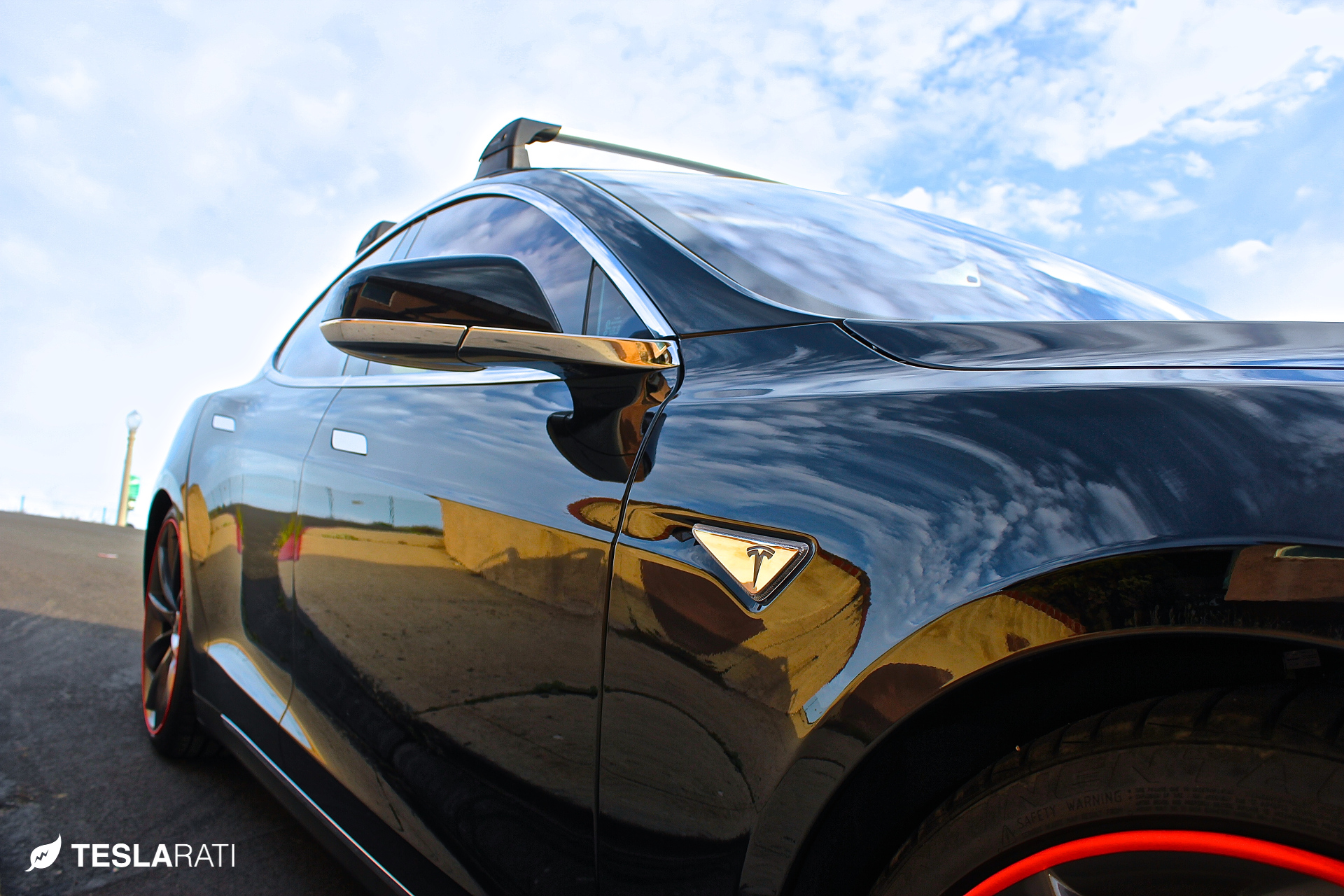
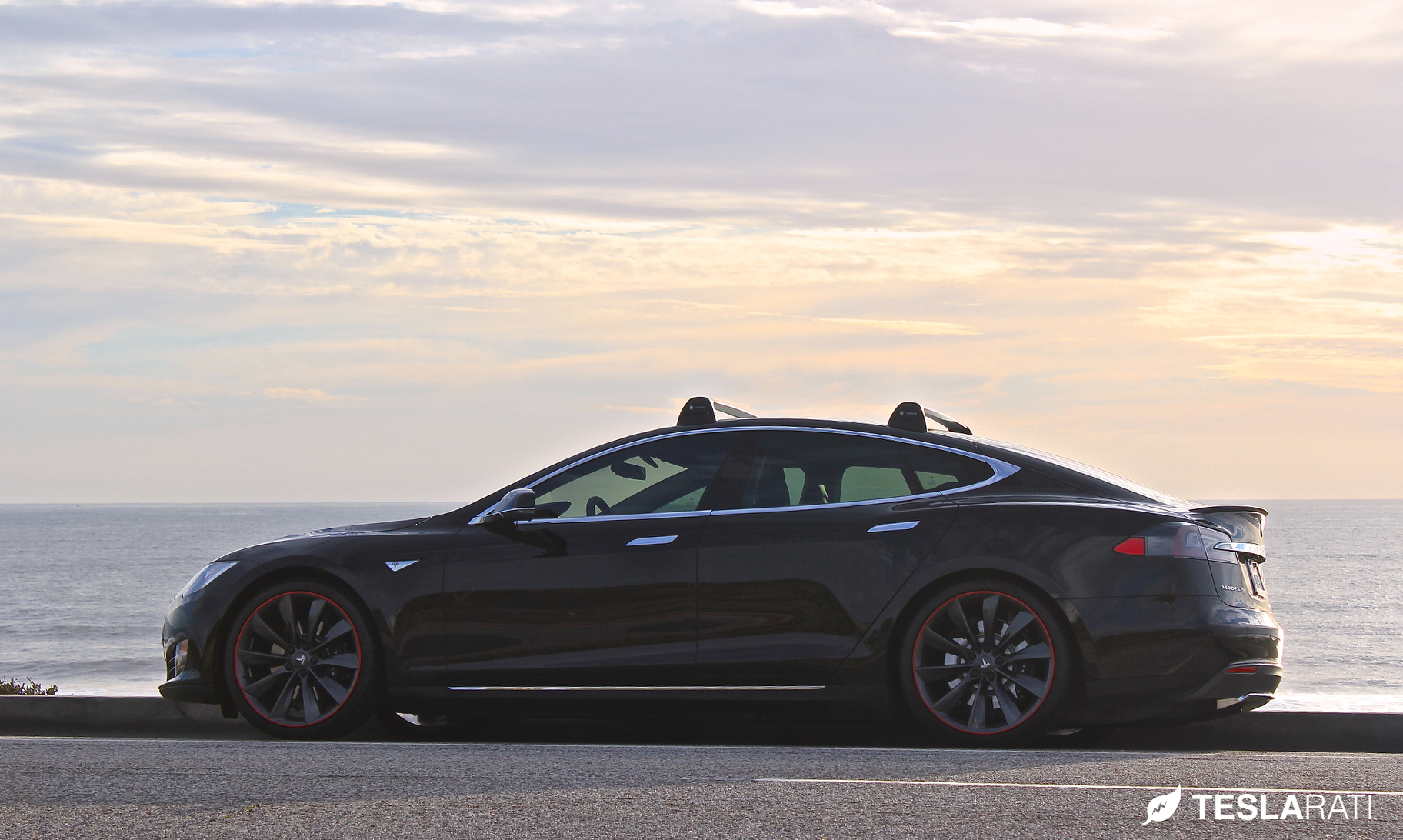
- Ultra-sleek design blends into the curves of the Tesla Model S and hardly noticeable
Whispbar Technology
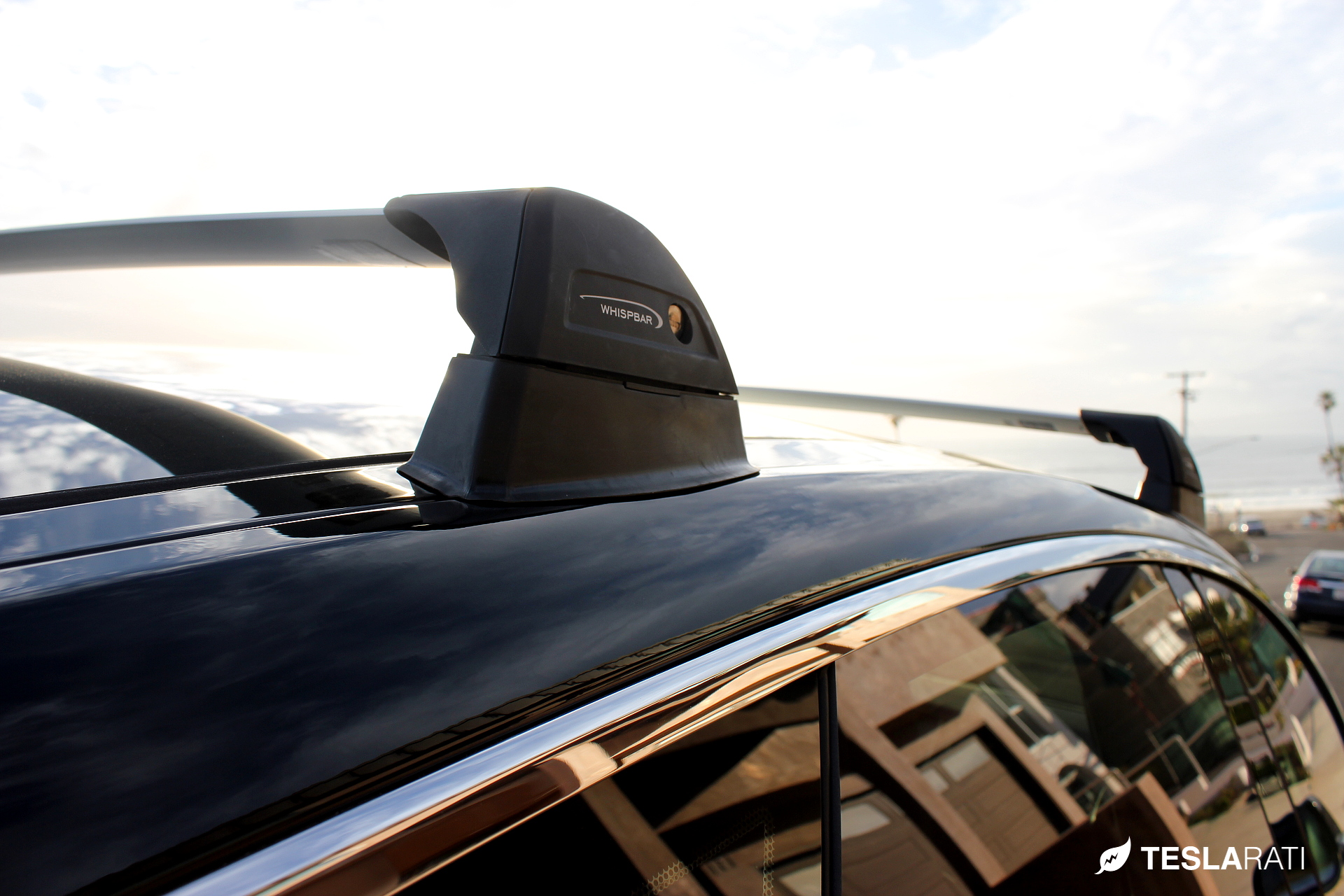 Design and Aerodynamics: The unique wing shape of the Whispbar Flush Bar is what really makes this roof rack system stand apart form its competitors. We’ve never seen anything like this before, both from a design perspective and aesthetic point of view.
The beautifully sculpted shape, said to reduce noise and wind drag by 70% over other crossbars, is an art piece in itself, and frankly made us instinctively handle the component as if it were a piece of fine jewelry. We found ourselves constantly wiping our fingerprints off of the polished aluminum finish in order to keep it as pristine and elegant as it naturally is. But don’t let the gorgeous looks fool you. The Whispbar Tesla Model S Rook Rack System is as rugged and durable as they come – capable of carrying cargo and withstand up to 165 lbs (75 kg) of load.
Installation
Having installed several roof rack systems before, we were armed with our usual Phillips screwdriver, Torx drivers and our folding hex key set, all which turned out to be valueless. Whispbar comes prepackaged with everything you’ll need for the installation which consists of a single T-handle hex key and some basic instructions.
Installation was fairly simple after we figured out how to mount the first of four mounting points, however documentation could have been a bit clearer especially when describing the procedure of replacing the Flush Bar slide-out plastic mounting blocks with those from the Tesla Model S SmartFoot kit (#K704W). We spent a good 15 minutes trying to figure out this portion of the installation process, presumably because we received one of the earlier versions of the documentation right as it was about to hit market, or we have a much lower brain cell count than the average human (most likely). We’ll let you figure that one out.
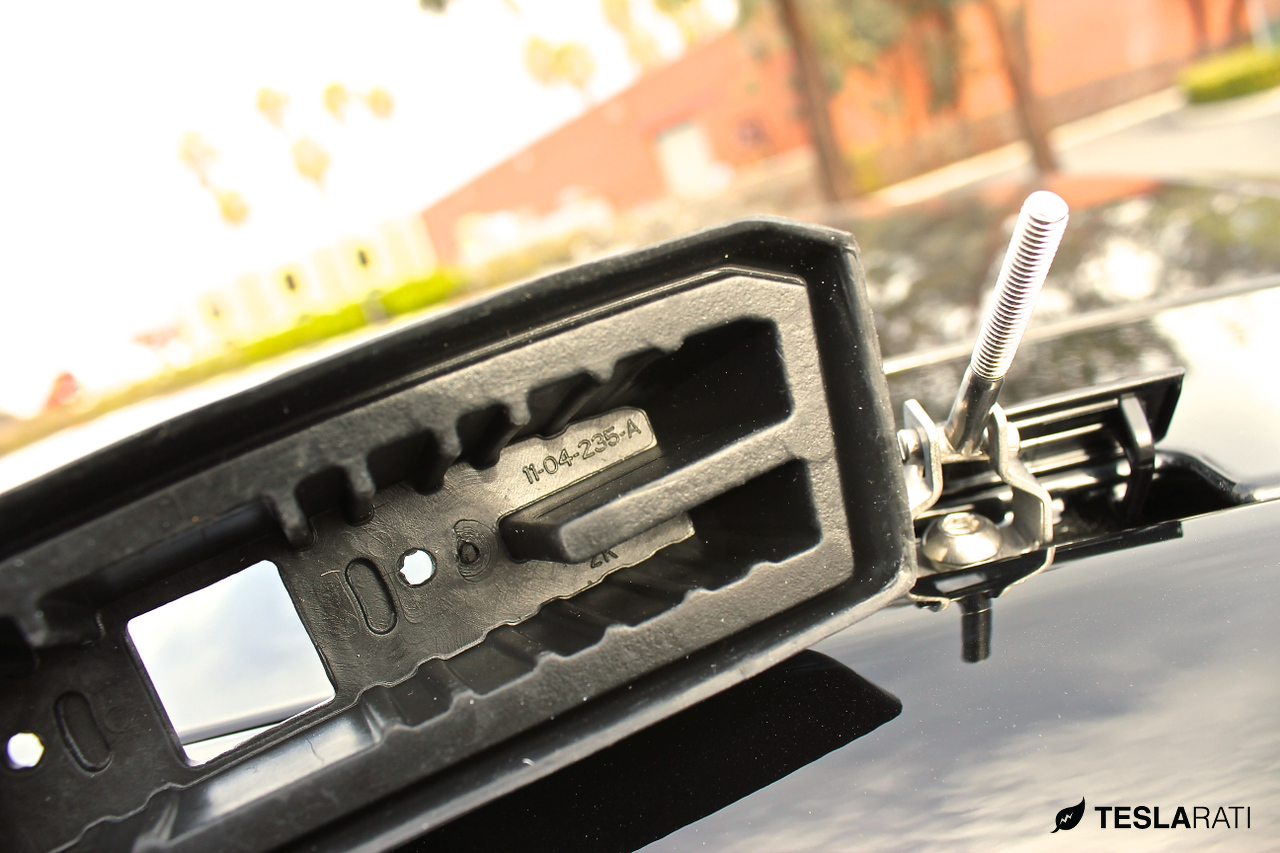
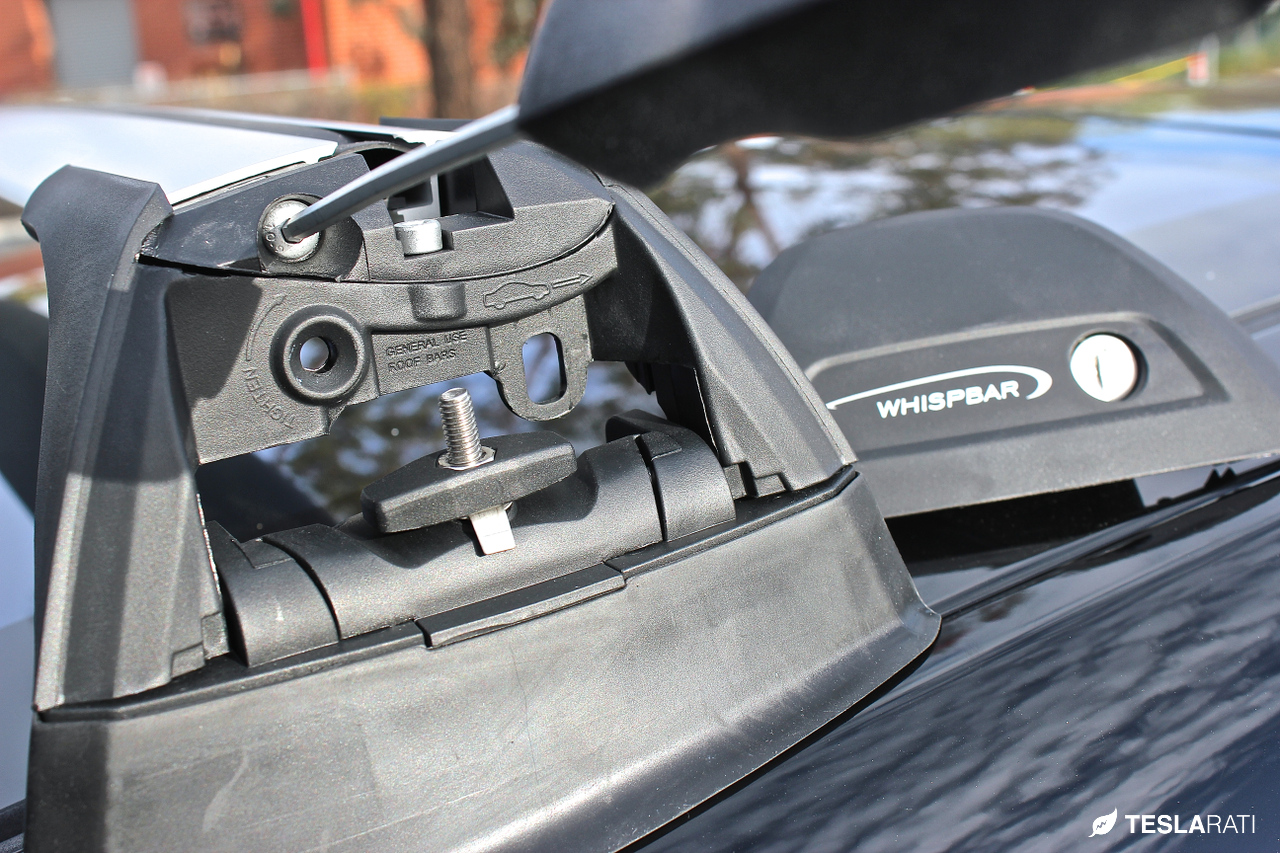
Installation Summary
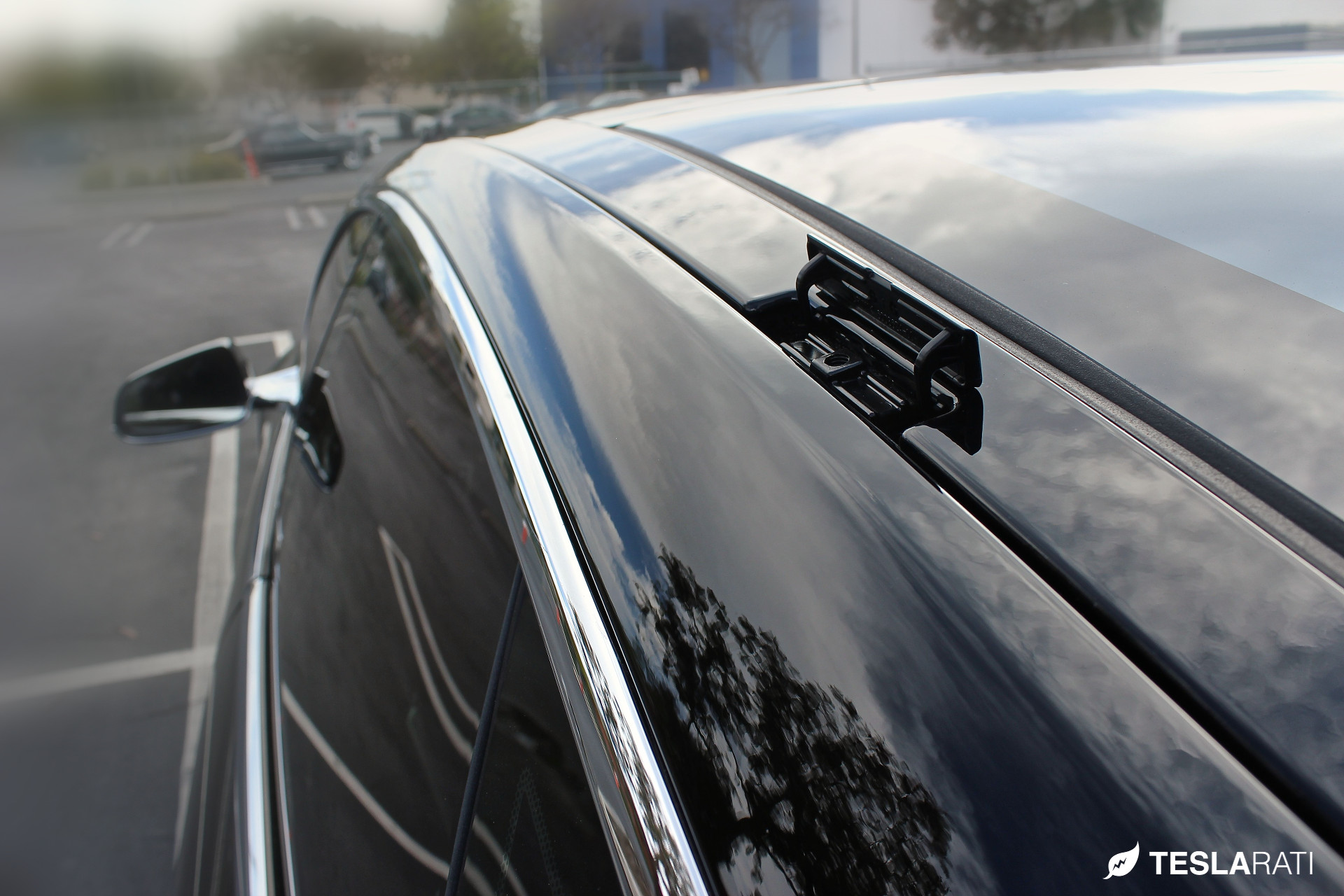
- Flip up factory mounting-point covers
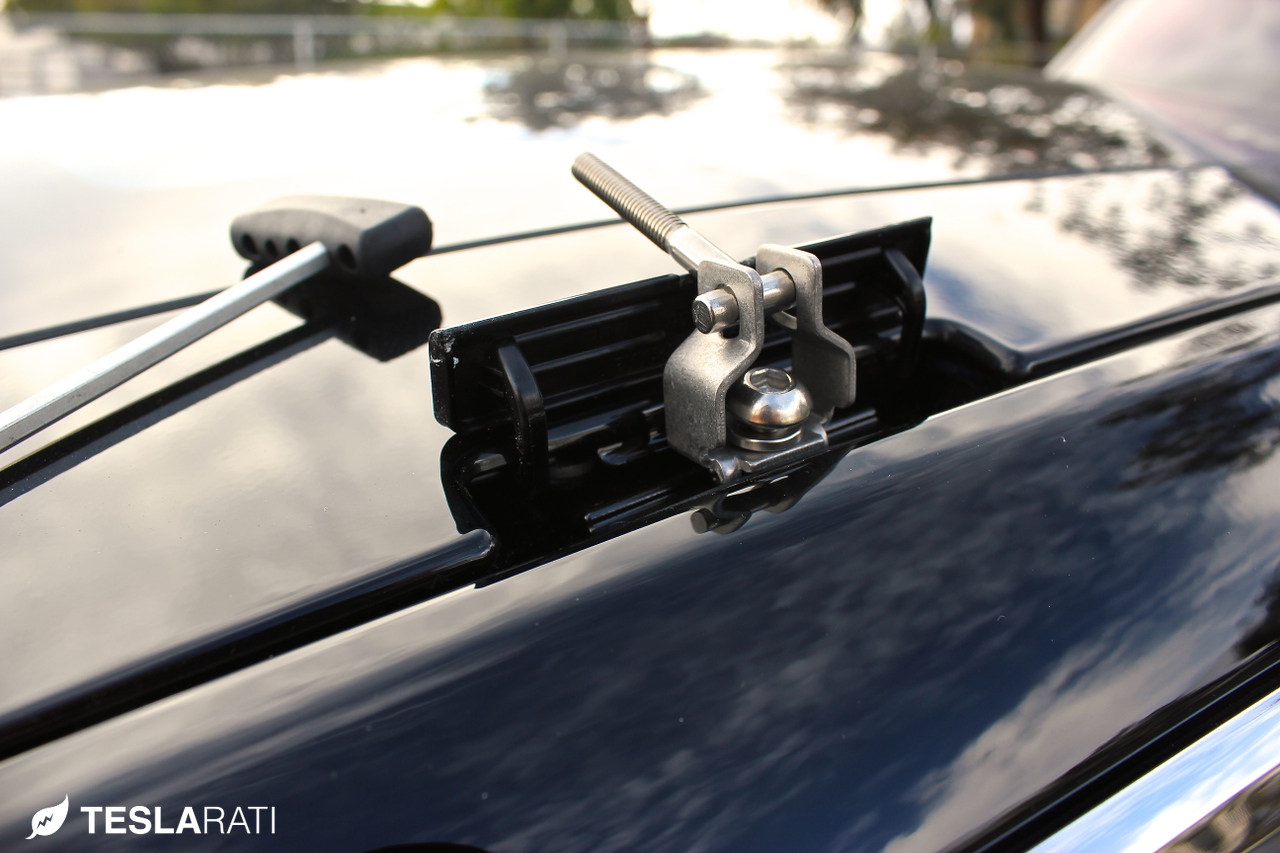
- Attach stainless hardware to mounting-points
- Fit weather-proof Tesla Model S specific mounting pad and block over stainless clamps
- Hand-tighten plastic knob and secure Flush Bar to the vehicle
Installation video provided by Tesla Motors.
Ultra-Quiet, Low Drag, Battery Efficient
Sound: The low profile mount and wing shape design of the Whispbar Tesla Model S Roof Rack System creates an amazingly quiet driving experience. At speeds below 40 mph (64 km/h) we barely noticed any noise at all, contrary to what we’ve experienced with other roof rack systems on the market. The Whispbar system exhibits some audible wind noise as expected during highway speeds, but the sound is much more soothing, and almost melodic in a way. It’s much softer, quieter and not the usual turbulent wind noise that’s often associated with round or square style crossbars.
The unique shape and design of the Whispbar is the result of extensive wind tunnel testing as seen in the video below.
Wind Drag Effect on Battery Range: This one surprised us the most. After 500 miles of testing with the Flush Bar mounted we noticed a negligible increase in energy consumption when compared against the vehicle’s lifetime average energy usage.
- Energy usage lifetime avg (10,180 miles):
318 Wh/mi
- ROAD TEST 1 with Tesla Model S Roof Rack System (~ 500 miles):
322 Wh/mi
- ROAD TEST 2 with Tesla Model S Rook Rack System + Ski/Snow attachment + 2 snowboards:
328 Wh/mi
(leave us a comment below if you’re interested in having us perform any special tests)
We concluded that the 1.26% increase in energy over the vehicle’s lifetime average is negligible and therefore it’s inconclusive that the change is a result of wind drag from the Tesla Model S roof rack system. Although we drove the same path over the course of the 500 mile sample, there’s not a large enough disparity for us to make a correlation. This is a remarkable testament to Whispbar’s pursuit of engineering excellence. We think they succeeded.
No Tools Required, Quick and Easy Attachments
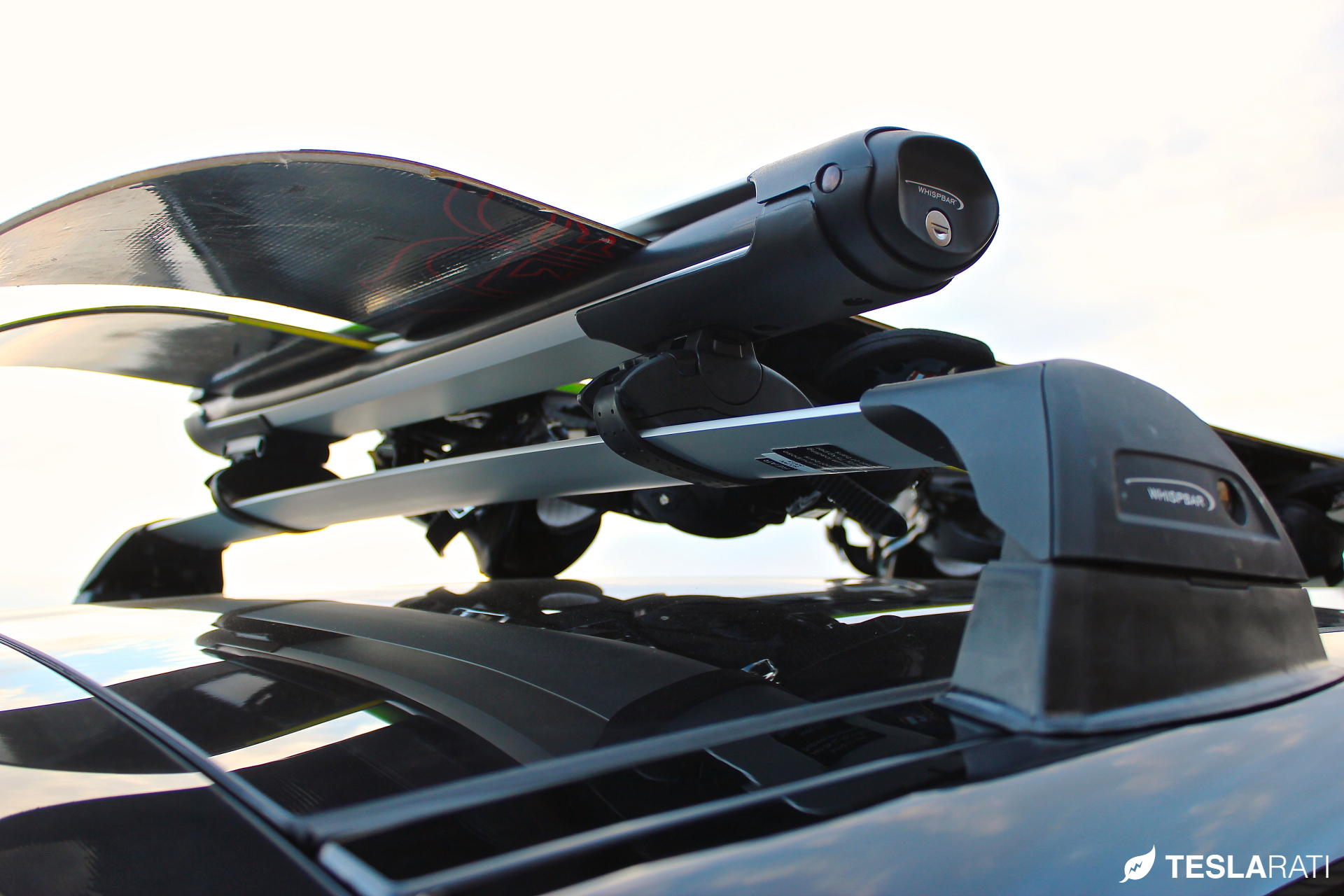
One of the great features of the Whispbar QuickDock System is that it can quickly attach and detach accessories without the use of tools. Removing attachments (ski, snowboard, cargo, bike ..etc when not in use maximizes the aerodynamics and maintains the clean look of the Whispbar Flush Bar.
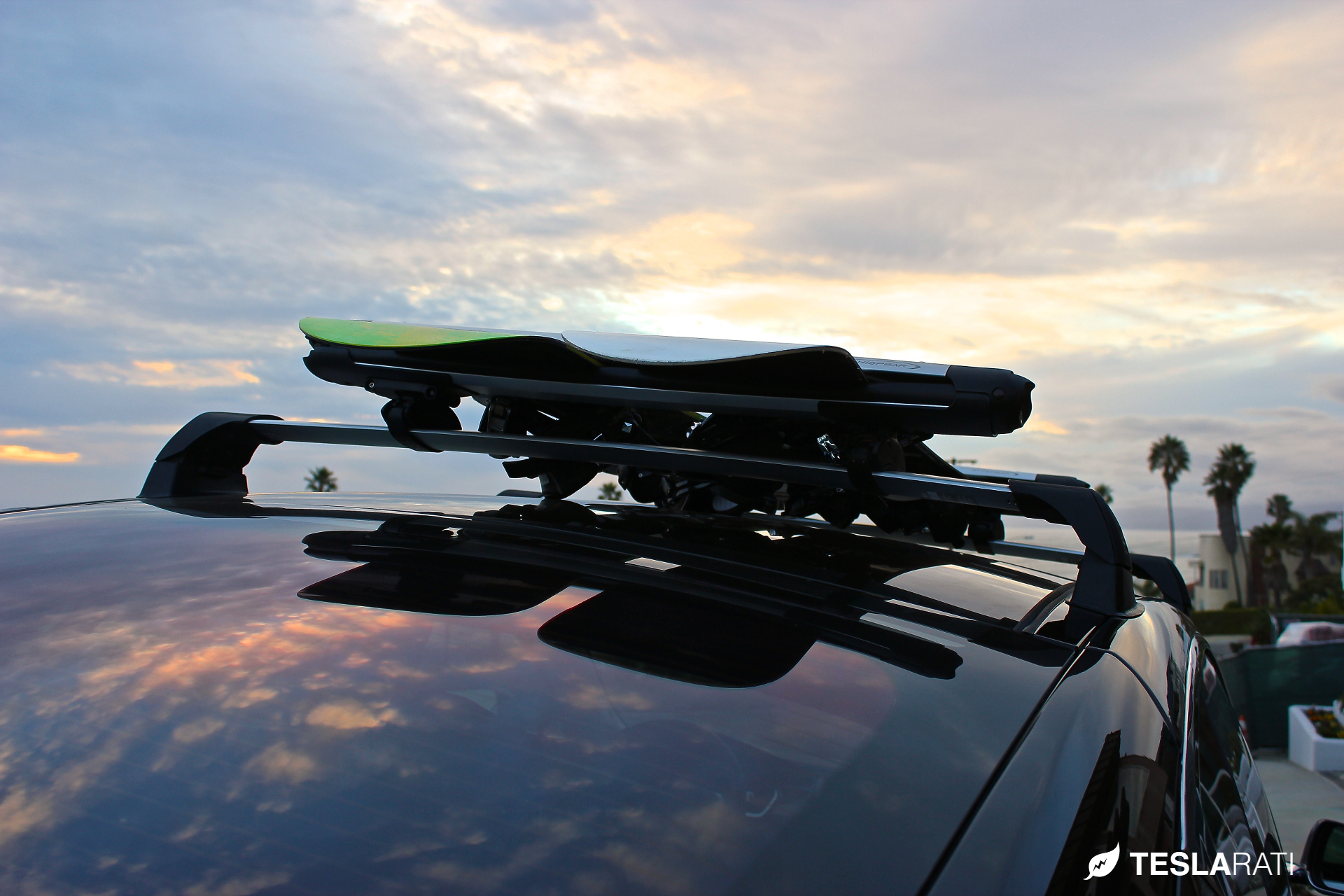
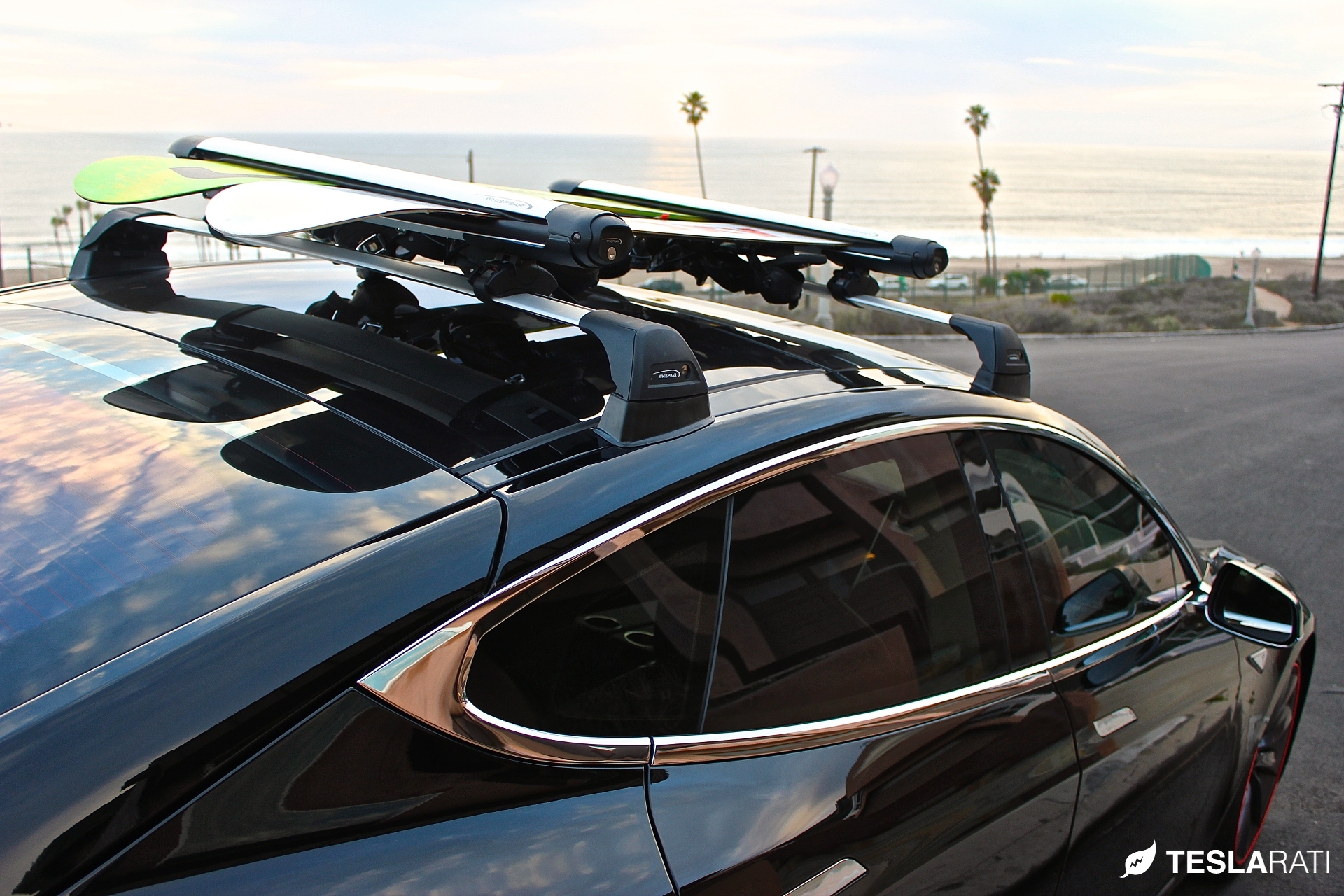
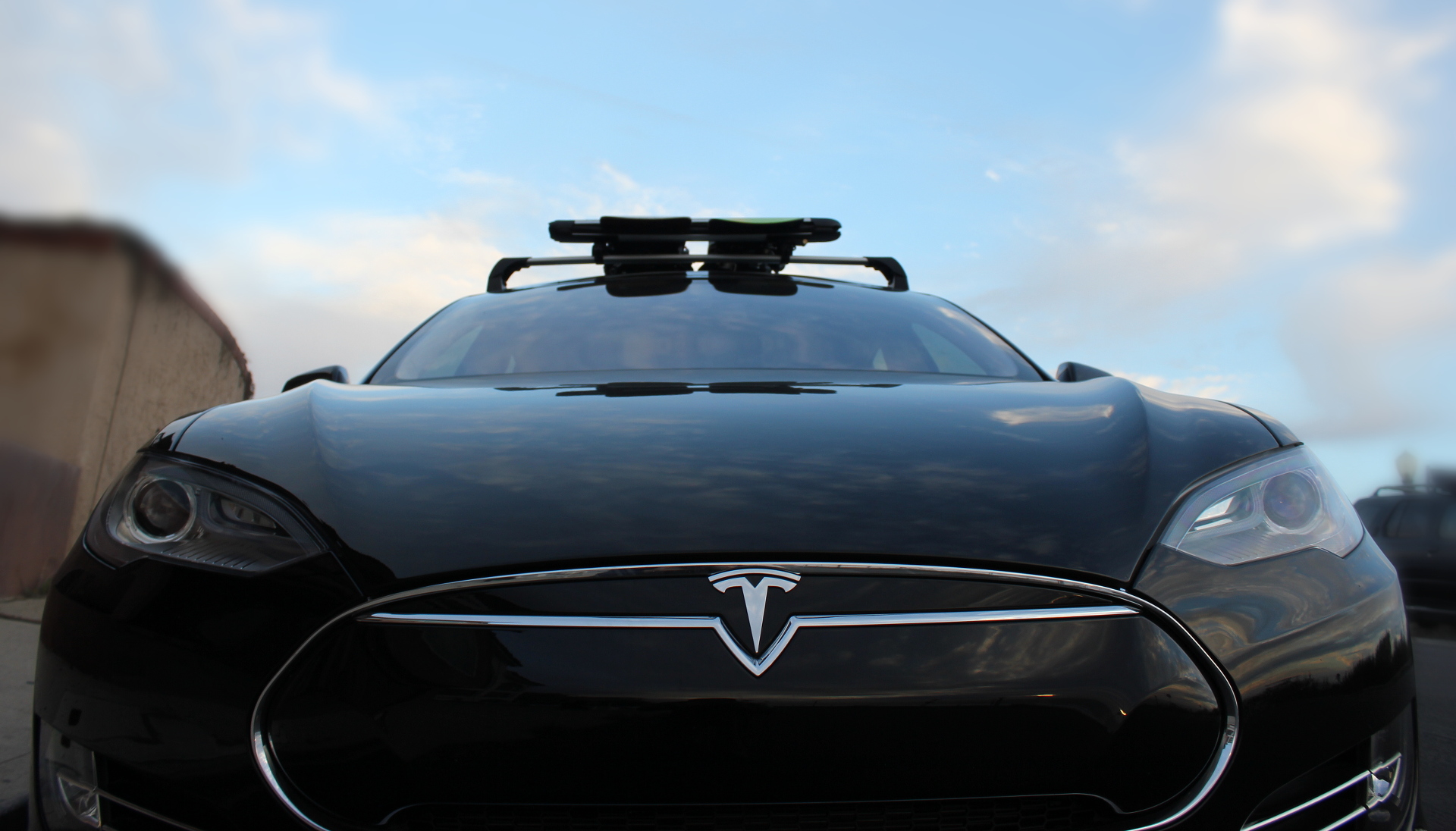
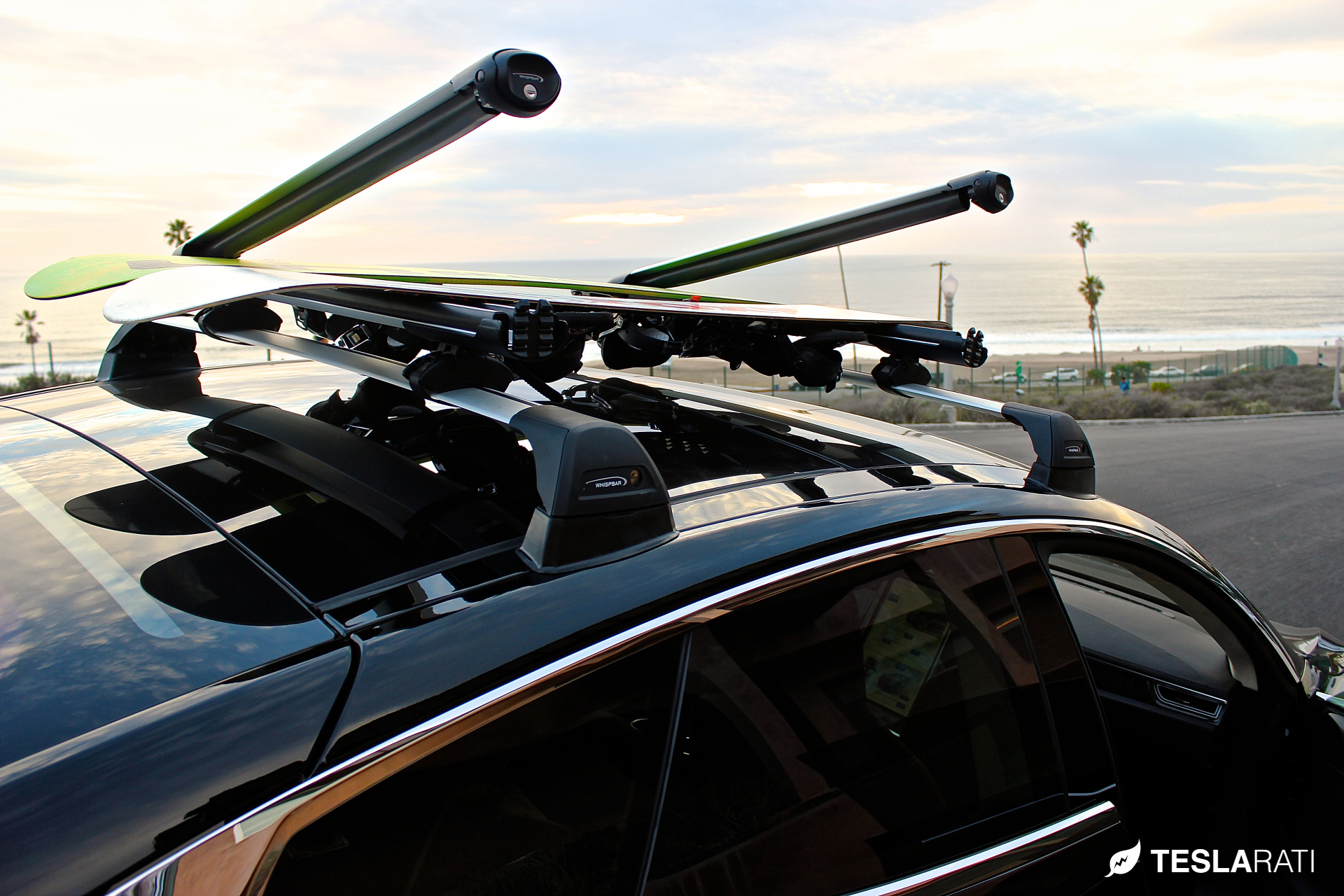
Below are pictures of the optional Whispbar SnowMount (#WB300) attachment mounted to our Whispbar Tesla Model S roof rack system. We loved the large integrated push lever, which was extremely easy to open, even while wearing heavy gloves.
Conclusion
The aerodynamic Whispbar roof rack system brings innovative design and technology to deliver the quietest crossbar on the market.
To our knowledge, Whispbar is currently the only manufacturer that offers the Tesla Model S roof rack system. We know that there will eventually be plenty of roof rack systems out on the market for the Tesla community, but when compromise is not an option and you’re seeking unparalleled perfection, then the Whispbar Roof Rack System is the obvious choice.
Tesla Model S Whispbar Roof Rack System
- MSRP: $519.00
Note: Use the vehicle selection dropdowns from the Flush Bar page.
Whispbar Snow Mount Attachment
- MSRP: $249.00
NOTE: The Whispbar Tesla Model S Roof Rack System is only available for models that have the panoramic roof option.


Elon Musk
India tells Elon Musk’s X to “Follow the Law” in latest censorship update
Elon Musk says X now exposes government censorship, but India’s secrecy laws complicate that promise.

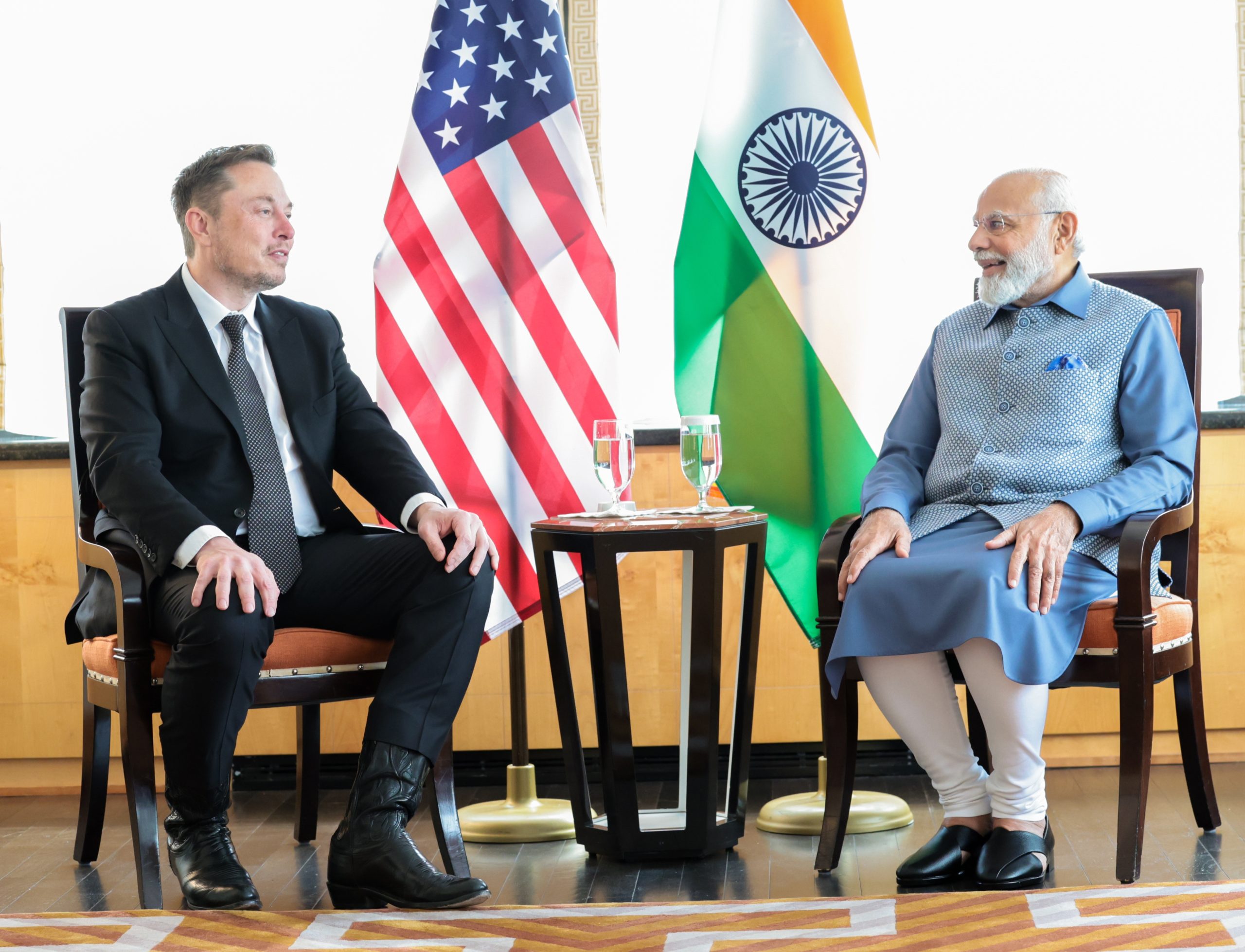
Elon Musk’s promise to make government censorship requests on X “clearly visible” is running into a wall in India, where the law forbids the very disclosure Musk is promising.
On August 15, Musk responded to an update from X’s open-source algorithm team by writing “Any censorship required by governments is now clearly visible.” The claim referred to a change X pushed two days earlier to its public xai-org/x-algorithm repository, which now includes a controversial filter written directly into the code. The filter suppresses posts from 665 accounts flagged by Brazil’s Superior Electoral Court from appearing in the For You feed of any viewer located in Brazil, unless the viewer already follows the account. The election tied to the filter is scheduled for October 4.
India’s government wasn’t as impressed, and responded on Monday that “X will have to follow the law of the land,” in response to Musk’s transparency push covered by the Times of India. The problem is structural rather than political. India issues content blocking orders under Section 69A of its IT Act, and Rule 16 of the accompanying 2009 Blocking Rules requires those orders to stay confidential. Publishing an India equivalent of the Brazil filter, naming specific accounts and citing specific government orders, would itself violate Indian law. Government use of Section 69A has grown from roughly 6,000 orders a year between 2018 and 2023 to about 24,300 in 2025, according to a Tech Times report.
The contrast puts Musk’s transparency pledge in an odd spot. It works largely as advertised in Brazil, where electoral law requires disclosure and X can point to specific account IDs and a specific court order in public code. It cannot work the same way in India, where the law requires the opposite. X users in India will keep seeing content disappear from search and their feeds without any public accounting of why, even as X tells the rest of the world that its censorship compliance is now inspectable.
This isn’t the first time X’s fights with a national government have shaped how the platform operates. Brazil’s Supreme Court ordered X to suspend the accounts of sitting lawmakers and journalists in 2024, a standoff that cost X its Brazilian revenue for months and froze Starlink’s local accounts before the investigation into Musk and X was closed in March with no evidence of wrongdoing found. X also sued California over a state law requiring moderation disclosures, arguing the mandate itself violated the First Amendment.
Whether India’s government pursues anything beyond a public statement remains to be seen. For now, the mismatch between what X can legally publish and what different governments legally allow it to publish is the real story behind Musk’s seven word claim.
Lifestyle
Tesla’s driverless Cybercab just passed a big test with State Governor
Florida’s governor rode Tesla’s Cybercab at a closed test track and called the experience impressive.
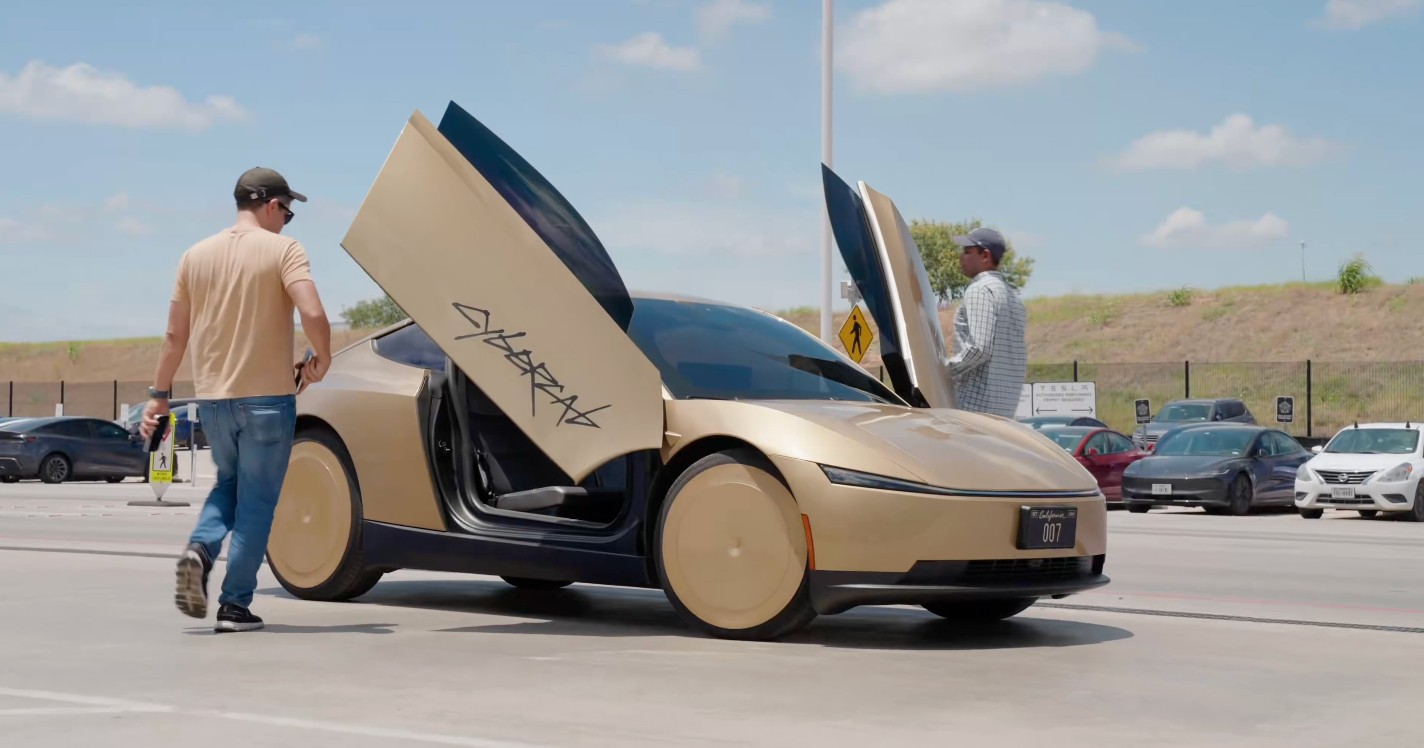
Florida Governor Ron DeSantis rode in a Tesla Cybercab on a closed test track this week and came away impressed, posting on X that the vehicle “successfully navigated all hazards — a kid running into the street, a crash with police stopping traffic, a Model S cutting us off, etc.” He called the ride “impressive.”
The stop was part of a broader event Monday at SunTrax, a 775 acre state owned proving ground in Auburndale that Florida built specifically to test autonomous and connected vehicles before they reach public roads. Standing next to a gold Cybercab, DeSantis described the car in plain terms: “You go in there and you just sit. You have a screen. There’s no steering wheel, no pedals. Clearly these things could be very beneficial.”
We took a ride on a robotaxi on the Suntrax course and it successfully navigated all hazards — a kid running into the street, a crash with police stopping traffic, a Model S cutting us off, etc.
Impressive! https://t.co/FVAkzFLz3r
— Ron DeSantis (@RonDeSantis) August 11, 2026
DeSantis paired the praise with a caveat that has followed autonomous vehicles since the category existed. “You don’t want to be in an autonomous vehicle and it drives you into a ditch. That would not be good,” he said, framing safety validation as the gate before wider deployment.
SunTrax, the 2.25 mile oval which the state calls the only high speed autonomous vehicle test track in the Southeast, can simulate rain, pedestrian crossings, hills and crowded urban conditions at highway speeds, letting companies push a car past what an early public rollout would risk. Tesla, Waymo and Beep all use the facility, and Florida’s regulatory approach, among the most permissive for autonomous vehicles in the country, doesn’t require a human operator inside a fully autonomous car.
Tesla has reason to want the blessing of Florida and states beyond, as the Cybercab entered volume production at Gigafactory Texas this spring and has since self certified as SAE Level 4 under Texas law. Public road testing so far has kept a safety monitor in the passenger seat, and Florida is where Tesla has been expanding its existing Model Y based Robotaxi service instead, adding Miami in July and then Orlando and Tampa two weeks later. A closed track endorsement from a sitting governor doesn’t change any of that, but it does put Tesla’s newest hardware in front of a state that has already shown it will move fast on rules.
Elon Musk
The real reason Elon Musk wants every car connected to space
Elon Musk says all cars will eventually need Starlink to handle massive AI bandwidth demand.
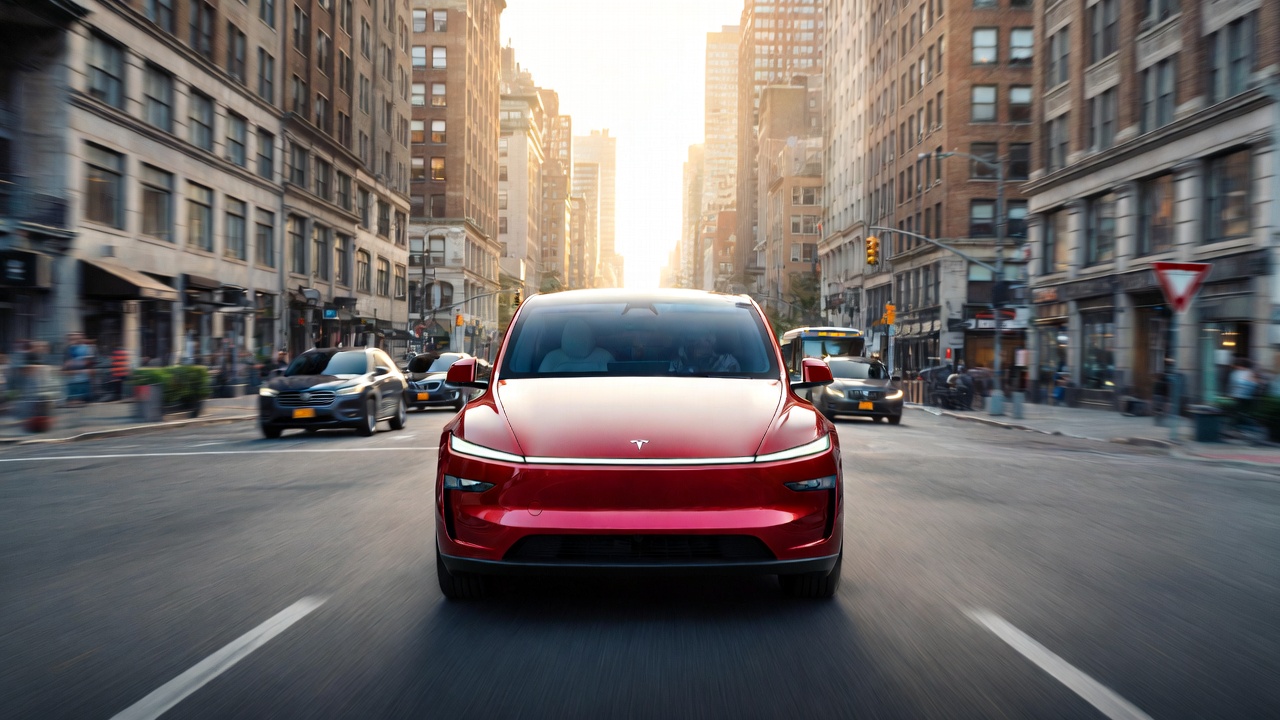
Elon Musk is making the case that satellite internet, not fiber or cellular towers, will end up wired into every car on the road. In a string of posts on X, the SpaceX CEO wrote that all cars will have Starlink in the future and called satellite connectivity the only way to get super high bandwidth to billions of vehicles.
The posts started with Musk endorsing a Cloudflare forecast that traffic generated by autonomous AI agents will soon dwarf traffic generated by humans browsing the internet, a shift he described as not a close call at all. From there he narrowed the argument to infrastructure, writing that the only system that can support the insanely fast bandwidth growth needed by AI is Starlink, before extending the logic to cars specifically.
AI agentic Internet traffic will obviously VASTLY exceed human usage. Not a close call at all.
Cloudflare’s forecast is accurate. https://t.co/VztgrinN5k pic.twitter.com/Wo4FiRKjPU
— Elon Musk (@elonmusk) August 9, 2026
The timing lines up with Tesla’s own hardware decisions. On July 20, Tesla confirmed the Cybercab would ship with a Starlink V5 terminal built into its roof, the first time the company had put satellite hardware in a production vehicle. A day later, Tesla’s head of AI, Ashok Elluswamy, explained the connection wasn’t there for safety and that Cybercab’s driving stack runs entirely on onboard cameras and compute, while the satellite link exists for navigation, customer service, and fleet management instead. Musk followed with his own post about the feature, saying riders would be able to watch 4K streaming video during rides.
By July 22, Musk had already said Starlink would extend beyond Cybercab to Tesla’s full lineup. Sunday’s posts push that same logic outward again, this time framed as a requirement across the industry rather than a feature specific to Tesla, and tied directly to the bandwidth AI systems are expected to consume.
SpaceX’s newest Starmind will make earth data centers obsolete
The AI argument has been building on SpaceX’s side for months. The company has an FCC filing pending for a third generation Starlink constellation, and it has separately proposed Starmind, a constellation of up to a million satellites designed to run AI computation directly in orbit rather than just relay data. Musk has said he expects space to become the cheapest place to deploy AI compute within two to three years. Starlink and Starmind serve different jobs inside that vision, one moving data and the other processing it, but Sunday’s posts treat vehicles as one more category of hardware that will eventually need both.
None of this changes anything for Tesla owners today. Cars already on the road keep running on LTE and Wi-Fi, and Tesla hasn’t outlined a retrofit path for existing vehicles. The July 22 commitment applies to future production, not the fleet already delivered. What Musk added on Sunday is the reasoning: satellite connectivity isn’t a Cybercab novelty, it’s a bet that ground based networks won’t keep up with how much data cars, robots, and AI systems are about to generate.

Tesla reveals plans for Robotaxi charging hub in Austin

Tesla Semi gets its largest order yet


