Lifestyle
How Tesla’s new age marketing builds overall consumer EV awareness

2016 was a year in which the Tesla Model X was cited as the ‘most significant’ vehicle, by growth contribution to total electric and plug-in hybrid sales in the U.S. It was also a year in which a survey of 2500 consumers illuminated how many Americans still feel uniformed about electric vehicles (EV).
However, Tesla’s innovative marketing strategy has just the right elements to enhance consumer background knowledge about what electric EVs are and how they work. In doing so, Tesla marketing will work reciprocally to place the Tesla brand at the forefront of the electric car industry. And it has the capacity to do so very quickly, if 2016 Tesla production numbers are any indicator.
How do Tesla sales differ from traditional car sales?
For most shoppers, the process of buying a car is essentially the same as it was a generation ago. Since long-established state franchise laws largely prohibit direct sales by auto manufacturers, an intermediary called a franchised dealer works as liaison between the manufacturer and the consumer. “The internet has dramatically changed the car-buying experience, but not the role of the dealer,” Maryann Keller & Associates wrote in a 2014 study for the National Automobile Dealers Association.
The Tesla buying experience is quite different. According to Tesla CEO Elon Musk, “Existing franchise dealers have a fundamental conflict of interest between selling gasoline cars, which constitute the vast majority of their business, and selling the new technology of electric cars.” There are no Tesla dealers, commissioned sales people, or aggressive sales pitches. The price is non-negotiable, as the Tesla is built according to a series of customer self-select options. Tesla transactions are conducted online.
How do consumers learn about the Tesla brand if there is no traditional advertising?
Tesla offers a completely different marketing experience than does a traditional car dealership advertising campaign. With an emphasis on marketing over advertising, the Tesla brand is slowly becoming a household word. How does it do that?
It’s a movement, not just another car: Tesla Motors created a movement around its innovative products and its mission, and the brand is equally as inspiring with its marketing. With a disdain for paid advertising, Tesla Motors is leading the trend of reaching new customers through existing ones.
Media matters: Want to know the most recent Tesla profitability updates? Tune into a streamed invitation-only press conference. Care to learn about the newest features of Tesla engineering? Watch on YouTube as Tesla CEO Elon Musk’s vision for the future comes to life. Want to find reviews, and awards for Tesla cars? They’re all online, of course with corresponding Tesla media analysis and positioning. And throughout every single media event, regardless of its topic or source, the company’s primary message resonates: The folks at Tesla are trying to build the best car ever made, not just the best electric car, and revolutionize the energy industry. That message, in turn, is reproduced by the media and becomes part of a common public discourse.
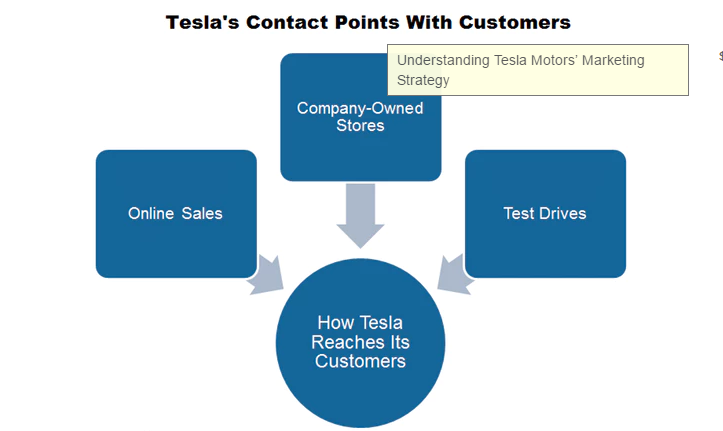
(Source: Tesla)
Online information portal: Since people begin their journeys with Tesla on their website, Tesla has designed their online presence to be a balance of information, commerce, community, press releases, consumer updates, and connections to other business within the Tesla network.
Forums and user community: Central to the Tesla online experience is something as old as language itself: the story. Tesla brings to light the joy of belonging to the Tesla buying and ownership experience through giving its current clientele the tools to share their experiences. As it’s a public community, forums provide a lot of content and context about what it’s like to own and experience a Tesla, and prospective buyers can live vicariously through these storied Tesla experiences. These forums demonstrate how Tesla encourages owners to interact with the company, and such transparency is confidence-inspiring for the originally EV wary consumer.
Referral program: Tesla has one of the world’s most acclaimed refer-a-friend programs, which reflects the view that customers acquired through advocate referral programs spend more, are more loyal, and are more likely to refer their friends to the brand.
Distribution strategy: The Tesla retail outlet is distinct from any other car sales showroom. This is because, according to Tesla CEO Elon Musk, Our technology is different, our car is different, and, as a result, our stores are intentionally different.” The physical stores serve only as displays and sometimes only galleries, due in part because in several states Tesla is not allowed to sell vehicles through its stores. These stores are carefully curated and visually appealing channels to promote the Tesla EV vehicles and help to solidify the Tesla brand in the consumer mind.
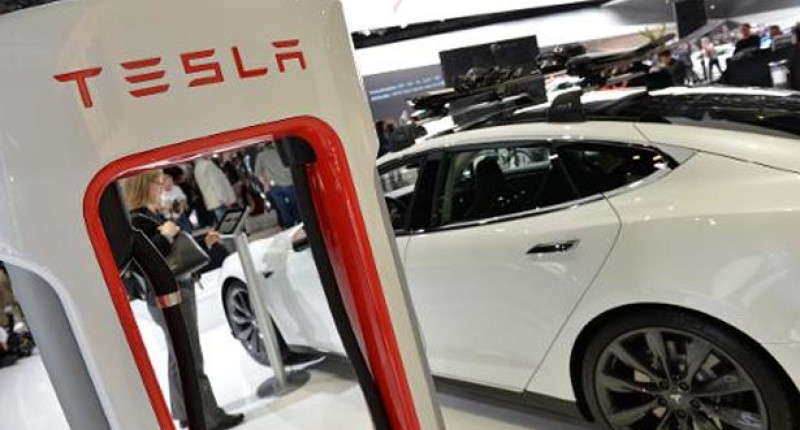
Destination charging: Tesla partners with frequently visited places such as restaurants, resorts, and shopping malls so Tesla owners can recharge their vehicle while engaging in retail activities. These charging sites are centrally located, well-lit and signed, and placed strategically for high visibility. Individuals with no prior knowledge of the Tesla brand get to see one up close and personal while they grab their groceries, offering a personal glimpse into a once-rare EV charging session.
Supercharger network: Indeed, the Supercharger network is an ecosystem unto itself and of a proprietary nature that ensures its customers will always have a safe haven to alleviate range anxiety.
Conclusion
With so many constituents worldwide pursuing advanced vehicle technologies that aim to reduce the consumption of petroleum in the forms of gasoline and diesel, consumer awareness and comfort with EVs is essential. Tesla’s marketing approaches, which are so dissimilar from the distasteful traditional car dealership model, appeals to today’s 21st century IT populace and can assist to reduce barriers to and enhance opportunities for a broader acceptance of new technologies, such as EVs in general.


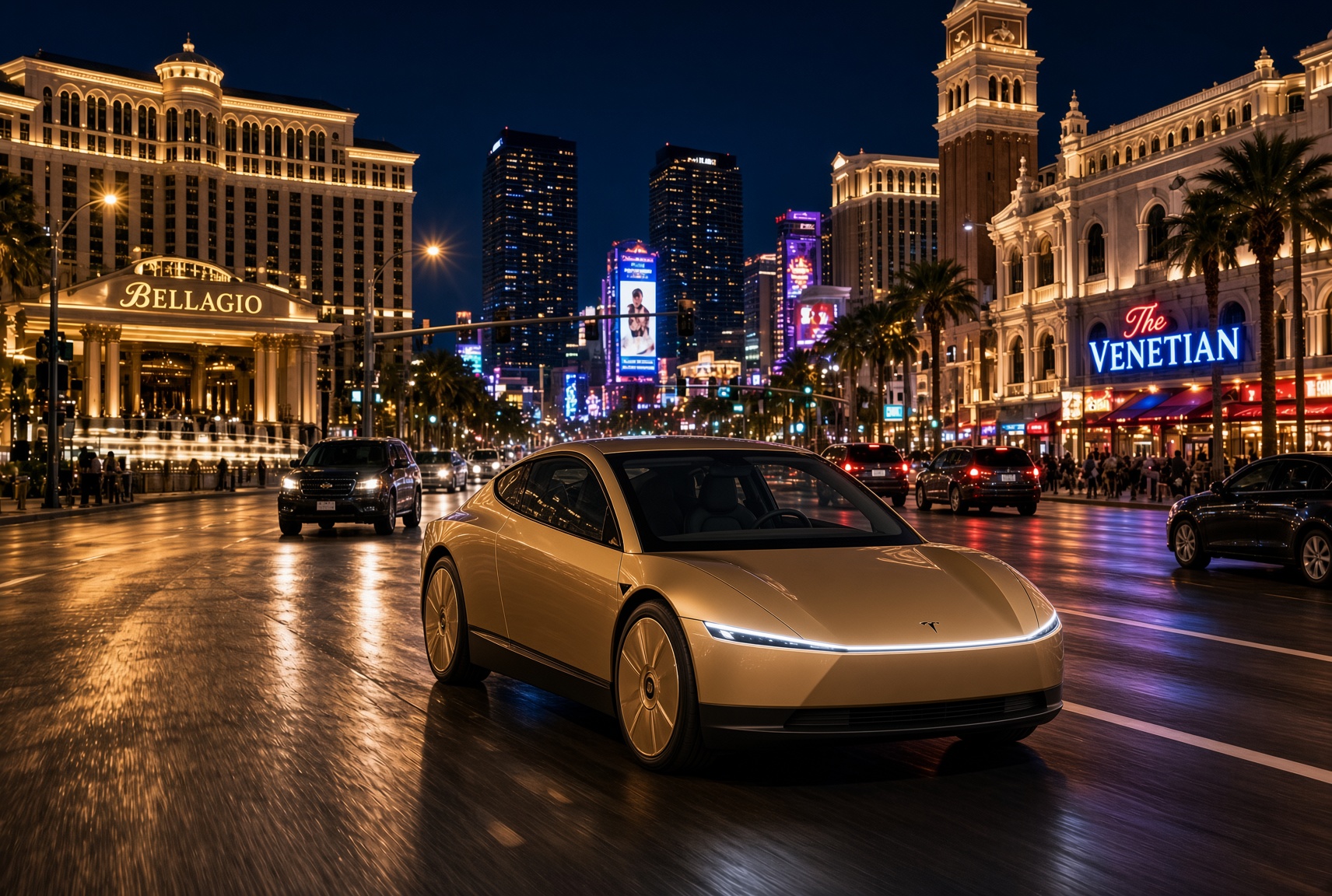
For a century, the car has asked the same thing of its owner, which is basically to pay attention. Even the best ride-hailing app like Uber or Lyft only moved the problem into someone else’s hands. You stopped driving, but you still sat in a stranger’s car, while half listening, and wondering whether to take a phone call in the car without being rude. The Cybercab has no wheel, no pedals and no driver. With Grok @bot now live inside it, it becomes something else entirely, and I think that matters more than the fleet count that everyone is tracking.
Grok @bot is an agent, not a voice assistant. A rider signs in once, and from then on can say what they need and watch it happen. Order dinner from a favorite restaurant. Fill the grocery cart. Move money, answer email, adjust a calendar, push a work project forward. Tesla engineer Yun-Ta Tsai confirmed it is enabled across every Cybercab and the rest of the Model Y fleet, and Tesla’s own pitch is that Full Self-Driving handles the commute while Grok handles the errands.
Think about what that does to a thirty minute ride. Uber sells you a trip, while Waymo sells you the same trip in a more private setting. Tesla is selling the thirty minutes themselves, returned to you with an assistant attached. Errands that used to eat a Saturday get done between pickup and drop off. The ride stops being dead time between two places and becomes a place of its own.
Tesla integrates Grok Bot into its vehicles for the ultimate personal assistant
Best of all, your Bots follow you into any Cybercab, and presumably your own Tesla, then logs you out automatically when you step out. Anyone can bolt a chatbot onto a screen, but much harder to own the vehicle, the autonomy stack and the assistant at once. It also quietly ties SpaceX’s Super Intelligence business to Tesla’s fleet, after Tesla converted its xAI stake into SpaceX equity. The relationship between those two companies is getting harder to describe as separate.
This is also where the hard questions start, because an agent that can spend your money in a vehicle other people also ride in needs some answers. How does it handle a voice it shouldn’t trust? What gets recorded, who can see it, and for how long? What happens when a rider leaves halfway through a task?
If Tesla gets those answers right, the scoreboard changes. We have been counting Cybercabs and wait times. The more telling number may be what riders accomplish per trip. That is data almost no one else will ever have, and it is the real reason to watch Grok @bot.
What do you think? Leave me a comment.
Lifestyle
Tesla’s mirrorless Cybercab will give riders a visibility upgrade
Tesla engineer confirms Cybercab update letting riders pull up rear and repeater cameras on demand.

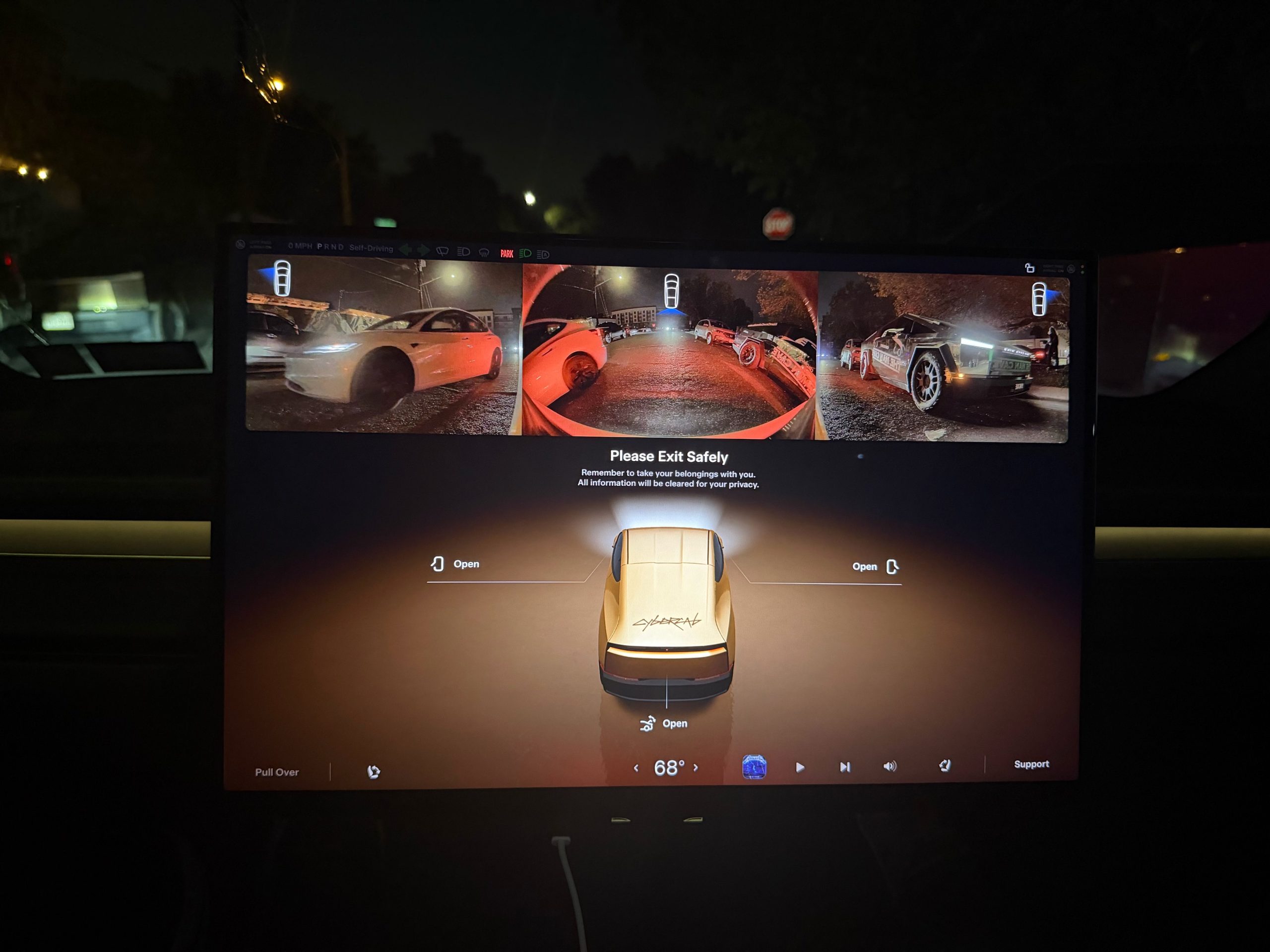
Tesla is working on a Cybercab update that would let passengers pull up the vehicle’s rear and side cameras on demand, and the request came straight from a rider.
The exchange played out on X late Friday. Cybercab rider Dan Burkland shared photos of the two-seater’s cabin screen after an evening ride, praised the UI team’s work, and left one request: let riders open the rear and repeater cameras whenever they want, “especially for peace of mind.” Tesla UI software engineer Evan (@CarCoder) answered with two words: “In development.”
The Tesla UI team absolutely crushed it with the infotainment software. Nicely done @CarCoder!
One feature request: Allow folks to pull up the rear & repeater cameras on demand. This would be great especially for peace of mind. https://t.co/mNAOSLx6pE
— Dan Burkland (@DBurkland) October 10, 2026
The idea fits a pattern Teslarati has tracked since public rides began. Days after paid Cybercab service opened in Austin, Tesla sent riders a survey that asked them to rate the touchscreen, the app and the cabin, and to pick the features they wanted most. We reported on that survey in September, and a camera view is the kind of small software change Tesla can push quickly if riders keep asking.
It also speaks to something unique about the vehicle. With no steering wheel, no pedals and no driver, passengers have no mirror to check and no way to see behind them. The hardware is clearly built for camera awareness, from the repeater cameras to the rear camera. Letting a passenger look through those same cameras would give a nervous first time rider a way to confirm what is around the car.
The timing matters because the fleet is growing fast. Tesla’s Robotaxi account said on Saturday that more than 300 Cybercabs are now serving Austin, an eightfold increase in 30 days, and Tesla AI chief Ashok Elluswamy named Dallas as the next city. More cars and more cities mean more people riding in a driverless vehicle for the first time, which is exactly when small trust features carry weight.
For now, the feature is confirmed only as in development. If Tesla follows its usual pattern with Cybercab software, riders could see it appear in a point release without any announcement, and Teslarati will watch for it.
Elon Musk
Elon Musk’s surprise addition to the X Takeover lineup has fans talking
Elon Musk will join Saturday’s X Takeover at Giga Texas for a live virtual interview.
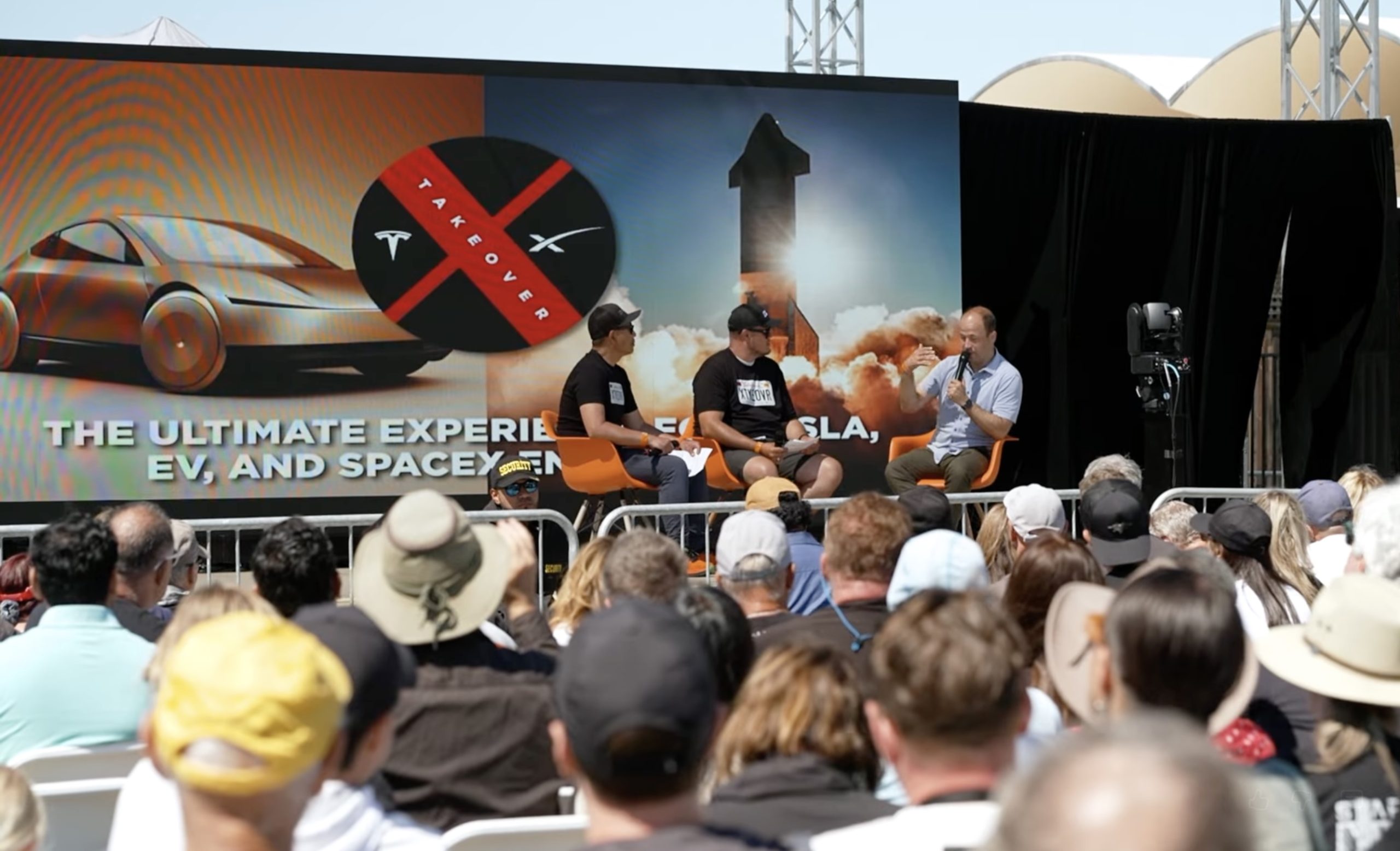
Elon Musk will join X Takeover at Giga Texas on Saturday for a live virtual interview, according to Sawyer Merritt, who shared the news late Thursday. Musk will not be on stage in Austin. The conversation is set to stream for free on the @teslaownersSV account on X.
Organizers had kept expectations in check. In a September update, Tesla Owners Silicon Valley said Musk had appeared at the event twice before but was not promising a third appearance, even as fans hoped he would walk the Giga Texas grounds in person. A virtual spot matches 2024, when Musk gave a surprise interview of about an hour to the crowd in San Luis Obispo, as Teslarati reported at the time.
Wasn’t expecting this 🫡
— Tesla Owners Silicon Valley (@teslaownersSV) October 9, 2026
This year’s edition is a first in several ways. It is the first X Takeover held outside California and the first at a Tesla facility, with tickets selling out in eight days. Tesla provides the venue, but the event is produced independently by Tesla Owners Silicon Valley. The main event runs from 10 a.m. to 6 p.m. CT, followed by a drone and light show at 9 p.m. Maye Musk is the keynote speaker, Franz von Holzhausen is set for a virtual keynote, and Nicki Minaj is the special guest. Joe Tegtmeyer, whose drone footage Teslarati used to track the Optimus factory steel frame at Giga Texas, is also on the speaker list.
Musk’s interview topics have not been revealed, but the backdrop is busy. Tesla doubled its Cybercab fleet in Austin in late September, and last week Musk explained why Robotaxi hours only moved from 10 p.m. to 11 p.m.. Merritt also reported Thursday that Texas DMV records now show 319 registered Cybercabs, up from 169. NHTSA’s deadline for Tesla’s sworn answers on Cybercab certification is October 30, and Tesla reports third quarter earnings on October 21.
Fans who cannot make it to Austin can watch the livestream on X. Musk tends to say more in unscripted settings than he does in prepared remarks, which is the reason this one is worth having open on Saturday.

Tesla’s flying Roadster just revealed something bigger than the car

How Tesla’s Roadster fan system and thrusters are built to dominate the corners

Tesla Roadster: Three configs, one can fly, 0-60 in 0.8 seconds

SpaceX reveals how its 1 Million AI satellite network will work and prevent space collisions

Elon Musk’s Boring Company lands a new Middle East deal, and Nashville is about to get faster


