News
Tesla Semi is exceeding range estimates, notes CHP in recent sighting

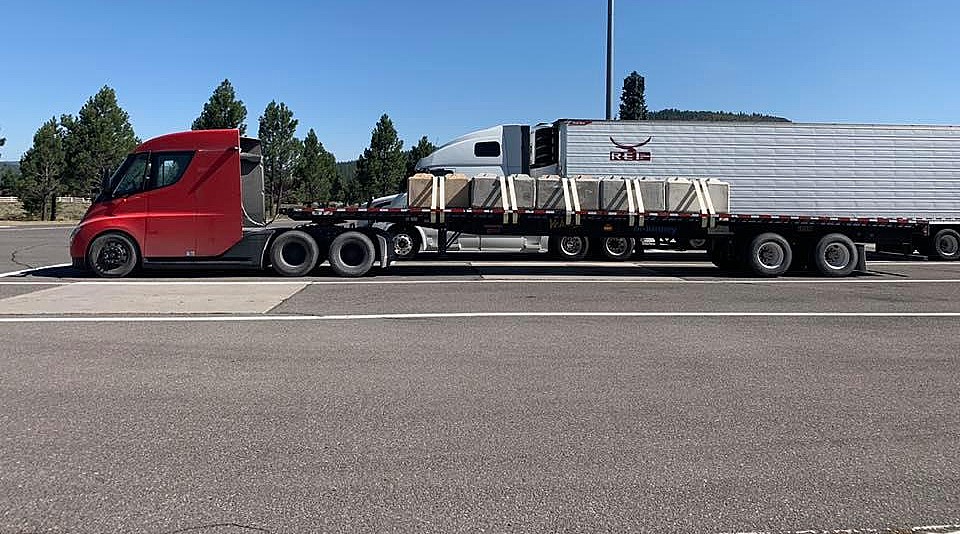
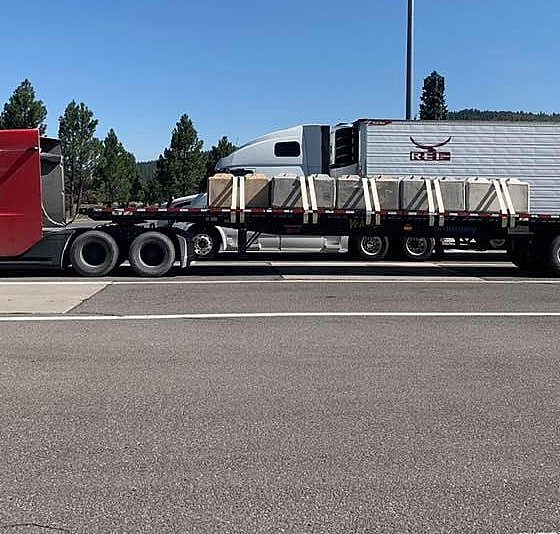
The Tesla Semi was recently spotted by officers of the California Highway Patrol in the Donner Pass area. Images of the vehicle taken by the CHP show the all-electric truck hauling several concrete blocks, as the vehicle continued its real-world testing in the lead-up to its initial production run.
Fortunately, the Tesla Semi’s sighting this time around proved to be a bit more special, as the CHP-Donner Pass officers were able to speak with the upcoming truck’s driver, who was gracious enough to give some details about the vehicle. According to the Semi’s driver, the matte red all-electric truck is currently operating at approximately 75,000 pounds with its trailer and cargo. What’s particularly impressive is that the vehicle is reportedly meeting or exceeding its range estimates despite its heavy load.
“Tesla is out testing the new electric truck tractor. The driver stated the concrete blocks are for testing purposes only. According to the driver the truck is operating at approximately 75,000 lbs and the truck is meeting or exceeding the range estimates. Electric trucks are definitely the future. We look forward to seeing more electric trucks on the road,” the group wrote.
This is not the first time that the CHP shared images of Tesla’s upcoming all-electric truck. Last year, the silver Semi prototype, complete with a trailer full of cargo, was inspected by the CHP at the Donner Pass Inspection Center, which is located just off Interstate 80. The vehicle was met with notable excitement from the group, who noted in a Facebook post that “the future has arrived.” When asked about the inspection, a representative from the CHP-Donner Pass group stated that the Semi was “very easy to inspect” and the vehicle was “very clean.” No violations were found by the CHP during its inspection of the Semi then.
The Tesla Semi holds a lot of potential, particularly as it is a vehicle that can tap into the immensely lucrative trucking market. The Semi definitely has what it takes to cause a disruption in terms of raw specs, considering that the vehicle is equipped with four Model 3-derived electric motors and a range of up to 500 miles. Tesla has continued to make improvements to the Semi since its unveiling too, with Musk stating on Twitter that the vehicle’s range will likely be closer to 600 miles per charge.
The Semi has attracted the attention of several notable businesses, particularly those which are looking for ways to actively reduce their carbon emissions footprint while cutting transportation and logistical costs at the same time. Among the Semi’s reservation holders are PepsiCo, Anheuser-Busch, J.B. Hunt, FedEx, and UPS in the United States, as well as Bee’ah in the United Arab Emirates. Production of the Semi was initially slated for 2019, though Tesla has adjusted this estimate to sometime in 2020.


Elon Musk
Elon Musk’s Boring Company has big plans for Las Vegas by year’s end
Elon Musk’s Boring Company says Vegas Loop stations will double by year end once again.

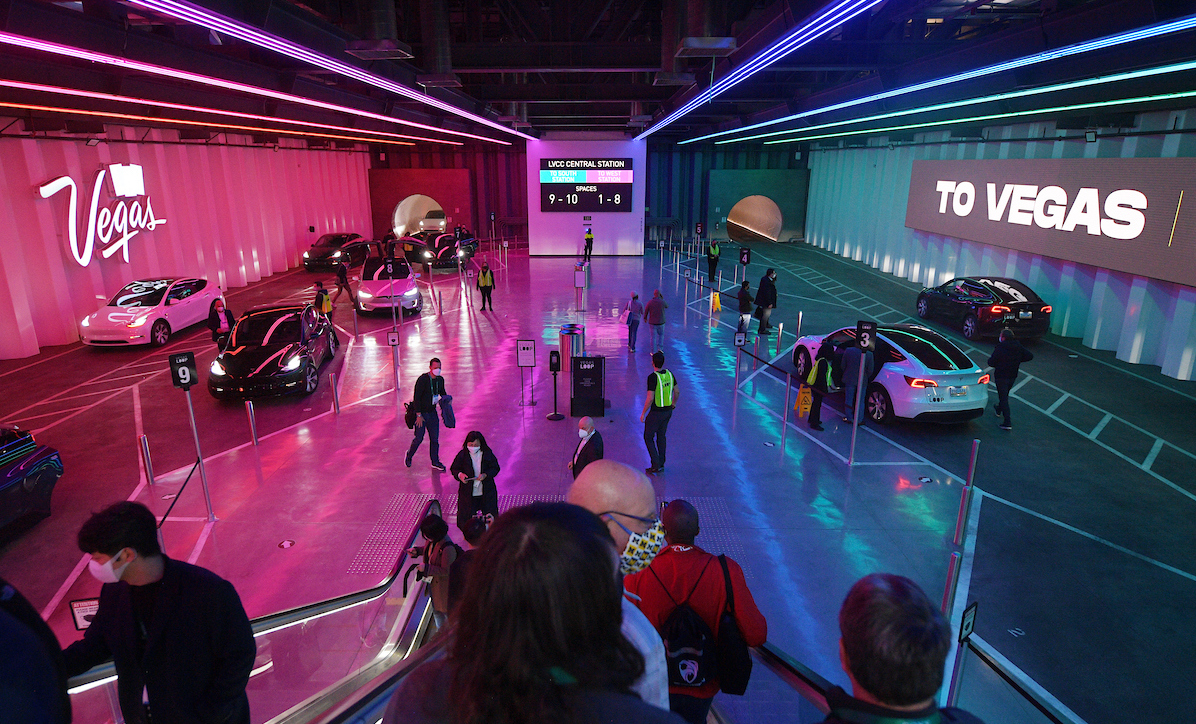
The Boring Company says the Vegas Loop’s station count will double by the end of the year, tying the target to a hiring push for drivers and operations managers in Las Vegas. “Vegas Loop is getting bigger – the station count will double by end of year!” the company wrote in a post on X, attaching listings for a Loop driver and a senior Loop operations manager.
The number checks out against what’s already public, with the Vegas Loop currently running 14 operational stations, while the Boring Company’s own project page lists 28 as the target for the end of 2026.
Vegas Loop is getting bigger – the station count will double by end of year!
Urgently hiring exceptional and enthusiastic Drivers and Ops Managers.
Apply here!
Driverhttps://t.co/ZUPXBYTONb
Senior Loop Ops Managerhttps://t.co/mV6V22V8jH pic.twitter.com/IZ9FqIw8WY
— The Boring Company (@boringcompany) September 14, 2026
Much of that growth is tied to tunnels that are already built and waiting on an opening date. A roughly two-mile dual tunnel system under Paradise Road, connecting Westgate to a planned station at 4744 Paradise Road, is expected to open in stages over the coming weeks, Las Vegas Convention and Visitors Authority chief executive Steve Hill told the Review-Journal last week. New stations at 4744 Paradise, Virgin Hotels Las Vegas, and the former Gordon Biersch site would come online with it, several of them built to speed up rides to Harry Reid International Airport ahead of Formula 1’s Las Vegas Grand Prix.
Clark County entitled Vegas Loop for 123 stations after approving 19 more in August, as Teslarati reported at the time. Entitlement and construction move at different speeds on this project, so county approval alone does not guarantee a station opens on any particular schedule.
Clark County approved 18 additional stations back in 2023, part of a plan that pushed the system’s target to 69 stations across 65 miles, doubling the network on paper for the first time. The target kept climbing after that, to roughly 93 stations by the end of that year and 104 by last year, before August’s vote pushed it to 123. This week’s announcement is the first time that doubling language has been attached to stations actually running rather than stations merely approved on a county map.
Ridership gives some sense of what a denser network could carry. Boring Company executive Mike Baier said in July that the Vegas Loop already moves around 40,000 passengers on busy convention days, a total that tops most light rail systems in the country despite the system running on a fraction of its planned tunnel mileage. Company leadership has projected ridership could triple or quadruple once the airport connector tunnels fully open.
Boring Company did not say which stations beyond those already under construction would open by year end, or whether the hiring push points to a fleet expansion alongside the new stops.

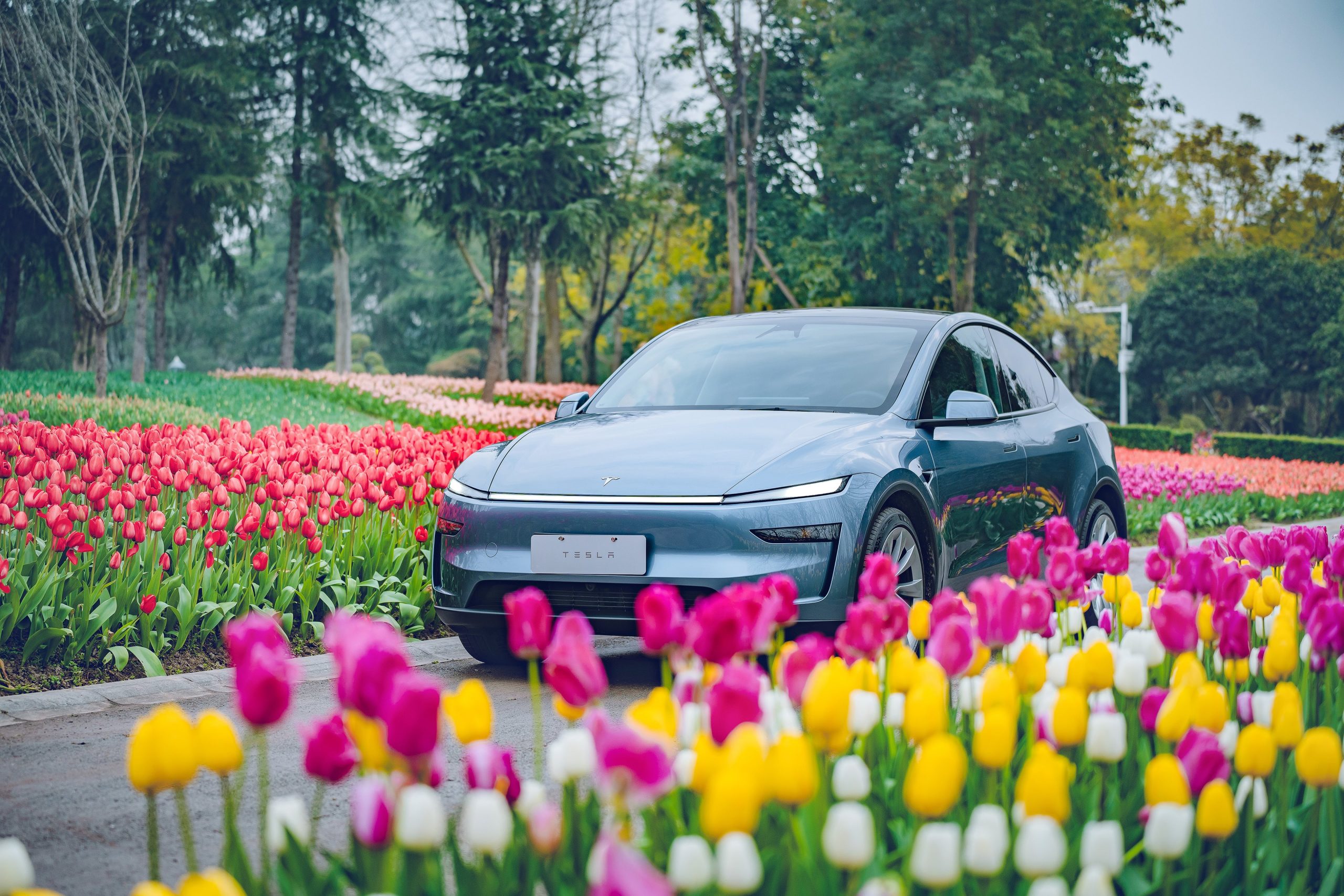
Tesla is looking to expand into a new Asian market, strengthening its presence in a region that has been bullish on electric vehicles as a whole.
Tesla officially filed to establish a subsidiary of its business in Vietnam, a report from Reuters suggests. Tesla named the entity “Tesla Motors Vietnam Limited Liability Company.”
The planned entrance into the Vietnamese market is a good sign and move for Tesla, as it has become one of the fastest-growing EV markets in Southeast Asia. It is already among the leaders in the region in both volume and electrification rate. In the first half of this year, Vietnam led Southeast Asia in battery-electric passenger car sales at about 116,000 units, up about 71 percent year over year.
Currently, Vietnamese EV drivers rely on VinFast’s V-Green network, which has about 150,000 ports, but these are primarily reserved for VinFast vehicles. Public third-party charging is fragmented and unreliable for those who do not own chargers that are dedicated to a certain manufacturer’s vehicles.
Tesla has had mixed results in Asia as a whole, and as China remains the core part of its story in Asia, the company is evidently working on expanding its footprint on the continent. Tesla’s domestic retail deliveries fell about 12 percent year over year through the first eight months of 2026.
Model Y remains a standout individual product, holding its position as one of, if not the, best-selling vehicles in the world. However, Model 3 has been weaker than it has been in past years.
Gigafactory Shanghai, the company’s Chinese production facility, still performs very well. Wholesale volumes in terms of exports have more than doubled and now exceed domestic retail sales; Giga Shanghai builds vehicles for Europe, South Korea, Japan, Australia, and other markets. South Korea has been an explicit bright spot, with registrations doubling year-to-date and Tesla frequently appearing as the top imported brand.
Tesla just did something in South Korea that no foreign carmaker has ever done
Tesla’s entrance into Vietnam signals a broader effort to take over the Asian market and grab more market share from rivals.
Elon Musk
Elon Musk’s companies made up with Apple but OpenAI still on the hook
Elon Musk’s X Corp and SpaceXAI dropped their Apple antitrust suit, leaving OpenAI as defendant.
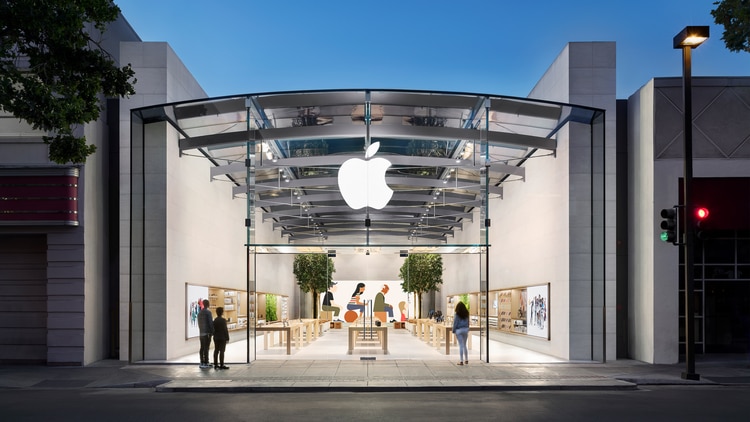
X Corp and SpaceXAI, Elon Musk’s social platform and AI venture, have dropped Apple from the antitrust lawsuit that they filed against the iPhone maker and OpenAI last year. In a filing in the U.S. District Court for the Northern District of Texas, attorneys for X and SpaceXAI moved to dismiss the Apple portion of the case, first reported by Reuters. The filing does not explain why the companies are dropping Apple or say whether a settlement was reached.
X and SpaceXAI say they intend to keep pursuing the case against OpenAI, which remains a defendant. That resolves the dispute with one company while leaving the core allegation intact against the other, with no public accounting of what changed in between.
The lawsuit dates to August 2025, when xAI and X sued Apple and OpenAI, arguing that Apple’s decision to make ChatGPT the only generative AI chatbot built into iOS gave OpenAI an unfair structural advantage. The complaint claimed ChatGPT controlled roughly 80 percent of the chatbot market at the time, while Grok held only a few percent. It sought billions of dollars in damages and asked the court to unwind the arrangement.
Elon Musk’s xAI and X file antitrust suit against Apple and OpenAI over AI exclusivity
The filing followed weeks of Musk publicly complaining that Grok and X weren’t appearing in Apple’s “Must Have” App Store section, though Grok ranked second in the Productivity category and X ranked first in News at the time. He accused Apple of “playing politics” and warned of immediate legal action before following through days later.
Apple and OpenAI tried to get the case thrown out, but a federal judge denied both motions in November, ruling the dispute was better suited to summary judgment than an early dismissal. That decision sent the case into discovery, which is presumably what led to Monday’s filing.
Hey @Apple App Store, why do you refuse to put either 𝕏 or Grok in your “Must Have” section when 𝕏 is the #1 news app in the world and Grok is #5 among all apps?
Are you playing politics? What gives? Inquiring minds want to know. https://t.co/3wenLZGtwG
— Elon Musk (@elonmusk) August 11, 2025
The timing is notable given how Musk’s sentiment toward Apple has shifted, with Musk noting that he was open to letting Grok power a revamped Siri after a user suggested Apple replace its aging assistant with xAI’s model.
xAI, the AI venture Musk folded into X Corp last year, has since combined with SpaceX under the SpaceXAI brand. That structure now puts X, Grok and SpaceX’s rocket and satellite businesses under one roof as Musk pushes his AI ambitions beyond chatbots.
OpenAI remains the sole defendant going forward, and Musk’s companies have not said if there’s any changes to those original claims. Apple and OpenAI did not immediately respond to requests for comment on the filing.

Elon Musk’s Boring Company has big plans for Las Vegas by year’s end

Tesla looks to expand into new Asian market, strengthening presence


