Elon Musk
Elon Musk’s xAI and X file antitrust suit against Apple and OpenAI over AI exclusivity
The suit accuses the companies of violating antitrust rules by limiting competition in the AI sector.

Elon Musk’s artificial intelligence startup xAI and social media platform X have filed a federal lawsuit against Apple and OpenAI. The suit accuses the companies of violating antitrust rules by limiting competition in the fast-growing AI sector.
The lawsuit
The lawsuit, filed on Monday, challenged Apple’s plan to integrate OpenAI’s ChatGPT into its devices. xAI argued that the partnership gives ChatGPT exclusive first-party access to hundreds of millions of iPhone users worldwide, providing an unfair landscape for competitors in the AI sector.
“As a result of the Apple-OpenAI deal, ChatGPT is not just the default — it is the only generative AI chatbot with a first-party integration into Apple’s smartphones,,” the lawsuit noted. The suit also stated that the deal would give OpenAI “exclusive access to billions of potential prompts.”
Musk’s filing describes the Apple-OpenAI agreement as an “unlawful” arrangement that unfairly disadvantages rivals and denies consumers choice. The complaint also accuses Apple of manipulating App Store rankings and delaying updates to disadvantage ChatGPT’s rivals, such as xAI’s very own Grok, as noted in a report from the Financial Times.
A broader feud
Musk’s move escalates an already contentious relationship with Apple and OpenAI. In 2022, he accused the iPhone maker of threatening to remove Twitter, now X, from its App Store, though he later resolved the “misunderstanding” with Apple CEO Tim Cook.
In 2023, Apple briefly paused advertising on X before resuming campaigns. Musk has also been outspoken against Apple’s 30% App Store commission.
OpenAI, for its part, has dismissed the claims in xAI and X’s lawsuit. In a comment, a spokesperson from the artificial intelligence startup stated that the suit was just part of Elon Musk’s tendency to harass the company.
“This latest filing is consistent with Mr Musk’s ongoing pattern of harassment,” the OpenAI spokesperson stated.
Musk has had a turbulent relationship with OpenAI. Musk is a co-founder of the startup when it was launched as a nonprofit, though he left its board in 2018. Since then, Musk has been very critical of OpenAI’s shift to a for-profit entity. He has also escalated his rhetoric against OpenAI CEO Sam Altman, whom he has called a “liar” several times.



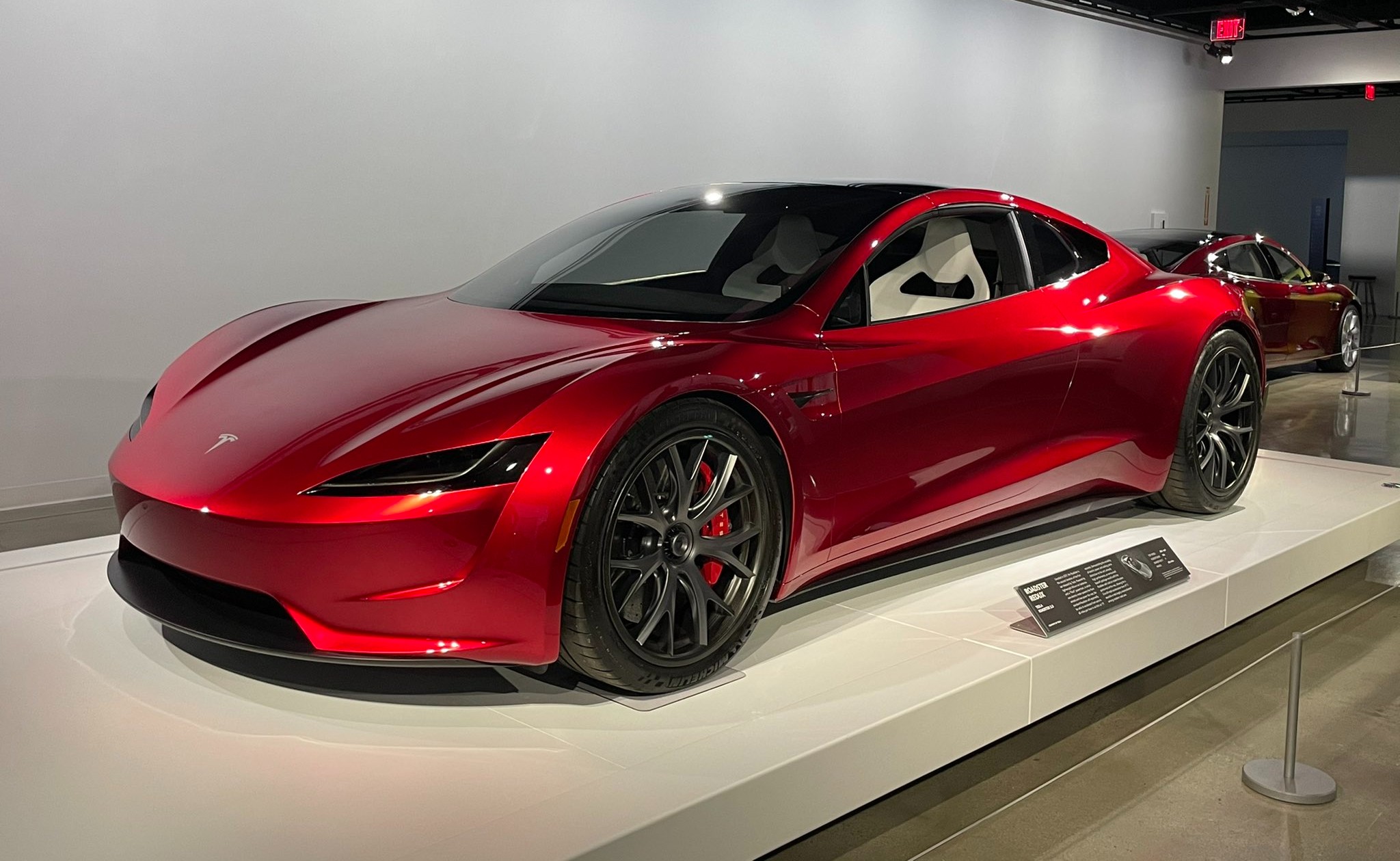
Ahead of its highly anticipated unveiling, Tesla’s upcoming Roadster received a new patent that aims to keep it grounded while enabling white-knuckle speeds.
The patent, which was granted on September 29, is titled “Electric Car Fan,” bluntly stating its design but not its purpose, which is further detailed in the text of the application. Interestingly, it comes two weeks before the Roadster event, which was delayed due to unfavorable weather on Thursday, which could cause issues, as Tesla revealed the event must be held outdoors.
🚨 The design uses electrically driven ducted fans, typically shown as a row of four at the rear, powered by the vehicle’s high-voltage battery.
The fans pull air from an underbody inlet, route it through ducts, and expel it from a larger rear outlet that functions as a… https://t.co/CHQB9u9UA3 pic.twitter.com/QVXmWTdggh
— TESLARATI (@Teslarati) September 29, 2026
The purpose is to solve a problem that is relatively unique to high-performance electric cars. Instant motor torque is useless if the tires cannot plant that force, and conventional wings and underbody tunnels generate downforce only when air is already rushing past the car. At launch, in slow corners, and under hard braking from modest speed, passive aerodynamic additions contribute essentially very little to downforce.
Tesla’s filing says that its fans can produce the downforce needed, independent of vehicle velocity, then ease off so the same hardware does not pile on drag at highway speeds, an issue that can come from excessive body modifications.
The hardware outlined in the patent is a ducted-fan package that is placed into the rear of the vehicle. An underbody inlet between the rear wheels feeds a duct that rises to a wide outlet in the diffuser. In that outlet are four axial fans, which are divided by vertical strakes. They will pull air from under the floor and press the chassis onto the pavement.
The language in the patent claims it can cut drag rather than add to it while simultaneously increasing downforce.
Tesla Roadster event requires restricted airspace, and the FAA obliges
The fans run from the high-voltage battery and a vehicle control system, so output can be modulated rather than left on as a fixed penalty.
There are additional strengths that can come from this design, like extra tire load at low speed, which can contribute to even more face-melting acceleration rates, decrease stopping distance, and sharper turn-in before a wing has air to work with. Adjustable fan speed lets the car add grip only when needed, so it can be catered to the force of a turn or acceleration.
These designs were previously used, and banned, in some competitive settings. The Brabham BT46B was banned in F1 competition for using a similar fan design and being labeled as too effective.
Tesla still lists the Roadster as having a sub-two-second 0-60 MPH time and a 250-plus-MPH top speed, and there are expectations for a SpaceX cold-gas thruster package that could not only increase acceleration but potentially cause the vehicle to hover.
It is important to note that a patent is not a production part, and packaging four fans in a rear diffuser, managing noise, and potential debris are all things Tesla must consider. With that being said, the patent being granted shows Tesla is designing the Roadster to go fast, but it is also attempting to use unique strategies to combat any issues it might have at those speeds.
Elon Musk
SpaceX turned a heralding moment for Starship into its greatest
Starship reached orbit despite losing an engine, deployed 26 Starlink V3 satellites on Flight 14.

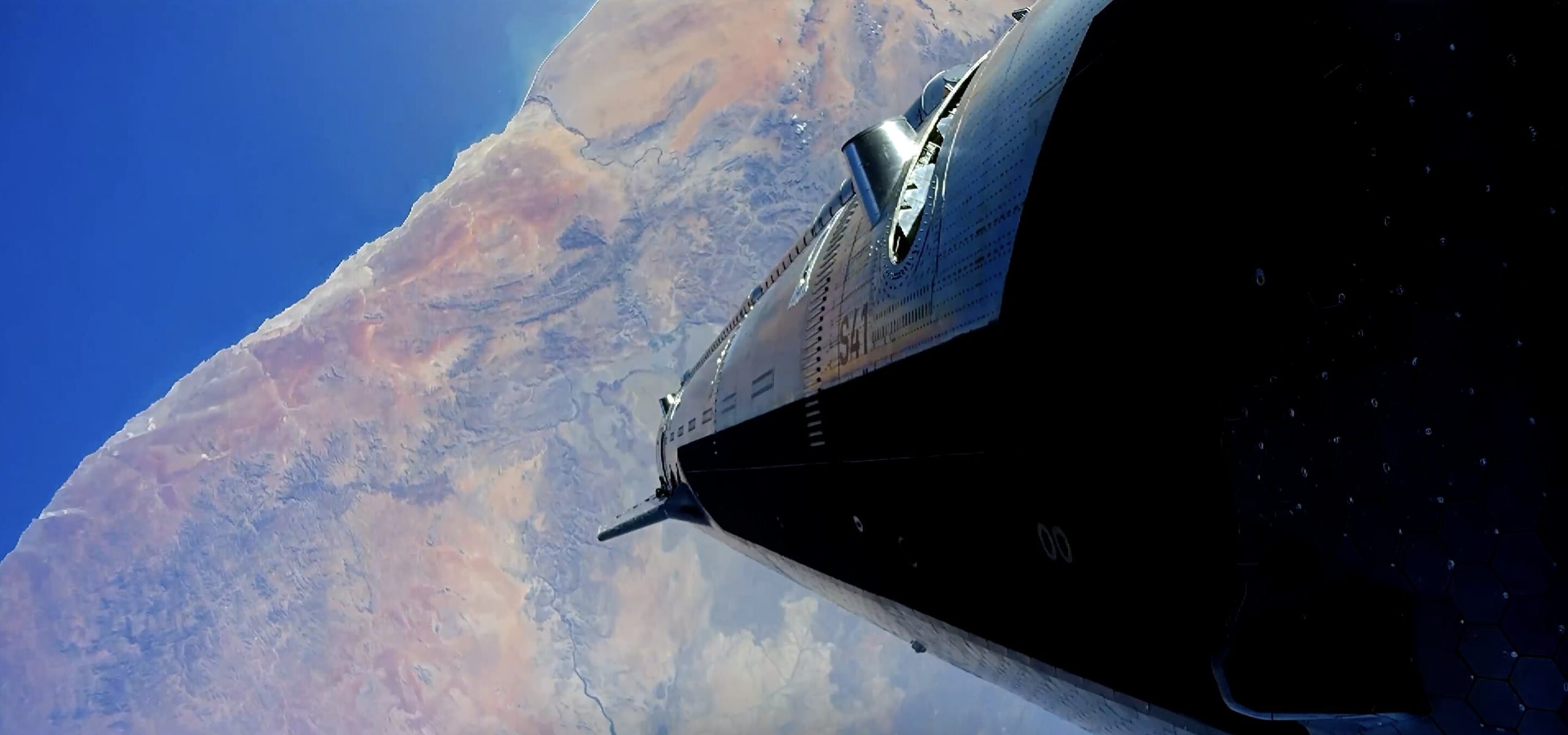
SpaceX’s Starship reached orbit for the first time on Monday, and for a few nail-biting minutes it looked like it wouldn’t. During ascent on Flight 14, one of Ship 41’s six Raptor engines shut down early, and SpaceX’s livestream host Dan Huot told viewers the team had decided not to commit to orbit. Minutes later, after what Huot described as a lot of conversation in the control room, the final poll came back in favor, and a roughly 19 second burn of a single Raptor pushed the ship into orbit about 170 miles up.
The reversal matters because SpaceX had written the exit ramp into the mission plan. The company said it would only fire the orbital insertion burn if flight controllers confirmed enough backup hardware remained for the deorbit burn, a condition Teslarati laid out ahead of the flight. Losing an engine was exactly the scenario that rule was built for.
Pressing forward fits Elon Musk’s history. Falcon 1 failed three straight times before its fourth launch reached orbit in 2008, with SpaceX nearly out of money, and Starship was developed by flying prototypes until they broke. What changed this year SpaceX going public, and with $SPCX sliding below its IPO price in July when Flight 13 slipped, the short interest climbed significantly, as Teslarati reported at the time. A Starship potentially lost today with revenue generating next-gen Starlink satellites aboard would have landed directly on shareholders.
Splashdown confirmed. Congratulations to the entire SpaceX team on the first orbital flight of Starship! pic.twitter.com/urjmiwnvNl
— SpaceX (@SpaceX) September 28, 2026
That pressure showed up after orbit. SpaceX cut a flight planned to last nearly 10 hours to about three, moving splashdown from west of Chile to the North Pacific near Hawaii. SpaceX gave no reason, though Musk said this month the company was being extremely cautious about debris risk. The single Raptor for deorbit worked, and Ship 41 completed its flip and landing burn before breaking apart in the water, an outcome SpaceX expected. Musk has structured SpaceX’s governance to shield long term bets from market pressure.
The payload is the bigger business story. Musk posted that all 26 Starlink V3 satellites deployed and are “operating nominally.” Each V3 is rated for about 1 Tbps of downlink and 160 Gbps of uplink, so this single launch adds roughly 26 Tbps, about 10 times what a Falcon 9 load of V2 Mini satellites adds. The V3 is too large for Falcon 9, making Starship the only vehicle that can build out the planned 100,000 satellite constellation, at up to 60 per flight once it reaches routine service. Unlike the 20 V3 units on Flight 13, which reentered on a suborbital path, these will raise their orbits and could begin serving customers within weeks and bring in hundreds of millions of additional dollars in projected Starlink revenue.
SpaceX has already begun winding down Falcon 9 Starlink launches from Florida in favor of Starship. Reported targets put Flight 15 as early as October 19, leaving about three weeks to diagnose Monday’s engine shutdown before the next orbital attempt.
Starship’s 14th flight is set to launch on Monday, Sept 28. The 75-minute launch window opens at 7:15 a.m. CT. Live coverage of the mission starts ~35 minutes before launch → https://t.co/uQKQvgaTmJ
— SpaceX (@SpaceX) September 27, 2026
Elon Musk
Elon Musk’s AI Grok Bot can now handle banking while your Tesla FSD handles the road
Elon Musk says Grok Bot can manage your finances through linked bank and investment accounts.
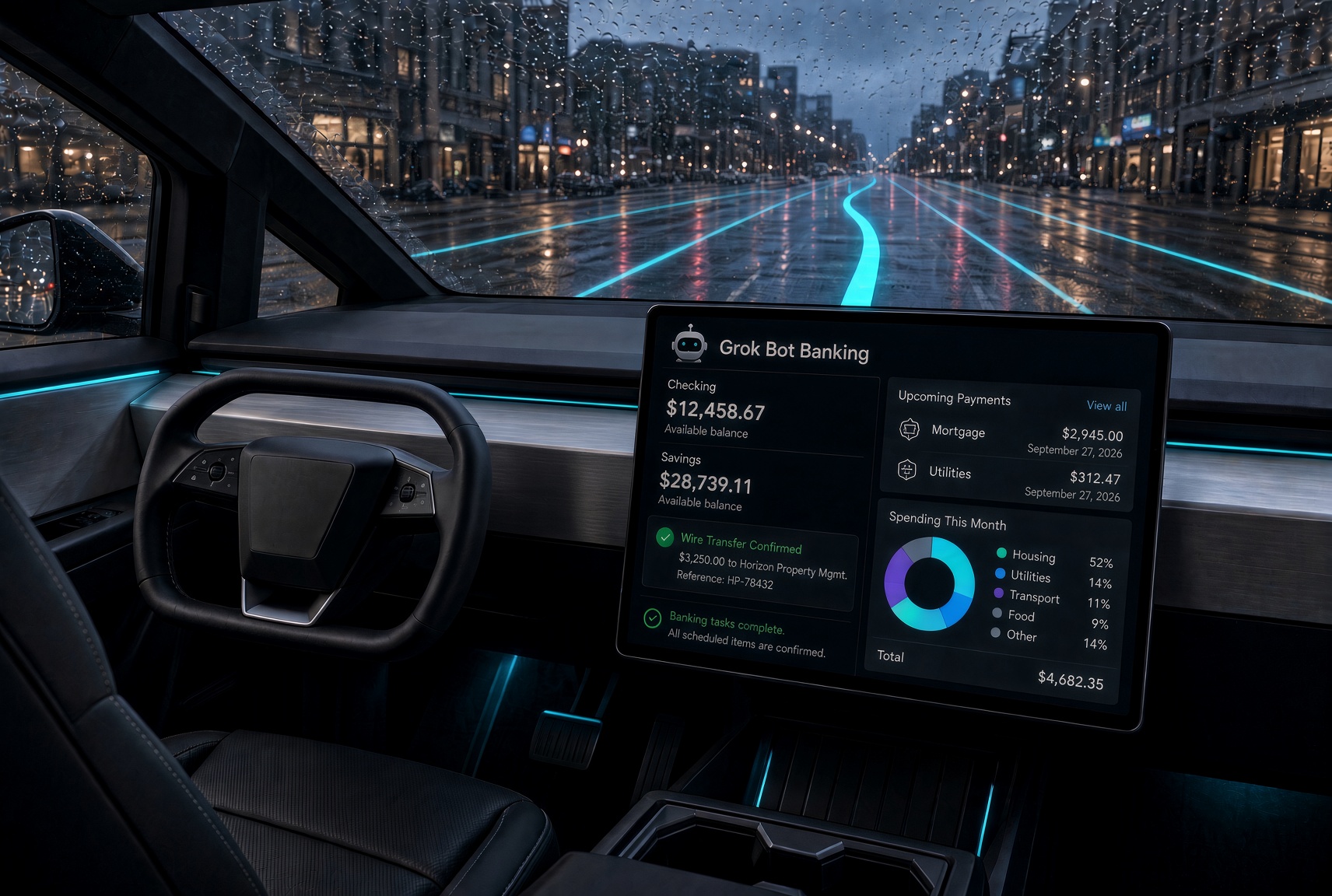
Grok Bot now wants access to your wallet, with SpaceXAI rolling out a new Finance integration for its agent platform that lets users link bank, credit card and investment accounts thereby letting their Bots help manage spending, investments and more. Elon Musk amplified the announcement on X with a short endorsement, “Grok Bot can manage your finances.”
The feature builds on two earlier steps. In early September, Grok gained the ability to answer questions about spending, savings, investments and cash flow using accounts connected through Plaid, starting with users in the U.S. Before that, on August 28, SpaceXAI let Grok Bot buy things online through Link, with users approving every spend request and the Bot receiving a single use card for each payment.
Musk has already shown how far he wants users to push it. In late August, when Tesla investor account Teslaconomics said he was weighing whether to give Grok Bot access to his bank accounts, Musk replied, “Try it out. If Grok Bot messes up, we will make you whole.” That promise goes beyond SpaceXAI’s consumer terms, which make users responsible for what their agents do and generally cap the company’s liability at the greater of fees paid or $100. SpaceXAI’s own documentation recommends requiring approval for purchases and financial transfers.
For Tesla owners, the update lands five days after Tesla brought Grok Bot into its vehicles, letting drivers hand off errands by voice while FSD (Supervised) handles the road. Bot access inside the car is currently limited to SuperGrok Heavy subscribers, though Connectors are open to anyone signed into Grok. With Finance linked, a driver could ask for a spending summary or a check on upcoming bills during the commute.
Grok’s role in the car has grown quickly since Tesla’s Summer Update let it control cabin features by voice. We have been using Grok Bot in our own Tesla for several weeks, and here’s how our latest test went.

Tesla Roadster’s new patent preps white-knuckle speeds, keeping it grounded

Tesla showrooms picked clean ahead of Q3 end as demand looks strong


