News
Tesla refines Full Self-Driving, latest update impresses where it last came up short
We were able to go out and test it pretty extensively on Saturday, and the changes Tesla made from the previous version were incredibly impressive, especially considering it seemed to excel where it last came up short.

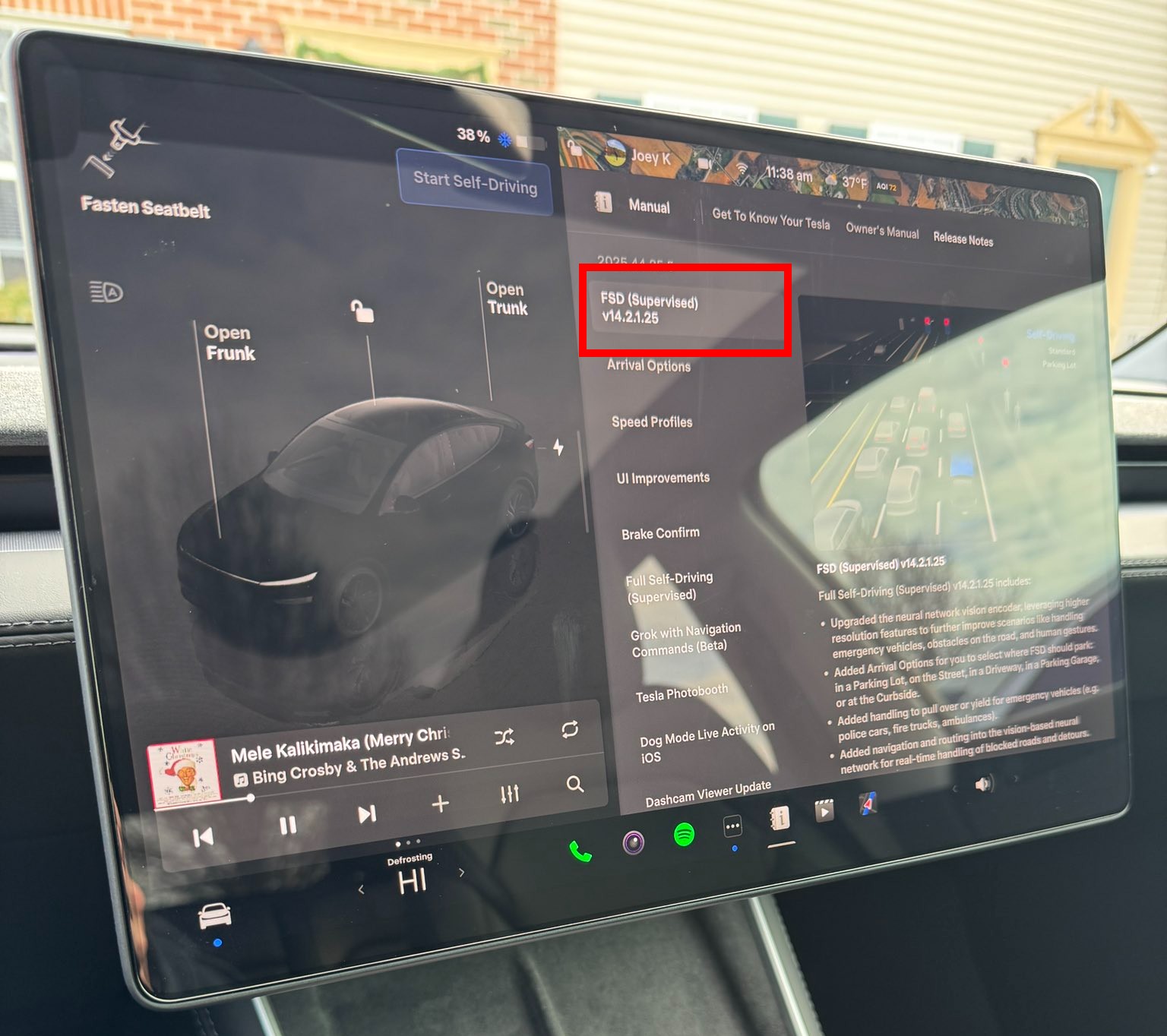
Tesla released Full Self-Driving v14.2.1.25 on Friday night to Early Access Program (EAP) members. It came as a surprise, as it was paired with the release of the Holiday Update.
We were able to go out and test it pretty extensively on Saturday, and the changes Tesla made from the previous version were incredibly impressive, especially considering it seemed to excel where it last came up short.
Tesla supplements Holiday Update by sneaking in new Full Self-Driving version
With Tesla Full Self-Driving v14.2.1, there were some serious regressions. Speed Profiles were overtinkered with, causing some modes to behave in a strange manner. Hurry Mode was the most evident, as it refused to go more than 10 MPH over the speed limit on freeways.
It would routinely hold up traffic at this speed, and flipping it into Mad Max mode was sort of over the top. Hurry is what I use most frequently, and it had become somewhat unusable with v14.2.1.
It seemed as if Speed Profiles should be more associated with both passing and lane-changing frequency. Capping speeds does not help as it can impede the flow of traffic. When FSD travels at the speed of other traffic, it is much more effective and less disruptive.
With v14.2.1.25, there were three noticeable changes that improved its performance significantly: Speed Profile refinements, lane change confidence, and Speed Limit recognition.
🚨 Many of you asked us to test highway driving with Tesla Full Self-Driving v14.2.1.25. Here’s what we noticed:
✅ Speed Profiles are significantly improved. Hurry Mode is no longer capped at 10 MPH over the speed limit, and now travels with the flow of traffic. This is much… pic.twitter.com/48ZCGbW0JO
— TESLARATI (@Teslarati) December 13, 2025
Speed Profile Refinement
Speed Profiles have been significantly improved. Hurry Mode is no longer capped at 10 MPH over the speed limit and now travels with the flow of traffic. This is much more comfortable during highway operation, and I was not required to intervene at any point.
With v14.2.1, I was sometimes assisting it with lane changes, and felt it was in the wrong place at the wrong time more frequently than ever before.
However, this was one of the best-performing FSD versions in recent memory, and I really did not have any complaints on the highway. Speed, maneuvering, lane switching, routing, and aggressiveness were all perfect.
Lane Changes
v14.2.1 had a tendency to be a little more timid when changing lanes, which was sort of frustrating at times. When the car decides to change lanes and turn on its signal, it needs to pull the trigger and change lanes.
It also changed lanes at extremely unnecessary times, which was a real frustration.
There were no issues today on v14.2.1.25; lane changes were super confident, executed at the correct time, and in the correct fashion. It made good decisions on when to get into the right lane when proceeding toward its exit.
It was one of the first times in a while that I did not feel as if I needed to nudge it to change lanes. I was very impressed.
Speed Limit Recognition
So, this is a complex issue. With v14.2.1, there were many times when it would see a Speed Limit sign that was not meant for the car (one catered for tractor trailers, for example) or even a route sign, and it would incorrectly adjust the speed. It did this on the highway several times, mistaking a Route 30 sign for a 30 MPH sign, then beginning to decelerate from 55 MPH to 30 MPH on the highway.
This required an intervention. I also had an issue leaving a drive-thru Christmas lights display, where the owners of the private property had a 15 MPH sign posted nearly every 200 yards for about a mile and a half.
The car identified it as a 55 MPH sign and sped up significantly. This caused an intervention, and I had to drive manually.
It seems like FSD v14.2.1.25 is now less reliant on the signage (maybe because it was incorrectly labeling it) and more reliant on map data or the behavior of nearby traffic.
A good example was on the highway today: despite the car reading that Route 30 sign and the Speed Limit sign on the center screen reading 30 MPH, the car did not decelerate. It continued at the same speed, but I’m not sure if that’s because of traffic or map data:
🚨 We listened to and read a lot of you who had a complaint of Tesla Full Self-Driving v14.2.1 incorrectly reading Speed Limit signs
This appears to be resolved in v14.2.1.25.
Here’s a breakdown: pic.twitter.com/TEP03xrMbt
— TESLARATI (@Teslarati) December 13, 2025
A Lone Complaint
Tesla has said future updates will include parking improvements, and I’m really anxious for them, because parking is not great. I’ve had some real issues with it over the past couple of months.
Today was no different:
🚨 My lone complaint with my drive on Tesla FSD v14.2.1.25 was this strange parking instance.
FSD swung out wide to the left to pull into this spot and this is where it seemed to be stumped. I gave it about 10 seconds after the car just stopped moving for it to make some… https://t.co/ZEkhTHOihG pic.twitter.com/TRemXu5DLf
— TESLARATI (@Teslarati) December 13, 2025
Full Self-Driving v14.2.1.25 is really a massive improvement over past versions, and it seems apparent that Tesla took its time with fixing the bugs, especially with highway operation on v14.2.1.


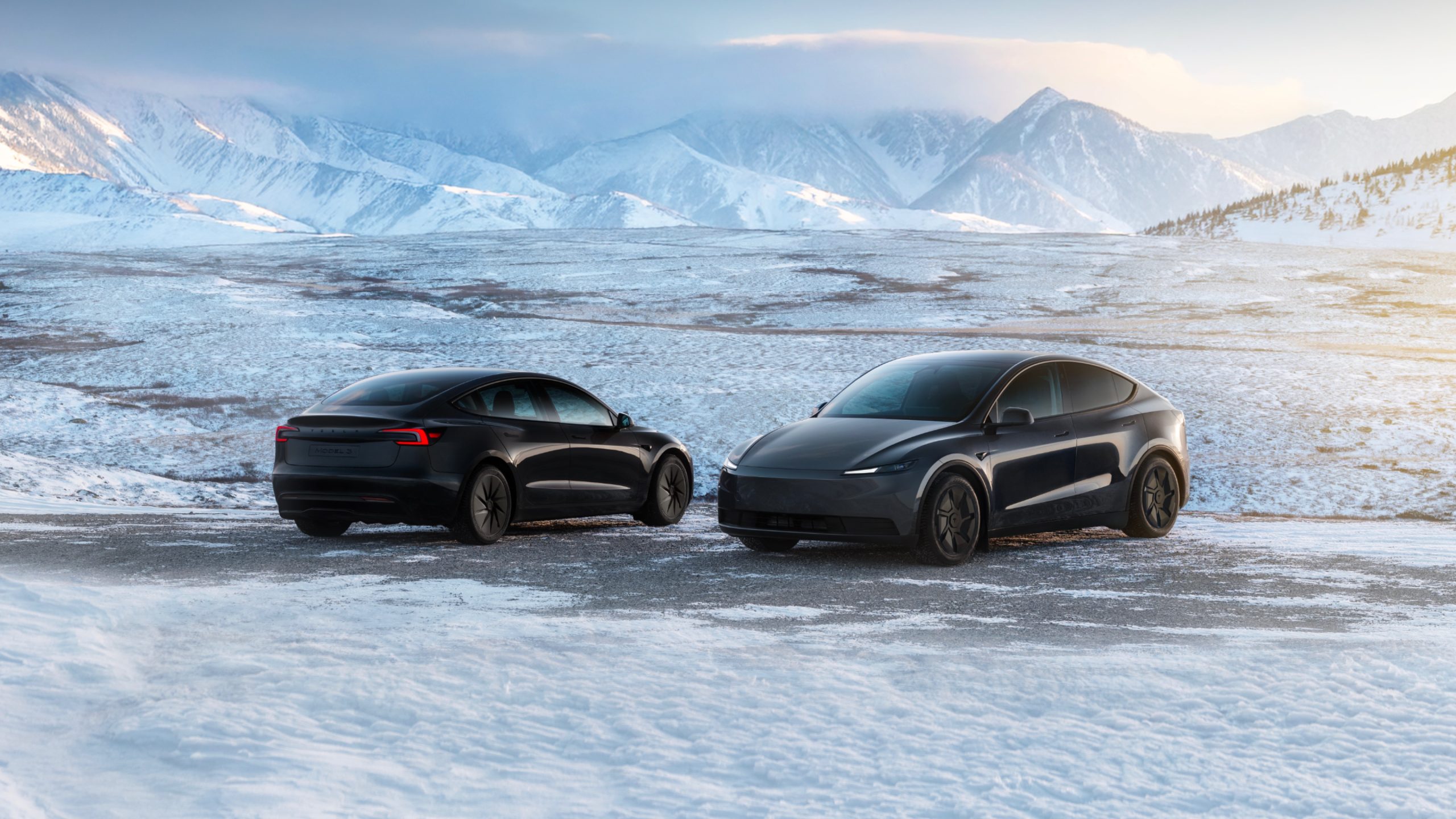
Tesla (NASDAQ: TSLA) reported strong delivery figures that beat Wall Street guesses, and they were revealed alongside the company’s second-best quarter in terms of energy deployments ever.
Tesla announced this morning that it delivered 486,532 cars in Q3, while producing 464,391, exceeding analyst consensus, which sat around 462,000 units.
Meanwhile, Tesla reported 13.7 GWh of energy storage deployed for the quarter. That’s the second-best quarter Tesla has ever reported on that side of things.
🚨 Tesla delivered 486,532 vehicles in Q3, beating expectations at 464,391.
Big Q from the Tesla team, also 13.7 GWh of energy was deployed. pic.twitter.com/olioLWgG7a
— TESLARATI (@Teslarati) October 2, 2026
Vehicle Deliveries
Deliveries were strong, and it was another quarter when Tesla had the opportunity to outshine the Wall Street pundits who are quick to criticize and slow to give credit. Tesla saw a slight decrease in deliveries compared to Q3 2025, but Tesla still had the $7,500 EV Tax Credit to use to help incentivize consumers to pick an EV.
A small decrease of 2.1 percent is pretty telling because it shows Tesla does not need massive federal credits to convince consumers to purchase its vehicles.
It was also the company’s third-best performance all-time in terms of deliveries, trailing that of Q3 2025 with 497,099 deliveries and Q4 2024, when the company handed over 495,570 cars.
We reported several days ago that Tesla Showrooms across the United States were completely bare of inventory or unclaimed units. Many locations also removed Demo Drive units, which had been bought by customers looking to take delivery sooner.
Tesla showrooms picked clean ahead of Q3 end as demand looks strong
Energy Generation
Tesla’s Energy Generation performance in Q3 was also very strong, as the company deployed 13.7 GWh of energy storage over the past three months. The only quarter when Tesla reported stronger energy deployment figures was Q4 2025, when 14.2 GWh of energy storage was deployed.
Tesla’s Q3 performance in energy generation has continued to grow each quarter, with the company increasing its deployments by ten-fold since Q3 2021, when just 1.3 GWh was deployed.
It is also nearly double what it was in Q3 2024, when the company reported 6.9 GWh. This is one of Tesla’s quickest-growing divisions, and it flies under the radar with fans and analysts, as many are focused on self-driving or the vehicles themselves.
Tesla Stock
Shares rose 5.07 percent to $372.06 at just after 10 a.m. on the East Coast. This is a rarity for Tesla after a strong delivery report, as positive news usually brings the stock down. Many quarters with extremely robust delivery reports have not been as kind to the Teslanaires of the world.
Lifestyle
Tesla’s newest feature lets you floor it out of a Supercharger while plugged in
Tesla’s new Emergency Drive Away feature lets owners flee a Supercharger while still plugged in.

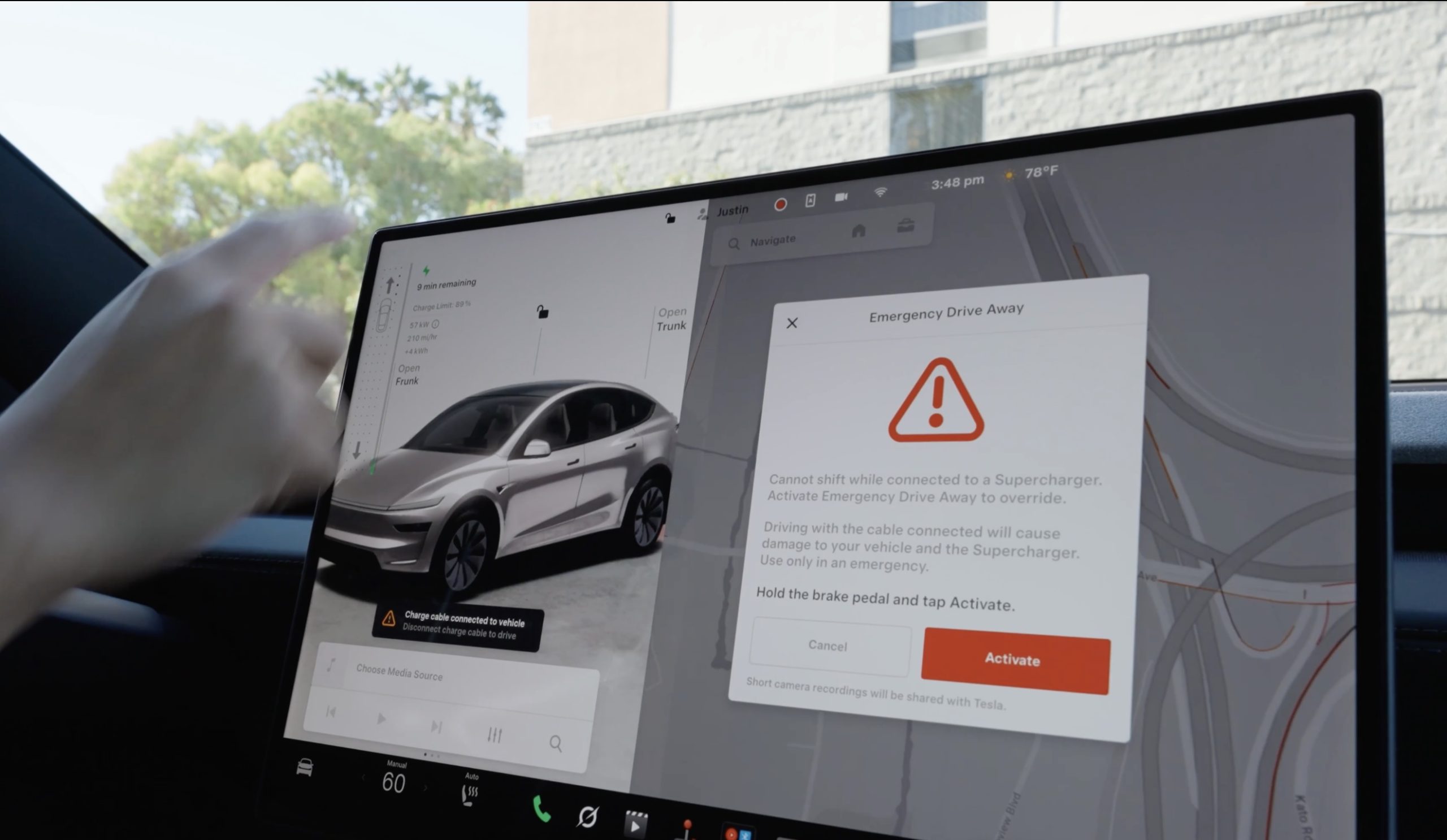
Tesla has given drivers a way to escape while a vehicle is plugged-in at a Supercharger, in the event of an emergency. The company’s charging team announced a new feature on X called Emergency Drive Away, which lets a driver shift into Drive and pull away while the charging cable is still connected to the car.
Until now, a Tesla would not leave Park with a charge cable plugged in. Drivers had to release the latch from the touchscreen, the Tesla app, or the button on the charge handle, then wait for the port to let go. Emergency Drive Away removes that lockout, but Tesla is clear that it comes at a cost. “Use of this feature will damage your vehicle and the Supercharger,” the company wrote, adding that the function is meant for emergencies only and that deliberate misuse will lead to “additional penalties.” Tesla did not say what those penalties are.
Emergency Drive Away lets you shift into Drive while still plugged into a Supercharger pic.twitter.com/40GSzyP4lG
— Tesla Charging (@TeslaCharging) October 1, 2026
The in-car prompt is just as direct, with the warning reading: “Driving with the cable connected will cause damage to your vehicle and the Supercharger. Short camera recordings will be shared with Tesla.” That footage gives Tesla a way to separate a real emergency from someone who simply did not want to wait for the latch.
The feature requires software update 2026.38.3, and Tesla said in replies to owners that it works at every Supercharger in the United States without new stall hardware. Model S and Model X vehicles built before 2021 are not supported, and the company says the feature applies to U.S. Superchargers “for now,” leaving Canada and other markets out at launch.
Tesla Supercharger argument leads to tragic shooting incident
Tesla did not tie the announcement to any specific event, but it arrives two months after a gunman opened fire at an In-N-Out in Twin Falls, Idaho, on August 1, targeting three people in two Teslas at the neighboring Supercharger. One of them, a 66 year old man from Salt Lake City, was killed. Superchargers have been the scene of violence before, including a fatal shooting at a station near Denver in 2023.
In the weeks after Twin Falls, owners pushed Tesla for a native way to escape a stall, and many pointed back to EVject, the aftermarket breakaway connector Tesla sued in 2024 over claims it lacked overtemperature protection. The two companies later reached an agreement that led EVject to recall its earlier connectors in favor of a version with thermal sensors.
Our mission has always been about providing peace of mind and eliminating sitting duck scenarios.
We patented the built-in breakaway charger tip on Feb 15, 2023. Awarded Jan 30, 2024. Then shared the designs with @TeslaCharging
Thank you @Tesla for rolling out a solution. This… https://t.co/djOzswLw9N
— EVject (@EVject) October 2, 2026
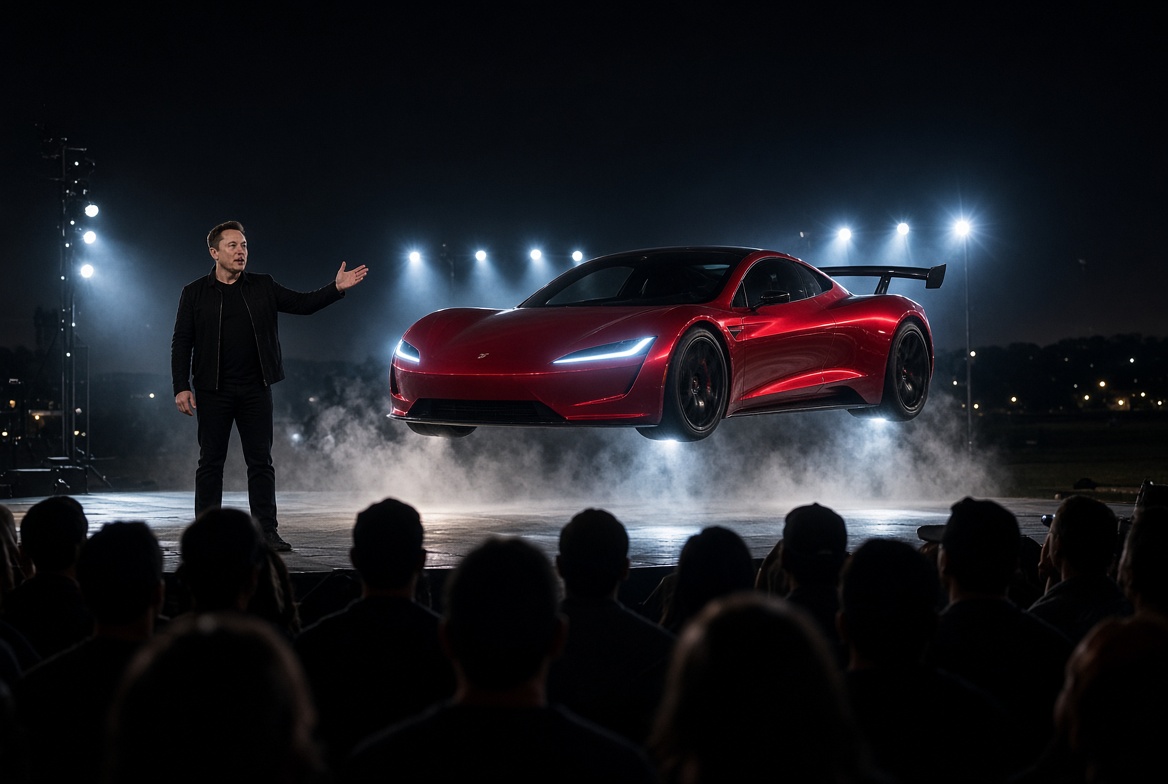
Tesla announced on Monday that the Roadster event scheduled for today would be postponed due to the need for it to be held outside.
Less than 24 hours later, CEO Elon Musk broadened that by stating it was due to high winds, immediately sending everyone into a frenzy over the Roadster’s potential ability to fly.
And realistically, it could definitely have to do with it flying, hovering, or hopping; whatever Tesla has in mind for this demonstration could not be impacted by wind. However, it might have nothing to do with the vehicle flying whatsoever, and instead could be a simple precaution, as the Roadster is a very unique vehicle with some already official specs that are just mind-blowing.
Tesla will very, very likely be showcasing both the acceleration rate and potentially even a top speed demo at the event in Waco. Both of these demonstrations, performed with a vehicle that has such incredibly fast metrics, could easily be impacted by wind as well.
Tesla Roadster event requires restricted airspace, and the FAA obliges
Top Speed Demo
At high speeds, aerodynamic forces are already overwhelmingly present. A crosswind or sudden gust adds a layer of sideways force that the tires must counter with slip angle. On a short demo course, that force can shove the car off the intended line, especially in a light car with a low frontal area and little mass to resist the push.
Electric cars, due to their battery packs, have an advantage of an extremely low center of gravity, giving them extra stability. However, the speeds at which the Roadster could travel at the demo could spell some issues if crosswinds are present.
Gusts are worse than a steady wind because the load changes faster than a driver can smoothly correct. That shows up as weaving or a late correction. Headwinds and tailwinds can also spell disaster. Headwinds cut a measured top speed but raise the power needed to get there or maintain it. Meanwhile, a tailwind can inflate the top speed, and downforce issues could become more noticeable.
Wind also loads the body unevenly. A low car can feel light on the upwind side or see a sudden change in downforce if the gust hits a wing or diffuser at an angle. Tire temperature and pressure might stay near a normal level, but lateral grip can be lost as the vehicle is spent fighting the wind.
Acceleration Demo
Launch and 0-60 MPH runs are shorter, so the car spends less time exposed to forces that could cause things to go awry. However, the first second is very sensitive, as a crosswind at launch could yaw the car before speed builds and prior to aerodynamic impact being too great. The driver will be required to correct traction control or manage how much the wheels are spinning, which will likely be corrected automatically by some sort of traction control system within the Roadster (we are fairly certain Tesla will implement something brilliant with it).
These things could cause an unstable run.
A headwind would increase drag as speed rises, while a tailwind would do the opposite. Meanwhile, surface effects, like wind-driven dust, light debris, or even rain, could reduce grip at the exact moment the tires are asked for peak longitudinal force. Standing water plus a crosswind is a common reason an acceleration attempt might be scrapped.
Flying or Not
No matter what Tesla has in store for the Roadster, waiting for ideal conditions is a great idea. People who follow and support the company, along with the engineers involved in the Roadster program, have been waiting nine years since the last unveiling for this moment. Everything should be ideal.
Some speculate that it’s just not ready, and that’s ridiculous. Why would Tesla even schedule the event — albeit prematurely — after nine years if it was not ready? Why would they jump the gun now?
We were all excited for today, but it truly is the most ideal thing in the world to wait two more weeks so everything, including the weather, can be perfect. The delay is simply worth it. But Tesla, seriously, make this the last one.

Tesla deliveries best Wall Street guesses alongside second-best energy quarter

Tesla’s newest feature lets you floor it out of a Supercharger while plugged in


