News
Rare photo of a Tesla Model 3 on the factory production line surfaces

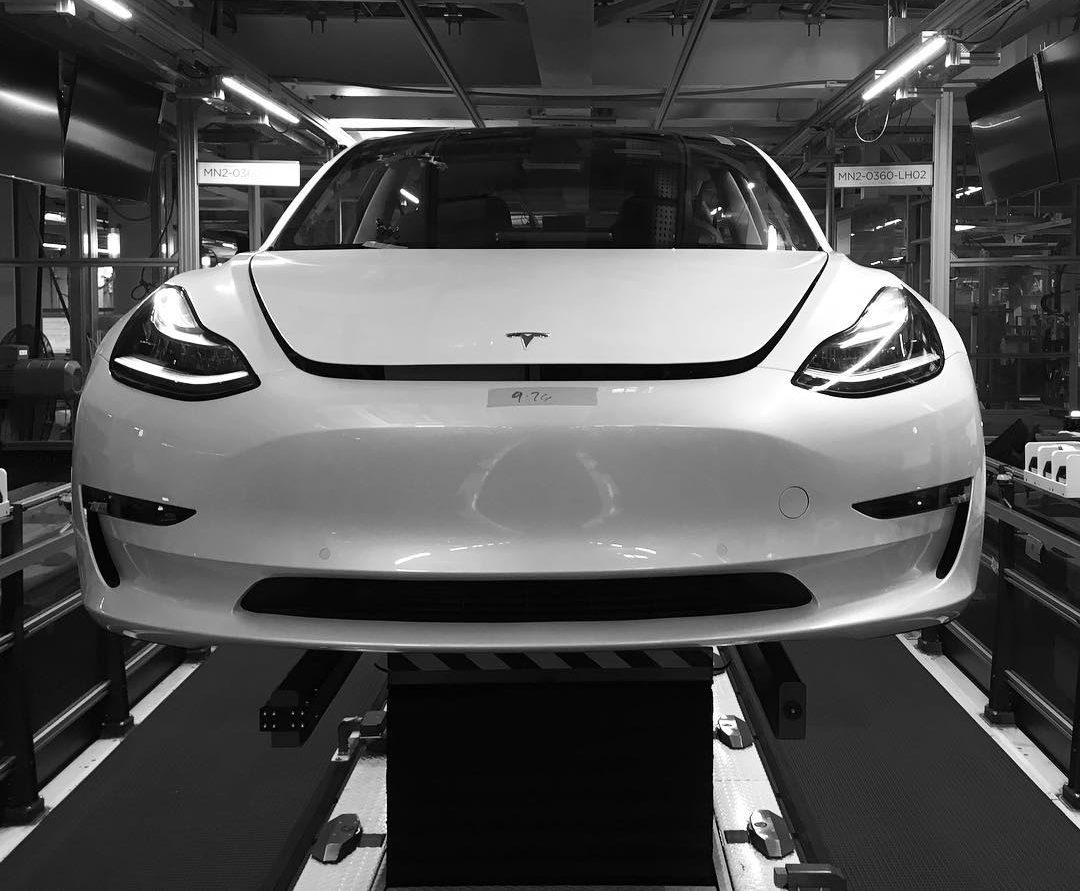
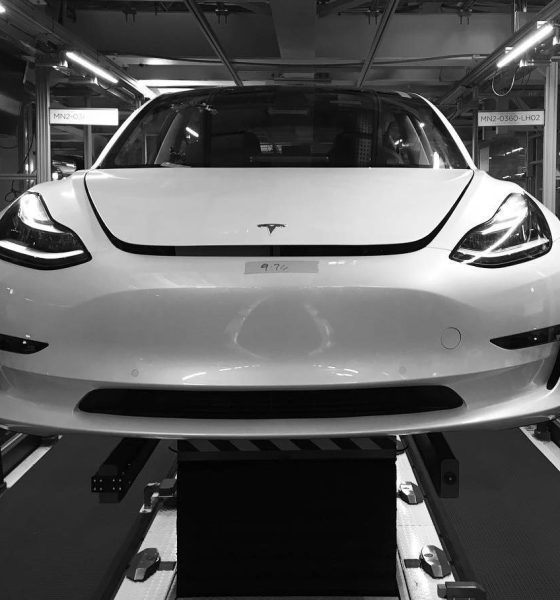
Teslarati has obtained a rare photo shot in black and white of a Tesla Model 3 on the Fremont factory production line. The Model 3 is seen with a handwritten timestamp of “9-26” on a portion of the bumper below the front trunk, which suggests that the vehicle was produced just days ago.
The Model 3 appears to be in its final stages of production inside of what CEO Elon Musk calls Tesla’s “alien dreadnaught” factory. The first sighting of Tesla’s robot army to be used on the Model 3 production line took place in April of this year after a Field Service Engineer for Kuka Robotics – maker of Tesla’s “X-Men superhero robots” – revealed an army of 467 new robots that was reportedly to be used for Model 3 production. More photos followed suit when an attendee of Tesla’s “VIP Factory Tour” snapped a quick photo of the Model 3 production line under construction, at a time when the company was pushing to build its first production “SN1” Model 3.
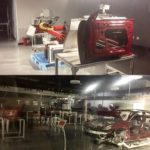
Also seen in the newest set of photos from inside the Tesla factory is a Model 3 door taken from a vehicle that was used for crash test purposes. A gutted red Model 3 door is reportedly inside a “learning center” at the Fremont factory. A Kuka robot is seen grasping presumably another Model 3 door and being “trained”.
As Tesla readies to deliver its Q3 2017 Production and Deliveries report to investors, the Silicon Valley-based electric carmaker has remained relatively silent on all topics related to Model 3. As of now, we know that Tesla aims to produce 1,500 Model 3 units in September, before ramping up to 20,000 units in December.
It’s not clear if Tesla is on track to meet these numbers, but an inside source tells Teslarati that Model 3 production is ahead of forecasts and early reservation holders will soon receive an email invitation to configure their Model 3.
The original source for the photos has been withheld.



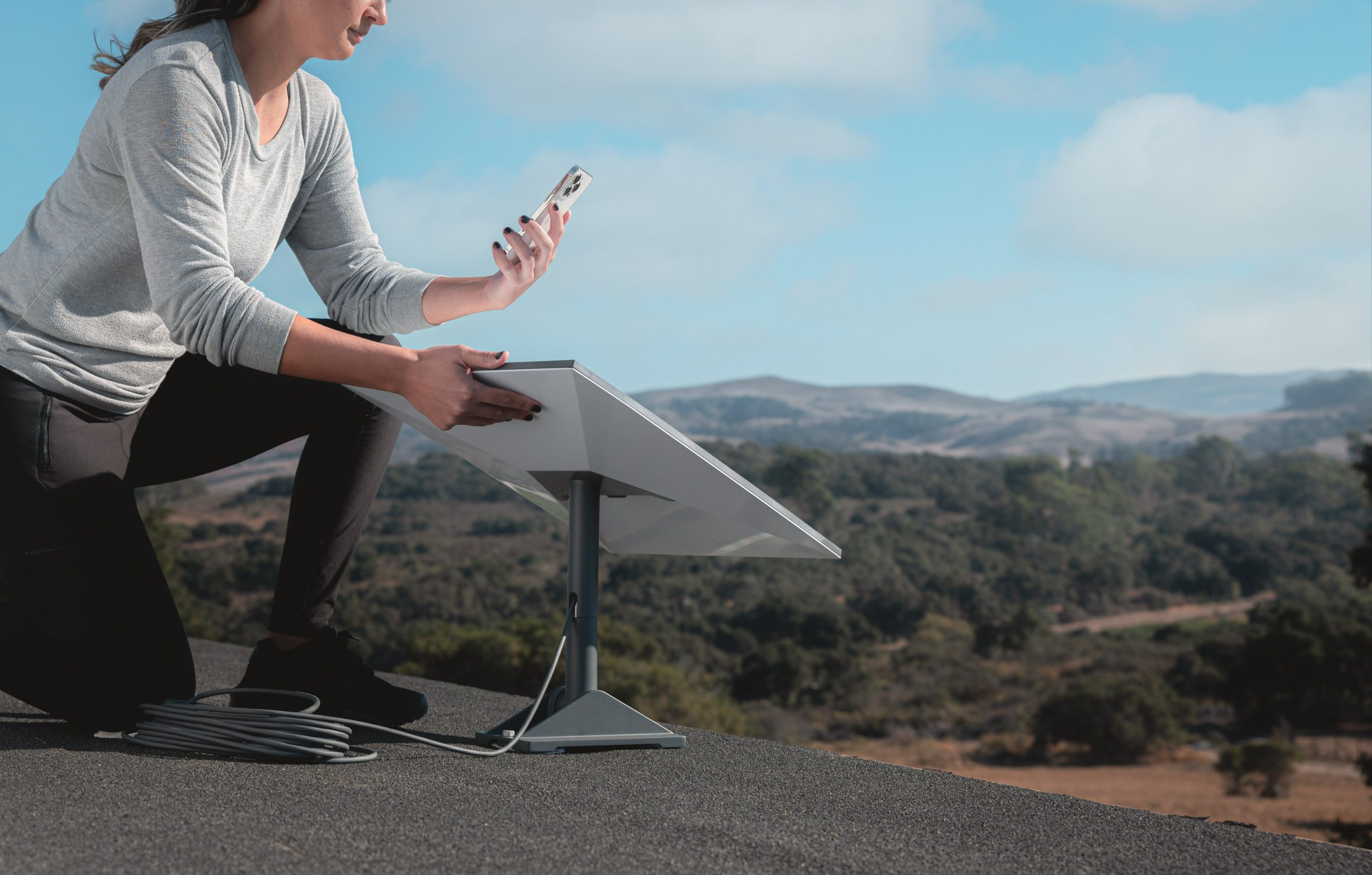
Starlink is launching a new beta path for ordinary property owners and local operators to turn a single Starlink kit into a small shared-access business for passive income.
Under the Starlink for Communities program, a host installs one dish and router setup in a location with nearby demand: an apartment complex, campground, rural crossroads, or event site. Neighbors or local users can buy short-term passes rather than full individual subscriptions, giving the Starlink provider a potential path to passive income.
Hour, day, and week passes cover one device. A month pass covers up to four. Starlink handles account creation, payments, access controls, and the satellite link itself. The host’s role is mainly placement, power, and basic upkeep, with earnings tied to each paid connection.
Big news! SpaceX is introducing a new @Starlink for Communities program that lets you earn money by providing Starlink internet to your neighbors or people nearby, who can pay for access by the hour, day, week, or month.
Neighbors pay for the access they need, while the person… pic.twitter.com/DtOUs0Ekvt
— Sawyer Merritt (@SawyerMerritt) October 1, 2026
The model echoes the passive-income vision long attached to Tesla’s Robotaxi plans, and it seems like it’s something Musk has hinted toward in the past as he believes AI will make the need to work relatively optional. In both cases, the platform owns the hard parts of matching, billing, and network management, while an individual supplies a physical asset that sits idle much of the time.
A Starlink host’s dish can serve multiple nearby users without each household buying and installing its own terminal. A Tesla owner, under the stated Robotaxi concept, would leave a vehicle enrolled in the fleet during unused hours so the car generates rides while the owner is at work or asleep.
Both arrangements convert under-utilized hardware into a revenue stream. They also let the company scale coverage or capacity without owning every endpoint.
Differences are practical. A Starlink kit is a fixed, relatively low-cost terminal whose main constraint is local congestion and line-of-sight. A Tesla Robotaxi is a mobile, high-value vehicle whose earnings depend on demand density, utilization rates, insurance, cleaning, and charging.
Starlink’s program is already accepting host applications in multiple countries and describes the revenue split as ongoing. Tesla’s owner-network version remains more aspirational.
The company currently operates a limited company-controlled robotaxi service in select areas and has solicited interest from fleet buyers for Cybercab vehicles, while private Full Self-Driving owners have not yet been able to dispatch their own cars for paid rides at scale.
Tesla primes Cybercabs for 4K streaming and high bandwidth gaming with Starlink integration
Starlink is a satellite broadband service operated by SpaceX that uses a constellation of low-Earth-orbit satellites to deliver internet to locations where terrestrial broadband is slow, expensive, or absent. It has grown to millions of subscribers worldwide by selling direct residential, mobile, and enterprise terminals, and have become widely available at a wide array at retail locations like Target and Best Buy.
The Communities program extends that reach by letting hosts resell short bursts of capacity to people nearby, while also providing high-speed internet access to those who are simply around a Starlink user.
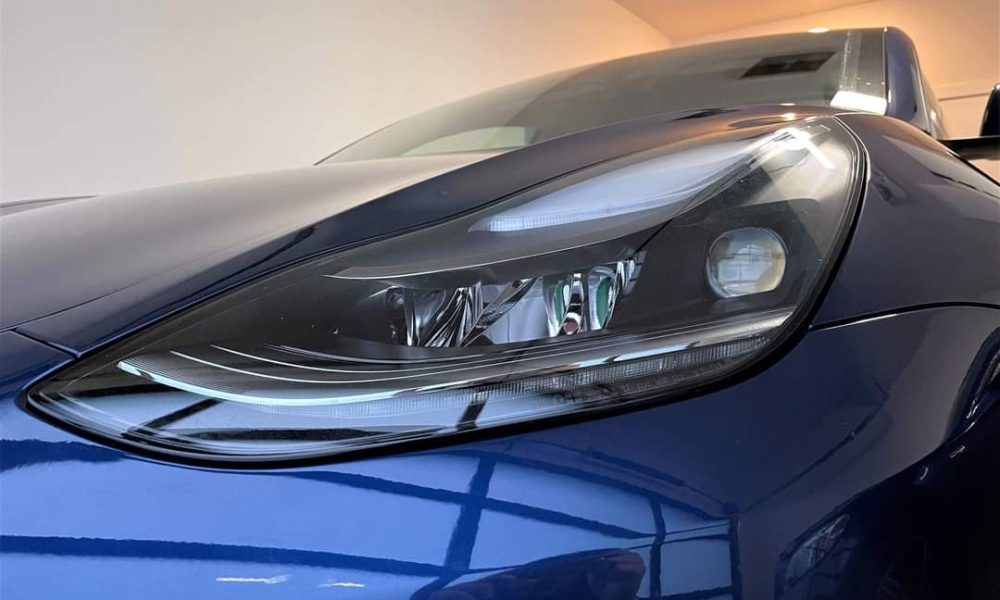
Tesla just upgraded its headlights through a software update, making them even better without any physical or hardware upgrade.
Tesla’s latest software update is quietly improving nighttime driving for a small number of owners. Version 2026.38 includes a new capability called Dynamic Headlight Leveling.
The feature automatically adjusts the aim of the low beams in response to driving conditions and nearby traffic, with the goal of giving the driver more usable light on the road while reducing glare for oncoming vehicles and traffic ahead.
2026.38 just dropped.
Model 3 gets Dynamic Headlight Leveling — low beams auto-aim around traffic for max visibility, less glare. Model 3 / Y (AMD HW3) also pick up sharper Tesla visuals + an enhanced park scene on the center display.
Legacy Intel cars get Supercharger Site… pic.twitter.com/45ac4AH6Vs
— Frunk To Trunk (@FrunkToTrunk) September 30, 2026
Unlike Tesla’s matrix high-beam system, which selectively dims individual LED segments to create shadows around other cars, Dynamic Headlight Leveling physically tilts the low-beam projectors. Internal motors respond to changes in vehicle pitch.
When the car accelerates hard, climbs a steep grade, or carries extra weight in the rear, the headlights can otherwise point higher than intended. The software counters that movement in real time so the beam stays aimed at the road surface rather than into the eyes of other drivers.
Early indications reveal the update is reaching a limited set of vehicles, including certain Model 3 and Cybertruck examples in the United States and the United Arab Emirates. The rollout does not appear tied to a single hardware revision, and Tesla has not published a broader schedule. It is simply a common waiting game until your car receives it.
The change arrives against a backdrop of wider complaints about headlight glare. Some earlier Model 3 and Model Y vehicles were the subject of an NHTSA recall related to excessive low-beam glare; the software adjustment offers a potential mitigation for cars equipped with the necessary leveling hardware. It does not replace adaptive high beams where those are already available, nor does it alter the basic low-beam pattern itself.
Instead, it keeps an existing beam pointed where it is most useful.
For drivers who have received the update, the system requires no new settings or user input. The headlights simply respond as road conditions and traffic change. As the feature reaches more vehicles, it adds another example of Tesla using over-the-air software to refine existing hardware rather than waiting for a new model year. Nighttime visibility and reduced glare for others are the practical results owners are expected to notice first.
Lifestyle
Tesla teases “Halloween Mode” update with Optimus rising from a graveyard
Tesla’s Halloween teaser hides a covered vehicle and an Optimus hand rising from the ground.
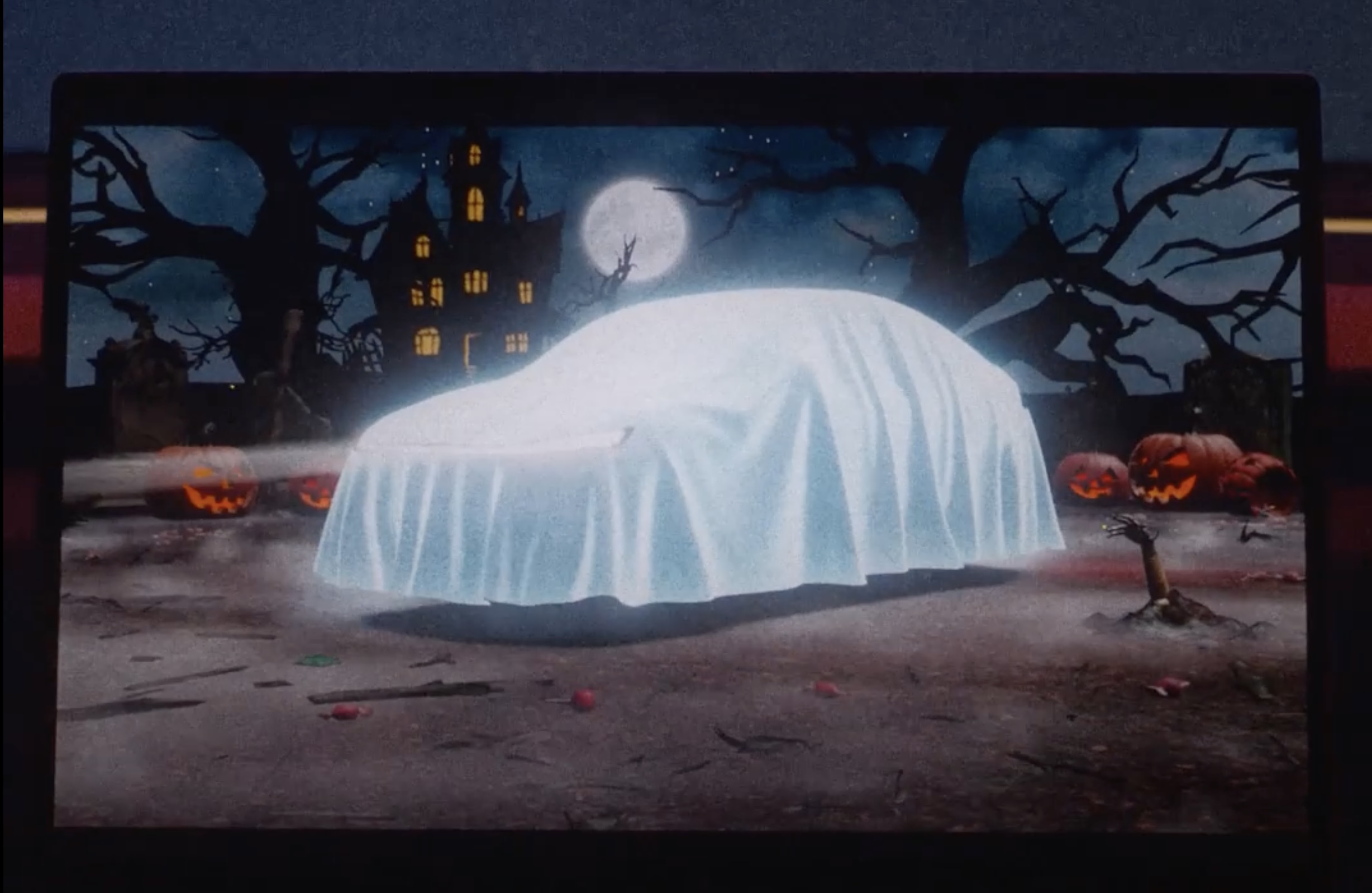
Tesla has started teasing a Halloween software update for its vehicles, with a short clip on X that reads, “Halloween is coming.” The clip opens on a glowing pumpkin before pulling back to the car’s center touchscreen, where the usual parked visualization has been replaced by a graveyard scene, and the vehicle draped with a white sheet so it reads as a cartoon ghost.
Halloween is coming pic.twitter.com/lM3ASUeOqX
— Tesla (@Tesla) October 1, 2026
The second detail is a robotic hand clawing its way out of the dirt like a zombie, which looks to be the hand of Tesla’s latest Optimus V3 humanoid robot. While Tesla still has not formally shown Optimus Gen 3 walking around in service, renders pulled from Tesla’s Android app last month gave the clearest look yet, including far more refined hands that Tesla has said carry 22 degrees of freedom. The hand has been the hardest part of the program. Musk has called it the majority of the robot’s engineering difficulty, and Tesla’s patents describe a design driven by tendons with the actuators moved into the forearm.
Tesla Optimus V3 hand and arm details revealed in new patents
Optimus also has a Halloween track record. Last October the robot handed out candy in Times Square, and a costumed “zombie” Optimus shuffled around the Tesla Diner in Los Angeles on Halloween night.
On the software side, Tesla’s 2025 Holiday Update expanded Santa Mode with a Santa sleigh, snowmen, snow effects, and a festive lock chime, so it wouldn’t be too far fetched if we saw something similar but themed for a Halloween Mode.

Starlink launches Communities Program for passive income through internet sharing

Tesla just made its headlights even better through a software update


