SpaceX
SpaceX to submit Moon lander proposal for latest NASA spaceflight competition

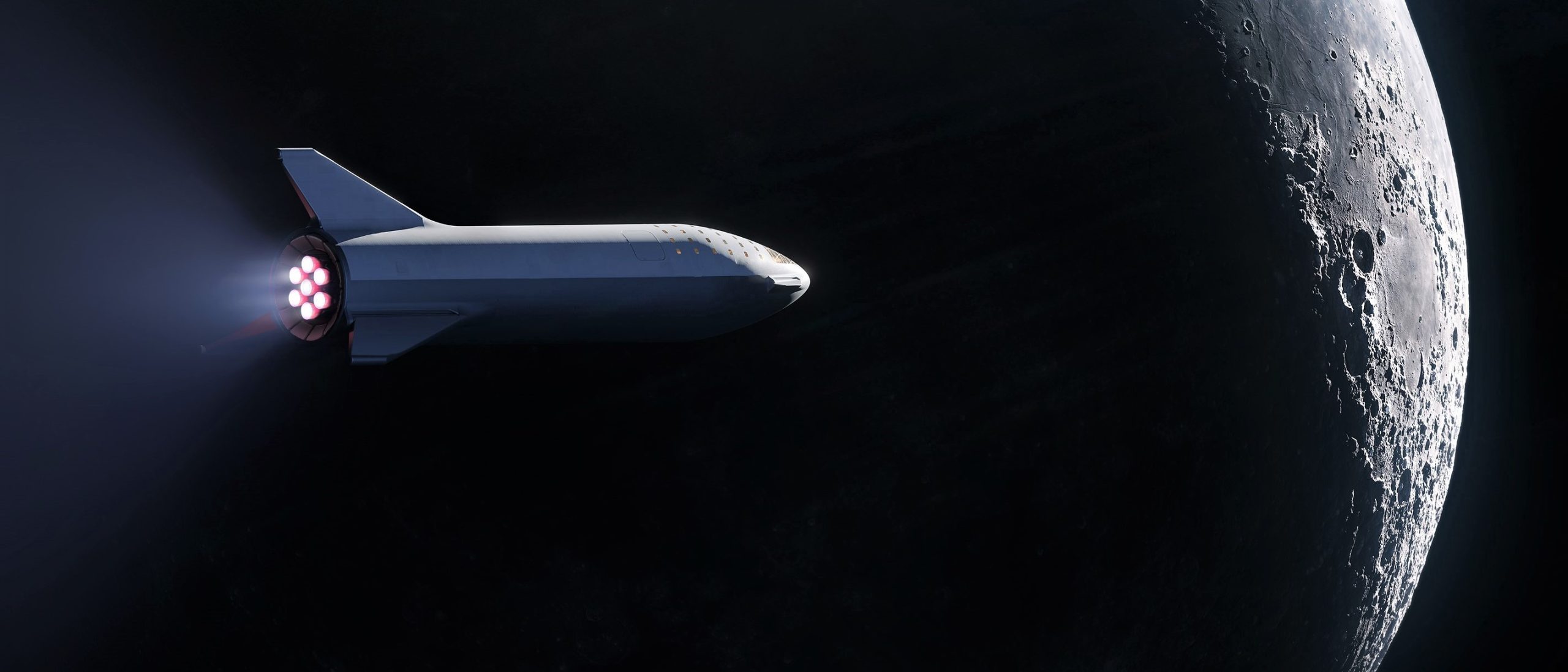
SpaceX reportedly plans to submit its own human-rated Moon lander design for NASA’s latest major request for proposal (RFP), part of the agency’s rough plan to return humans to the Moon no earlier than 2028.
Meant to begin delivering NASA astronauts to the surface of the Moon as early as 2028, the agency hopes to base those lander operations on a thus far unbuilt space station orbiting the Moon with the support of its SLS rocket and Orion spacecraft.
This is actually a pretty big deal. https://t.co/P6LXAMXVJI
— Eric Berger (@SciGuySpace) February 11, 2019
SpaceX will submit a lunar lander design.
— Eric Berger (@SciGuySpace) February 11, 2019
Meant to build directly off of SLS/Orion, a NASA-designed rocket and spacecraft beset with at least three years of delays and billions of dollars in cost overruns, it’s unclear where SpaceX might fit into NASA’s latest modernized attempt at an Apollo Program 2.0. Alongside the 2017 cancellation of Crew Dragon’s propulsive landing program due in part to the likely cost of the certification burden NASA would have placed on the technology before allowing it to land astronauts, SpaceX also canceled Red Dragon (and thus Grey Dragon), a proposal to use a minimally modified version of Crew Dragon as an ad-hoc Mars lander and R&D testbed.
Aside from the likely cost of certifying propulsive Crew Dragon to NASA specifications, CEO Elon Musk also explained the program’s cancellation as a consequence of SpaceX’s far greater interest in what he described as “vastly bigger ship[s]” in July 2017. This translated into a presentation at IAC 2017 a few months later, where Musk revealed SpaceX’s updated design for a giant, fully-reusable launch vehicle meant to enable sustainable Mars colonization, known then as BFR. BFR has since been reconceptualized at least two more times, settling (at present) on a radical new approach said to rely heavily on stainless steel as a replacement for advanced carbon composites.
Initially making one 200 metric ton thrust engine common across ship & booster to reach the moon as fast as possible. Next versions will split to vacuum-optimized (380+ sec Isp) & sea-level thrust optimized (~250 ton).
— Elon Musk (@elonmusk) February 1, 2019
In the second half of 2018 and the first few months of 2019, the SpaceX CEO’s BFR (now Starship/Super Heavy) narrative has noticeably diverged from a largely exclusive focus on Mars to include a new interest (be it genuine or out of convenience) in the Moon. Most notably, Musk stated in January and February 2019 that SpaceX’s single-minded goal for BFR was now “to reach the moon as fast as possible”. In response to a question about SpaceX’s intentions for the first few orbital BFR (Starship) launches, Musk also replied, “Moon first, Mars as soon as the planets align”.
This is likely explicitly connected to Japanese billionaire Yusaku Maezawa’s decision to purchase the first operational Starship (BFR) launch in support of his philanthropic #DearMoon project, meant to send 8-10 artists from across Earth on the first commercial voyage around the Moon as early as 2023. While no specific value was given, the implication of CEO Elon Musk’s emotional response when discussing the financial support pegged the number in the hundreds of millions of dollars, likely on the order of $250M to $500M. However, any astute bureaucrat or aerospace executive would also be (and have been) distinctly aware of a new political undercurrent pushing for the US and NASA to return humans to the Moon, circulating for the last few years before breaking through to the surface in the last six or so months.
-
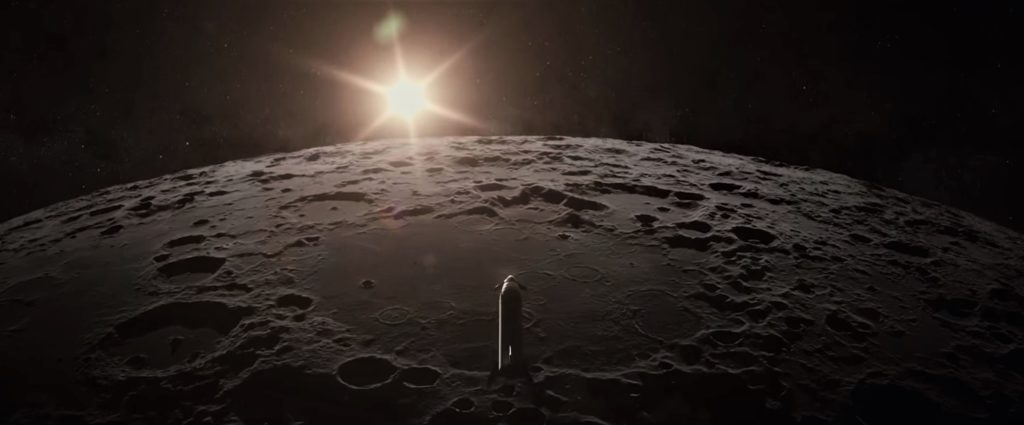
- SpaceX’s updated BFR spaceship seen cresting over the Moon’s limb. (SpaceX)
-
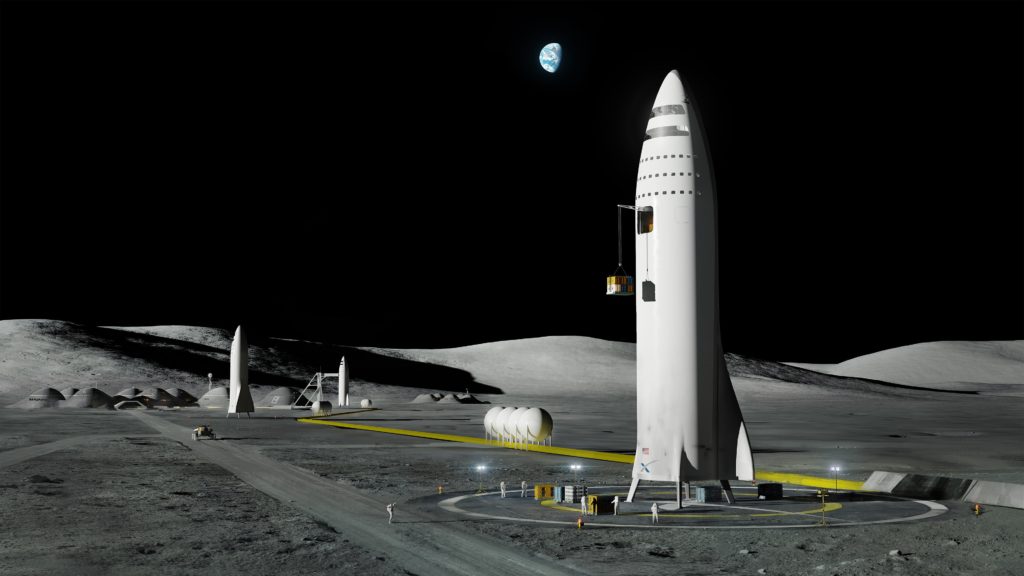
- SpaceX’s 2017 BFS (now Starship) delivers cargo to a large lunar base. (SpaceX)
Orion/SLS versus Starship/Super Heavy?
Per Musk’s frequent and insistent comments on just how hard he expects it to be for SpaceX to fully fund the development of BFR, it would come as no surprise to learn that SpaceX had set its eyes on potential sources of major BFR development funds. Where exactly NASA will find the multibillion-dollar sum likely required to develop even a commercial human-rated Moon lander is entirely unclear, but alas. Although NASA’s new Moon mission seems like an apt fit for SpaceX, funding aside, the problem remains that SpaceX’s next-generation Starship/Super Heavy (formerly BFR) launch vehicle poses a direct, existential threat to NASA’s SLS rocket and Orion spacecraft, an almost entirely expendable system likely to cost no less than $1B per launch and unlikely to launch for the first time until 2021.
NASA’s human return to the Moon is meant to directly complement SLS/Orion thanks to the intention of using a theoretical Moon-based space station (known as Gateway) in a bizarre lunar orbit (known as a “Near Rectilinear Halo Orbit” or NRHO) as the base of lunar-landing operations. The decision to place said Gateway in a lunar halo orbit derives almost exclusively derives (PDF) from a separate decision to design NASA’s future exploration plans around SLS and Orion, particularly Orion in the context of the Moon. Put simply, Orion is relatively mass-inefficient and has a fairly limited amount of delta V (shorthand for the capacity to change one’s velocity), preventing far more useful orbits (i.e. actual lunar orbits). The fragile web of Gateway, SLS, Orion, and any potential crewed Moon landers is intentionally designed to be interdependent, meaning that each piece on its own makes little objective sense and has no obvious functional benefit relative to a bevy of alternatives.
-
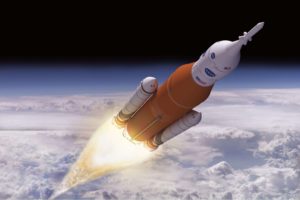
- SLS Block 1. (NASA)
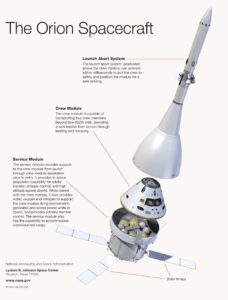
-
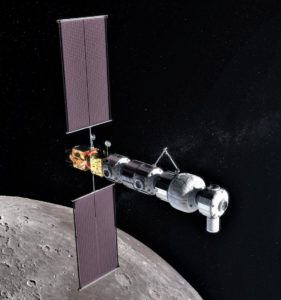
- NASA’s proposed Moon-based space station, known as Gateway. (NASA)
-
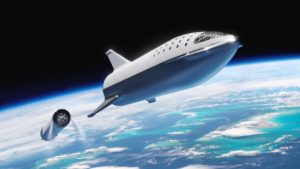
- BFR’s spaceship and booster (now Starship and Super Heavy) separate in a mid-2018 render of the vehicle. (SpaceX)
-
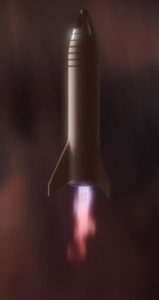
- A BFS attempts a Mars landing in this official updated render. (SpaceX)
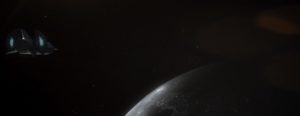
As designed, SpaceX’s Starship/Super Heavy combo would be a nearly redundant and radically simpler solution to the mishmash of Gateway, SLS, Orion, and others. A return to using propulsive Crew Dragon landings as a method of significant payload delivery to the lunar surface is immensely unlikely. The value of an entirely new SpaceX-built craft is equally unclear, given Musk and SpaceX’s general stance on putting development funds towards things that bring the company closer to achieving its ultimate goal of sustainable interplanetary colonization. Regardless, it will undoubtedly be exciting to see what happens and whether SpaceX actually chooses to submit a proposal for one or all aspects of NASA’s baselined lunar lander.
Check out Teslarati’s newsletters for prompt updates, on-the-ground perspectives, and unique glimpses of SpaceX’s rocket launch and recovery processes!


News
Why SpaceX is finishing another space-internet system that isn’t Starlink
SpaceX launched three final O3b mPower satellites Sunday, finishing a lesser known SES satellite network.

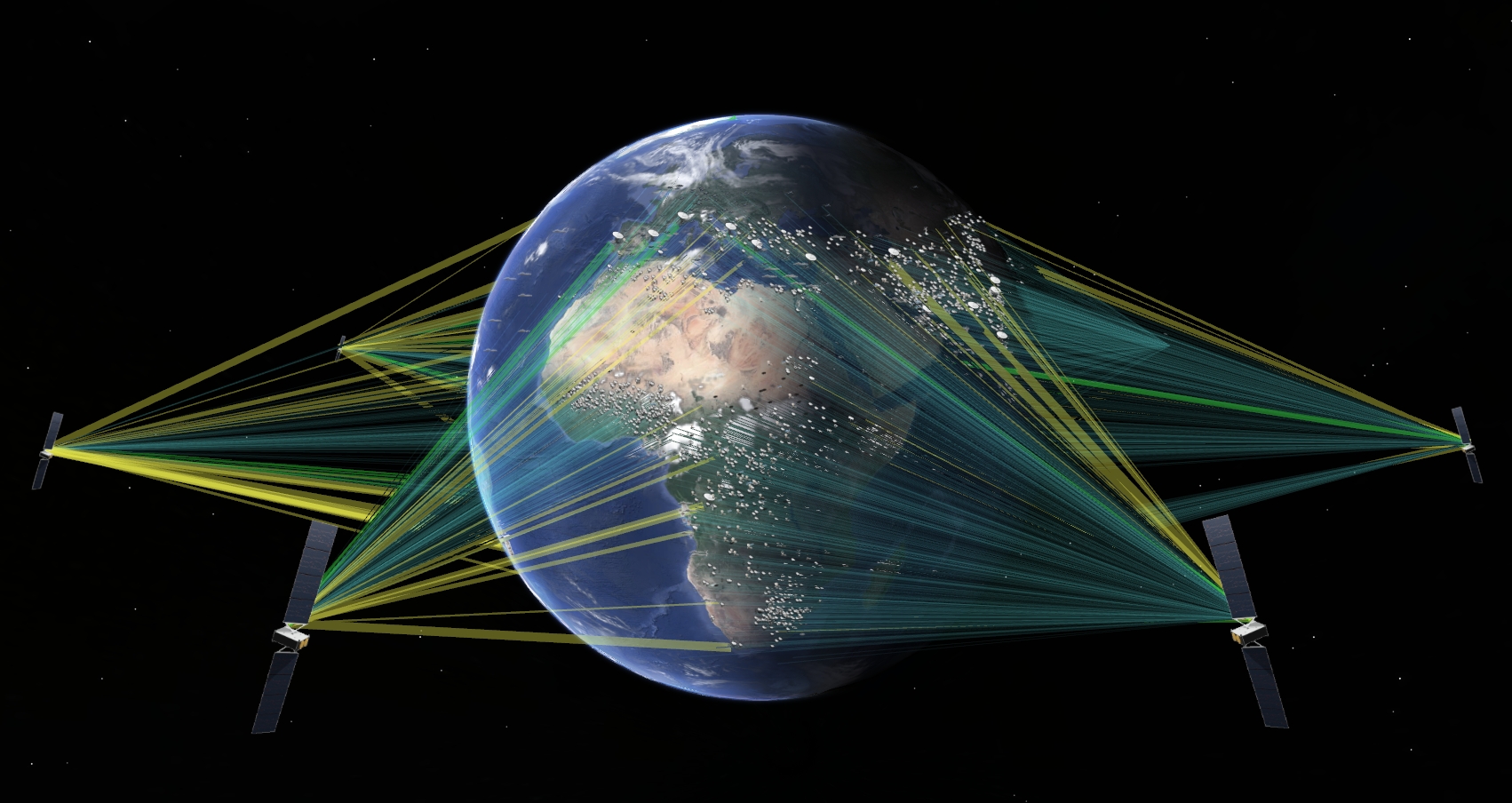
SpaceX had an 87 minute window opening at 2:49 p.m. Eastern on Sunday to fly a Falcon 9 out of Cape Canaveral carrying the final three satellites for SES’s O3b mPower constellation, a project that has taken more than a decade to finish since Boeing and SES first signed SpaceX on for the work.
Unlike the thousands of Starlink satellites SpaceX has stacked into orbit over the years, O3b mPower flies in a different neighborhood entirely. The three new satellites, tagged F11, F12 and F13, are headed for medium Earth orbit at roughly 5,000 miles up, more than ten times higher than Starlink’s shell around 340 miles but still a small fraction of the 22,000 miles where old school geostationary satellites sit. That middle position is the whole point, because a satellite that far out needs far fewer siblings to blanket the globe than a low orbit constellation does. Essentially, SES only needed 13 satellites total to build a network offering quick, steady service that used to require thousands of spacecraft.
With most people having heard plenty about Starlink and almost nothing about O3b mPower, SES and SpaceX already blend the two networks for some customers. Both SpaceX and SES sell satellite broadband, but they’re aimed at different buyers. Starlink is built for volume, direct to consumers, RVs, homes, small businesses, plus a growing aviation and maritime business. O3b mPower skips consumers entirely and sells enterprise grade connectivity to airlines, cruise lines, offshore energy operators, telecoms needing backhaul, and governments, priced and provisioned more like a dedicated circuit.
A 2023 partnership lets cruise ships combine Starlink’s speed with O3b mPower’s steady capacity depending on what a ship needs at a given moment. Sunday’s completed 13 satellite constellation effectively finishes the medium orbit half of that pairing, years after.
Sunday’s mission was already a something on SpaceX’s manifest well before O3b mPower entered the picture. This flight marked its 29th trip to orbit, a history that includes two crewed Axiom missions, the European Space Agency’s Euclid telescope and 22 separate Starlink batches. SpaceX has landed boosters on the droneship A Shortfall of Gravitas so often that Sunday’s touchdown attempt, if it went as planned, was set to be the 661st successful Falcon booster landing to date.
For a company that pushed the Starlink constellation past 11,000 satellites back in August, almost entirely through bulk launches from California, Sunday’s flight was a reminder that SpaceX’s schedule still has room for someone else’s satellites too. SES gets a finished network built for a narrower set of customers, and Falcon 9 gets one more line on an already long resume.
Elon Musk
Tesla gives the Roadster an official “Go for launch” demonstration date
Tesla teased an October 1 Roadster reveal, reviving years of delayed SpaceX thruster hover promises.
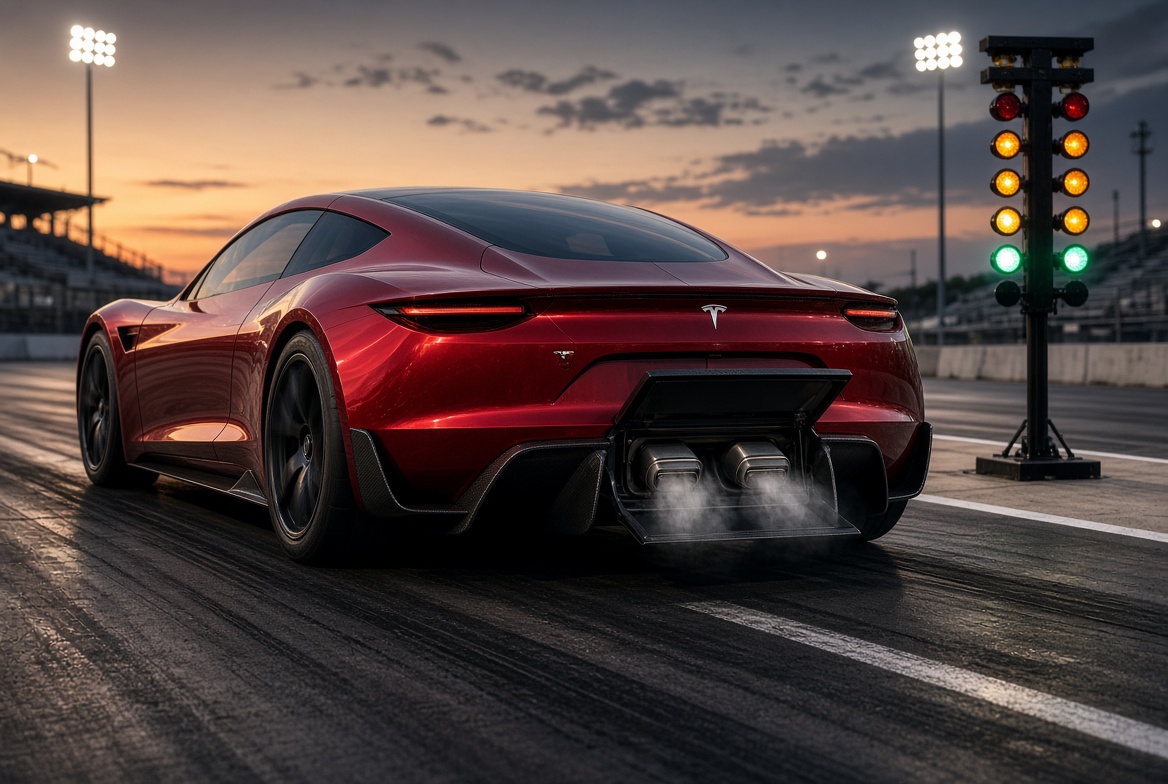
Tesla teased an October 1 event date for its next generation Roadster, posting an image on X Saturday that shows the car lit up like it is sitting on a launch pad, with the date “10.01” stamped across the bottom and the caption “Go for launch.” A countdown clock on Tesla’s Roadster order page now points to the same date, which falls on a Thursday. The company has not said where the event will happen or whether it will be streamed at the moment. Stay with us @Teslarati for live updates.
Go for launch pic.twitter.com/Khu03eiZ04
— Tesla (@Tesla) September 12, 2026
Tesla has since sent formal invitations to reservation holders confirming the event will take place in Waco, Texas, about 90 minutes north of its Austin headquarters, based on a digital ticket shared on X by Sawyer Merritt. Tesla did not name the exact venue, though Waco sits close to SpaceX’s McGregor, Texas, rocket test site, previously reported as the planned location for a Roadster thruster demonstration. The invite sets the reveal for 8:30 p.m. Eastern on October 1, requires RSVPs by midnight on September 16, and limits entry to guests 21 and older. Invitations are non-transferable.
The tease follows nine years of a project defined by unimaginable specs along with slipped dates. Musk first showed the second generation Roadster in November 2017 as a surprise reveal at the end of the Tesla Semi event, promising a 0 to 60 mph time under two seconds, a top speed above 250 mph, 620 miles of range from a 200 kWh battery, and production starting in 2020. At last November’s shareholder meeting, Musk set an April 1 demo date and joked the choice gave him “deniability” if it slipped again, which it did, moving first to late April, then to “a month or so,” then to August.
Tesla Roadster SpaceX Package’s 1.1-second 0-60 mph launch visualized in concept video
Whatever Tesla shows on October 1 is expected to center on the SpaceX developed thruster package Musk has described since 2018. Internally code named A71, a nod to the Lockheed SR-71 Blackbird, the system reportedly uses cold gas thrusters fed by a composite overwrapped pressure vessel, the same tank design SpaceX uses on Falcon 9. Musk has said a thruster equipped Roadster could hit 60 mph in about 1.1 seconds under roughly 2.75 g of launch force, well past the 1.9 second figure quoted for the standard car. That version reportedly will not be street legal and has reportedly been discussed as a limited run sold through a track only program.
The standard Roadster is still expected to carry the original $200,000 base price and $250,000 Founders Series tier, both set when Tesla opened $50,000 and $250,000 reservations in 2017. Tesla VP of Vehicle Engineering Lars Moravy has confirmed production will happen at Gigafactory Texas, with Musk targeting 2027 or 2028, 12 to 18 months after whatever the company demonstrates next month.
News
SpaceX tells the FCC that Starship Flight 14 is going to orbit
SpaceX filed with the FCC for Starship Flight 14, its first true orbital launch attempt.
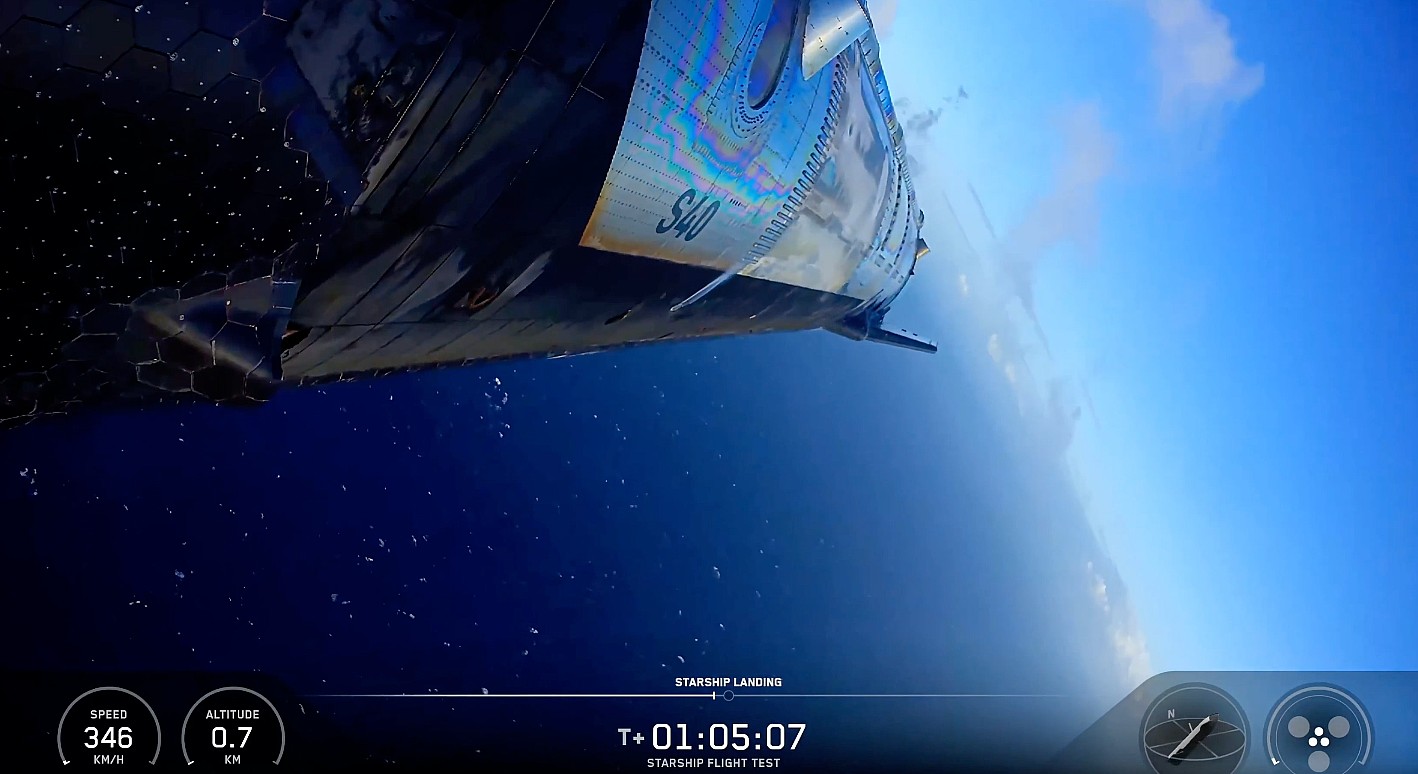
SpaceX has asked the Federal Communications Commission for permission to fly Starlink terminals during Starship’s fourteenth flight test, and the filing lays out a genuine trip to orbit, something the program has never attempted.
Every Starship flight so far, including Flight 13’s successful splashdown in the Indian Ocean on July 24, has flown a suborbital arc that ends with the ship reentering the atmosphere within the same hour it launches. The FCC paperwork describes a mission profile built around an actual orbital insertion instead.
The payload is the other half of the story. Flight 13 carried 20 production Starlink V3 satellites, but because that mission never reached orbit, the satellites reentered along with the ship rather than joining the constellation, something Teslarati covered in detail after SpaceX released footage shot from one of those satellites as it drifted away from Starship in space. Flight 14 is designed to close that gap. If the orbital insertion holds, the roughly 20 V3 satellites onboard would separate into an operational orbit and could eventually go into service, each one rated for about 1 terabit per second of downlink capacity by SpaceX’s own account.
SpaceX announces new Starbase for ‘thousands of Starship launches annually’
Elon Musk first flagged the orbital attempt during SpaceX’s August 4 earnings call, the company’s first as a public entity following its June IPO under the ticker SPCX. He also floated catching the ship with the Starbase tower on the same flight, an idea he walked back on August 20, saying the catch attempt would more likely come “in a few months,” as Teslarati reported at the time. Flight 14 will instead target a splashdown for the ship in the Indian Ocean, the same recovery method used since Flight 12.
Hardware has been catching up to the ambition. Booster 21 completed a full 33-engine static fire on August 28, and Ship 41 finished its own six-engine test the week before. An airspace briefing circulated to pilots on August 20 listed September 15 as the target date, later than the end of August window Musk mentioned on the earnings call, though SpaceX has not confirmed a launch date publicly and Starship schedules routinely slip while hardware and FAA paperwork line up.
The FCC filing itself does not guarantee a launch date. It covers communications authority, and not flight readiness, considering SpaceX still needs Ship 41 fully stacked and cleared by the FAA before Flight 14 can fly. But the filing is a real marker of intent and it puts a specific regulatory process behind what had so far only been Musk’s word on the earnings call.

Tesla looks to expand into new Asian market, strengthening presence

Elon Musk’s companies made up with Apple but OpenAI still on the hook


