Lifestyle
Giving Thanks to the Tesla Village

They say it takes a village to raise a child. I say it takes a village to raise a young car company. A village to handle advertising for the company, so that it doesn’t have to spend big bucks on traditional advertising. A village to help potential owners understand that they too can be free of gas – a novel concept that requires a little faith to fully embrace.
And it was that village that led to my husband and I taking the plunge on a car with a price tag of nearly triple that of the vehicle it replaced. That village that has contributed to our ownership experience wildly exceeding our very high expectations.
First, there came a test drive. After having seen the car in person in November of 2012 at an event, I left scratching my head, interest definitely piqued. Fast forward to Spring 2014, and I convinced the old ball and chain we needed to drive it. There was a lot of soul searching and numbers crunching in the months to follow and we landed in a magical place where hopes, dreams and fears are shared. That is, the forums section of the Tesla Motors website. There, owners and enthusiasts answer newbie questions and share stories. In August, a fine man organized a coffee meet up in the Philadelphia suburbs. One veteran owner and Supercharger pro joined us from a road trip that had taken him to Atlantic City, which was already 2,000 miles away from his home. We chatted about charging and batteries and road trips. Most of all, we chatted about how this was “the best” car any of them had ever driven. Needless to say, meeting real life owners was the exact push we needed. Our order was placed the following morning. To those gentlemen, I say thank you.
Then came the waiting. In October, Elon showed us the D. Between that and the time of the quarter we made our order, our wait was longer than usual for a domestic delivery. 108 days actually. Visiting the Tesla forum became a daily ritual for me. I even attended one more meet up, this time as an actual reservation holder. I also commiserated with others who saw their delivery projection slip from November to December, as Tesla shifted production to accommodate a new motor configuration. Aside from filling my time, I got to learn everything about the car. The mythical “range anxiety” concept proved to be a phenomenon often reserved for potential owners and detractors, not so much once you actually have the car and understand how to plan. To every forum contributor, I say thank you.
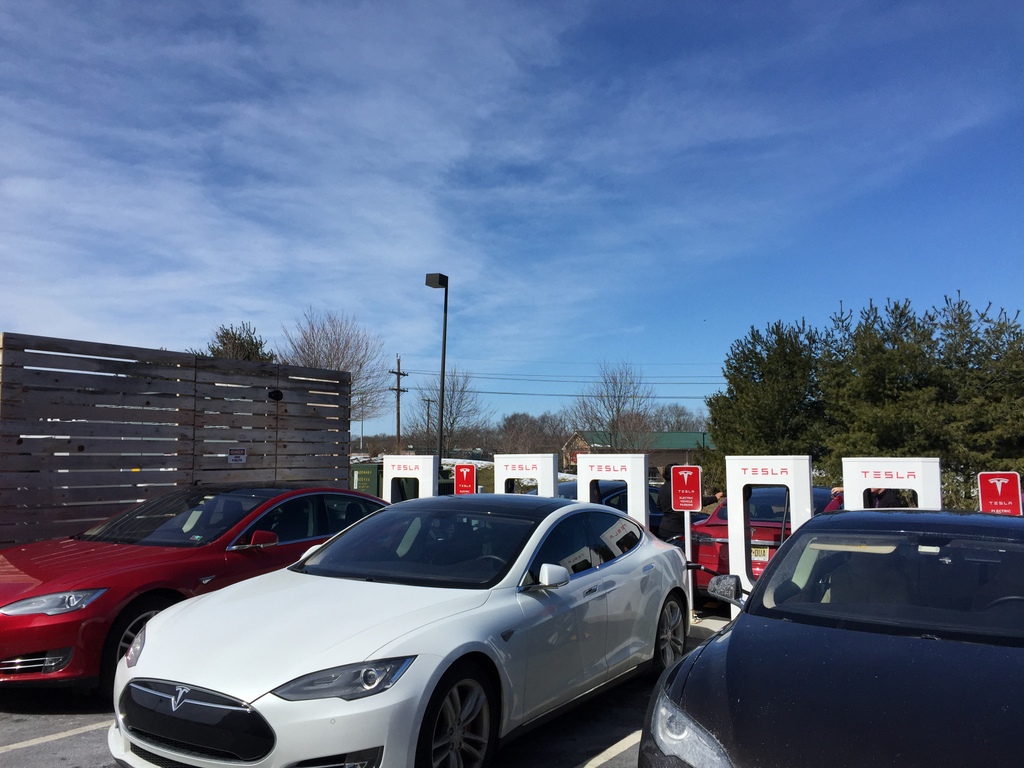
Next came the disappointment. The Tesla supercharger map advertised the charger we needed the most as being completed within 2014. Allentown, PA – midway between our Philadelphia home and the driveway/garage-less home of my in-laws – was lit up with a little red dot. Weeks turned to months and 2014 came and went. Finally in the summer of 2015, it was confirmed: the location fell through and the scouting process had to start all over. Every trip we take there requires us to borrow someone’s car to drop our Tesla off at a L2 charger 10 miles away. The Supercharger team has been working extremely hard and scouted a location that will actually work even better for folks traveling North and South along the Pennsylvania Turnpike. They even hit a snag with township zoning board approval that cost the process an entire month, which I know was as frustrating to them as it was to owners counting on that location. To Max and Jesse (who I bugged about this) and the whole Tesla Supercharger team responsible for a whopping 556 supercharging locations to date, I say thank you.
Then came the kindness of a stranger. This summer, my husband and I were headed to Jersey Shore to celebrate with some friends. Two of those friends were coming from Texas with their 1-year old and it was our Model S that would take the 5 of us from Philly to the shore. There are no Superchargers along the way and were no L2 chargers in any convenient location. After making mention of this on the forums, a fellow owner reached out with a solution. That solution was his own home just a short walk from the hotel we were staying in. (Which oddly had no outlets anywhere near the parking spaces.) We touched base a bit about when we would come and his level of accommodation was extraordinary. He moved his own Model S to the street and left his charge cable outside. We parked, took enough juice to get us home with a comfortable buffer, and were on our way without ever having met this kind owner in person. To him, I say thank you.
Last month came Autopilot. It has proven to be the source of countless hours of fun, the inspiration to start making videos, and yet another layer of safety to keep Model S occupants as far away from potential injury as possible. To the engineers and programmers, testers, visionaries and everyone else at Tesla responsible for making this system a reality, I say thank you.
Most recently came protection over profits. After a single vehicle in Europe experienced a detached seat belt situation resulting in no injury, Tesla decided to recall 90,000 vehicles to check them. Last I heard, no other defects had been found. In addition to checking cars at service centers everywhere, Tesla has even taken to sending testers to Superchargers to reach more vehicles and provide no disruption to owners. To the members of the Tesla leadership team that acted swiftly, the number-crunchers that allowed caution over costs, and every employee pulling hard on a belt, I say thank you.
Finally, a great big thank you to the readers. I am now fully entrenched in this wonderful community of Tesla owners and enthusiasts and can only hope that I contribute to someone else’s decision to jump into the future and experience the Tesla life for themselves.


Elon Musk
SpaceXAI just launched into your kitchen with their new app
SpaceXAI just powered its first consumer app and it predicts what you want to buy.

SpaceXAI just made its first move into consumer AI, and it involves your grocery cart. On June 3, 2026, Gopuff and SpaceXAI announced the launch of Go, a Grok-powered shopping assistant built directly into the Gopuff app that predicts what you need before you even start searching for it.
Gopuff is an instant delivery platform that operates more than 400 micro-fulfillment centers across the U.S., delivering everyday essentials, snacks, drinks, and household items in as little as 15 minutes. It is not a restaurant delivery app or a marketplace. It owns its inventory, controls its warehouses, and handles its own logistics, which means it has built one of the most detailed consumer behavior datasets in retail over its 13-year history.
Go combines SpaceXAI’s advanced reasoning, voice, and image generation models with Gopuff’s dataset of hundreds of millions of orders and real-time cultural signals from X to prepare a suggested cart the moment a customer opens the app. It learns each shopper’s habits and automatically builds a personalized cart based on time of day, location, order history, and real-time indicators. Returning customers can check out with a single tap.
Rather than searching for specific items, users can describe a situation like a game-day party or the desire for a healthy breakfast and Go will assemble a cart automatically. It can also predict when shoppers are running low on items like coffee or paper towels and have them packed and delivered in under 15 minutes. Grok voice integration lets users talk to the app in plain conversational language and check out completely hands-free.
Gopuff co-founder and co-CEO Yakir Gola said: “Today, we believe the greatest friction left in commerce is not delivery or instantaneous access to the essentials customers need. It’s the moment before: the thinking, the deciding, the remembering. We’re combining Gopuff’s demand intelligence with xAI’s frontier reasoning to create an everyday shopping experience that feels like a true extension of you.”
Why SpaceX just made a $60 billion bet on AI coding ahead of historic IPO
The timing carries context beyond the product launch. SpaceXAI was formed after SpaceX completed an all-stock merger with Elon Musk’s xAI earlier this year, folding one of the most advanced AI labs in the world into the same corporate structure as the company preparing what could be the largest IPO in history. SpaceXAI is dipping into consumer-focused AI just as it prepares for its public debut, and while Musk has openly discussed building an everything app, this launch uses Grok to power another company’s product rather than launching a standalone consumer platform. Every consumer-facing deployment of Grok ahead of the IPO roadshow adds tangible evidence that SpaceXAI is not just an infrastructure play but a direct competitor in the AI application layer where OpenAI and Google are already fighting for dominance.
Lifestyle
Tesla saves its passengers again – This time after a 300-foot cliff fall in Malibu
A Tesla Model 3 fell 300 feet off a Malibu cliff and both passengers survived.
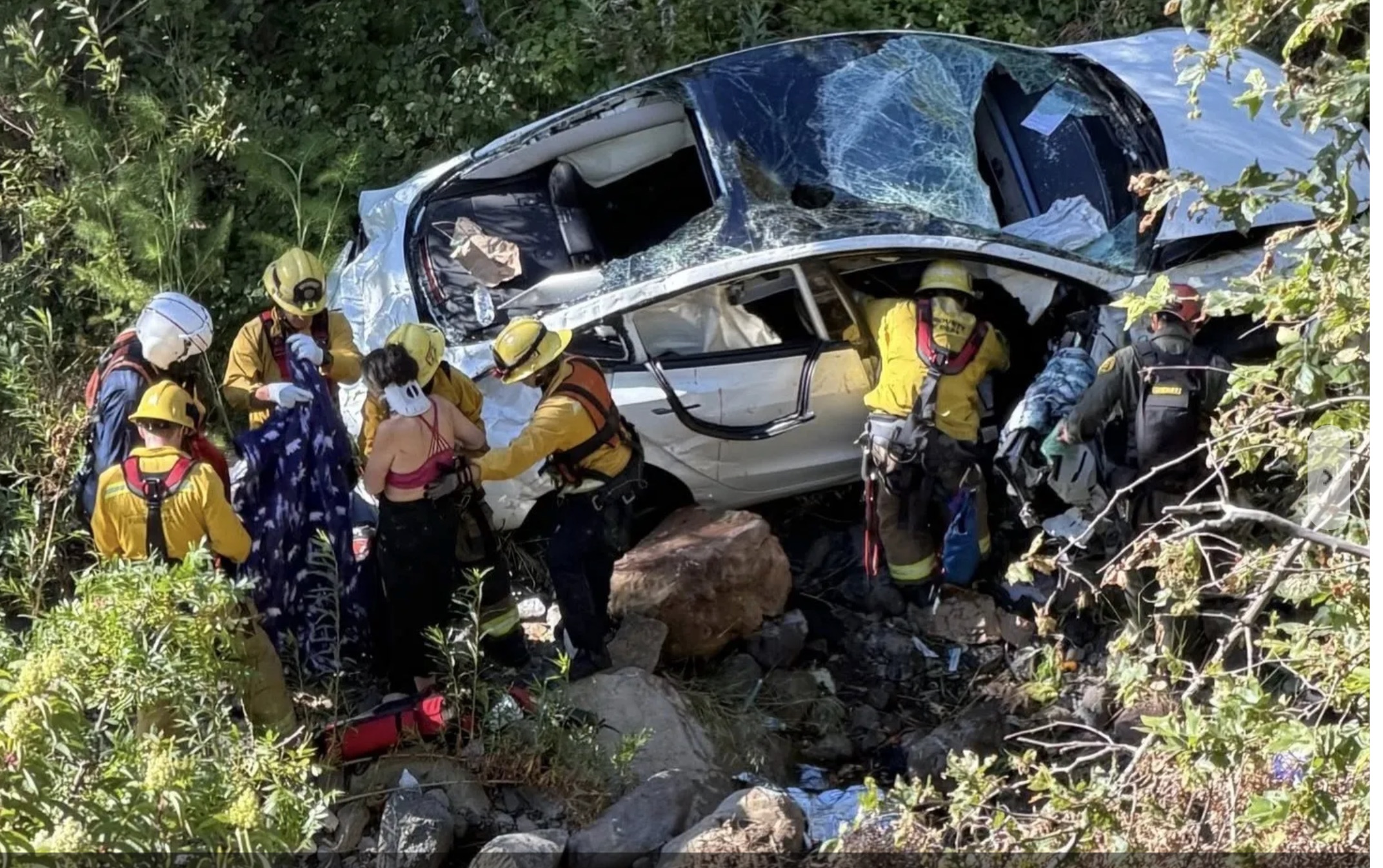
A Tesla Model 3 plunged roughly 300 feet off a cliff on Mulholland Highway in Malibu on Friday morning, May 29, 2026, and both occupants survived. The crash was reported at approximately 7:30 a.m. near the 2500 block of Mulholland Highway, triggering a multi-agency rescue operation involving Malibu Search and Rescue, the Los Angeles County Fire Department, the California Highway Patrol, and McCormick Ambulance.
When first responders arrived, the male driver was outside the vehicle shouting for help while the female passenger remained pinned inside the Tesla. Rescue crews rappelled down the cliffside on ropes to reach the wreckage. A flight medic was lowered by helicopter to begin treating both victims, and the driver was hoisted up to the roadway before crews used the Jaws of Life to free the trapped passenger. Both were airlifted to a local trauma center with moderate injuries despite a remarkable result for a fall that steep.
The outcome is not surprising, considering Model 3 earned an overall 5-star rating from NHTSA in every category and sub-category, and recorded the lowest probability of injury of any car ever evaluated by the U.S. New Car Assessment Program. The absence of a traditional engine in the front of the vehicle creates a longer crumple zone that absorbs impact energy before it reaches occupants, and the battery pack running along the floor gives the car an unusually low center of gravity that reinforces structural rigidity.
This is not the first time a Tesla has kept passengers alive after going off a cliff. A Tesla Model Y carrying a family of four survived a plunge off a cliff at Devil’s Slide near San Francisco in January 2023, with two adults and two children walking away from a 250-foot fall. That incident drew widespread attention to how the structural integrity of Tesla’s electric platform performs in extreme crash scenarios that most vehicles would not survive.
Tesla Model Y driver who drove off cliff with family attempts to avoid criminal conviction
Elon Musk
NASA’s first human outpost on the Moon starts now – SpaceX on deck
NASA named the rovers, landers, and vendors that will build America’s first Moon Base.
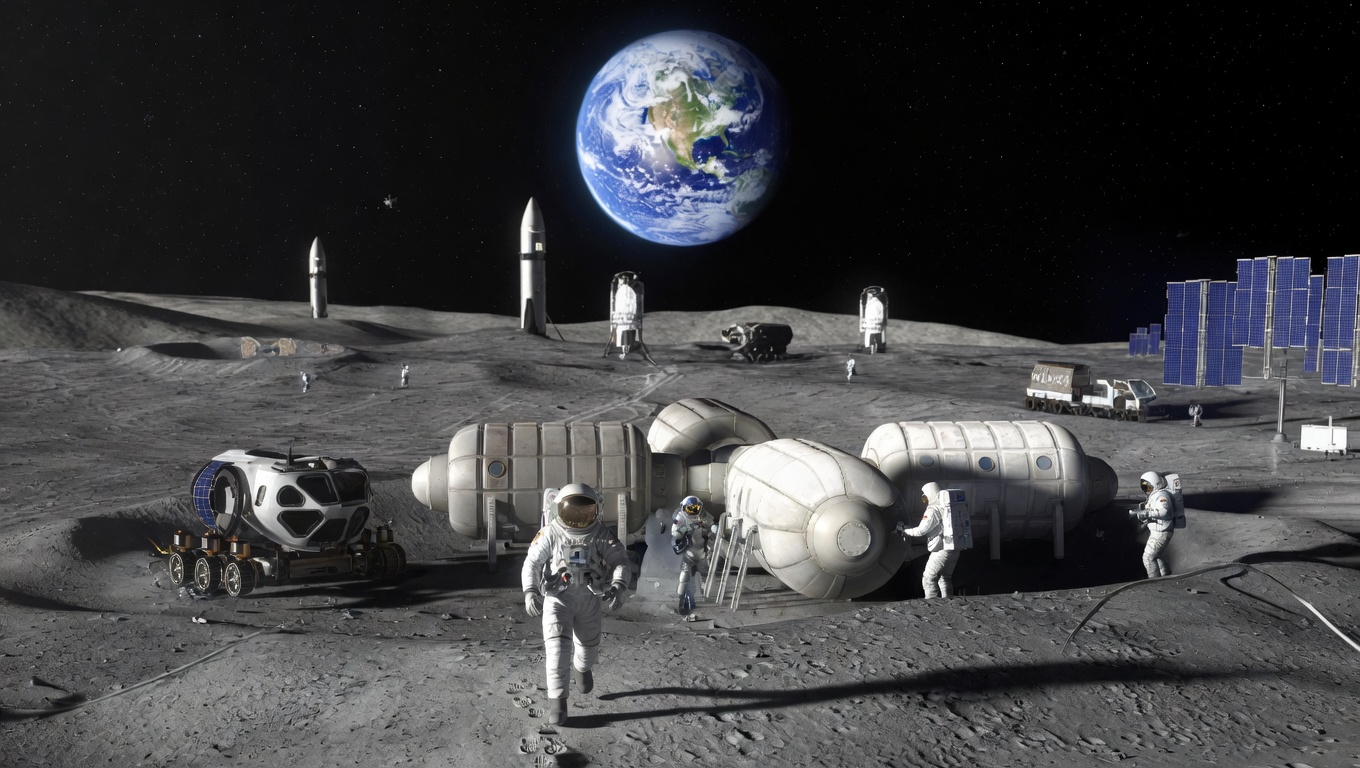
NASA has laid out its most detailed Moon Base plan to date, describing a permanent outpost near the Moon’s south pole that the agency intends to build over the coming decade as a direct stepping stone to Mars. “The Moon Base will be America’s and humanity’s first outpost on another celestial world,” NASA Administrator Jared Isaacman said, adding that every mission crewed and uncrewed “will be a learning opportunity as we return to the lunar surface, build the infrastructure to stay, and master the skills required to live and operate in one of the most demanding and dangerous environments imaginable.”
The plan is structured in three phases involving both uncrewed and crewed missions to deliver equipment, vehicles, and infrastructure to the surface, with the first three moon base missions targeted to launch before the end of 2026.
Moon Base I, targeting fall 2026, will use Blue Origin’s Blue Moon Mark 1 lander to deliver scientific instruments to the Shackleton Connecting Ridge, the same region where Artemis astronauts will land. Moon Base II will send Astrobotic’s Griffin lander carrying more than 1,100 pounds of cargo including Astrolab’s FLIP rover to begin developing mobility systems on the surface. Moon Base III will carry the Lunar Vertex science mission on Intuitive Machines’ Nova-C Trinity lander to study lunar swirls near the south pole, with ESA and Korean science payloads aboard.
On the rover side, NASA awarded Astrolab $219 million and Lunar Outpost $220 million to build the first phase of Lunar Terrain Vehicles, with both rovers targeted for deployment to the lunar surface by 2028. Astrolab’s crewed rover weighs roughly 2,000 pounds and can reach over 6 mph. Lunar Outpost’s Pegasus rover can operate autonomously or via remote control at over 9 mph. Blue Origin separately received $188 million with an option worth $280.4 million to deliver cargo landers for rover transport.
NASA also confirmed that MoonFall, a mission deploying four survey drones to scout Artemis landing sites, has selected Firefly Aerospace to build the transport spacecraft, with a 2028 launch target.
SpaceX sits at the center of that commercial layer. SpaceX holds the NASA Human Landing System contract for the Starship-derived lander that will put astronauts on the surface under Artemis IV, currently targeting 2028. Before that can happen, SpaceX must demonstrate in-orbit propellant transfer at scale, a process requiring multiple Starship tanker launches to fuel a single mission. Water ice at the lunar south pole is central to the base’s long-term viability, as it can be converted into drinking water, breathable oxygen, and rocket fuel, directly reducing dependence on Earth resupply. That resource loop becomes far more practical if Starship can land and be refueled on or near the Moon itself.
Elon Musk has publicly stated that Starship V3, which recently completed its first flight, should be capable enough for initial Mars missions. The Moon Base plan announced Tuesday is the infrastructure layer that connects everything between those two ambitions, and SpaceX is the only American company currently contracted to build the rocket that gets humans to either destination.

SpaceXAI just launched into your kitchen with their new app

Tesla piggybacks recent Supercharger feature with update that takes it further


