News
Tesla earns nod of respect from legacy auto for pushing sustainable transportation

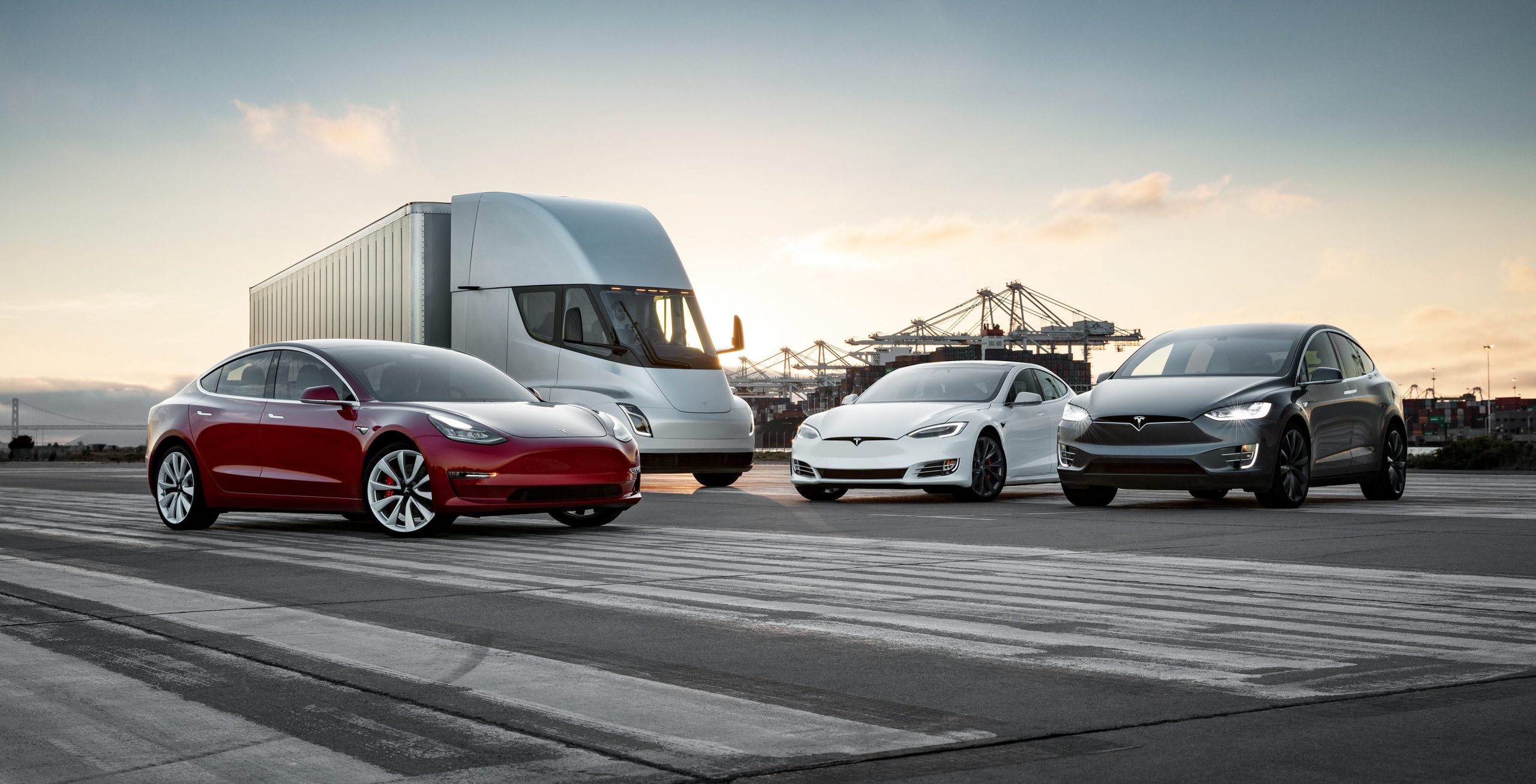
It took multiple bet-the-company situations, trips to “production hell,” and a massive push towards profitability in the third quarter, but Tesla has pretty much become the undeniable leader in premium electric mobility. With the Model 3 proving to be a success in the United States and getting a lot of interest in markets such as Europe and Asia, Tesla is practically becoming an inconvenient truth to traditional automakers — particularly those that have held off on the development of zero-emissions vehicles.
Earlier this year, Paul Sankey of Mizuho Securities noted during a segment on CNBC that the “Tesla Effect” is starting to spill over to industries beyond the car market. Sankey described the Tesla Effect as a trend that pushes the idea that the 21st century will be driven by clean electricity in the same way that the 20th century was driven by oil. Among legacy carmakers, this particular shift is starting to become notable.
Recently, executives from a number of established automakers acknowledged Tesla’s contribution to the evolution of sustainable transportation. In a recent interview with the Los Angeles Times, for example, Porsche North America Chief Executive Klaus Zellmer validated Tesla’s breakthroughs in the electric car market, praising the company for its “astonishing” work.
“If you look at what Tesla has done, if you look at their volume and look at their price level, it’s truly astonishing. If you can do that with one brand and a sales network that is not comprised of dealers and a real sales organization, it’s even more astonishing,” he said.
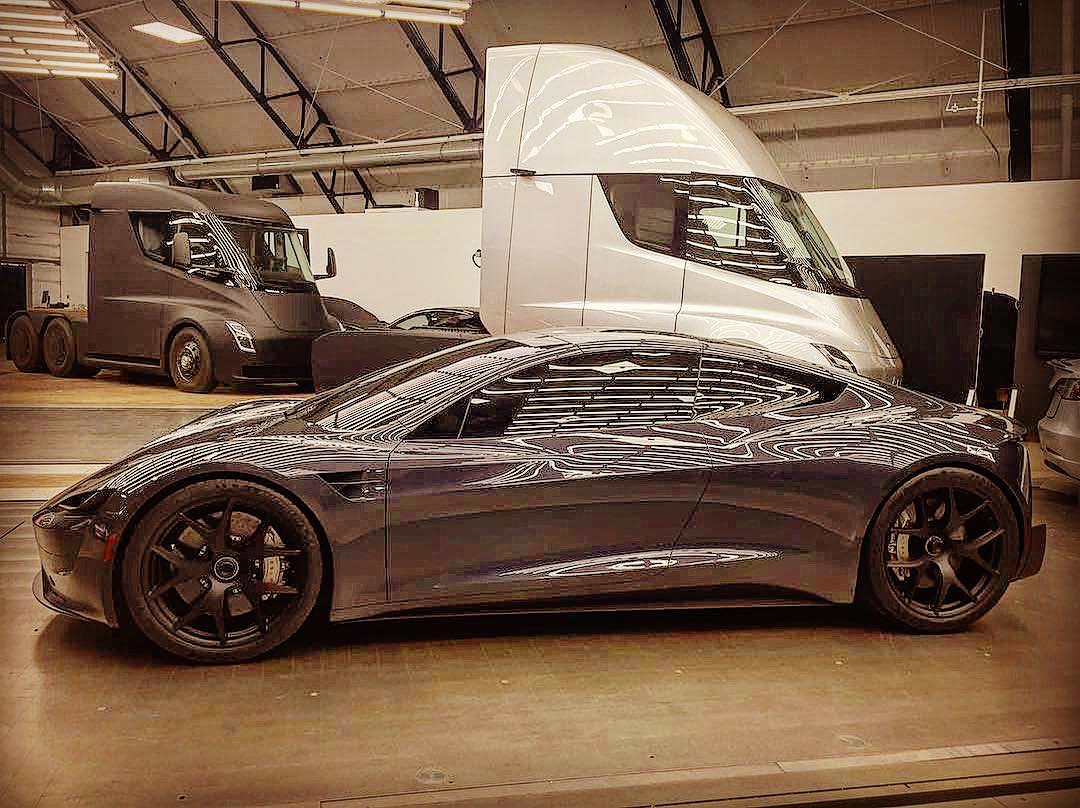
Hope King of Cheddar inquired about Tesla while speaking with executives from several legacy carmakers during the 2018 LA Auto Show as well. Just like Porsche’s Zellner, the execs from the establishes carmakers also admitted that Tesla’s progress over the years had affected their business and the industry as a whole.
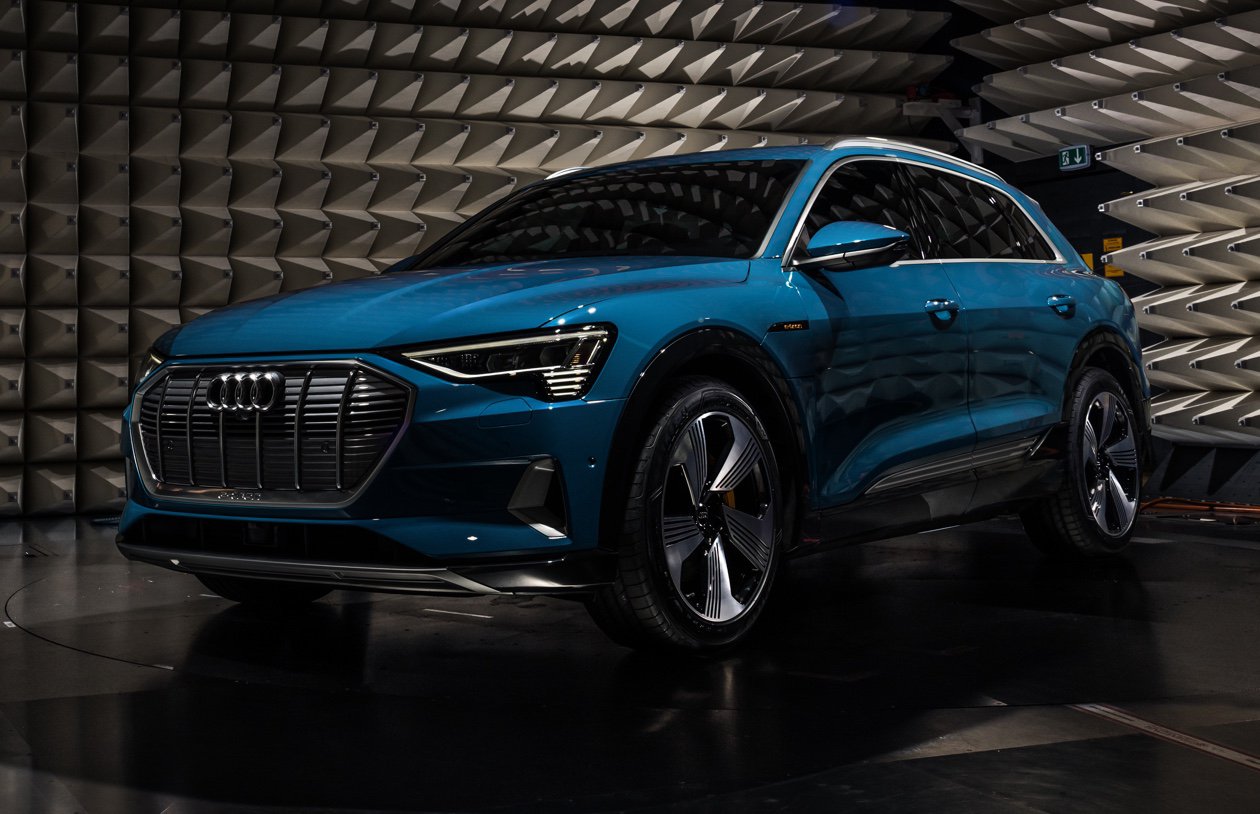
Audi of America senior product manager Anthony Foulk noted that Tesla has “pushed the entire auto industry forward and broken ground for some different topics in the industry.” Foulk pointed out that Tesla is among the reasons why Audi opted to release the e-tron SUV, an electric vehicle that is “meant to be accessible to a wide portion” of the market. Volkswagen of America Sales and Marketing executive Derrick Hatami echoed Foulk’s observations, stating that Tesla has provided an “interesting window into what the possibilities could be for electric vehicles and future retail models for the auto industry.” Hatami further remarked that the electric car maker had given other automakers “something to look at and aim for” with regards to the development of EVs.
Masahiro Moro, the President and CEO of Mazda’s North American operations, lauded Tesla for its tendency to boldly break through conventions and adopt strategies that are experimental at best. Moro noted that with Tesla in the market, “we (legacy carmakers) have to look at ourselves to see if there are unmet needs of consumers so we can innovate our process.” Bugatti President Stephan Winkelmann also validated Tesla’s contributions to the car market, stating that the electric car maker has “pushed the car industry in one direction,” while allowing other companies to admit that “social acceptance is key for the future of every car manufacturer.”
Gorden Wagener, Chief Designer of Mercedes-Benz, was optimistic about Tesla’s breakthroughs, particularly when it comes to the features and capabilities of vehicles on the road. Wagener noted that Tesla’s approach to its electric cars is encouraging other companies to “change this industry in the next 10 years more than in the 100 years before” — something that the designer admitted is a “very exciting to do.”
Tesla’s mission has been clear since day one — it aims to accelerate the world’s transition to renewable energy. Elon Musk has reiterated this multiple times, and the company itself has admitted that Tesla cannot push the transition to sustainability on its own. In the auto sector, other companies — particularly legacy carmakers that already have large manufacturing infrastructures — have to commit to developing zero-emissions vehicles as well.
Several companies have already taken valuable steps towards this goal. Porsche announced earlier this year that it is abandoning its entire diesel lineup ahead of the release of the Taycan, its first all-electric sedan. Reports have also emerged that Jaguar is looking to transition itself into a company that exclusively produces all-electric cars.
Perhaps more importantly, though, is that a number of legacy carmakers are starting to realize that there is a very real demand for electric vehicles. Norwegian news agency Dagens Næringsliv, for one, noted that Audi’s sales dropped almost 80% in Norway last month. Inasmuch as the steep decline is rather alarming, Audi’s Head of Communications Morten Moum stated that a big reason behind the decline is that car buyers are waiting for the company’s electrified vehicles, such as the hybrid Q7 e-tron SUV.
In October, estimates indicate that Jaguar sold around 1,200 units of the I-PACE, accounting for 8.7% of the company’s overall vehicle sales. Hyundai also reported that sales of the Kona Electric, its budget electric crossover, rose to 2,473 units in October, 1,000 more than the company sold in September. Estimates also point to 46% of Kona buyers opting in for the vehicle’s electric variant over its more affordable gas-powered counterpart.
Tesla’s growth over the past 15 years has been notable. Amidst the changing tides of the auto industry, the electric car maker is poised to grow even more as it establishes its place as a first mover and leader in the EV movement. It took daring gambits and years of pain and stress, but it appears that finally, Tesla has reached the point where the auto industry’s veterans are not only recognizing, but also respecting, the company’s efforts in pushing towards sustainable transportation.


News
Tesla FSD (Supervised) fleet passes 8.4 billion cumulative miles
The figure appears on Tesla’s official safety page, which tracks performance data for FSD (Supervised) and other safety technologies.
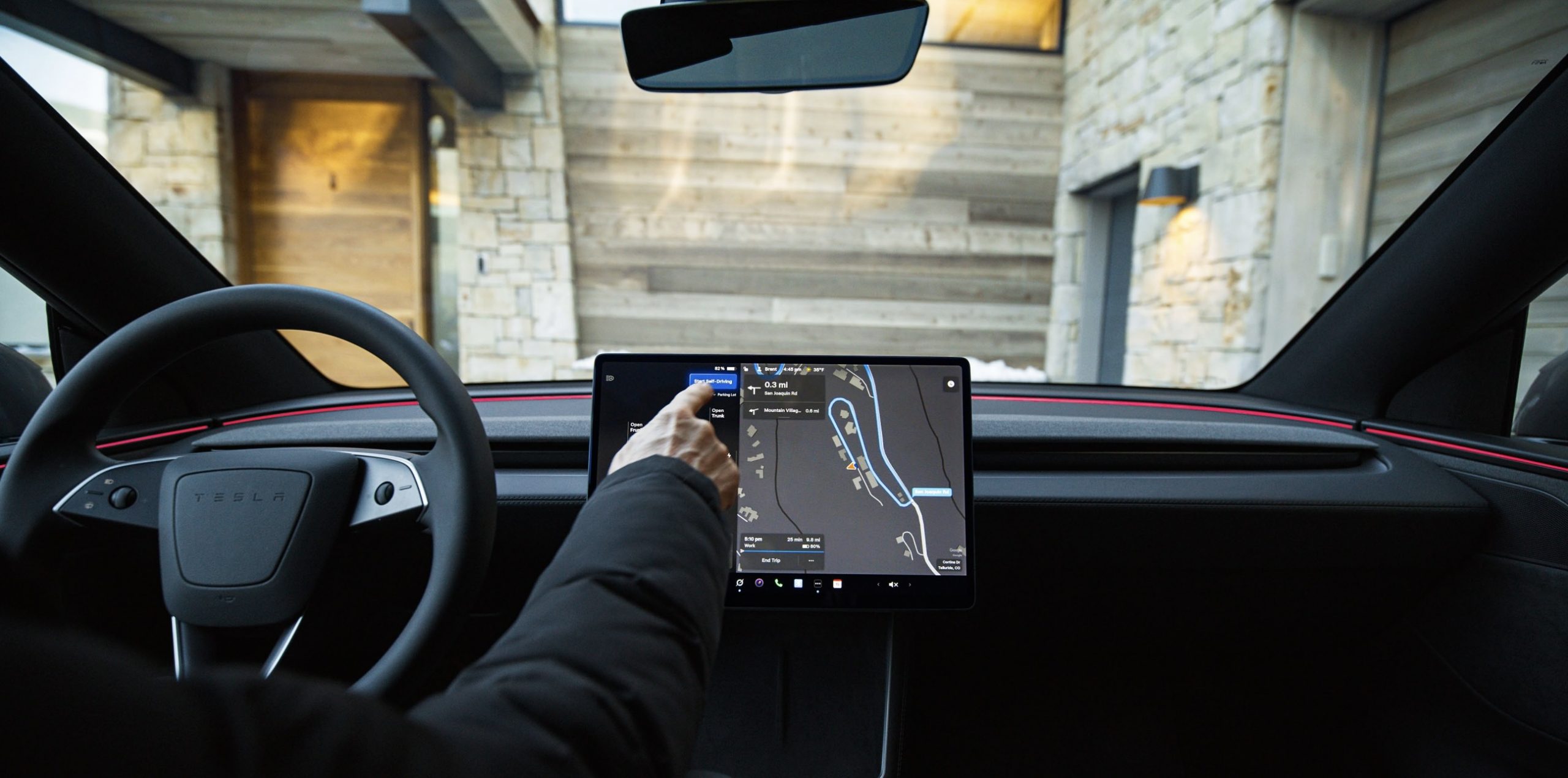
Tesla’s Full Self-Driving (Supervised) system has now surpassed 8.4 billion cumulative miles.
The figure appears on Tesla’s official safety page, which tracks performance data for FSD (Supervised) and other safety technologies.
Tesla has long emphasized that large-scale real-world data is central to improving its neural network-based approach to autonomy. Each mile driven with FSD (Supervised) engaged contributes additional edge cases and scenario training for the system.
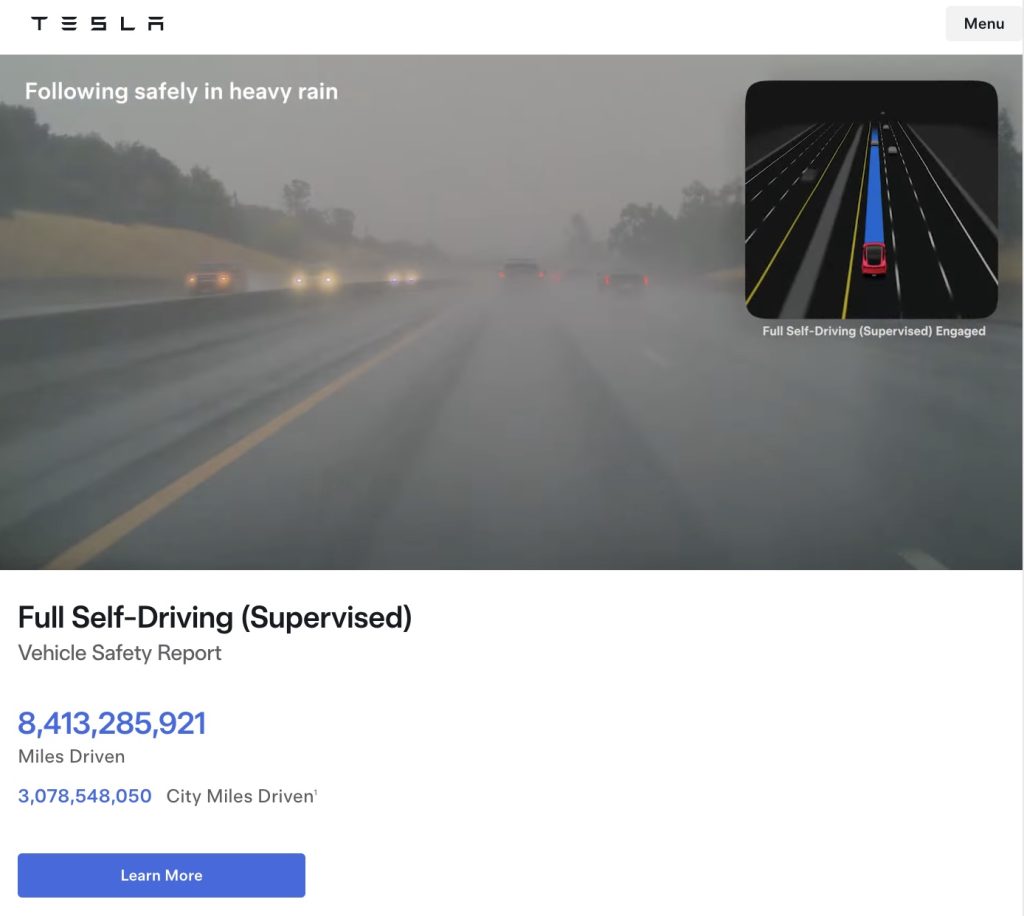
The milestone also brings Tesla closer to a benchmark previously outlined by CEO Elon Musk. Musk has stated that roughly 10 billion miles of training data may be needed to achieve safe unsupervised self-driving at scale, citing the “long tail” of rare but complex driving situations that must be learned through experience.
The growth curve of FSD Supervised’s cumulative miles over the past five years has been notable.
As noted in data shared by Tesla watcher Sawyer Merritt, annual FSD (Supervised) miles have increased from roughly 6 million in 2021 to 80 million in 2022, 670 million in 2023, 2.25 billion in 2024, and 4.25 billion in 2025. In just the first 50 days of 2026, Tesla owners logged another 1 billion miles.
At the current pace, the fleet is trending towards hitting about 10 billion FSD Supervised miles this year. The increase has been driven by Tesla’s growing vehicle fleet, periodic free trials, and expanding Robotaxi operations, among others.
With the fleet now past 8.4 billion cumulative miles, Tesla’s supervised system is approaching that threshold, even as regulatory approval for fully unsupervised deployment remains subject to further validation and oversight.
Elon Musk
Elon Musk fires back after Wikipedia co-founder claims neutrality and dubs Grokipedia “ridiculous”
Musk’s response to Wales’ comments, which were posted on social media platform X, was short and direct: “Famous last words.”
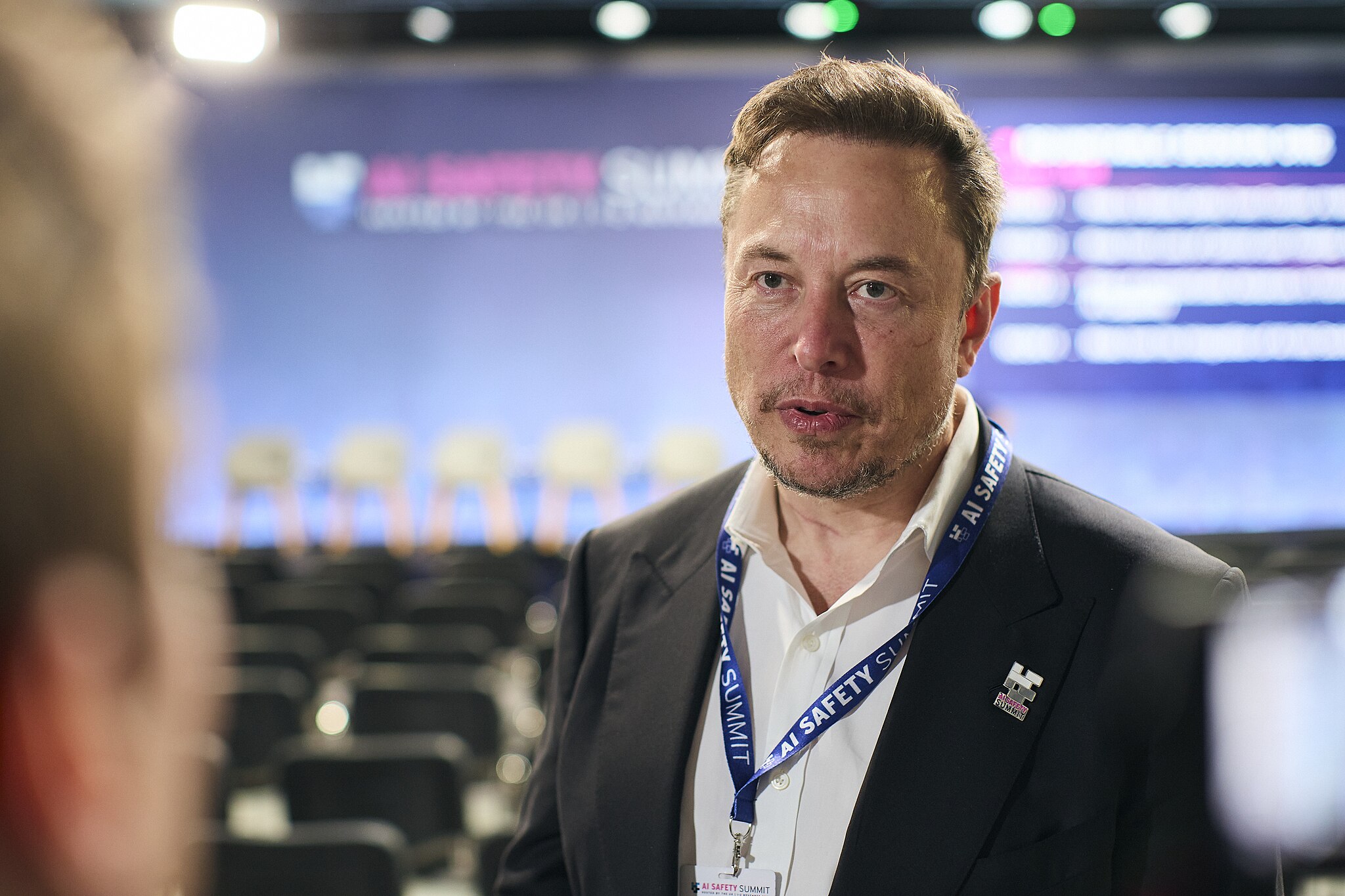
Elon Musk fired back at Wikipedia co-founder Jimmy Wales after the longtime online encyclopedia leader dismissed xAI’s new AI-powered alternative, Grokipedia, as a “ridiculous” idea that is bound to fail.
Musk’s response to Wales’ comments, which were posted on social media platform X, was short and direct: “Famous last words.”
Wales made the comments while answering questions about Wikipedia’s neutrality. According to Wales, Wikipedia prides itself on neutrality.
“One of our core values at Wikipedia is neutrality. A neutral point of view is non-negotiable. It’s in the community, unquestioned… The idea that we’ve become somehow ‘Wokepidea’ is just not true,” Wales said.
When asked about potential competition from Grokipedia, Wales downplayed the situation. “There is no competition. I don’t know if anyone uses Grokipedia. I think it is a ridiculous idea that will never work,” Wales wrote.
After Grokipedia went live, Larry Sanger, also a co-founder of Wikipedia, wrote on X that his initial impression of the AI-powered Wikipedia alternative was “very OK.”
“My initial impression, looking at my own article and poking around here and there, is that Grokipedia is very OK. The jury’s still out as to whether it’s actually better than Wikipedia. But at this point I would have to say ‘maybe!’” Sanger stated.
Musk responded to Sanger’s assessment by saying it was “accurate.” In a separate post, he added that even in its V0.1 form, Grokipedia was already better than Wikipedia.
During a past appearance on the Tucker Carlson Show, Sanger argued that Wikipedia has drifted from its original vision, citing concerns about how its “Reliable sources/Perennial sources” framework categorizes publications by perceived credibility. As per Sanger, Wikipedia’s “Reliable sources/Perennial sources” list leans heavily left, with conservative publications getting effectively blacklisted in favor of their more liberal counterparts.
As of writing, Grokipedia has reportedly surpassed 80% of English Wikipedia’s article count.
News
Tesla Sweden appeals after grid company refuses to restore existing Supercharger due to union strike
The charging site was previously functioning before it was temporarily disconnected in April last year for electrical safety reasons.
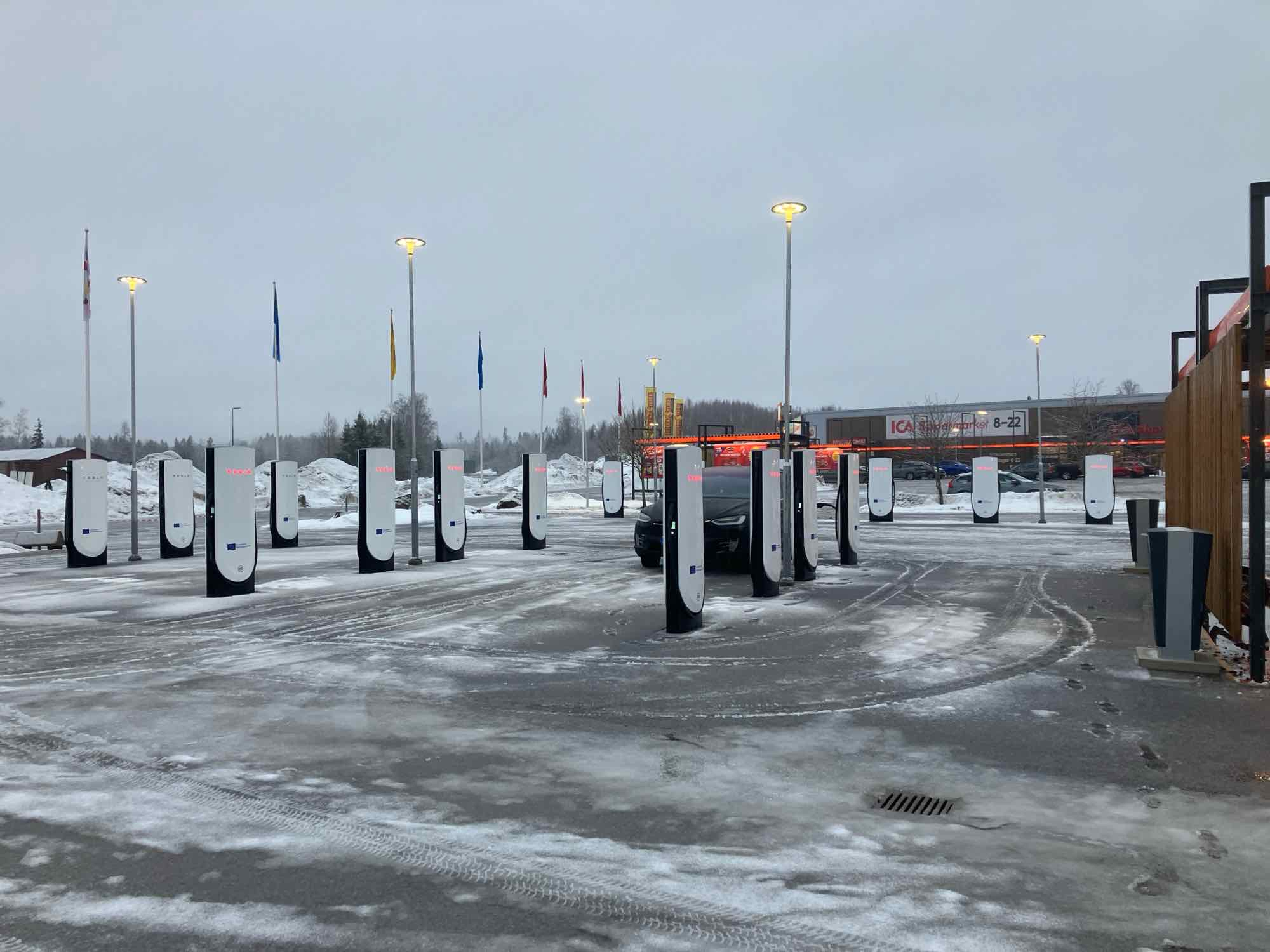
Tesla Sweden is seeking regulatory intervention after a Swedish power grid company refused to reconnect an already operational Supercharger station in Åre due to ongoing union sympathy actions.
The charging site was previously functioning before it was temporarily disconnected in April last year for electrical safety reasons. A temporary construction power cabinet supplying the station had fallen over, described by Tesla as occurring “under unclear circumstances.” The power was then cut at the request of Tesla’s installation contractor to allow safe repair work.
While the safety issue was resolved, the station has not been brought back online. Stefan Sedin, CEO of Jämtkraft elnät, told Dagens Arbete (DA) that power will not be restored to the existing Supercharger station as long as the electric vehicle maker’s union issues are ongoing.
“One of our installers noticed that the construction power had been backed up and was on the ground. We asked Tesla to fix the system, and their installation company in turn asked us to cut the power so that they could do the work safely.
“When everything was restored, the question arose: ‘Wait a minute, can we reconnect the station to the electricity grid? Or what does the notice actually say?’ We consulted with our employer organization, who were clear that as long as sympathy measures are in place, we cannot reconnect this facility,” Sedin said.
The union’s sympathy actions, which began in March 2024, apply to work involving “planning, preparation, new connections, grid expansion, service, maintenance and repairs” of Tesla’s charging infrastructure in Sweden.
Tesla Sweden has argued that reconnecting an existing facility is not equivalent to establishing a new grid connection. In a filing to the Swedish Energy Market Inspectorate, the company stated that reconnecting the installation “is therefore not covered by the sympathy measures and cannot therefore constitute a reason for not reconnecting the facility to the electricity grid.”
Sedin, for his part, noted that Tesla’s issue with the Supercharger is quite unique. And while Jämtkraft elnät itself has no issue with Tesla, its actions are based on the unions’ sympathy measures against the electric vehicle maker.
“This is absolutely the first time that I have been involved in matters relating to union conflicts or sympathy measures. That is why we have relied entirely on the assessment of our employer organization. This is not something that we have made any decisions about ourselves at all.
“It is not that Jämtkraft elnät has a conflict with Tesla, but our actions are based on these sympathy measures. Should it turn out that we have made an incorrect assessment, we will correct ourselves. It is no more difficult than that for us,” the executive said.

Tesla FSD (Supervised) fleet passes 8.4 billion cumulative miles

Elon Musk fires back after Wikipedia co-founder claims neutrality and dubs Grokipedia “ridiculous”


