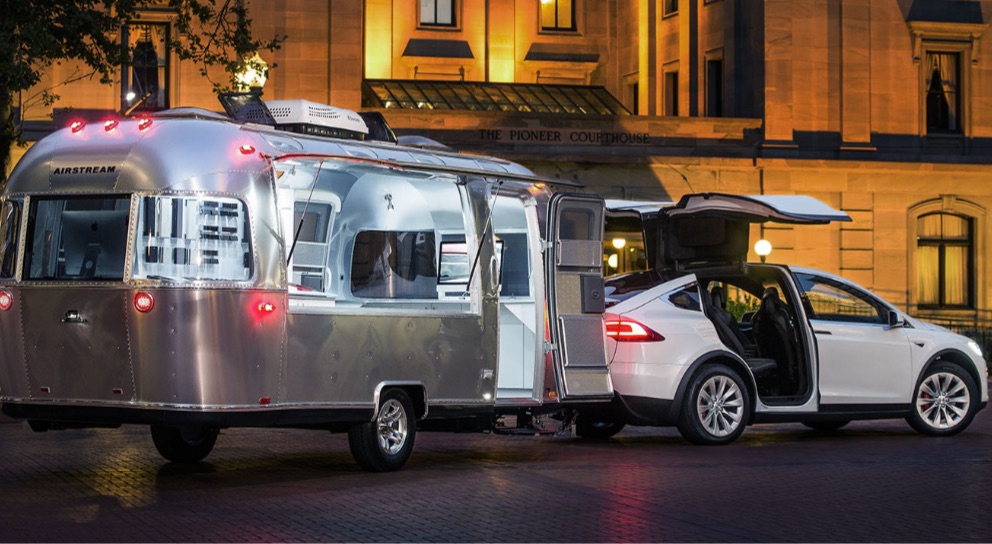
Tesla has announced that it will be launching a fleet of mobile Design Studio galleries across North America through its new “Explores” tour. Unlike popup showrooms that the company has been installing across malls and smaller venues, the new program will see Tesla-branded Airstream trailers converted into showroom centers and towed by the company’s all-electric Model X crossover SUV.
“Tesla is hitting the road across North America with our first-ever Tesla mobile Design Studios. Get the complete Tesla experience and design the Model S or Model X of your dreams as our fleet of mobile galleries roams to destinations near and far.”, says the company on its Tesla Explores page.
According to the site, Tesla’s mobile Design Studios will be visiting select cities across California, Oregon, Washington, Illinois, Georgia, Florida, New York, New Jersey, and Massachusetts. Incidentally, these are all states that already have store presence along with a high concentration of Tesla owners. The tour, designed to showcase the benefits of driving a Model S and Model X, will act as a mobile sales center allowing onsite Tesla Product Specialists to facilitate interested buyers with design of their vehicle. Rest assured that the company will also highlight the ability to tow using the electric Model X.
The new program is presumably another way for Tesla to extend its brand reach to consumers and stimulate sales without having to take on traditional advertising. If the program proves to be successful, we expect Tesla will be using this as a way to test the waters in markets where the Silicon Valley automaker has seen resistance from state law makers, preventing the company from selling direct to consumers.
SpaceX's first Falcon Heavy launch also happened to be a strategic and successful test of Falcon upper stage coast capabilities. (SpaceX)
When Falcon Heavy lifted off in February 2018 with Elon Musk’s personal Tesla Roadster as its payload, SpaceX was at a much different place. So was Tesla. It was unclear whether Falcon Heavy was feasible at all, and Tesla was in the depths of Model 3 production hell.
At the time, Tesla’s market capitalization hovered around $55–60 billion, an amount critics argued was already grossly overvalued. SpaceX, on the other hand, was an aggressive private launch provider known for taking risks that traditional aerospace companies avoided.
The Roadster launch was bold by design. Falcon Heavy’s maiden mission carried no paying payload, no government satellite, just a car drifting past Earth with David Bowie playing in the background. To many, it looked like a stunt. For Elon Musk and the SpaceX team, it was a bold statement: there should be some things in the world that simply inspire people.
Inspire it did, and seven years later, SpaceX and Tesla’s results speak for themselves.
Advertisement
Credit: SpaceX
Today, Tesla is the world’s most valuable automaker, with a market capitalization of roughly $1.54 trillion. The Model Y has become the best-selling car in the world by volume for three consecutive years, a scenario that would have sounded insane in 2018. Tesla has also pushed autonomy to a point where its vehicles can navigate complex real-world environments using vision alone.
And then there is Optimus. What began as a literal man in a suit has evolved into a humanoid robot program that Musk now describes as potential Von Neumann machines: systems capable of building civilizations beyond Earth. Whether that vision takes decades or less, one thing is evident: Tesla is no longer just a car company. It is positioning itself at the intersection of AI, robotics, and manufacturing.
SpaceX’s trajectory has been just as dramatic.
The Falcon 9 has become the undisputed workhorse of the global launch industry, having completed more than 600 missions to date. Of those, SpaceX has successfully landed a Falcon booster more than 560 times. The Falcon 9 flies more often than all other active launch vehicles combined, routinely lifting off multiple times per week.
Falcon Heavy successfully clears the tower after its maiden launch, February 6, 2018. (Tom Cross)
Falcon 9 has ferried astronauts to and from the International Space Station via Crew Dragon, restored U.S. human spaceflight capability, and even stepped in to safely return NASA astronauts Butch Wilmore and Suni Williams when circumstances demanded it.
Starlink, once a controversial idea, now dominates the satellite communications industry, providing broadband connectivity across the globe and reshaping how space-based networks are deployed. SpaceX itself, following its merger with xAI, is now valued at roughly $1.25 trillion and is widely expected to pursue what could become the largest IPO in history.
Advertisement
And then there is Starship, Elon Musk’s fully reusable launch system designed not just to reach orbit, but to make humans multiplanetary. In 2018, the idea was still aspirational. Today, it is under active development, flight-tested in public view, and central to NASA’s future lunar plans.
In hindsight, Falcon Heavy’s maiden flight with Elon Musk’s personal Tesla Roadster was never really about a car in space. It was a signal that SpaceX and Tesla were willing to think bigger, move faster, and accept risks others wouldn’t.
The Roadster is still out there, orbiting the Sun. Seven years later, the question is no longer “What if this works?” It’s “How far does this go?”
Tesla has launched a vehicle-to-grid (V2G) program in Texas, allowing eligible Cybertruck owners to send energy back to the grid during high-demand events and receive compensation on their utility bills.
The initiative, dubbed Powershare Grid Support, was announced by the official Tesla Energy account on social media platform X.
Texas’ Cybertruck V2G program
In its post on X, Tesla Energy confirmed that vehicle-to-grid functionality is “coming soon,” starting with select Texas markets. Under the new Powershare Grid Support program, owners of the Cybertruck equipped with Powershare home backup hardware can opt in through the Tesla app and participate in short-notice grid stress events.
During these events, the Cybertruck automatically discharges excess energy back to the grid, supporting local utilities such as CenterPoint Energy and Oncor. In return, participants receive compensation in the form of bill credits. Tesla noted that the program is currently invitation-only as part of an early adopter rollout.
Advertisement
The launch builds on the Cybertruck’s existing Powershare capability, which allows the vehicle to provide up to 11.5 kW of power for home backup. Tesla added that the program is expected to expand to California next, with eligibility tied to utilities such as PG&E, SCE, and SDG&E.
Vehicle to Grid coming soon
Starting in select Texas markets, owners of @cybertruck + Powershare will be able to participate in our first Powershare Grid Support Program
This allows you to earn money while supporting your community
To participate in Texas, Cybertruck owners must live in areas served by CenterPoint Energy or Oncor, have Powershare equipment installed, enroll in the Tesla Electric Drive plan, and opt in through the Tesla app. Once enrolled, vehicles would be able to contribute power during high-demand events, helping stabilize the grid.
Tesla noted that events may occur with little notice, so participants are encouraged to keep their Cybertrucks plugged in when at home and to manage their discharge limits based on personal needs. Compensation varies depending on the electricity plan, similar to how Powerwall owners in some regions have earned substantial credits by participating in Virtual Power Plant (VPP) programs.
Image used with permission for Teslarati. (Credit: Tom Cross)
Samsung has received temporary approval to begin limited operations at its semiconductor plant in Taylor, Texas.
This marks a key step towards the tech giant’s production of Tesla’s next-generation AI5 chips in the United States.
Samsung clears early operations hurdle
As noted in a report from Korea JoongAng Daily, Samsung Electronics has secured temporary certificates of occupancy (TCOs) for a portion of its semiconductor facility in Taylor. This should allow the facility to start operations ahead of full completion later this year.
City officials confirmed that approximately 88,000 square feet of Samsung’s Fab 1 building has received temporary approval, with additional areas expected to follow. The overall timeline for permitting the remaining sections has not yet been finalized.
Advertisement
Samsung’s Taylor facility is expected to manufacture Tesla’s AI5 chips once mass production begins in the second half of the year. The facility is also expected to produce Tesla’s upcoming AI6 chips.
Tesla CEO Elon Musk recently stated that the design for AI5 is nearly complete, and the development of AI6 is already underway. Musk has previously outlined an aggressive roadmap targeting nine-month design cycles for successive generations of its AI chips.
GOOD NEWS 🇺🇸 Samsung Electronics has secured temporary certificates of occupancy (TCO) for its Taylor fab, covering about 88,000 square feet at Fab 1, paving the way for limited operations ahead of full completion scheduled for the second half of this year.
Construction at the Taylor site remains on schedule. Reports indicate Samsung plans to begin testing extreme ultraviolet (EUV) lithography equipment next month, a critical step for producing advanced 2-nanometer semiconductors.
Samsung is expected to complete 6 million square feet of floor space at the site by the end of this year, with an additional 1 million square feet planned by 2028. The full campus spans more than 1,200 acres.
Advertisement
Beyond Tesla, Samsung Foundry is also pursuing additional U.S. customers as demand for AI and high-performance computing chips accelerates. Company executives have stated that Samsung is looking to achieve more than 130% growth in 2-nanometer chip orders this year.
One of Samsung’s biggest rivals, TSMC, is also looking to expand its footprint in the United States, with reports suggesting that the company is considering expanding its Arizona facility to as many as 11 total plants. TSMC is also expected to produce Tesla’s AI5 chips.