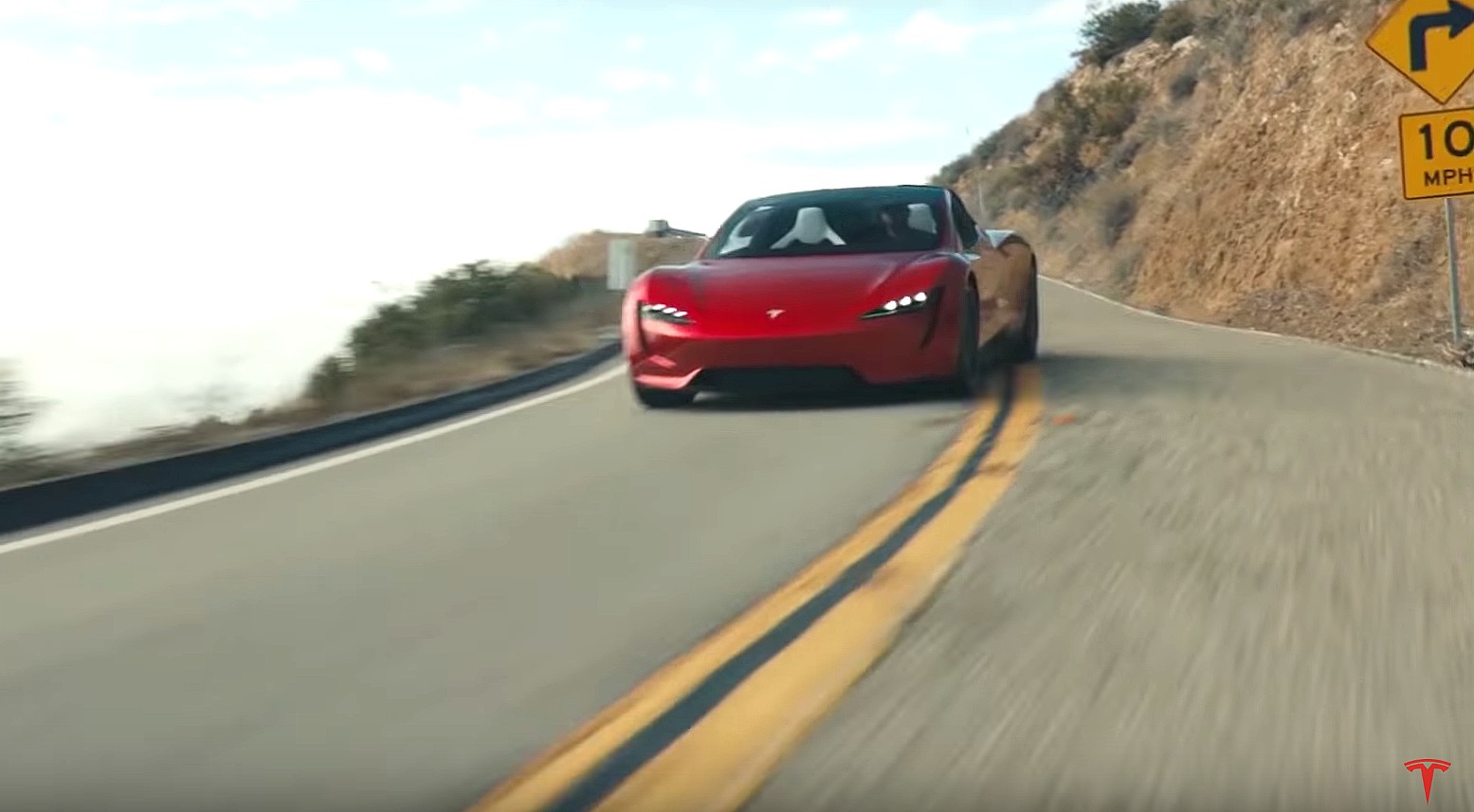

When Elon Musk unveiled the next-generation Tesla Roadster back in November 2017, he shocked the electric car community by revealing that the all-electric supercar has a range of 620 miles per charge. That’s 1,000 kilometers between charges. The figures are pretty much insane, even by today’s standards.
There are now indications that the next-generation Tesla Roadster will go even farther in between charges. Elon Musk mentioned this on Twitter, stating that the range of the upcoming vehicle will be “above 1,000 km.” Musk was responding to Ride the Lightning podcast host Ryan McCaffrey then, who was inquiring if the efficiencies recently introduced to the Model S and X will make it to the all-electric supercar.
A lot has happened since Tesla unveiled the next-generation Roadster. In true Silicon Valley fashion, Tesla never really stopped innovating since then, particularly in terms of its battery technology. Tesla Automotive President Jerome Guillen mentioned this in a previous interview, stating that the company’s batteries are never frozen since they are always in a state of improvement. The same is true for the vehicles’ other components, such as their electric motors.
These efficiencies and improvements were showcased recently when Tesla rolled out updates for the Model S and Model X, its two flagship vehicles. The premium sedan and SUV received several enhancements, such as better charging speeds and adaptive suspension. More importantly, the new Model S and Model X were given more range despite retaining the size of their battery packs. As revealed by Tesla, the 100 kWh variants of the Model S now have 370 miles of range per charge, while the 100 kWh versions of the far heavier Model X now has 325 miles of range.
These are incredibly impressive figures for Tesla’s vehicles. Rivian’s acclaimed R1T and R1S pickup and SUV are capable of going 400 miles per charge, but the vehicles require a 180 kWh battery pack. Motor Trend‘s test of the updated Model S showed that the 100 kWh sedan could probably reach the 400-mile mark in normal driving conditions. So how do these relate to the Roadster and its range? Well, the all-electric “hardcore smackdown to gasoline cars” is equipped with a 200 kWh pack.
Coupled with Tesla’s latest efficiencies, one can only imagine how much farther the Roadster could go with its monster battery. This range will likely be a big difference-maker for the next-gen Roadster, considering that conventional supercars are not exactly known for their fuel-efficiency. The Lamborghini Aventador gets up to 11 mpg in the city and 18 mpg on the highway, which gives it a range of around 428.4 miles of range on the highway and 261.8 miles in the city on a full tank. Higher-end cars like the Bugatti Veyron Grand Sport consume even more gas, only lasting 51 miles on a tank at top speed.
Tesla’s electric motors are expected to last a million miles, and Elon Musk himself has mentioned that the company is developing batteries that also last a million miles. With these, it appears that the next-gen Roadster might not only be an electric car that can outrun gasoline-powered supercars; it might be a vehicle that will far outlast the best supercars on the market as well.


News
Tesla FSD (Supervised) fleet passes 8.4 billion cumulative miles
Tesla’s Full Self-Driving (Supervised) system has now surpassed 8.4 billion cumulative miles.
The figure appears on Tesla’s official safety page, which tracks performance data for FSD (Supervised) and other safety technologies.
Tesla has long emphasized that large-scale real-world data is central to improving its neural network-based approach to autonomy. Each mile driven with FSD (Supervised) engaged contributes additional edge cases and scenario training for the system.
The milestone also brings Tesla closer to a benchmark previously outlined by CEO Elon Musk. Musk has stated that roughly 10 billion miles of training data may be needed to achieve safe unsupervised self-driving at scale, citing the “long tail” of rare but complex driving situations that must be learned through experience.
The growth curve of FSD Supervised’s cumulative miles over the past five years has been notable.
As noted in data shared by Tesla watcher Sawyer Merritt, annual FSD (Supervised) miles have increased from roughly 6 million in 2021 to 80 million in 2022, 670 million in 2023, 2.25 billion in 2024, and 4.25 billion in 2025. In just the first 50 days of 2026, Tesla owners logged another 1 billion miles.
At the current pace, the fleet is trending towards hitting about 10 billion FSD Supervised miles this year. The increase has been driven by Tesla’s growing vehicle fleet, periodic free trials, and expanding Robotaxi operations, among others.
With the fleet now past 8.4 billion cumulative miles, Tesla’s supervised system is approaching that threshold, even as regulatory approval for fully unsupervised deployment remains subject to further validation and oversight.
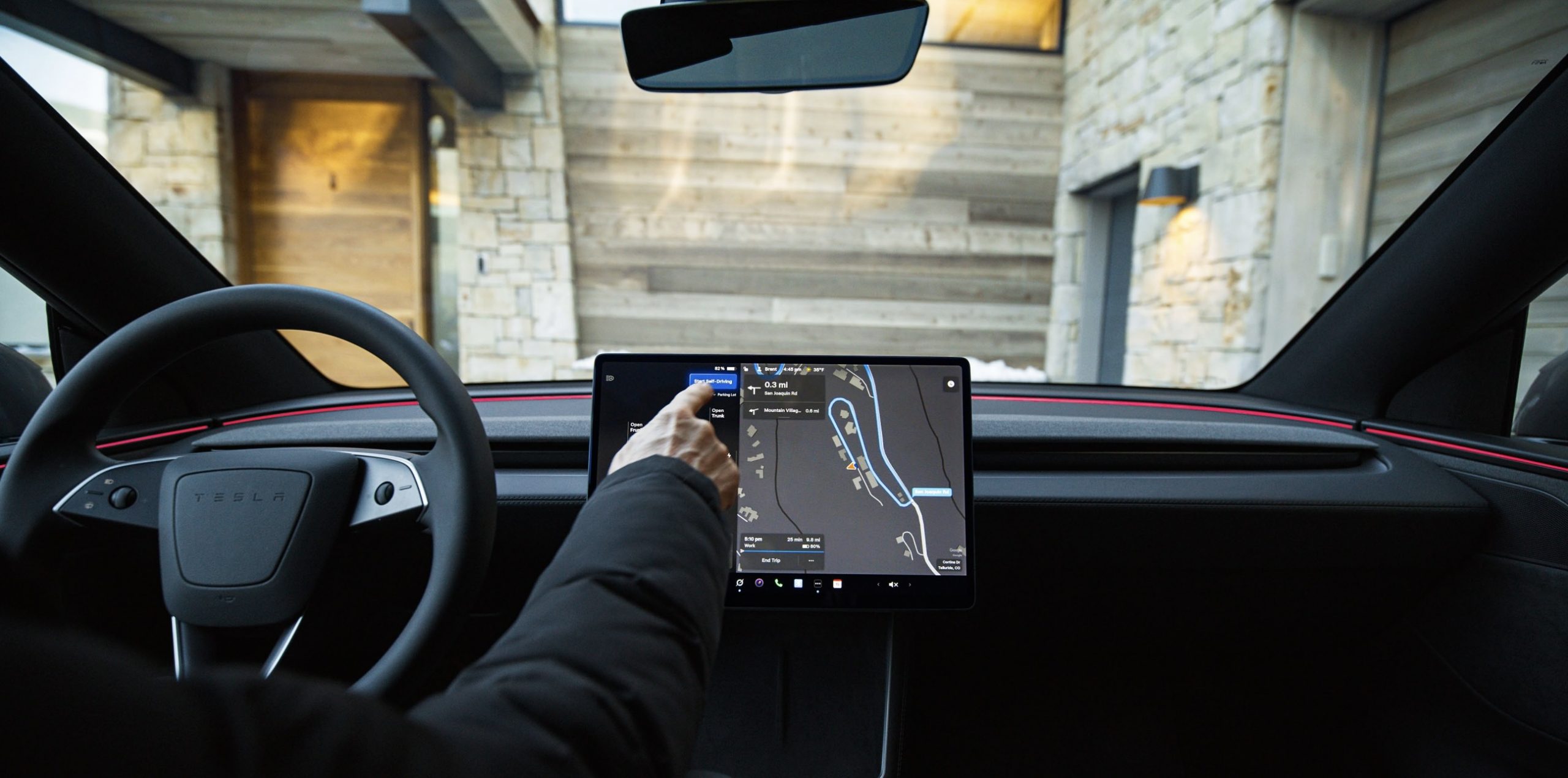
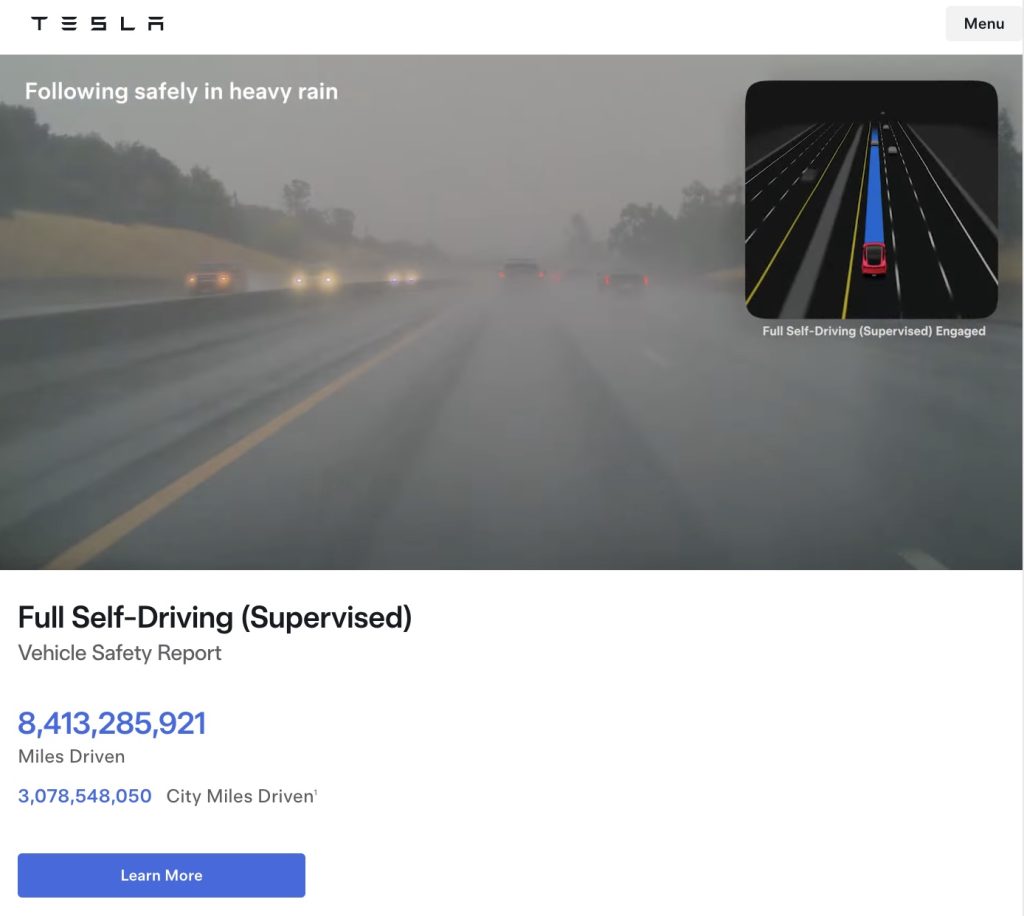
Tesla’s Full Self-Driving (Supervised) system has now surpassed 8.4 billion cumulative miles.
The figure appears on Tesla’s official safety page, which tracks performance data for FSD (Supervised) and other safety technologies.
Tesla has long emphasized that large-scale real-world data is central to improving its neural network-based approach to autonomy. Each mile driven with FSD (Supervised) engaged contributes additional edge cases and scenario training for the system.
The milestone also brings Tesla closer to a benchmark previously outlined by CEO Elon Musk. Musk has stated that roughly 10 billion miles of training data may be needed to achieve safe unsupervised self-driving at scale, citing the “long tail” of rare but complex driving situations that must be learned through experience.
The growth curve of FSD Supervised’s cumulative miles over the past five years has been notable.
As noted in data shared by Tesla watcher Sawyer Merritt, annual FSD (Supervised) miles have increased from roughly 6 million in 2021 to 80 million in 2022, 670 million in 2023, 2.25 billion in 2024, and 4.25 billion in 2025. In just the first 50 days of 2026, Tesla owners logged another 1 billion miles.
At the current pace, the fleet is trending towards hitting about 10 billion FSD Supervised miles this year. The increase has been driven by Tesla’s growing vehicle fleet, periodic free trials, and expanding Robotaxi operations, among others.
With the fleet now past 8.4 billion cumulative miles, Tesla’s supervised system is approaching that threshold, even as regulatory approval for fully unsupervised deployment remains subject to further validation and oversight.
Elon Musk
Elon Musk fires back after Wikipedia co-founder claims neutrality and dubs Grokipedia “ridiculous”
Musk’s response to Wales’ comments, which were posted on social media platform X, was short and direct: “Famous last words.”
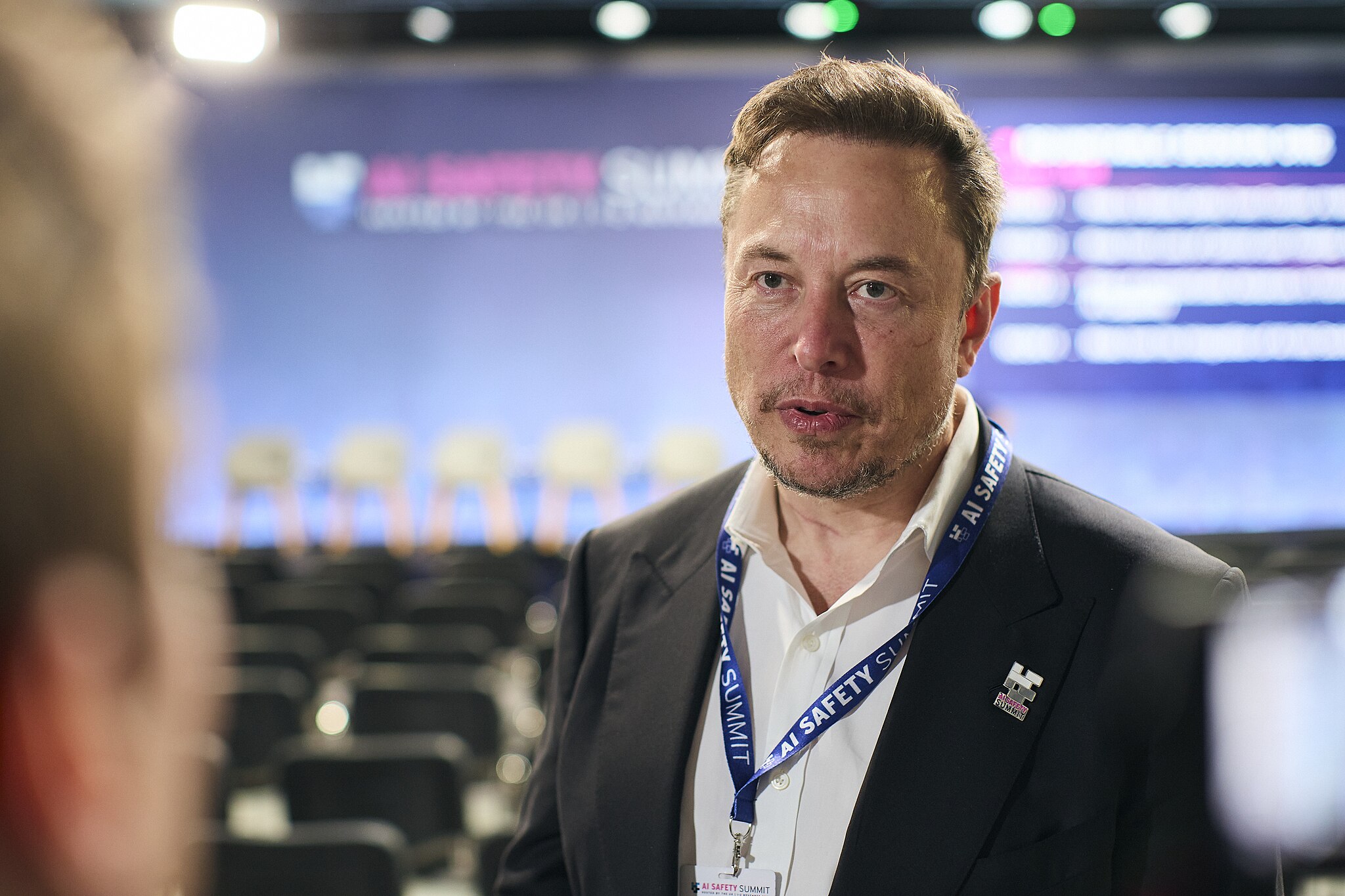
Elon Musk fired back at Wikipedia co-founder Jimmy Wales after the longtime online encyclopedia leader dismissed xAI’s new AI-powered alternative, Grokipedia, as a “ridiculous” idea that is bound to fail.
Musk’s response to Wales’ comments, which were posted on social media platform X, was short and direct: “Famous last words.”
Wales made the comments while answering questions about Wikipedia’s neutrality. According to Wales, Wikipedia prides itself on neutrality.
“One of our core values at Wikipedia is neutrality. A neutral point of view is non-negotiable. It’s in the community, unquestioned… The idea that we’ve become somehow ‘Wokepidea’ is just not true,” Wales said.
When asked about potential competition from Grokipedia, Wales downplayed the situation. “There is no competition. I don’t know if anyone uses Grokipedia. I think it is a ridiculous idea that will never work,” Wales wrote.
After Grokipedia went live, Larry Sanger, also a co-founder of Wikipedia, wrote on X that his initial impression of the AI-powered Wikipedia alternative was “very OK.”
“My initial impression, looking at my own article and poking around here and there, is that Grokipedia is very OK. The jury’s still out as to whether it’s actually better than Wikipedia. But at this point I would have to say ‘maybe!’” Sanger stated.
Musk responded to Sanger’s assessment by saying it was “accurate.” In a separate post, he added that even in its V0.1 form, Grokipedia was already better than Wikipedia.
During a past appearance on the Tucker Carlson Show, Sanger argued that Wikipedia has drifted from its original vision, citing concerns about how its “Reliable sources/Perennial sources” framework categorizes publications by perceived credibility. As per Sanger, Wikipedia’s “Reliable sources/Perennial sources” list leans heavily left, with conservative publications getting effectively blacklisted in favor of their more liberal counterparts.
As of writing, Grokipedia has reportedly surpassed 80% of English Wikipedia’s article count.
News
Tesla Sweden appeals after grid company refuses to restore existing Supercharger due to union strike
The charging site was previously functioning before it was temporarily disconnected in April last year for electrical safety reasons.
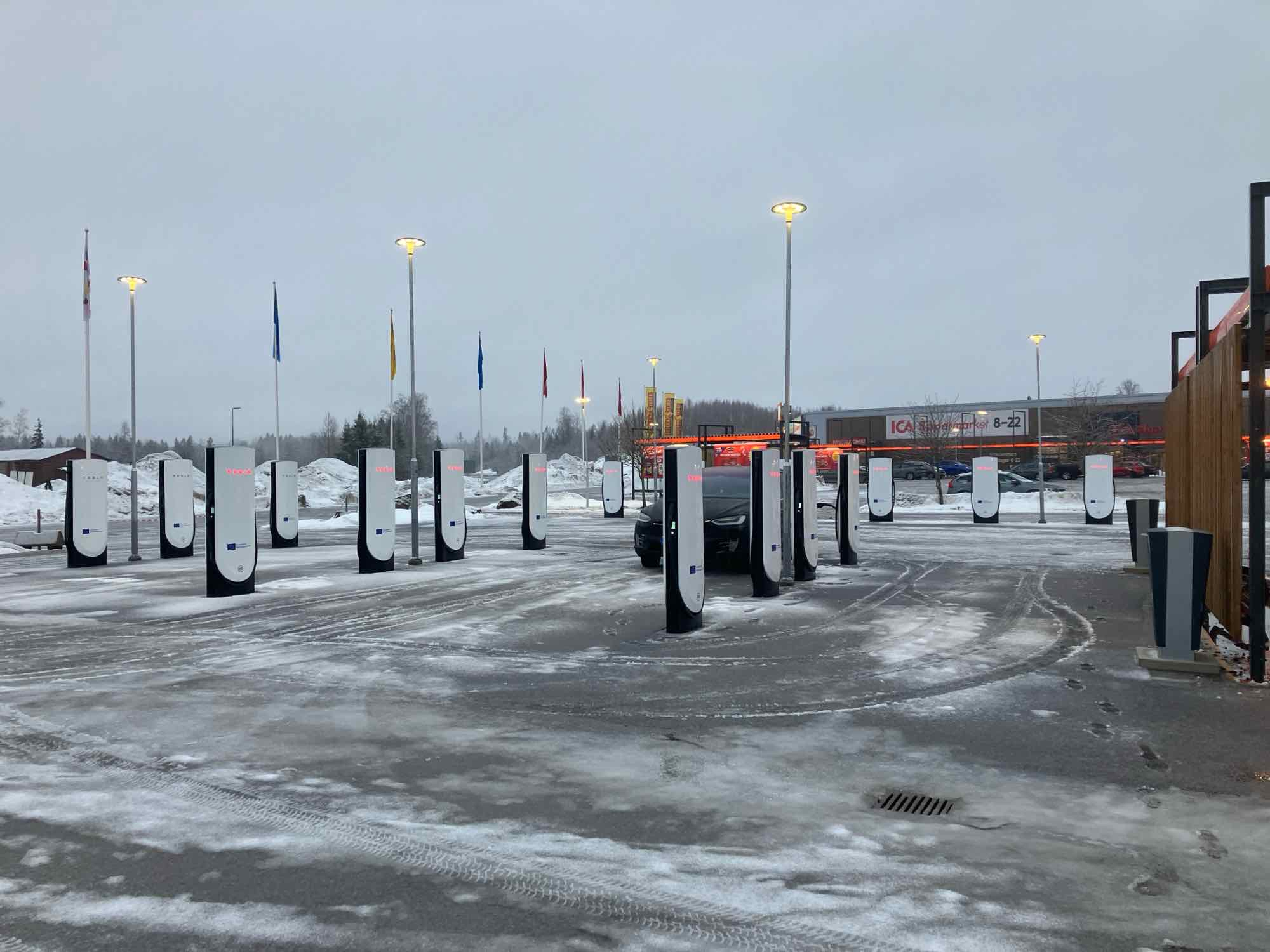
Tesla Sweden is seeking regulatory intervention after a Swedish power grid company refused to reconnect an already operational Supercharger station in Åre due to ongoing union sympathy actions.
The charging site was previously functioning before it was temporarily disconnected in April last year for electrical safety reasons. A temporary construction power cabinet supplying the station had fallen over, described by Tesla as occurring “under unclear circumstances.” The power was then cut at the request of Tesla’s installation contractor to allow safe repair work.
While the safety issue was resolved, the station has not been brought back online. Stefan Sedin, CEO of Jämtkraft elnät, told Dagens Arbete (DA) that power will not be restored to the existing Supercharger station as long as the electric vehicle maker’s union issues are ongoing.
“One of our installers noticed that the construction power had been backed up and was on the ground. We asked Tesla to fix the system, and their installation company in turn asked us to cut the power so that they could do the work safely.
“When everything was restored, the question arose: ‘Wait a minute, can we reconnect the station to the electricity grid? Or what does the notice actually say?’ We consulted with our employer organization, who were clear that as long as sympathy measures are in place, we cannot reconnect this facility,” Sedin said.
The union’s sympathy actions, which began in March 2024, apply to work involving “planning, preparation, new connections, grid expansion, service, maintenance and repairs” of Tesla’s charging infrastructure in Sweden.
Tesla Sweden has argued that reconnecting an existing facility is not equivalent to establishing a new grid connection. In a filing to the Swedish Energy Market Inspectorate, the company stated that reconnecting the installation “is therefore not covered by the sympathy measures and cannot therefore constitute a reason for not reconnecting the facility to the electricity grid.”
Sedin, for his part, noted that Tesla’s issue with the Supercharger is quite unique. And while Jämtkraft elnät itself has no issue with Tesla, its actions are based on the unions’ sympathy measures against the electric vehicle maker.
“This is absolutely the first time that I have been involved in matters relating to union conflicts or sympathy measures. That is why we have relied entirely on the assessment of our employer organization. This is not something that we have made any decisions about ourselves at all.
“It is not that Jämtkraft elnät has a conflict with Tesla, but our actions are based on these sympathy measures. Should it turn out that we have made an incorrect assessment, we will correct ourselves. It is no more difficult than that for us,” the executive said.

Tesla FSD (Supervised) fleet passes 8.4 billion cumulative miles

Elon Musk fires back after Wikipedia co-founder claims neutrality and dubs Grokipedia “ridiculous”


