News
Tesla to be eligible for $7.5B EV charging fund as Senate passes Infrastructure Bill

Tesla is currently making moves that will make it eligible for the $7.5 billion fund in Biden’s Bipartisan Infrastructure bill allocated to build electric vehicle charging stations. President Joe Biden’s Bipartisan Infrastructure Bill, H.R. 3684, passed in the Senate on Tuesday by a 69-30 margin.
“This bill is also going to put IBEW workers — electrical workers — to work installing a truly national network of electric vehicle charging stations that will transform the way we travel and move commerce,” said President Biden during a White House briefing in the East Room.
“And, by the way, around those charging stations, you’ll see — just like around — we put in gas stations in our state highways — you’ll see other industries build up. We have the benefit of significantly reducing pollution from vehicles on our roads,” he noted.
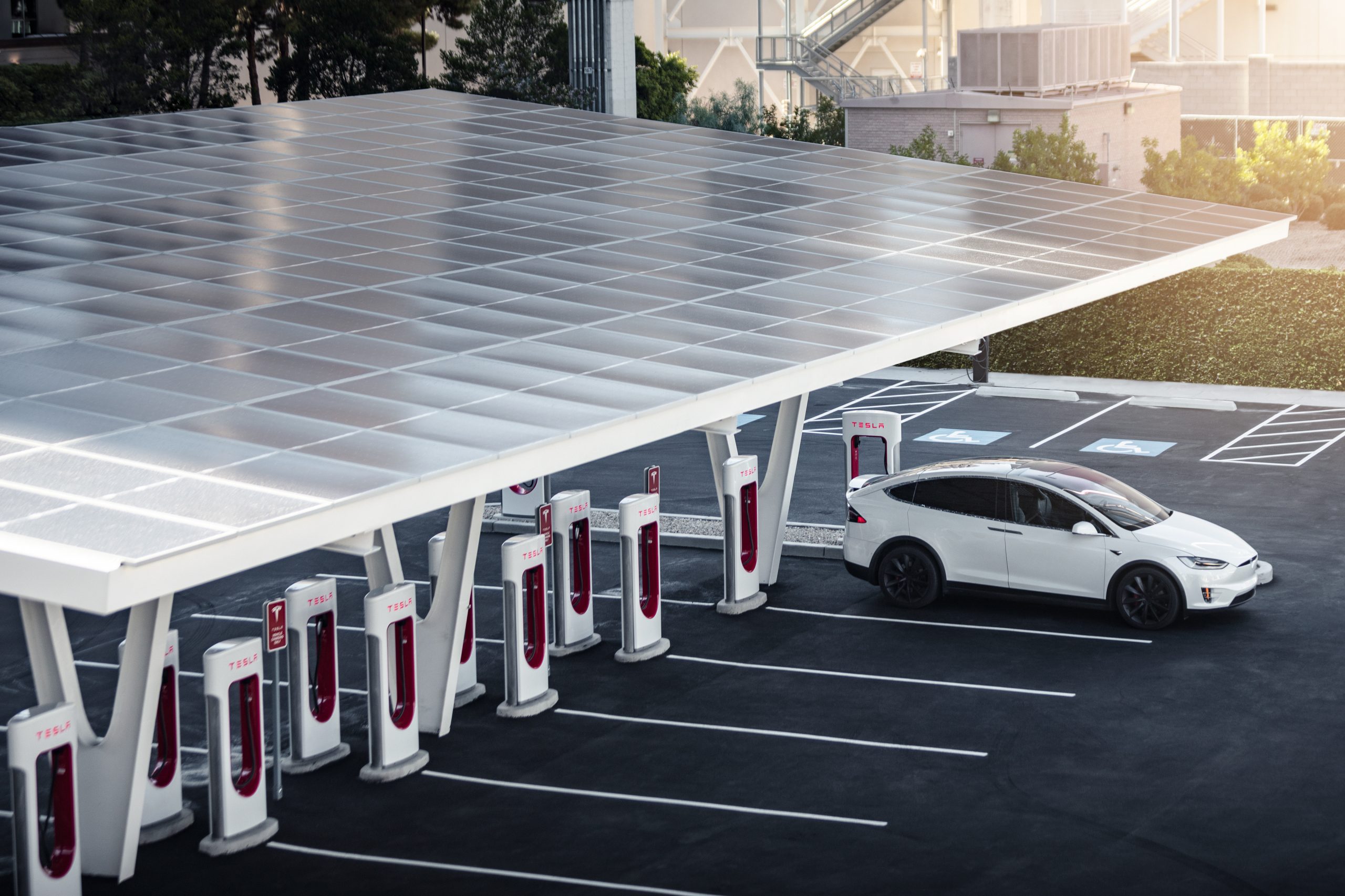
Tesla could be eligible to apply for the bill’s EV infrastructure fund once the Supercharger Network opens to non-Tesla cars.
The bill lists two provisions that companies must meet to qualify for the billion-dollar fund allocated specifically for EV charging stations. First, companies must provide non-proprietary charging connectors that meet industry safety standards. Second, companies must provide open access to payment methods that all members of the public can use.
Before the Senate passed H.R. 3684, Tesla CEO Elon Musk announced that the Supercharger Network would be open to non-Tesla vehicles soon. In the last TSLA earnings call, Musk and other Tesla heads explained how its open Supercharger Network would work.
Musk noted that the Tesla App would be open to non-Tesla owners, providing them with a convenient way to access the Supercharger network. While he believes Tesla uses the best connector for EV charging, Musk also noted that Tesla would offer an EV adaptor for other electric vehicle owners could purchase to use the Supercharger Network.
By opening the Tesla app to other EV owners and an adapter, Tesla could meet the requirements to apply for the Infrastructure Bill’s $7.5 billion fund. “Yeah. Obviously, in order for this to be — for the Supercharger to be useful to other car companies’ cars, we need to grow the network faster than we’re growing vehicle output, which is not easy. We’re growing vehicle output at a hell of a rate. So Superchargers need to grow faster than vehicle output,” noted Elon Musk at the last earnings call.
“This is a lot of work for the Superchargers team, but it is only useful in the grand scheme of things. Just only useful to the public if we’re able to grow faster than Tesla vehicle output. So that is our goal,” he added.
Read the Biden administration’s bipartisan Infrastructure Bill below.
Tesla Supercharger Network 75b Biden Infrastructure Bill by Maria Merano on Scribd
The Teslarati team would appreciate hearing from you. If you have any tips, reach out to me at maria@teslarati.com or via Twitter @Writer_01001101.


News
Tesla Model Y L gets new entertainment feature
Beyond audio quality, Immersive Sound X aligns with Tesla’s ecosystem of over-the-air updates, potentially allowing future refinements.

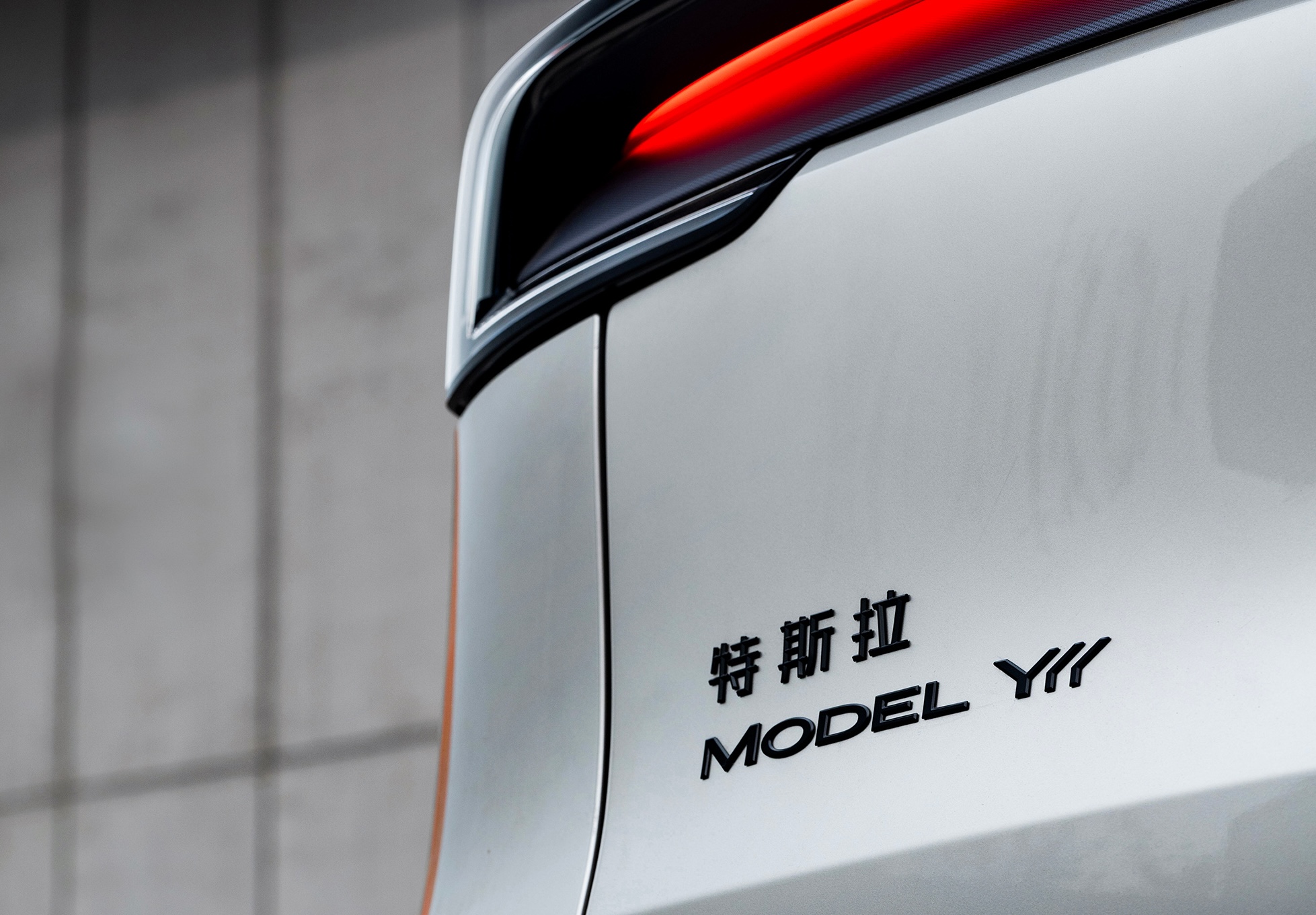
Tesla is including a new entertainment feature in the Model Y L, improving the vehicle even further and making it what appears to be the best configuration of the all-electric crossover globally.
Unfortunately, we in the U.S. do not yet have access to the vehicle, and the plans for it to enter the market remain up in the air, as CEO Elon Musk has said it could appear late this year. However, there is nothing concrete at this time.
Tesla’s latest enhancement to the Model Y L is a new Immersive Sound X feature, exclusive to the Model Y L.
Model YL has new sound system setting. Immersive Sound X. This is NOT on the new Y and 3 pic.twitter.com/7OpJuzyoGf
— Electric Future (@electricfuture5) March 16, 2026
It aims to transform the in-car listening experience into something truly cinematic. First introduced by Tesla China in October 2025, this advanced audio mode is now rolling out to deliveries in Australia and New Zealand, highlighting Tesla’s approach to region-specific premium upgrades.
At its core, Immersive Sound X leverages real-time sound extraction technology to create a customizable 3D soundstage. Using advanced algorithms, it analyzes audio tracks to separate direct sounds, such as vocals or lead instruments, from ambient elements like echoes and reverb.
The system then positions direct sounds front and center while diffusing ambient sounds to the side and rear speakers, simulating an expansive virtual environment. This results in a heightened sense of depth and spatial awareness, making listeners feel as if they’re in a concert hall or studio.
What sets Immersive Sound X apart from the standard Immersive Sound found in other Tesla models is its hardware dependency and enhanced processing. The Model Y L boasts an 18-speaker system with a subwoofer, compared to the 15-speaker setup, plus a subwoofer, in the Model Y Long Range’s previous premium audio configuration.
This upgrade provides more “kick” and precision, enabling finer control over the soundstage. Unlike traditional surround sound, which requires multi-channel mixes like Dolby Atmos, Immersive Sound X works with any stereo source from platforms like Spotify or Apple Music, so every owner will be able to use it.
Tesla Model Y lineup expansion signals an uncomfortable reality for consumers
You can fine-tune the experience via an adjustable immersion slider, scaling the “size” of the virtual space to personal preferences. This caters to a more custom sound.
An Auto mode intelligently adapts based on media type, whether it’s music, podcasts, or videos, ensuring optimal immersion without manual tweaks. This feature is unavailable on standard Model Y variants (with 7 or 15 speakers) or Model 3 trims, underscoring Tesla’s strategy to differentiate higher trims through superior hardware and software integration.
Beyond audio quality, Immersive Sound X aligns with Tesla’s ecosystem of over-the-air updates, potentially allowing future refinements.
For audiophiles and casual listeners alike, it elevates mundane commutes into immersive journeys, proving Tesla’s commitment to blending cutting-edge tech with user-centric design.
Elon Musk
Elon Musk teases crazy outlook for xAI against its competitors
Musk’s response was vintage hyperbole, designed to rally supporters and dismiss doubters, something his responses on social media often do.
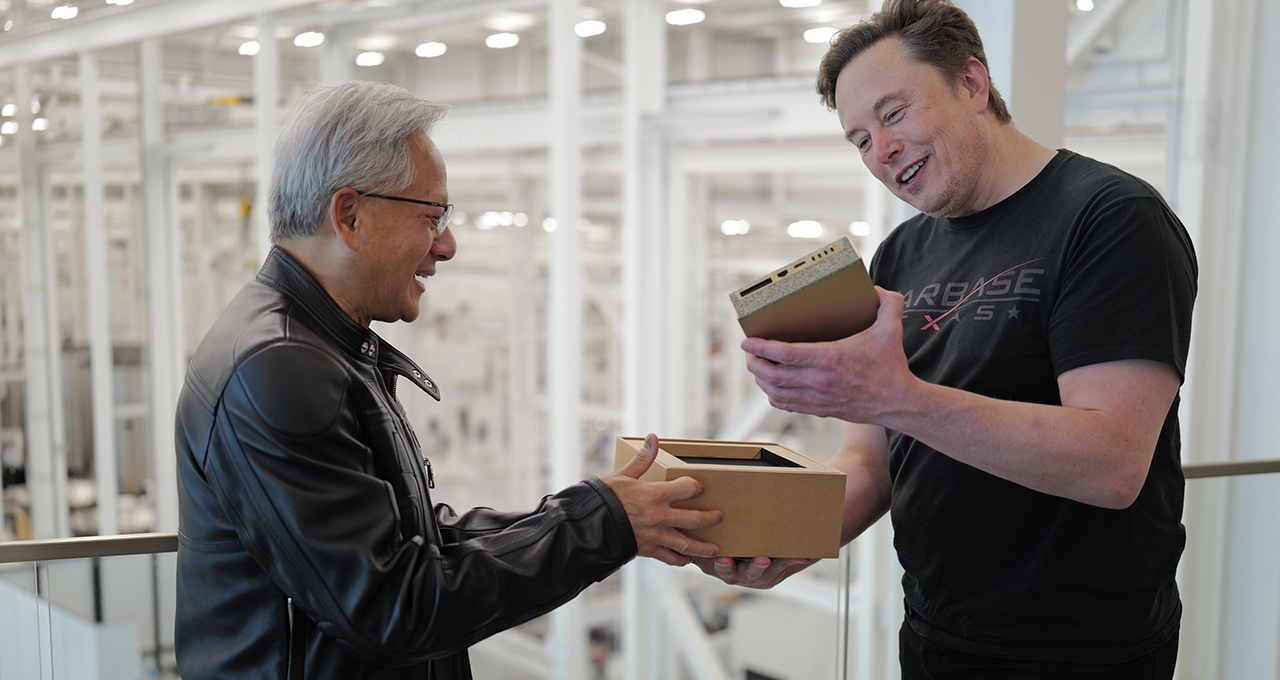
Elon Musk has never been one to shy away from crazy timelines, massive expectations, and outrageous outlooks. However, his recent plans for xAI and where he believes it will end up compared to its competitors are sure to stimulate conversation.
In a bold and characteristic response on X, Elon Musk fired back at a recent analysis that positioned his AI venture, xAI, as lagging behind industry frontrunners.
The post, from March 14, came as a direct reply to forecaster Peter Wildeford’s assessment, which drew from benchmarks and reporting to rank AI developers.
xAI will catch up this year and then exceed them all by such a long distance in 3 years that you will need the James Webb telescope to see who is in second place
— Elon Musk (@elonmusk) March 14, 2026
Wildeford placed Anthropic, Google, and OpenAI in a virtual tie at the top, with xAI and Meta trailing by about seven months. Chinese players like Moonshot, Deepseek, zAI, and Alibaba were estimated to be nine months behind, while France’s Mistral lagged by about a year and a half.
Musk’s response was vintage hyperbole, designed to rally supporters and dismiss doubters, something his responses on social media often do.
He claimed xAI would “catch up this year,” meaning by the end of 2026, erasing that seven-month deficit against the leaders. But he didn’t stop there.
Musk escalated his vision to 2029, predicting xAI would “exceed them all by such a long distance” that observers would need the James Webb Space Telescope, NASA’s orbiting observatory stationed about 930,000 miles from Earth, to spot whoever lands in second place. This analogy underscores Musk’s confidence in xAI’s trajectory, implying an astronomical lead that could redefine the AI landscape.
Breaking down these claims reveals Musk’s strategic optimism. First, the short-term catch-up: xAI, launched in 2023, has already released models like Grok, but recent benchmarks, including those for Grok 4.2, have shown it falling short in capabilities compared to rivals.
Anthropic’s Claude series, Google’s Gemini, and OpenAI’s GPT models dominate in areas like reasoning, coding, and multimodal tasks. Musk’s assertion suggests aggressive scaling in compute, talent, or architecture, perhaps leveraging xAI’s ties to Tesla’s Dojo supercomputers or Musk’s vast resources, to close the gap swiftly.
The longer-term dominance by 2029 paints an even more audacious picture. Musk envisions xAI not just parity but supremacy, outpacing competitors in innovation speed and model sophistication.
This could involve breakthroughs in energy-efficient training, real-world integration, like Tesla’s robotics, or ethical AI alignment, aligning with Musk’s stated goal of “understanding the universe.”
Critics, however, point to parallels with Tesla’s Full Self-Driving delays; one reply highlighted Musk’s 2023 promise of FSD readiness. Musk has made this promise for many years, and although the system has been strong and improving, it is still a ways off from the completely autonomous operation that was expected by now.
Tesla Full Self-Driving v14.2.2.5 might be the most confusing release ever
Musk’s comment highlights the intensifying U.S.-centric AI race, with xAI challenging the “three-way” dominance noted by Wharton professor Ethan Mollick, whom Wildeford quoted. As geopolitical tensions rise—evident in the Chinese firms’ lag—Musk’s tease could spur investment and talent wars.
Yet, it also invites scrutiny: Will xAI deliver, or is this another telescope-needed mirage? In an industry where timelines slip but stakes soar, Musk’s words keep the spotlight on xAI’s ambitious path forward.
Elon Musk
Tesla Terafab set for launch: Inside the $20B AI chip factory that will reshape the auto industry
Tesla set to launch “Terafab Project: A vertically integrated chip fabrication effort combining logic processing, memory, and advanced packaging.

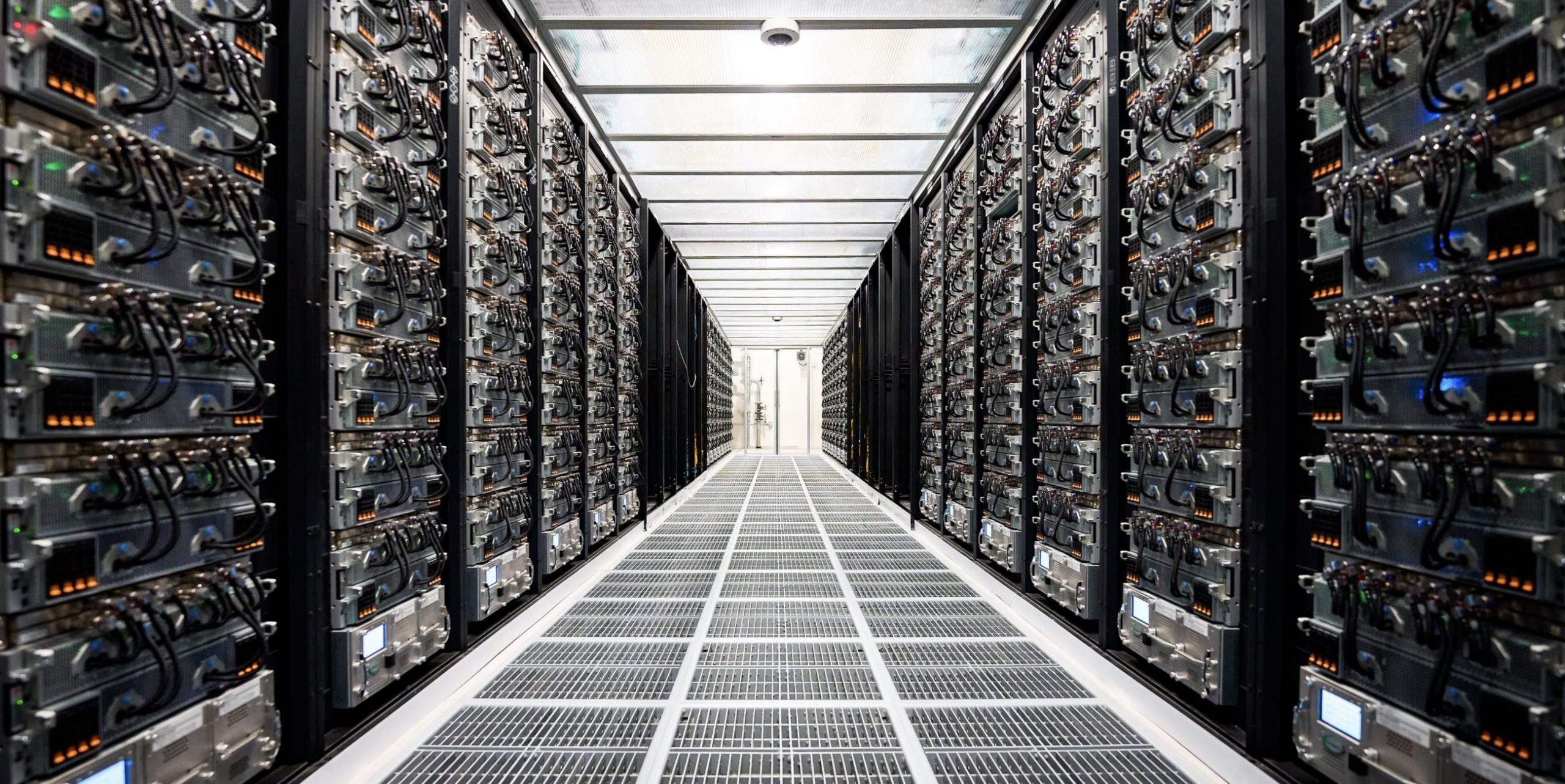
Tesla is making one of the boldest bets in its history. On March 14, Elon Musk posted on X that the “Terafab Project launches in 7 days,” pointing to March 21, 2026 as the start date for what he has described as a vertically integrated chip fabrication effort combining logic processing, memory, and advanced packaging.
Tesla first confirmed Terafab on its January 28, 2026 earnings call, where Musk told investors the company needs to build a chip fabrication facility to avoid a supply constraint projected to materialize within three to four years. But the seeds were planted even earlier. At Tesla’s annual general meeting last year, Musk warned that even in the best-case scenario for chip production from their suppliers, it still wouldn’t be enough, and declared that building a “gigantic chip fab” simply had to be done.
While there has been no official announcement on where Tesla plans to break ground on the massive Terafab, all signs point to the North Campus of Giga Texas in Austin.
Months of speculation has surrounded Tesla’s North Campus expansion at Giga Texas, where drone footage captured by observer Joe Tegtmeyer revealed massive construction site preparation just north of the existing factory on a scale that rivals the original Giga Texas footprint itself.
Samsung’s Tesla AI5/AI6 chip factory to start key equipment tests in March: report
The project is projected to produce 100–200 billion AI and memory chips annually, targeting 100,000 wafer starts per month, at an estimated cost of $20 billion. Tesla is targeting 2-nanometre process technology and anticipated to be the most advanced node currently in commercial production. Dubbed the Tesla AI5 chip, the chip will pack 40x–50x more compute performance and 9x more memory than AI4, and will be among the first products Terafab factory is set to produce. This highly optimized, and massively powerful inference chip is designed to make full self-driving (FSD) and Tesla’s Optimus robots faster, safer, and with full autonomy.
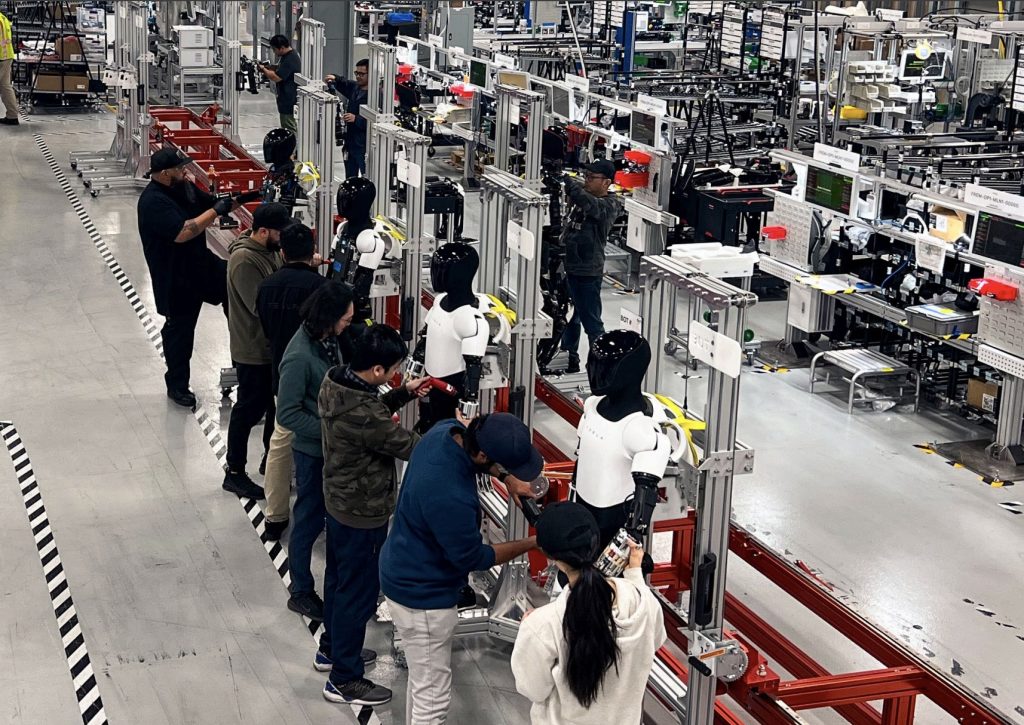
(Credit: Tesla)
This is where Terafab becomes a genuine game-changer. If Tesla successfully builds a 2nm chip fab at scale, it becomes one of only a handful of entities that’s capable of producing AI silicon in-house, with competitive implications that extend far beyond Tesla’s own vehicles, and potentially positioning Tesla as a chip supplier or licensor to other industries.
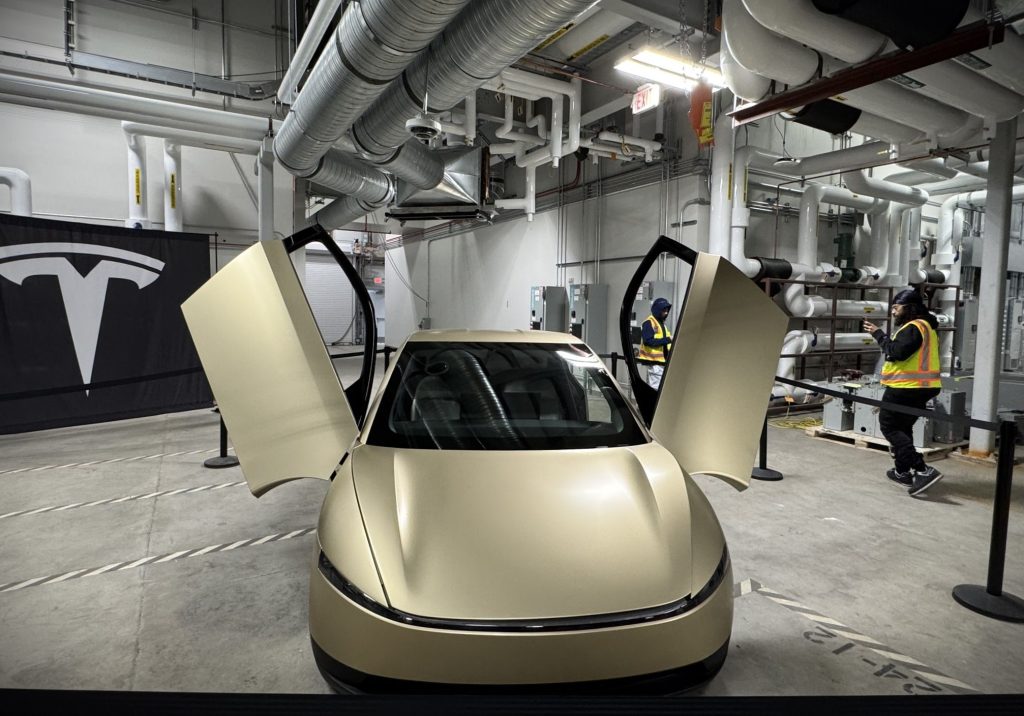
Credit: @serobinsonjr/X
The next-gen Tesla AI chips will power advancements in Full Self-Driving software, the Cybercab Robotaxi program, and the Optimus humanoid robot line. Musk’s projections for Optimus require chip volumes that no existing external supplier can commit to on Tesla’s timeline.Competitors like Waymo and GM’s Cruise remain dependent on third-party silicon, leaving them exposed to the same supply chain vulnerabilities Tesla is now working to eliminate entirely.
The Terafab launch this week may not mean a factory opens its doors overnight, but it signals Tesla is serious about owning the entire AI stack, from software to silicon.

Tesla Model Y L gets new entertainment feature

Elon Musk teases crazy outlook for xAI against its competitors


